

OEM, ODM and private label LED strip manufacturing
LED strip manufacturing for your brand: put your name on a proven model, change the specification to fit your range, or develop a new product with our manufacturing partners. Samples, binning records and any certification cost are agreed before a volume run starts.
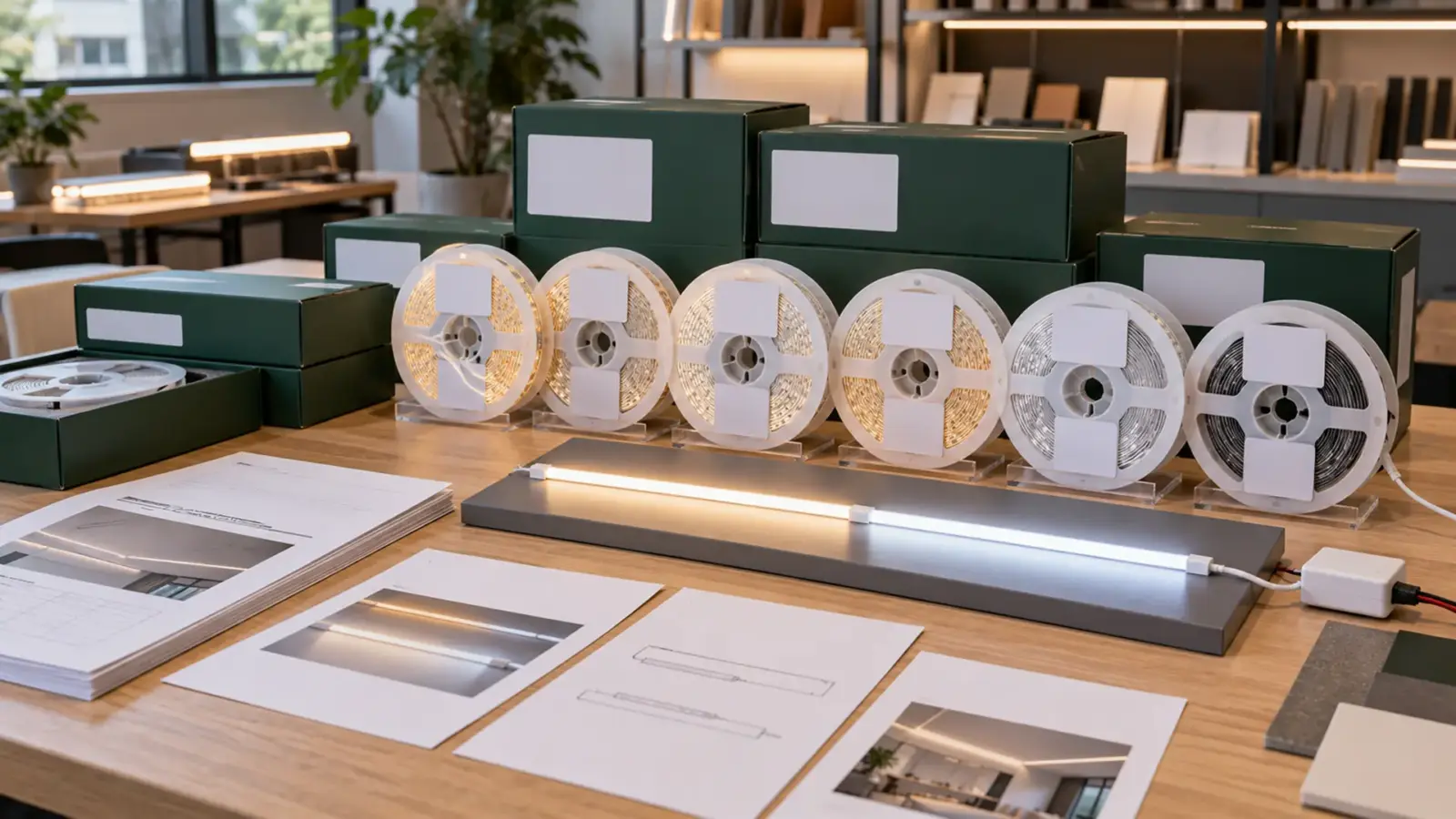
Pick the depth of change, and the work follows
Most programs start at the first level and move deeper only where the range needs it.
-
Private label on an existing model
A model from our range under your brand: your reel labels, packaging, datasheets and part numbers. The product, its test records and its listing route stay as they are.
-
Custom specification
An existing platform built to your numbers: CCT, CRI, chip density, PCB width, voltage, connector, lead length, reel length and packaging.
-
ODM development
A product that does not exist yet, developed with our manufacturing partners from your brief: new form factor, optics, profile or control, with prototypes before tooling.
Built to your drawing, documented for your brand
Every change is written into the approved sample and the order, so the tenth release matches the first. Samples are approved before volume, and binning and test records ship with every run.
-
Cover
Range: IP20 – IP68
Open PCB for dry locations, conformal coat or silicone sleeve for damp, full silicone extrusion for wet and submerged.
-
Light
Range: 1800 – 6500 K · Ra 90, up to 98 · one bin per job
COB, SMD or CSP package; static white, tunable white, dim-to-warm, RGB, RGBW and RGB+CCT. Binning records ship with the order.
-
Board
Range: COB 2.7 – 30 mm · SMD 5 – 15 mm · 30 – 1,600 LEDs/m
PCB width and chip density set the line of light and the output per foot; cut step down to mini cut, or free-cut anywhere. Other widths on request.
-
Voltage and run
Range: 12 · 24 · 48 · 120 V · up to 65 ft (20 m) a feed
Constant voltage 12 V and 24 V, 48 V for long single feeds, 120 V line voltage with no driver, constant current where the family uses it.
-
Ends and leads
Range: To your drawing
Lead length and exit, connector type, end caps, and pieces pre-cut and pre-wired to your run schedule.
-
Label and documents
Range: Your brand, your part numbers
Blank or private-label reel labels, carton marks, datasheet and installation sheet carrying your brand and part numbers.
What changes on each family
The same parts, with the range each product family covers. Values beyond these are quoted on request.
| Family | Light | Board or profile | Voltage and run | Protection and cut |
|---|---|---|---|---|
| COB | 2700 – 6500 K · Ra 90 – 98 | PCB 2.7 – 30 mm · 280 – 1,600 LEDs/m | 12 · 24 · 48 V · to 65 ft (20 m) a feed | IP20 – IP68 · cut from 0.25 in, free-cut series |
| SMD | 2700 – 6500 K · Ra 90 / 95 / 98 | PCB 5 – 15 mm · 2835 to 5050 · 30 – 480 LEDs/m | 12 · 24 · 48 V · CC · to 65 ft (20 m) | IP20 – IP68 · cut 0.98 – 3.94 in · S-shape, side-view |
| CSP | 2700 – 6500 K · Ra > 90 · ≤ 3 SDCM | 19 configurations, no gold wire or bracket | 12 · 24 V · 16 ft (5 m) a feed | IP20 – IP68 · cut from 0.39 in (10 mm) |
| Neon flex | White, single color, RGB, pixel | Profile 3×6 to 50×25 mm · top, side, 3D, 360° bend | 24 V CC · to 98 ft (30 m) | IP67 standard · IP68 · IK10 · cut per profile |
| RGB / RGBW | RGB, RGBW, RGBWW, RGB+CCT · white Ra ≥ 90 | 5050 SMD or dot-free COB | 12 · 24 V · matched controllers | IP20 standard · wet builds on request · cut per density |
| Tunable white | 2700 – 6500 K · dim-to-warm to 1800 K | SMD or COB | 12 · 24 V · 2-wire and 3-wire | IP20 · IP66 · cut 0.49 – 2.81 in |
| Addressable | RGB to RGBCW pixels | SMD or COB · SPI and DMX512 · breakpoint-resume | 5 · 12 · 24 V | IP20 standard · wet builds on request |
| 120 V | 2700 – 6500 K · dot-free COB options | Line-voltage build, no driver | 120 V AC · to 98 ft (30 m) · TRIAC dimming | IP65 · cut 4.9 – 19.7 in (125 – 500 mm) |
Ends, leads and labels change on every family and are not repeated in the table. Neon flex is specified by its profile, not a PCB width.
Who pays for a new certification
A private label on an existing model keeps its listing route; how your brand is covered is agreed with the certification body for each model. A new build or a changed specification can need new testing. The cost is agreed before the work starts, in one of three ways.
| Arrangement | Who pays | When it fits |
|---|---|---|
| Exclusive product | You pay the full certification cost | The certified product is reserved for your brand |
| Spread over orders | The cost is spread over your follow-on orders | Your forecast volume is large enough to carry it |
| Shared | Both sides share the cost, in a split agreed per project | Neither of the above fits on its own |
| Existing listed model | No new certification for an unchanged product | UL Listed options are available; coverage varies by model and is confirmed at quote |
From the brief to repeat orders
One contact from the first brief to the last release.
-
Brief
Send the target specification, the market, the volumes you expect and whether the product is exclusive.
You getA reply on which route fits: label, specification or development
-
Specification and quote
We match the brief to a platform, list what changes, and quote the minimum, the lead time and any certification cost and how it is shared.
You getA written specification and quote
-
Samples and artwork
Pre-production samples are built to the specification; your labels, packaging and datasheets are proofed with them.
You getApproved sample and approved artwork
-
Production and records
The volume run is built against the approved sample, with binning and test records shared before shipping.
You getShipment with its records
-
Repeat orders
Later runs are matched to the approved sample and the same specification revision; any change is a new revision you approve.
You getReleases that match the first
Before you commit to a private label program
The questions buyers ask about quality, listings and suppliers.
OEM and private label questions
What is the difference between OEM, ODM and private label?
Private label puts your brand on an existing model without changing the product. OEM, as we use it, builds an existing platform to your specification: CCT, CRI, density, PCB width, connector or packaging. ODM develops a new product from your brief with our manufacturing partners.
Who pays for certification on a private label or custom product?
It is agreed before the work starts. If the product is exclusive to your brand, you pay the full certification cost. If your follow-on volume is large, the cost can be spread over later orders. Otherwise both sides can share it, in a split agreed per project.
Can my brand appear on the listing?
How your brand is covered is agreed with the certification body for each model, and it can involve a fee and new paperwork. UL Listed options are available on our range; coverage varies by model and is confirmed at quote.
Is there a minimum order for private label?
Custom and private label work is quoted per job, and every quote states the minimum. Standard items start at one full reel per SKU.
How long does a custom build take?
Standard color temperature and CRI combinations ship in 1 to 2 weeks; custom builds, such as a nonstandard density, PCB width or connector, add roughly two to three weeks. Development projects are scheduled at quote, and the ship date is confirmed in writing.
Where are the products made?
Production runs through our manufacturing partners under our quality checks. Binning and test records are shared before anything ships, and the approved sample is the reference for every run.
Is Unitop an LED strip manufacturer?
Unitop Lighting is a US-based supplier; production runs through our qualified manufacturing partners under our quality checks. For an OEM or private label program that means one US contact for specification, samples, binning records and documents, while the strip itself is built by the partner whose test records and listing route the product carries.
Send the brief and the volumes
You will get the route that fits, a written specification, the minimum and the lead time, and any certification cost with how it is shared.
- Samples before volume
- Records with every run
- Costs agreed up front