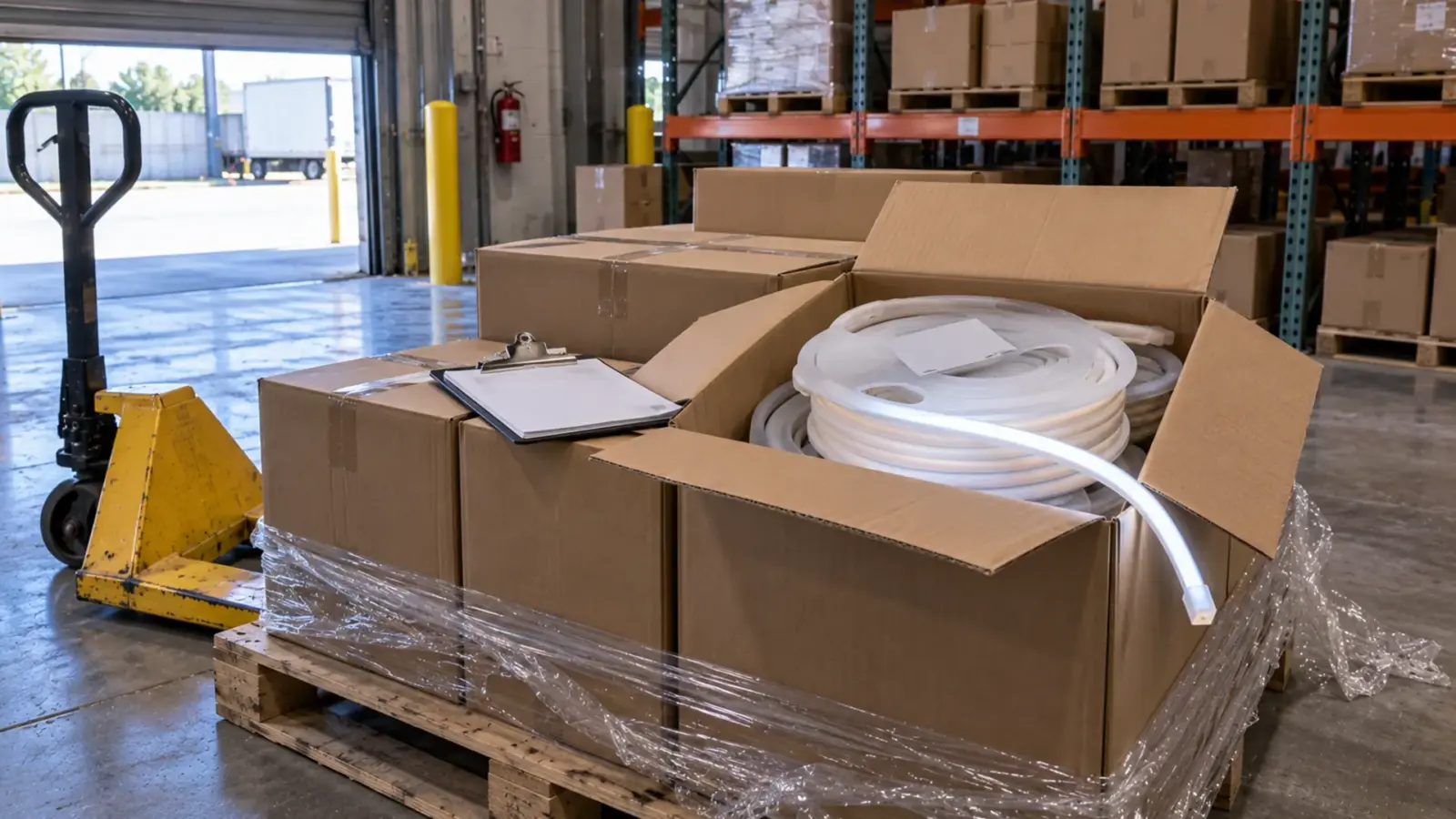
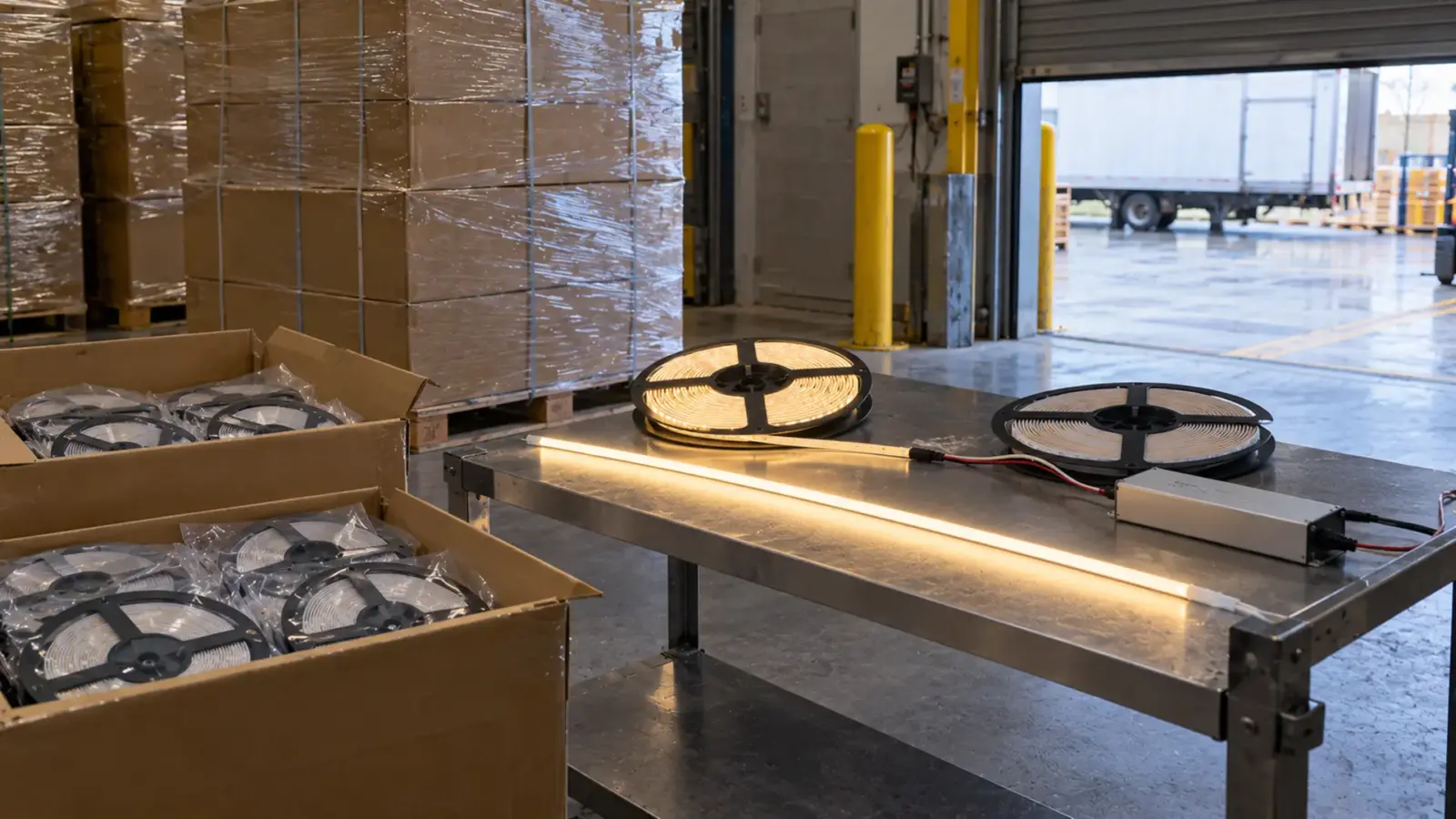
The submittal is due Friday, three quotes sit in your inbox, and the PDFs look the same. Choosing an LED strip supplier comes down to what each channel puts between you and the product: a factory-direct buy, an importer, or a distributor. Each fits some jobs and fails others, and the difference is rarely the unit price.
The Three Channels in One Table
The channels differ in who holds the paperwork, who answers a claim, and how easily a spec can change. These are typical patterns, not rules for every company, so test each against the quote in front of you.
| Factory-direct | Importer | Distributor | |
|---|---|---|---|
| Who holds the test files | The maker | The importer, from the maker | The distributor, per product line |
| Who answers a warranty claim | The maker | The importer | The distributor |
| Changing the spec | Easiest, with a drawing | Through the importer to the maker | Limited to the catalog |
| Split deliveries and multi-site orders | Depends on the maker | Often handled by the importer | Usually the strongest |
| Your verification work | Highest | Medium | Lowest |
| Gap to close in writing | Customs and file ownership | Whose file it is, and how fast it arrives | Which maker’s product you are getting, and for how long |
| Continuity across repeat orders | Yours to manage with the maker | Held by the importer if you ask | Held by the spec schedule if one exists |
| Fits | Custom or high-volume work | Custom work without taking on the import | Standard product, fast turnaround |
The bottom row is the point. A channel does not remove risk; it moves the work of checking the product to a different party, and the question is whether that party does it.
Who Carries the Paperwork: Importer of Record and Test Files
Two kinds of paperwork follow every shipment. The first is customs. According to U.S. Customs and Border Protection notices, the importer of record is responsible for using reasonable care to enter, classify and value imported goods, and for giving CBP the information it needs to assess duties. If you buy manufacturer-direct and ship to your own address, you may be that importer. If an importer or distributor ships to you, they are.
The second is the product file: the listing, the test reports, the binning records. A Global Sources case study on LED compliance argues that the importer, not the maker, is the party responsible for making sure a product meets the rules of the market it is sold into. Whether or not you accept that reading, it points to a practical question to ask in every channel: who holds the file for this exact model, and will they send it before the order? A distributor adds a second question, because one product line may come from different makers over time: which maker’s product is this reel, and will the next order be the same one?
A mark on a product is not a file. We cover the difference in our UL, UL Recognized and ETL article and the standards in the UL 2108, UL 8750 and UL 1598 comparison. The short version: a listing covers a named product within a scope, and the mark alone does not tell you whether it covers yours.
When Factory-Direct Is the Right Channel
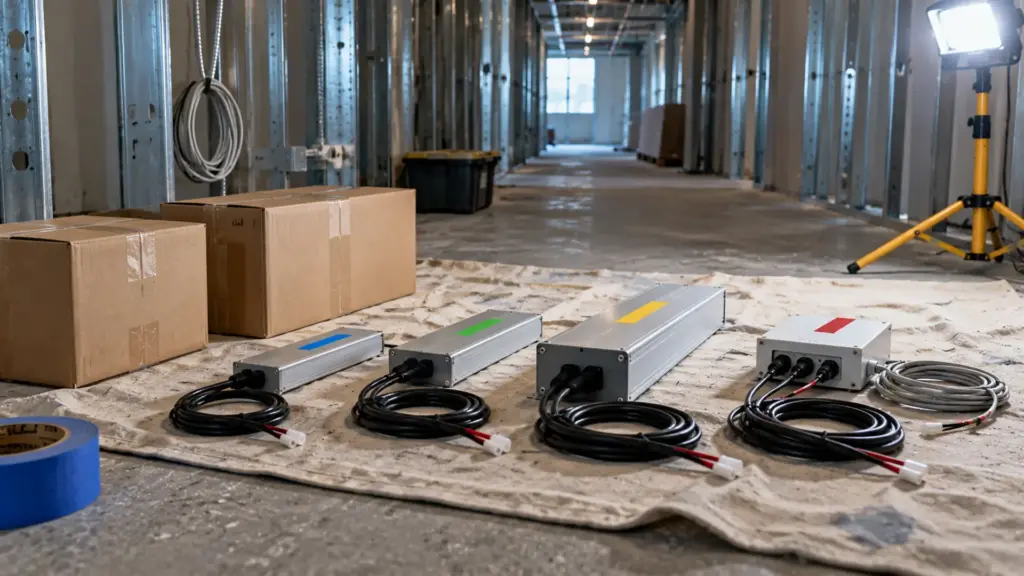
Buying from the maker fits when the spec is not in anyone’s catalog. A custom PCB width, a color temperature outside the standard list, a connector fitted at the end of each cut length, a reel length that matches a run schedule: these are decisions the maker makes, and every extra party between you and them adds a round of questions.
It also fits large volumes on a stable spec, where a single approved sample, a written binning tolerance and a repeat order replace the need for a distributor’s services.
The cost is yours to carry. Verification is yours: you review the samples, request the files and check the match to the model. The schedule is yours: a made-to-order run takes longer than a catalog order, and a design change late in the job costs more. The packaging is yours: one trade columnist notes that companies selling direct often cannot supply a complete package of fixtures, strip, drivers and controls. If you do not have someone to run that process, the channel is cheaper on paper and more expensive on the job.
When a Distributor Wins
A distributor wins on breadth, speed and terms. One counter handles strip, channels, drivers, controls and the rest of the fixture list. A trade piece on contractor purchasing lists payment terms, delivery of everything needed, and knowledge of rebates as the distributor’s advantages, and a lighting distributor warns that products vary from one distributor to another depending on their manufacturer relationships.
That last point is why a distributor suits a multi-site rollout: with one distributor and a written spec schedule, store 14 gets the same strip as store 2. It also suits a punch-list replacement that has to arrive this week, and a standard-spec job where nothing needs to be built.
A distributor also fits small and mixed orders. A made-to-order run has setup work that does not shrink with the order size, so a few hundred feet of catalog strip with a driver and a controller is a counter purchase, not a build. The same applies to anything you may need to exchange on site.
The trade-offs are a markup over what the distributor paid, a catalog that sets the limit on customization, and a file that is only as complete as the distributor’s contact with the maker. Ask for it anyway; a good distributor will chase it.

When an Importer Fits: US Entity of Record
An importer sits between the two. It buys from the maker to your drawing, holds the files in the US, ships under its own name, and is the importer of record, so the customs work is not yours. That fits a contractor who needs a custom item without the import process, a distributor who wants a private-label line, or a project that needs support from someone in the same time zone.
The risk is the same as in any resale: the importer’s value is the file it holds and the speed with which it answers. An importer that cannot show the listing for your model, or that is slow to name the maker of the driver, is a trader with a logo. Test it the way you test the others: ask for the documents before you order. Four questions separate a working importer from a trader. Does it show the listing for your model with the model number in it? Can it name the maker of the strip and of the driver? Does it keep a reference sample for repeat orders? Will it tell you before any component changes?
Documents to Ask For Before the PO
Ask for the same documents from every channel and compare how fast they arrive. A quote that comes with a complete package is a different product from a quote with a datasheet. Seller-side buying guides agree on the core list, and this version adds the model-match test.
- Listing or certificate file, with the model it names. Open the file and find your model number in it. A logo on the datasheet is not a match.
- LM-80 and TM-21 for the LED source, and LM-79 or an IES file for the product. These are the documents behind the lumen and life figures; our spec sheet guide explains which answers which question.
- A datasheet with test conditions. Lumens at what current and temperature, and a run limit that says what it counts.
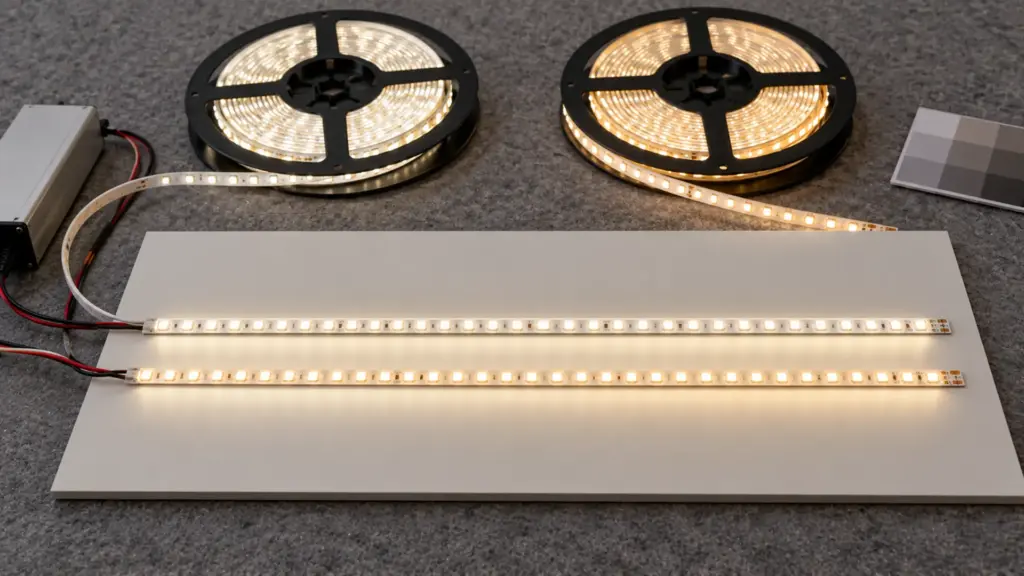
- A binning tolerance in writing. Adjacent reels and repeat orders should match in tint.
- An IP test report from a third party, if you are ordering waterproof strip.
- Warranty terms, in writing, with the name of the party that answers the claim.
- A sample from production, kept as the reference reel for later orders.
- A written rule on substitutions. According to one seller guide, a change in drivers or materials without re-certification moves the compliance risk to the buyer. Require notice before any change.
Our power supply sizing guide covers the driver side, which belongs on the same list when drivers come from a different channel than the strip.
Make the Quotes Comparable
Quotes are only comparable if every channel was asked the same question. Send each one the same package:
- The drawing or run schedule with lengths, so each quote prices the same quantity.
- Voltage, CCT, Color Rendering Index, 0–100: how truthfully the light shows colors next to a reference source. Ra≥90 is the usual bar for interiors. and IP requirement written as numbers.
- The driver and the control protocol, or a request that they quote the combined system.
- The documents you require with the quote, from the list above.
- The delivery date, and whether the order ships in one drop or several.
- The packaging you want: labeled by run location, or bulk.
Then compare the answers, not the prices. Which quote named the model, which attached the file, which gave a binning tolerance, and which asked a question about the job? The one that asked is usually the one that read the drawing.

Warranty Claims: Who Answers and What They Cover
A warranty is a claims process, and the channel decides who runs it. Ask three things before the order. Who receives the claim, and who ships the replacement? What does the warranty cover: the product only, or also the labor to remove and reinstall it? And what do you have to keep: batch or lot numbers, the installation date, photos, the run map?
On a strip in a finished cove, the access work is often the larger part of a failure, and a warranty that covers only the reel is worth less there than on a surface-mounted channel. Get the terms in writing, attached to the quote, and ask every channel on the shortlist the same three questions.
Multi-Site Rollouts: Keeping Reel 14 Matched to Reel 2
The hardest sourcing problem is not the first order; it is the tenth. A rollout runs for months, and the strip delivered in month six has to match the strip installed in month one. Three habits protect that.
- Keep a reference reel from the first approved production, and compare each new delivery with it on the bench before it goes to a site.
- Write the binning tolerance and the model into the spec schedule, so a reorder is checked against numbers instead of a color name.
- Require notice of any change to the LED, the PCB, the driver or the materials, with a new sample approved before the change ships.
A distributor with a fixed spec schedule does this by process. A maker or an importer does it if you ask for it in writing. In both cases the schedule has to exist before the second order, not after the first mismatch.

Three Typical Jobs, Three Answers
These are typical jobs, not client stories. Use them to test your own.
| Typical job | Likely channel | Why | Get in writing |
|---|---|---|---|
| A 600 ft cove retrofit on catalog strip, needed in two weeks | Distributor | One delivery, payment terms, local help | Model numbers, delivery date, return terms |
| A 40-site rollout, repeat orders for a year | One distributor with a spec schedule, or an importer under a fixed spec | Same strip at every site | Binning tolerance, spec schedule, notice of change |
| A custom PCB width and CCT for a custom profile | Manufacturer-direct, or an importer who passes the drawing to the maker | The spec is not in a catalog | Approved pre-production sample, document list |
| A single replacement run on a finished job | Distributor | Speed matters more than a custom spec | Model match to the installed run |
If your job fits two rows, pick the channel that holds the files for your model and is the easiest to reach when the first reel arrives wrong.
Red Flags in Any Channel
- A certificate that does not name your model.
- A listing claim on the quote with no file number or issuing body.
- A sample that looks different from the production reel.
- No binning tolerance for a multi-reel order.
- No answer on who makes the driver.
- A slow reply to a technical question during the quote; it predicts the reply to a claim.
- A spec change that reaches you after the shipment.
- Unit price as the only number on the quote.
FAQ
Is buying LED strip manufacturer-direct cheaper?
It can be on the unit price for custom or high-volume orders, but compare the whole job. Add the verification work, the import steps, the longer schedule for made-to-order product and the cost of a mismatch found after delivery. A quote that is cheaper on paper and slower on site is not cheaper.
Who is responsible if imported LED strip fails an inspection?
It depends on your contract and the authority having jurisdiction, so settle it before the order. Ask which party holds the listing file for your model and get the answer in writing. Whoever installs the product answers to the inspector.
Should I ask for a sample before a large order?
Yes. Ask for a sample from production, not a hand-picked one, test it on the driver and dimmer the job will use, and keep it as the reference reel for repeat orders.
Do strip, channels and drivers have to come from the same channel?
No, but they have to match. A single channel that checks the combined system (strip, driver and control) removes a source of mismatch, which is why many contractors use one distributor for the whole kit. If you split the sources, put the match in writing.
Decision Rule
Choose the channel that holds the files for your exact model and answers fastest when something is wrong. Manufacturer-direct wins when the spec is custom and you can run the verification yourself, a distributor wins when speed, terms and a single counter matter, and an importer fits the work in between.
Unitop Lighting quotes LED strip, channels, drivers and controls for commercial and architectural projects across the US. An order can go through Unitop US, with one US invoice and one US contact for the whole bill of materials and Unitop as the importer of record, or it can ship factory-direct with Unitop handling the spec, QC and shipping documents. Send the drawings, run lengths and control scheme with your quote request, and we will check the combined system before anything is priced. The Services page explains both options.