

LED Drivers, Controllers & Connectors
LED drivers, power supplies and controllers matched to every strip we supply — specified as one system, delivered together.
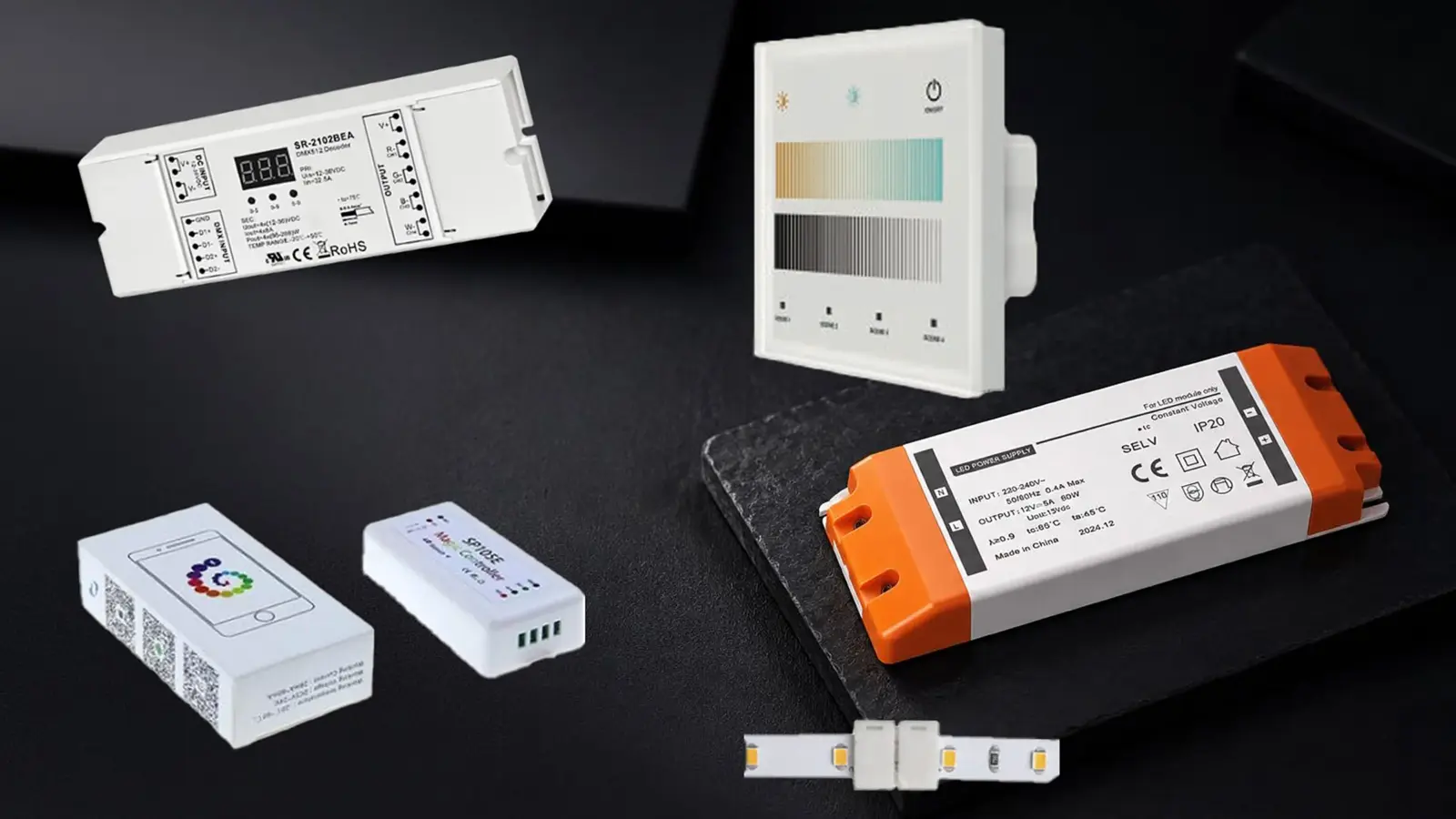
LED Drivers
Constant-voltage power supplies designed to UL 8750, organized the way an inspector reads the job — Class 2 first, then high-power and wet-location, then dimming. Constant-current strip and constant-current neon run on constant-current drivers, matched at quote.
Class 2 Power Supplies
NEC Class 2 / UL 1310 power-limited supplies — our 24V Class 2 drivers are rated at 60W each, so a longer run splits across several drivers and circuits. The wiring method for the output is confirmed with the AHJ. The default spec for interior architectural runs.
| Model | Type | Input VAC | Output | Power | Dimming | IP | Efficiency* | Ambient temp.* | PWM output* |
|---|---|---|---|---|---|---|---|---|---|
| UT-D40-24-C2 | Class 2 CV | 100–277 | 24V DC | 40W | Non-dim | IP20 | ≈82% | -4 to 122°F (-20 to 50°C) | None (DC output) |
| UT-D60-24-C2 | Class 2 CV | 100–277 | 24V DC | 60W | Non-dim | IP20 | ≈85% | -4 to 122°F (-20 to 50°C) | None (DC output) |
| UT-D60-24-C2-010 | Class 2 CV | 120–277 | 24V DC | 60W | 0-10V | IP20 | ≈85% | -4 to 122°F (-20 to 50°C) | ≈1 kHz |
*Typical values for this driver class, taken from comparable published datasheets and rounded conservatively (efficiency at full load, ambient operating range). The datasheet for the exact model is confirmed with your quote.
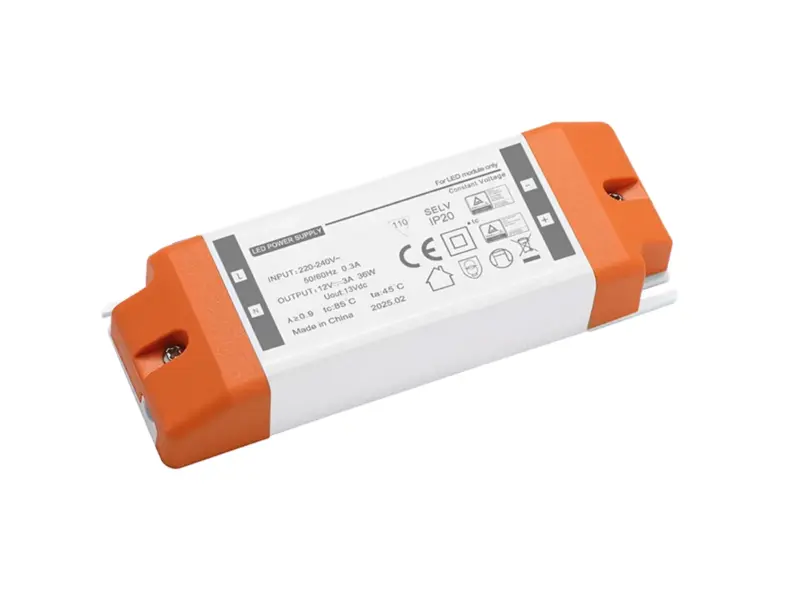
High-Power & IP67 Drivers
20–600W for long feeds and multi-run zones. IP67 sealed enclosures rate for damp and wet locations; linear case drivers tuck into channels and millwork. The sealed 12/24V line runs from a 20W plastic case to a 600W aluminum case.
| Model | Type | Input VAC | Output | Power | Dimming | IP | Efficiency* | Ambient temp.* | PWM output* |
|---|---|---|---|---|---|---|---|---|---|
| UT-D60-1224-67 | CV, universal input | 90–264 | 12/24V DC | 60W | Non-dim | IP67 | ≈86% | -13 to 140°F (-25 to 60°C) | None (DC output) |
| UT-D100-24-67 | CV, potted | 90–264 | 24V DC | 100W | Non-dim | IP67 | ≈88% | -13 to 140°F (-25 to 60°C) | None (DC output) |
| UT-D150-24-L | Linear CV | 100–277 | 24V DC | 150W | Non-dim | IP65 | ≈88% | -4 to 122°F (-20 to 50°C) | None (DC output) |
| UT-D400-24-L | Linear CV | 100–277 | 24V DC | 400W | Non-dim | IP20 | ≈90% | -4 to 122°F (-20 to 50°C) | None (DC output) |
| UT-D20-1224-67S | CV, sealed plastic case | 100–240 | 12/24V DC | 20W | Non-dim | IP67 | 86% | -13 to 140°F (-25 to 60°C) | None (DC output) |
| UT-D30-1224-67S | CV, sealed plastic case | 100–240 | 12/24V DC | 30W | Non-dim | IP67 | 86% | -13 to 140°F (-25 to 60°C) | None (DC output) |
| UT-D40-1224-67S | CV, sealed plastic case | 100–240 | 12/24V DC | 40W | TRIAC | IP67 | 86% | -13 to 140°F (-25 to 60°C) | ≈1 kHz |
| UT-D60-1224-67S | CV, sealed plastic case | 100–240 | 12/24V DC | 60W | TRIAC | IP67 | 86–88% | -13 to 140°F (-25 to 60°C) | ≈1 kHz |
| UT-D100-1224-67S | CV, sealed aluminum case | 100–240 | 12/24V DC | 100W | Non-dim | IP67 | 90–92% | -13 to 140°F (-25 to 60°C) | None (DC output) |
| UT-D150-1224-67S | CV, sealed aluminum case | 100–240 | 12/24V DC | 150W | Non-dim | IP67 | 90–92% | -13 to 140°F (-25 to 60°C) | None (DC output) |
| UT-D200-1224-67S | CV, sealed aluminum case | 100–240 | 12/24V DC | 200W | Non-dim | IP67 | 90–92% | -13 to 140°F (-25 to 60°C) | None (DC output) |
| UT-D250-1224-67S | CV, sealed aluminum case | 100–240 | 12/24V DC | 250W | Non-dim | IP67 | 90–92% | -13 to 140°F (-25 to 60°C) | None (DC output) |
| UT-D300-1224-67S | CV, sealed aluminum case | 100–240 | 12/24V DC | 300W | Non-dim | IP67 | 90–92% | -13 to 140°F (-25 to 60°C) | None (DC output) |
| UT-D400-1224-67S | CV, sealed aluminum case | 100–240 | 12/24V DC | 400W | Non-dim | IP67 | 93–94% | -13 to 140°F (-25 to 60°C) | None (DC output) |
| UT-D500-1224-67S | CV, sealed aluminum case | 100–240 | 12/24V DC | 500W | Non-dim | IP67 | 90–92% | -13 to 140°F (-25 to 60°C) | None (DC output) |
| UT-D600-1224-67S | CV, sealed aluminum case | 100–240 | 12/24V DC | 600W | Non-dim | IP67 | 90–92% | -13 to 140°F (-25 to 60°C) | None (DC output) |
*Typical values for this driver class, taken from comparable published datasheets and rounded conservatively (efficiency at full load, ambient operating range). The datasheet for the exact model is confirmed with your quote.
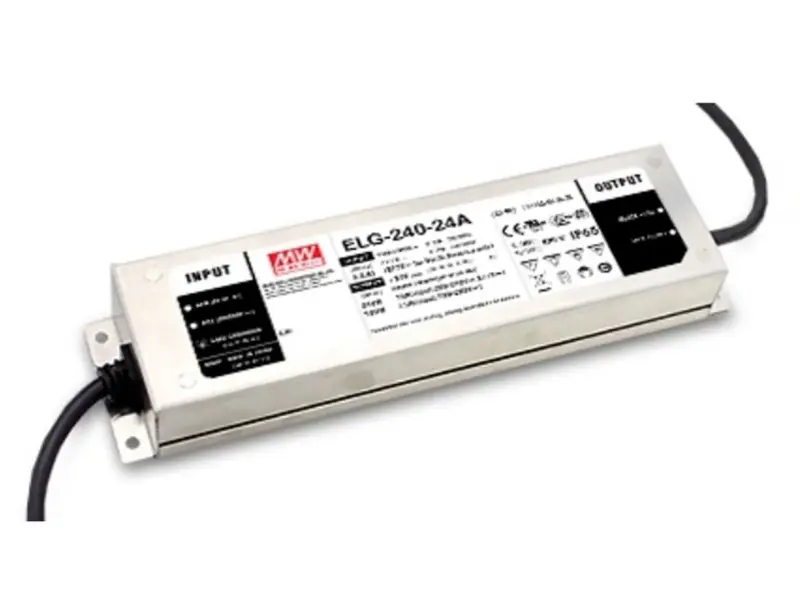
IP20 Enclosed Drivers
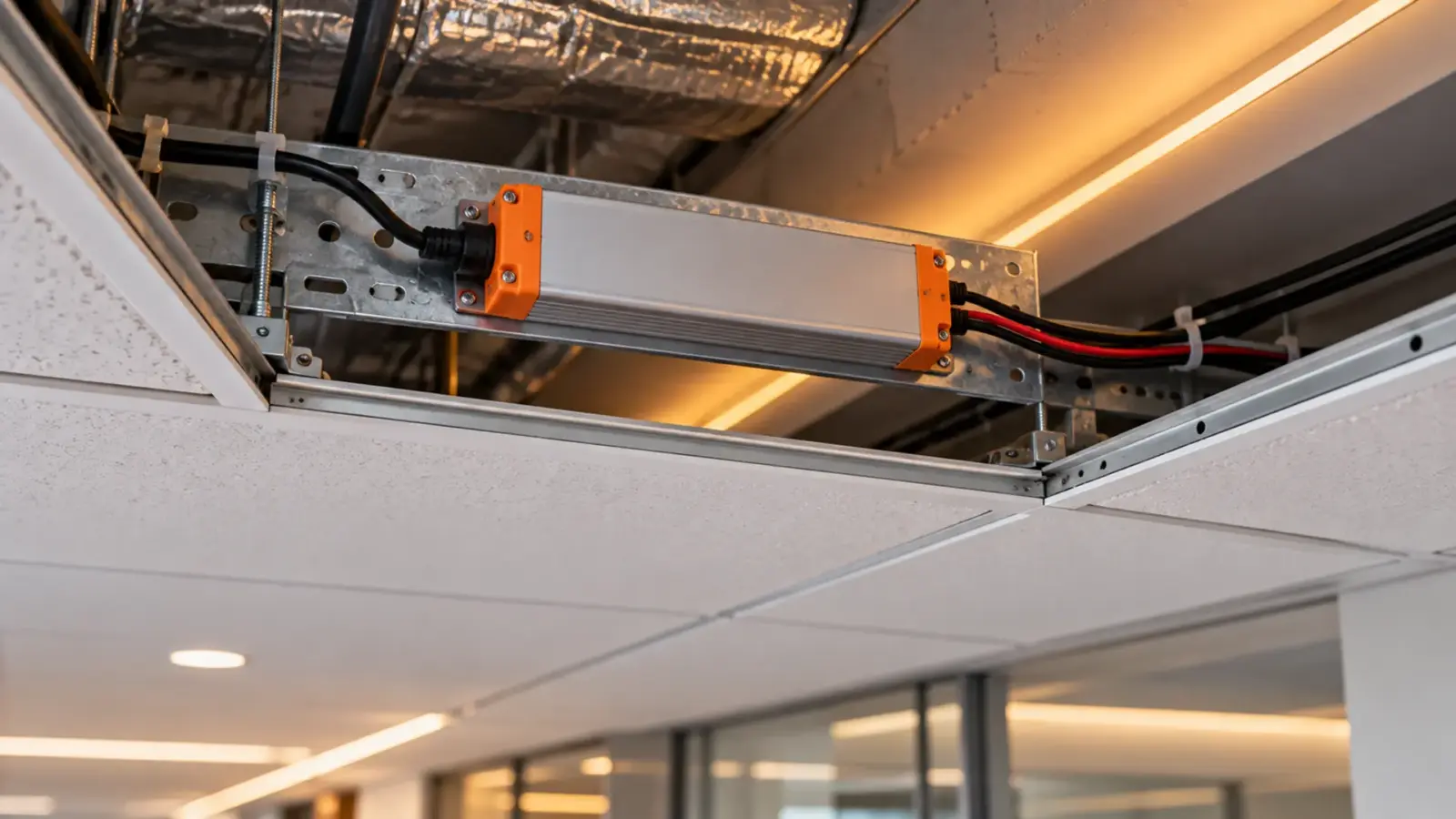
Slim aluminum-case 12/24V supplies for dry interior locations: ceiling voids, millwork and electrical closets. The high-efficiency line reaches 94.5% at 24V. The 350W and 400W slim cases are fan-cooled, so leave room for airflow and service access.
| Model | Type | Input VAC | Output | Power | Dimming | IP | Efficiency* | Ambient temp.* | PWM output* |
|---|---|---|---|---|---|---|---|---|---|
| UT-D30-1224-20S | CV, slim case | 100–240 | 12/24V DC | 30W | Non-dim | IP20 | 86–88% | -4 to 122°F (-20 to 50°C) | None (DC output) |
| UT-D60-1224-20S | CV, slim case | 100–240 | 12/24V DC | 60W | Non-dim | IP20 | 86–88% | -4 to 122°F (-20 to 50°C) | None (DC output) |
| UT-D100-1224-20S | CV, slim case | 100–240 | 12/24V DC | 100W | Non-dim | IP20 | 86–88% | -4 to 122°F (-20 to 50°C) | None (DC output) |
| UT-D150-1224-20S | CV, slim case | 100–240 | 12/24V DC | 150W | Non-dim | IP20 | 86–88% | -4 to 122°F (-20 to 50°C) | None (DC output) |
| UT-D200-1224-20S | CV, slim case | 100–240 | 12/24V DC | 200W | Non-dim | IP20 | 86–88% | -4 to 122°F (-20 to 50°C) | None (DC output) |
| UT-D250-1224-20S | CV, slim case | 100–240 | 12/24V DC | 250W | Non-dim | IP20 | 86–88% | -4 to 122°F (-20 to 50°C) | None (DC output) |
| UT-D350-1224-20S | CV, slim case, fan-cooled | 100–240 | 12/24V DC | 350W | Non-dim | IP20 | 86–88% | -4 to 122°F (-20 to 50°C) | None (DC output) |
| UT-D400-1224-20S | CV, slim case, fan-cooled | 100–240 | 12/24V DC | 400W | Non-dim | IP20 | 86–88% | -4 to 122°F (-20 to 50°C) | None (DC output) |
| UT-D60-1224-20H | CV, high efficiency | 100–240 | 12/24V DC | 60W | Non-dim | IP20 | 93–93.5% | -4 to 122°F (-20 to 50°C) | None (DC output) |
| UT-D100-1224-20H | CV, high efficiency | 100–240 | 12/24V DC | 100W | Non-dim | IP20 | 93–93.5% | -4 to 122°F (-20 to 50°C) | None (DC output) |
| UT-D200-1224-20H | CV, high efficiency | 100–240 | 12/24V DC | 200W | Non-dim | IP20 | 93.5–94% | -4 to 122°F (-20 to 50°C) | None (DC output) |
| UT-D250-1224-20H | CV, high efficiency | 100–240 | 12/24V DC | 250W | Non-dim | IP20 | 93.5–94% | -4 to 122°F (-20 to 50°C) | None (DC output) |
| UT-D350-1224-20H | CV, high efficiency | 100–240 | 12/24V DC | 350W | Non-dim | IP20 | 94–94.5% | -4 to 122°F (-20 to 50°C) | None (DC output) |
| UT-D500-1224-20H | CV, high efficiency | 100–240 | 12/24V DC | 500W | Non-dim | IP20 | 94–94.5% | -4 to 122°F (-20 to 50°C) | None (DC output) |
*Efficiency is the factory figure at full load, 12V to 24V. Ambient range and PWM are typical for this driver class, taken from comparable published datasheets and rounded conservatively. The datasheet for the exact model, its listing and its warranty term are confirmed with your quote.
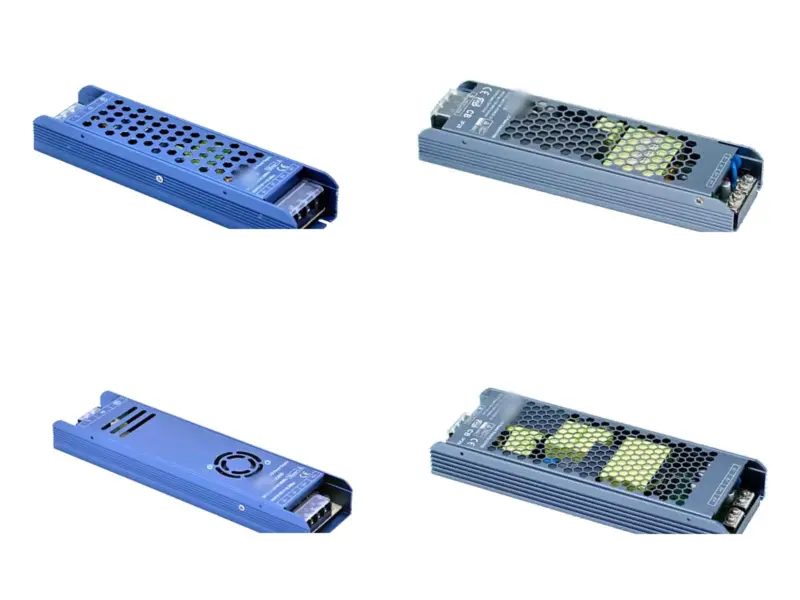
Dimmable Drivers — 0-10V and TRIAC
0-10V for commercial control systems; TRIAC (forward and reverse phase) where the job reuses existing wall-box dimmers. Confirmed dimmer compatibility lists ship with every quote.
| Model | Type | Input VAC | Output | Power | Dimming | IP | Efficiency* | Ambient temp.* | PWM output* |
|---|---|---|---|---|---|---|---|---|---|
| UT-D96-24-010 | CV dimmable | 100–277 | 24V DC | 96W | 0-10V | IP20 | ≈88% | -4 to 122°F (-20 to 50°C) | ≈1 kHz |
| UT-D100-24-010-67 | CV dimmable, potted | 90–264 | 24V DC | 100W | 0-10V | IP67 | ≈88% | -13 to 140°F (-25 to 60°C) | ≈1 kHz |
| UT-D60-24-TRC | CV dimmable | 120 | 24V DC | 60W | TRIAC (fwd/rev phase) | IP20 | ≈85% | -4 to 122°F (-20 to 50°C) | ≈1 kHz |
| UT-D60-1224-67D | CV dimmable, sealed | 100–240 | 12/24V DC | 60W | 0-10V / TRIAC | IP67 | 90–90.5% | -13 to 140°F (-25 to 60°C) | ≈1 kHz |
| UT-D100-1224-67D | CV dimmable, sealed | 100–240 | 12/24V DC | 100W | 0-10V / TRIAC | IP67 | 90.2–90.6% | -13 to 140°F (-25 to 60°C) | ≈1 kHz |
| UT-D150-1224-67D | CV dimmable, sealed | 100–240 | 12/24V DC | 150W | 0-10V / TRIAC | IP67 | 93–93.5% | -13 to 140°F (-25 to 60°C) | ≈1 kHz |
| UT-D200-1224-67D | CV dimmable, sealed | 100–240 | 12/24V DC | 200W | 0-10V / TRIAC | IP67 | 93–93.5% | -13 to 140°F (-25 to 60°C) | ≈1 kHz |
| UT-D250-1224-67D | CV dimmable, sealed | 100–240 | 12/24V DC | 250W | 0-10V / TRIAC | IP67 | 93–93.5% | -13 to 140°F (-25 to 60°C) | ≈1 kHz |
| UT-D300-1224-67D | CV dimmable, sealed | 100–240 | 12/24V DC | 300W | 0-10V / TRIAC | IP67 | 93–93.5% | -13 to 140°F (-25 to 60°C) | ≈1 kHz |
| UT-D350-1224-67D | CV dimmable, sealed | 100–240 | 12/24V DC | 350W | 0-10V / TRIAC | IP67 | 93–93.5% | -13 to 140°F (-25 to 60°C) | ≈1 kHz |
| UT-D500-1224-67D | CV dimmable, sealed | 100–240 | 12/24V DC | 500W | 0-10V / TRIAC | IP67 | 93–93.5% | -13 to 140°F (-25 to 60°C) | ≈1 kHz |
| UT-D60-1224-20D | CV dimmable | 100–240 | 12/24V DC | 60W | 0-10V / TRIAC | IP20 | 86–88% | -4 to 122°F (-20 to 50°C) | ≈1 kHz |
| UT-D100-1224-20D | CV dimmable | 100–240 | 12/24V DC | 100W | 0-10V / TRIAC | IP20 | 86–88% | -4 to 122°F (-20 to 50°C) | ≈1 kHz |
| UT-D150-1224-20D | CV dimmable | 100–240 | 12/24V DC | 150W | 0-10V / TRIAC | IP20 | 86–88% | -4 to 122°F (-20 to 50°C) | ≈1 kHz |
| UT-D200-1224-20D | CV dimmable | 100–240 | 12/24V DC | 200W | 0-10V / TRIAC | IP20 | 86–88% | -4 to 122°F (-20 to 50°C) | ≈1 kHz |
| UT-D250-1224-20D | CV dimmable | 100–240 | 12/24V DC | 250W | 0-10V / TRIAC | IP20 | 86–88% | -4 to 122°F (-20 to 50°C) | ≈1 kHz |
| UT-D300-1224-20D | CV dimmable | 100–240 | 12/24V DC | 300W | 0-10V / TRIAC | IP20 | 86–88% | -4 to 122°F (-20 to 50°C) | ≈1 kHz |
*Typical values for this driver class, taken from comparable published datasheets and rounded conservatively (efficiency at full load, ambient operating range). The datasheet for the exact model is confirmed with your quote.
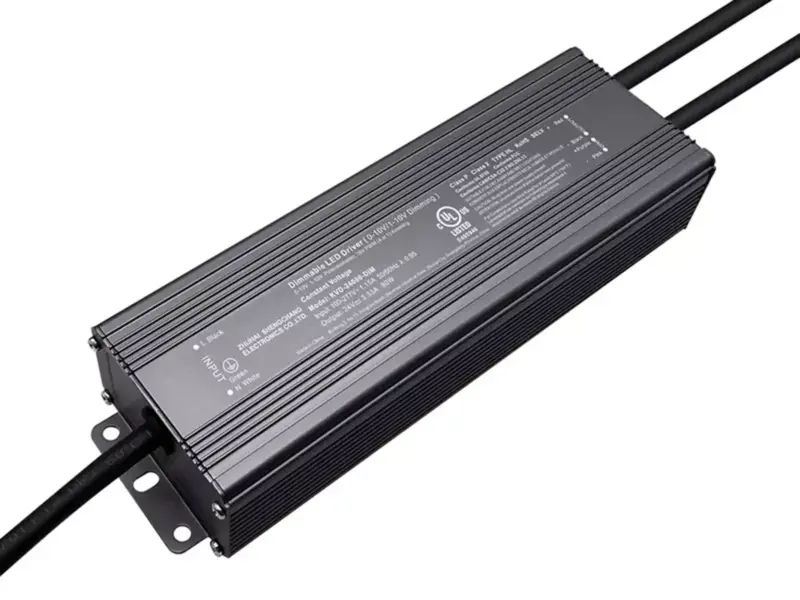
Controllers
Grouped by protocol — pick the control system first, and the decoder, panel, or amplifier follows. Every controller here is load-matched to the strips and drivers above it.
Dimming and protocol controllers
| Model | Protocol | Input | Max load | Channels | Control | PWM output* | Ambient temp.* |
|---|---|---|---|---|---|---|---|
| UT-C010-350 | 0-10V decoder | 12–24V DC | 350W | 1 | 0-10V dimming system | ≈1 kHz | -4 to 122°F (-20 to 50°C) |
| UT-CTP-010 | 0-10V wall panel | 100–277 VAC | — | 1 zone | Touch panel | — (control signal only) | 32 to 104°F (0 to 40°C) |
| UT-CTRC-240 | TRIAC | 120 VAC | 240W | 1 | Phase dimmer (fwd/rev) | — (phase-cut output) | 32 to 104°F (0 to 40°C) |
| UT-CDALI-DT8 | DALI DT8 | 12–24V DC | 360W | 2 (CCT) | DALI bus | ≈1 kHz | -4 to 122°F (-20 to 50°C) |
| UT-CDMX-480 | DMX512 decoder | 12–24V DC | 480W | 4 | DMX console | ≈1 kHz | -4 to 122°F (-20 to 50°C) |
| UT-CSPI-2048 | SPI / pixel | 5–24V DC | 2,048 px | 3 | App + RF remote | Set by the pixel IC | -4 to 122°F (-20 to 50°C) |
| UT-CRF-24G | 2.4G RF | 12–24V DC | 360W | 4 zones | RF remote / wall panel, group control | ≈1 kHz | -4 to 122°F (-20 to 50°C) |
| UT-CAMP-4 | Signal amplifier | 12–24V DC | 384W | 4 | Repeats PWM signal downstream | Follows the controller | -4 to 122°F (-20 to 50°C) |
*Typical values for this controller class, taken from comparable published datasheets and rounded conservatively. The PWM rate decides how the strip looks on camera; the datasheet for the exact model is confirmed with your quote.
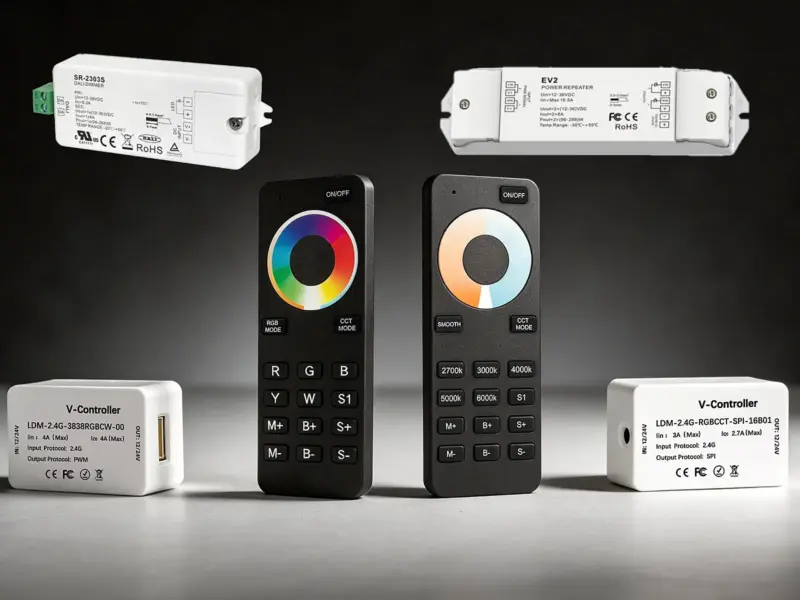
Smart and wireless control
App and voice control for residential and small commercial work. Wi-Fi + Bluetooth controllers run on the Tuya Smart Life app with Alexa and Google Assistant; Zigbee 3.0 controllers join a Zigbee gateway, and the single-color to RGBW models also pair with a Philips Hue bridge; the 2.4G remotes and wall remotes pair with the Wi-Fi controllers. On a larger job, settle who owns the network and the app login before handover.
| Model | Type | Protocol | Input | Output | Control | Ambient temp. |
|---|---|---|---|---|---|---|
| UT-CWF-SC | Single color | Wi-Fi + Bluetooth (Tuya) | 12–24V DC | 7.5A/ch, 15A total | App, voice; RF remote to 98 ft (30 m) | — |
| UT-CWF-CCT | Tunable white | Wi-Fi + Bluetooth (Tuya) | 12–24V DC | 7.5A/ch, 15A total | App, voice; RF remote to 98 ft (30 m) | — |
| UT-CWF-RGB | RGB | Wi-Fi + Bluetooth (Tuya) | 12–24V DC | 6A/ch, 15A total | App, voice; RF remote to 98 ft (30 m) | — |
| UT-CWF-RGBW | RGBW | Wi-Fi + Bluetooth (Tuya) | 12–24V DC | 6A/ch, 15A total | App, voice; RF remote to 98 ft (30 m) | — |
| UT-CWF-RGBCCT | RGB+CCT | Wi-Fi + Bluetooth (Tuya) | 12–24V DC | 6A/ch, 15A total | App, voice; RF remote to 98 ft (30 m) | -4 to 140°F (-20 to 60°C) |
| UT-CWF-5IN1 | Single color to RGB+CCT, set on install | Wi-Fi + Bluetooth (Tuya) | 12–24V DC | 6A/ch, 15A total | App, voice; RF remote to 98 ft (30 m) | -4 to 140°F (-20 to 60°C) |
| UT-CZB-SC | Single color | Zigbee 3.0 | 5–24V DC | 7.5A/ch, 15A total | Zigbee gateway or Hue bridge | -13 to 113°F (-25 to 45°C) |
| UT-CZB-CCT | Tunable white | Zigbee 3.0 | 5–24V DC | 7.5A/ch, 15A total | Zigbee gateway or Hue bridge | -13 to 113°F (-25 to 45°C) |
| UT-CZB-RGB | RGB | Zigbee 3.0 | 5–24V DC | 6A/ch, 15A total | Zigbee gateway or Hue bridge | -13 to 113°F (-25 to 45°C) |
| UT-CZB-RGBW | RGBW | Zigbee 3.0 | 5–24V DC | 6A/ch, 15A total | Zigbee gateway or Hue bridge | -13 to 113°F (-25 to 45°C) |
| UT-CZB-RGBCCT | RGB+CCT | Zigbee 3.0 | 5–24V DC | 6A/ch, 15A total | Zigbee gateway | -4 to 140°F (-20 to 60°C) |
| UT-CZB-5IN1 | Single color to RGB+CCT, set on install | Zigbee 3.0 | 5–24V DC | 6A/ch, 15A total | Zigbee gateway | -4 to 140°F (-20 to 60°C) |
| UT-CRM4-SC | Handheld remote, 4 zones, single color | 2.4G RF | 3V (2× AAA) | — | 98 ft (30 m) | 14 to 104°F (-10 to 40°C) |
| UT-CRM4-CCT | Handheld remote, 4 zones, tunable white | 2.4G RF | 3V (2× AAA) | — | 98 ft (30 m) | 14 to 140°F (-10 to 60°C) |
| UT-CRM4-RGB | Handheld remote, 4 zones, RGB / RGBW / RGB+CCT | 2.4G RF | 3V (2× AAA) | — | 98 ft (30 m) | 14 to 104°F (-10 to 40°C) |
| UT-CRM8-RGB | Handheld remote, 8 zones, RGB / RGBW / RGB+CCT | 2.4G RF | 3V (2× AAA) | — | 98 ft (30 m) | 14 to 140°F (-10 to 60°C) |
| UT-CRM8-RGB-LR | Handheld remote, 8 zones, long range | 2.4G RF | 3V (2× AAA) | — | 492 ft (150 m) | 14 to 140°F (-10 to 60°C) |
| UT-CWP4-CCT | Wall remote, 4 zones, tunable white, magnetic | 2.4G RF | 3V (2× AAA) | — | 98 ft (30 m) | — |
| UT-CWP4-RGB | Wall remote, 4 zones, RGB / RGBW / RGB+CCT, magnetic | 2.4G RF | 3V (2× AAA) | — | 98 ft (30 m) | — |
| UT-CGW-RF | Gateway, 2.4G RF to Wi-Fi app | Wi-Fi 802.11b/g/n | 5V DC, micro USB | — | 98 ft (30 m) RF | -4 to 140°F (-20 to 60°C) |
| UT-CGW-ZB | Gateway, wired network port | Zigbee 3.0 | 5V DC, 1A | — | Network cable to router | 14 to 131°F (-10 to 55°C) |
| UT-CGW-ZBH | Gateway, wired network port, Apple Home | Zigbee 3.0 | 5V DC, 1A | — | Network cable to router | 14 to 131°F (-10 to 55°C) |
| UT-CGW-ZBM | Gateway, Zigbee and Bluetooth Mesh (Tuya) | Zigbee 3.0 + Bluetooth Mesh | 5V DC, 1A | — | Wi-Fi to router | 14 to 131°F (-10 to 55°C) |
Loads and ambient ranges are the factory figures. Wireless approvals vary by model and are confirmed with your quote.
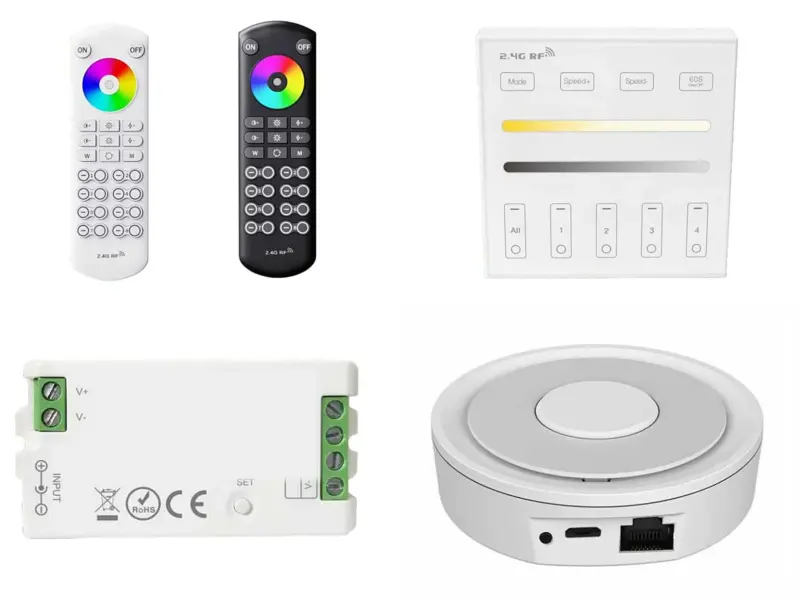
Connectors & Accessories
Three connection types cover every joint on a strip run, in variants matched to PCB width (8 / 10 / 12 mm), IP rating (IP20 / IP62 / IP65), and circuit — single color, CCT, RGB, RGBW. Cabinet sensor switches for 12/24V runs close the section.
Strip-to-strip
Butt two cut strip ends together with no soldering — continues a run past a cut point.
Wire-to-strip
Lands the power feed on the strip — driver lead or injection point to PCB.
Strip-wire-strip
Bridges two strips across a gap or corner with a wired jumper between them.
Strip connectors and clips
| Type | PCB width | IP rating | Circuit | Max current |
|---|---|---|---|---|
| BB strip-to-strip | 8 / 10 / 12 mm | IP20 / IP62 | Single color / CCT / RGB / RGBW | 5A |
| XB wire-to-strip | 8 / 10 / 12 mm | IP20 / IP62 / IP65 | Single color / CCT / RGB / RGBW | 5A |
| BXB strip-wire-strip | 8 / 10 / 12 mm | IP20 / IP62 / IP65 | Single color / CCT / RGB / RGBW | 5A |
| PCB corner connector | 8 / 10 mm | IP20 | Single color / CCT | 5A |
| Mounting clips | 8–20 mm | — | — | — |
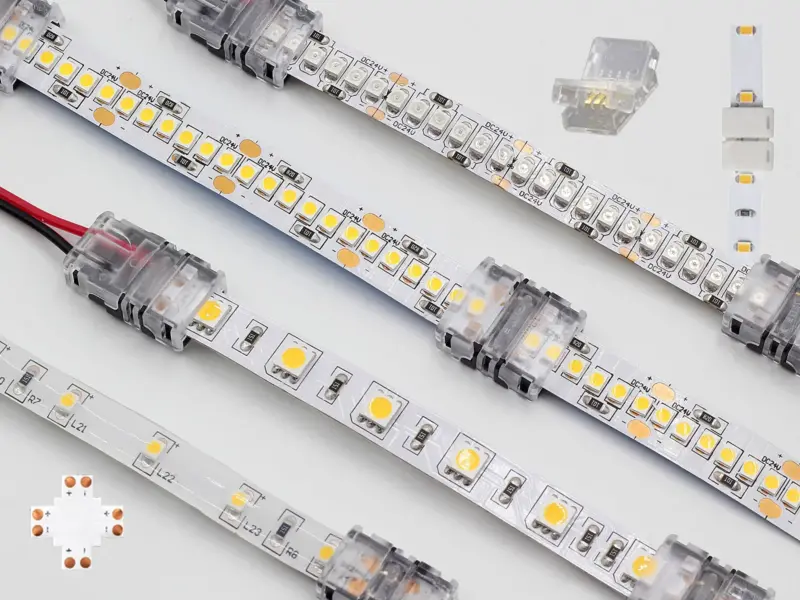
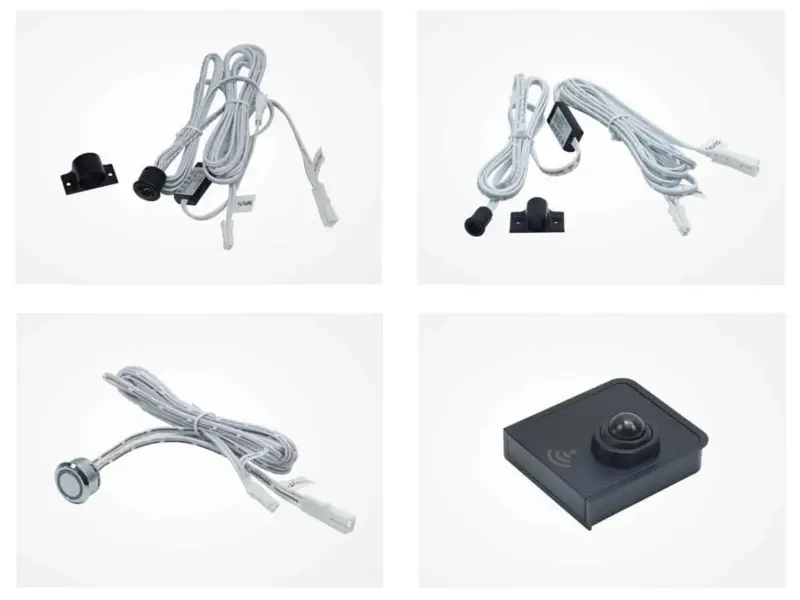
Cabinet sensor switches, 12/24V DC
DC-side switches that sit between the driver and the strip, so the driver stays on and the sensor breaks only the low-voltage feed. Door and hand-wave sensors fit cabinets and wardrobes, motion sensors cover toe kicks and closets, and battery transmitters pair to a receiver where no cable can run. Most are rated 60W at 12V or 24V, in line with our 60W Class 2 drivers; the 12V surface motion sensor is rated 24W. Read the rating in amps at the strip voltage: 60W is 2.5A at 24V and 5A at 12V.
| Model | Type | Input | Max load | Sensing | Mounting | Finish |
|---|---|---|---|---|---|---|
| UT-SW-PIR14 | Motion (PIR) | 12/24V DC | 60W | 10 ft (3 m), 120°, 35 s off delay | Recessed, 14 mm hole | Silver / white / black |
| UT-SW-PIR12 | Motion (PIR) | 12/24V DC | 60W | 10 ft (3 m), 120°, 35 s off delay | Recessed, 12 mm hole | Grey |
| UT-SW-PIRS | Motion (PIR) | 12/24V DC | 60W | 10 ft (3 m), 120°, 35 s off delay | Surface, 32×32×10 mm | Black / white |
| UT-SW-PIR12V | Motion (PIR) | 12V DC | 24W | 10 ft (3 m), 120°, 30 s off delay | Surface, 28×18×17 mm | White / black |
| UT-SW-DR8 | Door (IR) | 12/24V DC | 60W | Door opens, 3 in (8 cm) | Recessed, 8 mm hole | Silver / black |
| UT-SW-DR8-2 | Door (IR), two heads | 12/24V DC | 60W | Door opens, 3 in (8 cm) | Recessed, 8 mm hole | Silver / black |
| UT-SW-DR12 | Door (IR), removable head | 12/24V DC | 60W | Door opens, 3 in (8 cm) | Recessed, 12 mm hole | Silver / grey |
| UT-SW-DR14 | Door (IR) | 12/24V DC | 60W | Door opens, 3 in (8 cm) | Recessed, 14 mm hole | White / black |
| UT-SW-DRS | Door (IR) | 12/24V DC | 60W | Door opens, 2.4 in (6 cm) | Surface, 28×19×18 mm | Black |
| UT-SW-DRS-2 | Door (IR), two heads | 12/24V DC | 60W | Door opens, 2.4 in (6 cm) | Surface, 28×19×18 mm | Black |
| UT-SW-DRF | Door (IR), flat | 12/24V DC | 60W | Door opens, 3 in (8 cm) | Surface, 30×16×6 mm | Silver |
| UT-SW-HW8 | Hand wave (IR) | 12/24V DC | 60W | Hand wave, 3 in (8 cm) | Recessed, 8 mm hole | Silver / black |
| UT-SW-HW8-2 | Hand wave (IR), two heads | 12/24V DC | 60W | Hand wave, 3 in (8 cm) | Recessed, 8 mm hole | Silver / black |
| UT-SW-HW12 | Hand wave (IR), removable head | 12/24V DC | 60W | Hand wave, 3 in (8 cm) | Recessed, 12 mm hole | Silver / grey |
| UT-SW-HW14 | Hand wave (IR) | 12/24V DC | 60W | Hand wave, 3 in (8 cm) | Recessed, 14 mm hole | White / black |
| UT-SW-HWS | Hand wave (IR) | 12/24V DC | 60W | Hand wave, 2.4 in (6 cm) | Surface, 28×19×18 mm | Black |
| UT-SW-HWS-2 | Hand wave (IR), two heads | 12/24V DC | 60W | Hand wave, 2.4 in (6 cm) | Surface, 28×19×18 mm | Black |
| UT-SW-HWF | Hand wave (IR), flat | 12/24V DC | 60W | Hand wave, 3 in (8 cm) | Surface, 30×16×6 mm | Silver |
| UT-SW-TC17 | Touch | 12/24V DC | 60W | Touch on / off / dim | Recessed, 17 mm hole | Silver |
| UT-SW-TC17-2 | Touch, two buttons | 12/24V DC | 60W | Touch on / off / dim | Recessed, 17 mm hole | Silver |
| UT-SW-TC17B | Touch | 12/24V DC | 60W | Touch on / off / dim | Recessed, 17 mm hole | Black / white |
| UT-SW-TC12 | Touch | 12/24V DC | 60W | Touch on / off / dim | Recessed, 12 mm hole | Grey |
| UT-SW-WPIR | Wireless motion (PIR) transmitter | CR2450 battery | Via receiver | 10 ft (3 m), 120°, 30 s off delay | Surface, 50×43×24 mm | White / black |
| UT-SW-WDR | Wireless door (IR) transmitter | CR2450 battery | Via receiver | Door opens, 2.4 in (6 cm) | Surface, 50×43×24 mm | White / black |
| UT-SW-WHW | Wireless hand-wave transmitter | CR2450 battery | Via receiver | Hand wave, 2.4 in (6 cm) | Surface, 50×43×24 mm | White / black |
| UT-SW-WTC | Wireless touch transmitter | CR2450 battery | Via receiver | Touch on / off / dim | Surface, 50×43×24 mm | White / black |
| UT-SW-WDIAL | Wireless rotary dimmer | CR2450 battery | Via receiver | Soft on / off / dim | Freestanding, Ø50×33 mm | White / black |
| UT-SW-WREM | Wireless remote | CR2450 battery | Via receiver | Soft on / off / dim | Handheld, 110×40×9 mm | Black |
| UT-SW-RX6 | Receiver, 6 outputs | — | 120W | 98 ft (30 m) from the transmitter | Surface, 72×45×17 mm | White / black |
| UT-SW-RX1 | Receiver for one driver | — | — | 98 ft (30 m) from the transmitter | Surface, 32×32×9 mm | White / black |
Every quote ships with a matched driver and control plan — voltage drop, run length, and dimmer compatibility checked by our engineers before anything leaves the warehouse.
Request a quoteWiring, power and control guides
Power, dimming and wiring are system questions, not catalog questions — these guides walk through the decisions before you spec.
Certifications
Drivers and controllers are CE Marked. UL Listed driver options, FCC compliant controller options and RoHS compliant options are available through our qualified manufacturing partners. Certification coverage varies by model. Certification is held by the original manufacturing partner. Documentation and listing information are available upon request.
Which device carries the UL 924 listing on an emergency circuit
Projects outside North America: products are CE Marked, with RoHS compliant options and drivers matched to local mains. International orders
Power supply and control questions
How do I size an LED strip power supply?
Multiply watts per foot by the run length for every run on the supply, and keep the total at or below 80% of the driver's rating; the datasheet governs. For example, 40 ft of 3.2 W/ft strip loads 128 W, so it needs at least 160 W of rating.
What is the difference between a Class 2 and a non-Class 2 driver?
A Class 2 driver limits its output power, and the inspector checks the label, the listing and the load. Our Class 2 drivers are rated at 60 W each, so a larger load needs more than one driver, each on its own secondary circuit.
Which dimmer works with which driver?
The dimming method has to match the driver: a 0-10V driver needs a 0-10V control, and a TRIAC driver needs a compatible phase-cut dimmer. Mixing them is the most common cause of flicker. We match the pairing at quote.
Why does my LED strip glow faintly when it is switched off?
A small current is still reaching the driver or the strip. The usual paths are a dimmer that does not open the circuit completely at off, a switch with an indicator light, and long cables running side by side. A few milliamps are enough for a visible glow. Flicker only near the bottom of the dimming range is a different fault with a different fix.
Where should the driver go?
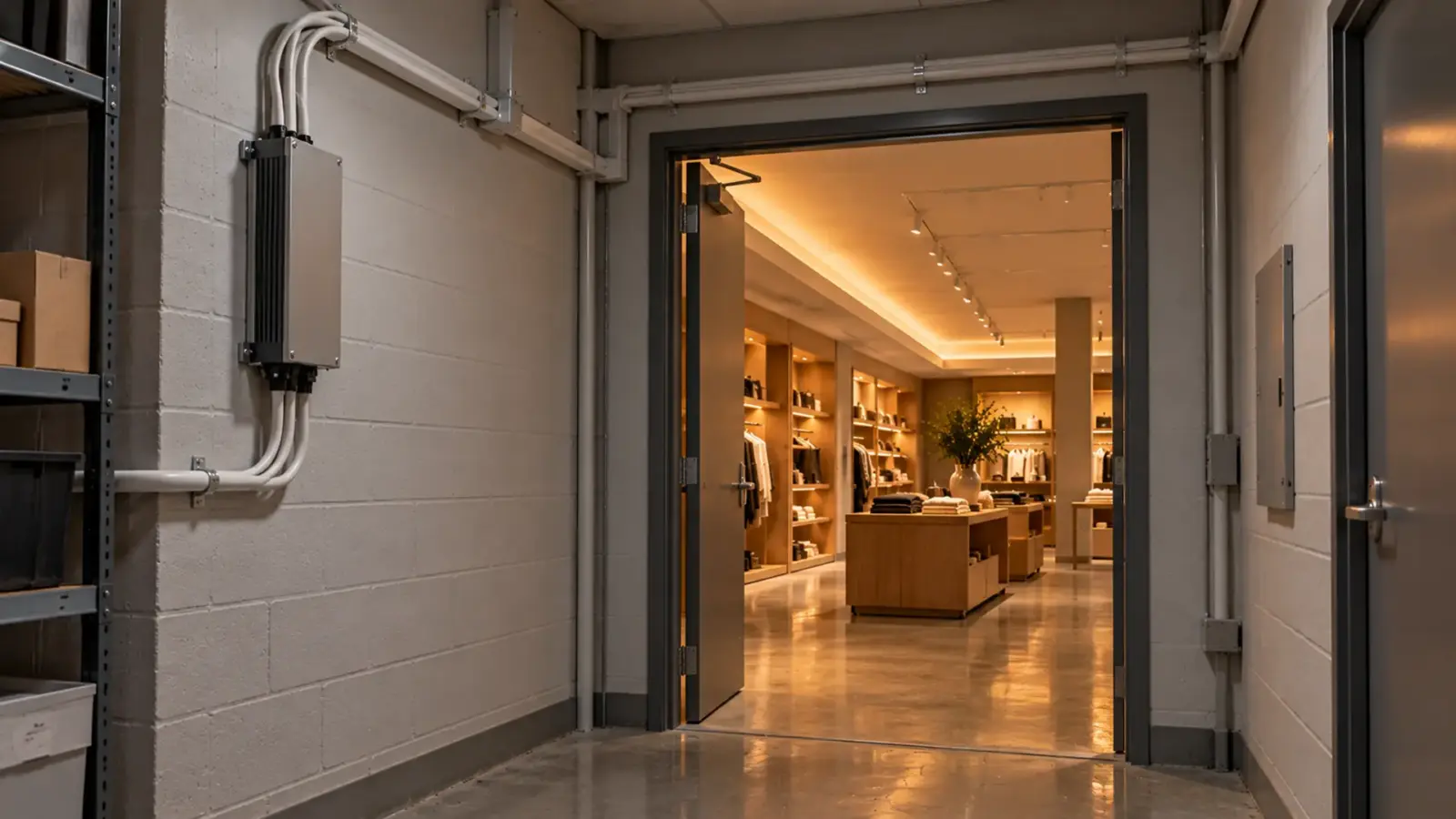
Somewhere you can reach without opening a finished surface, with air around the case and the shortest practical output run. A driver above a sealed ceiling or in a closed cabinet is where heat and service problems start.
Can an indoor driver be used outdoors?
No. Our Class 2 drivers are IP20 and stay in a dry space. For damp and wet locations use a potted IP67 driver such as UT-D100-24-67, and match the connectors to the same rating.
What is an LED driver?
The power unit between the building's 120V to 277V AC and the strip. A constant-voltage driver, often called a power supply, holds a fixed 12V, 24V or 48V DC output and the strip draws the current it needs; a constant-current driver holds a fixed current for strip and neon flex designed that way. The driver also carries the dimming input, 0-10V, TRIAC or DALI, so it is chosen with the wall control, not after it.
Is an LED driver the same as an LED power supply?
On a strip job the two names usually mean the same constant-voltage unit; power supply is the catalog term and driver is the term on the listing and in the code. The one case to watch is constant-current strip or neon flex, which needs a constant-current driver and will not run on a constant-voltage supply.
How do I wire one 0-10V dimmer to several drivers?
Run the control pair in parallel to every driver, violet to violet and negative to negative, and run the line side through the dimmer's relay to every driver. Two limits set the count: the dimmer's sink current, with each driver sourcing up to 2 mA, and the relay's current and inrush. On a larger zone, a separate relay or power pack switches the drivers and the dimmer keeps the pair.
How do I confirm LED strip will dim low without flicker?
The catalog's lowest level is only a claim; the real floor belongs to the driver and dimmer pair on the real circuit. Test with the circuit fully loaded, at the lowest level the room will use. A sound pass condition is steady light for ten minutes with no visible flicker and no glow when off, recorded and signed before the strip goes up.
More answers in our guides (7)
Which connector fits my LED strip?
Does a UL listing cover FCC and Prop 65 for drivers and controllers?
Does a low-voltage LED strip job have to follow the NEC?
Is LED strip Title 24 compliant?
Are LED strip lights a fire hazard?
Does a hot ceiling space mean I need a bigger LED driver?
Do LED drivers on a facade or in a garage need surge protection?
Spec your power and control system
Send your project details — an engineer replies with matched drivers, controllers, and documentation.
We typically respond within 24 hours. No spam, ever.