

CSP LED Strip Lights
Chip-scale package strip built without gold wires, brackets, or solder joints — the three parts that fail first. 19 configurations from 0.39 in cut interval to fully encapsulated IP68.
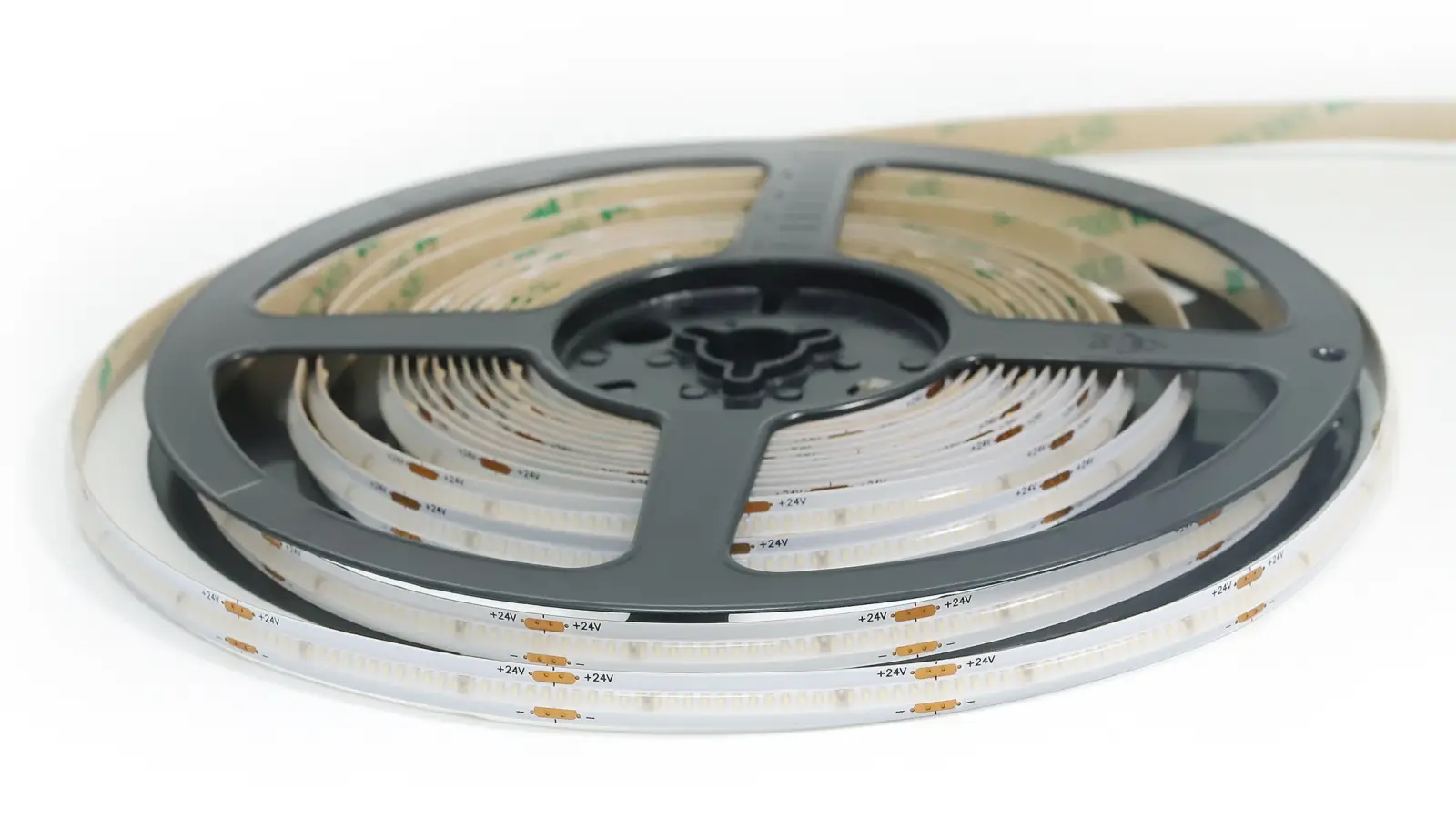
Our CSP program spans 160 to 540 LEDs per meter on 12V and 24V; white families render at Color Rendering Index, 0–100: how truthfully the light shows colors next to a reference source. Ra≥90 is the usual bar for interiors. >90 / R9 >40 — 2700, 3000, 4000, and 6500 K are the common choices, with 3500 K and 2200 K also available. Form factors run from 8 mm flat-coated profiles through domed, hazed extrusion to silicone-sealed builds — ingress ratings run IP20 through IP68. Tunable white, RGB, and single-color R/G/B round out the range; cut intervals reach 0.39 in. SMD still leads on raw efficacy — CSP trades a few lumens per watt for fewer points of failure.
Why contractors spec our CSP strip
Solder-free 100 m roll
Reel-to-reel production means no solder joints anywhere in the roll — the most common field failure on conventional strip simply is not there.
Flip-chip die, no gold wire or bracket
The die bonds straight to the PCB — no bond wire to snap under thermal cycling, no bracket plating to oxidize.
-40 °F to 185 °F verified
Thermal-shock tested from -40 °F to 212 °F for 500 cycles, and rated for continuous operation from -4 °F to 185 °F ambient.
CRI 90 with R9 >40, SDCM ≤3
White families ship at CRI >90 with R9 >40, binned to SDCM ≤3 on flat-coated builds and ≤5 on Dome Diffused.
Cut to 0.39 in
Mini Cut builds trim at 0.98, 0.79, 0.56, and 0.39 in intervals — spec exact lengths for cabinets and millwork without dark returns.
IP20 through IP68 in one technology
The same CSP platform runs from bare indoor strip to silicone-sealed builds that pass roughly 3 m submersion testing.
Five families, one spec conversation
Standard CSP — 320 and 480 LED/m
The default pick: 97–103 lm/W at 320 LED/m on a 1.85 mm ultra-thin profile, SDCM ≤3, upgradeable from IP20 to IP54 through IP68. The other families exist for specific constraints — start here and move only when a constraint says so.
| Model | LEDs/m | Output lm/ft | lm/W | Cut | IP rating |
|---|---|---|---|---|---|
| UT-CSP-320-N | 320 | 296–316 lm/ft | 97–103 lm/W | 1.97 in (50 mm) | IP20 |
| UT-CSP-480-N | 480 | 396–415 lm/ft | 90–94 lm/W | 1.97 in (50 mm) | IP20 |
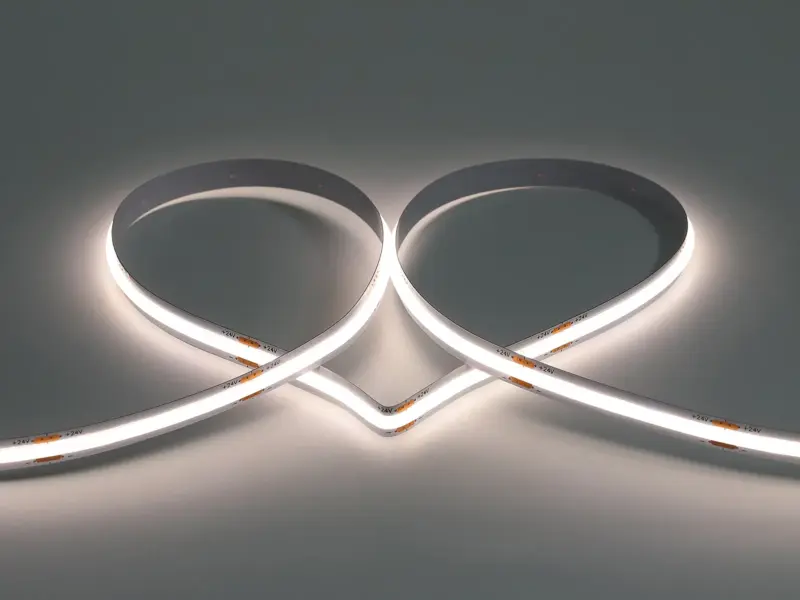
Mini Cut — down to 0.39 in cut interval
Four builds for cabinets, closets, display cases, and short millwork returns. All three 24V densities draw the same 2.93 W/ft and deliver comparable output — density here is a cut-interval decision, not a brightness decision. Pick the density by how short you need to trim, then set brightness with the Standard series.
| Model | LEDs/m | Voltage | Cut | Output lm/ft | IP rating |
|---|---|---|---|---|---|
| UT-CSP-160-MC | 160 | 24V | 0.98 in (25 mm) | 249–293 lm/ft | IP20 |
| UT-CSP-200-MC | 200 | 24V | 0.79 in (20 mm) | 249–293 lm/ft | IP20 |
| UT-CSP-280-MC | 280 | 24V | 0.56 in (14.3 mm) | 249–293 lm/ft | IP20 |
| UT-CSP-300-MC12 | 300 | 12V | 0.39 in (10 mm) | 123–128 lm/ft | IP20 |
Output for the three 24V builds is shown as a verified range pending the final factory datasheet — request current test data with your quote.
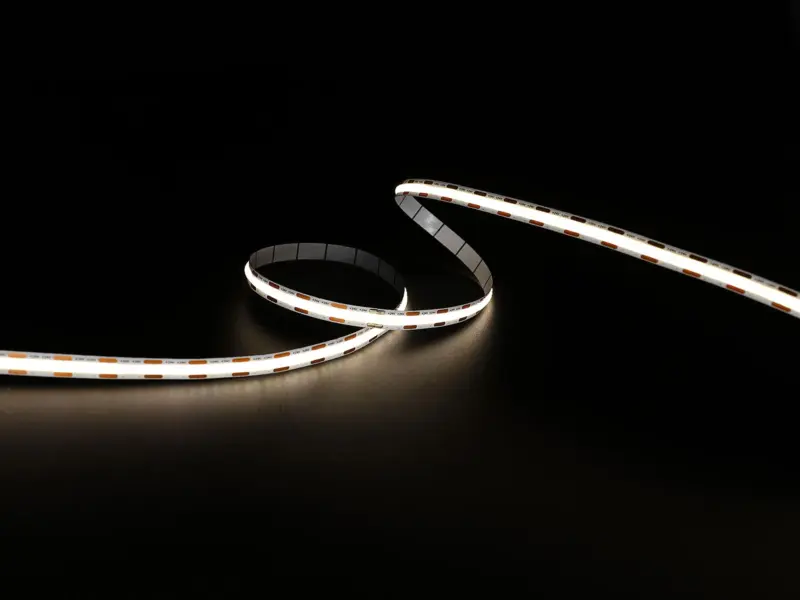
Dome Diffused — smoother line, wider spread
The domed, hazed extrusion spreads output across a 170° field for a smoother line with less visible pixelation than a flat-coated strip. Diffusion costs lumens — expect 78–89 lm/W against 97–103 lm/W on Standard. Spec Dome Diffused where the strip is seen directly or sits close to the viewing plane; spec Standard where it is hidden and output matters most.
| Model | LEDs/m | Output lm/ft | Beam | W×H | IP rating |
|---|---|---|---|---|---|
| UT-CSP-320-DD | 320 | 238–271 lm/ft | 170.5° | 8 × 3.6 mm | IP20 |
| UT-CSP-280-DD-R | 280 | 67 lm/ft (R) | 166.1° | 8 × 3.6 mm | IP20 |
| UT-CSP-280-DD-G | 280 | 256 lm/ft (G) | 166.1° | 8 × 3.6 mm | IP20 |
| UT-CSP-280-DD-B | 280 | 49 lm/ft (B) | 166.1° | 8 × 3.6 mm | IP20 |
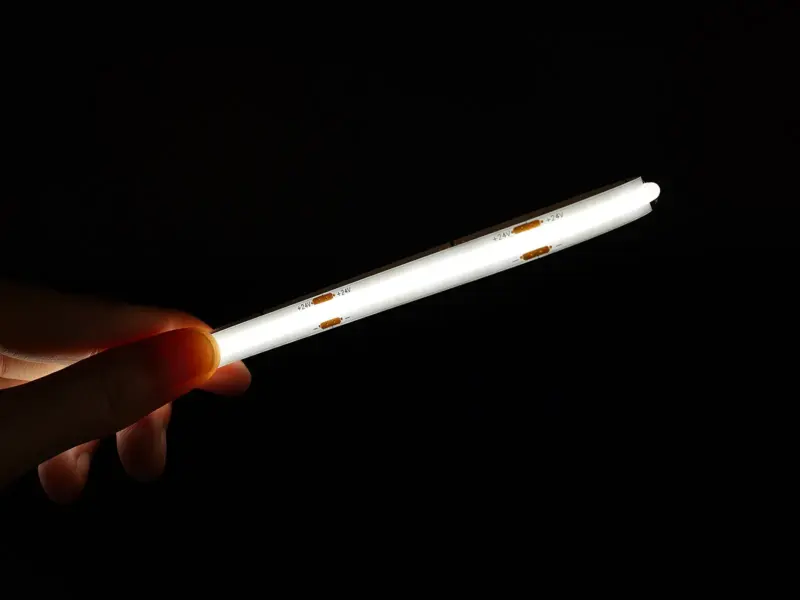
Tunable white and RGB
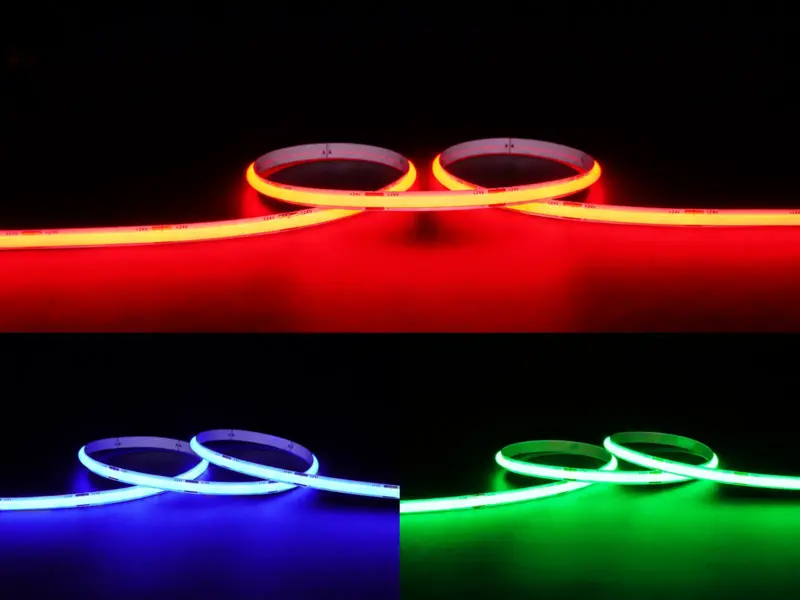
One dual-white build for 2700 K to 6500 K tuning on a single run, and a 540 LED/m RGB in IP20 and IP68 — the same solder-free CSP construction behind every white family.
| Model | LEDs/m | Color | Cut | Output lm/ft | IP rating |
|---|---|---|---|---|---|
| UT-CSP-512-CCT | 512 | 2700 K + 6500 K | 2.46 in (62.5 mm) | 238 lm/ft @2700 K / 244 lm/ft @6500 K | IP20 |
| UT-CSP-540-RGB | 540 | RGB | 1.31 in (33.3 mm) | 168 lm/ft (RGB) | IP20 |
| UT-CSP-540-RGB-68 | 540 | RGB | 1.31 in (33.3 mm) | 166 lm/ft (RGB) | IP68 |
RGB per-channel output — IP20: R 150 / G 340 / B 75 lm/m; IP68: R 145 / G 335 / B 70 lm/m.
Silicone-sealed construction — IP54 through IP68
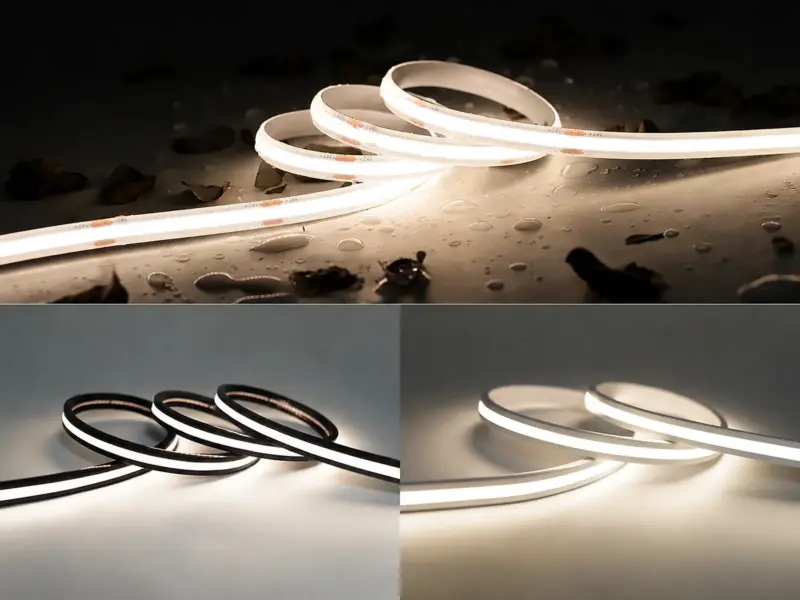
Six sealed builds on one silicone platform: an extruded IP54 coat for damp interiors, sealed-sleeve IP68 builds that pass roughly 3 m submersion testing, and white- or black-jacket IP68 versions. Verified through 1,000 hours at 185 °F (85 °C) / 85 % RH with zero lumen loss.
| Model | LEDs/m | Output lm/ft | Beam | W×H | IP rating |
|---|---|---|---|---|---|
| UT-CSP-320-54 | 320 | 299–308 lm/ft | 151.8° | 8 × 3 mm | IP54 |
| UT-CSP-480-54 | 480 | 402–405 lm/ft | 149.4° | 8 × 3 mm | IP54 |
| UT-CSP-320-68 | 320 | 293–302 lm/ft | 145.4° | 10 × 5 mm | IP68 |
| UT-CSP-480-68 | 480 | 396–405 lm/ft | 147.8° | 10 × 5 mm | IP68 |
| UT-CSP-320-68WJ | 320 | 183–201 lm/ft | 115.5° | 10 × 4 mm | IP68 |
| UT-CSP-320-68BJ | 320 | 91–104 lm/ft | 103.4° | 10 × 4 mm | IP68 |
Black-jacket silicone absorbs light — output is roughly half the white-jacket version by design. Specify it for runs that must disappear when off, not for output.
Pool, sauna, and landscape applications — including a 640 LED/m CSP sauna series — are specified on the Outdoor & Waterproof LED Strip page.
CSP-based neon profiles
Four CSP-based neon profiles — a 9.8 × 9.8 mm curve top, 10 × 6 mm and 10 × 10 mm top view, and a 12 × 8 mm RGB — carry the same solder-free construction into encapsulated linear form. They are specified alongside the rest of our neon range, marked by an LED package column.
Browse LED neon flex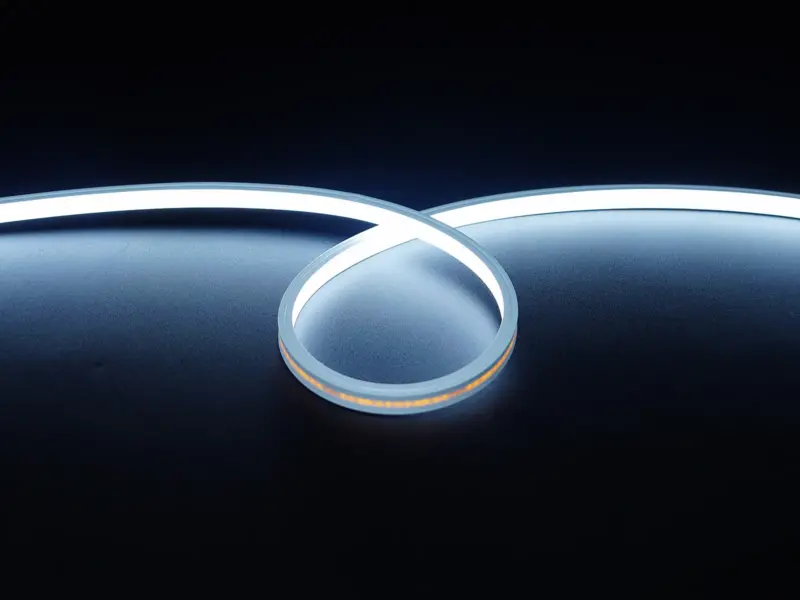
Master spec table
All 19 models across the five on-page families. The four CSP-based neon profiles are specified on the LED Neon Flex page. Full photometric files and IES data ship with your quote.
How to read our model numbers: UT-CSP-{LED density}-{variant}; 12V builds add 12. Variants: N standard IP20 · MC mini cut · DD dome diffused (R/G/B suffixed) · CCT tunable white · RGB · 54/68 ingress rating · WJ white jacket · BJ black jacket.
Tap a row for full specs.
| Model | LEDs/m | Voltage | Power W/ft (W/m) | Output lm/ft | lm/W | CRI / R9 | SDCM | Cut increment | Max run | W×H mm | Beam | IP rating | CCT / color |
|---|---|---|---|---|---|---|---|---|---|---|---|---|---|
| UT-CSP-320-N | 320 | 24V | 3.05 W/ft (10 W/m) | 296–316 lm/ft | 97–103 lm/W | >90 / >40 | ≤3 | 1.97 in (50 mm) | 16 ft (5 m)/feed | 8 × 1.85 mm | 151.6° | IP20 | 2700–6500 K |
| UT-CSP-480-N | 480 | 24V | 4.39 W/ft (14.4 W/m) | 396–415 lm/ft | 90–94 lm/W | >90 | ≤3 | 1.97 in (50 mm) | 16 ft (5 m)/feed | 8 × 1.85 mm | 147.7° | IP20 | 2700–6500 K |
| UT-CSP-160-MC | 160 | 24V | 2.93 W/ft (9.6 W/m) | 249–293 lm/ft | 85–100 lm/W | — | — | 0.98 in (25 mm) | 16 ft (5 m)/feed | 8 × 2 mm | — | IP20 | — |
| UT-CSP-200-MC | 200 | 24V | 2.93 W/ft (9.6 W/m) | 249–293 lm/ft | 85–100 lm/W | — | — | 0.79 in (20 mm) | 16 ft (5 m)/feed | 8 × 2 mm | — | IP20 | — |
| UT-CSP-280-MC | 280 | 24V | 2.93 W/ft (9.6 W/m) | 249–293 lm/ft | 85–100 lm/W | — | — | 0.56 in (14.3 mm) | 16 ft (5 m)/feed | 8 × 2 mm | — | IP20 | — |
| UT-CSP-300-MC12 | 300 | 12V | 1.83 W/ft (6 W/m) | 123–128 lm/ft | 67–70 lm/W | >90 / >40 | ≤3 | 0.39 in (10 mm) | on request | 8 × 2 mm | 140.1° | IP20 | 2700–4000 K |
| UT-CSP-320-DD | 320 | 24V | 3.05 W/ft (10 W/m) | 238–271 lm/ft | 78–89 lm/W | >90 / >40 | ≤5 | 1.97 in (50 mm) | 16 ft (5 m)/feed | 8 × 3.6 mm | 170.5° | IP20 | 2700–6000 K |
| UT-CSP-280-DD-R | 280 | 24V | 3.05 W/ft (10 W/m) | 67 lm/ft (R) | — | — | — | 1.97 in (50 mm) | 16 ft (5 m)/feed | 8 × 3.6 mm | 166.1° | IP20 | Red 620–640 nm |
| UT-CSP-280-DD-G | 280 | 24V | 3.05 W/ft (10 W/m) | 256 lm/ft (G) | — | — | — | 1.97 in (50 mm) | 16 ft (5 m)/feed | 8 × 3.6 mm | 166.1° | IP20 | Green 515–525 nm |
| UT-CSP-280-DD-B | 280 | 24V | 3.05 W/ft (10 W/m) | 49 lm/ft (B) | — | — | — | 1.97 in (50 mm) | 16 ft (5 m)/feed | 8 × 3.6 mm | 166.1° | IP20 | Blue 450–470 nm |
| UT-CSP-512-CCT | 512 | 24V | 2.44 W/ft (8 W/m) | 238 lm/ft @2700 K / 244 lm/ft @6500 K | 97–100 lm/W | >90 | ≤3 | 2.46 in (62.5 mm) | 16 ft (5 m)/feed | 8 × 1.85 mm | 148.8° | IP20 | 2700 K + 6500 K |
| UT-CSP-540-RGB | 540 | 24V | 4.57 W/ft (15 W/m) | 168 lm/ft (RGB) | — | — | — | 1.31 in (33.3 mm) | 16 ft (5 m)/feed | 10 × 1.7 mm | 140.1° | IP20 | RGB |
| UT-CSP-540-RGB-68 | 540 | 24V | 4.57 W/ft (15 W/m) | 166 lm/ft (RGB) | — | — | — | 1.31 in (33.3 mm) | 16 ft (5 m)/feed | 12 × 5 mm | 143.7° | IP68 | RGB |
| UT-CSP-320-54 | 320 | 24V | 3.05 W/ft (10 W/m) | 299–308 lm/ft | 98–101 lm/W | >90 / >40 | — | 1.97 in (50 mm) | 16 ft (5 m)/feed | 8 × 3 mm | 151.8° | IP54 | 2700–6500 K |
| UT-CSP-480-54 | 480 | 24V | 4.39 W/ft (14.4 W/m) | 402–405 lm/ft | 91–92 lm/W | >90 / >40 | — | 1.97 in (50 mm) | 16 ft (5 m)/feed | 8 × 3 mm | 149.4° | IP54 | 2700–6000 K |
| UT-CSP-320-68 | 320 | 24V | 3.05 W/ft (10 W/m) | 293–302 lm/ft | 96–99 lm/W | >90 | — | 1.97 in (50 mm) | 16 ft (5 m)/feed | 10 × 5 mm | 145.4° | IP68 | 2700–6500 K |
| UT-CSP-480-68 | 480 | 24V | 4.39 W/ft (14.4 W/m) | 396–405 lm/ft | 90–92 lm/W | >90 | — | 1.97 in (50 mm) | 16 ft (5 m)/feed | 10 × 5 mm | 147.8° | IP68 | 2700–6000 K |
| UT-CSP-320-68WJ | 320 | 24V | 3.05 W/ft (10 W/m) | 183–201 lm/ft | 60–66 lm/W | — | — | 1.97 in (50 mm) | 16 ft (5 m)/feed | 10 × 4 mm | 115.5° | IP68 | 2700–6000 K |
| UT-CSP-320-68BJ | 320 | 24V | 3.05 W/ft (10 W/m) | 91–104 lm/ft | 30–34 lm/W | — | — | 1.97 in (50 mm) | 16 ft (5 m)/feed | 10 × 4 mm | 103.4° | IP68 | 2700–6000 K |
Common whites: 2700 K · 3000 K · 4000 K · 6500 K; 3500 K and 2200 K also available. Any IP20 build can be ordered with IP54, IP66, IP67, or IP68 sealing; Dome Diffused is extruded as-is and stays IP20. 24 V builds run 16 ft (5 m) per feed; longer lines take a feed at both ends or an added feed.
Where CSP construction earns its keep
Sauna & Steam Rooms
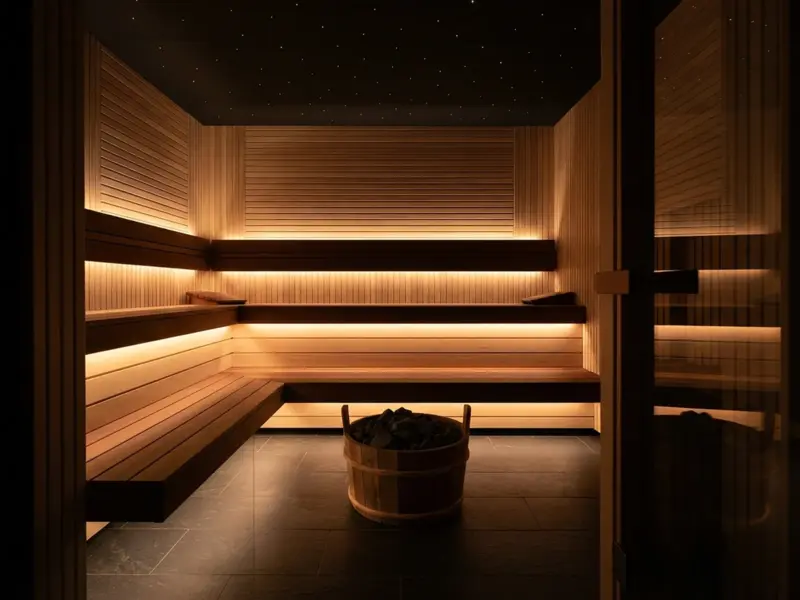
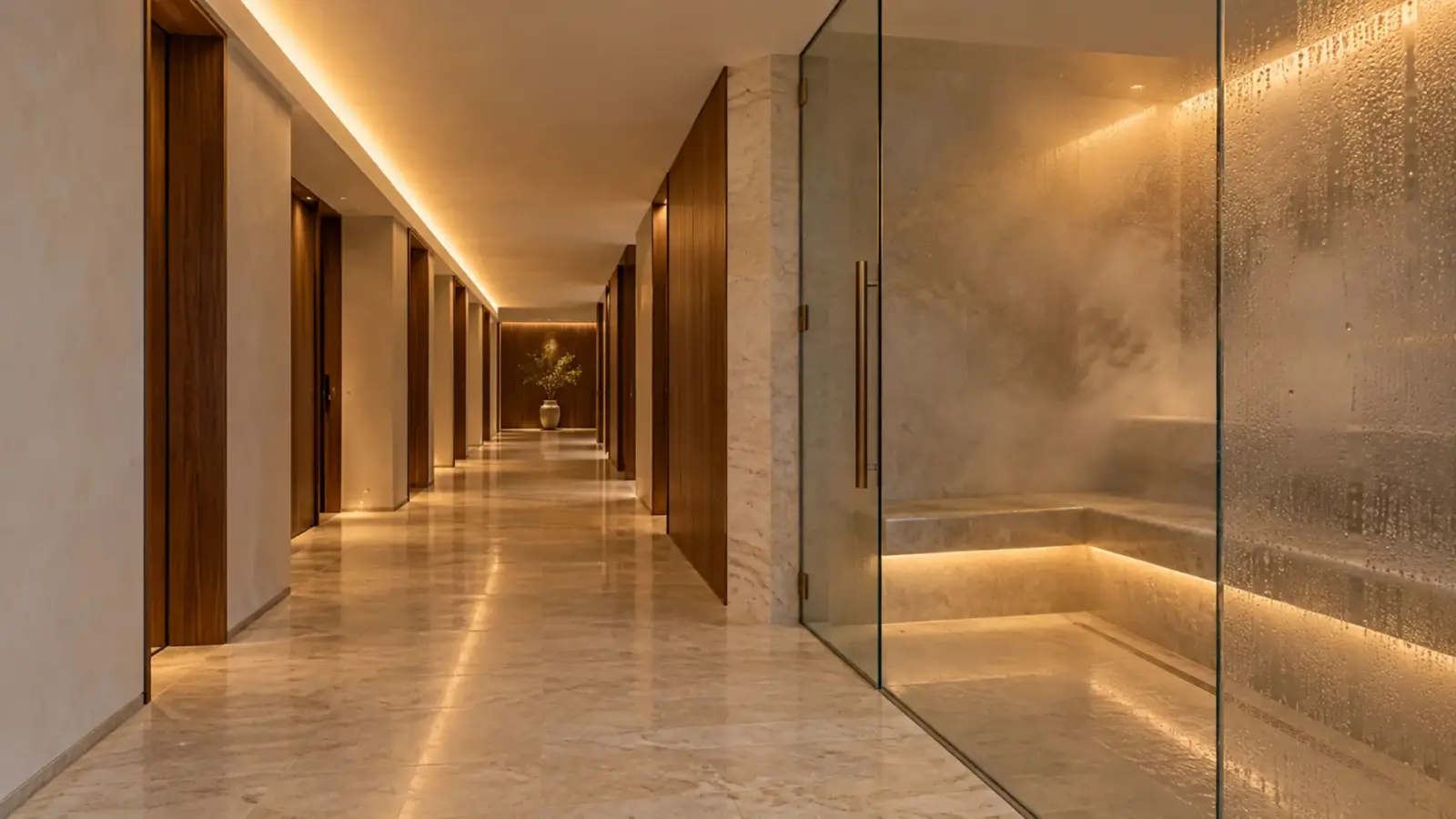
Rated for 1,000 hours at 185 °F and 85% RH with zero lumen depreciation, plus 1,000 hours of cycling between -40 °F and 212 °F. Application-rated sauna series are specified on the Outdoor & Waterproof page.
Sub-Freezing Exteriors
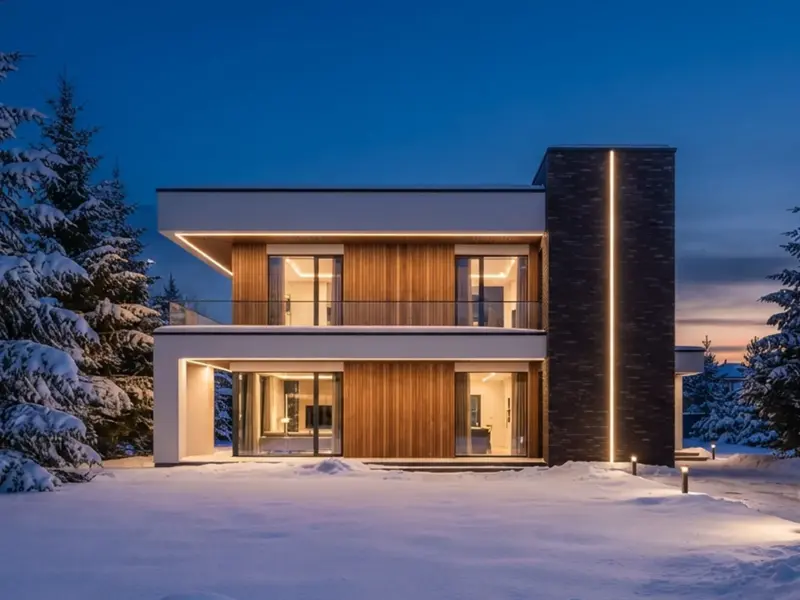
The same -40 °F to 212 °F cycling qualifies these builds for unheated exteriors — facade grazing, soffits, and entry canopies that sit below freezing for months at a time.
Submerged & Wet Locations
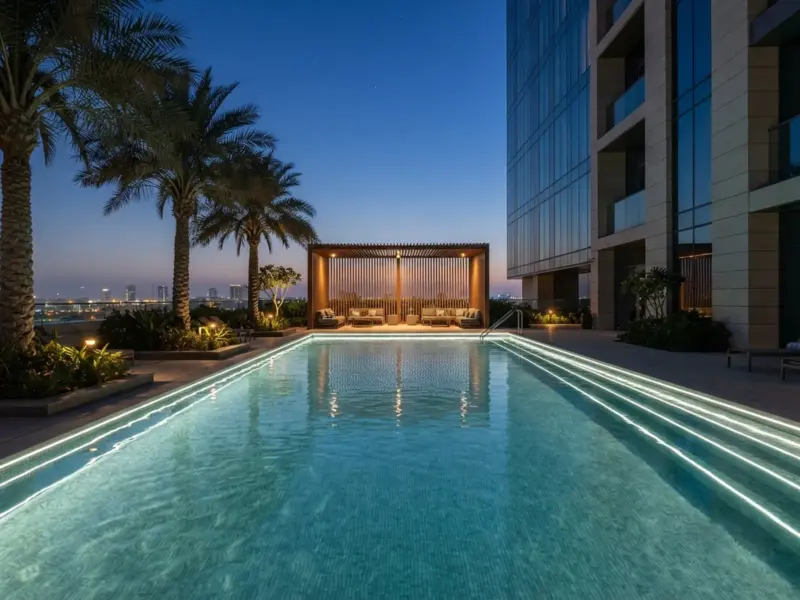
Sealed constructions pass roughly 10 ft (3 m) submersion at IP67/IP68. Application-rated pool series are specified on the Outdoor & Waterproof page.
Residential Interiors
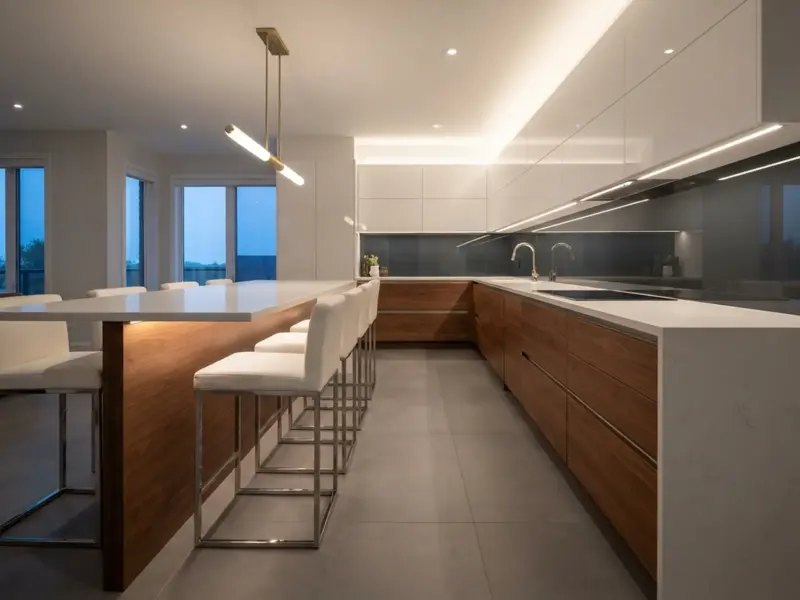
7,000 cycles of 720° torsion and 15,000 switching cycles — the strip survives installer handling around tight millwork returns and years of daily switching.
Certifications
Products are sourced from qualified manufacturing partners and are available with UL Listed, ETL Listed, FCC compliant, RoHS compliant and other applicable configurations. Certification coverage varies by model. Certification is held by the original manufacturing partner. Documentation and listing information are available upon request.
CE-compliant options available for buyers outside North America — contact us for EU specifications.
Related guides
Specification, power and installation guides for this range.
CSP LED strip questions
What is a CSP LED strip?
CSP stands for chip-scale package: the LED die is flip-chip bonded directly onto the flexible circuit board, with no gold bond wires and no plastic bracket around each emitter. The package is barely larger than the chip itself, and the strip is produced reel-to-reel with no solder joints along the roll.
CSP vs COB — which should I spec?
They solve different problems. COB strip exists for appearance: a continuous phosphor layer that reads as one unbroken line of light. CSP strip exists for reliability: no bond wires, brackets, or solder joints to fail under heat, vibration, or humidity. Note that CSP is not the same as SCOB — SCOB strips use ultra-compact SMD packages to approximate the COB look, while CSP is a different die-level construction. If the strip is visible and line quality is the spec, start with COB; if the environment is the spec, start here.
Is CSP more efficient than SMD?
No. Comparable SMD strip still delivers more lumens per watt, and any honest spec sheet will show it. CSP trades a few points of efficacy for a construction with fewer failure modes — no bond wires to break, no bracket plating to oxidize, no solder joints to go cold. Buy CSP for reliability, not efficiency.
How short can CSP strip be cut?
The 24V Mini Cut builds trim at 0.98, 0.79, and 0.56 in intervals; the 12V build cuts every 0.39 in (10 mm). Standard families cut at 1.97 in (50 mm), and the tunable-white build at 2.46 in (62.5 mm).
Does higher LED density mean more light?
Not in this range. The three 24V Mini Cut densities draw the same 2.93 W/ft and deliver comparable output — the extra emitters buy you shorter cut intervals, not more lumens. Choose density by how short you need to trim, then set brightness with the Standard series.
How much temperature and humidity can CSP strip take?
Type testing on file: thermal shock from -40 °F to 212 °F for 500 cycles, 1,000 hours of temperature cycling across the same range, and 1,000 hours at 185 °F (85 °C) and 85 % relative humidity with zero measured lumen loss, plus 15,000 on/off cycles. Sealed IP67 and IP68 builds pass roughly 3 m submersion testing. For pool, sauna, and other application-rated series, see the Outdoor & Waterproof range.
What is the difference between Standard and Dome Diffused CSP?
Dome Diffused adds a 3.6 mm domed, hazed extrusion over the same 320 LED/m board — the line reads smoother, individual light points are harder to see, and the beam opens to 170.5° against 151.6°. Diffusion costs output: expect 78–89 lm/W against 97–103 lm/W on Standard. It is an upgrade for visible runs, not a downgrade.
Why does the black-jacket IP68 version put out half the light?
Because black silicone absorbs light — by design. The black-jacket build exists so the run disappears into dark channels and shadow lines when it is off; the white-jacket version carries the output. Never spec the black jacket by lumens.
Which color temperatures are available?
Four common whites — 2700 K, 3000 K, 4000 K, and 6500 K — plus 3500 K and 2200 K also available. Tunable white pairs 2700 K and 6500 K on one strip; RGB and single-color red, green, and blue cover the saturated end.
Spec your CSP project
Send your run lengths, cut intervals, and environment — an engineer replies with matched CSP configurations, type-test data, and documentation.
We typically respond within 24 hours. No spam, ever.