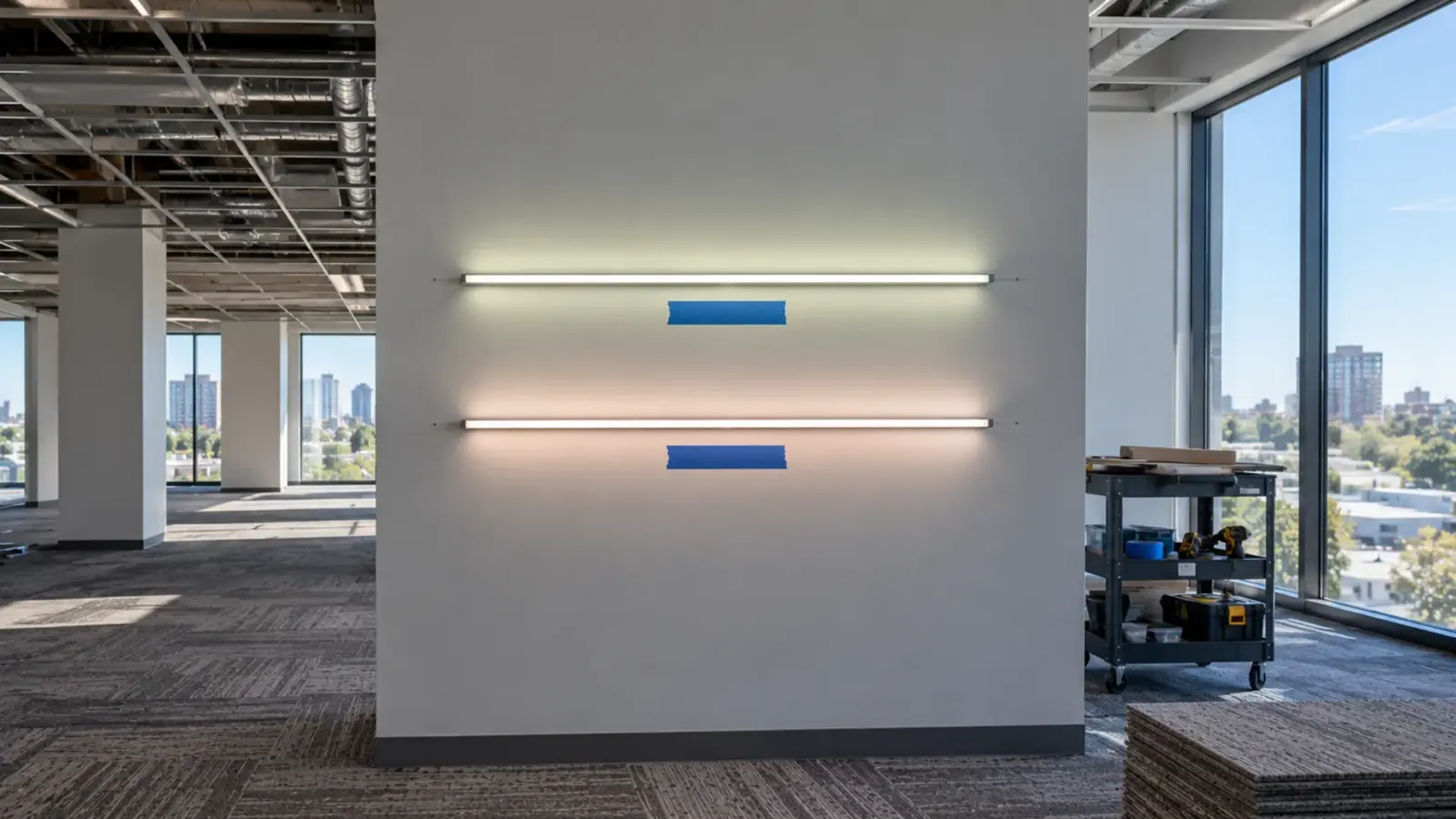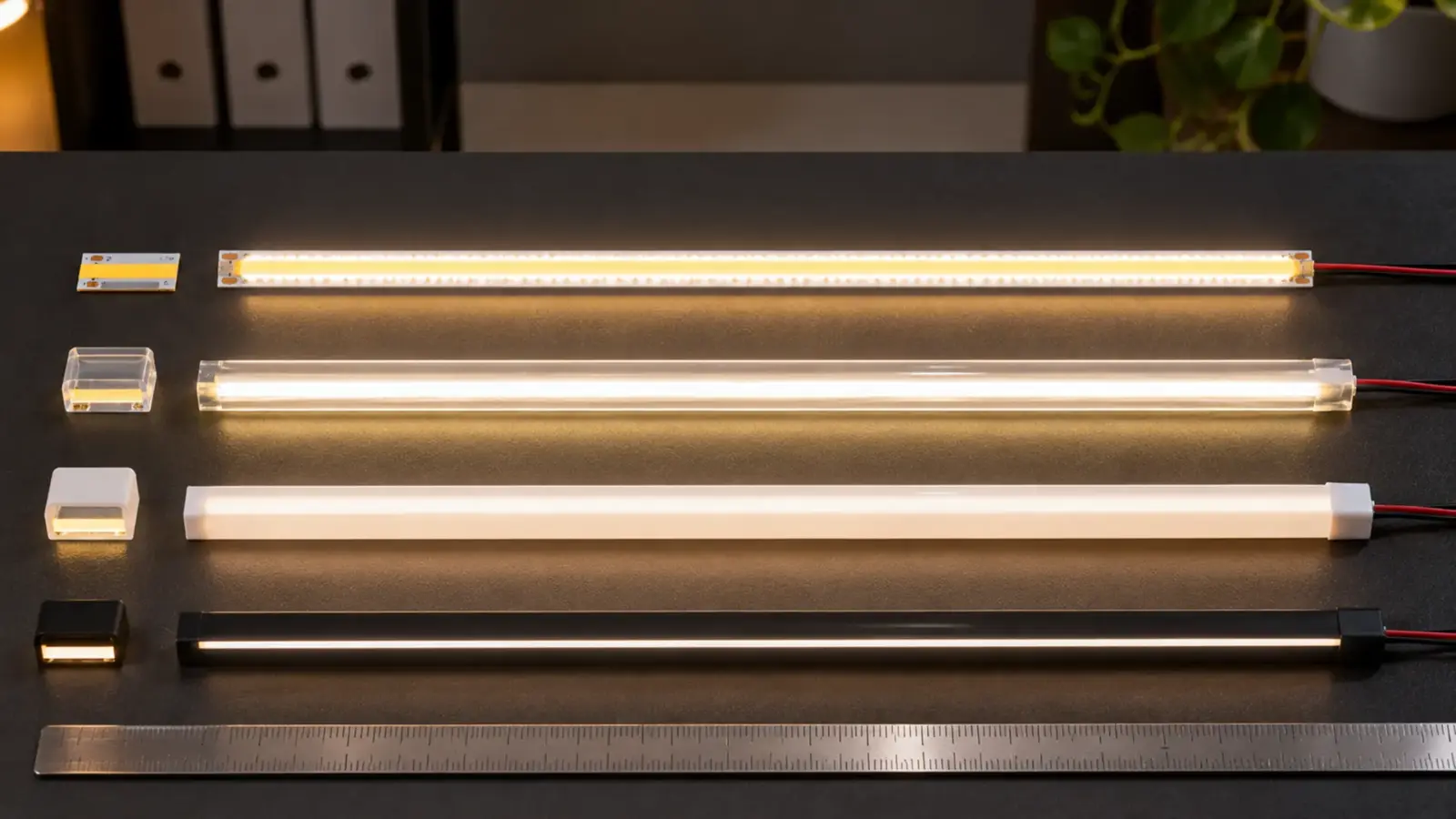
Two 24V strips can both draw 3.05 W/ft and still differ threefold in light. On our CSP table, the bare UT-CSP-320-N delivers 296–316 lumens per foot, while the black-jacket IP68 version of the same platform delivers 91–104. LED strip price per foot only means something next to what each foot delivers.
The price on a quote is set by parts: the LEDs and their bin, the board, the coating, the color quality, and the documents and warranty behind them. Each part can be checked on a datasheet or a sample. This article walks through them so two quotes can be compared on the same basis, without guessing which one cut a corner.
The Parts Behind the Price
| Part | What it changes on the job | How to check it |
|---|---|---|
| LED package and bin | Output, efficacy, color match between reels | Datasheet lm/ft, lm/W, SDCM; a sample from the production bin |
| LED density | Dot visibility, output per foot | LEDs per meter on the datasheet |
| Board copper and width | Heat, voltage drop, run per feed | Rated run per feed; the board’s copper weight if stated |
| Voltage and circuit | Run length, feed count, driver count | Rated run per feed, constant voltage or constant current |
| Coating or jacket | Moisture protection, light loss, heat | IP code, construction, lm/ft of the coated version |
| CRI and R9 | How colors and skin look | Ra and R9 on the datasheet |
| Documents | Submittal, listing, inspection | Datasheet, listing record, test reports |
| Warranty | Who pays when it fails | Period and terms on the quote |
The rest of this article takes the parts in turn. Signlite’s advice to buyers is the shortest version of it: ask for the bill of materials, meaning chip brand, board specification, density and test reports, before comparing prices.
LEDs: Package, Density and Bin
The LED package decides how much light each watt makes. High-efficacy packages cost more and run cooler at the same output. Our UT-S2835-128-HE, for example, is rated at 190 Lumens per watt: how much light the strip gives for the power it draws. Higher means less heat and less driver load per foot. for the whole strip, not just the LED, which is the number that matters when you compare it with another strip.
Density changes two things. More LEDs per foot spread the light and hide dots, and at the same total wattage each LED runs at a lower current and lower temperature. Loxone’s buying advice makes the same point about chip spacing: fewer chips per meter produce visible spots.
The bin decides whether reel two matches reel one. A tight binning specification, such as SDCM ≤3 on our UT-CSP-320-N, costs more to supply because fewer LEDs qualify. On a long cove where reels meet in the middle, it is the difference between one line and two colors; our article on why the second reel doesn’t match covers it.
The Board: Copper, Width and Run Length
The board carries current along the strip, and copper is the expensive part of it. According to Hitlights, higher-quality strip uses thicker copper, typically 2 oz against 1 oz, which improves heat dissipation and reduces voltage drop. Superlighting goes further and says some low-cost strip uses iron, coated copper or laminated copper boards instead of pure copper; treat that as a vendor claim, but it explains why two strips with the same LEDs behave differently.
You rarely see the copper weight on a quote. You see its effect in the rated run per feed:
- Most of our 24V COB and SMD strip runs 16 ft (5 m) per feed.
- UT-C312-8 and UT-C384-8 run 32 ft (10 m).
- UT-C480-8-48V and the constant-current UT-C480-8-CC run 65 ft (20 m).
A strip that runs twice as far per feed halves the feeds on a long run, and each feed is wiring, a driver output, a joint and labor. Our article on why the far end goes dim explains the physics; the budget effect is in our installed cost guide.
The Coating: IP Rating Costs Light
Waterproofing adds material and labor to every foot, and it costs light. Our CSP table shows it clearly on one platform, all at 24V and 3.05 W/ft:
| Model | Construction | Light per foot |
|---|---|---|
| UT-CSP-320-N | Bare, IP20 | 296–316 lm/ft |
| UT-CSP-320-68 | IP68, clear | 293–302 lm/ft |
| UT-CSP-320-68WJ | IP68, white jacket | 183–201 lm/ft |
| UT-CSP-320-68BJ | IP68, black jacket | 91–104 lm/ft |
The black-jacket version gives about a third of the bare strip’s light from the same watts. It exists for a reason: a black jacket disappears into dark details by day. But a quote that compares a jacketed strip with a bare one on price per foot is comparing two different lights. Our article on how LED strip is waterproofed covers what each construction protects against.
CRI and Color Consistency
Higher Color Rendering Index, 0–100: how truthfully the light shows colors next to a reference source. Ra≥90 is the usual bar for interiors. costs more because the phosphor that fills in the missing colors also costs some efficacy. Our standard strip is Ra≥90; UT-S2216-300 is Ra≥95 and the full-spectrum UT-S2835-480-FS is Ra≥98.
Whether the extra points are worth paying for depends on what the strip lights. A full-spectrum strip in a back-of-house corridor is money spent where nobody looks; the same strip over a jewelry case or a salon chair is what the space is judged by. Food, skin, art and merchandise show the difference; a corridor cove does not. Our guide to CRI 90, 95 or 98 sorts applications by need. When comparing quotes, check that both strips are quoted at the same Ra and, for reds, the same R9 minimum.
Documents and Warranty Are Part of the Price
Two reels can look identical and come with very different paper. On a commercial job, the paper is part of the product:
- A datasheet that states lm/ft, W/ft, CRI, binning and run length for the exact model.
- A listing record where the job needs one, for the model as supplied. Our guide to checking a UL or ETL listing shows how to confirm it.
- Test and binning records for the production lot.
- A warranty with a stated period. Our LED strip carries a limited warranty of up to 5 years, with the period for each series stated on the quote and order confirmation.
A low price that arrives without these costs the difference later, in a resubmittal, a failed inspection or a claim nobody honors. Our article on what a buyer can verify goes further.
A Worked Comparison of Two Quotes
Take a 64 ft cove and two illustrative quotes for warm white strip. They are not real products; they isolate the effect of run length, the part a price per foot hides most often.
| Quote A | Quote B | |
|---|---|---|
| Strip | 24V, 3.0 W/ft, 300 lm/ft on its datasheet, rated 16 ft (5 m) per feed | 24V, 3.0 W/ft, 300 lm/ft on its datasheet, rated 32 ft (10 m) per feed |
| Feeds for 64 ft | 4 | 2 |
| Driver outputs | 4 | 2 |
| Joints at feed points | 4 | 2 |
| Documents | Datasheet only | Datasheet, binning record, listing record |
Quote A may well be lower per foot. With the same watts and the same light, cost per lumen follows price per foot exactly, so the difference is all in the run. To compare them fairly, add what the extra two feeds cost in wire, driver capacity, joints and labor on this job, and the cost of chasing the missing documents before submittal. On a short shelf the difference is small. On a long cove, a corridor or a facade, the feed count usually decides it.
Reels, Lengths and Labels
How the strip arrives also sits inside the price.
- Reel length. Standard reels are the cheapest way to buy. Custom lengths, pre-cut pieces and pre-wired assemblies add labor at the factory and, on our range, about two to three weeks to the standard lead time. They also save labor on site, which belongs in the comparison.
- Labels. A reel labeled with model, CCT and bin lets the installer keep reels from the same bin together in one room. Unlabeled reels push that sorting onto the site, or skip it.
- Minimums. Our minimum is one full reel per SKU. Small quantities of many SKUs cost more per foot than the same footage in a few SKUs.
Accessories Are Not in the Foot
A strip quote covers the strip. The parts that make it work are priced separately, and they have to suit that exact strip:
- Connectors must match the board width and the circuit. Our connectors are listed for 8, 10 and 12 mm boards and rated 5 A.
- End caps and sealing kits must match the coating on IP-rated strip, or the rating is lost at every cut.
- Drivers must match the voltage, and constant-current strip such as UT-C480-8-CC needs a matching constant-current supply.
A cheap strip that only works with its own connectors and caps, or with a driver type nobody stocks, moves cost from the strip line to the accessory and labor lines.
Compare per Lumen and per Run, Not per Foot
Price per foot rewards the strip that does least. Compare quotes in three steps instead:
- Per lumen. Divide each quoted price per foot by the strip’s lm/ft. That gives cost per lumen delivered. Our article on rated vs delivered lumens per watt explains which lumen figure to use.
- Per run. For the longest run on the job, count the feeds each strip needs from its rated run per feed. Each extra feed adds wiring, a driver output and labor.
- Per approval. Check that each strip has the documents the job needs. A strip that cannot be submitted is not cheaper.
A strip that wins on all three is the cheaper strip, whatever its price per foot.
Rules of Thumb
- Never compare price per foot without lm/ft beside it.
- A jacket or coating costs light; compare the coated version’s lm/ft, not the bare strip’s.
- Longer rated runs per feed save money outside the strip line.
- Tighter binning and higher CRI cost more and pay off where color is seen side by side.
- Ask for the bill of materials and the documents before you compare.
Watts, lumens, run length and CRI for each model are on our SMD LED strip spec table and every category page.