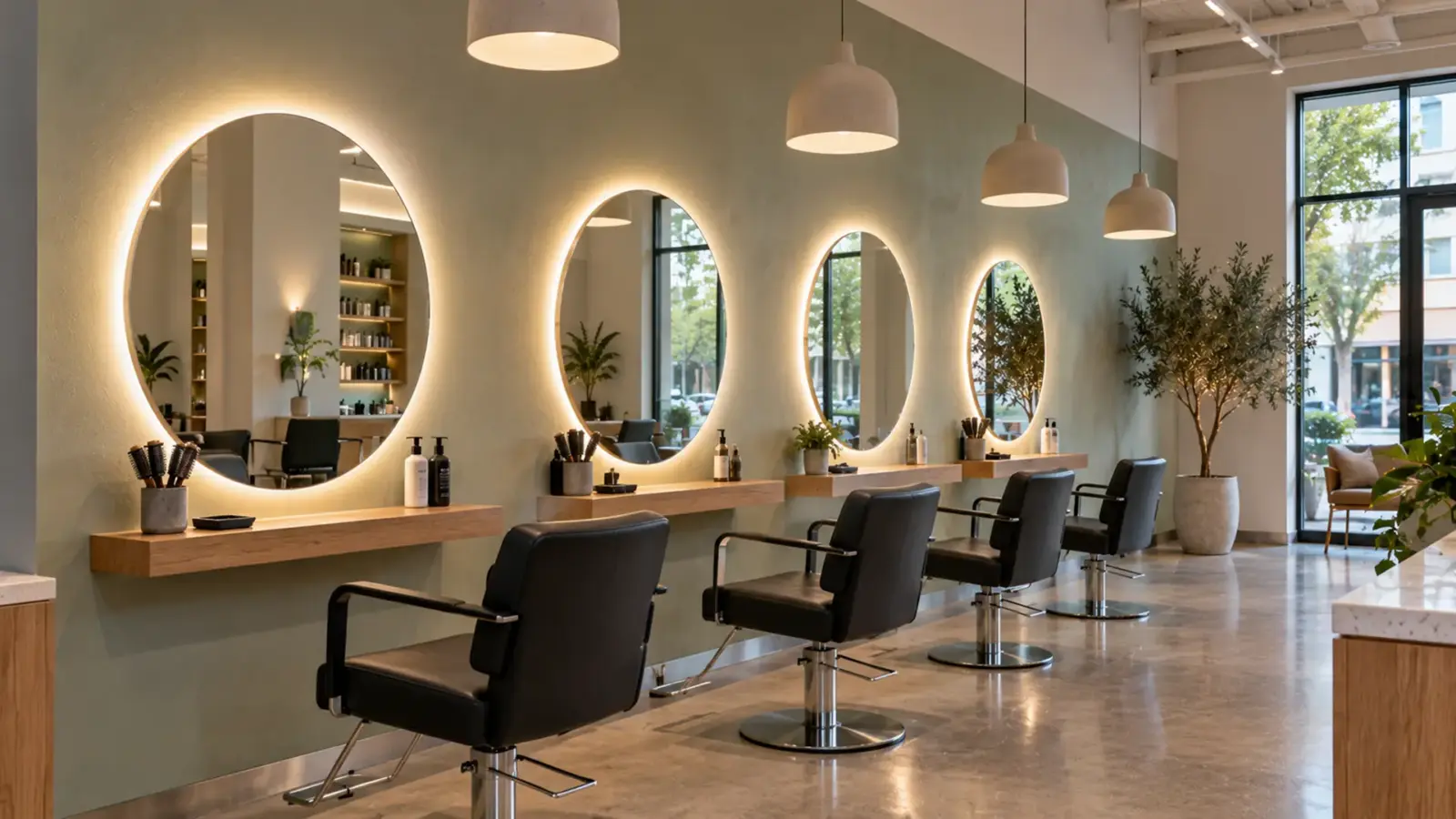
A backlit mirror needs three decisions behind the glass: which strip gives the glow you want at the gap you have, where the driver goes so someone can reach it, and how much water the detail will see. Get those right and the halo stays even for years. Get one wrong and it fails at the first service visit.
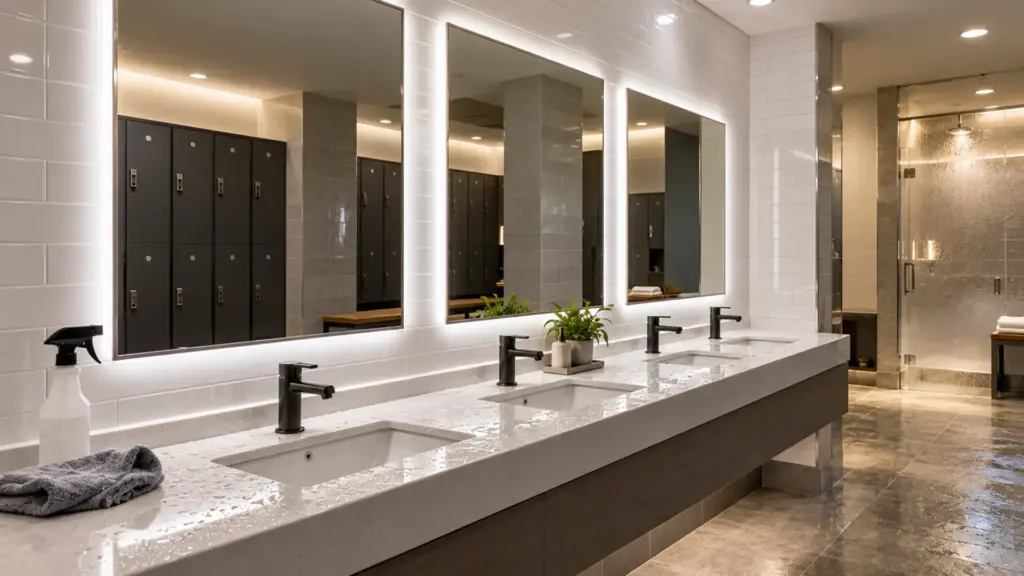
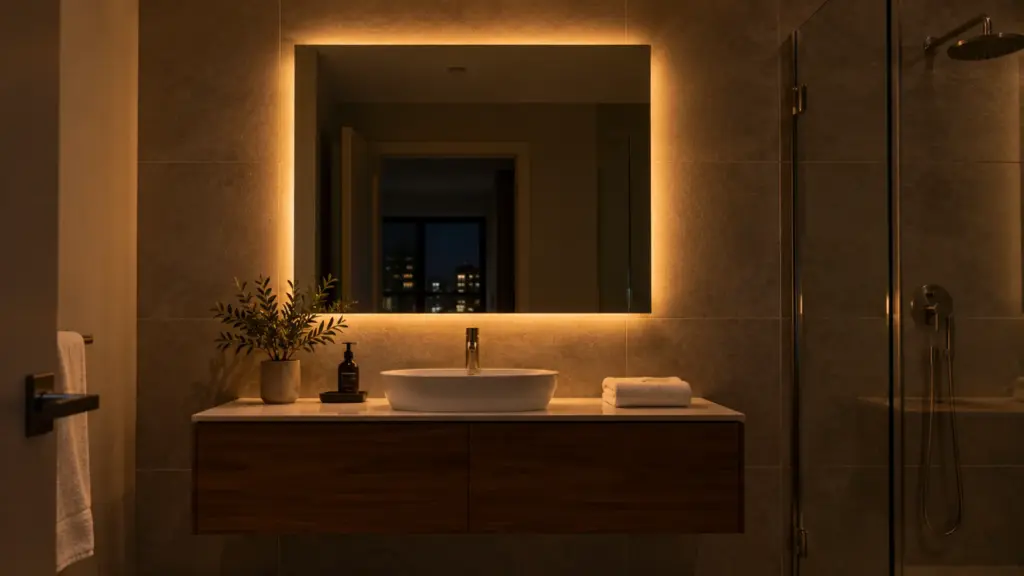
A typical hotel bathroom mirror floats a short distance off the tile, glowing at its edges. Six months later one side is dimmer than the other, and the driver that needs replacing is behind a glued-on mirror. That is how many backlit mirrors are specified: a strip and a driver chosen at the last minute, attached wherever they fit. The rest of this article is about specifying it the other way round.
Halo, Edge or Wall-Wash? Pick the Mirror Detail First
Backlit mirrors come in three basic details, and each one changes the strip you need.
| Detail | What you see | Strip that suits it |
|---|---|---|
| Halo on the wall | Light spills from behind the mirror onto the wall around it | Dot-free COB facing the wall, such as UT-C480-8 |
| Edge-lit glass | Light shows through a frosted or etched band in the glass | Side-view strip aimed into the glass edge, such as UT-C320-6-SV or UT-S3014-120-SV |
| Wall-wash above or below | A cove or shelf throws light down or up the wall beside the mirror | Standard strip in a channel, chosen like any cove |
Halo and edge details are the two people mean by “backlit mirror.” According to Homestyler’s guide, frameless mirrors are the easiest to backlight because their edges are clean; a framed mirror needs a recess on the back deep enough to hide the strip and its supply.
Decide whether the mirror is factory-built or field-built. A factory-built lighted mirror arrives as one product with its own documentation. A field-built detail, where a contractor mounts strip on a frame behind a standard mirror, is a small lighting system that you assemble, and the strip, the driver and the wiring each have to suit the location.
The Gap: How Far Off the Wall
The gap between the back of the mirror and the wall decides how wide and how soft the halo is. A small gap gives a narrow, bright line close to the mirror edge. A larger gap lets the light spread into a wider, softer glow.
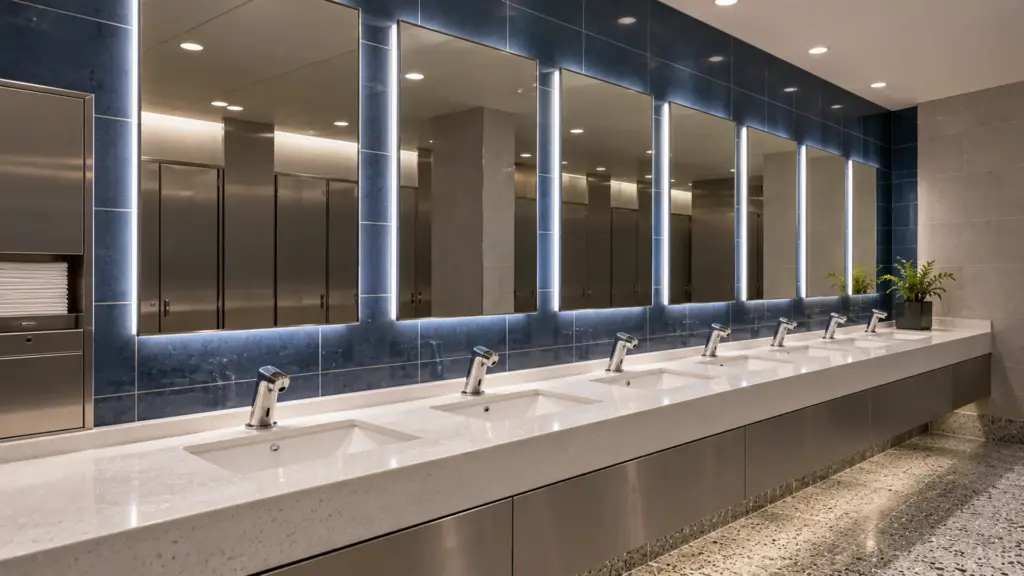
According to Flexfire, the first planning step is to make sure the mirror has space behind it for the light to reach the wall, and Bookabuilder notes that spacers keep the glass at a consistent distance all the way round. An uneven gap is the most common reason one side of a halo looks brighter than the other.
- 1Small gapNarrow haloCrisp line close to the edge
- 2Larger gapWide haloSofter glow, more wall lit
- 3Strip setbackIn from the edgeHidden from every viewpoint
- 4DriverOutside the cavityReachable, dry, labeled
Three rules make the gap work:
- Keep the strip set back from the mirror edge so nobody sees it from the side. The glass should hide the strip from every normal viewpoint, including a person standing close at the sink.
- Aim the strip at the wall, not out past the edge. Strip that faces outward shows as a bright line instead of a glow.
- Mock up one corner at the real gap before the mirror is ordered. Five minutes with a scrap of strip, a driver and a piece of board tells you whether the glow is the width the designer drew.
Checkpoint: mark the gap and the setback on the shop drawing for the mirror frame, so the fabricator builds them in.
Which Strip Goes Behind the Glass
Behind a mirror the strip is seen at a short distance and often at a low angle, so dots are the first thing people notice.
- For a halo, use dot-free COB. Our UT-C480-8 runs 3.2 W/ft (10.5 W/m) on an 8 mm board and reads as one line even when a guest leans close.
- For edge-lit glass, use side-view strip that fires sideways into the glass edge. UT-C320-6-SV is a 6 mm side-view COB at 2.4 W/ft on 12V; UT-S3014-120-SV is an 8 mm side-view SMD at 2.9 W/ft on 12V or 24V. A 12V strip needs a 12V driver; plan it before the driver schedule is set.
- For light on faces, choose the output by purpose. According to Flexfire, about 80–100 lumens per foot suits accent light, while 350–500 lumens per foot is needed when the mirror is the task light. A halo that looks lovely at 100 lm/ft will not light a face for shaving.
Our COB LED strip page lists the widths and cut intervals that fit a mirror frame; cut intervals matter here because the strip has to stop exactly at the frame corners.
Moisture: Vanity, Shower Wall and Salon Station
How wet a mirror gets depends on where it hangs, not on the fact that it is in a bathroom.
| Location | Typical exposure | What to specify |
|---|---|---|
| Vanity wall away from the shower | Steam, splash from the basin, daily cleaning spray | Strip with a silicone top coat, such as IP65 UT-O320-8-65, or bare strip fully enclosed behind the glass; sealed connections |
| Mirror on a shower wall or next to a tub | Direct water, condensation | Treat as a wet location; follow the product’s listing and the adopted code; the driver stays outside the wet area |
| Salon station | Water spray, hair products, color chemicals, heat from dryers | Sealed strip and joints, a frame that keeps spray off the strip, and cleaning-chemical resistance on the finish |
The IP code and the location marking are different things; our guide to wet location LED strip explains why, and it applies to every row above.
Cleaning is part of the exposure. Housekeeping in a hotel sprays glass cleaner on the mirror every day, and the spray runs down behind the edge. A strip with a silicone coat and sealed end caps survives that; a bare strip with an open cut end corrodes at the cut.
Driver Location and Access
The driver is the part most likely to need replacing in the life of the mirror, so it decides whether a service call takes ten minutes or a day.
- Never behind a glued mirror. If the mirror is bonded to the wall, the driver goes somewhere else.
- In the vanity cabinet or a ceiling access panel, close enough to keep the low-voltage run short, and reachable without tools that could damage finishes. Bookabuilder suggests a nearby cabinet for exactly this reason.
- Out of the wet zone. Our Class 2 drivers such as UT-D60-24-C2 are IP20 and belong in a dry space.
- Labeled. A tag on the driver and a note on the as-built drawing saying which mirror it feeds saves the next technician an hour per room.
Size the driver at the 80% rule: a 60 W Class 2 driver carries up to 48 W of strip. Our driver placement guide covers access and heat in millwork, and the same logic holds for a vanity.
Color and CRI for Faces
People judge a mirror by how their skin looks in it. Two numbers matter more than the style of the glow.
- CRI. Light with a low color rendering index makes skin look gray or sallow. For salons, where clients judge hair color, use the highest CRI the strip offers: our UT-S2216-300 is Ra≥95 and UT-S2835-480-FS is Ra≥98. Our high-CRI guide explains why the extra points matter on skin.
- CCT. Bathroom vanities in hotels and apartments usually sit between 3000K and 4000K. Salons that color hair often prefer the cooler end so the result matches daylight. Our guide to choosing color temperature by sightline covers mixed spaces.
According to Livingetc, light from behind the mirror reduces shadows on the face, which is why a backlit mirror works as a task light when its output is high enough. For a hotel night light, a dim-to-warm strip such as UT-T672-10-DTW drops toward 1800K as it dims, so a guest can find the sink at 3 a.m. without a bright white glare; our dim-to-warm guide covers when that is worth the cost.
Mounting the Strip So It Stays Put
Most backlit mirror failures that are not the driver are the strip letting go. Heat, steam and cleaning work on the adhesive every day.
- Mount on a frame or a channel, not on the mirror’s backing paint. A thin aluminum channel or a frame around the back of the mirror gives the strip a clean metal surface, spreads heat, and keeps the adhesive off the mirror coating.
- Prepare the surface. According to Flexfire, the mounting surface should be cleaned with alcohol and left to dry before the strip goes on, and the strip pressed along its whole length.
- Add mechanical hold. Clips at the corners and every short distance along each side stop a strip from peeling at the ends, where steam and heat attack first.
- Seal the cut ends. Every cut end gets an end cap and sealant, even on strip that will never see a splash. The corners of a mirror frame are where cuts happen.
- Plan the cable exit. The lead leaves the frame at one point, through a grommet or a slot, and runs to the driver location without being pinched when the mirror is hung.
Write these into the mirror shop drawing. A fabricator who builds the frame with the channel and the cable exit in place saves a site crew from improvising behind every mirror.
Switches, Sensors and Scenes
Control is part of the detail. In apartments, a wall switch or a simple dimmer is enough and outlasts most built-in touch panels. In hotels the mirror usually joins the room’s scene control, with a night setting that a guest can reach without a light switch hunt. In salons the mirrors are on whenever the station is open, so a single switch per row is common.
Whatever the control, match it to the driver: a 0-10V driver such as UT-D60-24-C2-010 needs a 0-10V control, and a plain Class 2 driver needs switching on its input.
Hotels, Salons and Apartments Differ
| Hotel bathroom | Salon station | Apartment vanity | |
|---|---|---|---|
| Main job | Mood plus usable task light, night light | Accurate color on hair and skin | Daily grooming at low maintenance |
| Strip | Dot-free COB halo, dim-to-warm option | High-CRI or full-spectrum strip | Dot-free COB or side-view, IP65 near splash |
| Control | 0-10V or scene control, night setting | Simple on/off, full output | Wall switch or dimmer |
| Driver | Ceiling access or vanity cabinet, labeled per room | Station cabinet, accessible daily | Vanity cabinet |
| Risk | Hundreds of identical rooms: any flaw repeats | Chemicals and spray | Owner-operated maintenance |
Hotels multiply every decision by the room count. Mock up one complete bathroom before the order is released, and approve the strip, the driver location and the gap together.
Spec Notes for This Detail
- Choose the detail first: halo, edge-lit or wall-wash.
- Fix the gap and the strip setback on the mirror shop drawing; mock up one corner.
- Dot-free strip for halos, side-view strip for edge-lit glass; output by purpose, accent or task.
- Silicone-coated strip and sealed joints wherever spray or cleaning reaches.
- Driver outside the wet zone, reachable, labeled, sized at 80%.
- Color Rendering Index, 0–100: how truthfully the light shows colors next to a reference source. Ra≥90 is the usual bar for interiors. and CCT chosen for faces; dim-to-warm where a night light is wanted.
We supply the strip, drivers and samples for mirror details in hotels, salons and multifamily projects. Send the mirror drawing and the room count, and we will match the strip, the driver and a sample for the mockup: request a quote.