

LED Neon and Strip for Signage and Channel Letters
A sign is drawn before it is lit, so the drawing picks the product: the bend each line makes, the tightest curve, the longest piece, and where the sign lives.
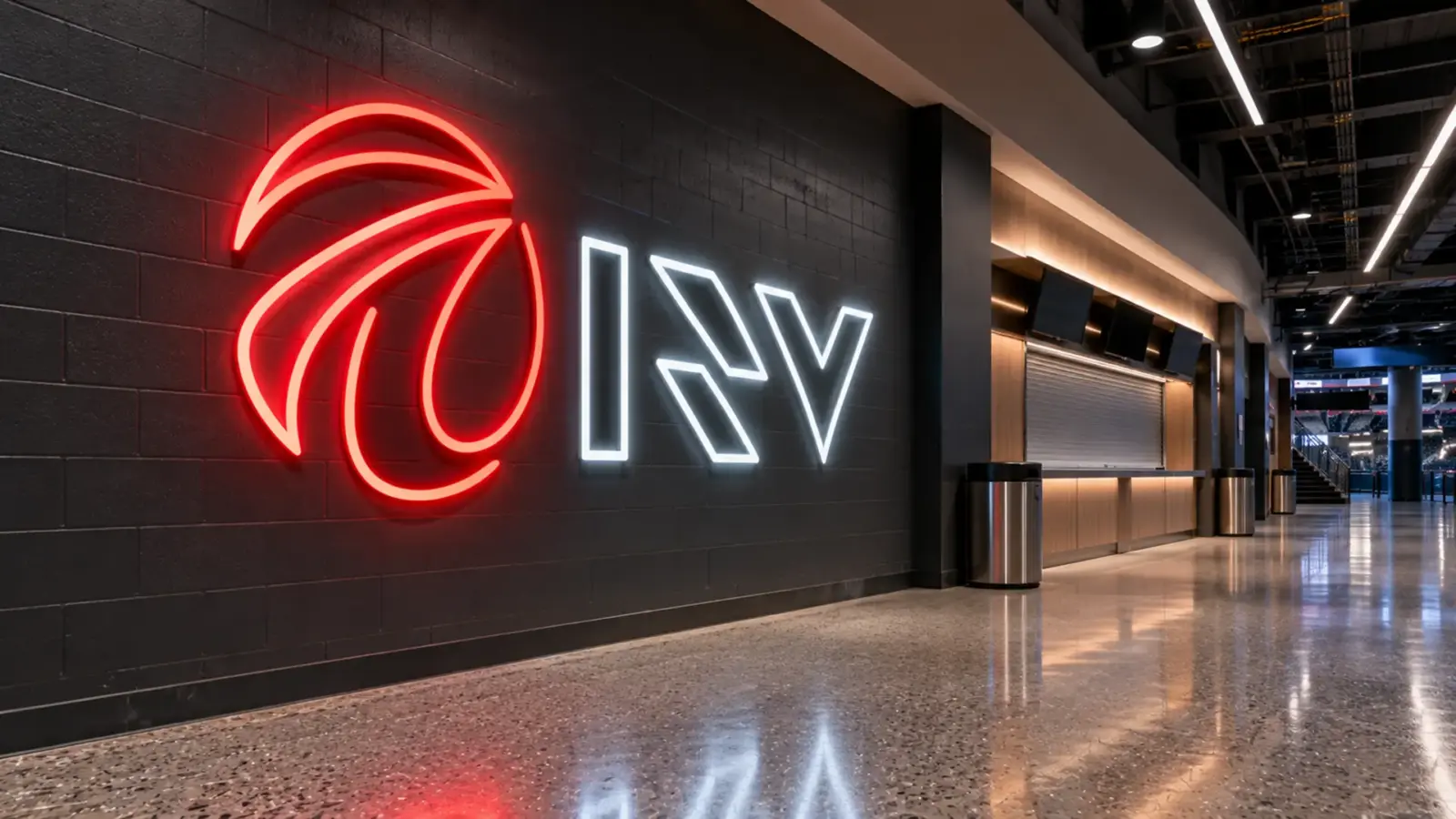
LED neon flex for signs draws continuous lines of light that bend to a drawing: lettering, logos, outlines and wayfinding. LED strip does the hidden work inside channel letters, light boxes and backlit signage. Both are chosen from the sign drawing, not the catalog: the bend direction of each line, the smallest radius, the longest piece, the feed points, and whether the sign is indoors, outdoors or within reach of the public. This page goes through each and lists the configurations we usually supply for commercial signs.
Signage configurations we usually supply
A starting point by sign element. Every model comes from the neon flex, RGB or addressable spec tables; the final pick is confirmed on your sign drawing.
| Sign element | Product | Example models | Bend / radius | Watch for |
|---|---|---|---|---|
| Lettering and script on a flat wall | Side bend neon flex | UT-N0612-SB, UT-N1212-SB | Side bend, 4.72 in (120 mm) | Tightest curve in the letterforms |
| Outlines, arcs and waves in one plane | Top bend neon flex | UT-N0606-TB, UT-N1010-TB, UT-N1212-TB | Top bend, 2.36 in (60 mm) | Does not bend sideways |
| Fine detail and small logos | Nano neon flex | UT-NN08, UT-NN12 | Top bend, from 1.57 in (40 mm) | Cuts every 1.97 in (50 mm) |
| Large building signs and long outlines | Large or constant-current neon flex | UT-N2020-TB (98 ft / 30 m CC), UT-N2525-TB | Top bend, 3.94 in (100 mm) and up | Large profiles need larger radii |
| Forms that turn in two planes | 3D bend neon flex | UT-N1010-3D, UT-N1616-3D | 3D, from 3.15 in (80 mm) | 16 ft (5 m) per feed |
| Animated or color-changing signs | Addressable neon · RGB / RGBW | UT-N1616-SPI, UT-N1010-SPI, UT-N2525-TB (DMX512) | Top bend | Controller and data runs matched at quote |
| Channel letters, light boxes and backlit faces | SMD · COB · 120V strip | UT-S2835-120, UT-C320-6-SV (side-view), UT-H120-60 | Strip inside the letter or box | Even spacing behind the face |
Full spec tables: Neon flex · Addressable · RGB & RGBW · 120V
Eight decisions on a neon sign
Read them off the sign drawing before choosing a model; most problems on site come from a line asked to bend the wrong way or a piece longer than one feed.
Bend direction: top, side or 3D
Top bend neon flex bends up and down along its emitting face and draws waves, arcs and building outlines in one plane; it does not bend sideways. Side bend neon flex bends left and right along the emitting face, which is what letterforms, script and tight curves need; it does not bend up and down.
3D bend neon flex turns vertically and horizontally in the same run, for signs that wrap a column or turn a corner in more than one plane. 360° round profiles have no visible back, for pendants and freestanding lines.
Bend only in the rated direction. Forcing a profile the wrong way can damage the LEDs inside the silicone.
Bend radius: the profile size sets the smallest curve
Bigger profiles bend less tightly. The Ø8 mm nano line turns in 1.57 in (40 mm), the 6×6 to 12×12 mm top bend profiles in 2.36 in (60 mm), side bend profiles in 4.72 to 5.91 in (120 to 150 mm), and a 50×25 mm large-format profile needs 11.81 in (300 mm) or more.
Find the tightest curve on the drawing, usually inside a letter, and pick the largest profile that still makes it. Never bend below the rated radius.
Piece lengths: a reel is not a run
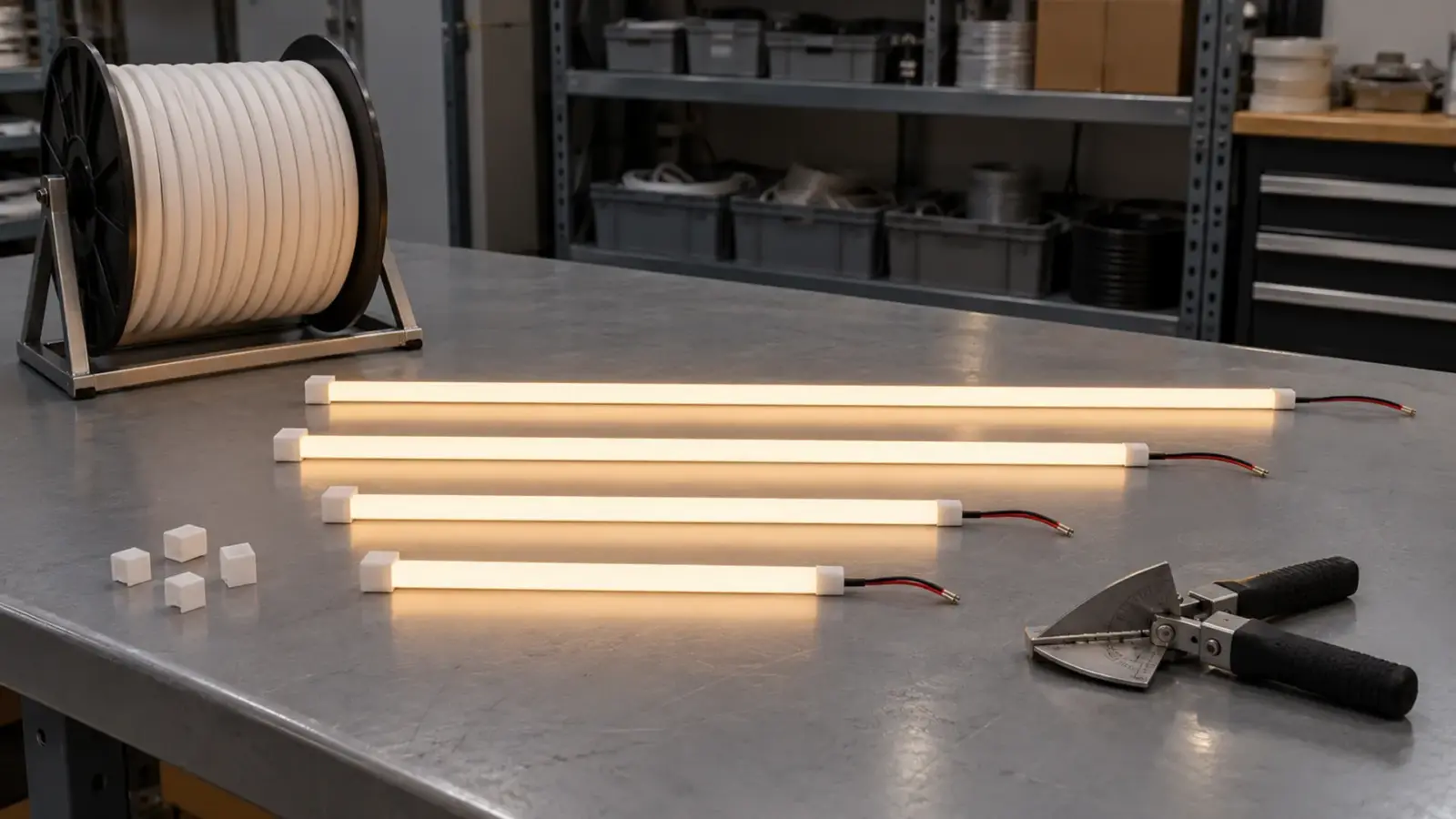
Neon flex comes on reels up to 164 ft (50 m) for profiles up to 16×16 mm. A reel is a supply length: it lets each piece be cut to the drawing instead of joined from short lengths on site, where every joint needs a connector and its own seal.
Cut only at the marked points, every 3.94 in (100 mm) on standard profiles and 1.97 in (50 mm) on nano, so plan each piece to land on a mark; a 10 ft (120 in) piece on a 100 mm interval cuts to about 118 in.
List every piece the drawing needs, longest first, and check each against the one-feed limit below.
Feeds and voltage drop
Standard 24V profiles light 16 ft (5 m) from one feed and about 32 ft (10 m) fed from both ends. The constant-current series go much further from one end: 49 ft (15 m) on UT-N1212-TB and UT-N0612-SB, 62 ft (19 m) on UT-N1616-TB and UT-N1212-SB, 82 ft (25 m) on UT-N1616-SB and 98 ft (30 m) on UT-N2020-TB.
Put feed points where the wire can hide behind the sign or in the wall, and keep each driver's load at or below 80% of its rating.
Outdoor signs and public reach
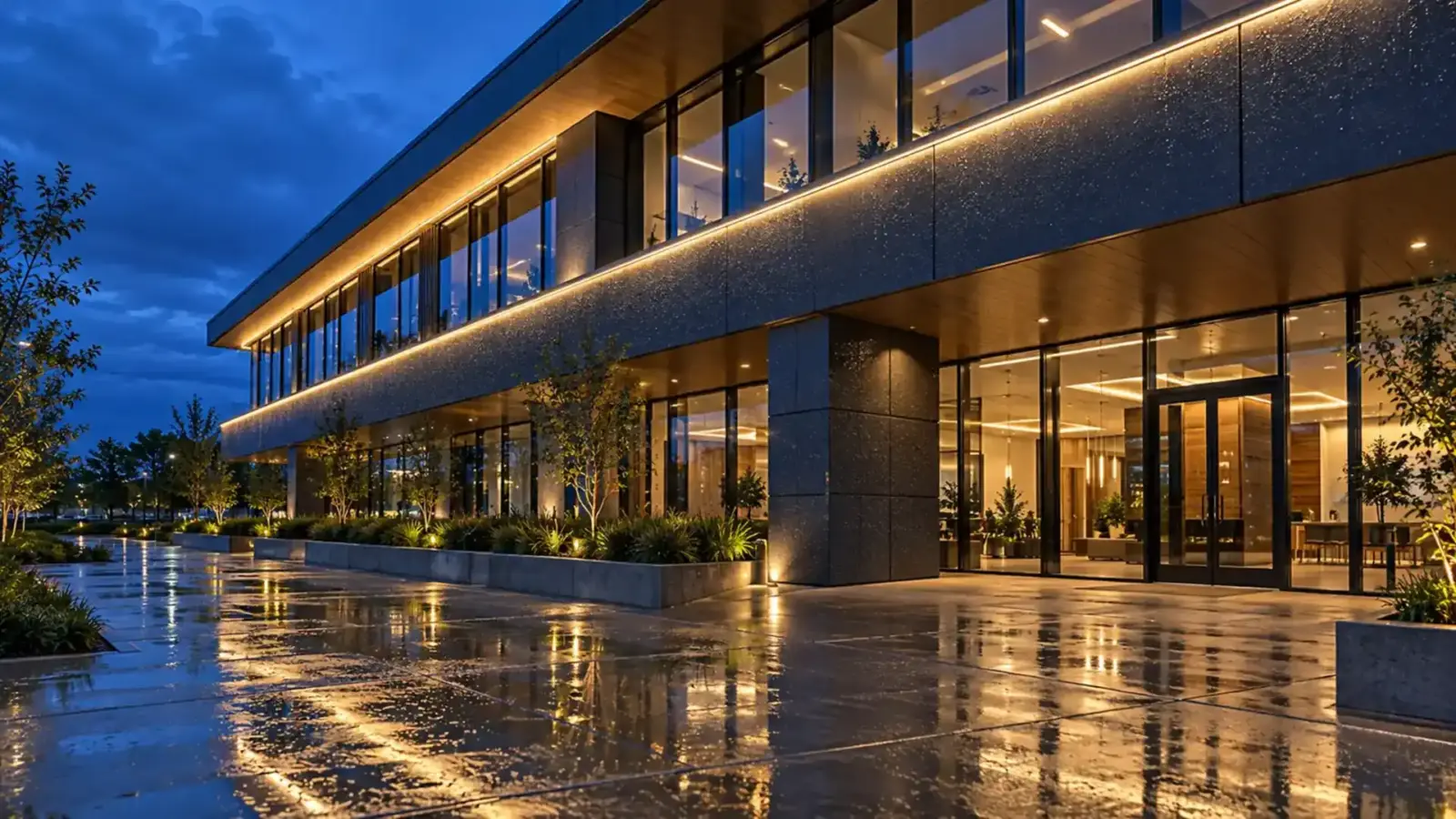
IP67 is standard across the neon flex range. Where a line sits within reach of the public or near water, UT-N1616-68 is rated IP68 and IK10, which adds impact resistance.
An IP code is a lab test; the wet location marking comes from the product's listing and is confirmed per model at quote. The connectors and the driver have to match the location as well as the profile.
A line is only as sealed as its cut ends: count every cut on the drawing and order a matching silicone end cap and adhesive for each.
Glare at eye level and the sign by day
Wayfinding and lettering at eye level can glare when viewed straight on. The honeycomb anti-glare profiles, UT-N1212-AG and UT-N1610-AG, put a louvered face over the emitting surface to cut direct glare.
A sign is seen unlit for half the day. The camouflage shell, UT-N1616-CM, comes in black, white, gray or orange so the profile disappears against its background until it is switched on.
Color and control
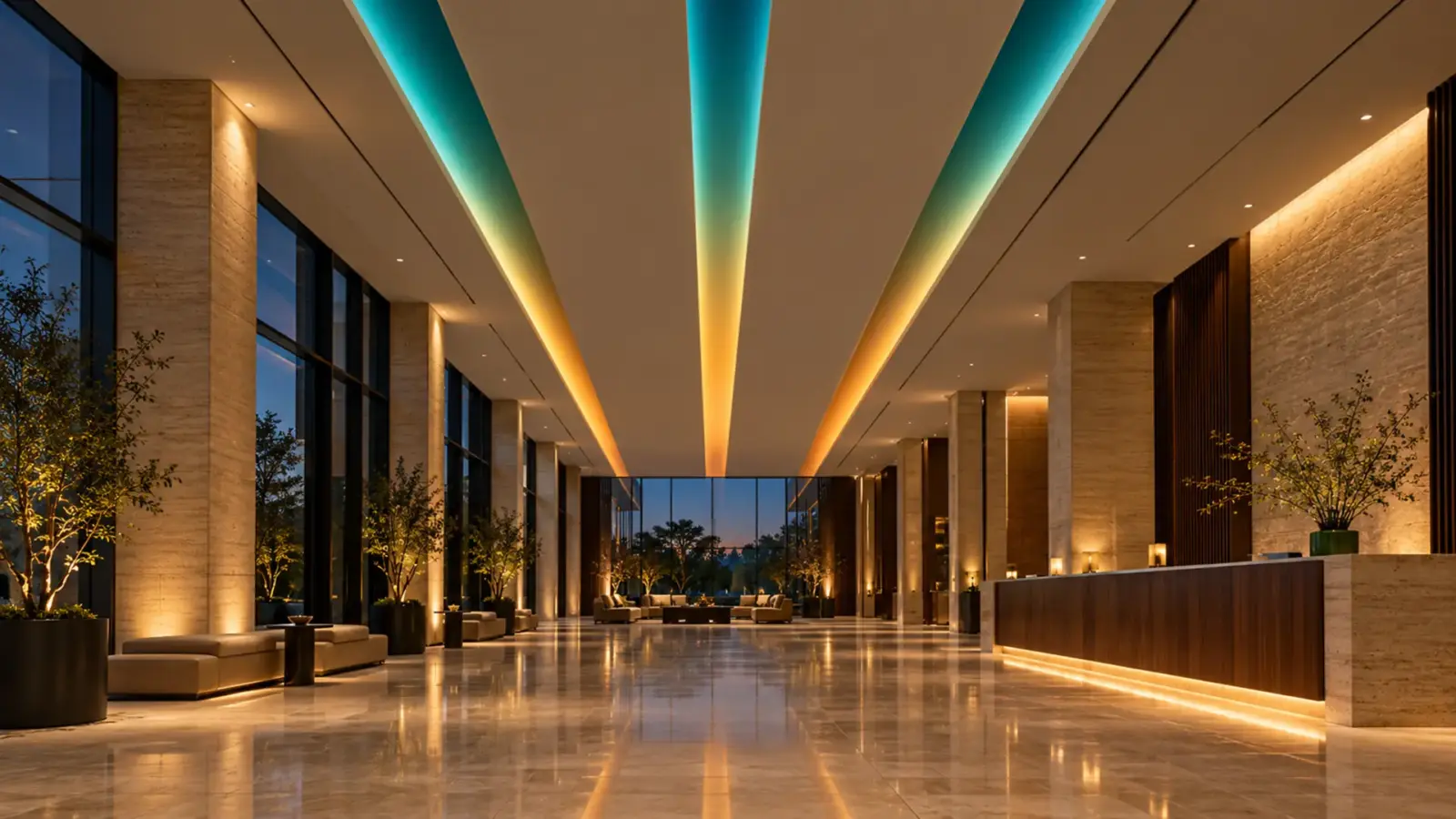
Profiles come in single color, tunable CCT, RGB and RGBW depending on size; large profiles such as UT-N2525-TB and UT-N3017-TB take DMX512, and UT-N1010-SPI and UT-N1616-SPI are addressable for chases and animation.
SPI suits self-contained signs with a short data run from the controller; DMX suits signs tied into a building or venue control system. The controller, any data amplifier and the power injection plan are matched at quote.
Channel letters and light boxes
Inside a channel letter or a light box, the strip is hidden and the face does the diffusing, so even spacing behind the face matters more than the look of the strip itself. Standard SMD strip covers most faces; side-view COB lights narrow returns; 120V strip feeds long light boxes without remote drivers, dimming by TRIAC or ELV only.
Send the letter or box depth and the face material with the drawing so the strip, the spacing and the power are matched together.
Go deeper on signage

Signage questions
Which LED neon flex is best for sign lettering?
Side bend neon flex, which bends left and right along its emitting face the way letterforms and script need. Top bend profiles suit outlines, arcs and waves in one plane, and 3D bend handles forms that turn in two planes.
How tight can LED neon flex bend?
It depends on the profile size: from 1.57 in (40 mm) on the Ø8 mm nano line, 2.36 in (60 mm) on small top bend profiles, 4.72 in (120 mm) on side bend, up to 11.81 in (300 mm) or more on large-format profiles. Never bend below the rated radius.
How long can one piece of neon flex be?
A reel holds up to 164 ft (50 m), but one feed lights 16 ft (5 m) on standard 24V profiles, about 32 ft (10 m) fed from both ends, and up to 98 ft (30 m) on the constant-current series.
Can LED neon flex signs be used outdoors?
Yes. IP67 is standard and UT-N1616-68 is IP68 and IK10 for lines within public reach. The wet location marking is confirmed per model at quote, and every cut end needs a matching sealed end cap.
Can a neon sign change color or animate?
Yes. RGB and RGBW profiles change color, large profiles take DMX512, and the SPI addressable profiles run chases and animation. The controller and data plan are matched at quote.
Can LED strip be used inside channel letters?
Yes. Face-lit channel letters are filled with rows of strip laid so the pitch between rows is no more than the depth to the face, which keeps the acrylic even; halo-lit letters take strip around the inside of the return aimed at the wall. Count the rows per letter, feed each letter within the strip's rated run, and seal every cut end on an outdoor sign.
What is backlit signage?
A sign whose face or wall is lit from behind: a light box or cabinet sign with strip rows behind a translucent face, or a halo-lit letter that throws light onto the wall around it. The brightness and evenness come from the row spacing, the depth to the face and the diffusion of the face material, so those three numbers go on the drawing before the strip is ordered.
Spec your sign
Send the sign drawing, the size and where it will be mounted. An engineer replies with the profiles, piece lengths, feeds and control plan.
We typically respond within 24 hours. No spam, ever.