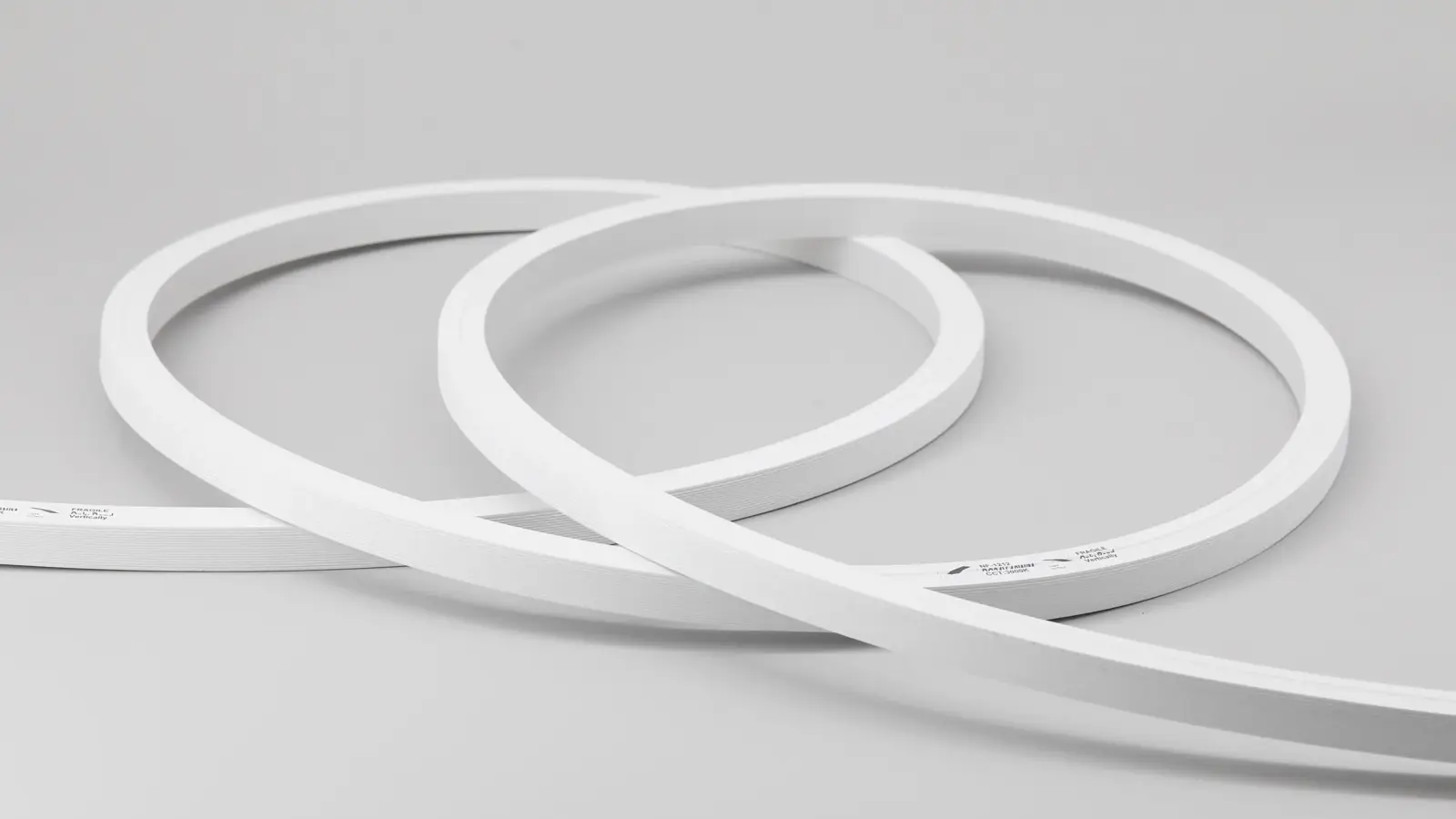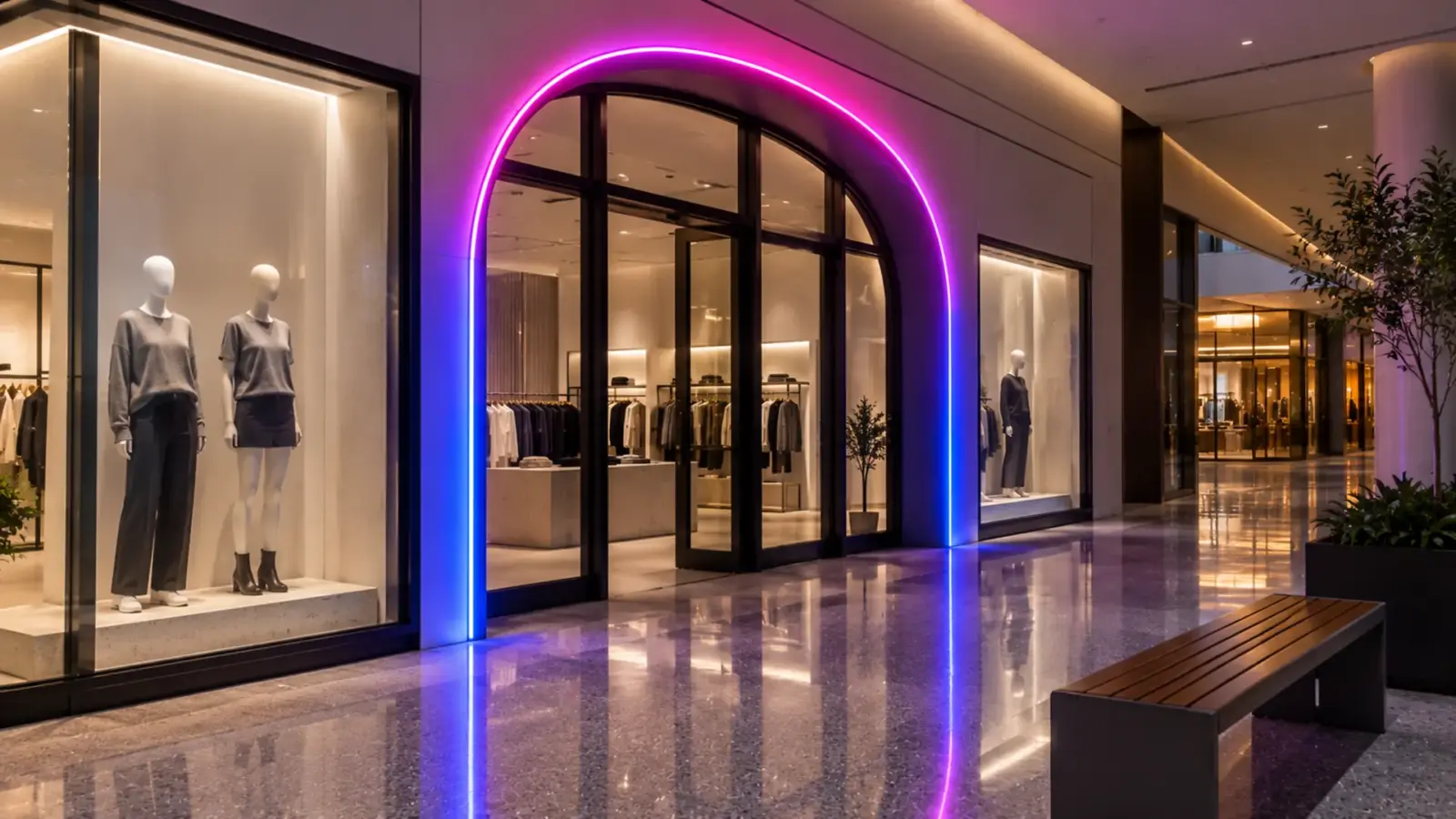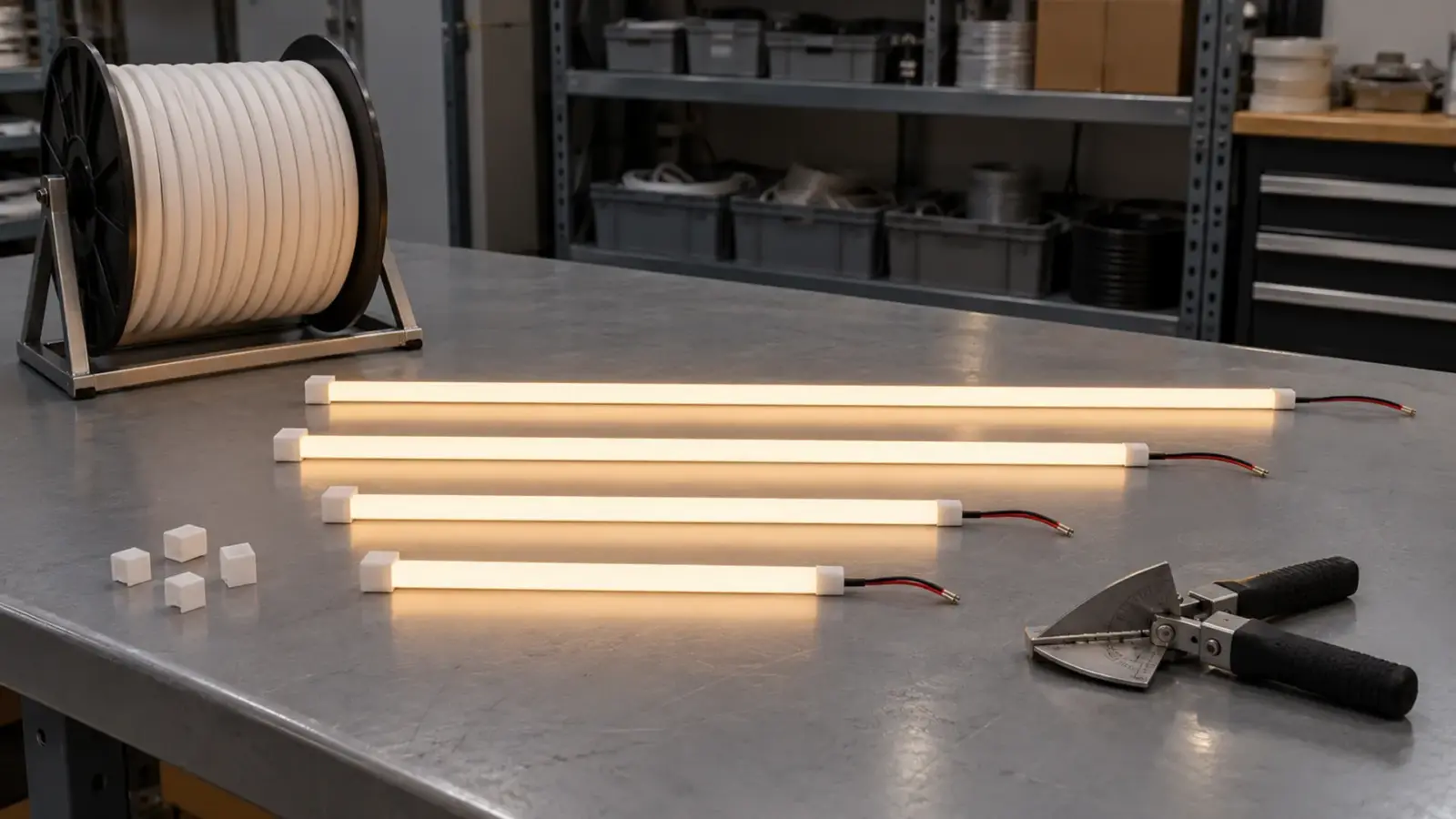
You have a 164 ft (50 m) reel, a 23 ft (7 m) wall and 16 ft (5 m) per feed. The reel is not the problem. It is a supply length that lets a crew cut each piece to the drawing; how far a cut piece lights evenly is a different number, set by the model and the feeds.
Reel vs Run: Two Numbers, Two Jobs
A reel length says how much flex you can cut from one roll. A run length says how much of it one power feed can light before the far end goes dim. The two numbers are on different lines of the spec, and the second one is the one that decides whether a job works.
LED neon flex from Unitop is available on reels up to 164 ft (50 m) for profiles up to 16×16 mm. Larger profiles are heavier on a reel, so we quote them by size. Each piece you cut from the reel is powered on its own, and each piece has to stay inside its run limit.
The reason to cut from a long reel is the join. A 23 ft (7 m) piece made from a 16 ft (5 m) length and a 7 ft (2 m) length has a joint in the middle, and that joint needs a connector and its own seal. It is one more place for water to get in and one more thing for a crew to get wrong. One piece cut from a long reel has no joint to make.
| Series (examples) | One feed | Fed from both ends |
|---|---|---|
| Standard 24V: UT-N0606-TB, UT-N1010-TB, 3D bend, nano | 16 ft (5 m) | 32 ft (10 m)* |
| Constant current: UT-N1212-TB, UT-N0612-SB | 49 ft (15 m) | On request |
| Constant current: UT-N1616-TB, UT-N1212-SB | 62 ft (19 m) | On request |
| Constant current: UT-N1616-SB | 82 ft (25 m) | On request |
*Calculated from the one-feed limit, with power applied at both ends of the piece. Confirm the figure for your model at quote.
Most neon flex jobs we quote use the standard 24V models, which cost less than constant-current models and fit most projects. A longer piece on those models comes from feeding it at both ends, or from adding parallel feeds along it. Constant-current models are the other route, and they are covered near the end.
Piece Length: Start from What You Will Cut
Make the piece list before you pick a model. Write down every length the drawing needs, including the longest, and compare each one with the one-feed limit.
Cut points on standard profiles fall every 3.94 in (100 mm), so a piece lands on a mark and not between two. A 23 ft (7 m) piece is exactly 70 marks. A piece of 23 ft 2 in (7.05 m) is not, and neon flex cannot be cut between marks, so plan the mounting for a tolerance of one mark.
Take the 23 ft (7 m) wall from the opening. On a standard 24V model, the one-feed limit is 16 ft (5 m), so one feed at one end leaves the last 7 ft (2 m) dim. Power at both ends puts the farthest point 11 ft (3.5 m) from a feed, which is inside the limit. The reel did not change, the feed plan did.

Feeding: One End, Both Ends, or Parallel Feeds
Three feed plans cover most jobs.
- One end. For a piece up to the one-feed limit, 16 ft (5 m) on standard 24V.
- Both ends. For a piece up to twice the limit, 32 ft (10 m). Each end feeds half.
- Parallel feeds. For anything longer, add feed points so no point on the piece is more than 16 ft (5 m) from a feed.
The table below works out the plan for piece lengths from 16 ft to the full reel. It uses UT-N1010-TB at 3.0 W/ft (10 W/m).
| Piece length | Feed points | Load | Driver rating, load at 80% |
|---|---|---|---|
| 16 ft (5 m) | 1 | 50 W | 63 W |
| 23 ft (7 m) | 2 | 70 W | 88 W |
| 32 ft (10 m) | 2 | 100 W | 125 W |
| 49 ft (15 m) | 3 | 150 W | 188 W |
| 98 ft (30 m) | 5 | 300 W | 375 W |
| 164 ft (50 m) | 7 | 500 W | 625 W |
Feed points come from the one-feed limit. Up to 16 ft (5 m) takes one point at one end. Beyond that, split the piece into segments of 32 ft (10 m) or less, each fed at both ends, and count one feed point at each segment end, shared where two segments meet: segments plus one. A 98 ft (30 m) piece is four segments, so five feed points. The driver column keeps the load at or below 80% of the rating. Split a large load across several drivers, one per feed point or group of feed points, and size each for its share. Our drivers, controllers, and connectors range covers the supply side.
Wire every feed point with the same polarity, and feed a piece from one driver where the load allows. Where it does not, use separate drivers of the same voltage and rating. Keep the leads at each feed short. This is general wiring practice, not a spec for one model, so follow the datasheet of the model you order.
These feed counts are our calculation from the one-feed limit. Confirm the plan for your model and piece list at quote.
DC only: why AC flex cannot be fed from both ends
Feeding from both ends works on low-voltage DC flex, which includes every model in the table above. It does not work on mains-voltage flex. According to Glowlab, “AC fixtures cannot be double fed due to the use of alternating current.” On a mains-voltage reel, a two-ended plan is not available, and the one-feed limit is the whole story.
Voltage Drop: What the Far End Looks Like
Current has to travel the length of the piece, and the voltage falls along the way. At the far end the flex runs on less voltage than at the feed, so it looks dimmer. On RGB and tunable-white flex the far end can also shift in color. The full picture, with the numbers, is in our voltage drop guide.
A bigger driver does not fix this, because the drop happens along the piece, after the driver. More feed points do.
To check a piece, power it at full load before it is mounted, and measure the voltage at the far end. A visible dip against the voltage at the feed means the piece needs another feed. A dim far end that shows up on the walkthrough means a re-feed above a finished surface. On an outdoor fascia or a ceiling reveal, that is a lift and a second day on site.
Cutting and Sealing Neon Flex: Where the Quality Is Decided
A reel makes the cut the main field operation, and the quality of the job depends on it as much as on the product.
The cut
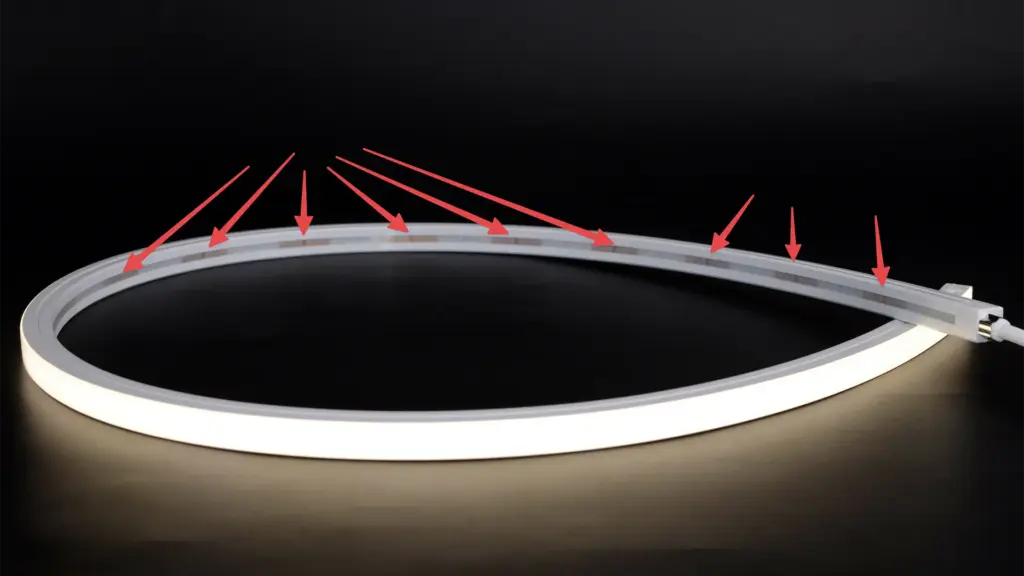
Cut marks are printed on the back of the flex. Cut straight across at a mark, never between marks. Lay the reel flat before cutting. Glowlab warns that cutting while coiled risks an angled cut, and that “even slight angles can cause issues”: an angled cut damages the circuit board and keeps the end seal from seating.
Guides disagree on the tool. Glowlab says an anvil cutter or similar is required. Signlite says scissors or a knife will do. What they agree on is the result: a clean, square cut that does not crush the flex. An angle-guide cutter is available from us, and a sharp cutter of your own is fine if it leaves a square, uncrushed face.
The seal
A cut opens the flex. The open end is closed with a matching silicone end cap and adhesive, which restores the model’s ingress rating. At a feed end, the wire is soldered and the joint is sealed with silicone. A reel is only as waterproof as its worst cut, and how each waterproofing method is built shows why. Test each piece on the bench before it goes up, and look at the cut end for crushing or a ragged edge. A piece that lights on the bench and has a clean, sealed end is ready to mount.
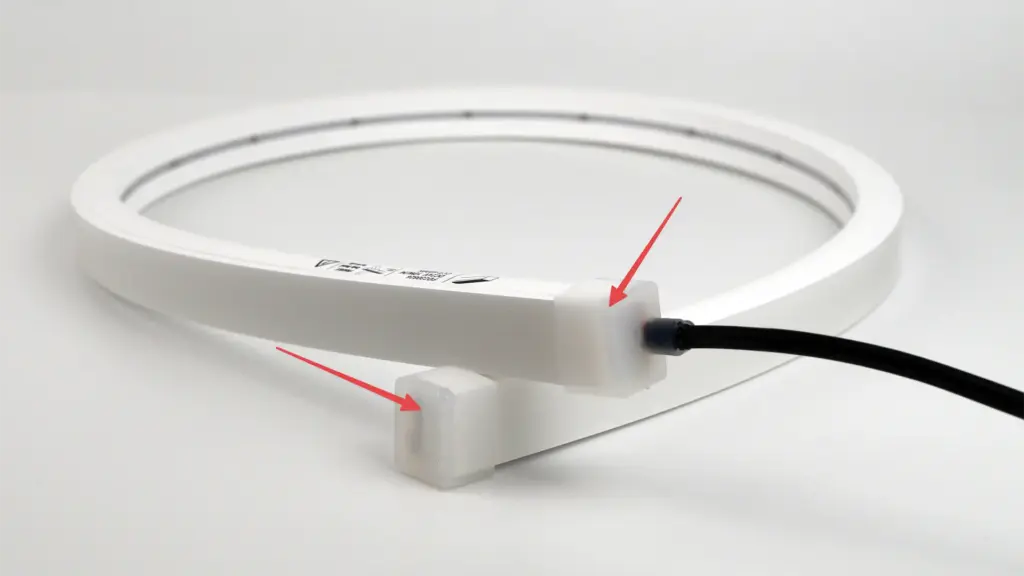
Resellers handle it the same way. Ultra LEDs, a UK reseller, lists a 24V reel with a power cord pre-attached at one end and says accessory kits must be bought to power the cut lengths, one kit per cut length. We send end caps, silicone, and a cutting video with each order, so a crew has what it needs for every piece.
Cut at the marked points and wire and seal each cut as shown in the instructions. That is installation, and it is covered by our warranty policy, which also lists what is not covered, including cuts outside the marked points.
Reel Size: Which Profiles Come on a 50 m Reel
Reels up to 164 ft (50 m) are available for profiles up to 16×16 mm. That covers the top-bend, side-bend, 3D, and nano models up to that size. Larger profiles weigh more per foot, and a long reel of them is awkward to handle, so those are quoted by size.
A shorter reel is often the better order. If every piece on the job is under 33 ft (10 m), a 164 ft (50 m) reel yields five pieces at most, so order the reel length the piece list needs.
Longer Pieces: When Constant Current Is the Better Fit
For a single long piece with one feed, constant-current models reach 49 ft (15 m) on UT-N1212-TB, 62 ft (19 m) on UT-N1616-TB, and 82 ft (25 m) on UT-N1616-SB, with the profiles above 16×16 mm going further. They cost more than standard 24V models. Choose them where a second feed point is hard to reach, such as a continuous elevation with one equipment room. The LED neon flex selection guide compares the two families by run length.
FAQ
How long can LED neon flex be?
A reel can be up to 164 ft (50 m) on profiles up to 16×16 mm, but a piece you light is limited by its run limit. Standard 24V neon flex runs 16 ft (5 m) from one feed and 32 ft (10 m) fed from both ends. Constant-current models run 49–82 ft (15–25 m) from one feed.
Can I cut a neon flex reel to any length?
You can cut at the marked cut points, which fall every 3.94 in (100 mm) on standard profiles, but not between them. Check the cut increment of your model in the spec table, because the nano and mini-cut models use shorter steps.
Can neon flex be powered from both ends?
Yes on low-voltage DC flex, which includes our 24V models. Both-end feeding roughly doubles the length of piece you can light on one plan. Mains-voltage flex cannot be fed from both ends.
What happens if a piece is longer than its feed limit?
The far end goes dim, and on RGB flex it can shift in color. Adding a feed point at the far end or the middle fixes it. A bigger driver does not.
Does cutting a reel void the warranty?
No, when the cut is made at a marked cut point and the end is wired and sealed as the instructions show. Our warranty policy treats that as normal installation, not as an unauthorized modification. It excludes cuts outside the marked points and field work not done as instructed.
Before the Reel Ships
Before you order, settle these six things:
- The piece list, with every length the drawing needs.
- The longest piece, compared with the one-feed limit of the model.
- The feed plan for each piece: one end, both ends, or parallel feeds.
- The driver rating for each feed group, with the load at or below 80%.
- The cut increment of the model, and the nearest mark for each length.
- End caps and silicone counted by the number of cuts, and a cutter for the crew.
Send the piece list, the model you are looking at, and where the power can reach. We come back with the reel length, the feed points, and the driver size: request a quote. Unitop Lighting supplies LED neon flex for commercial and architectural projects across the US, and each order includes end caps, silicone, and a cutting video.