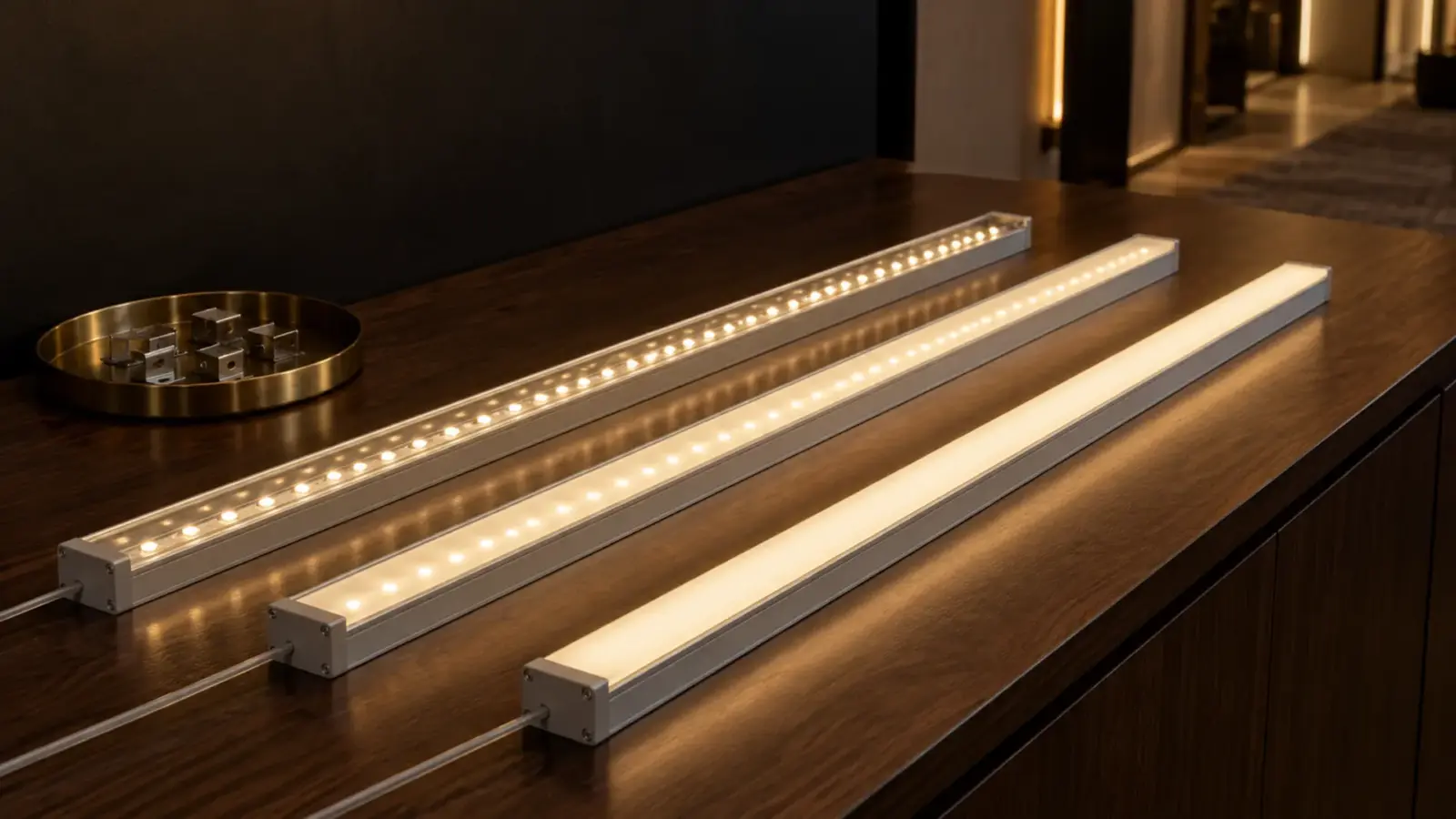
Swapping a clear LED channel diffuser for opal does not fix visible dots. The dots come from the distance between the LED and the cover, which the cover can only hide. Spec opal where the lit line is seen directly, and clear where the channel is hidden or the job is task light.
Clear vs Frosted vs Opal: Three Covers, One Table
Our LED channels and diffusers ship with one of two polycarbonate covers: PC clear or PC opal. “Frosted” is the market name for a middle option, and it is not a third cover in our range. The table puts all three side by side so the trade is visible before the detail.
| Cover | Light transmission | LED dots | Glare on glossy surfaces | Typical use |
|---|---|---|---|---|
| PC clear | roughly 90–95% | Visible | Highest | Hidden channels, task light, strip protection |
| Frosted (market term) | No standard figure | Reduced, often still visible | Moderate | A softer look where some dotting is acceptable |
| PC opal | roughly 70–80% | Blended into one line, given enough depth | Lowest | Any lit line the eye reaches directly |
The two transmission figures are from our channel page. Frosted has no figure here because the word names a surface finish and not a measured transmission, and we do not publish numbers for a cover we do not supply. The frosted section below explains how to read a spec that asks for it.
The cover choice does not lock the channel choice. All eight profiles in the range, recessed, surface, and corner, take either cover, and each kit ships with the diffuser, two end caps, and mounting clips. Pick the profile for the substrate and the strip width first, as the channel selection guide lays out, then pick the cover for what the eye will see.
Light Loss: What Each Cover Costs
Transmission by cover
A cover cannot add light. It can only pass the strip’s output or hold some of it back. Clear polycarbonate passes roughly 90–95% on our channels, and opal passes roughly 70–80%. Outside figures run in the same direction. According to Signlite, a channel maker that publishes a comparison table, clear covers pass about 90–95% and milky covers about 70–85%. The same page’s FAQ says a milky diffuser cuts total output by 30–50%, which does not match its own table. Manufacturer numbers vary with cover thickness and channel depth, so use them for direction and check the datasheet of the cover you order.
Worked example: lm/ft after the cover
Take UT-CSP-320-N, which lists 296–316 lm/ft. Calculate from the low end, as the datasheet-reading rule in our lumens per foot guide says.
| Cover | Transmission (low end) | Light leaving the cover | Strip output needed to deliver 250 lm/ft |
|---|---|---|---|
| None | 100% | 296 lm/ft | 250 lm/ft |
| PC clear | 90% | 266 lm/ft | 278 lm/ft |
| PC opal | 70% | 207 lm/ft | 357 lm/ft |
Opal at the low end puts out about 22% less than clear on the same strip. The last column is the one that matters on a drawing. A cove that needs 250 lm/ft at the cover needs a strip rated near 278 lm/ft behind clear and near 357 lm/ft behind opal, which is one output tier higher. Size up before the order, not after the mockup comes in dim.
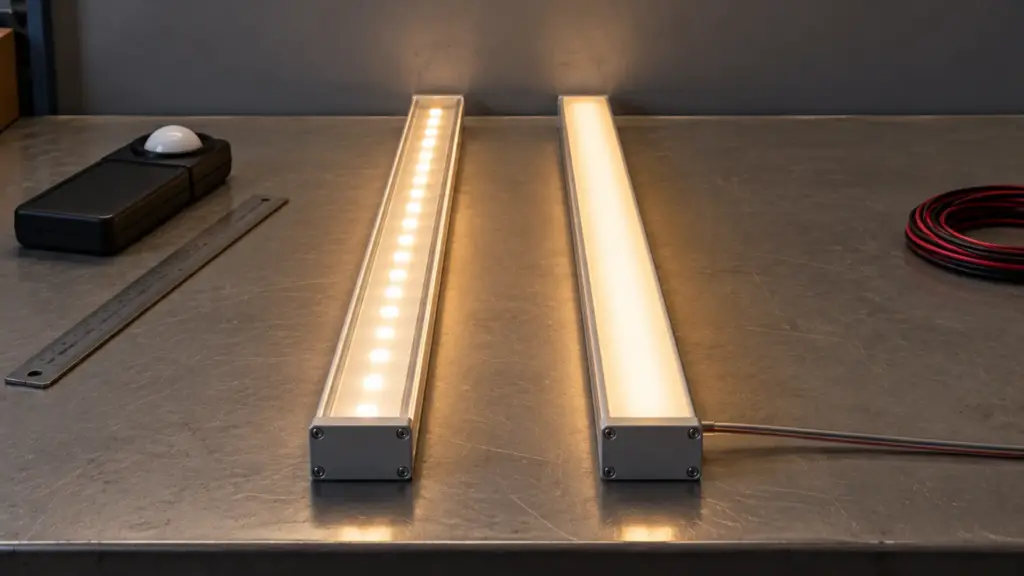
Sizing up has a cost that the cover comparison hides. A strip that must supply 357 lm/ft instead of 278 lm/ft is carrying about 28% more output, and more output means more watts per foot on the same run. Recheck the driver load and the far-end voltage drop after the cover is chosen, not before. The voltage drop guide covers the run limits.
Dots: Why Opal Alone Does Not Fix Them
LED pitch against depth
Dots show when the cover sits too close to the LEDs for their light to overlap before it reaches the surface. Two things set how much room the light has: the distance between neighboring LEDs, and the optical depth from the emitters to the cover. Opal hides some of it. It does not change either number.
LED pitch is 1,000 mm divided by the LEDs per meter. The depths in the last column are the rules of thumb from our channel selection guide.
| Strip | LEDs per meter | Pitch between LEDs | Optical depth with opal* |
|---|---|---|---|
| UT-S2835-60 | 60 | 16.7 mm | ~12–15 mm |
| UT-S2835-120 | 120 | 8.3 mm | ~7–10 mm |
| UT-S2835-240 | 240 | 4.2 mm | on request |
| UT-C480-8 (COB) | 480 | 2.1 mm | ~3–5 mm |
*Rule of thumb for opal covers, not a Unitop test result. Confirm with a sample mockup before ordering.
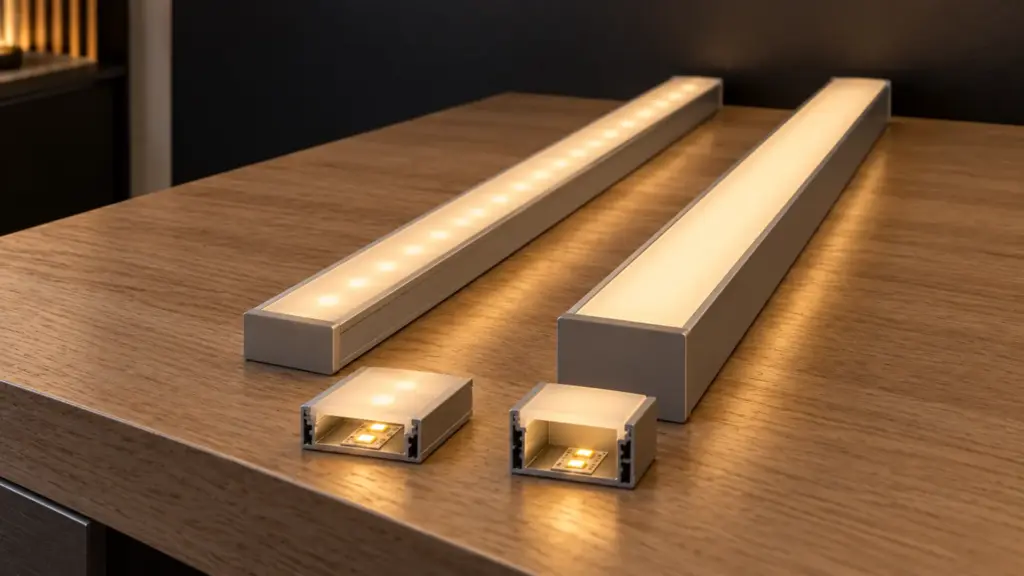
Read the table across. Halve the pitch and the depth you need falls by roughly the same step. That is why a 60-per-meter SMD LED strip in a 7 mm channel shows beads behind any cover, and a COB LED strip in the same channel reads as one line.
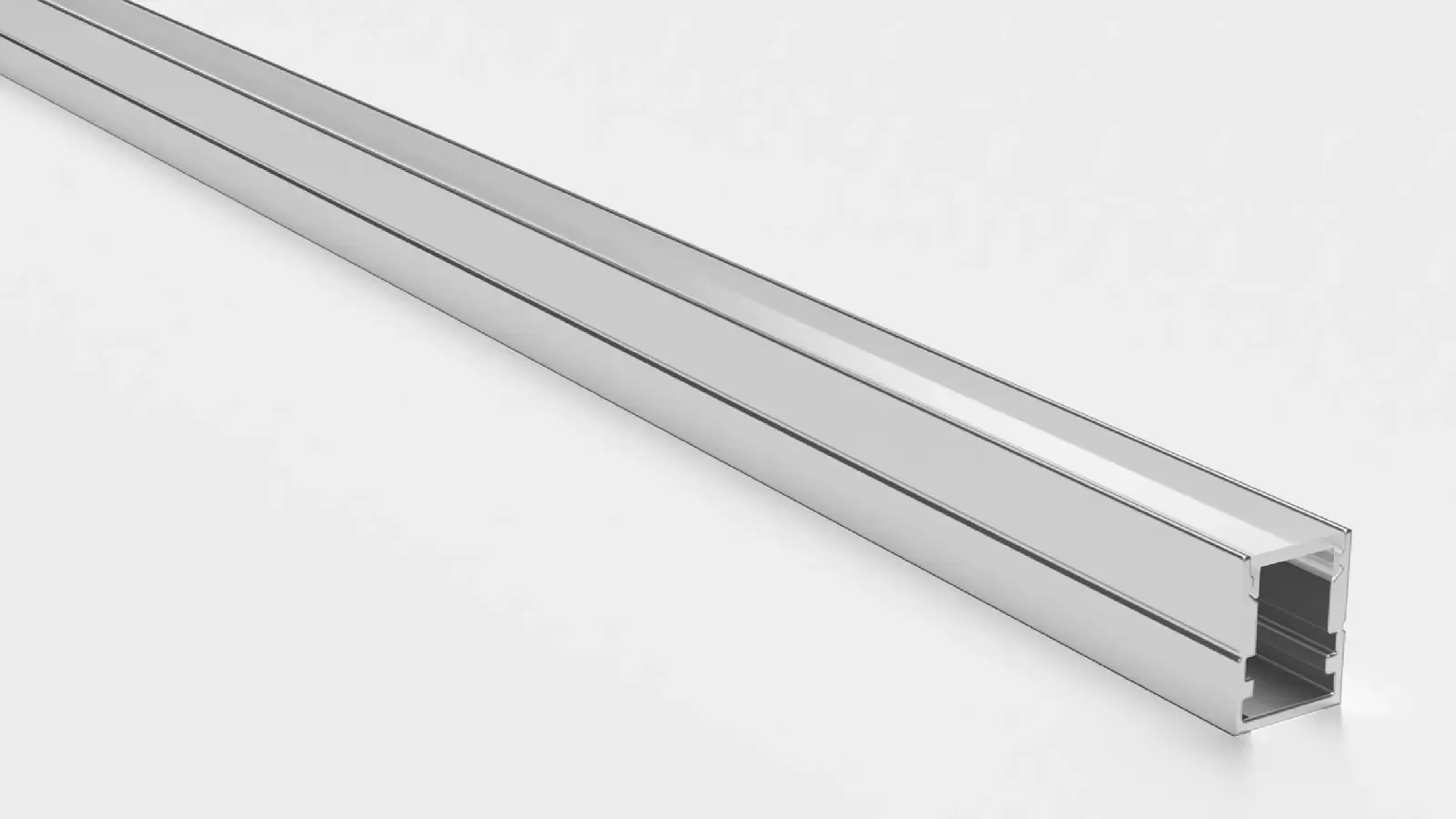
Optical depth is always less than the profile height, because the strip sits on the channel floor. UT-CH1207 is 7 mm tall and UT-CH1708 is 8 mm tall, so both are channels for COB. UT-CH2415 has 14.5 mm of optical depth and is the profile documented for fully diffused, dot-free output with standard-density strip.
If a finished run already shows dots
Choosing a cover and diagnosing a run that already shows dots are different jobs. For the choice, the order is: strip density or COB first, channel depth second, cover third, because opal is already the strongest cover we supply. Going from clear to opal in a shallow channel recovers some of the effect and costs the light shown above, while a denser strip costs watts but no light. A field diagnosis of a run that has already been installed is a separate guide.
Frosted: Where the Middle Option Fits
Frosted covers sit between clear and opal in most descriptions, but the word names a finish, not a measured result. Lee Valley, which sells both, says its frosted covers pass light well but leave the LEDs somewhat visible, and that its opal covers conceal them better. That is the useful part of the description: frosted trades some of opal’s dot hiding for output, and by how much depends on the cover.
For a job spec, that means “frosted” is not a performance requirement until someone attaches a number to it. If a drawing calls for a frosted cover, ask what it is meant to do. If the answer is “hide the dots,” the answer from our range is opal at the right depth. If the answer is “keep more output than opal,” the answer is clear in a channel deep enough that the eye never reaches the cover. We supply PC clear and PC opal, and we do not offer a frosted option.
If a spec does ask for frosted, three questions turn it into something orderable:
- What transmission is expected, as a percentage, and from whose data?
- Is the goal fewer dots, less glare, or more output than opal?
- At what viewing distance, and over which strip density?
Answers to those three usually point to clear or opal. If they do not, send the question with the quote request and we will say what we can supply.
Whatever the cover is called, confirm it with a sample at the real strip density. A frosted cover that looks smooth over a 240-per-meter strip can show dots over a 60-per-meter one.
Glare and Color: What the Eye Sees at the Cover
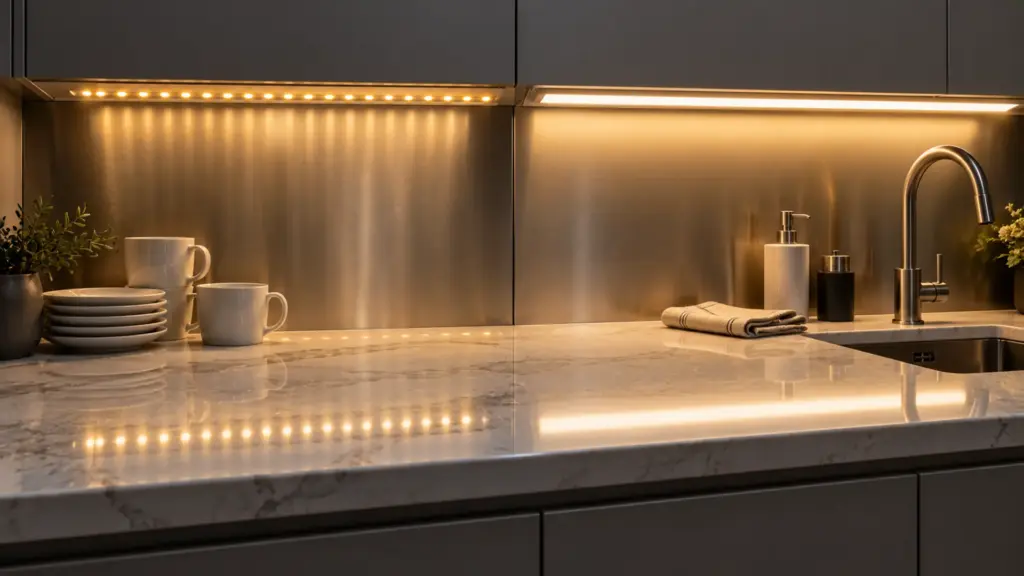
Dots are the visible problem. Glare is the second one. Clear covers throw a bright, point-like reflection on polished stone, glass, and lacquered millwork, and the reflection shows as a dotted line in the surface, not only in the fixture. Opal spreads the source so the reflection reads as a soft band. For under-cabinet strip over a stone counter, or a lit shelf over glass, glare is a stronger reason to choose opal than dot hiding.
Cover material can also nudge color. Signlite reports that milky covers warm the output by roughly 100–200K. That figure is a manufacturer’s claim and we have not verified it on our covers. On a job with a tight color target, mock up the strip behind the real cover and read it there, which is the same discipline we recommend in the color temperature guide.
By Application: Which Cover for Which Job
| Job | Cover | Why |
|---|---|---|
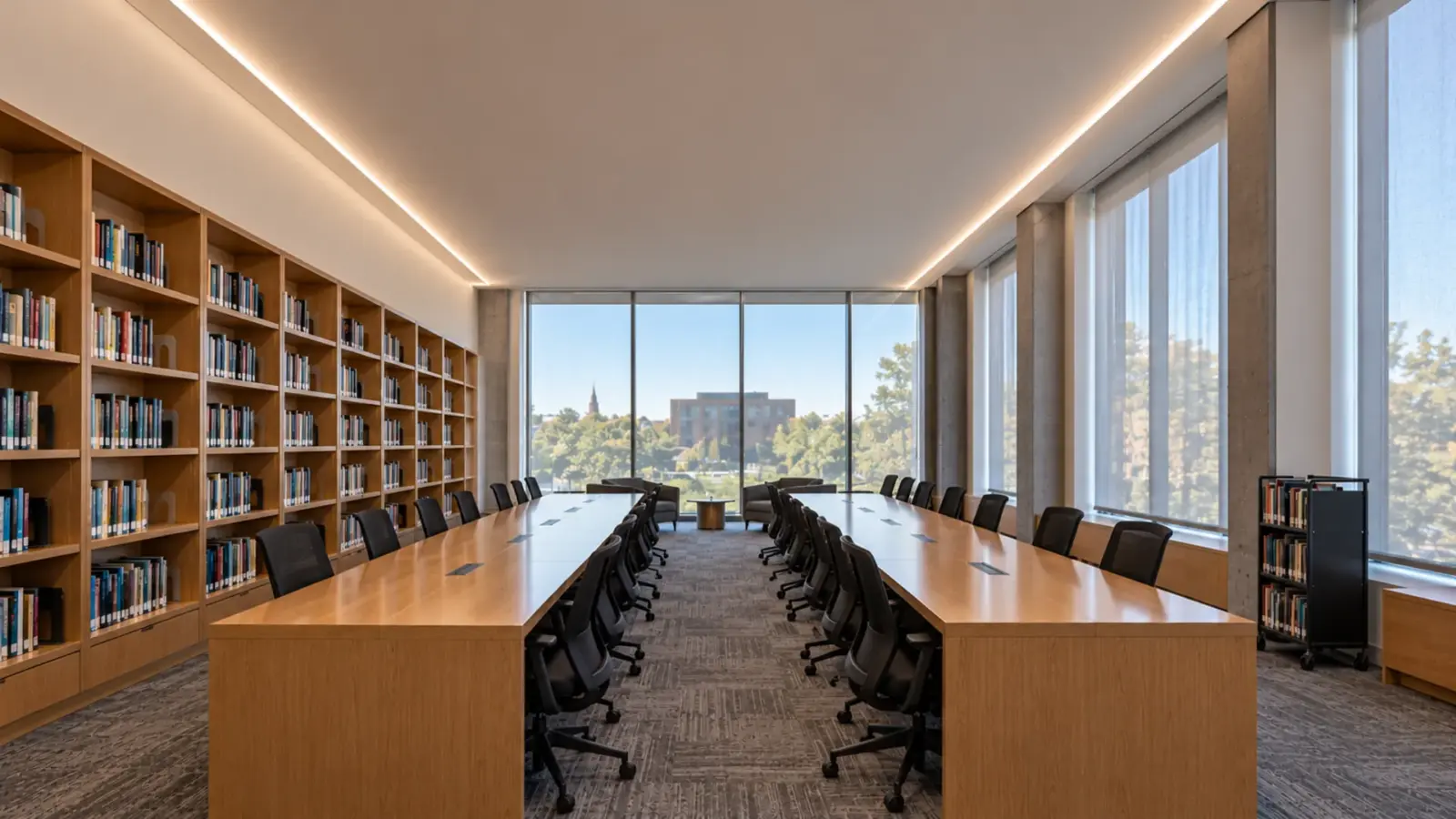
| Cove, strip hidden behind the lip | Clear | The eye never reaches the cover. Keep the output. |
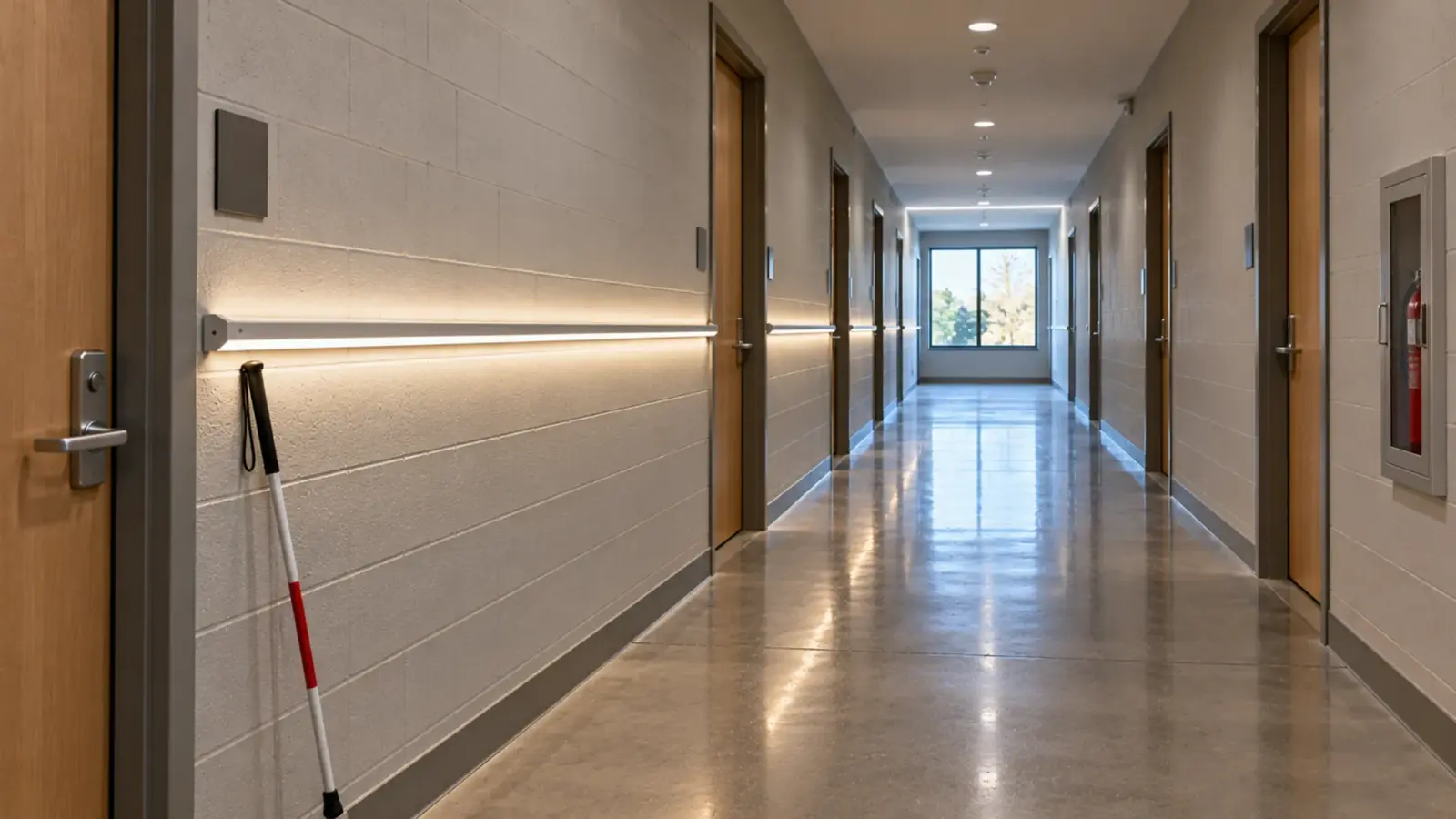
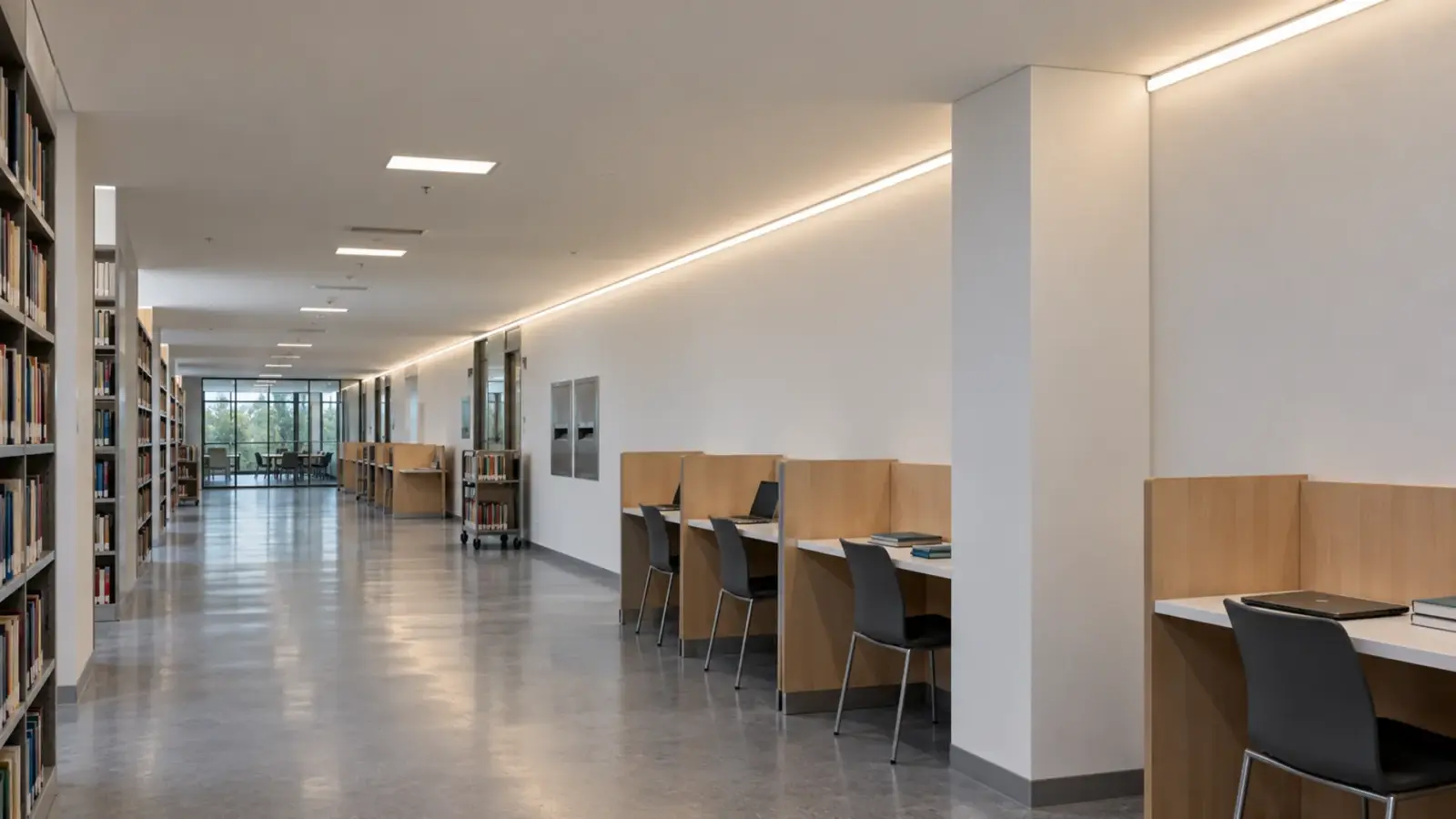
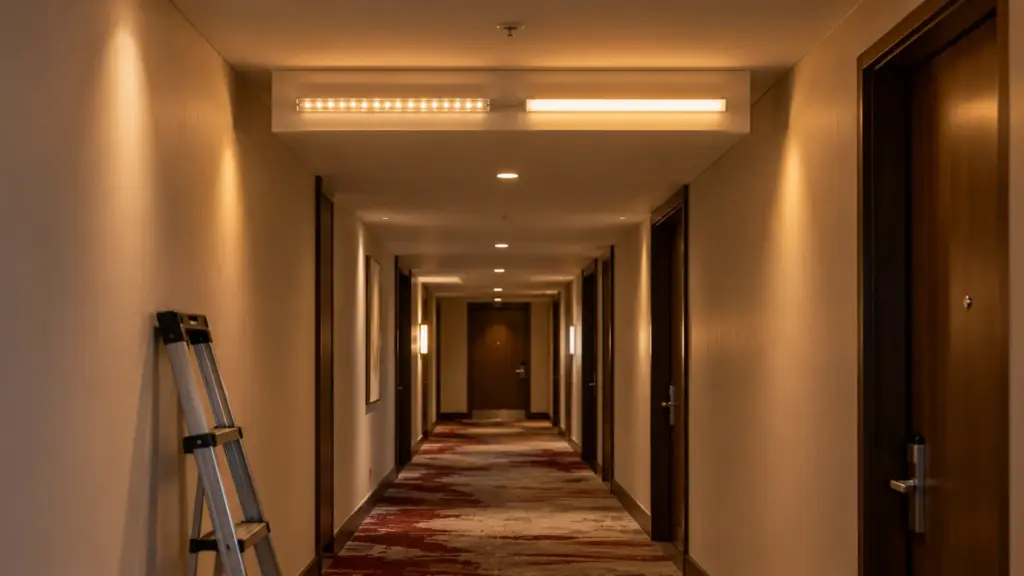
| Soffit or corridor, lit line seen from below | Opal | The line is the finish. |
| Under-cabinet over stone or glass | Opal | Controls the reflection as well as the dots. |
| Open shelving and display cases | Opal | The line is seen close up and often at eye level. |
| Back-of-house, task light, millwork interiors | Clear | Output matters more than appearance. |
| Dust and contact protection only | Clear | The cover is a shield, not a diffuser. |
These are starting points, not rules. A hidden channel with a shallow SMD strip can still throw scalloping onto a nearby surface, which is a separate geometry problem covered in our COB vs SMD cove lighting guide.
The viewing distance changes the answer too. A shelf edge is read from 2 to 3 ft (0.6 to 0.9 m), so every LED in the line is a candidate for a visible dot. A corridor soffit is read from 10 to 15 ft (3 to 4.5 m), and a lower-density strip behind opal may pass. Put the real distance on the drawing when you ask for a cover.
Mockup: Test the Cover at Viewing Distance
Every number in this article is a starting point. The mockup is what settles the choice, and it takes less time than a revision after install.
- Cut a 3 to 5 ft (0.9 to 1.5 m) sample of the real strip into the real channel, at the planned color temperature and drive level.
- Put clear and opal covers on side by side, so the comparison is made in the same light.
- View the run from where people will stand, and from the worst angle, which is usually a low angle looking along the channel.
- Check three things: whether dots show, what the nearest glossy surface reflects, and how the run looks at the end cap.
- Record the pick, including the cover and the channel model, before the order goes out.
Spec Mistakes: Four Ways Covers Get Misordered
Opal in a shallow channel with standard-density SMD. The cover gets blamed for dots that depth and density caused. Check the table above before the order.
Clear where the line is seen. A clear cover on a visible run shows every LED and every reflection. If the eye reaches the channel, spec opal.
Opal without sizing the strip up. The strip meets its lm/ft on the datasheet and delivers about a fifth less at the cover. The first mockup comes in dim and the fix is a different strip, after the channel is installed.
Mixed covers in one visible run. Clear and opal side by side in the same room read as two different fixtures. Pick one per zone and order the covers with the channels, from the same quote.
FAQ
Is frosted or opal better for LED strip?
Opal is better when the goal is hiding the dots, because it diffuses more and transmits roughly 70–80% of the strip’s light. A frosted cover usually leaves some dotting visible, and Lee Valley says the same of its own frosted covers, so frosted is a better fit only where some dotting is acceptable and you want more output than opal gives.
Do LED channel diffusers reduce brightness?
Yes. A PC clear cover passes roughly 90–95% of the strip’s output and a PC opal cover roughly 70–80%. Calculate from the low end of the strip’s lm/ft range and size the strip up one output step when you use opal.
Why can I still see LED dots through the diffuser?
The LEDs sit too close to the cover for their light to overlap. Dots depend on the distance between LEDs and the optical depth of the channel, not only on the cover. A denser strip, COB, or a deeper channel fixes it. A different cover rarely does.
Can I change the diffuser after the channel is installed?
Yes. Our diffusers click in by hand and lift out with a plastic trim tool, so the cover can be swapped after a mockup or a walkthrough without removing the channel. Clips ship at 19.69 in (500 mm) spacing.
Does an opal diffuser change the color temperature?
It can shift it slightly. One channel manufacturer reports about 100–200K of warming from milky covers, which is a vendor figure and not a Unitop measurement. If the color target is tight, read the strip behind the real cover on a mockup.
Which to Spec
Spec opal wherever the lit line is seen, and give it the depth the strip needs. Spec clear where the channel is hidden or the job is task light. Treat “frosted” on a drawing as a question to answer before ordering, not a product to match. Then size the strip for the cover you chose.
Send the strip model, the channel profile and the viewing distance for each run. We will check the cover, the depth and the output against the drawings and mark clear or opal on the channel schedule: request a quote.