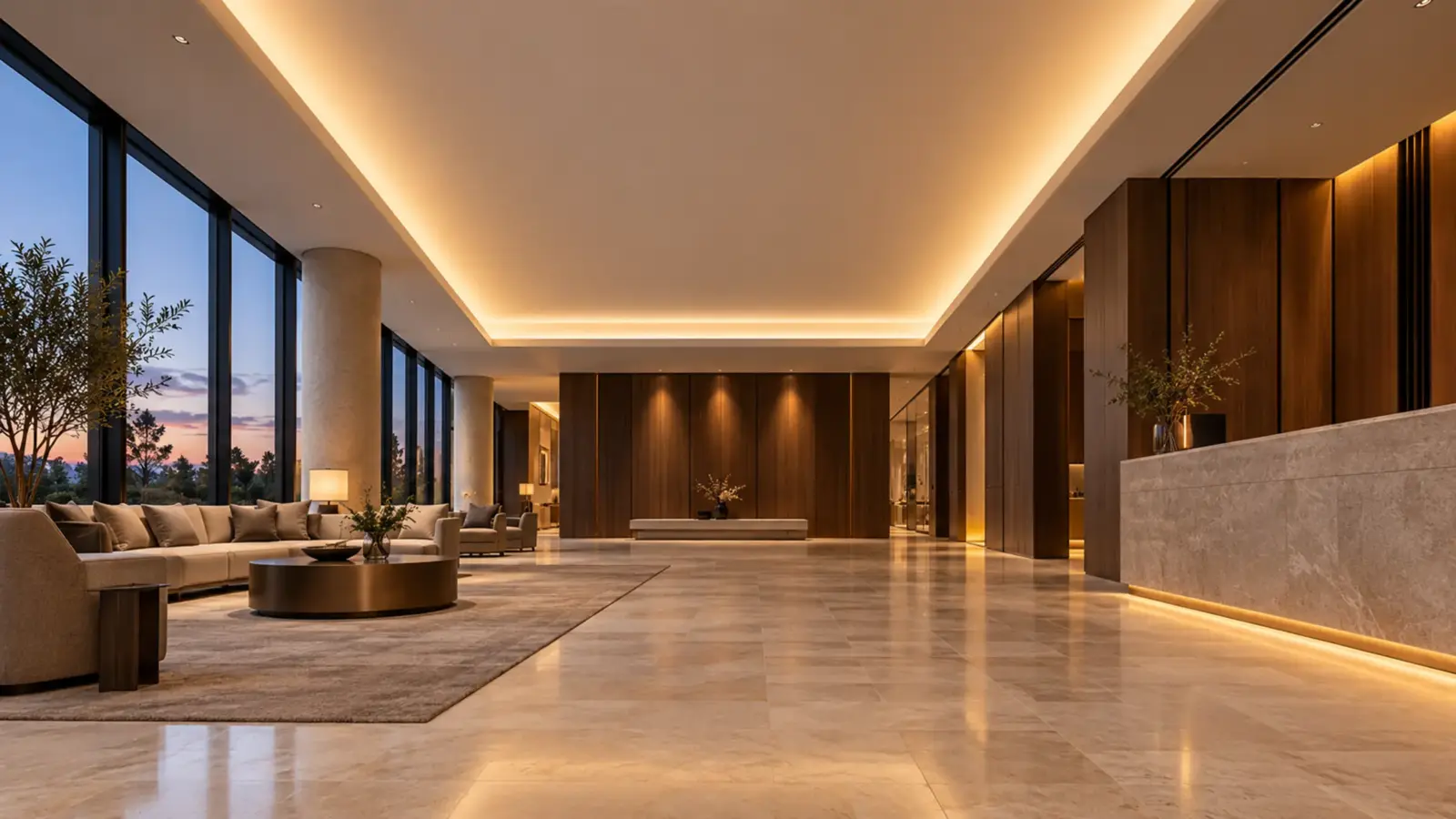
Spec COB LED strip for any cove where people can see the strip or its reflection. Spec SMD LED strip for coves that hide the strip completely, and for jobs where every watt counts against an energy code. The deciding question is whether anyone will see the source.
Most of the COB vs SMD debate online skips that split and argues about which technology is “better” in general. In a cove, the answer comes down to three things: the sightline, the finish of the surface being lit, and the watts per foot you can afford. The numbers below come from our COB and SMD spec tables, and the full cove section, with setback and lip height, is on our cove lighting application page.
COB vs SMD: The Short Answer
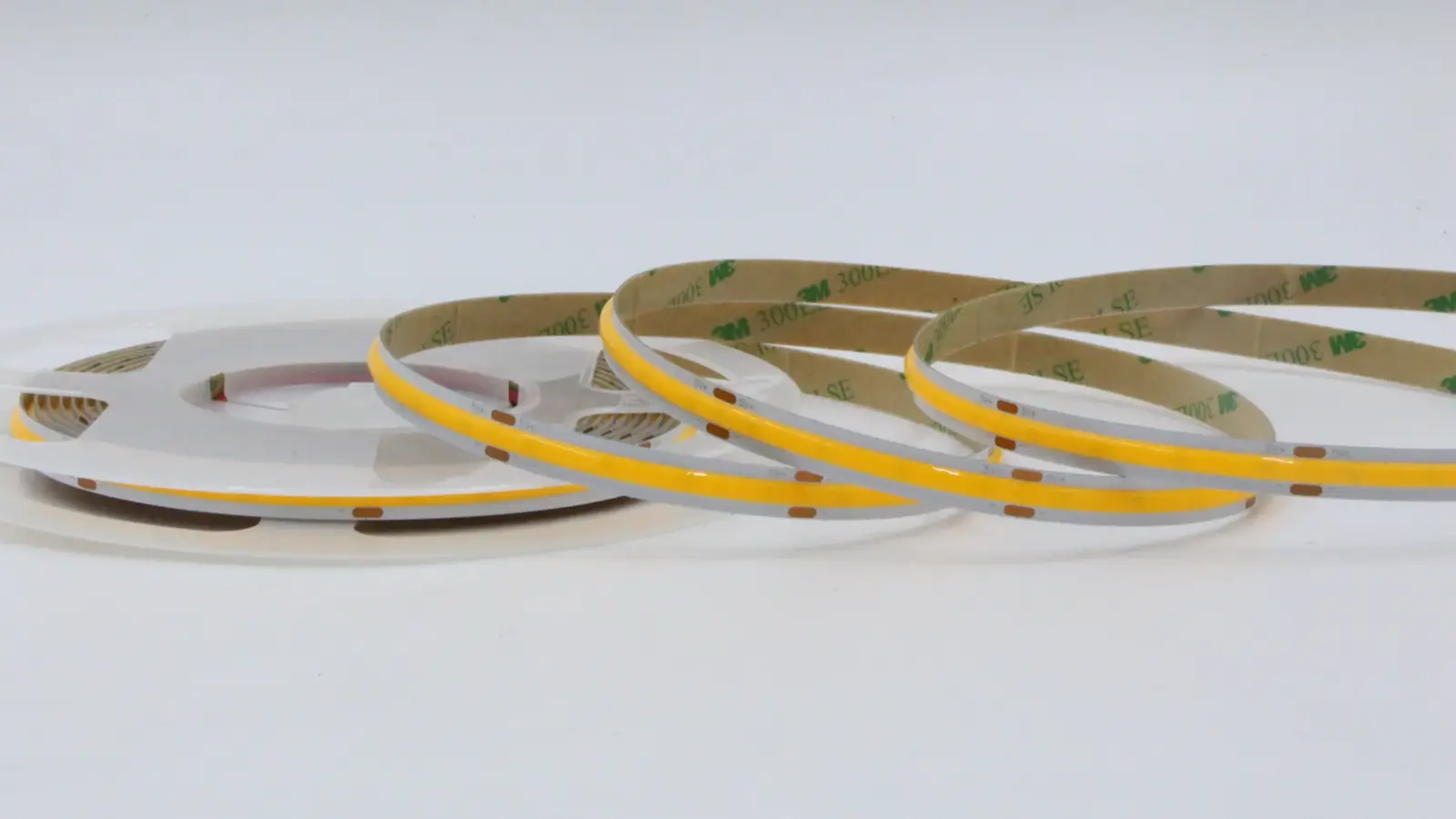
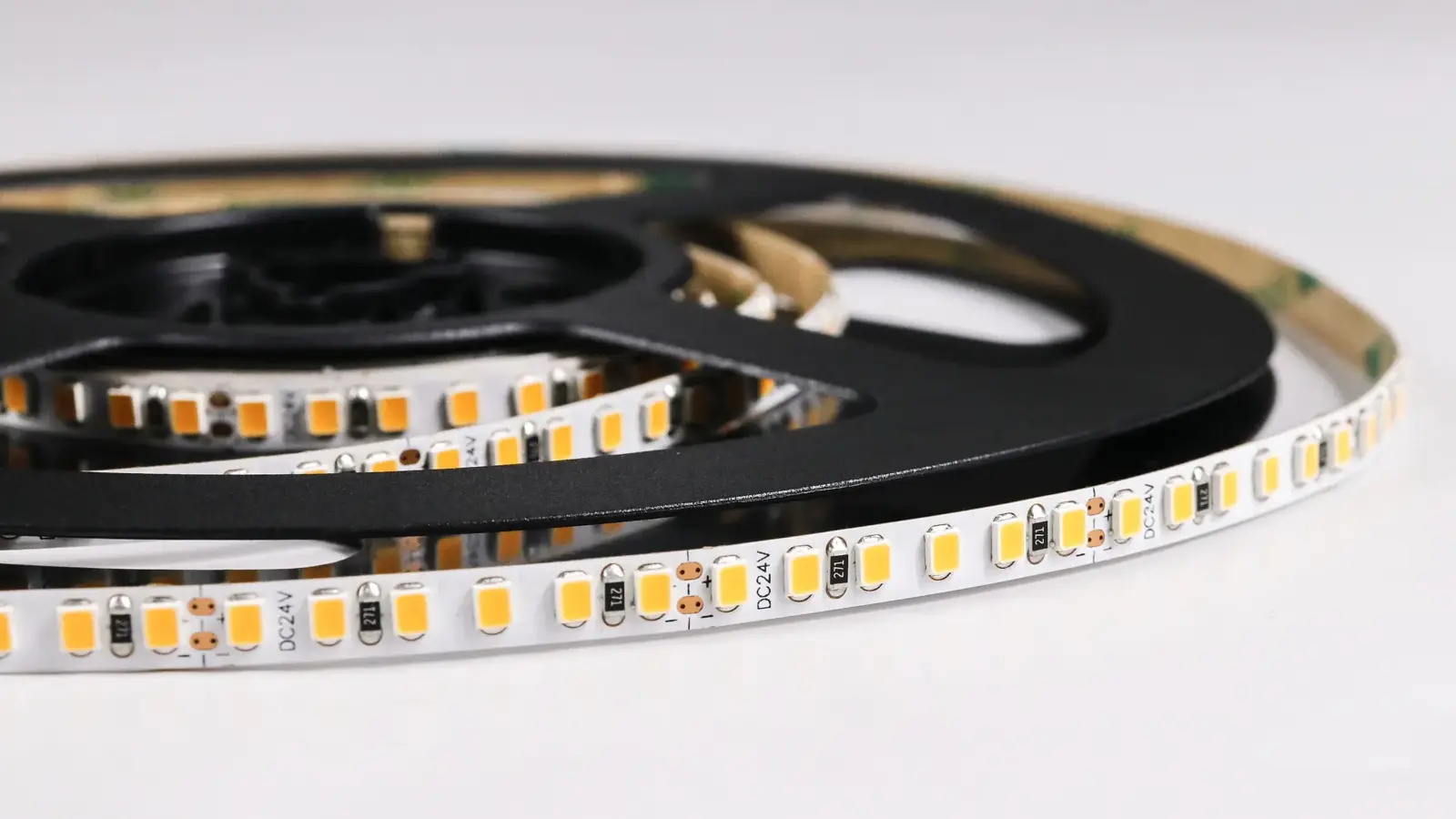
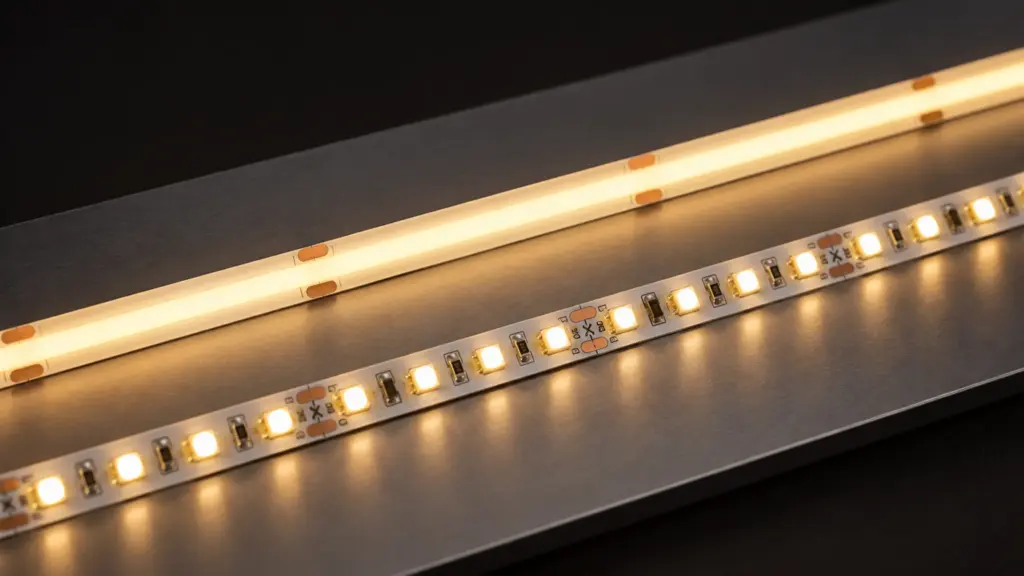
COB (chip-on-board) LED strip mounts bare LED chips directly on the flexible PCB and covers them with one continuous phosphor layer. SMD (surface-mounted device) LED strip uses individual packaged LEDs, such as 2835 or 5050, spaced along the PCB.
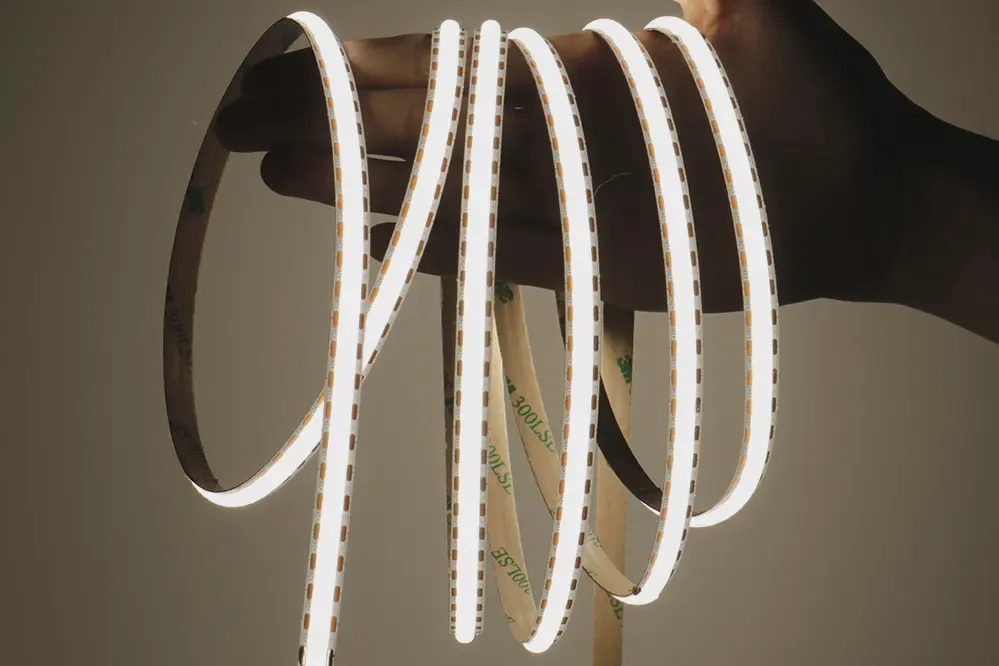
That construction difference shows up on the ceiling. A typical COB strip carries 280 to 800 chips per meter under a single phosphor line, so COB strip reads as one unbroken line of light. Standard SMD strip carries 60 to 120 LEDs per meter, and even high-density SMD at 240 to 480 per meter is still a row of individual points. When an SMD point source sits close to a surface or in direct view, the eye picks out each LED as a dot.
So the real question for a cove is simple: will anyone ever see the source, directly or in a reflection? If yes, COB. If no, SMD usually wins on cost, and high-efficacy SMD wins on watts.
Side-by-Side: The Specs That Matter in a Cove
Here is how five representative strips from our program compare on the numbers a cove designer actually uses.
| Model | Type | LEDs/m | Power | Efficacy | CRI | Run per feed |
|---|---|---|---|---|---|---|
| UT-C480-8 | Standard COB | 480 | 3.2 W/ft (10.5 W/m) | ~90 lm/W* | Ra≥90 | 16 ft (5 m) |
| UT-SC320HE-15 | SCOB, high efficacy | 320 | 4.6 W/ft (15 W/m) | 130–140 lm/W | Ra≥90 | On request |
| UT-S2835-120 | Standard SMD | 120 | 4.4 W/ft (14.4 W/m) | ~100 lm/W* | Ra≥90 | 16 ft (5 m) |
| UT-S2835-128-HE | High-efficacy SMD | 128 | 2.9 W/ft (9.6 W/m) | 190 lm/W | Ra≥90 | 16 ft (5 m) |
| UT-S2835-480-FS | Full-spectrum SMD | 480 | 5.5 W/ft (18 W/m) | ~85 lm/W* | Ra≥98 | 16 ft (5 m) |
*Typical value for this class of strip, rounded down. Confirm the model datasheet figure with your quote.
Three things stand out. COB strip gives you a dot-free line with no diffuser. The most efficient strip in the table is an SMD strip. And on standard 12V and 24V, both technologies need a new feed about every 16 ft (5 m), so run length is not the deciding factor between them.
When COB Is the Right Spec
Visible coves and low cove lips
A cove lip is supposed to hide the strip, but the lip only works from the angles the designer checked. A mezzanine, a stair landing, or a second-floor balcony can look straight down into a cove that is invisible from the lobby floor. People on ladders during maintenance see it too, and so does anyone standing close to a low wall cove.
If any common viewing position can see into the cove, spec COB. A bare SMD strip seen from above looks like a string of beads. A bare dotless COB LED strip looks like a neon line, which is an acceptable view even when nobody planned for it.
Glossy ceilings, stone, and polished floors
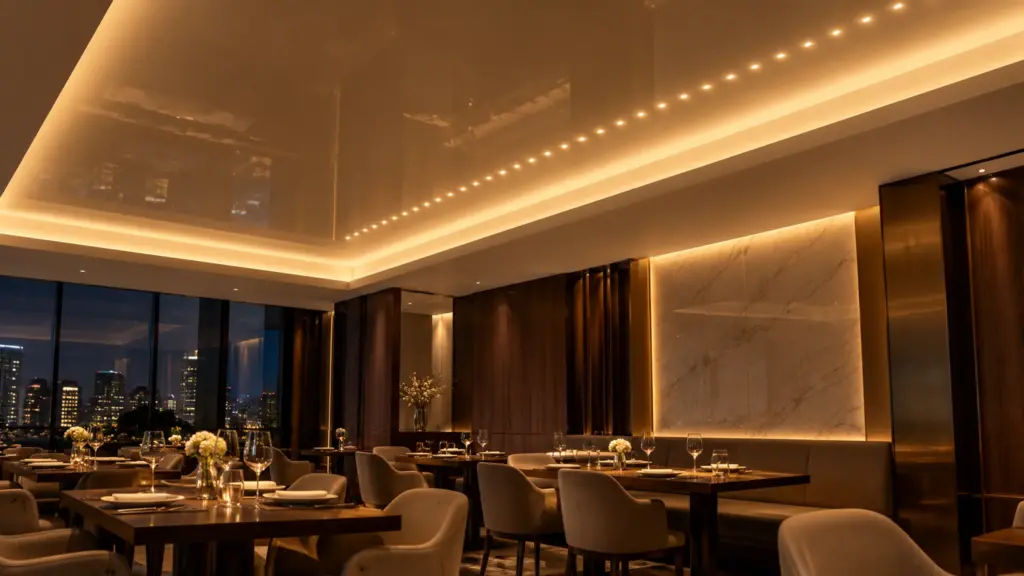
This one tends to show up after the ceiling is finished. The strip is hidden, the wash on the ceiling looks even, and then someone looks at the ceiling from across the room and sees a row of bright dots.
The dots are a reflection. High-gloss paint, stretch ceilings, polished plaster, and lacquered wood panels all behave like weak mirrors. So do polished stone floors and glass under a low wall cove. A mirror-like surface shows the light source itself as well as the wash, and an SMD source shows up as individual points.
COB strip removes the problem because the reflected source is a continuous line. When the finish schedule calls for anything above an eggshell sheen on the lit surface, treat COB as the default.
Shallow coves with no room for a diffuser
Some coves are built too tight for a channel and diffuser, especially in millwork, retrofit soffits, and slim ceiling reveals. SMD strip in a shallow cove with no diffuser tends to throw distinct pools of light on the ceiling right above the strip.
COB strip needs no diffuser to look continuous, so it is the safer choice when the detail leaves only enough depth for the strip itself. Standard COB such as UT-C480-8 sits on an 8 mm PCB, and our ultra-narrow COB series goes down to 2.7 mm wide.
When SMD Is the Right Spec
Fully concealed coves with enough setback
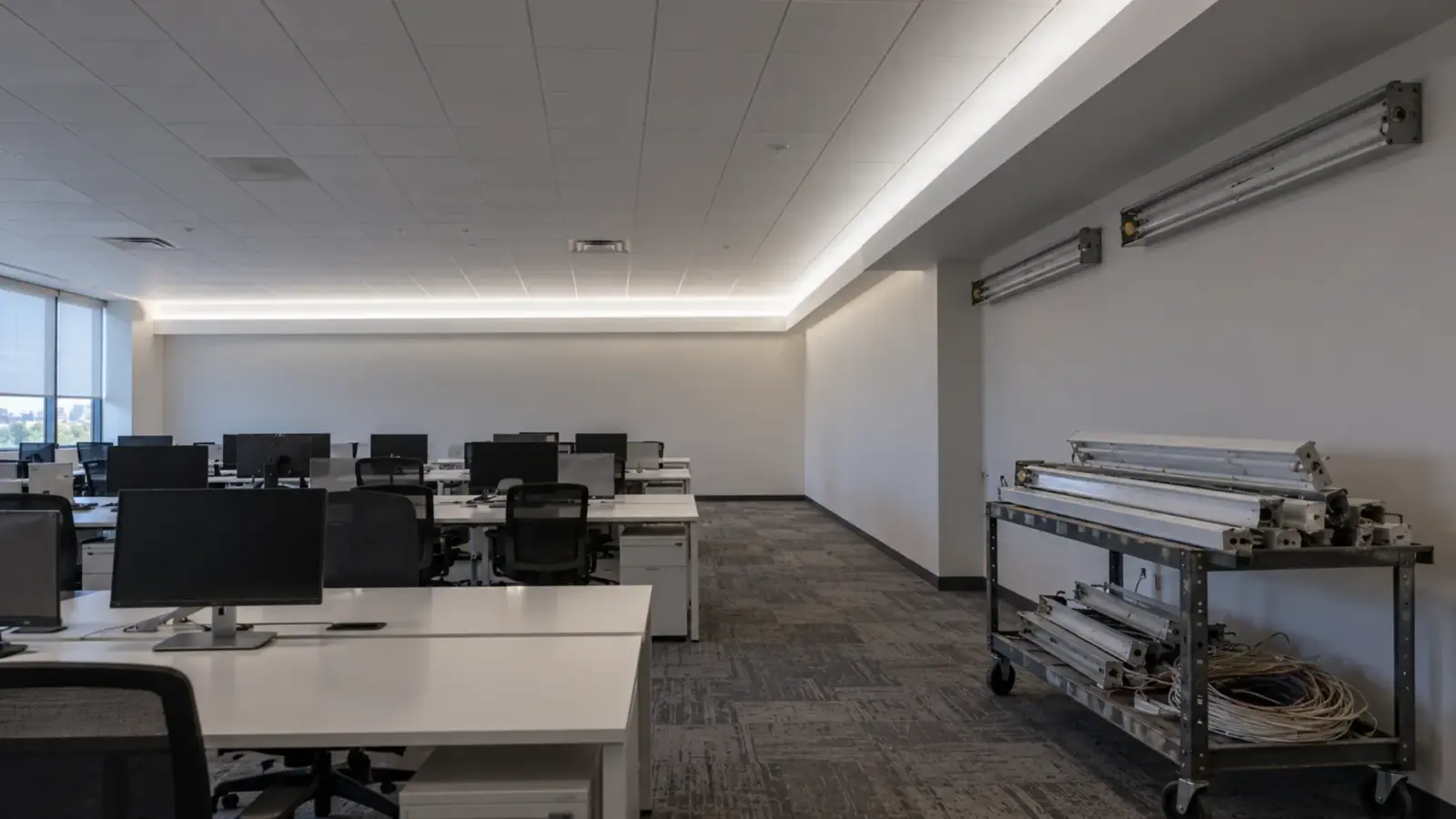
In a well-built cove with a proper lip and a matte ceiling, the eye only sees the wash, never the source. When the strip has enough distance from the ceiling, the light from each SMD package spreads and overlaps before it lands, and the wash looks as smooth as COB to anyone standing in the room.
In that situation, paying for COB buys you nothing visible. Standard SMD LED strip such as UT-S2835-120 at 4.4 W/ft (14.4 W/m) is the cost-efficient spec for diffused coves and perimeter slots.
Energy-code jobs: 190 lm/W vs 90–140 lm/W
Many COB vs SMD articles claim COB strip is more efficient. Our spec tables say the opposite. The highest-efficacy strip in our program is UT-S2835-128-HE, an SMD strip rated at 190 lm/W. Our COB-family strips run from about 90 lm/W for standard Ra≥90 COB such as UT-C480-8 up to 130 to 140 lm/W for the high-efficacy SCOB model UT-SC320HE-15.
The efficacy gap between high-efficacy SMD and COB matters on commercial work where lighting power density limits apply, such as projects under ASHRAE 90.1 or California Title 24. If the cove is one of several layers competing for a fixed watts-per-square-foot budget, high-efficacy SMD delivers more light for the same connected load. For a concealed cove on an energy-code job, start with SMD and only move to COB if the sightline or surface finish forces it.
When the owner asks for Ra≥98
Galleries, high-end retail, and hospitality lobbies sometimes specify color rendering above the standard Ra≥90. Our full-spectrum SMD strip UT-S2835-480-FS is rated Ra≥98 at 480 LEDs per meter, which also makes it dense enough to look close to continuous behind an opal diffuser. Expect to trade efficacy for it: full-spectrum Ra≥98 strip runs around 85 lm/W, so budget more watts per foot than a standard Ra≥90 cove. On the COB side, the high-CRI SCOB model UT-SC320CRI97-15 reaches Ra≥97.
COB vs SMD Beyond the Cove
The same two questions, can anyone see the source and what does the job pay per watt, settle most other uses too. This is the short version for the jobs that come up next to a cove.
| Application | Usual pick | Why |
|---|---|---|
| Shelves, casework, display cases | COB | The strip or its reflection is in view at close range |
| Under-cabinet over polished stone | COB, or SMD behind opal | The counter reflects the source |
| Light boxes and sign backgrounds | SMD | Diffused at depth; low-density SMD is cost-efficient |
| Long concealed slots and perimeters | SMD, or 48V and constant-current COB | Cost per foot and feed count decide |
| Energy-limited general lighting | High-efficacy SMD | 190 lm/W on UT-S2835-128-HE |
| Color and tunable white | Either | Both exist; COB RGB and RGBW read as a continuous band |
| Outdoor and wet runs | Either, in the sealed build | The jacket and the listing matter more than the chip |
Two habits help on any of them. Order a short sample of each candidate and look at it in the real channel at the real viewing distance. And compare models on lumens per foot and watts per foot, not on the chip name, because a high-efficacy SMD and a standard COB can differ by more than the technologies do.
Cove Geometry: Setback, Aim, and Scalloping
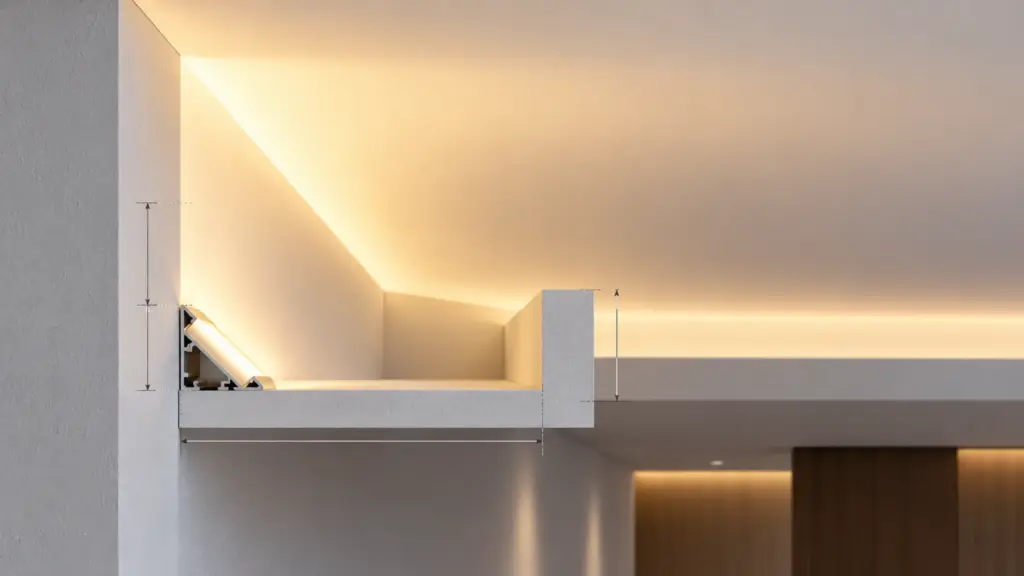
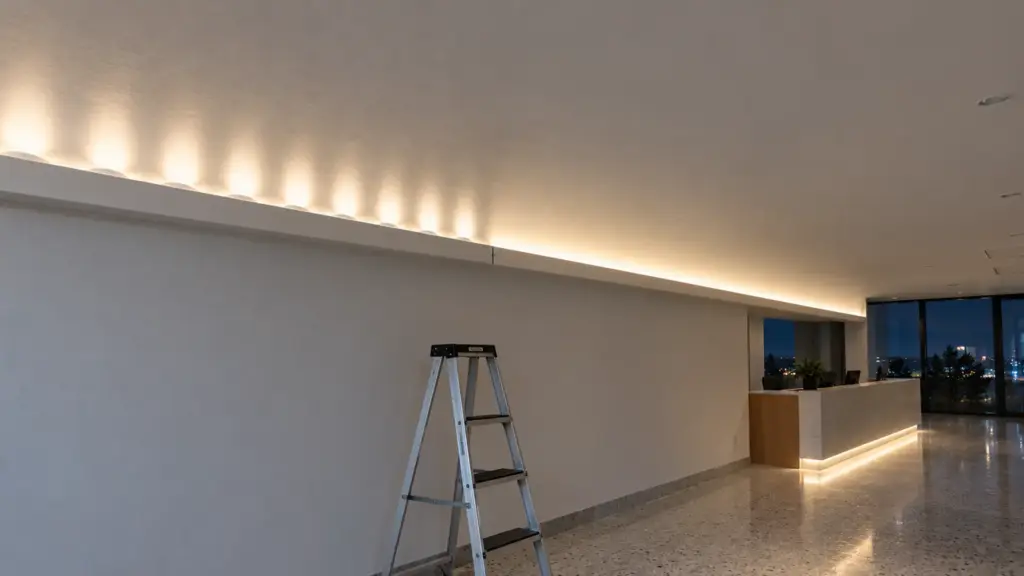
Once the strip is hidden, the cove geometry matters more than the chip type. Scalloping is the classic symptom of a strip mounted too close to the ceiling: the beam lands as a series of bright arcs instead of a smooth gradient.
Published guidance on setback varies widely, from about 4 in to well over 12 in. Bright House’s cove planning guide puts the minimum gap between strip and ceiling at 4 to 6 in (100 to 150 mm). Treat 4 in as the minimum and go deeper when the cove allows it. The closer the strip sits to the lit surface, the more you need COB or a diffuser to hide the individual sources.
Aim matters as much as distance. A strip lying flat on the cove floor throws most of its light straight up and leaves a hot band directly above the lip. Tilting the strip toward the joint between wall and ceiling spreads the wash further across the ceiling. Our UT-CH1616 corner channel seats in a 90° corner and aims the strip out at 45°, and it takes strip up to 10 mm wide, so UT-C480-8 fits with room to spare.
If you add a diffuser, budget for the light loss. A PC clear diffuser transmits roughly 90 to 95% of strip output but leaves the individual LEDs visible. A PC opal diffuser transmits roughly 70 to 80% and blends the LEDs into one line. When you use opal to smooth an SMD strip, size the strip output up one step to compensate. Deeper profiles blend better: the UT-CH2415 surface channel, with 14.5 mm of optical depth, delivers dot-free output even with standard-density strip.
Long Perimeter Coves: Run Length and Feed Planning
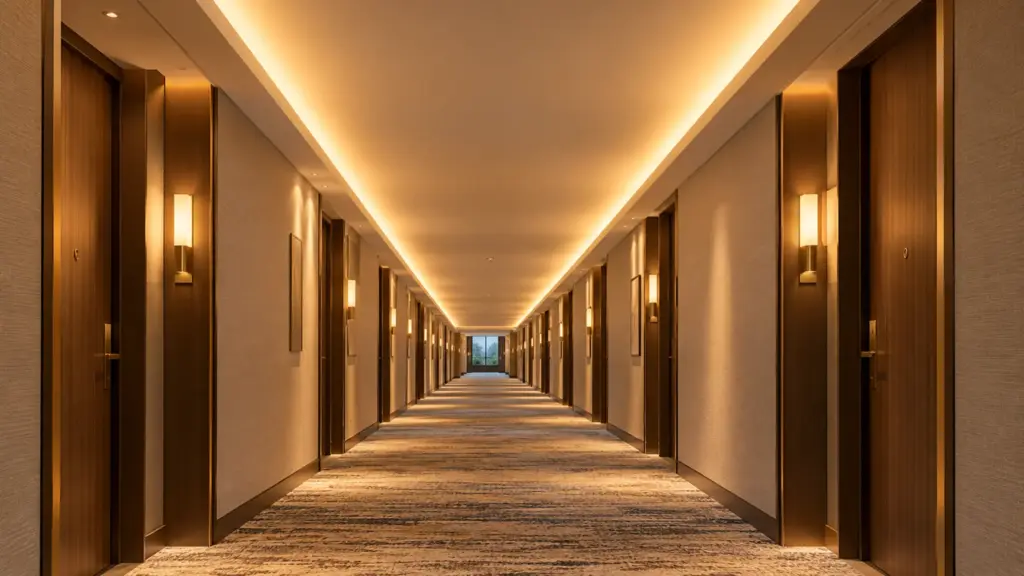
Coves in hotel corridors, lobbies, and ballrooms can easily run past 50 ft, and that is where voltage drop shows up as a far end dimmer than the near end. On standard 12V and 24V strip, plan on 16 ft (5 m) per feed for both COB and SMD before voltage drop becomes visible. A few 24V COB series, such as UT-C384-8, reach 32 ft (10 m).
For longer continuous runs, three series in our program feed 65 ft (20 m) from a single end:
- UT-C480-8-48V: 48V COB, 2.4 W/ft (8 W/m)
- UT-C480-8-CC: 24V constant-current COB, 2.3 W/ft (7.5 W/m)
- UT-S2835-140-CC: 24V constant-current SMD, 3.7 W/ft (12 W/m)
Here is a worked example. Take a 60 ft hotel corridor cove. With standard 24V strip at 16 ft per feed, you need four feeds, which means four home runs or mid-run power injection points hidden in the cove. With UT-C480-8-48V, the whole 60 ft runs from one end. Connected load is 60 ft × 2.4 W/ft = 144 W. Keep the load at or below 80% of the driver rating, so spec an LED driver of at least 180 W and place it at the feed end, where the driver closet or an access panel can reach it.
Quick Decision Checklist
Answer these in order. The first “yes” decides the strip.
- Can anyone see into the cove from a stair, balcony, mezzanine, or close standing position? COB
- Is the lit ceiling or wall glossy, or is there polished stone or glass below a low cove? COB
- Is the cove too shallow for a channel and diffuser? COB
- Does the owner require Ra≥98? Full-spectrum SMD, or high-CRI SCOB at Ra≥97
- Is the project under a lighting power density limit where the cove competes for watts? High-efficacy SMD
- Is the cove fully concealed, matte, and at least 4 in (100 mm) from the ceiling? Standard SMD
If nothing above got a “yes”, for example a concealed cove that sits closer than 4 in to the ceiling, spec COB. COB strip is the lower-risk choice when the geometry is tight.
Whichever strip you pick, check run length separately. Anything over 16 ft (5 m) of continuous cove needs extra feeds or a 48V or constant-current series.
FAQ
Is COB or SMD better for cove lighting?
COB LED strip is better for coves where the strip or its reflection can be seen, because COB strip produces a continuous, dot-free line. SMD LED strip is better for fully concealed coves with a matte finish and adequate setback, because SMD strip costs less and high-efficacy SMD reaches 190 Lumens per watt: how much light the strip gives for the power it draws. Higher means less heat and less driver load per foot..
Do you need a diffuser for COB LED strip in a cove?
No. COB LED strip looks continuous without a diffuser, which is its main advantage in shallow or visible coves. An aluminum channel is still a good idea because it acts as a heat sink and holds the strip at a consistent angle.
Is COB LED strip more energy efficient than SMD?
Not in our program. The most efficient strip we offer is the SMD model UT-S2835-128-HE at 190 lm/W, while our COB-family strips run from about 90 lm/W (standard COB) to 140 lm/W (high-efficacy SCOB). On energy-code jobs, high-efficacy SMD delivers more light per connected watt.
Should a cove run on 12V or 24V LED strip?
Use 24V for cove lighting. At 24V, LED strip draws half the current of 12V strip for the same wattage, which reduces voltage drop and wire size. For single runs over 16 ft (5 m), move to a 48V or constant-current series that feeds 65 ft (20 m) from one end.
Which is brighter, COB or SMD?
Brightness depends on the model, not the technology. Compare lumens per foot and watts per foot for the specific models; we send full photometric files and IES data with every quote. Both our white COB and single-color SMD series dim smoothly to below 1% with a compatible TRIAC, 0-10V, or DALI driver. For restaurant and hotel coves that should warm as they dim, see our guide to dim-to-warm LED strip.
Spec Notes for This Job
For a cove, decide by what people can see. If the strip or its reflection is ever in view, specify COB. If the cove hides the source on a matte surface, specify SMD, and choose high-efficacy SMD when the job has an energy budget. Then check run length separately and plan the feeds.
Mark the cove sections and sightlines on the drawings and send them over. We will propose COB LED strip where the source shows and SMD LED strip where it hides, with the feed plan and drivers for each run: request a quote.