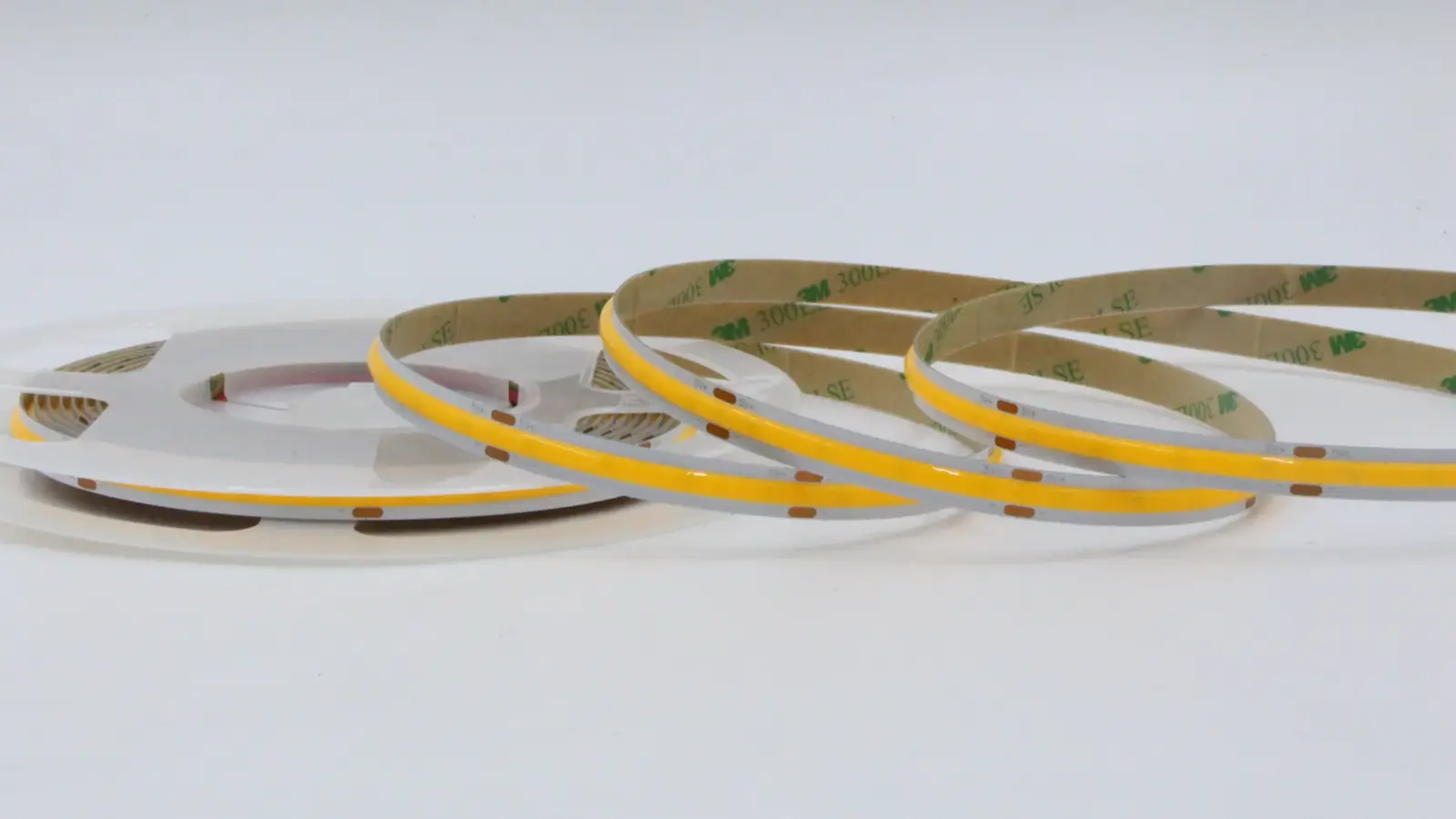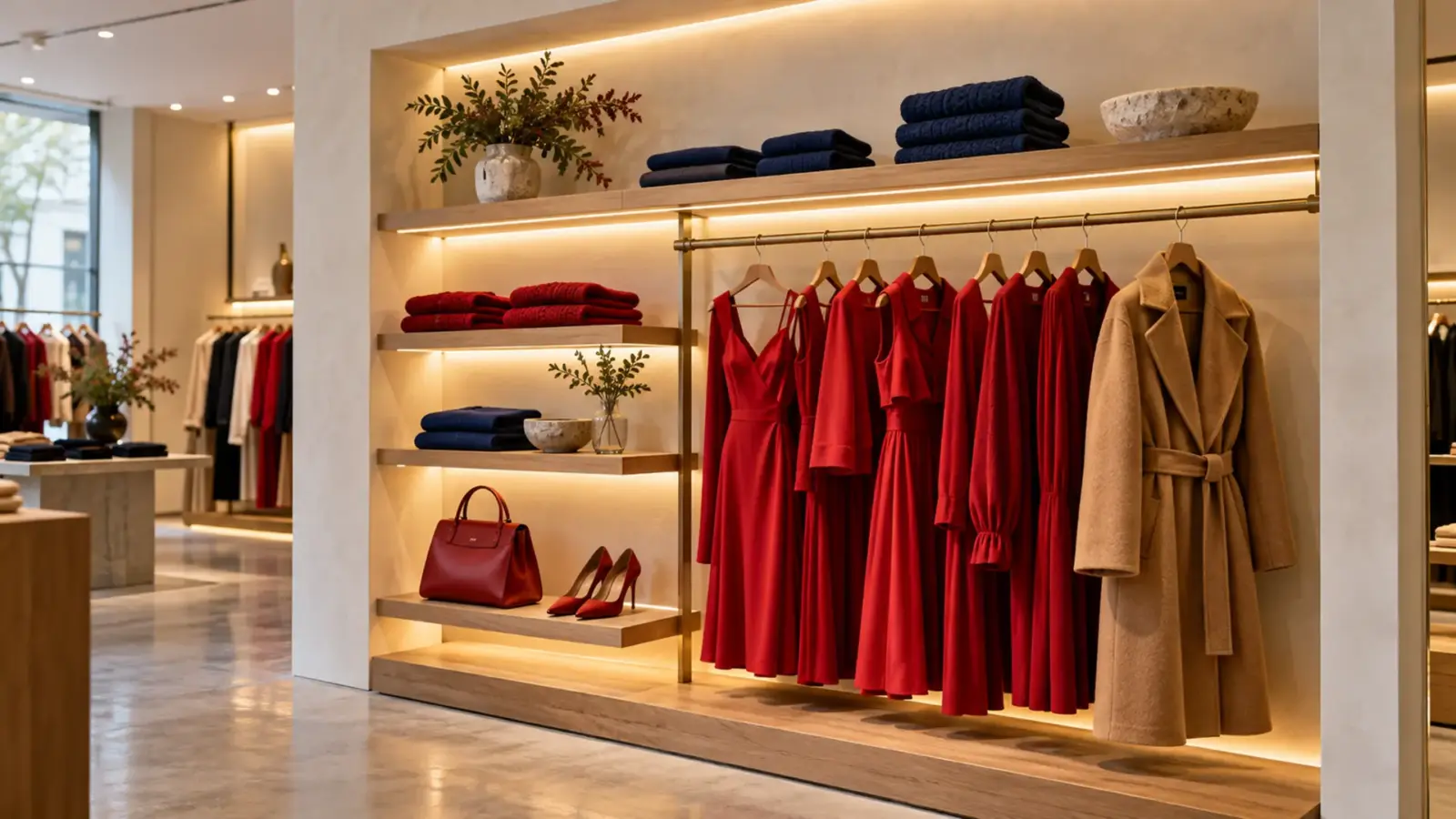
The boutique opens, the display racks light up, and the red dresses on the feature wall look brown. The strip is rated Ra≥90, the spec sheet says “high Color Rendering Index, 0–100: how truthfully the light shows colors next to a reference source. Ra≥90 is the usual bar for interiors.,” and the merchandise still reads wrong. The number on the reel was fine for a corridor. It was not enough for the thing the store sells.
High-CRI LED strip comes in three practical tiers. Ra≥90 covers most commercial work. Ra≥95 is the spec where color is the product: apparel, cosmetics, food, and hospitality spaces with art. Ra≥98 is for museums, galleries, studios, and color matching.
Each step up costs efficacy, so compare R9 and watts per foot along with the headline CRI, and judge the tier on the owner’s own materials rather than on one number.
The Short Answer: CRI 90 vs 95 vs 98
Pick the tier by what the light has to show, then check what it costs in watts.
| Tier | What it adds | Typical spaces | Our models | Efficacy |
|---|---|---|---|---|
| Ra≥90 | Natural color for general use | Offices, corridors, hotel common areas, most coves | UT-C480-8, UT-S2835-120, UT-S2835-128-HE | Up to 190 lm/W (UT-S2835-128-HE) |
| Ra≥95 | Truer reds, skin tones, and food | Apparel and cosmetics retail, restaurants, food display | UT-SFS full-spectrum series, UT-S2216-300 | About 100–125 lm/W (UT-SFS series) |
| Ra≥97 to 98 | Rendering close to the reference source | Museums, galleries, studios, color matching | UT-SC320CRI97-15 (COB), UT-S2835-480-FS | 105 lm/W (COB), ~85 lm/W* (SMD) |
*Typical value for this class of strip, rounded down. Confirm the model datasheet figure with your quote.
The efficacy for the UT-SFS series is worked out from the listed lumens and watts per foot. The pattern holds across the table: every step up in color rendering gives back some light per watt.
What CRI Measures: and What It Misses
Ra Averages Eight Pastel Colors
The CRI number printed on a reel is Ra, the average of the first eight test colors, R1 through R8. Those eight are muted, medium-saturation colors. A strip can score well on all eight and still render saturated colors poorly, because the average never looks at them.
That is how two strips with the same Ra can look different on the same wall. The headline number is a starting point, not the whole spec.
R9: The Red That Ra Leaves Out
R9 is the saturated red test color, and it is not part of Ra. Saturated red is where white LED strip tends to fall short, and red is what matters in the jobs that pay for high CRI: skin tones, red fabric, wood finishes, meat, and produce.
A low R9 is the usual reason reds turn brown under strip that meets its CRI rating, as in the opening example. When color is part of the product, ask for R9 along with Ra. Our full-spectrum series lists R1 through R15 at 90 or above, which includes R9. For models that do not list R9 in the spec table, R9 is available on request.
TM-30: Fidelity and Gamut
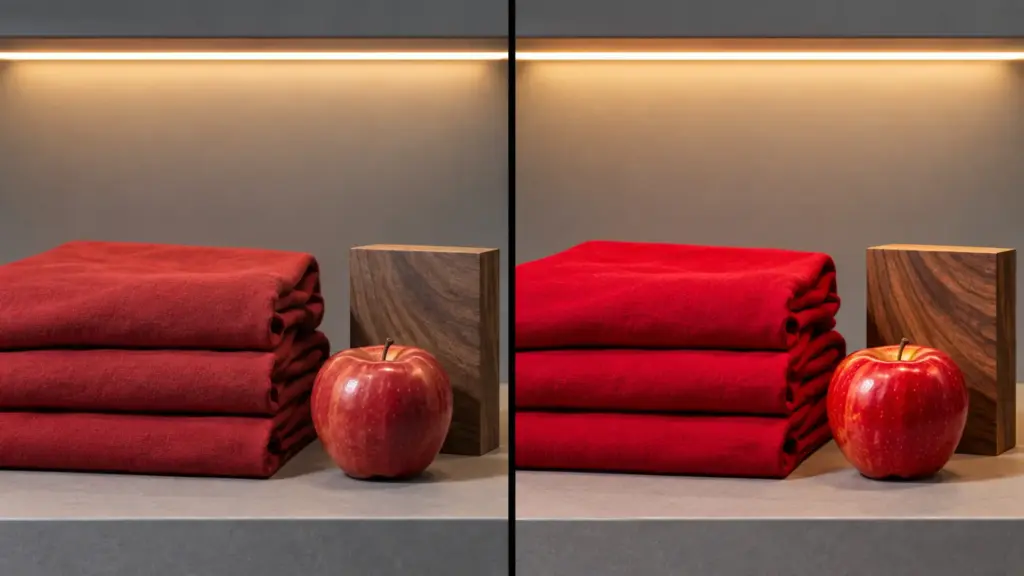
IES TM-30 is the newer method many lighting designers now specify for color-sensitive work. It reports two numbers. Rf is fidelity, how closely colors match the reference source, scored from 99 color samples. Rg is gamut, whether colors look more saturated (above 100) or duller (below 100) than the reference.
Our full-spectrum SMD series is rated at Rf 94 to 95 and Rg 101: close to the reference, with color saturation almost exactly neutral. For galleries and museums, that neutral gamut matters as much as fidelity, because oversaturated light changes how artwork reads.
The Efficacy Cost: Better Color, Fewer Lumens per Watt
High color rendering needs more red in the spectrum, and red light gives fewer lumens per watt. Every high-CRI strip trades some efficacy for color.
The clearest example in our program is one COB platform in two versions. UT-SC320HE-15 renders at Ra≥90 and reaches 130 to 140 Lumens per watt: how much light the strip gives for the power it draws. Higher means less heat and less driver load per foot.. UT-SC320CRI97-15 is the same 320-LED, 4.6 W/ft construction tuned for Ra≥97, and it delivers 105 lm/W. For the same light output, the Ra≥97 version needs roughly 25 to 33 percent more watts.
At the efficient end, UT-S2835-128-HE reaches 190 lm/W at Ra≥90. At the other end, Ra≥98 full-spectrum strip such as UT-S2835-480-FS runs at ~85 lm/W*, so a Ra≥98 cove draws far more power per lumen than a high-efficacy Ra≥90 cove.
Put two strips side by side at the same power and the trade is easy to see. UT-SFS160-8, our full-spectrum Ra≥95 strip, draws 2.9 W/ft and delivers 307 to 365 lm/ft. UT-S2835-128-HE draws the same 2.9 W/ft at 190 lm/W, which works out to about 550 lm/ft. At equal watts, the full-spectrum strip gives roughly a third less light.
That is the price of the better reds, and on a display wall it is usually worth paying.
On jobs under a lighting power density limit, this is a real budget line. Spec the high tiers where the color pays for itself, and use high-efficacy Ra≥90 strip for circulation and back-of-house runs on the same job.
Our High-CRI Options: SMD and COB
Full-Spectrum SMD (R1–R15 ≥90, TM-30)
Our full-spectrum series is the premium tier: CRI ≥95, R1 through R15 at 90 or above, and TM-30 Rf 94 to 95 with Rg 101. It comes in 2700K, 3000K, and 4000K, on 24V, and is built for retail, galleries, studios, and food display.
| Model | LEDs/m | Power | Output | Cut point |
|---|---|---|---|---|
| UT-SFS80-8 | 80 | 1.5 W/ft | 160–183 lm/ft | 1.97 in (50 mm) |
| UT-SFS160-8 | 160 | 2.9 W/ft | 307–365 lm/ft | 1.97 in (50 mm) |
| UT-SFS80-10 | 80 | 4.4 W/ft | 439–483 lm/ft | 3.94 in (100 mm) |
| UT-SFS160-8-HO | 160 | 5.9 W/ft | 585–702 lm/ft | 3.94 in (100 mm) |
The four models span low-output display cases to high-output coves. Maximum run length per feed for this series is on request. All four are in our SMD LED strip range.
Ra≥98 and Ra≥95 SMD
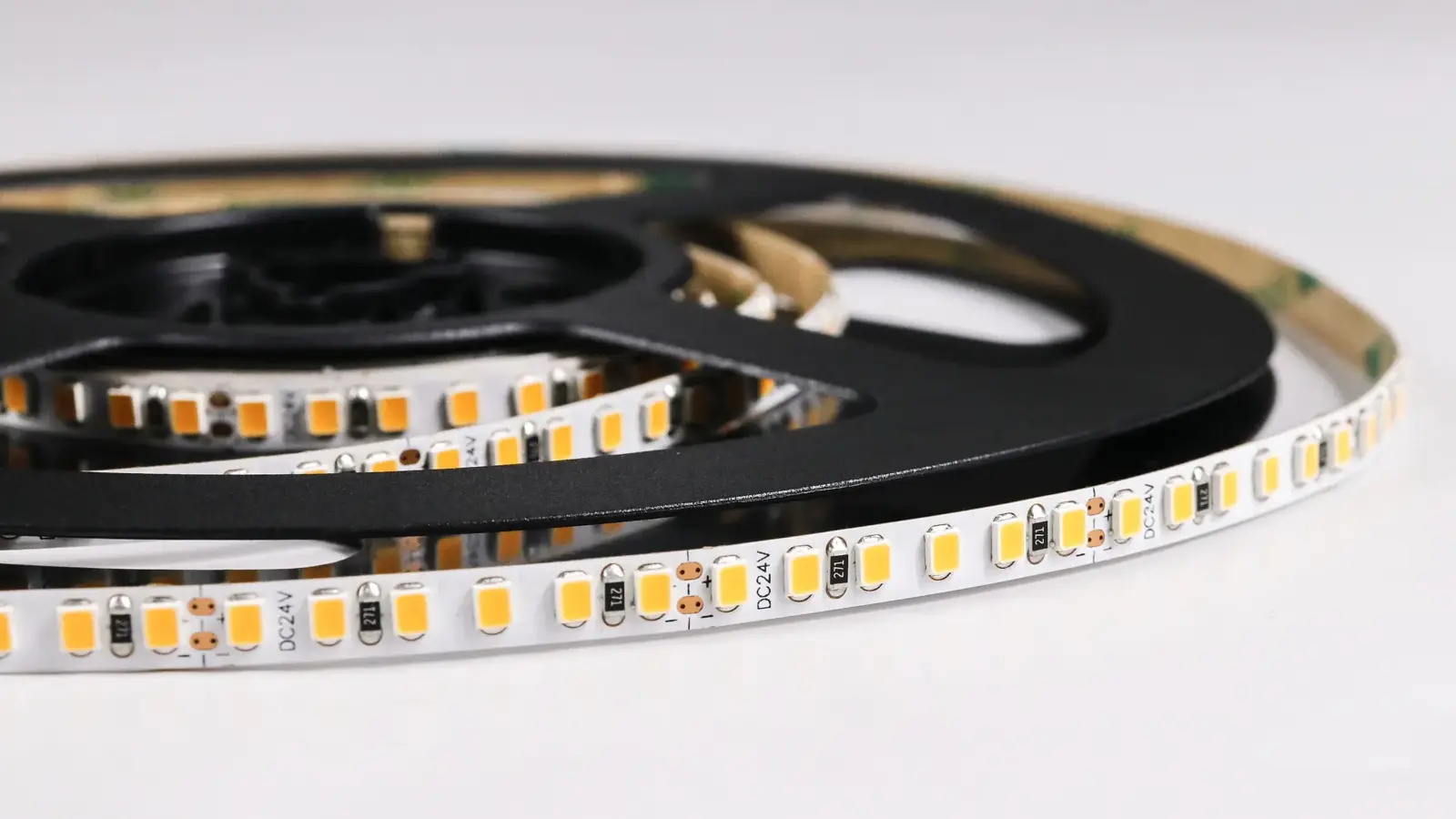
UT-S2835-480-FS is our Ra≥98 full-spectrum 2835 strip at 480 LEDs/m and 5.5 W/ft, in 2700 to 6500K on 24V, with a cut every 0.98 in (25 mm) and 16 ft (5 m) per feed. The 480 LEDs/m density also helps it read as a near-continuous line behind a diffuser.
UT-S2216-300 is a Ra≥95 option in the 2216 package at 300 LEDs/m and 5.8 W/ft, with the same 0.98 in (25 mm) cut and 16 ft (5 m) per feed. R9 for both models is available on request.
Ra≥97 COB for Dot-Free Lines
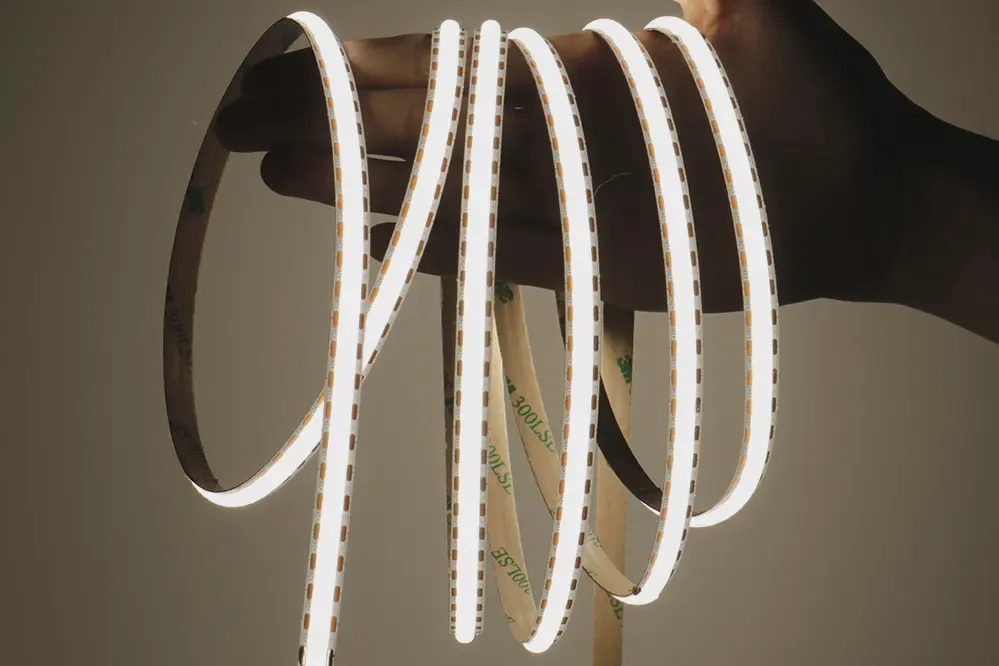
Where the strip or its reflection is in view, such as a gallery wall slot, a glass case, or a glossy shelf, a dot-free line matters as much as color. UT-SC320CRI97-15 gives both: a continuous COB line at Ra≥97 and 105 lm/W, on 12V or 24V, cutting every 0.98 in (25 mm) at 24V. It is in our COB LED strip range.

Where Each Tier Belongs
Ra≥90: Offices, Corridors, General Hospitality
Most commercial lighting does not need more than Ra≥90. Offices, corridors, hotel common areas, back-of-house, and most architectural coves look right at Ra≥90, and the efficacy savings are real. This is also where high-efficacy strip earns its place on energy-code jobs.
Ra≥95: Apparel, Cosmetics, Food, Restaurants
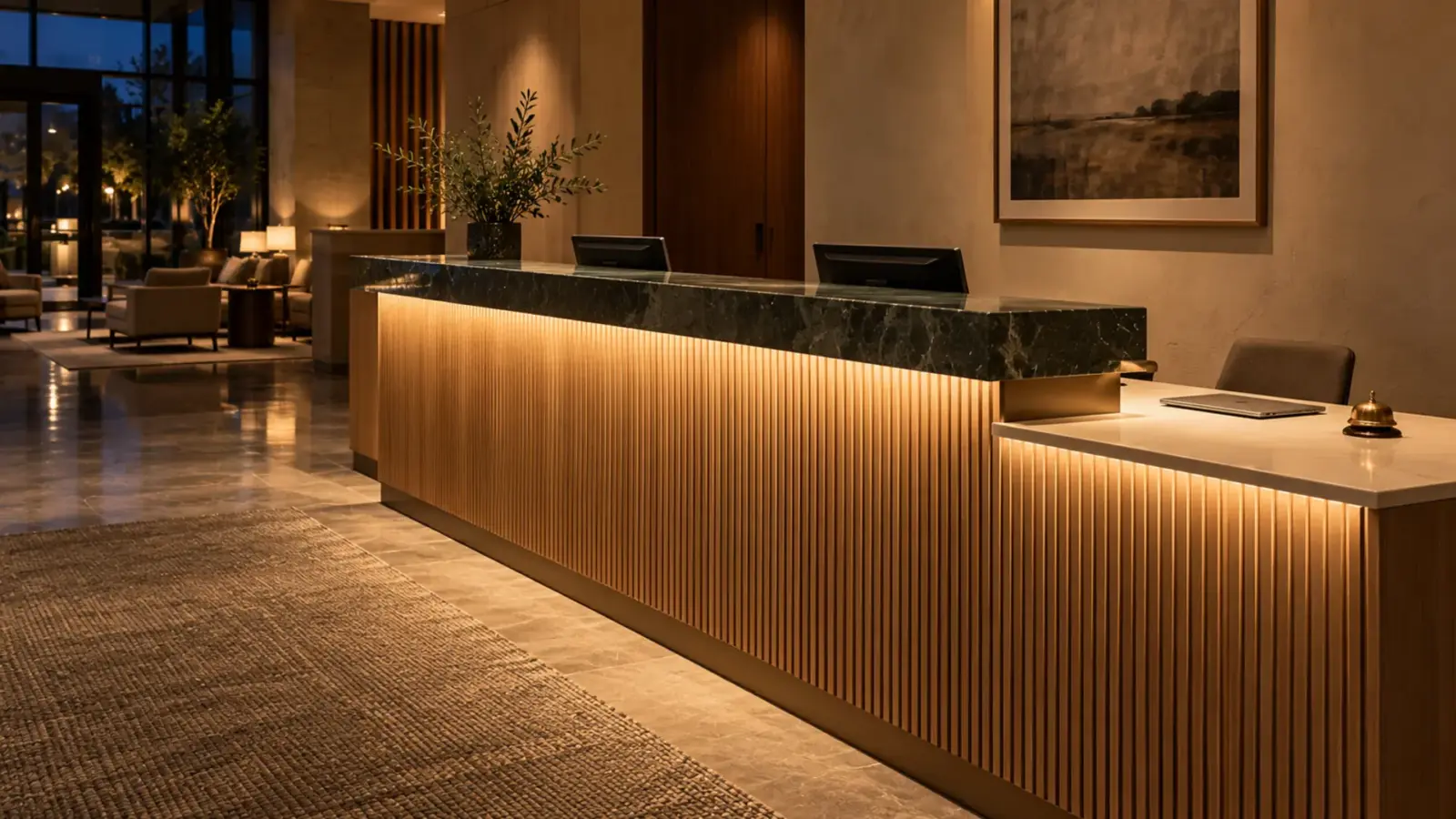
Step up to Ra≥95 where people judge color up close. Apparel and cosmetics retail, restaurants, bakery and deli cases, and hotel lobbies with art all benefit. In these spaces, ask for R9 as well as Ra, because saturated red is what the customer is looking at.

Ra≥98: Museums, Galleries, Studios
Ra≥98 belongs where color accuracy is the job itself: museum cases, galleries, photo and video studios, and color-matching areas such as print or paint counters. Here, ask for TM-30 as well, and keep the gamut close to neutral.
Build a Sample Board From the Owner’s Materials
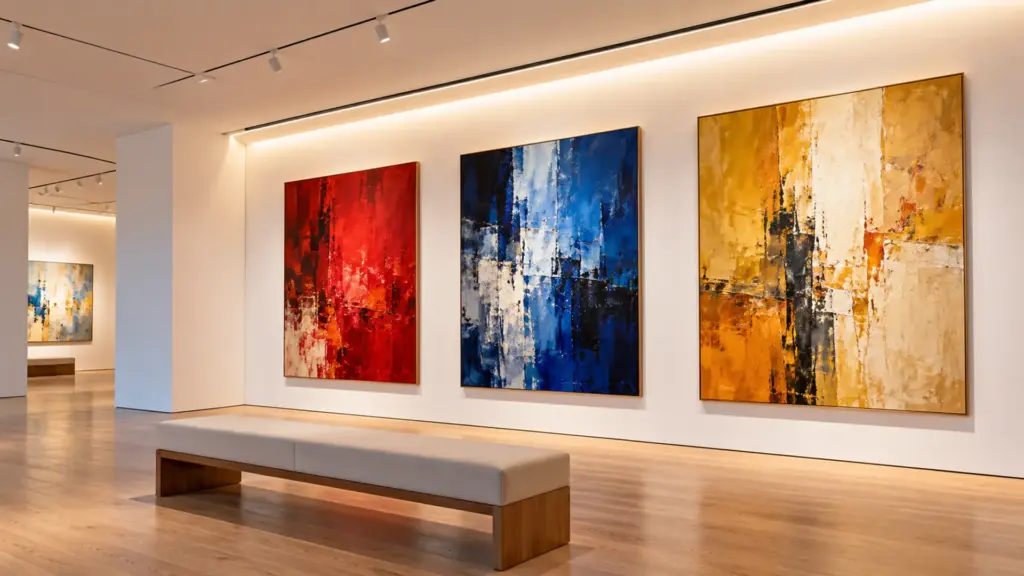
A CRI value is an average over test colors, and the owner’s products are not test colors. The fastest way to settle the tier is a sample board: short lengths of each candidate strip lighting the same set of real materials, side by side.
Put five kinds of things on the board:
- A saturated red. A fabric, a lacquer chip, or packaging in the brand’s red. This is where a low R9 shows first.
- Skin tone. A printed skin-tone swatch, or simply the hands of the people judging.
- Wood or leather. Warm, mid-saturation materials that turn flat under a weak spectrum.
- The product itself. Produce, bakery goods, cosmetics, a framed print: whatever the space sells or shows.
- A white reference. A white card, so everyone judges the white point as well as the colors.
Run every strip at the same CCT, at the same distance and angle the installed strip will have, and behind the same diffuser. Look at the board from where customers stand, not from arm’s length. A Ra≥90 strip that looks right on the board is the efficient answer; a Ra≥95 or Ra≥98 strip earns its watts only where the board shows a difference the owner cares about.
Keep a photo of the board with the model numbers next to each sample. It becomes the approval record and the reference for any later reorder.
Mixing Tiers on One Job: Keep the Whites Matched
Most projects end up with more than one tier: Ra≥95 in the display cases, Ra≥90 in the coves and corridors. That is the right call for the power budget, but it needs one rule. Where two tiers sit in the same view, match the CCT exactly, and mock them up side by side.

Two strips at the same CCT can still look slightly different when their spectra differ, and a full-spectrum strip next to a standard strip is where that shows. Keep the high-CRI strip on its own surfaces, such as the inside of a case, a shelf edge, or an art wall, and let the standard strip carry the general light around it.
A diffuser does not change this. An opal lens smooths the line and softens the dots, but it does not add color rendering. Specify the CRI at the strip, then choose the channel and lens for the look.
The most useful mock-up uses the owner’s own product. Put a few garments, a tray of food, or a framed print under each candidate strip at the planned CCT, and let the people who sell it decide. It usually settles the tier in one visit.
Color Consistency: Binning Matters as Much as CRI
A high CRI does not help if two reels on the same wall are visibly different colors. Color consistency comes from binning, how tightly the LEDs on each reel are matched in color, measured in SDCM steps.
Our strip is binned to ±2 Color-consistency steps (MacAdam ellipses). Fewer steps means two strips from different reels look like the same white; 3-step is hard to tell apart by eye. across every reel, and each reel ships with a datasheet stating CRI, SDCM binning, and W/ft. On a feature wall or a long display run, order all the strip for that wall together, and keep reels from the same order on the same surface.
Think ahead to phased work and repairs as well. Keep the order details and the reel datasheets in the closeout package, so a later extension or a replacement section can be matched to the strip already on the wall rather than to a new catalog number.
What to Ask For at Quote
The CRI number alone does not describe the light. For a color-sensitive job, ask for these with the quote:
- Ra, and R9 for any model that does not list it.
- TM-30 Rf and Rg for gallery, museum, and high-end retail work.
- The binning tolerance in SDCM, and how reels are matched on one order.
- The CCT options for the tier you need.
- Photometric files and IES data. We send full photometric files and IES data with every quote.
- Samples at the planned CCT for the sample board, so the owner can judge the strip under their own product before the order is released.
With those in hand, the lighting designer can compare strip on what it will actually render, not on the number printed on the reel.
FAQ
Is CRI 90 good enough for retail?
CRI 90 is good enough for general retail floors, circulation, and back-of-house. For apparel, cosmetics, and food, where customers judge color up close, specify Ra≥95 LED strip and ask for R9, because saturated red is what those products depend on.
What is R9 and why does it matter?
R9 is the saturated red test color, and R9 is not included in the Ra average printed on most LED strip. A strip can have a high Ra and a low R9, which makes reds, skin tones, and wood look dull. Ask for R9 on any color-sensitive job.
What is the difference between CRI 95 and CRI 98?
CRI 98 LED strip renders color closer to the reference source than CRI 95, most visibly in saturated reds. CRI 98 costs more efficacy, so reserve CRI 98 for museums, galleries, studios, and color matching, and use CRI 95 for retail and hospitality.
Does high-CRI LED strip use more power?
Yes. High-CRI LED strip gives fewer lumens per watt, because high color rendering needs more red light. In our program, the same COB platform delivers 130 to 140 lm/W at Ra≥90 and 105 lm/W at Ra≥97.
What CRI do galleries and museums need?
Galleries and museums usually start at Ra≥95, and many ask for Ra≥98 with TM-30 values. Our full-spectrum series is rated TM-30 Rf 94 to 95 with Rg 101, and UT-S2835-480-FS reaches Ra≥98.
Decision Rule
Choose the tier by what the light has to show. Ra≥90 is right for most commercial space, Ra≥95 is the spec where color is the product, and Ra≥98 is for museums, galleries and color matching. Check R9, TM-30 and watts per foot before committing to the higher tiers, and let a sample board of the owner’s own materials settle any doubt. On a mixed job, split the spec: high tiers where customers judge color, high-efficacy Ra≥90 strip everywhere else, one binned order per wall.
Tell us what the space sells and the CCT you have in mind. We will send samples of SMD LED strip and COB LED strip at Ra≥90, 95 and 98 for the sample board, with R9 for each: request a quote.