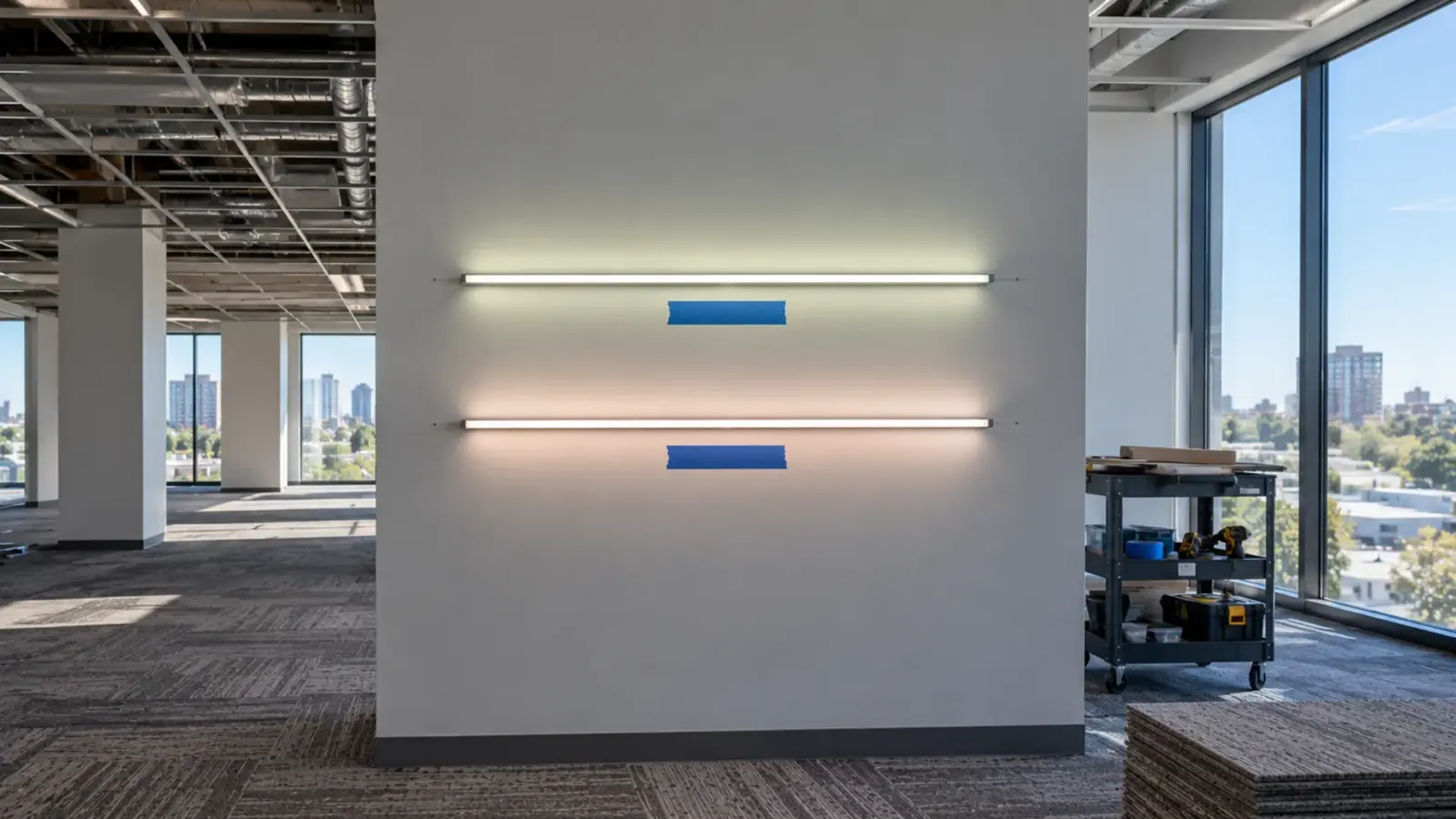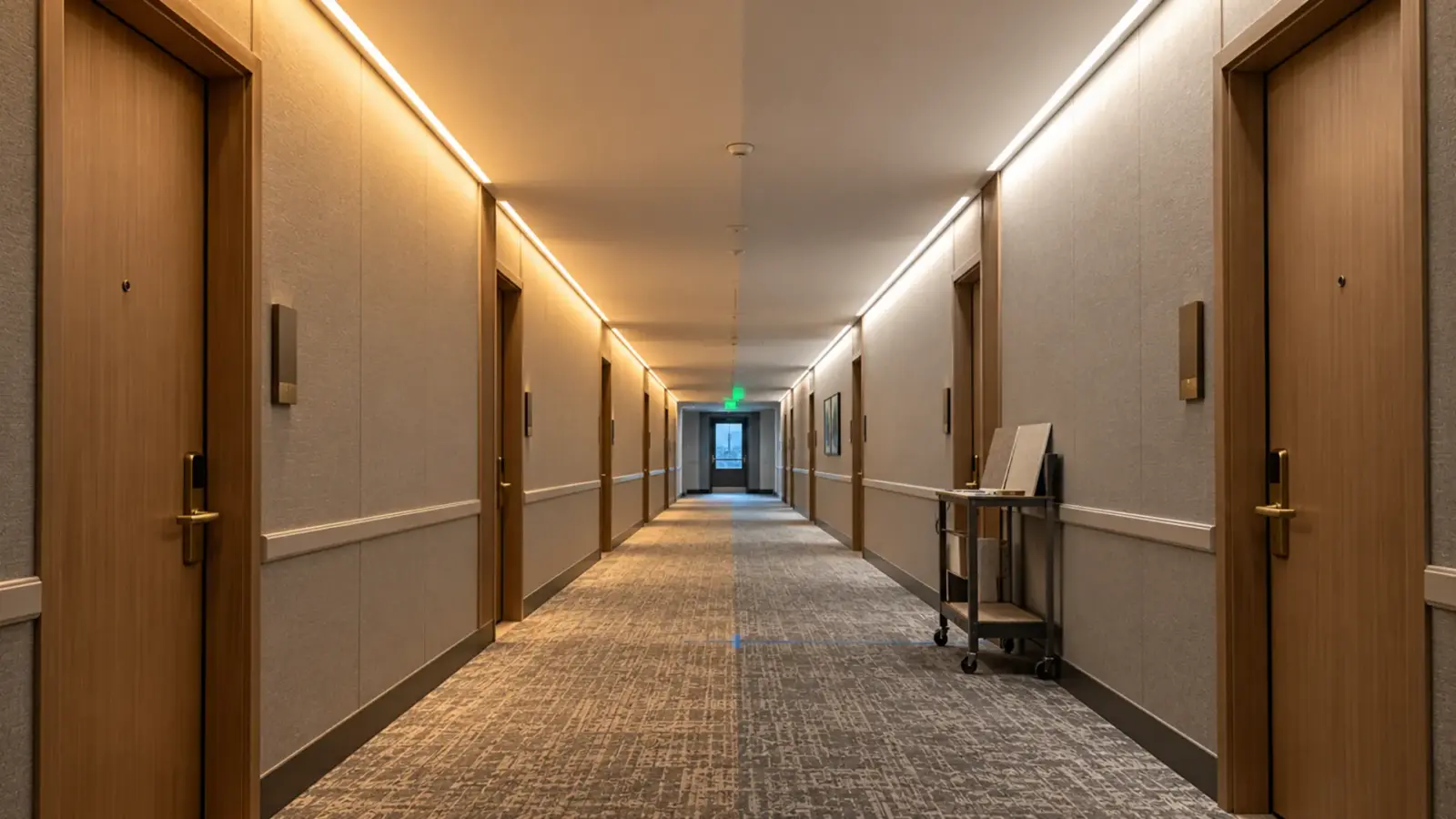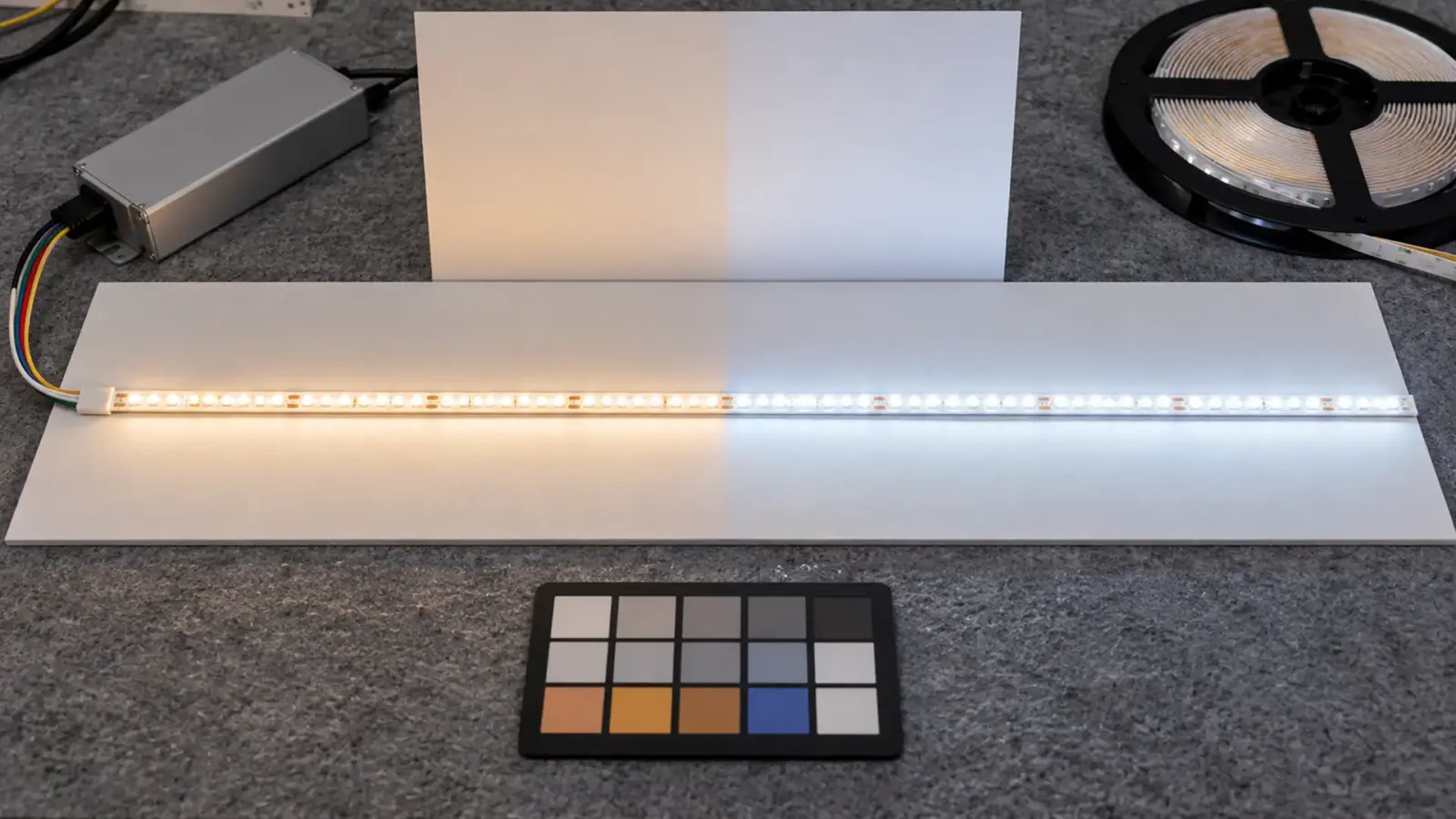
Three of our COB strips list a maximum run: 16 ft (5 m) per feed, 32 ft (10 m) with no voltage drop, and 65 ft (20 m) from a single feed. The same column holds three meanings. A commercial LED strip spec sheet has to answer six questions, in this order: environment, voltage, light output, color, control and documents.
Gate 1, Environment: What the IP and Location Lines Promise
The environment line on a spec sheet gives an IP code and an operating temperature range. The IP code is a lab result: the first digit is dust, the second is water, and the test comes from IEC 60529. It does not say where the strip may be installed. That answer is a dry, damp or wet location marking on the listing, and a strip can carry one without the other.
Ask for both, plus the parts around the strip. A strip rated IP67 on a spec sheet still needs a driver and connectors that match the location. Our wet location guide covers the split in detail. For indoor commercial work the line to find is IP20 or higher, the temperature range, and any note on mounting in a channel for heat. Read the temperature range against where the strip sits, not against the room: a strip in a sealed cove or an unventilated channel runs warmer than the ambient reading on the sheet.
Gate 1 is passed when the sheet states the IP code, the location marking or the listing it comes from, and the temperature range, and when you can name the driver and connector rating for the same location.
Gate 2, Voltage and Run Length: What “Max Run” Means
Voltage decides how long a run can be before the far end dims. The spec line is “max run”, and it is the most misread line on a strip sheet. In our COB tables, the same column holds five different statements:
| Model | Max run as listed | Voltage | What to ask |
|---|---|---|---|
| UT-C320-8 | 16 ft (5 m) per feed | 12V / 24V | How many feeds does my layout need? |
| UT-C384-8 | 32 ft (10 m) with no voltage drop | 24V | Is the figure per feed or per run? |
| UT-C960-15 | 10 ft (3 m) per feed | 24V | High density shortens the feed length |
| UT-C480-8-48V | 65 ft (20 m) single feed | 48V | Does my driver output 48V? |
| UT-C480-8-CC | 65 ft (20 m) constant current | 24V constant current | Do I have a constant-current driver? |
A 16 ft feed and a 65 ft single feed are different circuits. The first is a constant-voltage strip that needs a new feed point every 16 ft, the last two are long-run designs that change the driver. Read the column together with the voltage and with the word after the number. The cause and the fixes are in our voltage drop guide, and the driver side is in the power supply sizing guide. The COB LED strip range lists the limit for every model.
Take a 40 ft (12.2 m) corridor cove on UT-C320-8 at 24V. The sheet says 16 ft (5 m) per feed, so the run needs three feed points, not one. The load is 40 ft times 2.4 W/ft, which is 96 W, and at our 80% rule the driver needs a rating of at least 120 W. The feed count, the load, the driver size and the voltage all come from reading one row correctly.
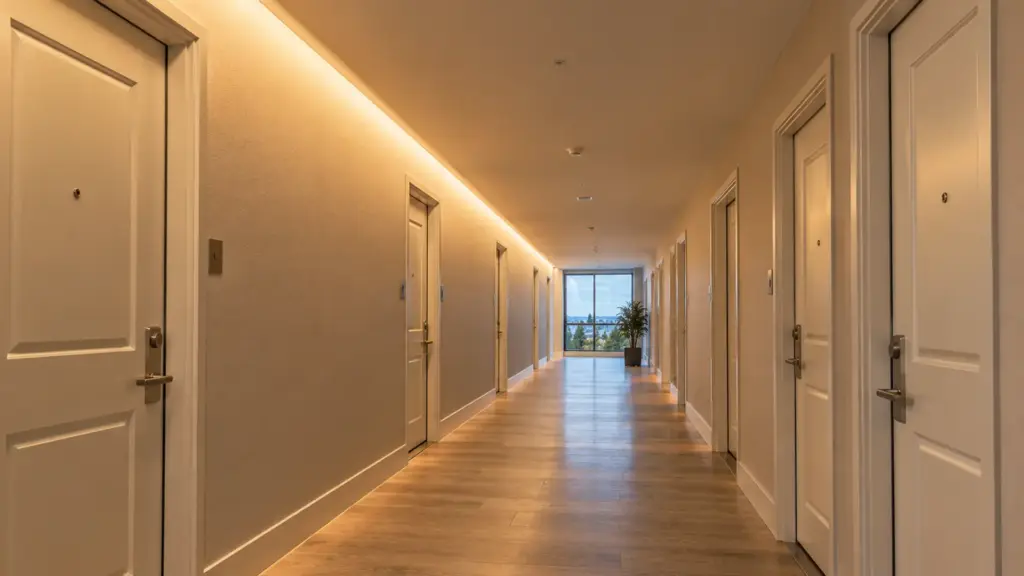
For 120V strip the voltage line also decides the dimming method, which is gate 5.
Gate 2 is passed when you know the voltage, what the run limit counts, the number of feeds your layout needs, and the driver type.
Gate 3, Light Output: W/ft, lm/ft and lm/W
Three numbers describe output, and they answer different questions. Watts per foot sizes the driver. Lumens per foot is the light you get. Lumens per watt is the ratio of the two. A spec that gives only watts per foot says how much power you will buy, not how much light.
Check the units first. Many sheets list lumens per meter. According to Elstar’s lumens guide, dividing lm/m by 3.28 gives lm/ft; a 1,008 lm/m rating is 307 lm/ft. Check that every row on the sheet uses the same unit before you compare strips.
Then check the conditions. A lumen figure belongs to a drive current, a temperature and a measurement method. If the sheet does not say how the number was obtained, treat it as a rating, not a measurement. Our SMD full-spectrum rows show how this looks in practice:
| Model | Power | Light output as listed | Efficacy, calculated |
|---|---|---|---|
| UT-SFS160-8 | 2.9 W/ft | 307–365 lm/ft | about 105–125 lm/W |
| UT-SFS80-10 | 4.4 W/ft | 439–483 lm/ft | about 99–109 lm/W |
| UT-SFS160-8-HO | 5.9 W/ft | 585–702 lm/ft | about 99–118 lm/W |
The ranges are the listed minimum and maximum, and the efficacy is lumens divided by watts at each end. Design to the low end. The high-efficacy 2835 row is listed the other way round: UT-S2835-128-HE gives 190 lm/W for the whole strip at 2.9 W/ft, about 550 lm/ft. When a sheet lists efficacy, multiply by watts per foot to get lumens per foot. If a cove needs 300 lm/ft, UT-SFS160-8 at 307 lm/ft clears it with almost no margin; a spec that depends on the top of the range fails on the low reel. Two strips at the same watts per foot can differ a lot in light, which is the subject of our lumens per watt article, and the target for a given space is in the lumens per foot article. The SMD LED strip range carries the full-spectrum series.

Gate 3 is passed when watts per foot, lumens per foot and the test conditions are all on the sheet, in the same units as the strip you are comparing it with.
Gate 4, Color: CCT, CRI, R9 and Binning
Color has four lines. Correlated color temperature (CCT) sets the tint of white. Our COB and SMD tables list 2700K to 6500K by model. Color Rendering Index, 0–100: how truthfully the light shows colors next to a reference source. Ra≥90 is the usual bar for interiors., written Ra on our sheets, is a score out of 100; most of our COB and SMD rows list Ra of 90 or higher, and the high-CRI rows go higher, such as Ra of 95 or more on UT-S2216-300, Ra of 97 or more on UT-SC320CRI97-15 and Ra of 98 or more on UT-S2835-480-FS.
Two lines do not appear on every sheet and matter more on a long job. The first is R9, the red component. According to Jarvis Lighting’s guide, CRI averages eight test colors, so a strip can score well and still render reds poorly, which shows up on skin tones and food. The second is binning, written as SDCM or MacAdam steps. It measures how much the tint varies from reel to reel. One vendor’s table calls 3 steps or fewer professional grade and 5 or fewer standard for general lighting (Ledpoint); that is one vendor’s grading, not a standard. If the sheet has no tolerance, ask for one before you order multiple reels. A label such as 3000K on two sheets from two makers is a name, not a measurement; the chromaticity tolerance is what makes the label comparable. Our high-CRI article covers the CRI choice, and the color temperature article covers where to use which tint.
Gate 4 is passed when the sheet gives CCT, CRI with the R9 value if color matters, and a binning tolerance for adjacent reels.
Gate 5, Control: What the Strip Line Cannot Tell You
A line that says “dimmable” is not a control spec. Dimming is done by the driver and the controller, and the protocol has to match both: 0-10V, TRIAC, DALI, DMX or an RF controller. A 0-10V driver such as UT-D96-24-010 and a TRIAC driver such as UT-D60-24-TRC are different parts, and a dimmer made for one will not work on the other.

A controller also has its own maximum load: 240 W for the TRIAC controller UT-CTRC-240 and 350 W for the 0-10V decoder UT-C010-350, so a 384 W run needs more than one. Ask for the control protocol of the whole system, not of the strip alone. For 120V AC strip the answer is narrower: TRIAC or ELV dimming only. For RGB, RGBW and addressable strip the controller is part of the specification, and the strip sheet should name the signal type and the number of channels. Our dimming guide compares the methods, and the 120V versus 24V article covers where line voltage fits.
Gate 5 is passed when the dimming or control protocol is named for the driver and the controller, and the strip is listed as compatible with it.
Gate 6, Documents: Which Report Answers Which Question
A spec sheet is a manufacturer’s statement. The documents behind it are what you can check. They answer different questions, and none of them is a pass or fail on its own.
| Document | What it answers | What it does not answer |
|---|---|---|
| Spec sheet | The rated values for the model | How the numbers were measured |
| LM-79 report | Light output, power, efficacy, color and distribution of the whole product, at the start of life | How the product ages |
| LM-80 report | How the LED source loses light over at least 6,000 hours of testing | The life of the whole strip |
| TM-21 projection | An estimate of source light loss beyond the test period, such as L70 | A measured life |
| Listing (UL, ETL) | The product was evaluated to a safety standard, within its scope | Light quality |
| IES file | The light distribution for layout software | Safety |
The first four rows follow DOE’s explanations of LM-79, LM-80 and TM-21, which date from 2008 to 2014, so check the current editions when you write them into a specification. DOE also stresses that these are test methods, not compliance ratings. For listings, the point that matters is scope: a listing covers a named product, and the mark alone does not say so. We cover that in the UL and ETL article.
Gate 6 is passed when each claim on the sheet has a document you can open, and the document names the same model.
Red Flags on a Spec Sheet
| What you see | Why it matters |
|---|---|
| Lumens with no current or temperature | The number may not hold in your installation |
| Lumens for the whole reel, not per foot | Reels of different lengths cannot be compared |
| “Max run” with no unit after it | The figure may be per feed or per run |
| CRI with no R9 on a color-critical job | Reds may look wrong |
| No binning tolerance on a multi-reel order | Adjacent runs can differ in tint |
| “Waterproof” with no IP code or location marking | The claim cannot be checked |
| A certification logo with no file or model | The mark may not cover your model |
| “Dimmable” with no protocol | The control may not work on your driver |
| Typical values with no minimum | You may plan on a number the reel does not reach |
| No cut increment or PCB width | The channel and the last piece cannot be planned |
FAQ
What is the difference between lm/ft and lm/m on an LED strip spec sheet?
Both measure light output over length, in different units. Divide lumens per meter by 3.28 to get lumens per foot. For example, 1,008 lm/m is about 307 lm/ft. Convert every row to the same unit before comparing strips.
What CRI should a commercial LED strip have?
Ra of 90 or higher is listed on most rows of our COB and SMD tables, and it suits most commercial spaces. Where color judgments are made, such as retail, healthcare or art, use a higher-CRI series and ask for the R9 value, since the CRI average can hide weak reds.
What does SDCM mean on an LED strip spec sheet?
Color-consistency steps (MacAdam ellipses). Fewer steps means two strips from different reels look like the same white; 3-step is hard to tell apart by eye., also called MacAdam steps, measures how much the tint varies from one LED or reel to another. A lower number means more consistent color. It matters most when adjacent runs from different reels are seen together, so ask for the tolerance in writing. Every other term on the sheet, from Duv to LM-80, is defined in our LED strip lighting glossary.
Does the IP rating on a spec sheet say where the strip can be installed?
No. The IP code is a lab test of dust and water ingress. Where the strip can be installed is set by its location marking and listing, and by the driver and connectors on the same run.
Before You Order
- Environment: IP code, location marking, temperature range, and matching driver and connectors.
- Voltage: what the run limit counts, the number of feeds, and the driver type.
- Output: watts per foot, lumens per foot and the test conditions, in one unit.
- Color: CCT, CRI with R9, and a binning tolerance.
- Control: the protocol for the driver and the controller.
- Documents: a file for every claim, naming your model.
Need the numbers for your job? Our COB LED strip and SMD LED strip spec tables list every run limit and cut interval, and we can check the supply for your layout. Request a quote.