An LM-79 report proves what one complete sample of the finished product measured when it was new: light output, power, efficacy, color and distribution. It does not prove how long the product lasts, and it applies only to the exact model, color temperature and drive settings tested. Check the match before you trust the number.
A datasheet says 3000K, 90 CRI and a lumens-per-foot figure, and the owner’s rep asks for the report behind it. Three standards get named in the same breath, LM-79, LM-80 and TM-21, and they answer different questions. This article takes LM-79 apart, shows how to check a report against the model you are buying, and says what it cannot prove.
What LM-79 Measures
According to the summaries we reviewed, LM-79 is the approved method for electrical and photometric measurement of solid-state lighting products. It tests the complete product, not a bare LED, and the results apply to the product as tested. A report covers five things:
- Total luminous flux. The light output, in lumens, of the whole product.
- Electrical power. The watts drawn, measured at the input.
- Efficacy. Lumens divided by watts, from the two numbers above.
- Chromaticity. The color of the light, from which CCT and the color rendering data come.
- Intensity distribution. How the light is spread, for products where direction matters.
The lumens-per-watt figure on a datasheet should trace to the first three lines. Our guide to rated or delivered lumens per watt shows why the same strip can carry two different figures.
Sphere or Goniophotometer
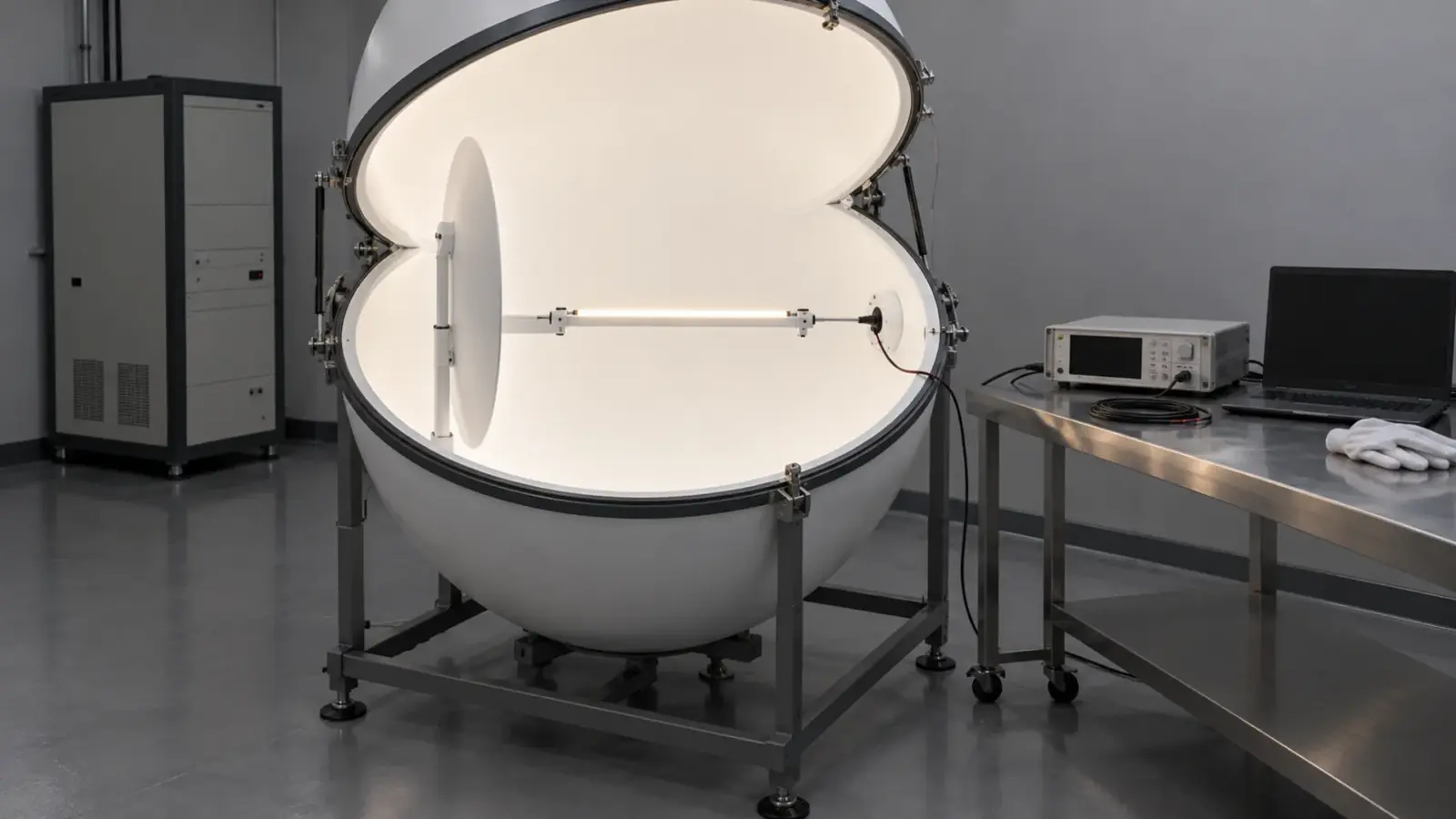
Two instruments produce these numbers. An integrating sphere is a hollow ball coated in white, with the sample inside. It collects all the light the sample emits and reports total flux and color in one measurement, which is why the report for a strip often names it. A goniophotometer measures light at many angles around the sample and builds the distribution, which becomes the IES file a designer loads into software.
For a flexible strip the choice matters. A sphere reads total output well and says nothing about where the light goes; a strip behind a lens or in a channel needs the distribution of the whole assembly, not the bare tape. Our COB page says full photometric files and IES data ship with a quote; the file you receive should say which instrument made it and what was in the beam.
Where the Datasheet Number Comes From
A datasheet is a summary written by someone who may or may not have the report in front of them. The lumens per foot on it can come from three places: a measured LM-79 sample, a calculation from the LED maker’s chip data, or a rounded sales figure. The first is evidence, the second is an estimate and the third is a claim. Ask which one it is. Where the number comes from a calculation, it is an estimate of the chips and says nothing about the strip as built, with its board, its coating and its drive current, and the finished product usually delivers less than the chip data suggests. That gap is the reason the report exists.
A Report, Checked Line by Line
Leotek’s buyer checks for LED luminaires apply to strip with small changes. Read a report against the model you are buying, field by field.
| Report item | What it proves | What to check for strip |
|---|---|---|
| Model or catalog number | Which product was tested | The exact model, not a family name |
| CCT, CRI and bin | The color of that sample | The same CCT and bin as the order |
| Drive current or wattage | The condition the numbers belong to | The same current as the installed driver output |
| Sample length | How much strip was measured | A real length, and how the number was scaled per foot |
| Ambient temperature and stabilization | Whether the sample was warm | Warmed to steady state, at a stated temperature |
| Date and laboratory | When and where | A date, a named laboratory, a standard edition |
| Flux, power, efficacy | The headline numbers | Do they match the datasheet within a stated tolerance |
| Distribution (IES) | The light pattern | Whether it covers the strip alone or the strip in its channel |
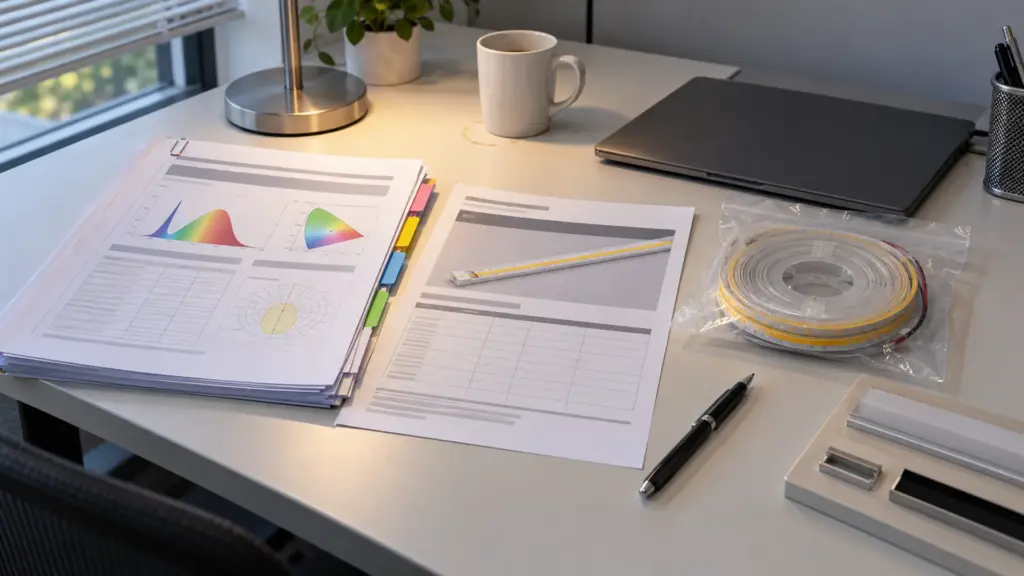
A report that fails the first row fails the rest, because the numbers belong to a different product. The most common problem is the family name: a report for “the 2835 series” is not a report for UT-S2835-120.
Sampling a Strip: Length, Current and Heat
A reel is long and a sphere is small, so strip is usually tested as a short length and the result is scaled to per foot or per reel. That is acceptable if the length is stated and the strip is measured at steady state. Three details change the number.
- Length. A 1 ft sample and a 16 ft run do not behave the same: the longer run warms along its length and loses a little output at the far end.
- Drive current. Constant-voltage strip is tested at its rated voltage; a driver that delivers less gives less. Constant-current strip depends on the set current.
- Heat. A strip tested bare, on a cold plate, outputs more than the same strip in a closed channel. Ask what it was mounted on.
Our lumens per foot guide explains how to convert a report to the number a design needs.
A Worked Check: One Report Against One Order
The numbers below are an invented example, labeled as such, to show how the check runs. A report arrives with a datasheet for an order of 4000K strip.
| Item | Order | Report | Result |
|---|---|---|---|
| Model | The 120 per meter strip, 4000K | “2835 series, 4000K” | Fails: a family name, ask for the model |
| CCT and bin | 4000K, one bin | 4000K, bin not stated | Ask for the bin |
| Drive | 24V constant voltage | 24V | Passes |
| Sample length | Not stated | Not stated | Ask for the length and the scaling |
| Efficacy | Datasheet figure | Within a few percent | Passes if the model matches |
| Date and lab | Within the last few years | Named lab, dated | Passes |
Three rows pass, one of them only if the model matches, one fails and two need an answer. None of this says the strip is poor; it says the report cannot yet be tied to the order. A good supplier answers the questions in one email, and the answers go into the file.
Tolerance and Bins
A report states what one sample measured, and production varies around it. Two things govern the spread. The first is the bin, the color and flux range each reel is selected from; our guide to why the second reel does not match covers it. The second is the tolerance in the datasheet, the range around the stated lumens, watts and CCT. Ask what the tolerance is and check that the report sample sits inside it. A figure with no tolerance is a promise with no edge.
Questions to Send With the Request
When you ask a supplier for the report behind a datasheet, send the model list and these questions:
- Which exact model, CCT and bin does the report cover?
- What sample length and drive current were used, and how was the result scaled?
- At what ambient temperature and after what warm-up?
- Which laboratory, which date and which standard edition?
- Does the distribution file cover the strip alone or the strip in its channel?
- Which models in the quote have no report, and what covers them?
Keep the answers with the report. A project that asks for them at the start pays nothing; one that asks after a rejected submittal pays in weeks.
What LM-79 Does Not Prove
LM-79 is a snapshot of a new product. It does not describe aging, and that is the job of two other documents. According to the summaries we reviewed, LM-80 measures lumen and color maintenance of LED packages, arrays and modules over a minimum of 6,000 hours, with 10,000 hours preferred, and TM-21 uses that data to project maintenance beyond the test, limited to six times the test period. A 6,000 hour LM-80 report cannot support a projection beyond 36,000 hours, and a TM-21 projection is a calculation and not a test that ran for the projected hours.
Leotek makes the further point that these methods address the LED source and not the driver, connectors, seals or optics, which can fail independently, and that an L70 value is a light-output threshold, not a moment when the product shuts off. Our guide to LED strip lifespan walks through the chain.
LM-79 also does not prove a listing, a safe installation or a warranty. Those are separate documents, covered in our UL listing guide.
Red Flags
Leotek lists signs that a claim has no evidence behind it. Applied to strip:
- an hour value or a lumens-per-watt figure with no report;
- a report with no model, a family name, or an unidentified LED;
- no sample length, no drive current or no ambient temperature;
- a missing laboratory, date or standard edition;
- a projection presented as a warranty.
Any one of these is a question to ask the supplier, and a request for the missing page, not an accusation. If the page cannot be produced, the figure on the datasheet is a claim.
Using It in a Submittal
Put the report in the submittal beside the datasheet, with the model, CCT and bin highlighted. Our submittal package guide shows where each page goes, and the spec sheet guide shows the six questions a datasheet must answer. Our certifications page states that LM-80 lumen-maintenance data options are available, that coverage varies by model and that documents are confirmed at quote. If a project requires an LM-79 report for a specific model, say so with the model list and we confirm what exists before the order.
The Short Version
LM-79 measures the whole product when it is new: flux, power, efficacy, color and distribution. LM-80 and TM-21 speak to how the LED source ages. None of them is a listing. Match the model, the CCT, the current and the sample length before you trust a number, and ask for the page when it is missing.