Sometimes, usually because a green-building coordinator has a material-ingredients credit to document. The request names a document: a Health Product Declaration (HPD), an Environmental Product Declaration (EPD), a Declare label or a manufacturer inventory. They answer different questions, and an LED strip supplier should say plainly which, if any, it can provide.
The submittal log has a line like this for the strip: “material disclosure: HPD, EPD or Declare.” What is being bought is a reel, a driver and a channel, and the coordinator who wrote the line may never have seen any of them.
Four Documents, Four Questions
| Document | The question it answers | Who writes it | What the programs say |
|---|---|---|---|
| Manufacturer inventory | What is in it? | The maker | LEEDuser’s summary of the LEED v4 credit: a public list of ingredients by name and CASRN or EC number, with a hazard screen for any withheld trade secret |
| HPD | What is in it, and what health information goes with it? | The manufacturer or its preparer, in HPD Builder | The HPD Collaborative: “a standardized report of a product’s contents and associated health information, following the HPD Open Standard” |
| Declare label | Are the ingredients disclosed to 100 ppm, and where does the product sit against the Red List? | The manufacturer, on a public database | ILFI: “a platform to share and find healthy building products,” where manufacturers voluntarily disclose product information; Hatch Lighting, a driver maker, says most listings are self-disclosed, with optional third-party certification |
| EPD | What does making and using it do to the environment? | The manufacturer, verified by a third party | Wikipedia: it “quantifies environmental information about the life cycle of a product,” from a life cycle assessment, and is “a transparency tool” that does not certify a product as environmentally friendly |
The Declare label has three statuses, as Hatch Lighting and Luminii describe them (Hatch calls the third “LBC Compliant”, Luminii “Declared”). Red List Free means the product discloses 100 percent of its ingredients at or above 100 ppm and contains no Red List chemicals. Red List Approved means it discloses at least 99 percent and meets the Red List through approved exceptions. The third means it discloses 100 percent but contains one or more Red List chemicals not covered by an exception. Hatch adds that the Red List is updated every year, usually in January, so a label’s date matters.
The four do not substitute for each other in our reading. An EPD answers the life-cycle question, and ingredient disclosure is a separate ask. Handing over the wrong one answers a different question, and the coordinator is likely to ask again.
Where the Request Comes From
The usual source is a green-building credit. LEEDuser’s summary of LEED v4 Building Product Disclosure and Optimization, material ingredients, sets Option 1 at 20 different permanently installed products from at least five manufacturers, each disclosing its chemical inventory to 0.1 percent (1,000 ppm). Accepted documents include a manufacturer inventory, an HPD and a Declare label that shows disclosure to that level.
The number matters to a supplier. Under Option 1 the count is a project-wide minimum, so one trade’s gap is not decisive. That is a reason to answer plainly and early, not a reason to stay silent.
Read the version before answering. This summary covers LEED v4. LEED v4.1 and v5 are separate versions with their own credit text, and the project’s own contract language, an owner standard or WELL may ask for something else. Ask for the line in the specification, not for a paraphrase.
LEEDuser’s summary of the v4 credit has a second route, Option 2, material ingredient optimization, which asks for more than disclosure. Products are valued by cost and the total has to reach at least 25 percent of the value of the permanently installed products, through paths such as a GreenScreen benchmark, a Cradle to Cradle certificate or REACH optimization. Ask the coordinator which option the project is pursuing; a disclosure document and an optimization assessment are different asks.
Component or Finished Product
For lighting, Hatch Lighting, a driver maker writing for fixture makers, says that “Declare labels are only offered for completed lighting fixtures,” that “LED Drivers cannot be Declare certified on their own,” and that a driver “can be added to the ‘Ingredients’ section of a Declare label as long as it’s RoHS compliant.” It calls the small-electrical-components exception, RL-002b, one of the most significant for fixture makers and says the only condition is that the electronic modules meet RoHS.
For a strip job the pieces are a reel, a channel, a diffuser, a driver and connectors, assembled into one installed system. Luminii’s Declare page lists “LED Strip/Backlighting” among the categories of its Declare products, under its Optic Arts brand, so a Declare listing for strip exists at least at one maker. We did not confirm which SKUs it covers, or whether a label covers a reel sold as a component. Ask the maker for the listing by SKU, and ask the coordinator which product the line is for: the strip system as installed, or a finished fixture.
A Typical Submittal Line
Take a typical hospital log, an illustration and not a named job. The coordinator lists the lighting products and who has what:
| Line | What the coordinator hopes for | What often exists, in our reading |
|---|---|---|
| Luminaires from a fixture maker | A Declare label or an HPD | A luminaire maker may hold one, as Hatch Lighting describes for fixtures that use its drivers |
| Strip, from a strip supplier | An HPD, a Declare label or an inventory | Often a RoHS statement and a listing, with documentation on request |
| Channel and diffuser | An inventory or an EPD | Unknown until the maker is asked |
| Driver | Covered as an ingredient of a fixture label | Listed as an ingredient only where a fixture label exists |
The last column is our reading, not a survey. The point of the table is the first column: the coordinator is collecting documents across a building and may expect some lines to come back empty.
The Honest Answer
Our product pages say what we can say. Products come from qualified manufacturing partners and “are available with UL Listed, ETL Listed, FCC compliant, RoHS compliant and other applicable configurations.” Certification coverage varies by model, certification is held by the original manufacturing partner, and documentation is available on request, matched to your exact SKUs. Nothing on our pages offers an HPD, an EPD, a Declare label or an ingredient inventory.
That leaves a three-line answer for any strip supplier without those documents:
- If no HPD, EPD or Declare exists for the model, say so in one line. Do not substitute a certificate that answers a different question.
- Offer what exists: RoHS documentation for the model, and a component or material statement if the maker provides one. Our FCC and Prop 65 guide explains why we do not state Prop 65 conclusions ourselves.
- Ask which credit, which version and whether a manufacturer inventory would satisfy it.
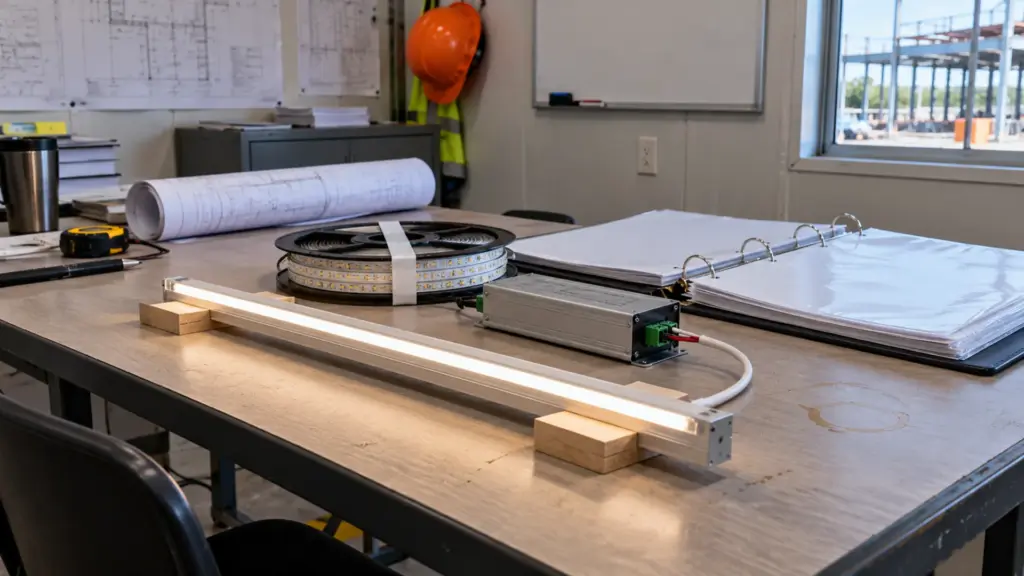
RoHS compliance is a statement about restricted substances, which is not a list of what a product contains. Hatch uses it as the entry condition for the driver exception, and that is a separate job from disclosure.
What to Send With It
A reply that closes the line has four parts:
- The model numbers by line: strip, driver, channel, connector.
- The documents that exist, matched to those SKUs, and a statement of which do not.
- The credit and version the answer was written against.
- A contact for the maker’s documentation, and a date by which more can be supplied.
A reply can be short. For example: “Line [12], strip model [UT-…]: no HPD, EPD or Declare label exists for this model. Attached: RoHS documentation for the model and the listing record. Written against LEED [v4], Option 1; please confirm whether a manufacturer inventory would satisfy the line, and we will request one from the maker.” It closes the line, shows what was not available, and asks the one question that moves the credit.
The submittal package guide lists the rest of what goes in the binder, and the certifications page states what we hold and how we describe it.
FAQ
Does LED strip need a Declare label?
No source we read says a project requires one for strip. Declare is a voluntary program: manufacturers share product information on labels posted to a database. A project may ask for one, and the answer is to say what exists for the model.
Is an HPD a certification?
The HPD Collaborative defines it as a report of a product’s contents and associated health information, written by the manufacturer. Its home page links to a Third-Party Verification Program without explaining it. Treat an HPD as a disclosure document, and ask whether the project wants it verified.
Does RoHS compliance count as material disclosure?
It is not in the list of documents LEEDuser’s summary of the v4 credit accepts. It does appear as the condition for the driver exception in Hatch’s account of Declare labels for fixtures. It speaks to restricted substances, not to what the product contains.
What if the coordinator insists on an HPD?
Say what exists, offer to ask the manufacturer, and do not substitute another document. Under Option 1 of the v4 credit as LEEDuser summarizes it, a manufacturer inventory is also an accepted document, so ask whether that would satisfy the line.
Will every hospital or university ask for this?
We did not find a rule that applies to all of them, and we did not read any owner’s standard. Some projects pursue LEED credits that use these documents. Look for the line in the specification, or for the coordinator’s request.
What to Verify with the Project Team
- Which credit and which version is the request written against?
- Which documents does the team accept: an inventory, an HPD, a Declare label, an EPD?
- Which products on the strip job count toward the team’s total, and which are not being asked for?
- Is the line for the strip system as installed or for a finished fixture?
- Who collects the answers, and by what date?
Send the line from the submittal log with your request a quote, and we will tell you which documents we can obtain for the models on it.