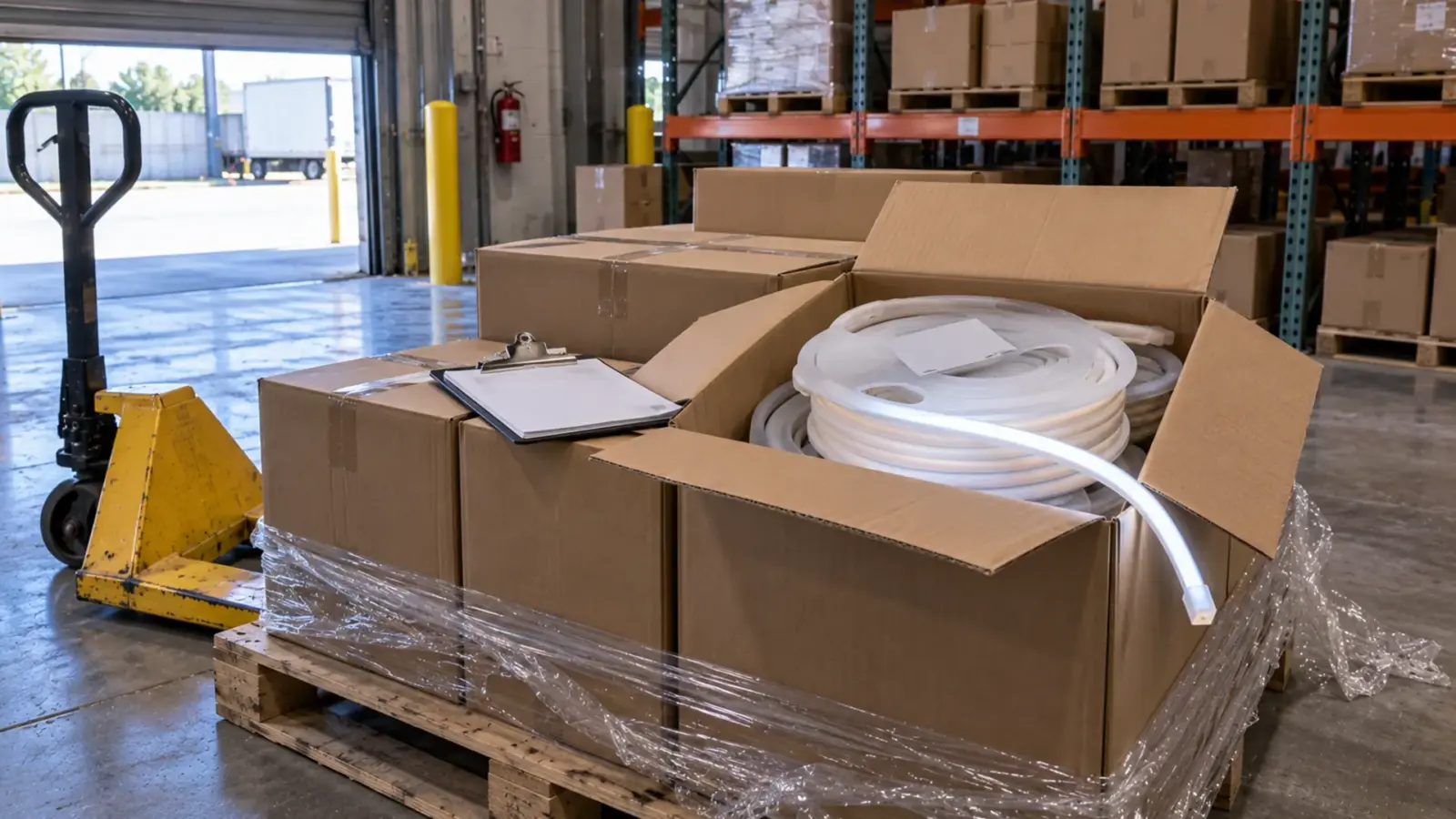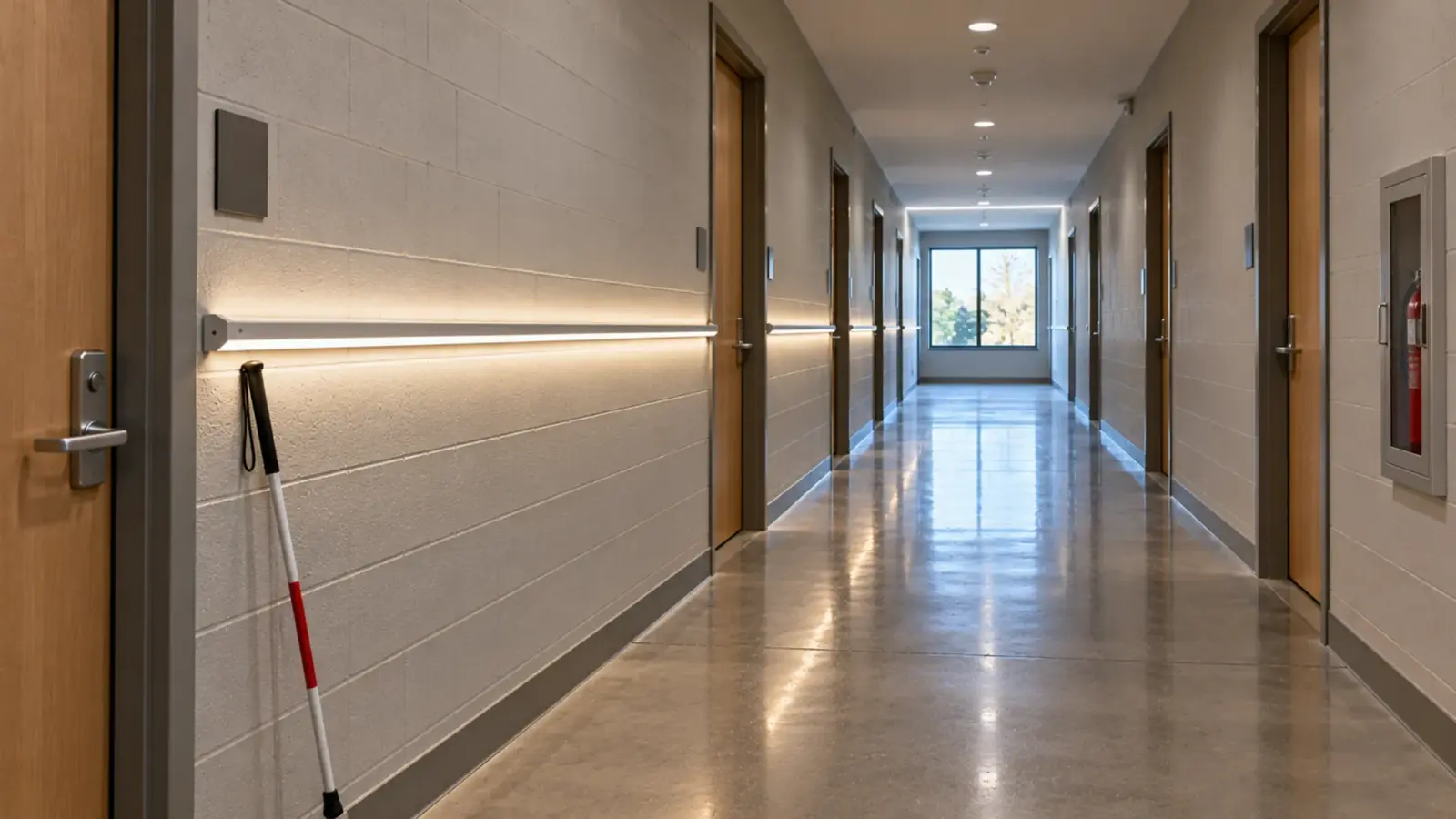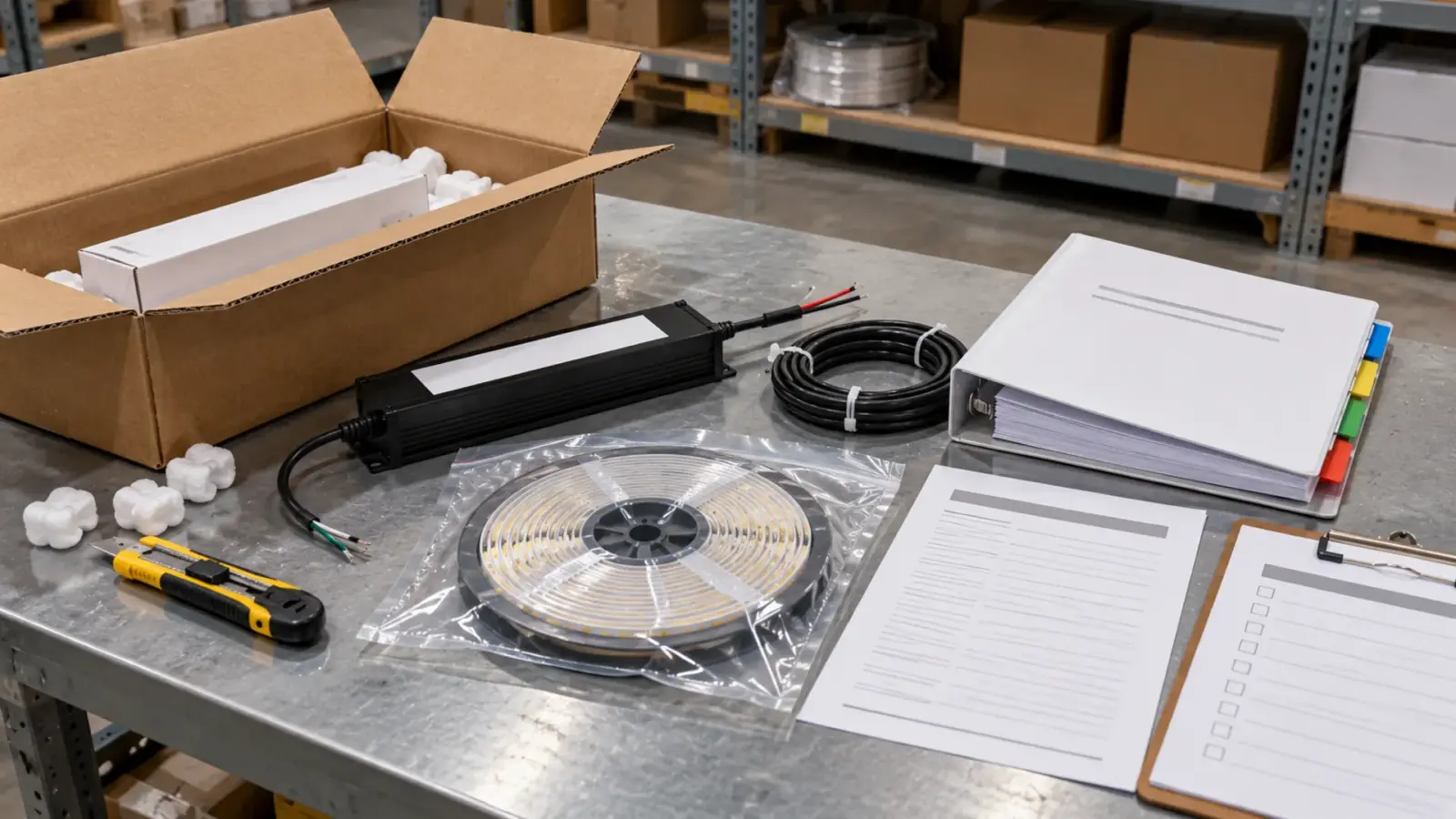
Beyond UL, three checks apply to LED strip systems sold in the US: FCC Part 15 for the electronics, a Prop 65 assessment for the cable and components, and product marking and labeling. Each has a different responsible party, and a UL listing answers none of them. This article is a framework, not legal advice.
The submittal has the UL listing, the owner’s rep asks for the FCC statement, and the distributor asks whether a Prop 65 warning goes on the carton. Three questions, three different rule books, and one supplier file that has to answer all of them. Here is how each one works and what to ask for.
Why UL Does Not Cover These
A UL listing is a safety evaluation: shock, fire, construction and marking of the system. Our guide to UL 2108, UL 8750 and UL 1598 covers what it does and does not say, and how to look up a listing shows how to verify one. It does not measure radio noise, chemicals, or whether a label is right.
| Question | Regime | What it covers | Responsible party | What to ask for |
|---|---|---|---|---|
| Does the electronics disturb radios? | FCC Part 15 | Radio-frequency emissions of drivers and controllers | Manufacturer, or the importer when imported | Test report or declaration for the exact model |
| Does the product expose people to a listed chemical? | California Prop 65 | Cable jackets, solder, plastics, components | The business that sells in California, including distributors | Supplier’s component statement and any exposure assessment |
| Is the product marked correctly? | Marking rules | Ratings, model, listing mark, FCC statement, warnings | Manufacturer and importer | A label drawing and photo of the actual label |
| Is the listing valid? | UL or ETL | Safety of the system | Listing holder | Listing number and scope |
The responsible party is the point. If the company that imports the strip is the one that declares compliance, it carries the obligation, whatever the supplier’s paperwork says.
FCC Part 15: What Applies to Strip, Drivers and Controllers
LED strip is mostly passive: chips, resistors and copper on a flexible board. The part that switches fast and can disturb radios is the electronics around it: the driver and any controller. That is where the FCC question sits.
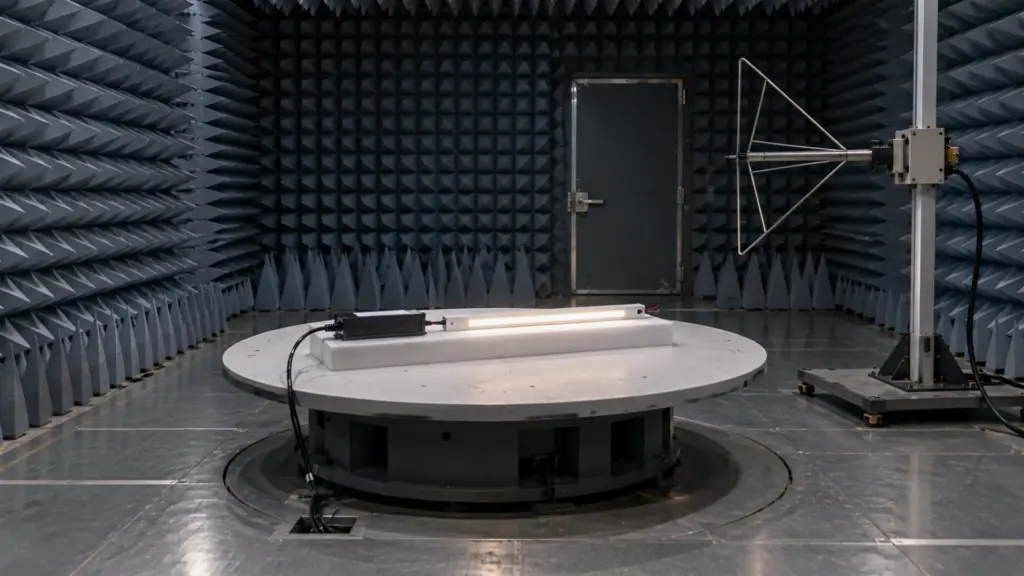
According to an Intertek fact sheet on radio-frequency lighting, LED lighting devices are not treated as RF lighting devices under Part 18, which covers fluorescent and high-intensity types. LED products are evaluated under Part 15, as unintentional radiators. The sample supplier’s declarations of conformity we reviewed cite 47 CFR Part 15 Subpart B and the ANSI C63.4 test method, and carry the standard Part 15 statement that the device complies with Part 15 of the FCC rules.
The route depends on what the product does:
- No radio function, such as a driver or a wired controller. According to Intertek, this is usually authorized by Verification or a supplier’s declaration of conformity, with no certification filing.
- A radio function, such as a 2.4G RF remote or a wireless controller. The radio is an intentional radiator and goes through Certification.
Our controller table includes an RF controller, UT-CRF-24G, that works on 2.4G, so that class applies to it. Whether a particular model has the right paperwork is a question for its test report; this article does not say.
Responsibility follows the product. According to a supplier’s declaration we reviewed, the manufacturer, or the importer if the product is imported, is responsible for compliance under 47 CFR 2.909(b). Verify the current text of the rule, because these are supplier documents and the rule can change.
Our certifications page states that FCC compliant options are available for the drivers and controllers in our systems, that the certification is held by the original manufacturing partner, and that coverage varies by model. The documents for a specific model are confirmed at quote. The drivers are described on the drivers, controllers and connectors page.
Prop 65: A Warning Question, Not a Ban
California’s Proposition 65 does not ban a product. It requires a clear and reasonable warning when a product exposes people to a listed chemical above a threshold, unless the exposure is below the safe harbor level. The duty runs through the chain: according to the compliance guides we reviewed, manufacturers, distributors and retailers all have it.
For LED strip systems, the question is usually the cable. According to California Attorney General records, DEHP in the vinyl cords of portable lighting products has been the subject of complaints and a consent judgment that named importers and distributors. The chemical sits in the PVC jacket as a plasticizer, and lead has appeared in solder and brass fittings in other lighting complaints. A strip system has cable, connectors, solder and a driver housing, and each is a candidate. Ingredient and material disclosure sits beside Prop 65; see HPD, EPD and Declare for LED strip.
Two statements from LED component makers describe how the chain works. LEDiL and Cree both say, in their Prop 65 statements, that the presence of a listed chemical does not by itself require a warning, and that incorporating their components into a higher-level product can create a warning obligation for the product that goes on sale. That obligation lands on whoever sells in California.
What to ask a supplier for:
- the jacket material of every cable and lead, and whether it is PVC;
- a component statement or a test report for listed chemicals;
- whether an exposure assessment was done and which safe harbor it used;
- who will print a warning if one is needed and where it goes.
We do not publish a safe harbor figure here. The numbers come from the state’s regulations and change; ask counsel or an accredited lab for the current values and for the conclusion on your product.
Who Holds Which Obligation in the Chain
The same product passes through several hands, and each regime lands on a different one. A rough map helps decide what to ask whom.
| Party | FCC | Prop 65 | Marking |
|---|---|---|---|
| Manufacturer | Tests and holds the report or declaration | Knows the materials and can state them | Prints the product label |
| Importer | Responsible when the product is imported, according to the supplier declarations we reviewed | Carries the duty if it sells in California | Responsible for the carton and the origin marking |
| Distributor | Should hold a copy of the declaration | Carries the duty in California, as in the enforcement records | Checks the label matches the documents |
| Contractor or specifier | Asks for the declaration in the submittal | Asks for a statement where a project calls for one | Checks the labels on delivery |
A distributor or a contractor who buys from a US seller is usually one step removed from the FCC filing and still close to the Prop 65 duty, because both sell into California. When the seller imports, it takes the first step for you; when you import, you take it yourself.
Marking and Labels
A product carries marks for each regime. They sit in different places and belong to different people.
| Mark | Where | Source |
|---|---|---|
| Model number, voltage, power | On the product or reel and the driver housing | Manufacturer |
| Listing mark and number | On the listed product, with the standard it was evaluated to | Listing holder |
| FCC statement | On the device or in the manual, as the declaration format requires | Manufacturer or importer |
| Prop 65 warning | On the product, the carton or the point of sale, when one is needed | Seller in California |
| Country of origin | As customs rules require | Importer; check with a customs broker |
Two cautions apply to labels. A listing mark belongs only to the listed product; a mark on a reel of unlisted strip is a false statement even if the driver is listed. And a label has to match the document: the model on the carton, the model on the test report and the model on the quote must be the same string.
Country-of-origin marking is a customs rule, and the right wording depends on the product and the route. Check it with a customs broker; we do not give conclusions here.
The Document Pack
Ask for the same pack for every model, and keep it with the submittal. The submittal package guide shows where each page goes.
| Document | Covers | Comes from |
|---|---|---|
| Listing number and scope | Safety of the system | The listing holder |
| FCC test report or declaration | Radio-frequency emissions | The manufacturer or importer |
| Component or material statement | Prop 65 and restricted substances | The supplier |
| Label drawing and photo | What is printed on the product and carton | The manufacturer |
| Model list | Which models each document covers | The seller |
A pack that mixes models is the usual problem: the driver report covers the 60 W model and the quote is for the 100 W one. Check the model strings across all documents before anything is accepted. Our guides on importing LED strip yourself versus buying through a US supplier and on choosing between a factory, an importer and a distributor show who ends up holding which obligation.
Red Flags in a Compliance File
Most compliance files fail in the same few ways, and each is visible before the order.
- A certificate with no model list. A report that names a family and not a model does not cover the model you buy.
- A declaration for the driver only. The strip, the controller and any RF remote each have their own question.
- A report with a date long before the product’s last change. If the driver was redesigned, the old report may not apply.
- A listing mark on an unlisted part. The mark belongs to the listed product, and the strip may be a different product from the listed driver.
- A Prop 65 statement that says “complies”. The law does not use that word; ask what was assessed and against which level.
- A label that differs from the document. A different model string on the carton is a documentation fault, even if the product is the same.
Each is a question to the supplier and not an accusation. Put the answers in the file and the file in the submittal.
What We State and What We Do Not
We state compliance options at product level, never for the company, and always with the original manufacturing partner as the holder. On our certifications page the plain statements are UL 2108 and RoHS compliant options; LM-80, FCC and ETL are forward-framed with “options available” and are confirmed per model. We do not state Prop 65 conclusions, because they depend on a product, a chemical and an exposure, and the proof is a test report.
If your project needs a specific statement, send the model list and the requirement and we confirm what exists for those models before it is quoted. Rebate programs that name DLC are a separate question, covered in our guide to DLC listing and utility rebates.
FAQ
Does LED strip need FCC approval?
LED strip itself is mostly passive; the electronics around it, the drivers and controllers, are the Part 15 question. Without a radio function they are usually authorized by Verification or a declaration of conformity, and with a radio function they need Certification. Ask for the test report for the exact model.
Does LED lighting need a Prop 65 warning?
Only if the product exposes people in California to a listed chemical above the safe harbor level. The usual candidates are cable jackets, solder and plastics. Ask the supplier for a component statement and whether an exposure assessment was done.
Is a UL listing enough to sell LED strip in the US?
A UL listing answers safety. It does not cover FCC emissions, chemical warnings or marking, and the responsible parties for those differ. Collect the full document pack for each model.
Who is responsible for compliance when you import LED strip?
According to the supplier declarations we reviewed, the manufacturer or, when the product is imported, the importer carries the FCC responsibility. For Prop 65, the business that sells in California carries the warning duty. Agree it in writing with the supplier and check with counsel.
What to Verify With Your Counsel and the Supplier
Before the first order, confirm four things: which regime applies to each model, who holds the declaration, what the test reports cover, and which labels go where. Put them in the supplier file with the model list. This article is a framework; the conclusions belong to the reports and to your counsel.