

Stair and Handrail Lighting with LED Strip
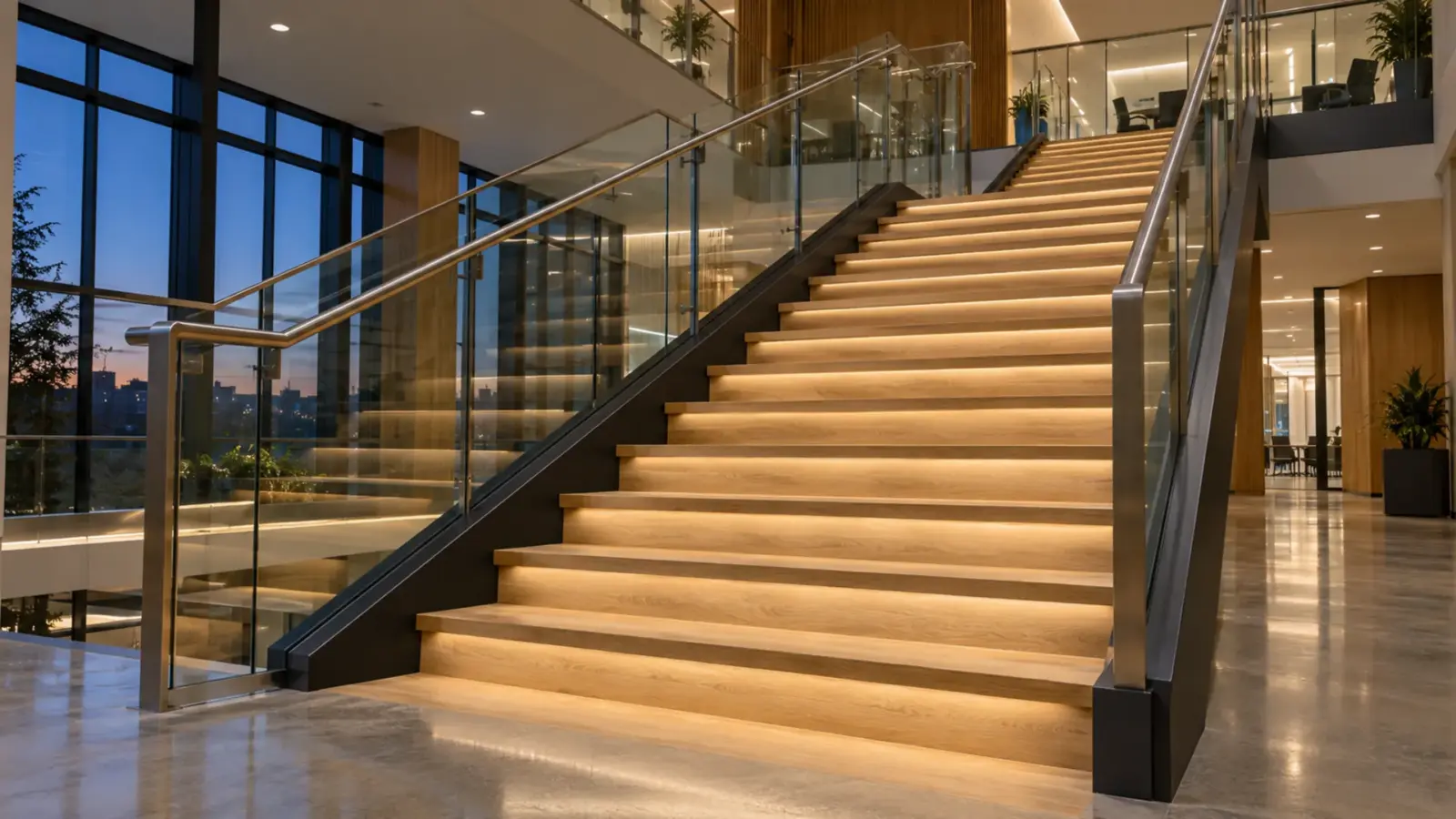
On a stair the strip has two jobs: light the treads people step on, and stay out of the eyes of people walking down. The detail at the nosing, the wall and the rail decides both.

Stair LED strip is judged on the treads, not from the landing. A good detail lights the walking surface from a hidden source, adds to the measured stair level, survives feet and cleaning machines, and leaves the handrail a rail you can grip. This page covers the three places strip goes on a commercial stair, under the nosing, in a wall slot and inside the handrail, and the strip, channel and driver we usually supply for each.
Stair details we usually supply
A starting point by detail. Every model comes from its category spec table, and the final pick is confirmed on your stair section and a mockup flight.
| Stair detail | Strip | Example models | Channel / power | Watch for |
|---|---|---|---|---|
| Under the nosing, interior stair | Dot-free COB | UT-C480-8 (3.2 W/ft), UT-C400-3 for slim nosings | UT-CH1616 corner channel, 45° aim, opal cover | Channel fixed mechanically, never tape; fit behind the nosing product |
| Wall slot or stringer, grazing the treads | Dot-free COB | UT-C480-8 | Recessed slot; UT-CH2415 where surface-mounted | Protruding-object limits for a channel on the wall |
| Inside a round handrail, 1-1/2 in | Ultra-narrow COB | UT-C400-3 (2.7/3 mm PCB, 2.1 W/ft), UT-C400-5 for a wider slot | Milled underside slot, opal diffuser flush | Grip rules of ADA 505; wire out at a bracket |
| Flat-top or rectangular handrail | CSP · Ultra-narrow SMD | UT-CSP-320-N (8 × 1.85 mm), UT-S2835-120-UN behind a deep opal cover | UT-CH1207 routed channel, strip up to 8 mm | A dotted line shows at 6 ft; keep the source dense or diffused |
| Exterior steps and ramps | Sealed outdoor COB | UT-O320-8-65 (IP65, 2.4 W/ft) under nosings; UT-O320-8-67 (IP67, 3.0 W/ft) in rails | UT-D100-24-67 potted IP67 driver | Wet location marking confirmed per model at quote; drain the slot |
| Steps at or under water | IP68 PU neon flex | UT-PU1018, as on our Abu Dhabi water terrace | Ends, joints and cable entries sealed to IP68 | Water depth and immersion time agreed before the order |
| Aisle steps in theaters and auditoriums | Dimmable COB | UT-C400-3, UT-C480-8 | 0-10V Class 2 driver, UT-D60-24-C2-010 | A show level, a full level and a fire alarm tie |
Full spec tables: COB · CSP · Outdoor · Channels & diffusers
Eight decisions on a lit stair
Settle these on the stair section and the rail shop drawings, then check them with a meter on the first finished flight before the rest is ordered.
Light the treads to the stair level
NFPA 101 asks for at least 10 footcandles (108 lux) at the walking surface of new stairs, and the 2024 IBC text sets the same level on exit access and exit stairways and their landings while the stair is in use. The rest of the egress path needs at least 1 footcandle. The edition your jurisdiction adopted decides the numbers.
Strip counts toward that level under normal power when the meter reads it on the treads. A nosing strip lights the tread below it, a handrail strip the outer edge of each tread, so measure both sides of a wide stair and plan the night case of an atrium stair first, when the strip may be most of the light.
Emergency lighting is a separate decision
In an outage the egress path needs at least 0.1 footcandle at any point, 1 footcandle on average and no more than 40 to 1 between brightest and dimmest. Stair strip counts toward that only when it is fed from the emergency system the engineer specifies, with a listed bypass so a sensor or switch cannot keep it dark.
Most stair strip sits on a normal lighting circuit and goes dark with everything else. That is fine as long as the photometric plan does not count it in the emergency average.
Light the tread, not the eyes
A strip on the front edge of a nosing, aimed up or out, puts a bright line in the eyes of everyone walking down. People descending look at the treads, and glare at the edges makes the edges harder to see.
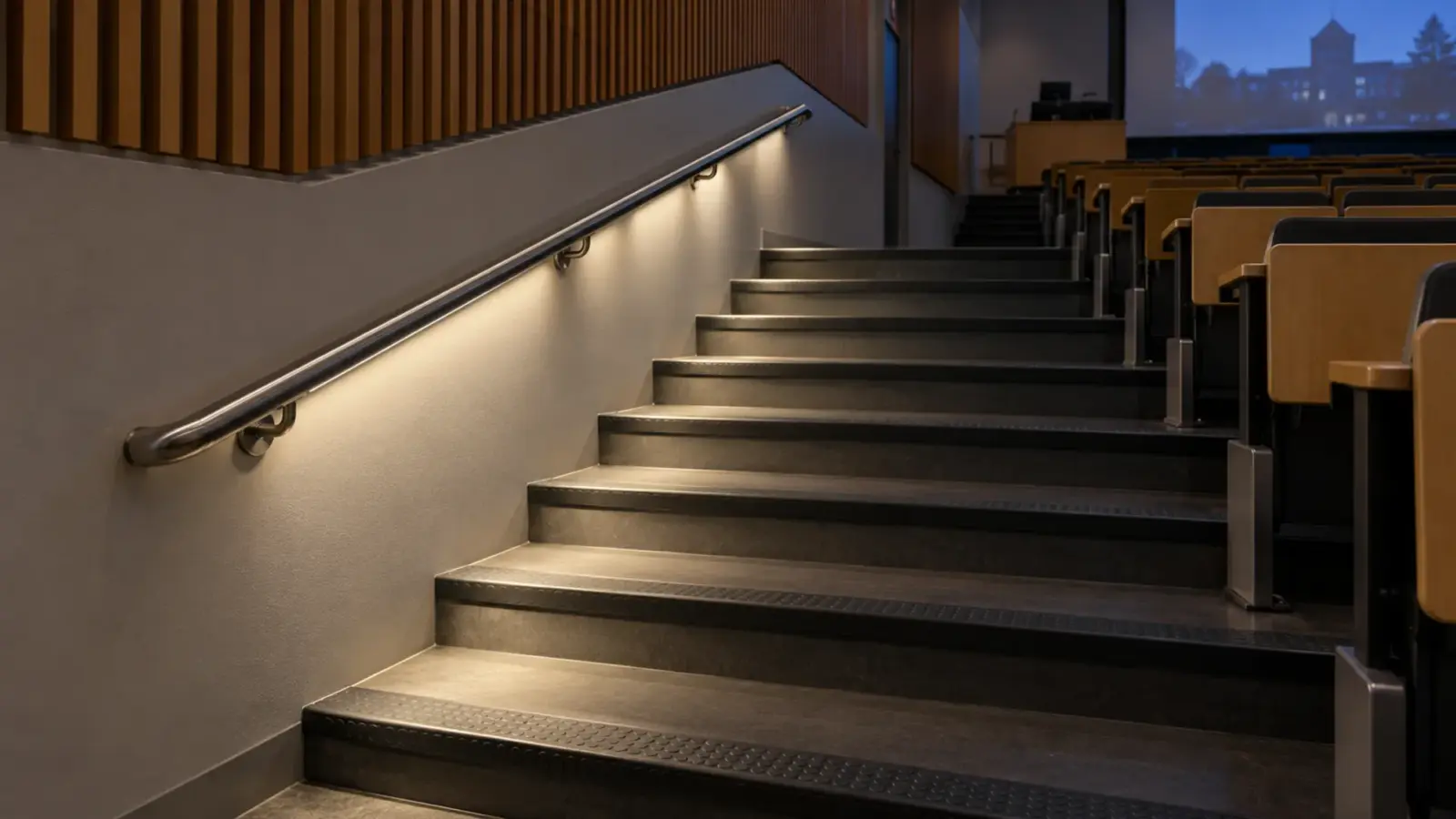
Three placements keep the source hidden: under the nosing aimed down at the riser and the tread below, under the handrail aimed down at the outer edge of each tread, and in a wall slot just above the treads, grazing the stair from the side. Our UT-CH1616 corner channel seats into a 90° corner and aims the strip at 45°, which suits both the nosing and the wall-base detail.
Fix the nosing channel, never tape it
A nosing takes feet, carts and cleaning machines, so the strip goes in a channel fixed mechanically to the stair, with a closed cover and end caps. NFPA 101 precludes adhesive-backed tapes on stair nosings because of the trip hazard, and tape lets go under heat and load in any case.
Coordinate the channel with the nosing product before ordering, so it fits behind or under the nosing without changing the projection the building code sets. Route the leads through the stringer or riser, never across the tread.
Keep the handrail a grip first
ADA 505 fixes the rail: a round section 1-1/4 to 2 in (32 to 51 mm) across, at least 1-1/2 in (38 mm) clear of the wall, and a gripping surface left unobstructed on top and sides. Only the underside leaves room for light.
Mill the slot off the bottom center, rotated 20 to 30 degrees toward the walkway, so the light lands on the treads and the outer lip hides the source from someone across the corridor. Close it with an opal diffuser, and use a dotless COB or dense CSP strip, because a rail at 36 in is seen from 6 ft away. A 1-1/2 in round rail has room for a slot about 10 to 12 mm wide, which makes the 2.7 to 5 mm ultra-narrow boards the handrail family.
Bring the wire out at a bracket
The wire leaves the rail through a hollow wall bracket or saddle adapter into a wall box, not through an end cap or a hole in the rail face. That makes the bracket layout an electrical drawing: the feed brackets and their wall boxes are dimensioned with the same numbers on the rail shop drawings and the rough-in sheet, before the drywall closes.
Keep the supply Class 2 and marked on the drawings, so the rail stays a low-voltage raceway; an unmarked or Class 1 source brings a heavier wiring method into the rail. Leave a service loop in each box so the rail can come off its brackets for a strip change.
Feeds and drivers on a long rail or flight
The narrow and outdoor strips used on stairs take 16 ft (5 m) per feed, so a long rail or a tall flight is planned as segments, each with its own feed at a bracket or a riser.
Our Class 2 drivers are rated 60 W each, loaded to no more than 80% (48 W). A 48 ft (14.6 m) corridor rail of UT-C400-3 at 2.1 W/ft loads 101 W: three feeds and three drivers, each on its own output circuit. Put the drivers in a closet, an electrical room or an accessible ceiling, never behind a finished wall at the bracket.
Exterior steps, ramps and water
Exterior stairs follow the same light levels plus weather. Under a nosing, rain, snow melt and de-icing salt call for a sealed strip such as the IP65 UT-O320-8-65; inside a rail, where water runs along the underside, the IP67 UT-O320-8-67 in a drained slot and a potted IP67 driver in a weatherproof box. We confirm the wet location marking for the model you specify at quote, because the IP code and the marking are different things.
Steps that go into water are a sealing job. On the Abu Dhabi water terrace we supplied more than 6,500 ft (2,000 m) of IP68 PU neon flex for submerged steps; ends, joints and cable entries are sealed to the same level as the strip, and the water depth and immersion time are agreed before the order.
Aisle steps, dimming and path marking
In theaters and auditoriums the IBC lets the walking-surface level drop during a performance, to not less than 0.2 footcandle or with steps marked by self-luminous materials listed to UL 1994, as long as full light returns automatically when the fire alarm activates. Aisle step strip needs a show level, a full level and that fire alarm tie, settled with the AHJ before the risers are built.
Our white COB strip dims below 1% with a compatible driver, which gives a stable night or show level. Where the code requires photoluminescent path marking, the strip does not replace it; keep the strip from covering or shading the marking.
Related projects
Projects that use this range.

Go deeper on stair lighting
When Stair LED Strip Counts Toward Egress Lighting
LED Strip Inside a Handrail: Grip, Glare and Where the Wire Exits
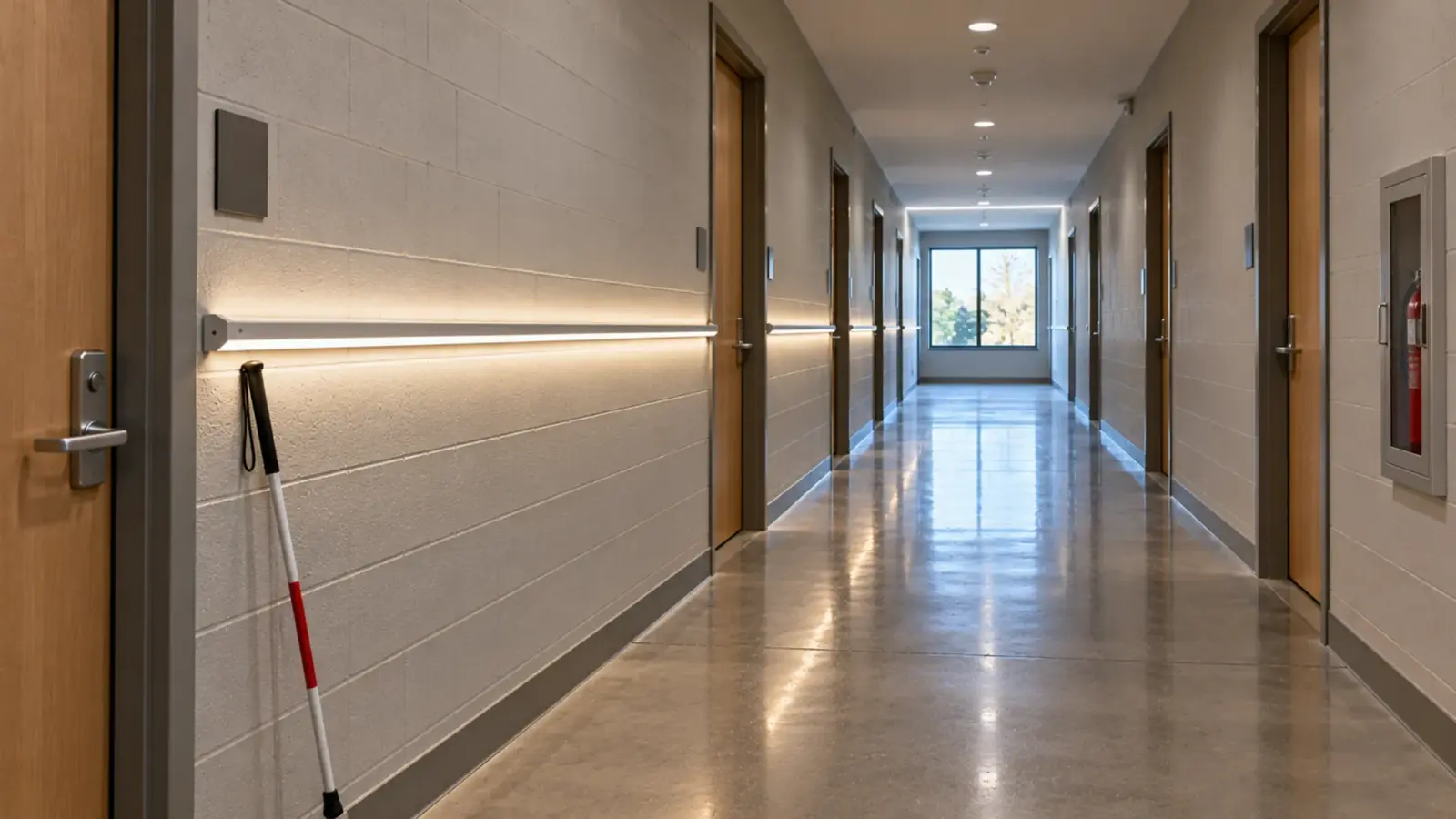
Is a Surface-Mounted LED Channel a Protruding Object Under the ADA?
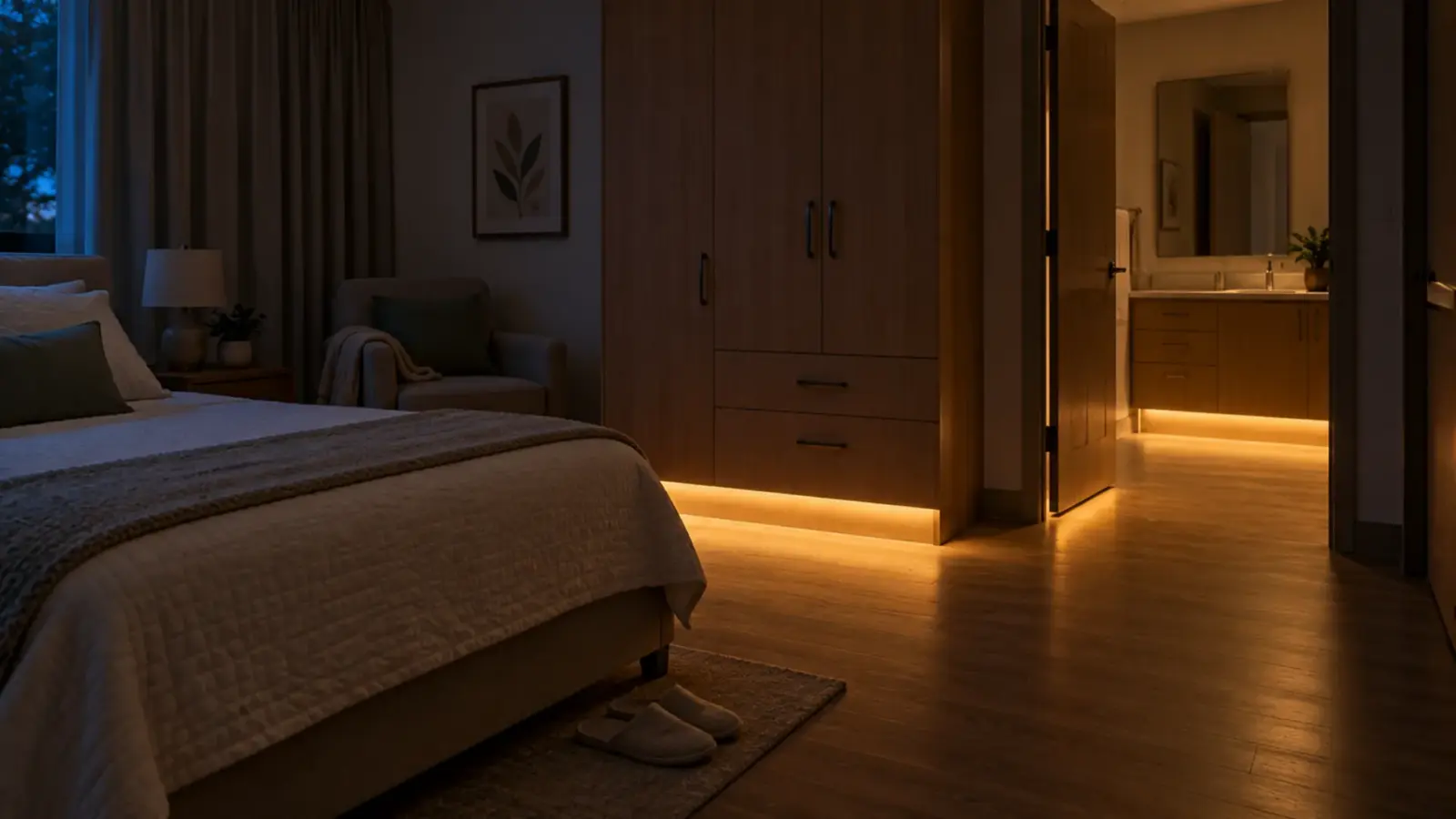
What Senior Living and Memory Care Need from LED Strip Lighting
How to Seal a Cut End of IP67 LED Strip So It Stays Dry
Stair and handrail questions
How many footcandles does a commercial stair need?
Under NFPA 101, new stairs need at least 10 footcandles (108 lux) at the walking surface, and the 2024 IBC text sets 10 footcandles on exit access and exit stairways and their landings while the stair is in use. Other parts of the egress path need at least 1 footcandle. Check the edition your jurisdiction adopted.
Where should LED strip go on a stair?
Under the nosing aimed down, under the handrail aimed down, or in a wall slot just above the treads. Each lights the walking surface with a hidden source. Avoid a strip on the front face of the nosing aimed up or out, which puts glare in the eyes of people walking down.
Can stair nosing LED strip be stuck on with tape?
No. NFPA 101 precludes adhesive-backed tapes on stair nosings because of the trip hazard. Use a channel fixed mechanically to the stair, with a closed cover and end caps, coordinated with the nosing product.
What LED strip fits inside a handrail?
A 1-1/2 in round rail has room for a slot about 10 to 12 mm wide, so the ultra-narrow boards fit: UT-C400-3 COB on a 2.7/3 mm PCB at 2.1 W/ft, or UT-C400-5 for a wider slot. Flat-top rails take UT-CSP-320-N in a UT-CH1207 routed channel. Close the slot with an opal diffuser.
How long can one handrail run be?
16 ft (5 m) per feed for the narrow and outdoor strips used on rails. A longer rail is split into segments with a feed at a bracket every 16 ft, and each segment gets its own Class 2 driver loaded to no more than 80%.
Is lit handrail or nosing strip an emergency light?
Not by itself. It counts toward emergency illumination only when it is fed from the emergency power system with listed controls that cannot keep it off in an outage. A strip on a normal lighting circuit should not be counted in the emergency calculation.
What strip works on exterior steps?
A sealed outdoor strip: IP65 silicone top-coat COB under nosings, IP67 extrusion-sleeve COB in a rail, with a drained slot and a potted IP67 driver. Steps that go into water need IP68 PU neon flex with every end and joint sealed to IP68. We confirm the wet location marking for each model at quote.
Spec your stair
Send the stair section, the nosing or rail detail and the run lengths. An engineer replies with the strip, channel, feed and driver plan for it.
We typically respond within 24 hours. No spam, ever.