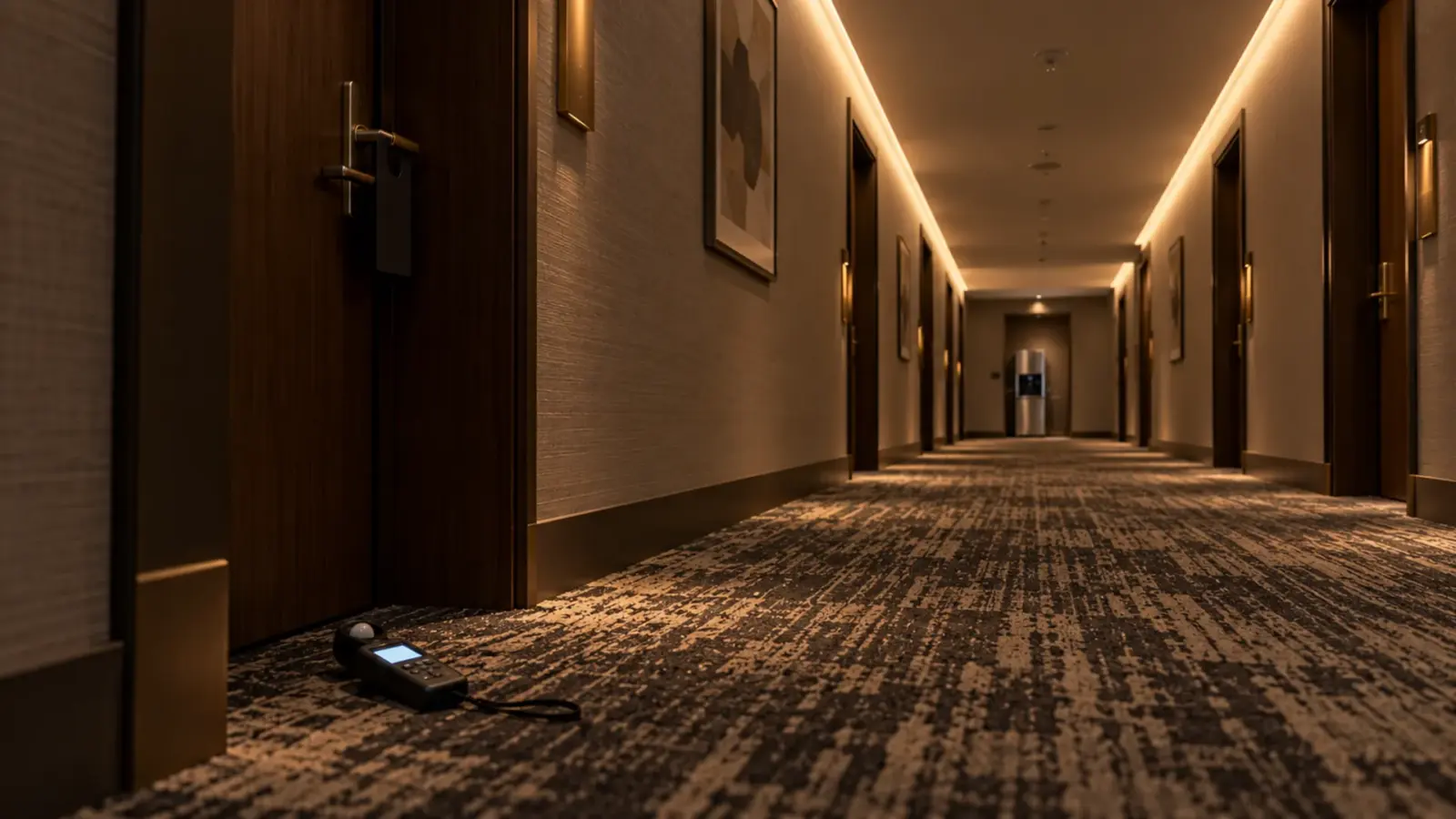
You have a hotel corridor that should feel dark at 3 a.m., a dimmer that goes to 1 percent, and a code that wants a number at the floor. To keep the egress floor, the cove should not dim below the point where the darkest reading at the walking surface falls under 1 footcandle (11 lux). On the wall side, a surface channel in the same corridor has its own limit under the ADA, covered in the ADA protruding-object limits for LED channels.
What the Code Asks at Night
The 2015 IBC, as the Washington State Building Code Council’s opinion quotes it, says the means of egress serving a room or space “shall be illuminated at all times that the room or space is occupied.” The level is in section 1008.2.1, which Richmond’s checklist and the Consulting-Specifying Engineer article cite: not less than 1 footcandle at the walking surface under normal power. The 2024 IBC keeps that sentence, and a Washington amendment petition reproduces it.
A hotel is occupied all night, and the exceptions do not name its corridors. They cover Group U, aisle accessways in Group A, “dwelling units and sleeping units in Groups R-1, R-2 and R-3,” and sleeping units in Group I. The 2018 and 2021 texts we read list the same four, and a 2024-based copy adds self-service storage and widens the last item; none names corridors. Read literally, the third exception removes the guest room itself. Whether a corridor that serves only sleeping units may fall below 1 footcandle at night is an interpretation we found no source for, and we found none that permits it. Get the AHJ’s answer in writing before dimming below the floor, and treat the floor as the working rule.
Other sources say the same in general terms. A 2006-edition bulletin from Kansas’s State Fire Marshal says normal illumination is required throughout the means of egress at all times the building is occupied, in addition to emergency lighting, and warns that “A simple light switch may not be appropriate”; it lists a keyed switch, a switch cover or no switch as protection, and it accepts motion-sensor lights as meeting the intention. Consulting-Specifying Engineer adds that the IBC “does not allow egress lighting to be shut off or reduced in most cases while the building is occupied,” while NFPA 101 allows automatic lighting control devices to switch egress lighting off temporarily under conditions: the device is listed in new installations, energizes the lights on loss of normal power, has timers of at least 15 minutes, is activated by occupant movement and by the fire alarm, does not turn off lights relied on for photoluminescent signs or path markers, and leaves battery-equipped emergency units on, all “unless prohibited by Chapters 11 through 43.” Those conditions are written for devices that turn lights off; none of our sources addresses dimming.
The Floor Is a Minimum, Not an Average
Richmond’s emergency lighting checklist puts the normal-power test in one line: not less than 1 footcandle “at any point in the path of egress at floor level.” CSE says the same, calling it a minimum and not an average. That is why the dimmest spot matters: a door recess, the end of a corridor, a spot far from a cove run, or the shadow under a ceiling bulkhead.
The emergency numbers are different and come from a separate section:
| Condition | Average | Minimum at any point | Uniformity |
|---|---|---|---|
| Normal power | not stated | 1 footcandle | not stated |
| Emergency, start | 1 footcandle | 0.1 footcandle | 40 to 1 maximum to minimum |
| Emergency, after 90 minutes | 0.6 footcandle | 0.06 footcandle | 40 to 1 maximum to minimum |
The emergency numbers are for the UL 924 relays, inverters and battery drivers in our emergency power guide, not for the dimmer. They matter because one fixture often serves both.
The Energy Code Meets the Floor
The energy code asks corridors to reduce when empty. Our occupancy sensor guide quotes California’s Title 24 as requiring controls that reduce a corridor’s lighting power by at least 50 percent when it is unoccupied, and one code-compliance site reports that the 2025 text names common-area corridors that give access to hotel guest rooms. ASHRAE and the IECC have their own sequences, and some allow off. Washington’s Building Code Council was asked whether its energy code’s automatic shut-off for egress luminaires conflicts with the IBC’s emergency lighting, and answered no: the IBC emergency lighting governs in a power failure, with the 90 minutes at an average of 1 footcandle met by an exception of 0.02 W/sq ft of building area, and IBC 1008.2 addresses egress illumination when the building is occupied. The opinion does not rule on normal-power dimming in an occupied hotel, so the energy code’s reduction and the egress floor are reconciled with the AHJ, and the floor is the safe side.
The practical design is two layers. Our suggestion is a cove for the look that dims or reduces, and a small fixed-level layer of hard-wired corridor lights that holds the floor at all times, so the cove can drop as far as the energy code or the owner wants without touching the minimum. The adopted code decides whether that second layer is needed. Our hotel guide notes that egress lighting is a separate, listed system on its own circuit, and a strip line counts as egress light only if the designer builds it into that system.
- 1Egress floorgate 11 footcandle minimum at any point, under normal power
- 2Energy codegate 2Reduce when empty: Title 24 corridor row, at least 50 percent
- 3Driver low endgate 3Minimum level and 0 V behavior, from the datasheet
- 4Measure and lockgate 4Dimmest spot first; controller minimum above the floor; record it
Dimming Range and the Off Trap
The low end belongs to the driver and the dimmer on the real circuit. Our hotel guide puts it plainly: the catalog’s lowest level is a claim, and the real floor belongs to the pair on the real circuit. Our drivers page lists UT-D60-24-C2-010 and UT-D96-24-010 for 0-10V, UT-C010-350 as a 0-10V decoder, UT-CTP-010 as a wall panel and UT-CDALI-DT8 for tunable white, and it gives no minimum level and no 0 V behavior for any of them. Whether a driver dims to off and stays powered is a datasheet property to confirm.
For a corridor, that decides three settings:
- Set a floor on the control. Program the lowest level the controller can send to the night level you measured, so no schedule, scene or wall panel can go lower.
- Do not use dim-to-off. A 0 V or off state takes the corridor below 1 footcandle. If the driver turns off at the bottom of its range, the controller’s floor has to sit above that point.
- Fail to a compliant level. New York City’s 2014 code, as a forum poster quotes it, allows automatic controls in the means of egress if the level is not reduced below the minimum and the controllers “are equipped for fail-safe operation” so a failure leaves the required level. A 0-10V control wire that is cut or lost should leave the strip at a level that meets the floor; ask what each driver does with no signal.
Setting and Locking the Night Level
Measure, then lock. The method is plain:
- With the space finished, at night level and with the ceiling and walls in place, put a light meter on the floor.
- Read the dimmest spots first: door recesses, corridor ends, corners, the far side from the cove, under bulkheads.
- Raise the night level until the lowest reading is at least 1 footcandle, and add a margin, since a strip dims with age.
- Lock that level as the controller’s minimum, and record it on the commissioning sheet.
- Repeat after the first service visit, and after any carpet or paint change.
A sheet for the record:
| Location | Reading at floor (fc) | Night level set | Pass |
|---|---|---|---|
| Corridor end, east | |||
| Door recess, nearest the elevator | |||
| Dimmest recess on the floor | |||
| Corner turn |
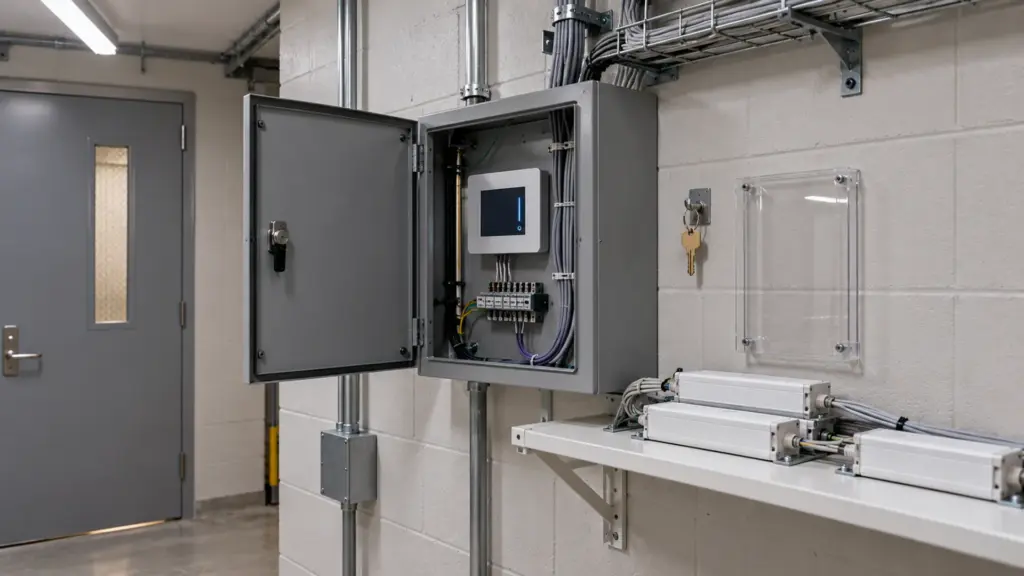
Our hotel guide covers keeping one CCT per sight line, and our lumens per foot guide covers why output at the strip is not the light at the floor. A cove lights the ceiling first, so the floor reading depends on the ceiling and wall finishes; a darker ceiling or darker walls lower it. Protect the control: Kansas’s State Fire Marshal lists a keyed switch, a switch cover or no switch, so the wall panel that sets the night level belongs in a locked enclosure, not on the corridor wall.
The Reading Falls as the Strip Ages
The night level you measure on opening day is not the level in year six. A strip rated L70 gives 70 percent of its initial light at the rated hours, as our lifespan guide explains, and a corridor at full output around the clock reaches 50,000 hours in at most about 5.7 years. If nothing else changed, a corridor that read exactly 1 footcandle at opening would read 0.7 footcandle then, so to hold 1 footcandle at L70 the opening reading has to be at least 1.43 (1 divided by 0.7). Dirt on the cove and a darker repaint lower it further. Set the margin on the commissioning sheet.
What Fails at the Walkthrough
Four things come up most on a dimmed corridor. The night mode sits at the bottom of the dimmer, which a controller can send as 0 and the driver can read as off. The wall panel is on the corridor wall where a guest can turn it down, the switch problem Kansas describes. The meter was read mid-corridor and not at the recesses. And the 0-10V wire is cut, and nobody knows whether the driver then goes to full, to its last level or to off. Each has a fix above.
Emergency Is a Separate Check
Normal-power dimming does not replace the emergency system. The IBC requires an emergency electrical system to illuminate corridors automatically in the event of power failure in rooms and spaces with two or more means of egress, and the emergency numbers above govern. Our UL 924 guide covers how strip joins that system, and our stair guide covers stair nosings.
FAQ
How bright must a hotel corridor be at night?
Under IBC 1008.2 and 1008.2.1, as the Washington opinion, Richmond’s checklist and CSE cite them, the means of egress must be illuminated at all times the room or space is occupied, at not less than 1 footcandle (11 lux) at the walking surface. The adopted edition and the AHJ decide how that applies to a corridor serving guest rooms.
Is 1 footcandle an average?
No. For normal power it is a minimum at any point in the path of egress at floor level, as Richmond’s checklist words it. The emergency standard has an average of 1 footcandle and a 0.1 footcandle minimum.
Can an occupancy sensor dim a hotel corridor below that level?
The IBC generally does not allow egress lighting to be reduced while the building is occupied, according to CSE. NFPA 101 permits listed control devices with conditions where it is adopted. Check which applies before programming a sensor.
Does the energy code override the egress floor?
Washington’s Building Code Council said its energy code’s shut-off does not conflict with the IBC’s emergency lighting, which governs in an outage. It did not rule on normal-power dimming, so reconcile the two with the AHJ.
What to Verify With the AHJ
- The adopted IBC or IFC edition and local amendments for means of egress illumination.
- Whether a corridor serving only sleeping units is covered at night, in writing.
- Whether NFPA 101 controls are allowed in this occupancy, and which device.
- The measuring points, the meter and the night level on the commissioning sheet.
- The driver’s minimum level and 0 V behavior, from the datasheet for the exact model.
The strips and drivers named above are on our COB LED strip and drivers, controllers and connectors pages.