A lifespan figure such as L70 at 50,000 hours does not say the strip stops after 50,000 hours. It says that, by then, the LEDs are expected to give 70 percent of their starting light, under test conditions. It is a statement about light, projected from lab data, and it says nothing about the board, the joints or the driver.
“Rated for 50,000 hours” is usually read as “it will run for 50,000 hours, then die.” Both halves are wrong. At 50,000 hours a typical strip is still lit; it is just dimmer than it was. And a strip can fail long before that for reasons the number never measured. Contractors who repeat the figure to an owner end up defending a promise nobody made. This article explains what the number means, how it is produced, what it leaves out, and what to ask for instead.
What L70 Actually Says
L70 is a point on a curve. LEDs lose light slowly as they age. L70 is the time at which the light output is expected to have dropped to 70 percent of the starting value. According to LEDYi’s explanation, L80 and L90 are the same idea at 80 and 90 percent, so an L90 figure is a stricter claim than an L70 figure for the same hours.
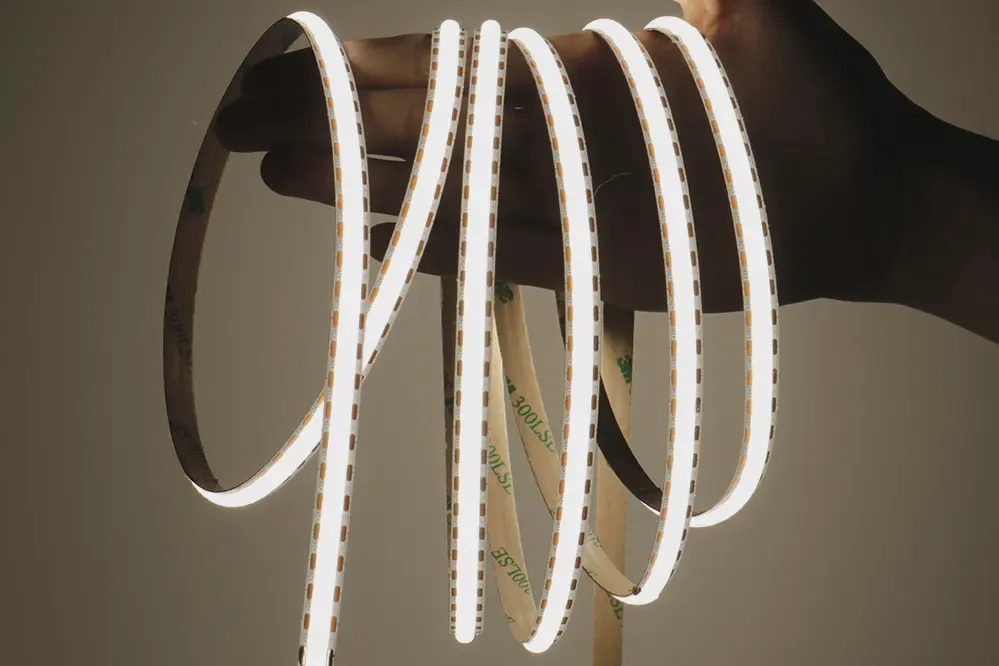
Our COB LED strip page states its rated life as L70 at or above 50,000 hours, the point where output falls to 70 percent of initial, which it puts at more than 17 years at 8 hours per day. That is a statement about light output under defined conditions. It is not a promise that every strip on every job runs for 17 years.
Three things follow:
- The strip does not go dark at L70. It gives about 70 percent of its original light. Whether that is acceptable depends on the space: a cove that was designed with headroom may still look fine; a display lit to a tight brightness target may not.
- The number is about the LEDs. It describes how the light sources age, not how the rest of the product ages.
- The number assumes conditions. Temperature and drive current in the test decide the curve, and a strip on a job may run hotter or harder than the test.
Lifetime figures are sometimes written with a second letter, such as B50, which describes the share of units expected to reach the light level by that time. Where a datasheet shows it, read it; where it does not, the L figure usually describes the typical unit, not the worst one.
LM-80: What the Lab Measures
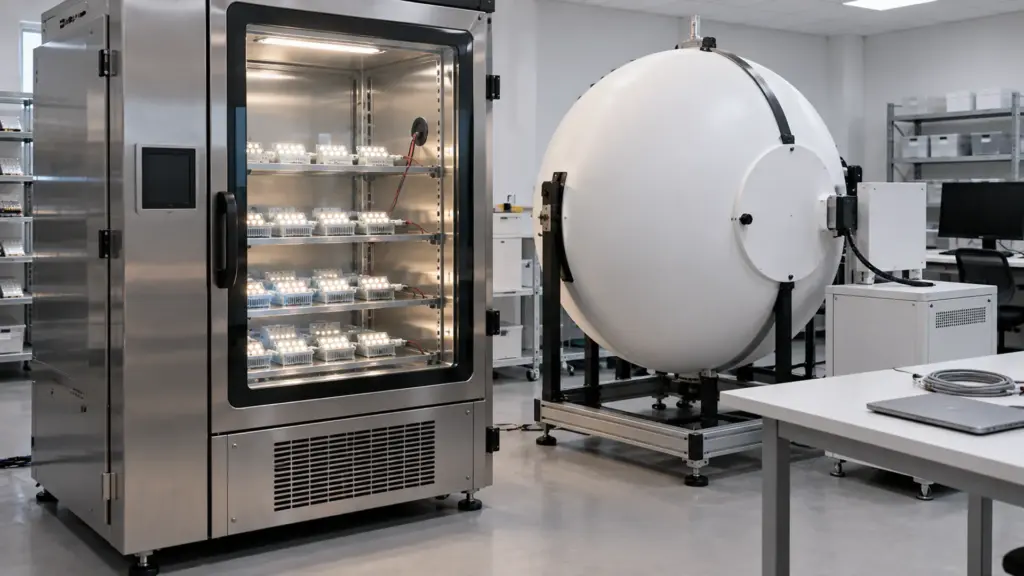
LM-80 is the test method behind most LED lifetime numbers. According to Simple Lighting’s explanation, LM-80 runs samples at set temperatures and drive currents and measures their light output at 1,000-hour intervals, typically up to 10,000 hours. Our certifications page describes it the same way: LM-80 provides lumen-maintenance data for the LED chip sources, which supports long-term L70 claims.
Two details matter for strip:
- LM-80 tests the LED package, not the strip. The samples are the LEDs that go onto the board. The board, the solder, the coating and the driver are not part of the test.
- LM-80 is measured, not projected. It records real hours: thousands, not tens of thousands. A test that ran for 10,000 hours has measured a little over a year of continuous operation.
According to Simple Lighting, testing a product to a full 50,000-hour claim would take about six years of continuous running. Nobody waits that long, which is why the next step exists.
TM-21: How the Hours Are Projected
- 1LM-80MeasuredLED package, thousands of hours
- 2TM-21ProjectedAt most 6 × the test hours
- 3L70 on the datasheetLight70% of initial, test conditions
- 4On the jobConditionsHeat, current, hours per day
- 5System lifeEverything elseBoard, joints, coating, driver
TM-21 takes the LM-80 data and projects it forward. It fits the measured decline and extends it to estimate when the light will reach 70 percent. The result is the L70 figure on a datasheet.
TM-21 also limits how far the projection may go. According to Simple Lighting, a projection can claim at most six times the tested hours. If the LM-80 test ran 10,000 hours, the projection can state at most 60,000; if it ran only 5,000 hours, at most 30,000. A figure beyond six times the test is not a TM-21 result.
That limit is the first thing to check when a lifetime claim looks generous. Ask how many hours the LM-80 test ran and at what temperature, and the claim either fits inside six times that number or it does not.
What the Number Leaves Out
According to Signlite’s discussion of lifetime and warranty, an L70 figure does not describe failures such as dead LEDs, damaged traces on the board, failed solder joints or a failed power supply. Those are exactly the failures contractors see on site. On a strip, the life of the whole product depends on parts the LM-80 test never touches:
- The board. Thin copper and narrow boards run hotter and carry less current; cracked traces from bending or vibration end a section regardless of the LEDs.
- The joints. Solder joints and connectors fail with heat cycling and movement. A run with ten joints has ten more places to fail than a run with none.
- The coating. Silicone and other coatings on waterproof strip can yellow or crack if the material is poor, cutting light output faster than the LEDs themselves. Our outdoor strip uses UV-stable silicone for that reason.
- The driver. Drivers usually fail before LEDs. Their electrolytic capacitors age with heat, which our article on driver derating in hot ceilings explains. A strip that outlives three drivers has still been dark three times.
- The adhesive. A strip that falls out of its cove has failed, whatever its LEDs could have done.
So the honest answer to “how long will it last?” has two parts: how long the light will stay above an acceptable level, which L70 estimates, and how long the system will keep working, which depends on design and installation. Our guide to high-quality vs cheap LED strip shows where those differences come from.
Heat and Drive Current Move the Curve
The LM-80 curve was measured at specific temperatures and currents. A strip on a job does not run at the test temperature; it runs at whatever its mounting allows.
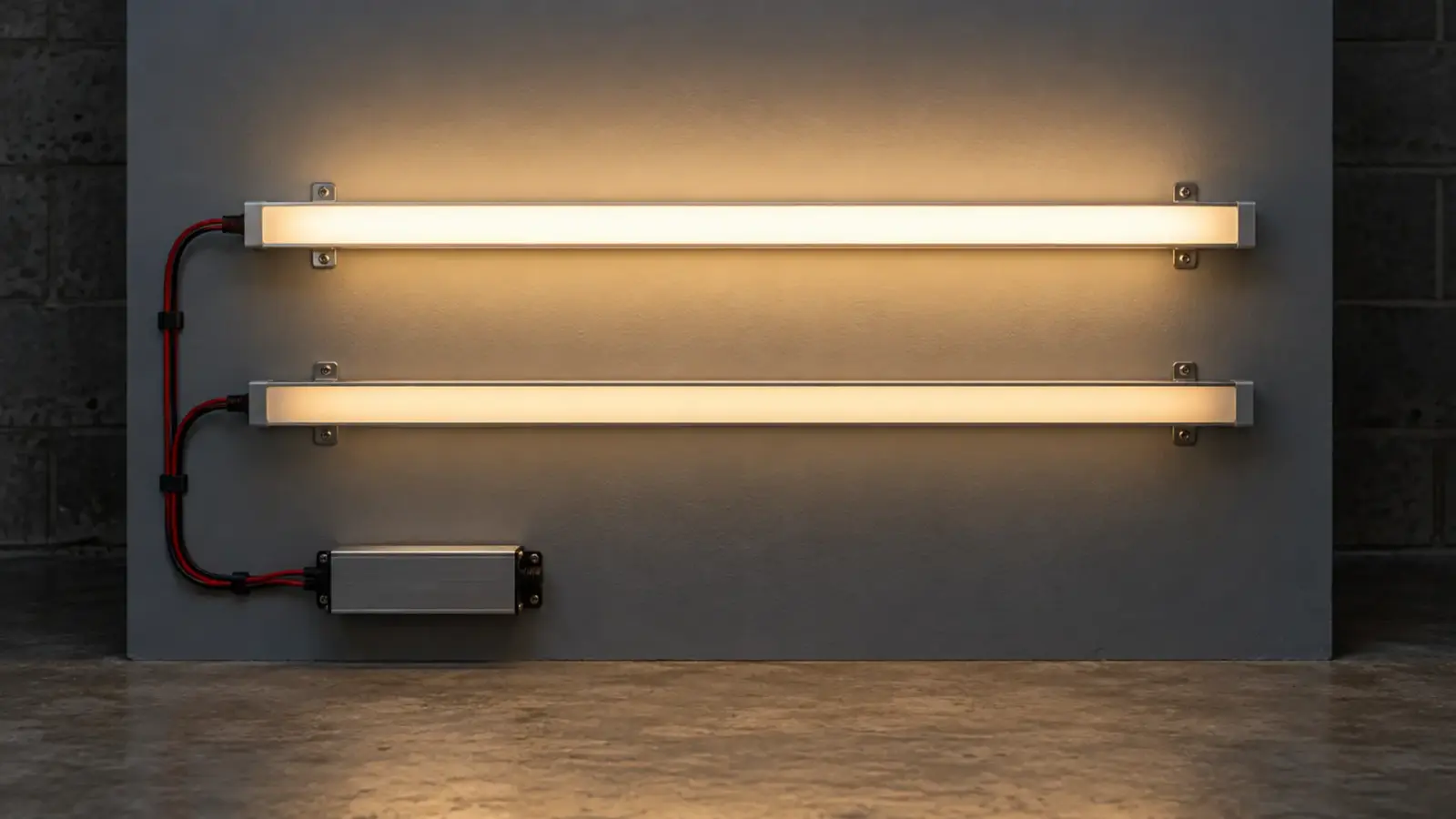
- Heat. Hotter LEDs lose light faster. A strip in a sealed cove or a closed cabinet runs hotter than the same strip in an aluminum channel with air around it. Our COB page notes that proper heat sinking in an aluminum channel is the single biggest factor in reaching the rated life, and our guide on whether LED tape needs a channel covers when it is required.
- Drive current. A strip driven harder than its design gives more light now and less later. High-density, high-output strips put more power into each foot and need more heat sinking to keep the curve.
- Hours of use. A strip on 24 hours a day reaches its L70 hours in under six years; the same strip on 8 hours a day takes more than 17. The hours are the same; the calendar is not.
A strip that turns dark or yellow early is usually showing heat. Our guide to LED strip turning black or yellow walks through the causes.
Same Rating, Two Different Lives
Take two jobs that use the same strip with the same L70 rating.
On the first, the strip sits in an aluminum channel in an open cove, runs at a moderate output, and is on 12 hours a day. Its drivers are in a ventilated closet. Ten years later the cove is a little dimmer than on opening day, nobody has noticed, and the drivers have been replaced once.
On the second, the same strip is pressed onto painted drywall inside a sealed cove above a kitchen, runs at full output, and is on 24 hours a day. Its drivers sit above the ceiling next to the insulation. Within a few years the adhesive has let go in places, two drivers have failed, and one section has darkened at the hottest end.
Both jobs used a product with the same lifetime figure. The difference came from the channel, the ventilation, the output, the hours and the driver location, none of which is in the number. That is why a lifetime figure belongs in the specification together with the conditions that protect it.
How to Explain It to an Owner
Owners ask “how long will it last?” in one sentence and deserve an answer in three:
- Light. “The LEDs are rated to keep at least 70 percent of their light for the rated hours under test conditions. On your hours, that is roughly this many years, if the strip stays as cool as we designed it.”
- Electronics. “The drivers are the part most likely to need replacing during that time. We put them where they can be reached.”
- Defects. “The warranty covers defects for the period on the quote. Gradual dimming is normal aging, not a defect.”
Writing those three lines into the handover documents saves a dispute later, when the cove is a little dimmer than in the photos.
Lifespan vs Warranty
A rated life and a warranty are different documents with different numbers. Our warranty policy is a limited warranty of up to 5 years, with the period stated on the quotation and order confirmation and varying by product series. The rated life is an engineering projection about light output; the warranty is a commercial commitment about defects.
According to Signlite, lifetime ratings and warranty terms should not be confused, and a long lifetime figure does not imply a matching warranty. Tell the owner both numbers and what each means. The owner’s question is usually “when will I have to replace it?”, and the honest answer uses the warranty for defects, L70 for gradual dimming, and the driver’s own life for the electronics.
What to Ask For
When a specification or an owner asks about lifespan, ask the supplier for:
| Ask for | Why |
|---|---|
| The L figure and the hours, with its temperature | L70 at 50,000 hours at what case temperature |
| The LM-80 test duration | To check the six-times limit |
| Which LED package the data applies to | The data must match the LED on the strip |
| The drive current in the test and on the strip | A strip driven harder ages faster |
| The warranty period for the series | Defects are a different number |
| The driver’s own life or temperature rating | The driver usually fails first |
Then design for the number. Put high-output strip in an aluminum channel, keep coves ventilated, keep drivers reachable and cool, and give the design some headroom in brightness so 70 percent is still enough.
Planning Maintenance Around the Curve
A lifetime figure is most useful as a maintenance plan, not a sales line.
- Design with headroom. If the space needs a certain brightness, design for more at opening, dimmed down, so the system can be turned up as the LEDs age instead of replaced.
- Keep spare reels from the job’s batch. When a section fails in year six, a new reel from a new batch will look brighter and possibly a different white next to aged strip. A spare from the original batch has aged on the shelf more slowly but matches far better than new stock.
- Replace visible runs whole. On a cove or a slot people look at, replace the full run, not a single section, so the light stays even.
- Plan driver replacements separately. Drivers age on their own schedule, set by heat. Record their locations and models so a replacement is a service call, not an investigation.
- Record the hours. Spaces that run 24 hours a day reach the rated hours three times faster than spaces on 8 hours. The maintenance plan should say which is which.
The Short Version
- L70 at 50,000 hours means 70 percent of the light at 50,000 hours, under test conditions.
- LM-80 measures the LED package for thousands of hours; TM-21 projects, and may claim at most six times the tested hours.
- The number leaves out the board, joints, coating, adhesive and driver, which is where most site failures happen.
- Heat and drive current change the curve; an aluminum channel and air protect it.
- Rated life is not a warranty. Quote both, and explain each.