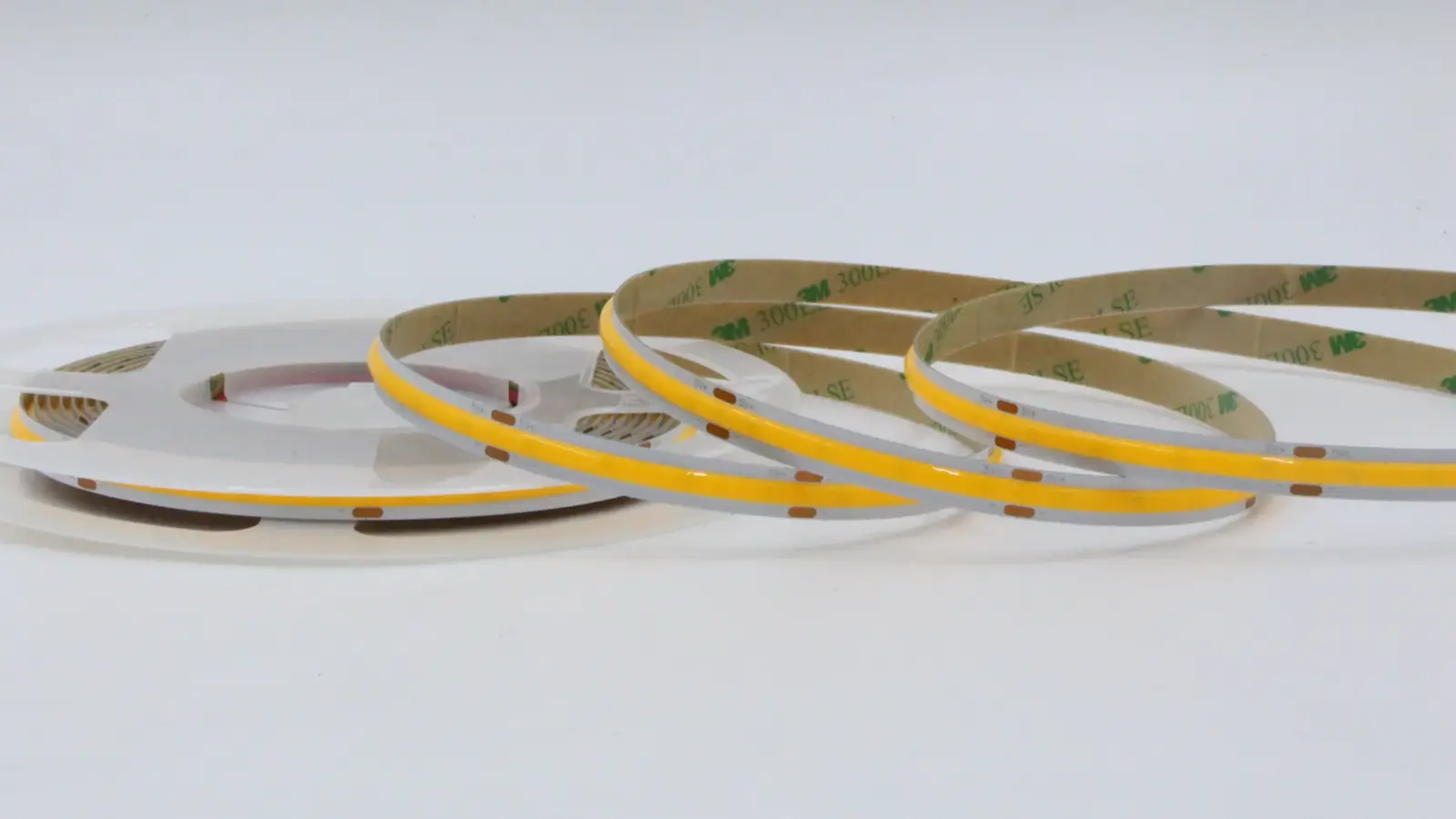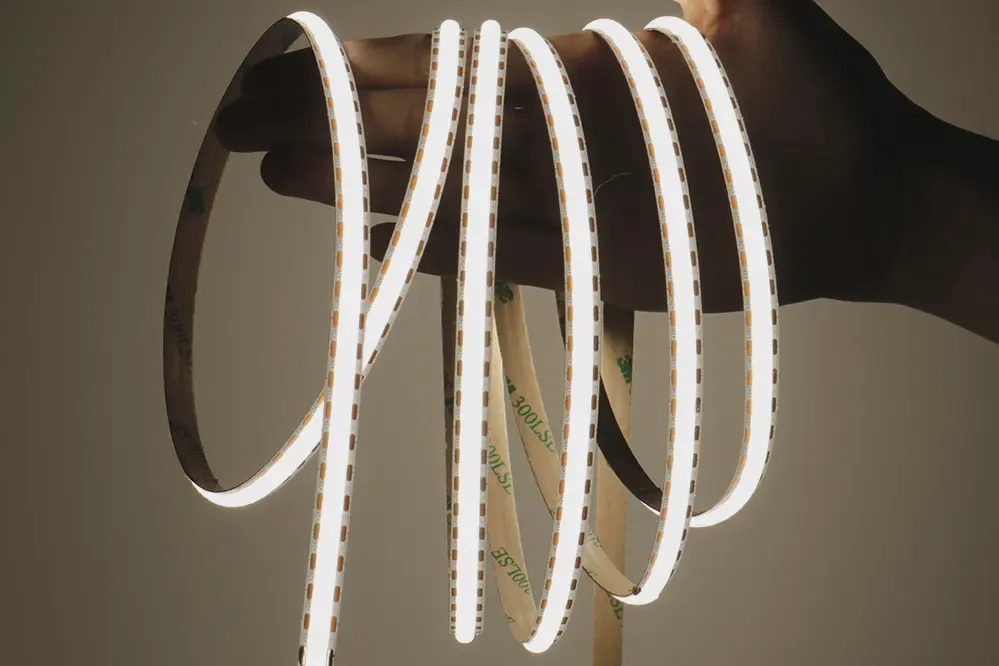
SCOB vs COB LED strip comes down to light per watt. Our high-efficacy SCOB strip, UT-SC320HE-15, lists 130 to 140 Lumens per watt: how much light the strip gives for the power it draws. Higher means less heat and less driver load per foot., while a standard Ra≥90 COB strip sits near 90 lm/W*. SCOB wins on output per watt and on handling. COB still wins on the smoothest bare line, the slimmest boards and the longest single-feed runs.
The gap is not free. SCOB packs its light into more watts per foot, so a run that took three drivers in COB can take four. And bare and close to the eye, a dense COB is still the smoother line. The gates below run in the order they settle a spec.
SCOB vs COB at a Glance
The table sets our SCOB builds against the COB rows they usually replace on a submittal. Every value comes from the spec tables on our COB LED strip page, where SCOB has its own section.
| Build | Model | LEDs/m | Width | Power | Efficacy | Cut |
|---|---|---|---|---|---|---|
| Standard COB | UT-C480-8 | 480 | 8 mm | 3.2 W/ft (10.5 W/m) | ~90 lm/W* | 0.98/1.97 in (25/50 mm) |
| SCOB, high efficacy | UT-SC320HE-15 | 320 | 10 mm | 4.6 W/ft (15 W/m) | 130–140 lm/W | 0.98 in (25 mm) at 24V |
| SCOB, high CRI (Ra≥97) | UT-SC320CRI97-15 | 320 | 10 mm | 4.6 W/ft (15 W/m) | 105 lm/W | 0.98 in (25 mm) at 24V |
| Free-cut COB | UT-C528-8-FC | 528 | 8 mm | 4.0 W/ft (13 W/m) | ~90 lm/W* | Any point |
| SCOB, free-cut | UT-SC300-15 | 300 | 10 mm | 4.6 W/ft (15 W/m) | 100 lm/W | Any point |
| Ultra-narrow COB | UT-C400-3 | 400 | 2.7/3 mm | 2.1 W/ft (7 W/m) | ~90 lm/W* | 0.39/0.79 in (10/20 mm) |
| SCOB, super slim | UT-SC336SS-6 | 336 | 5 mm | 1.8 W/ft (6 W/m) | 115 lm/W | 0.83 in (21 mm) |
| Tunable white COB | UT-T624-8 | 624 | 8 mm | 4.3 W/ft (14 W/m) | see datasheet | 0.76 in (19.23 mm) |
| SCOB, tunable white | UT-SC308TW-18 | 308 | 10 mm | 5.5 W/ft (18 W/m) | 110 lm/W | 1.31 in (33.3 mm) at 24V |
*Typical value for this class of strip, rounded down. Confirm the model datasheet figure with your quote.
Even the lowest SCOB efficacy, 100 lm/W, is above a typical Ra≥90 COB. And every 10 mm SCOB row draws 4.6 W/ft or more, which is where the trade-offs start.
Build: SMD Packages Under One Silicone Line
COB strip mounts bare LED dies straight onto the flexible board and pours one continuous phosphor layer over the whole run. The dies sit so close that the line reads as solid light with no dots. That single phosphor layer is also why a COB run cannot be sorted into tight color bins after the fact: according to LEDYi, the phosphor goes onto the whole strip at once, so there is no package to test and sort by machine.
SCOB starts from the other end. Small packaged SMD LEDs are soldered to the board on an ordinary SMT line, the same way an SMD strip is built, and then the strip is covered the way a COB strip is. Signlite describes one such process: a phosphor adhesive goes on first and a semi-transparent milky white silicone layer goes on top. The result is a dot-free line built from parts that were tested and sorted before they ever touched the board.
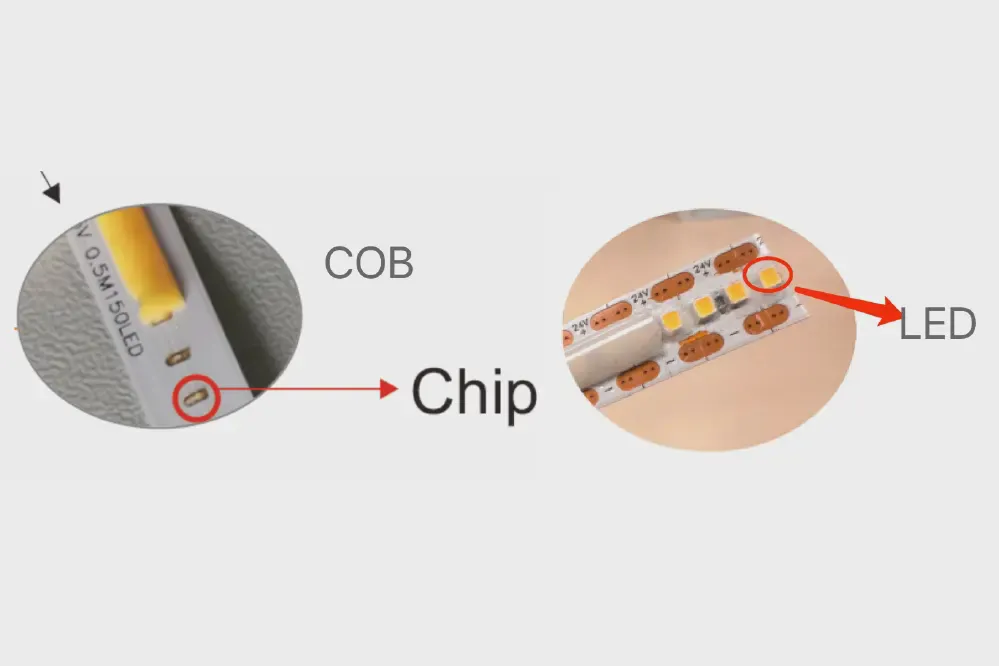
The S is usually given as stereoscopic. On a submittal the name does not matter: SCOB behaves like SMD strip on the bench and like COB to the eye.
That one difference in build drives everything below. Packaged LEDs can be picked for efficacy, Color Rendering Index, 0–100: how truthfully the light shows colors next to a reference source. Ra≥90 is the usual bar for interiors. and color point before assembly, which is why our SCOB family spans a 130–140 lm/W high-efficacy build, a Ra≥97 build and a tunable build on the same 10 mm platform. A COB strip’s phosphor recipe is set for the whole run, so a new CRI or color point means a new phosphor, not a different part on the reel.
Light per Watt: Where SCOB Pulls Ahead
On our tables, SCOB’s advantage is plain:
| Model | W/ft | lm/W | Light per foot (W/ft × lm/W) |
|---|---|---|---|
| UT-SC320HE-15 (SCOB HE) | 4.6 | 130–140 | about 600–640 lm/ft |
| UT-SC308TW-18 (SCOB tunable) | 5.5 | 110 | about 605 lm/ft |
| UT-SC320CRI97-15 (SCOB Ra≥97) | 4.6 | 105 | about 480 lm/ft |
| UT-SC300-15 (SCOB free-cut) | 4.6 | 100 | about 460 lm/ft |
| UT-C480-8 (standard COB) | 3.2 | ~90* | about 288 lm/ft* |
| UT-SC336SS-6 (SCOB super slim) | 1.8 | 115 | about 207 lm/ft |
| UT-C400-3 (ultra-narrow COB) | 2.1 | ~90* | about 189 lm/ft* |
*Typical value for this class of strip, rounded down. Confirm the model datasheet figure with your quote.
Per watt, the high-efficacy SCOB delivers roughly 45 to 55 percent more light than a typical standard COB, about a third less power for the same lumens. Per foot, it puts out about twice the light of UT-C480-8 at its typical efficacy. On energy-code work, where a lighting power density budget under ASHRAE 90.1 or California Title 24 caps the watts per square foot, the per-watt number is the one that counts. Our lumens per watt guide explains why the comparison is only fair at the same CRI and the same test conditions.
The high-CRI SCOB is the honest exception. At Ra≥97, UT-SC320CRI97-15 gives back most of the efficacy gain, landing at 105 lm/W. That is still above a typical Ra≥90 COB. High-CRI COB is available too, up to Ra 98 per our COB page; the difference is that the Ra≥97 SCOB is a listed row with its efficacy on the table, so compare like for like at quote.
Watts per Foot: What the Extra Light Costs at the Driver
A SCOB strip at 4.6 W/ft carries about 44 percent more load per foot than UT-C480-8 at 3.2 W/ft. The light is better per watt, but the driver count follows the watts, not the lumens.
Our Class 2 drivers are rated 60 W, and our rule is to load any driver to no more than 80 percent of its rating, which is 48 W. Our power supply sizing guide walks through the method. Here is a typical job: a 32 ft (9.75 m) hotel corridor cove, one continuous run.
| Strip | W/ft | Load for 32 ft | 60 W Class 2 drivers at 48 W each | Max ft per driver |
|---|---|---|---|---|
| UT-C480-8 (COB) | 3.2 | 102.4 W | 3 | 15 ft |
| UT-SC320HE-15 (SCOB HE) | 4.6 | 147.2 W | 4 | 10 ft |
| UT-SC336SS-6 (SCOB slim) | 1.8 | 57.6 W | 2 | 26 ft |
So the swap that doubles the light per foot also adds a driver and a feed point, and every driver needs a reachable location. It pays when the extra output lets you drop other fixtures from the room; if it does not, the COB run may be the better spec. The Class 2 driver guide covers why one Class 2 output cannot simply be made bigger.
Run length per feed is the second half of the question. Standard COB such as UT-C480-8 lists 16 ft (5 m) per feed. Our SCOB rows run 49 ft (15 m) from one end at 24V, or 98 ft (30 m) fed from both ends, so it needs fewer feed points. On Class 2 drivers the watts still set the segment: at 4.6 W/ft one 48 W output covers about 10 ft. For the longest run from a single end, COB still has the answer: the 48V UT-C480-8-48V feeds 65 ft (20 m), and there is no 48V SCOB in our range.
The Line, Lit and Unlit
Unlit, the two strips look different on the shelf and in an open cove. COB shows its phosphor: according to RS Components, the phosphor layer over the dies is an orangey-yellow color, and that is what a visitor sees on a COB strip that is switched off. SCOB’s top layer is a milky white silicone, so the unlit strip reads white and neutral. In a visible reveal or a glass case, owners notice.
Lit and bare, density still wins. In Unitop’s sample comparisons, a 320-LED SCOB reads smoother than a 320-chip COB, but a 480-chip COB like UT-C480-8 is still the smoothest bare line at arm’s length. Inside an aluminum channel with an opal cover, the difference disappears: both read as one continuous line with no spots. Our LED dots and diffuser guide covers channel depth and cover type.
The practical rule: if the strip will be bare and seen up close, as in a toe kick or a glass shelf edge, compare the actual reels in a mockup before accepting a substitution. In a channel with an opal cover, the choice comes down to watts and color, not looks. Our mockup approval guide covers what to sign off.
Bending and Handling on Site
SCOB’s packages are soldered to the board the same way an SMD strip’s are, and that is where its handling advantage comes from. A COB strip’s dies sit under one continuous phosphor layer, so a sharp fold puts that layer and the dies under it at risk. According to Signlite, the SMD-based SCOB build has better resistance to bending and folding, and the photo below shows the kind of twist it is built to take.
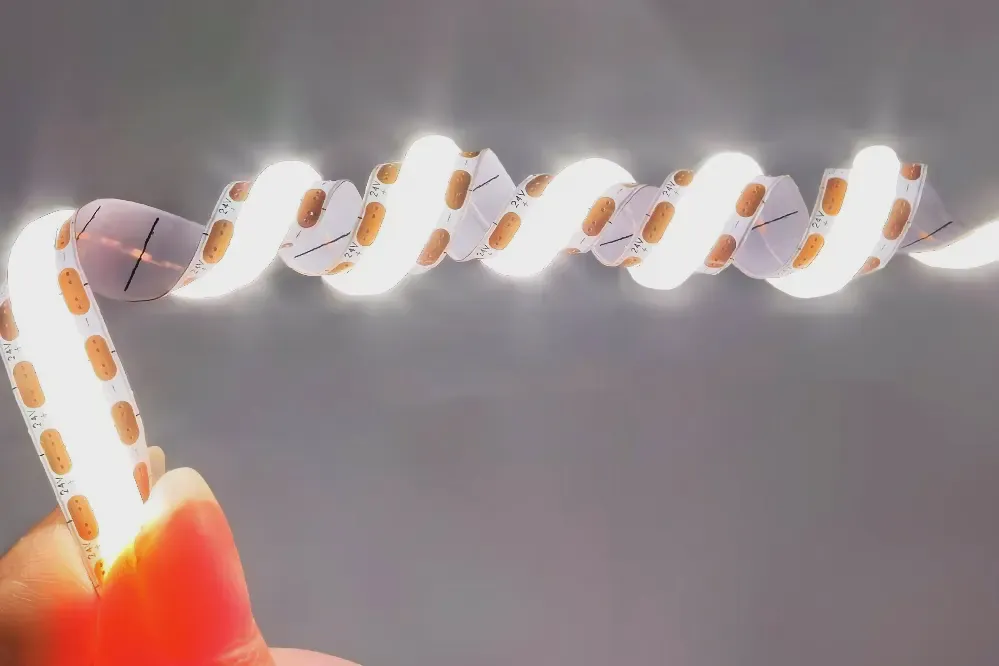
Neither strip is meant to be folded. According to a support note from Visionary Technologies, a strip maker, partial outages usually trace back to mechanical overstress that cracks a solder joint or the board itself. The installer rules are the same for both: bend across the flat face, not edge-on; keep to the bend radius on the datasheet; never crease the strip at a corner, and use a connector or a cut-and-rejoin there instead.
Heat is the other handling point. At 4.6 W/ft, a 10 mm SCOB run carries more heat per foot than standard COB, so mount it in an aluminum channel rather than on painted drywall or wood. Our thermal management guide has the numbers on what the channel does. Our COB page rates COB at L70 ≥ 50,000 hours, and either family reaches its rated life only when the heat has somewhere to go.
Color Bins, CRI and Tunable Builds
Color consistency is where the two builds are controlled differently. SCOB uses packaged LEDs, so the packages are binned before assembly; our SCOB rows are built from one bin, Color-consistency steps (MacAdam ellipses). Fewer steps means two strips from different reels look like the same white; 3-step is hard to tell apart by eye.<3. COB’s phosphor is applied over the whole strip, so COB is controlled at the strip level instead; our COB page lists ±2 SDCM binning across every reel.
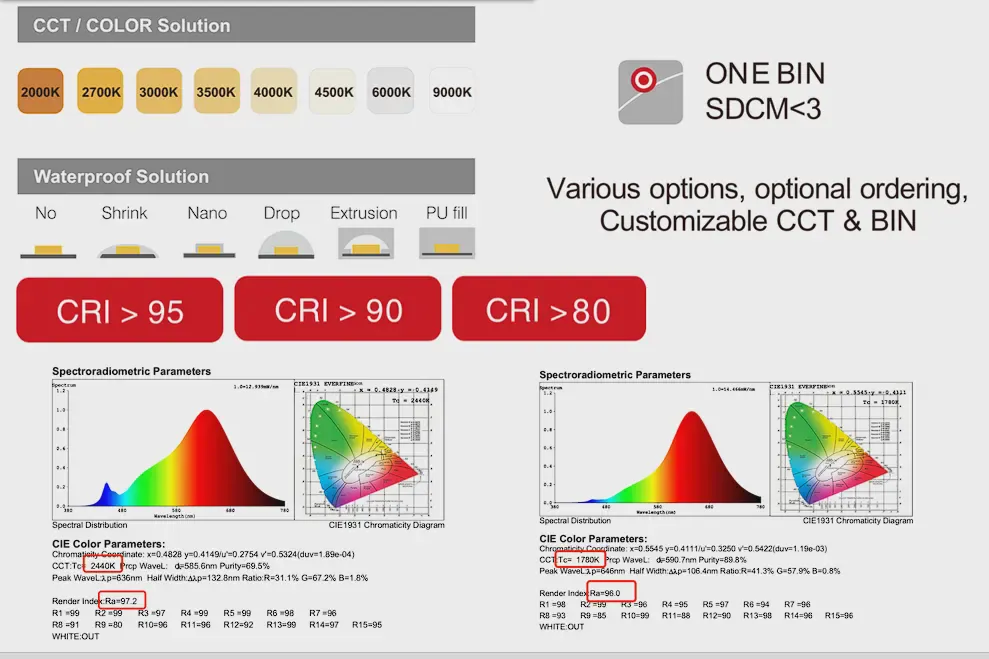
Either way, ask for the SDCM figure and the bin on the quote, and order each visible run from one lot. Our SDCM and color consistency guide explains what the number means and how to write it into the spec.
SCOB’s Ra≥97 and tunable white builds share the 10 mm platform. COB covers both as well: high-CRI COB up to Ra 98 on our COB page, and tunable white such as UT-T624-8 at 2700–6500K on our tunable white LED strip page.
Where Each One Belongs
The decision usually lands on one of these situations:
| Job | Better pick | Model | Why |
|---|---|---|---|
| Energy-code cove or indirect light, hidden in a channel | SCOB | UT-SC320HE-15 | 130–140 lm/W; count one driver per 10 ft |
| Gallery, jewelry case or retail display needing Ra≥97 | SCOB, or high-CRI COB | UT-SC320CRI97-15 | Listed Ra≥97 row at 105 lm/W; compare high-CRI COB figures at quote |
| Bare strip seen up close: glass shelf edge, toe kick, open cove lip | COB | UT-C480-8 | Smoothest bare line; mock up before any substitution |
| Narrow reveal or handrail slot | COB | UT-C400-3 | 2.7/3 mm board; our slimmest SCOB is 5 mm |
| 5 mm reveal where output matters | SCOB | UT-SC336SS-6 | 1.8 W/ft at 115 lm/W, 26 ft per 48 W driver |
| Long straight run with one feed | COB | UT-C480-8-48V | 65 ft (20 m) from one end at 48V |
| Long 24V run with few feed points | SCOB | UT-SC320HE-15 | 49 ft (15 m) from one end, 98 ft (30 m) from both |
| Field-cut runs with no fixed cut marks | Either | UT-C528-8-FC or UT-SC300-15 | Both cut at any point; SCOB gives more light per watt |
| Curved or twisted runs | SCOB | UT-SC320HE-15 | SMD-style build tolerates handling better |
| Tunable white | Either | UT-T624-8 or UT-SC308TW-18 | Pick by output and watts per foot |

Channel fit belongs on the same line of the submittal. A 10 mm SCOB strip does not fit a channel rated for 8 mm strip, such as our UT-CH1207. It fits our UT-CH1616 corner channel, rated for strip up to 10 mm, and the deep UT-CH2415, rated up to 15 mm. Our LED channels and diffusers page lists every profile’s maximum strip width, and the channel selection guide covers depth and cover choice.
Spec Mistakes
- Swapping strip, keeping the driver schedule. A SCOB substitute at 4.6 W/ft on a schedule sized for 3.2 W/ft COB overloads the drivers. Recount the drivers from the new W/ft before approving.
- Assuming the channel fits. A 10 mm SCOB strip does not fit a channel rated for 8 mm strip. Check the maximum strip width.
- Comparing lumens at different CRI. A 130–140 lm/W figure is for the Ra≥90 build. If the spec calls for Ra≥97, compare against the 105 lm/W high-CRI SCOB, not the high-efficacy one.
- Approving a bare-strip substitution from a datasheet. Where the strip is bare and close to the eye, approve the reel in a mockup, not from a table.
FAQ
What is SCOB LED strip?
SCOB LED strip is a dot-free strip built from small packaged SMD LEDs soldered to the board and covered with a phosphor adhesive and a milky white silicone layer. It looks like COB when lit but is assembled like SMD strip, which allows the LEDs to be sorted by color and efficacy before assembly.
Is SCOB brighter than COB?
Per watt, yes. Our high-efficacy SCOB, UT-SC320HE-15, lists 130–140 lm/W against a typical value of about 90 lm/W for a standard Ra≥90 COB, and at 4.6 W/ft it puts out about twice the light per foot of UT-C480-8. The extra light also means extra watts per foot, so recount drivers.
Can SCOB LED strip be cut anywhere?
Only the free-cut build. UT-SC300-15 cuts at any point along the run. The other SCOB rows cut at marked intervals, for example 0.98 in (25 mm) at 24V on UT-SC320HE-15. Free-cut COB, such as UT-C528-8-FC, cuts at any point as well. Our free-cut LED strip guide explains how the cut works.
Does SCOB LED strip need an aluminum channel?
On most commercial jobs, yes. At 4.6 W/ft the 10 mm SCOB builds carry more heat per foot than standard COB, and an aluminum channel keeps the strip cooler and protects its rated life.
How does SCOB compare with CSP LED strip?
Both use packaged LEDs that can be sorted before assembly. CSP packages are smaller and sit closer to the board, so a CSP strip is usually thinner. Our CSP vs COB guide and our CSP LED strip page cover CSP’s own data.
Decision Rule
Choose SCOB when the job needs light per watt, a listed Ra≥97 build, or a strip that will be handled and curved. Choose COB when the strip is bare and close to the eye, when the slot is under 5 mm, or when a run longer than 49 ft (15 m) has to be fed from one end. Either way, recount the drivers and check the channel width before the submittal goes out.
We supply both builds and quote them side by side. Send the run lengths, the channel you plan to use and the CRI the spec calls for, and we will return both options with their driver counts, so the comparison is on paper before anyone approves a substitution: request a quote.