Free-cut LED strip can be cut at any point, so each piece fits the measured length. Standard strip cuts only at marked points, as far apart as 1.97 in (50 mm) on some models, and the leftover shows as a dark stub. Free-cut suits signs and millwork, with four limits: feed, connection, cut-end protection and the cut list.
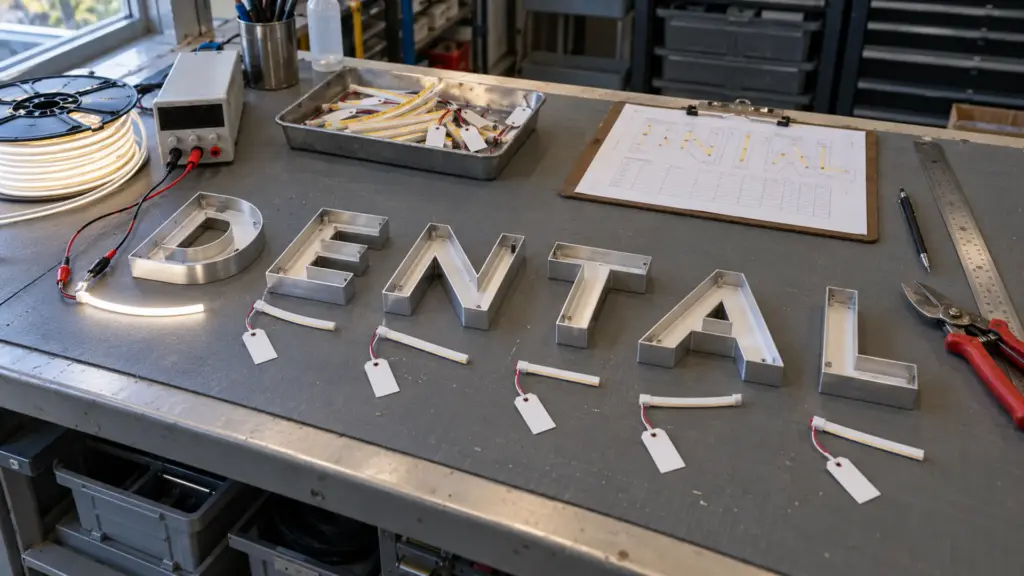
A sign shop has a letter set in front of it: 28 strokes, each with its own length, and a roll of strip that cuts every 1.97 in. Every stroke ends a little short or a little long. In a face-lit letter, a short stroke shows as a dark stub at the end of the line. The usual fix is to design to the interval. The better fix, when the strip allows it, is to cut to the stroke.
What Free-Cut Changes
A cut interval is the distance between marked cut points. The worst-case leftover on a piece is one interval, and the average is half of it. The table uses the intervals from our spec tables, the same values our cut length calculator applies to any run you enter.
| Strip | Cut interval | Worst-case leftover | Average leftover |
|---|---|---|---|
| UT-C528-8-FC, free-cut COB | Any point | None | None |
| UT-C320-6-SF, solder-free COB | 0.49 in (12.5 mm) | 0.49 in (12.5 mm) | 0.25 in (6 mm) |
| Standard 24V COB | 0.98 to 1.97 in (25 to 50 mm) | 0.98 to 1.97 in | 0.49 to 0.98 in |
| UT-S2835-120, SMD | 0.98 or 1.97 in (25 or 50 mm) | 1.97 in | 0.98 in |
| UT-H120-60, 120V strip | 19.7 in (500 mm) | 19.7 in | 9.8 in |
The 120V strip’s interval is long because the line voltage is higher and the segments are longer. That is why it suits long light boxes and not a letter stroke.
Free-cut also helps when the strip is dense. The UT-C528-8-FC has 528 LEDs per meter, a pitch of 1.9 mm, so a short piece still reads as a continuous line, with no dots even in a shallow return. Our COB LED strip page lists the free-cut and mini-cut series with the rest of the range.
What Free-Cut Is Not
A free-cut series is built to be cut anywhere, and cutting it at any point, then connecting and sealing the cut as the instructions show, is normal use. A standard strip is not built that way. Cutting a standard strip between its marked points breaks the circuit or leaves a section that does not light, and our warranty policy lists cuts outside marked cut points on such strip among the exclusions for physical damage. Free-cut is a property of the model, not a technique. Check the model number against the spec table before the first cut, and keep the marked-cut rule for every other strip.
Free-Cut and Pitch
Short pieces need a close pitch. The UT-C528-8-FC has 528 LEDs per meter, a pitch of 1.9 mm. A 2 in (50 mm) stroke carries about 27 LEDs, and it reads as a line. The same 2 in of a 120 LED/m SMD strip carries about 6 packages, a pitch of 8.3 mm, and in a shallow return the packages show as dots. Free-cut and a close pitch together are what let a short stroke look continuous, and they are the reason free-cut COB is the usual choice for letters and shallow millwork.
Where Leftovers Show
Take the 28 strokes in the letter set. At the 1.97 in (50 mm) interval, each stroke averages about 0.98 in of leftover, so the set carries about 27 in (700 mm) of dark stub on average and as much as 55 in (1.4 m) at worst. The sign reads as uneven at the ends of strokes, where the eye goes. With a free-cut piece, the stub is zero.
The same arithmetic applies to millwork, but the leftover is hidden. A shelf edge that is 28.7 in (730 mm) long gets a piece of 27.6 in (700 mm) or 29.5 in (750 mm) on a 50 mm interval, so it ends 1.2 in short or 0.8 in over, and the gap or the overhang is inside the cabinet. The benefit there is not appearance, it is time and waste: no re-cutting, and the offcuts are not stranded as short pieces.
| Application | Does a dark stub show? | Free-cut worth it? |
|---|---|---|
| Face-lit channel letters | Yes, in the lit face | Yes |
| Light box face | Yes, on the edge rows | Yes, if rows are short |
| Shelf edge, hidden | No | Saves time, not appearance |
| Open display edge | Yes | Yes |
| Long coves | No (long runs) | Rarely needed |
Our guide to halo-lit and face-lit letters covers the sign side, and the under-cabinet and millwork page covers the cabinet side.
Limit 1: Load and Feed
Free-cut changes where a piece ends. It does not change the electrical rules. The UT-C528-8-FC draws 4.0 W/ft and runs 16 ft (5 m) from one feed. A 16 ft piece loads 64 W, and a driver is sized for the sum of every piece it feeds, at or below 80 percent of its rating.
The practical limit is the lead count, not the length. A letter set of 28 pieces that totals 36 ft is a 144 W load, and it still needs 28 connections to the supply, because each piece needs its own feed. Cutting to any point makes pieces shorter, and short pieces multiply feeds. Plan the wiring before the cut list, so each lead has a place to land.
| Pieces | Total length | Load at 4.0 W/ft | Feeds needed (at least) |
|---|---|---|---|
| 12 shelf edges | 36 ft | 144 W | 12 |
| 28 letter strokes | 36 ft | 144 W | 28 |
| 6 long runs | 36 ft | 144 W | 3 (two runs of 6 ft per feed within 16 ft) |
The load is the same in all three. What changes is the wiring.
A Worked Millwork Job
A display wall has 12 shelves, each 28.7 in (730 mm) long, lit from under the front lip. The total strip is 12 × 28.7 in = 344 in, or 28.7 ft. At 4.0 W/ft the load is about 115 W, and at 80 percent driver loading the driver is at least 144 W, so a 150 W supply covers it. The cut list has 12 identical lengths, which is the easy case: each piece is cut once and labeled by shelf. The wiring is the work: 12 leads, each short, to a distribution point behind the unit.
On a standard 1.97 in interval the same shelf takes a 27.6 in piece, 1.2 in short, or a 29.5 in piece that has to be trimmed or folded back. The free-cut piece is cut once to the shelf and is done, and across 12 shelves that is 12 fewer decisions on the bench.
Limit 2: The Connection at the Cut
A marked cut point has pads that take a connector or solder. A free cut has to carry the same connection, and how it does so is a property of the model. Ask for the instruction sheet for the free-cut model you order, and read what it says about the lead, the connector or the solder. Do not assume the method from a marked-cut strip.
Four questions to put to the supplier before you cut the job:
- What is the minimum piece length?
- What lead or connector does the instruction use at a cut, and does it need solder?
- Does the LED nearest the cut still light on a finished piece?
- Does the cut end need covering or sealing, and for which location?
Test one cut on the bench before you cut the job. Cut a piece, attach the lead as the sheet shows, power it and check that every LED on the piece lights, including the one nearest the cut. Our cut and connect guide covers the general checks for marked cuts, and the power-off, plan-the-pieces and test steps in it still apply.
Limit 3: Protecting the Cut End
The free-cut COB strip is rated IP20, which means it is not protected against water. Use it in dry places: inside millwork, inside a sealed letter that drains, or behind a cover in a dry room. A strip with an IP65 or higher rating needs its cut end sealed with an end cap or a sealing method after the cut, as our guide to sealing a cut end of IP67 strip describes. If the application is wet, choose a sealed series and its marked cut points, and do not rely on free-cut.
Dust and handling matter too, and so does the order of work: cut and cap the pieces on the bench, then install them, so a cut end is never made inside a finished cabinet. A cut end is bare copper and phosphor, so cover it with an end cap or tape before it is placed in a cabinet where it can be touched.
Limit 4: The Cut List Still Matters
Free-cut does not remove the cut list. It removes the rounding. Measure the space, subtract the lead and the gap for the end cap, label each piece, and cut once. Keep the offcuts, because a piece that was cut too short can be reused on the next stroke, and a bench test needs a scrap.
Color matching across pieces is the other detail. Cut every piece of one visible line from the same reel, in sequence, and label them so adjacent pieces stay adjacent. A reel from another batch can differ slightly in CCT, and a letter with two shades shows it. The UT-C528-8-FC comes in 2700 to 6000K, so state the CCT on the cut list.
Order the strip with spares. A cut that goes wrong cannot be undone, and a free-cut series does not have a second marked point to fall back to. Keep one extra reel from the same batch for any visible run, as our maintenance guide recommends for batch matching.
Free-Cut, Mini-Cut or Standard
| Job | Pick | Why |
|---|---|---|
| Letter strokes of many lengths | Free-cut | No dark stub, no waste |
| Cabinet shelf edges and open displays | Free-cut or mini-cut | Fits measured lengths |
| Very short pieces in a tight cut list | Mini-cut (12.5 mm) | Fine steps with a known connection |
| Long coves and perimeters | Standard marked cut points | Few cuts, longer pieces |
| Wet or exterior locations | A sealed series at marked cut points | Free-cut is IP20 |
Final Checks
- Cut list drawn, each piece labeled, leads planned.
- One test cut made on the bench with the exact connector.
- Load summed for all pieces and driver headroom checked.
- Dry location confirmed for the IP20 free-cut strip.
- Pieces cut from one reel in sequence, with the CCT stated on the cut list.
- Spares and offcuts kept, and a spare reel from the same batch for every visible run.
The free-cut series is on our COB LED strip page, and we can match the strip to your cut list if you send it with your quote request.