Choose neon flex when the lit line is the design and it bends in one plane. Choose strip in a channel when the line should read as light and not as an object, when it needs more output, when the run is straight, or when the cover has to come off for service. Heat and weather settle the rest.
You have a drawing with a 40 ft line of light, a 2 in reveal, and an owner who wants “neon” without saying which kind. Both products make a continuous line, and they are built differently: neon flex is a silicone body that carries its own light, and a channel is an aluminum frame that carries strip and a cover. The choice follows what the eye should see.
Side by Side: Two Ways to Make a Line
| Factor | LED neon flex | LED strip in a channel |
|---|---|---|
| What the eye sees | The profile itself, glowing | A lit cover in a frame |
| Shape | Bends in its rated direction to a set radius | Straight lengths, joined |
| Dot-free line | By construction | By cover and depth |
| Output per foot | Limited by the silicone body | Set by the strip, with aluminum behind it |
| Water | IP67 standard | Strip rating, plus cut ends sealed |
| Impact | IP68 / IK10 option | Cover and frame |
| Cutting | At marked points, every 3.94 in (100 mm) on standard profiles | Channel with a saw, strip at its own interval |
| Service | Replace the piece | Lift the cover, replace the strip |
| Parts per run | One product and clips | Strip, channel, cover, end caps, clips |
The Line You See
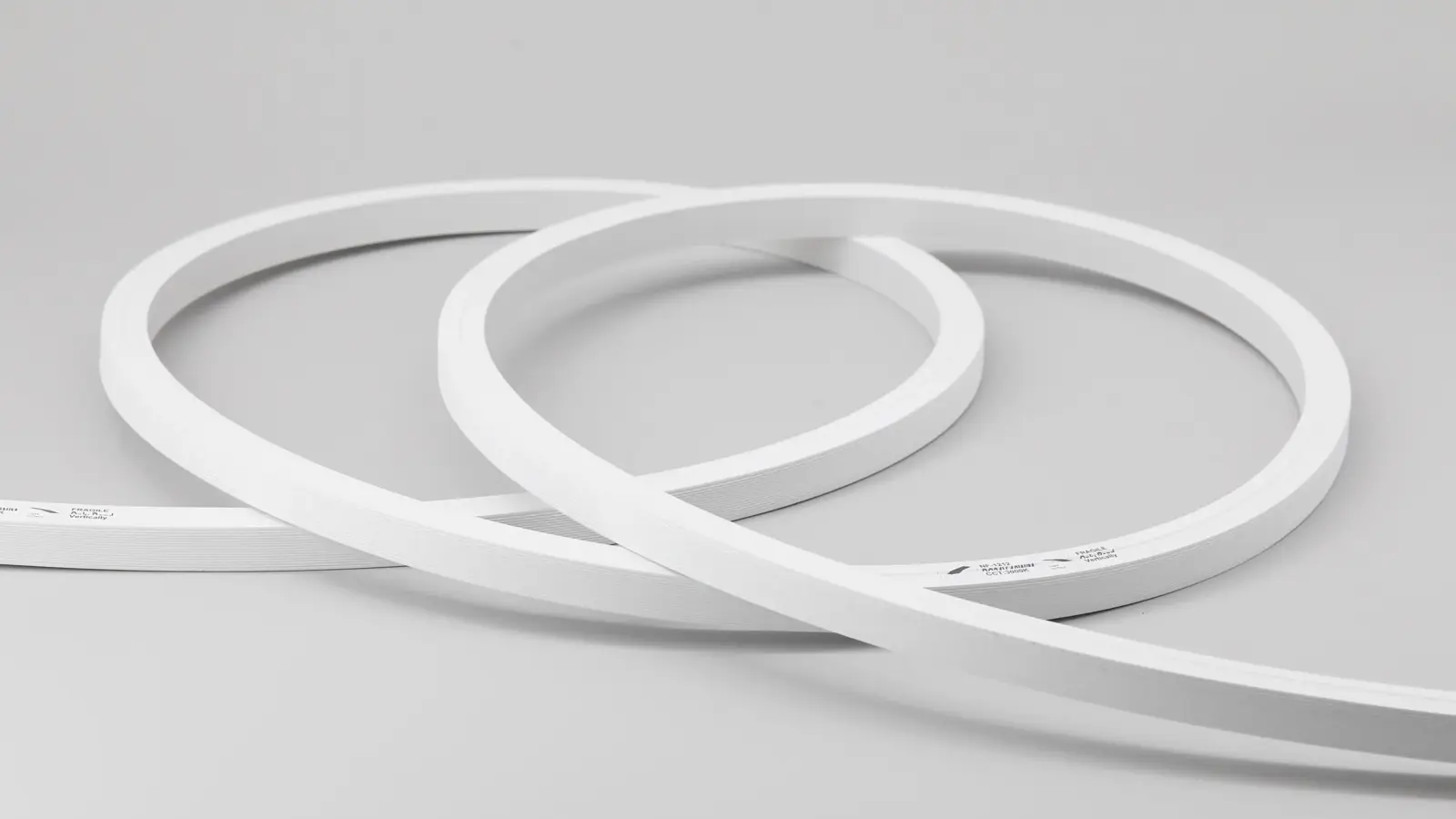
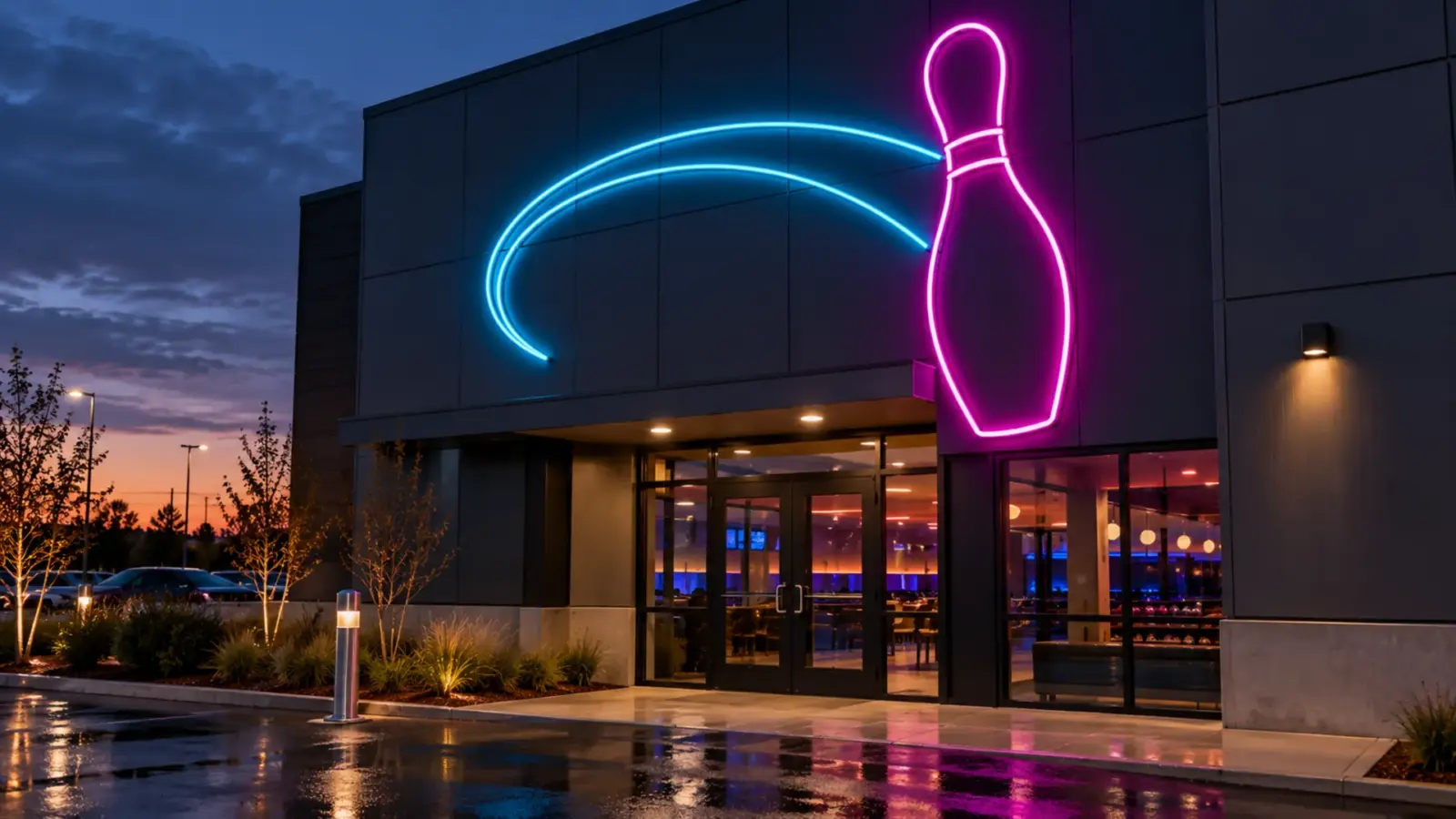
Neon flex is designed to be looked at. The silicone profile diffuses the LEDs into one continuous glow, with no dots, day or night, and the profile stays visible when it is off. That is the point on a sign, an outline or a wall feature, where the line is the message.
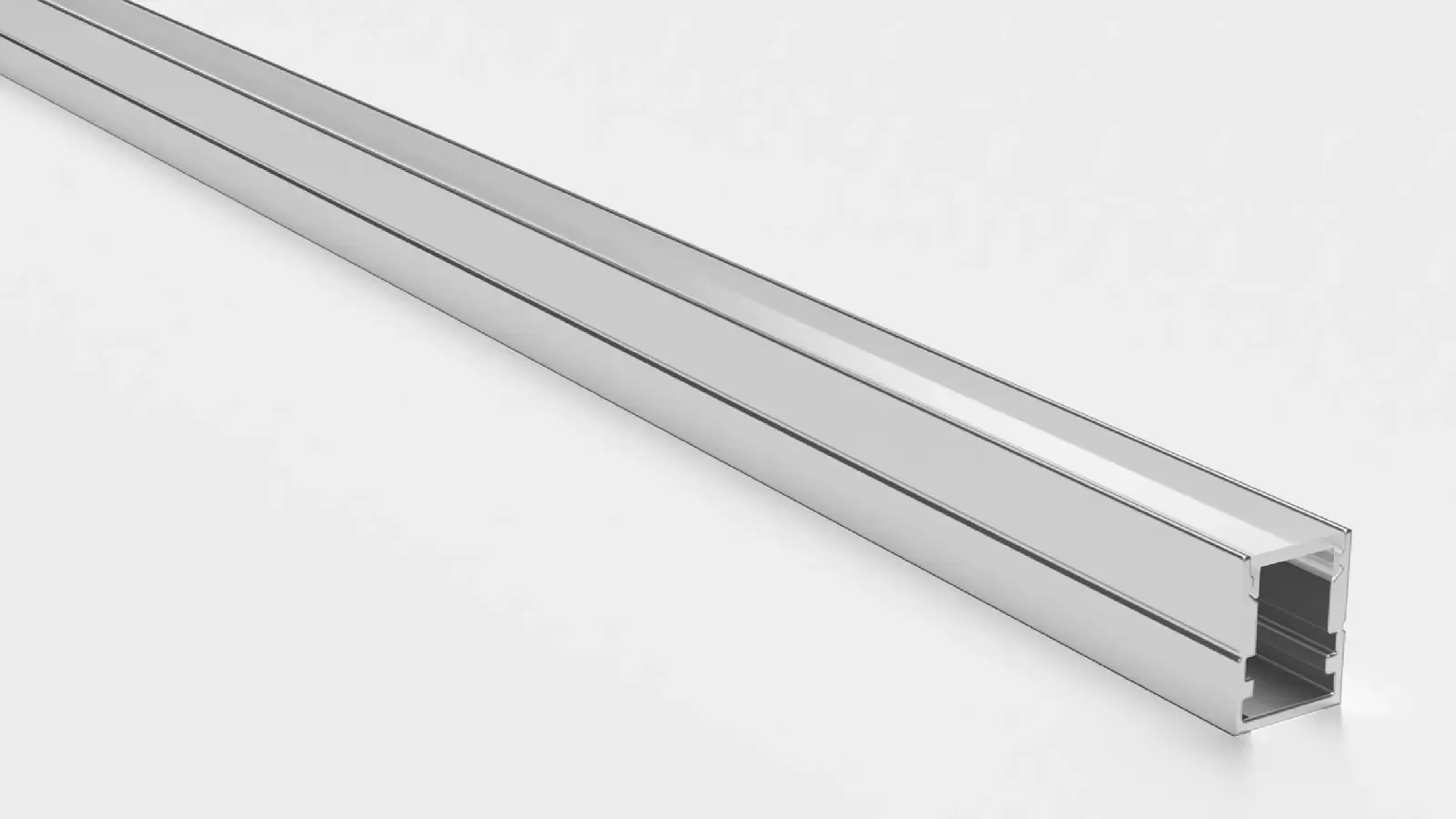
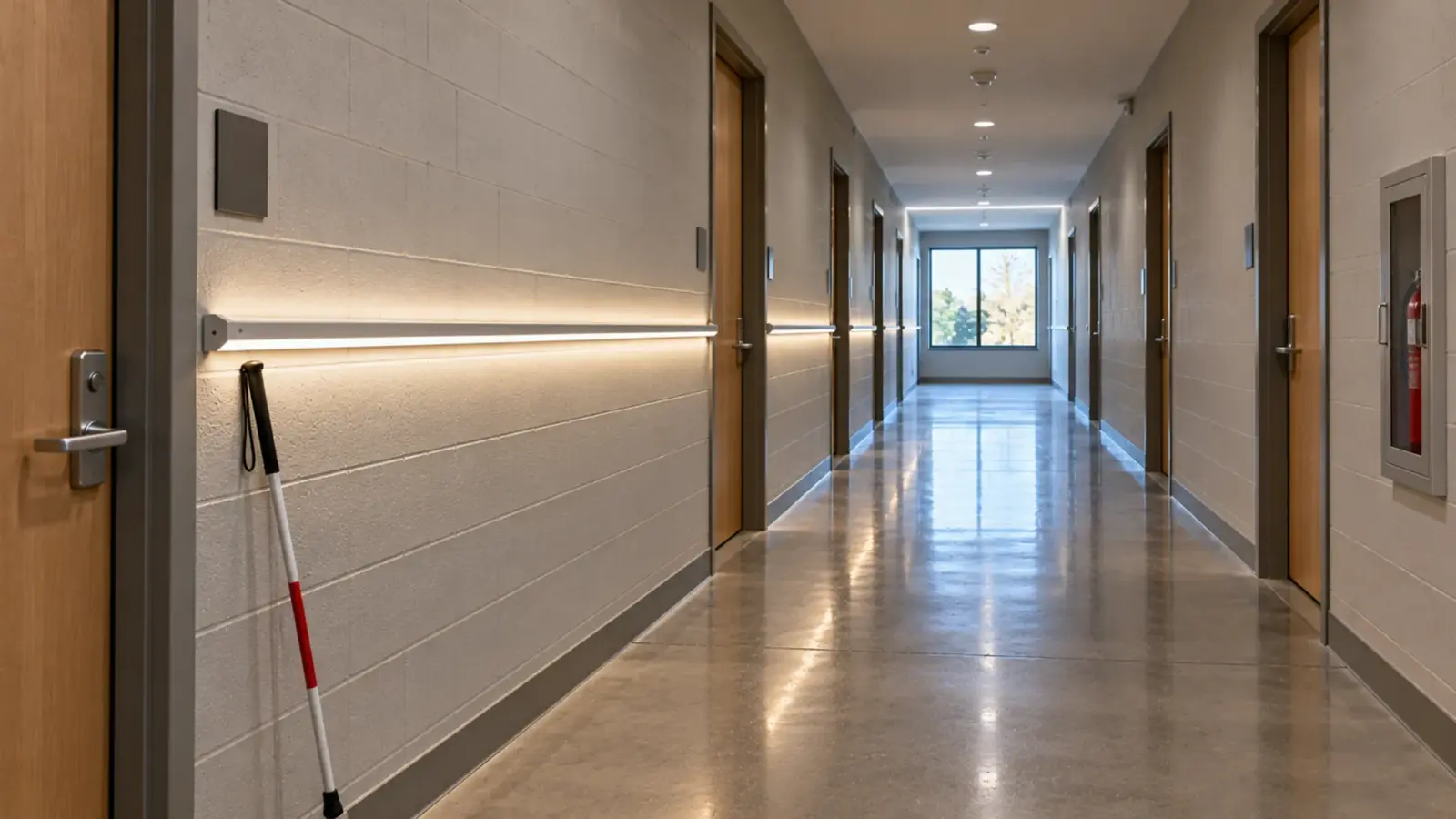
A strip in a channel is designed to be seen only as light. The cover diffuses, and the frame disappears into a reveal or a shelf edge. The dot-free result depends on the cover and the depth: our UT-CH2415 has 14.5 mm of optical depth and gives a dot-free line even with standard-density strip, and a shallow channel needs a denser strip. Our cover guide covers clear, frosted and opal.

Ask what the owner means by “neon.” If the answer is “a glowing tube we can see,” that is neon flex. If it is “a clean line of light in the wall,” that is a channel.
Curves and Straights
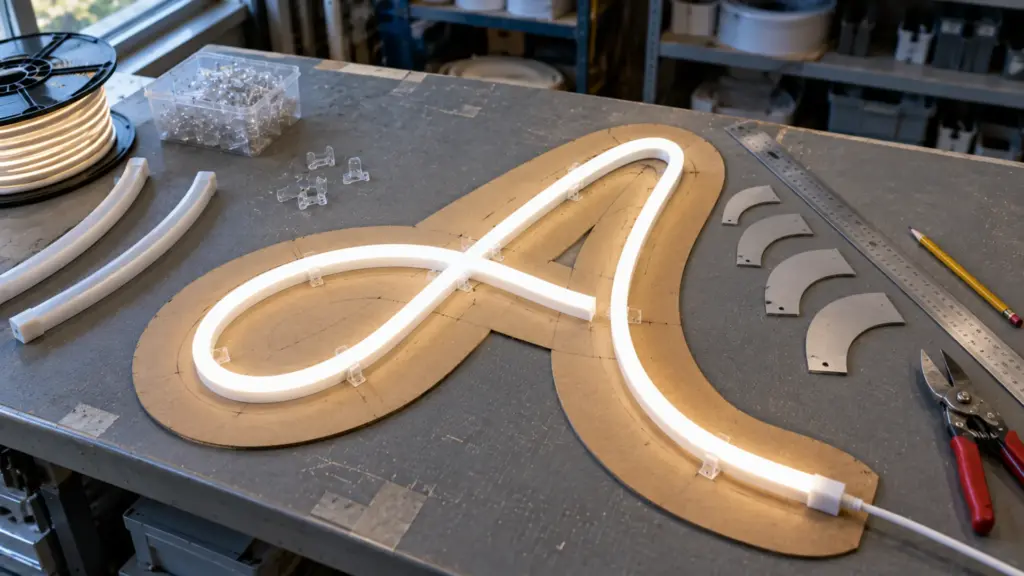
Neon flex bends in the direction it is built for, to a radius that depends on the profile. Top bend profiles such as the UT-N0606-TB turn in 2.36 in (60 mm), side bend profiles such as the UT-N0612-SB in 4.72 in (120 mm), and the 16 × 16 mm side bend UT-N1616-SB in 5.91 in (150 mm). Our neon selection guide covers the bend direction.
A channel is straight. It is cut and joined, and it follows a curve only as straight segments. A tight radius means neon, or a flexible product, and not a channel.
| Shape | Better fit | Why |
|---|---|---|
| Script and letterforms | Neon flex, side bend | Radius down to 4.72 in |
| Waves and arcs in one plane | Neon flex, top bend | Radius down to 2.36 in |
| Long straight lines | Strip in a channel | No bends, easy to align |
| Corners at 90 degrees | Either | A mitered channel or a neon bend |
| 3D forms | Neon flex, 3D bend | Turns in two planes |
| Mixed straight and curved | Both, joined at a defined point | Each does its own job |
Output and Heat
A silicone body does not sink heat. Neon flex therefore runs at low power per foot: our standard profiles run 2.4 W/ft on the 6 × 6 mm up to 4.3 W/ft on the 16 × 16 mm. Our thermal management guide notes that a strip at 6 W/ft or more needs aluminum behind it, and a neon profile stays below that line by design.
A strip in a channel can go higher. The UT-CH3020 carries wide or doubled strip, and a 7.6 W/ft strip fits the UT-CH2415, with the channel carrying the heat. When a line needs more light per foot than a neon profile gives, that is the channel’s job. Do not assume a neon line is brighter than a covered strip because it looks bold. A bright neon line on a dark wall reads as bright, and the same watts behind an opal cover read as soft. Compare lumens per foot from the spec tables and confirm on a mockup.
Weather and Impact
Neon flex is IP67 as standard, and the IP68 and IK10 option, UT-N1616-68, is for fountains, marine settings and lines within reach of the public. The profile carries its own seal, so cut ends need end caps and sealing, as our installation guide shows.
A strip in a channel is as weatherproof as the strip is. Standard strip is IP20, and an outdoor channel needs a sealed strip and sealed cut ends, with the cover sealed to the frame. Indoors, none of this applies, and the channel is the simpler detail.
Cutting, Feeding and Service
Neon flex cuts at marked points, every 3.94 in (100 mm) on standard profiles and 1.97 in (50 mm) on the nano family. A standard 24V run feeds 16 ft (5 m) from one end, and the constant-current profiles go much further: 49 ft (15 m) on the UT-N1212-TB and 82 ft (25 m) on the UT-N1616-SB. Plan each piece to land on a mark.
A channel cuts anywhere with a saw, and its strip cuts at the strip’s own interval, so the two do not have to agree. The feed limit is the strip’s. Our neon reel guide explains why a reel is a supply length and not a run.
Service differs. A failed neon piece is replaced as a piece, with new end caps and a sealed cut. A failed strip in a channel is replaced behind the cover, which lifts out. Neither is faster in every building; the one that fits is the one whose service is drawn.
Brightness: What to Compare
Do not compare the look. Compare the numbers on the spec tables. Neon flex shows watts per foot and cross-section for each profile: 2.4 W/ft on the 6 × 6 mm, 3.0 W/ft on the 10 × 10 mm, 3.7 W/ft on the 12 × 12 mm and 4.3 W/ft on the 16 × 16 mm. A strip in a channel takes the strip’s own rating: 3.2 W/ft for the UT-C480-8 up to 7.6 W/ft for the UT-C960-15, and double that in a wide channel. Power is not light, so ask for lumens per foot for each, and compare them after the cover’s loss, which is roughly 20 to 30 percent for opal. The mockup then confirms what the numbers cannot: how the line reads against the wall at night.
Color and Control
Both products reach the same colors. Neon flex comes in mono, CCT, RGB, RGBW and SPI addressable versions, such as the UT-N1616-SPI at 4.3 W/ft. A strip in a channel takes any strip we make, including tunable white, RGBW and addressable, behind a cover. Both run on 24V low-voltage control, so the driver and the controller are chosen the same way, and a project can run neon outlines and channel lines from one controller if the protocol matches. The difference is the look of the color: a neon profile shows color in its body, and a channel shows color through a cover, which softens it.
Day and Night
A line is seen unlit for half the day. A neon profile is visible when it is off, and our camouflage shell, the UT-N1616-CM, comes in black, white, gray or orange to disappear against a background. Honeycomb anti-glare profiles, the UT-N1212-AG and UT-N1610-AG, cut glare where the line is seen straight on at eye level. A channel unlit looks like an aluminum rail with a lens, and the finish can be silver or black. Decide how the line should look at noon as well as at night.
Neon in a Channel
The two are not exclusive. Our installation guide notes that neon flex mounts with clips for curves and in a channel for straights. A channel under a neon profile keeps a long straight line straight and gives the silicone a rigid backing, at the cost of an extra part. This hybrid suits a long straight run in a visible location, where a sagging neon line would show.
Mixed Jobs
A job that has straight lines and curves can use both products, each where it fits: neon flex for the curves and a channel for the long straight runs. Join them at a defined point, such as a corner or a column. Match the CCT and the brightness on a mockup, because two products with the same CCT can still differ in output and in how the cover or the silicone shifts the color. Keep one controller and one driver family if you can, so dimming behaves the same on both.
A 40 ft Outline, Counted
The table counts a 40 ft (12.2 m) straight outline built each way, with a 3.7 W/ft line.
| Item | Neon flex (UT-N1212-TB, CC) | Strip in a channel |
|---|---|---|
| Parts | Neon flex, end caps, clips | 5 channels (40 ÷ 9.8 = 4.1, rounded up), 5 covers, strip, end caps, clips |
| Feed | 1 feed (49 ft CC from one end) | Per the strip: for a 16 ft feed, 3 feeds |
| Load | 148 W (40 × 3.7) | The strip’s W/ft times 40 |
| Joints | None, if cut once on a mark | 4 channel joints |
| Alignment | Clips every few feet | Channel straight by construction |
The neon line is one product with one feed, and that makes the straight run short on parts. The channel is a system, and the system is the price of a serviceable, higher-output line.
Which Job Gets Which
| Job | Pick | Why |
|---|---|---|
| Sign outline or script | Neon flex | The line is the design |
| Wall feature seen unlit | Neon flex | The profile looks intentional |
| Hidden cove or reveal | Strip in a channel | The frame disappears |
| Shelf edge or under cabinet | Strip in a channel | Flat, low and serviceable |
| High output per foot | Strip in a channel | Aluminum carries the heat |
| Public reach, wet | Neon flex IP68 / IK10 | Sealed and impact rated |
| Long straight runs | Either | Feeds and parts decide |
Mistakes on a Choice
- Neon for a hidden line. The body is visible, so a hidden detail wastes it.
- A channel for a tight curve. A tight curve becomes segments.
- Comparing by look. Compare lumens per foot, not bold versus soft.
- No feed plan. A 16 ft feed limit on a 40 ft line needs three feeds or a constant-current profile.
- Service not drawn. Write how the line comes out.
- Two products, two looks. Mixed jobs need a mockup where the joint is, or the eye finds it.
- Neon in a closed detail. A silicone body has no heat sink, so a closed cove with neon needs a lower power or an open detail.
FAQ
Is neon flex brighter than strip in a channel?
Not by default. Output depends on the watts per foot and the optics. Neon flex runs 2.4 to 4.3 W/ft on our standard profiles, and strip in a channel can run higher with aluminum behind it. Compare lumens per foot from the spec tables and confirm on a mockup.
Can neon flex replace a channel on a straight line?
Yes, if you want the profile seen and you can accept the lower output. A straight neon run has fewer parts and one feed on a constant-current profile. For a hidden or high-output line, use a channel.
Which is easier to service?
A strip in a channel comes out behind a lift-out cover. A neon profile is replaced as a piece, with new end caps. The easier one is the one drawn for service.
Spec Check
Name what the eye should see, then the shape, the output, the weather and the service. Draw the feeds. Put the model numbers on the schedule with the bend radius or the channel depth.
Unitop Lighting supplies LED neon flex and LED channels and diffusers for commercial and architectural projects across the US. Send the drawing, the run lengths and the smallest radius with your quote request, and we will check the profile, the feeds and the power against the drawing.