
LED neon flex selection comes down to four decisions, in order: which way the line bends, how tight the tightest curve is, how long each run is, and what environment it lives in. Bend direction picks the family, the tightest curve picks the size, run length picks standard or constant current, and the environment picks the rating. If the choice is still between LED flex and glass tube, our LED neon flex vs glass neon comparison covers cost, lifespan and code.
The figures below come from the spec table on our LED neon flex page. Where a point is general practice instead of a spec, the text says so.
Short Answer: Read the Drawing, Then Pick the Bend
Mark the emitting face and every curve on the drawing. A line that bends up and down along its face is a top bend. A line that bends left and right along its face is a side bend. A line that turns in more than one plane is a 3D bend, and a line that must glow on every side is a 360° round. Then size the profile to the tightest curve, and check the run length before anything else.
| Family | How it bends | Example model |
|---|---|---|
| Top bend | Up and down along the emitting face | UT-N1616-TB |
| Side bend | Left and right along the emitting face | UT-N0612-SB |
| 3D bend | Vertically and horizontally in one run | UT-N1616-3D |
| 360° round | Glows in every direction | UT-ND18-360 |
| Nano | Top bend, Ø8 and Ø12 mm | UT-NN08 |
Skipping a step is how an order comes back with the wrong profile. If one line needs both bend directions, treat it as a 3D job from the start, because a top-bend or side-bend profile cannot be forced to do both.
Bend Direction: Top, Side, or 3D
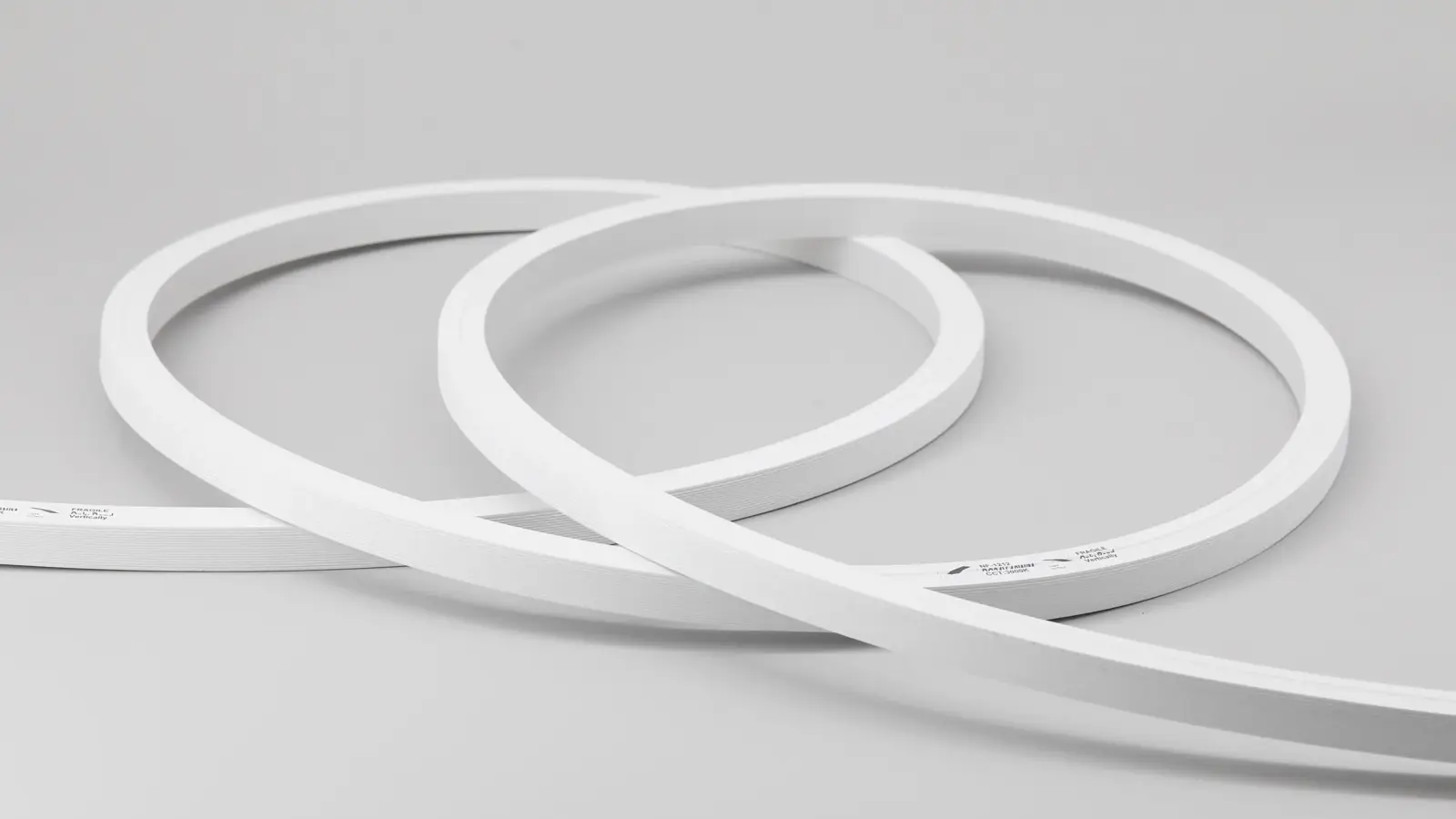
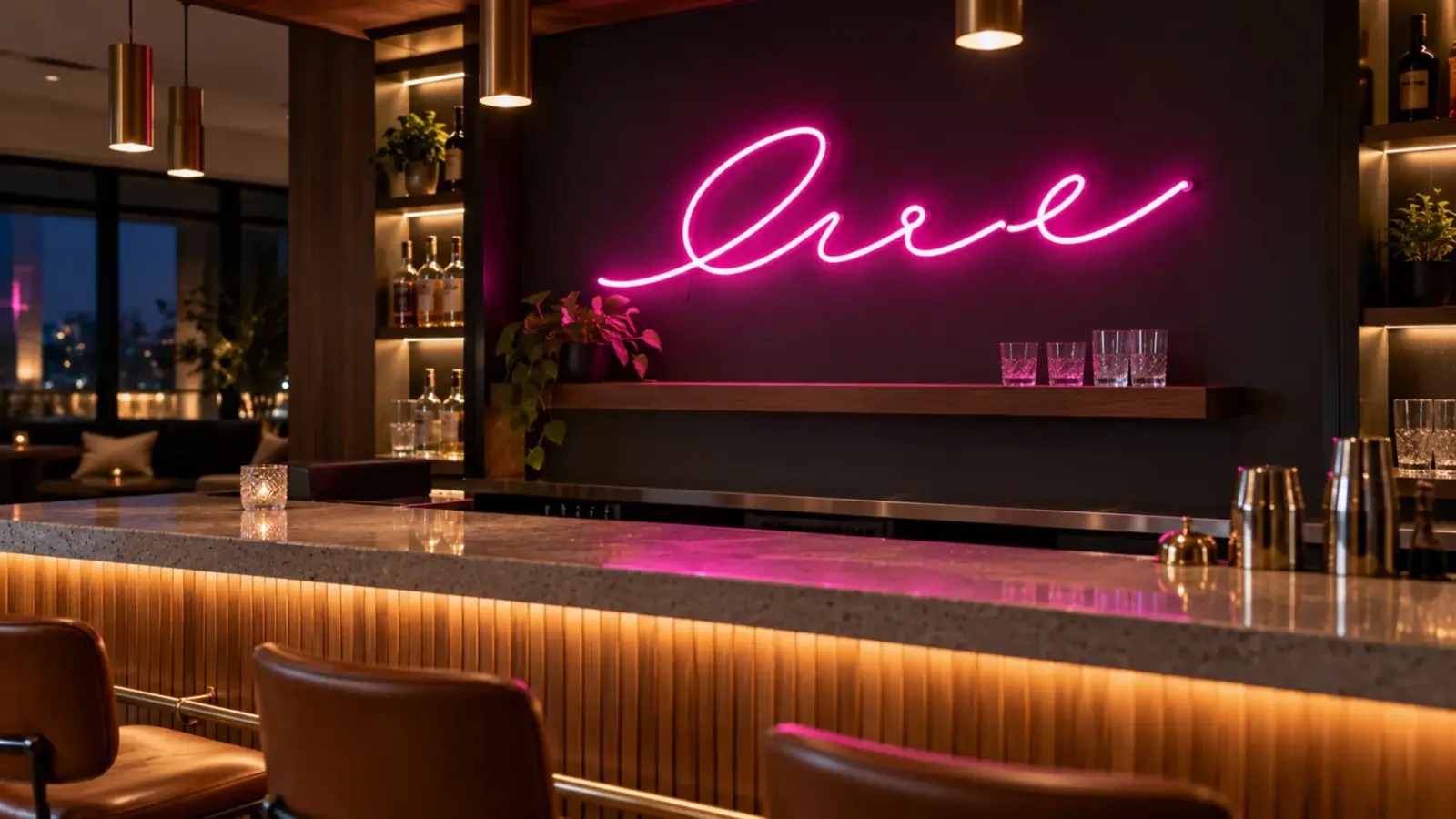
Top bend neon flex draws waves, arcs, and building outlines in one plane. It bends up and down along its emitting face, and it does not bend sideways. Side bend neon flex is the opposite. It bends left and right along the emitting face, which is what letterforms, script, and tight curves need, and it does not bend up and down.
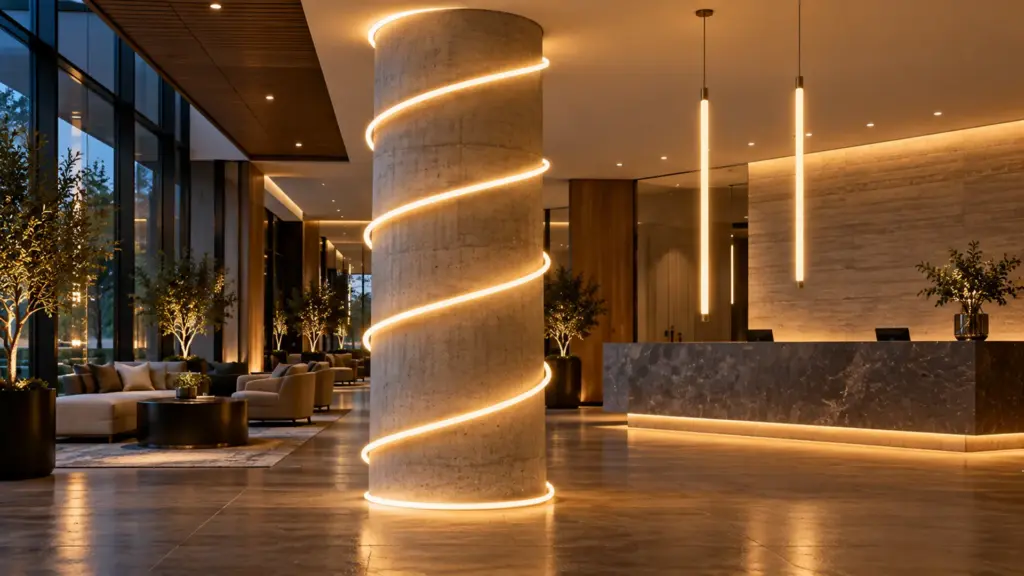
3D bend neon flex bends vertically and horizontally in the same run, for forms that turn in more than one plane, from sculptural signs to wrapped columns. 360° round neon flex has no visible back, so it suits pendants, wrapped elements, and freestanding lines.
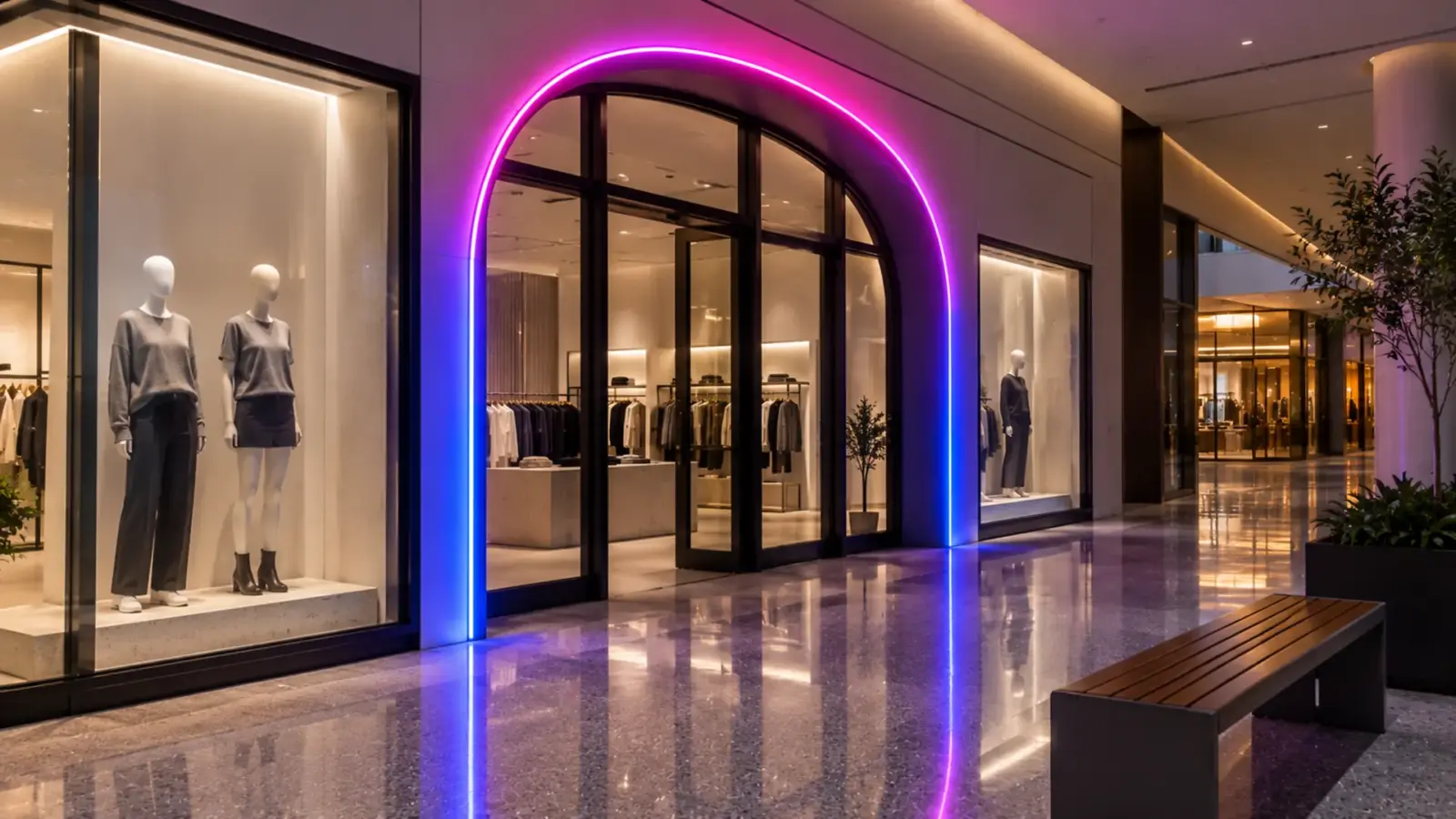
Bend only in the rated direction and never below the rated radius. As a general rule, forcing a profile the wrong way, or past its radius, can damage the LEDs inside the silicone. The drawing tells you the family, so read it before you choose a model. A storefront outline that follows a flat facade stays in one plane. A sign that wraps a column turns in two, and that is a 3D job. For animated signs, the SPI versions add pixel control on the same line. Our SPI vs DMX guide covers how those are wired and controlled.
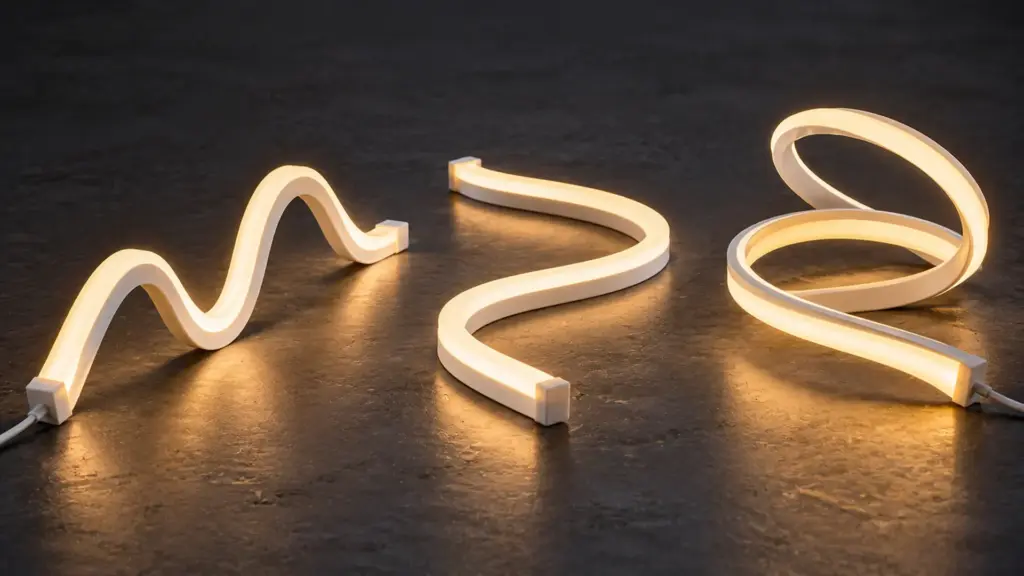
Reading the bend direction off the drawing
Three questions on the drawing settle the family before any model number is chosen.
- Where does the light face? Mark the emitting face on every segment. Top-bend and side-bend names refer to the plane the line bends in relative to that face, not to where it is mounted.
- Does the line stay flat to the wall, or lift off it? A line that curves along the wall surface in the plane of the wall bends along its face. A line that has to rise off the wall or ripple in and out bends across it.
- Does any single run do both? One run that curves along the wall and also rises off it is a 3D run.
Makers do not all use the same names: “top bend”, “side bend”, “back bend”, “horizontal” and “vertical” are used for the same motions, and pages disagree on which is which. Treat our family names as defined on our spec table, and ask for a short sample if the drawing could be read either way.
Bend Radius: Size Sets the Smallest Curve
Bigger profiles bend less tightly. A Ø8 mm nano line turns in 1.57 in (40 mm). A 50×25 mm large-format profile needs 11.81 in (300 mm) or more. So find the tightest bend on the drawing first, and only then pick a model that can make it.
| Model | Cross-section | Min bend radius |
|---|---|---|
| UT-NN08 | Ø8 mm | 1.57 in (40 mm) |
| UT-NN12 | Ø12 mm | 1.97 in (50 mm) |
| UT-N0606-TB, UT-N1010-TB, UT-N1212-TB | 6×6, 10×10, 12×12 mm | 2.36 in (60 mm) |
| UT-N1616-TB | 16×16 mm | 3.15 in (80 mm) |
| UT-N2020-TB | 20×20 mm | 3.94 in (100 mm) |
| UT-N0612-SB, UT-N1212-SB | 6×12, 12×12 mm | 4.72 in (120 mm) |
| UT-N1616-SB | 16×16 mm | 5.91 in (150 mm) |
| UT-N1010-3D | 10×10 mm | 3.15 in (80 mm) |
| UT-N1616-3D | 16×16 mm | 3.94 in (100 mm) |
| UT-ND18-360, UT-ND25-360 | Ø18, Ø25 mm | 3.15 in (80 mm), 3.94 in (100 mm) |
| UT-N2525-TB, UT-N3017-TB, UT-N5025-TB | 25×25, 30×17, 50×25 mm | From 7.09, 7.87, 11.81 in (180, 200, 300 mm) |
Size also sets the power a foot of line draws: UT-N0606-TB is 2.4 W/ft, UT-N1616-TB 4.3 W/ft, UT-N2020-TB 4.6 W/ft and UT-N5025-TB 6.1 W/ft. A larger profile costs radius and wattage, so choose the smallest one that still reads at the viewing distance.
Radius or diameter: read the spec line
Our table lists the minimum bend radius: the radius of the tightest arc the centerline of the line may follow. Some makers publish a minimum bending diameter instead, and Glowlab, for one, tests to minimum bending diameters that it says must not be exceeded. A diameter is twice the radius, so a quoted 4.72 in (120 mm) diameter is a 2.36 in (60 mm) radius. When two quotes disagree on bend, check the word first, then the number.
Side-bend lines are the stiffest of the small families, at 4.72 in (120 mm) and up. That matters for lettering. If a script “e” has a 2 in radius, a side-bend profile will not make it, and the detail has to change. The micro side-emitting profiles (UT-N0306-S, UT-N0408-S-MC, and UT-N1616-S-MC) list their bend radius on request, so ask before you commit them to a tight curve.
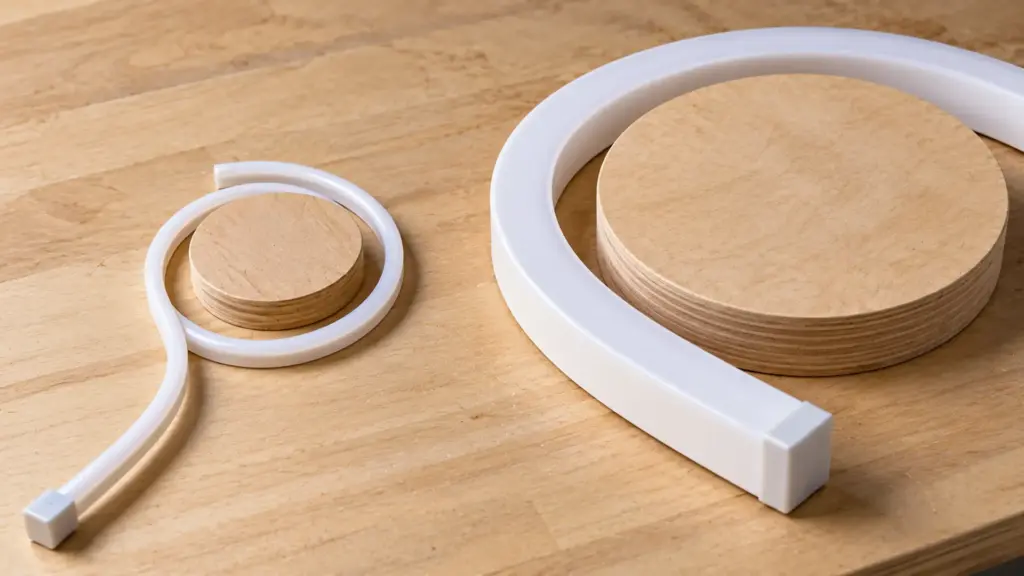
Run Length: Standard 24V vs Constant Current
Standard 24V neon flex runs 16 ft (5 m) per feed. Past that, brightness fades toward the far end. Constant-current models stretch a single feed much further, which is how one feed can cover a whole elevation with no mid-run fade.
| Model | Type | Max single feed |
|---|---|---|
| UT-N0606-TB, UT-N1010-TB, 3D, 360°, nano, and most others | Standard 24V | 16 ft (5 m) |
| UT-N1212-TB, UT-N0612-SB | Constant current | 49 ft (15 m) |
| UT-N1616-TB, UT-N1212-SB | Constant current | 62 ft (19 m) |
| UT-N1616-SB | Constant current | 82 ft (25 m) |
| UT-N2020-TB | Constant current | 98 ft (30 m) |
| UT-N2525-TB, UT-N3017-TB, UT-N5025-TB | Large profiles | On request |
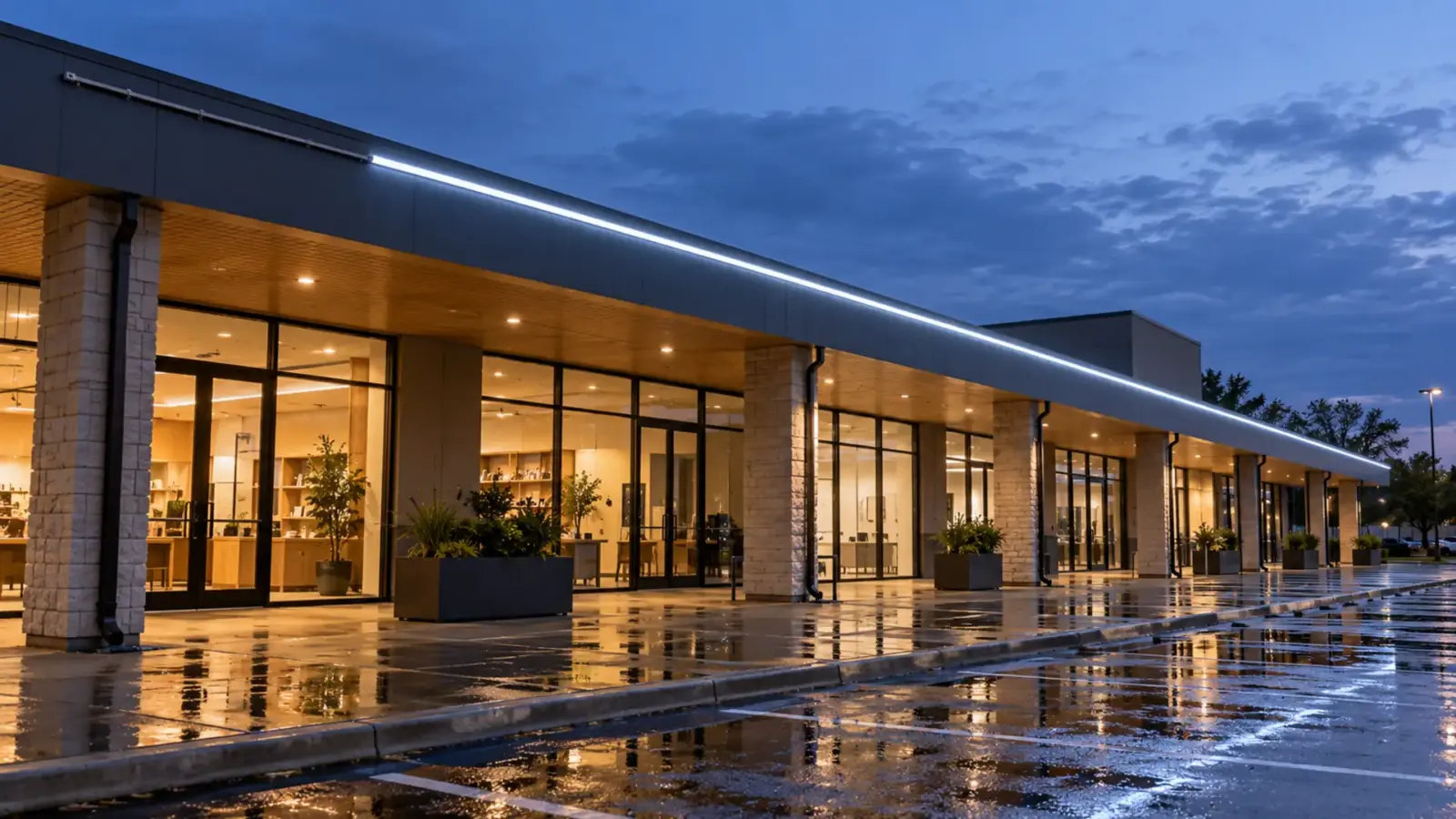
Take a 60 ft elevation as an example. A standard 24V model needs four feeds, because 60 ft is more than three runs of 16 ft. UT-N1616-TB covers it from one feed, since its limit is 62 ft (19 m), and a 60 ft run draws about 258 W at 4.3 W/ft. Size the driver for that load, with headroom.
Neon flex is commonly built in 12V and 24V. We specify 24V, and every model in our range is 24V. At the same wattage, 24V draws half the current of 12V, so voltage drop is lower, and that is what makes the constant-current designs above possible.
Constant-current models need a matching driver. Send the run lengths with the quote request, and the driver is matched along with the profile. Our drivers, controllers, and connectors range covers the options.
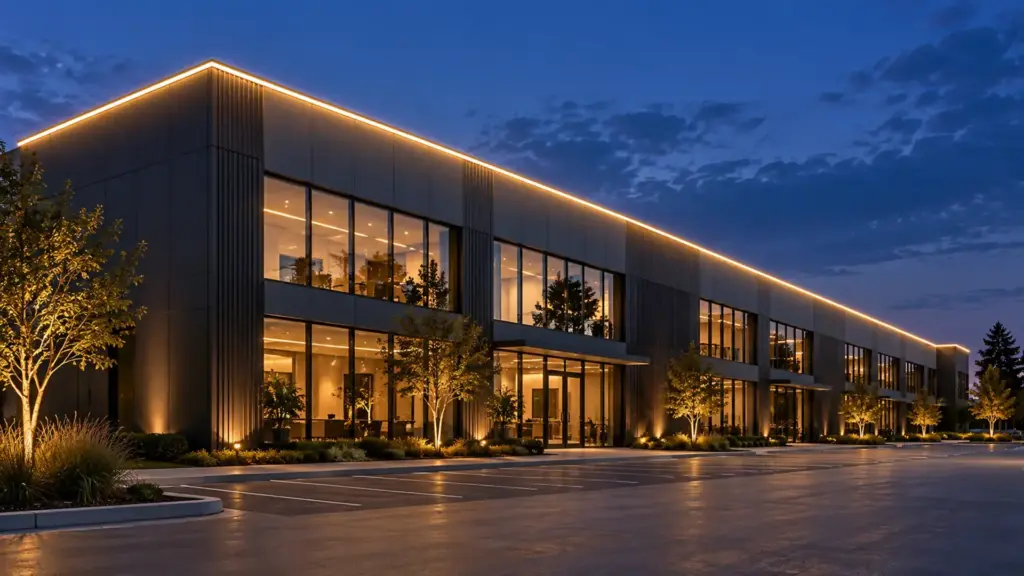
Environment: IP, IK, Glare, and Camouflage
IP67 is standard across the range. The micro side-emitting family (UT-N0306-S and UT-N0408-S-MC) is IP66. For a line near water or within reach of the public, UT-N1616-68 is the model rated IP68 and IK10 on our page. Those are lab and impact ratings, not a location marking, so confirm the listing for the exact model. Our wet location guide explains the difference.
Outdoors, plan the end caps as part of the rating. A line is only as waterproof as its cut ends, so count every cut on the drawing and order a matching silicone end cap and adhesive for each one, as how LED strip is waterproofed explains. Indoors, the same caps keep the cut end clean and finished.
Two options handle how the line looks. The honeycomb anti-glare profiles, UT-N1212-AG and UT-N1610-AG, put a louvered face over the emitting surface to cut direct glare where the line is viewed straight on at eye level. The camouflage shell, UT-N1616-CM, comes in black, white, gray, or orange, so the unlit profile disappears against its background.
Color options follow the family. UT-N1616-TB comes in mono, CCT, RGB, and RGBW. UT-N1010-TB comes in mono and CCT. UT-N1212-TB adds RGB. Pick the color option together with the profile, because not every size offers every color.
Rated life is 50,000 hours, and the UV-stable silicone holds its color and flexibility outdoors without yellowing.

Cutting, Sealing, and Mounting
Neon flex cuts only at the marked points. Standard profiles cut every 3.94 in (100 mm), and the nano series cuts every 1.97 in (50 mm). UT-N0306-S is sold as free-cut with a 0.39 in (10 mm) increment, and UT-N0408-S-MC has a 0.28 in (7.14 mm) mini-cut interval. Cut anywhere else and the circuit is damaged. Plan each run to the cut interval. On a 100 mm interval, a 10 ft (120 in) run cuts to about 118 in, so allow for that short length in the layout.
Sealing the cut end is the step that protects the waterproofing. After cutting, re-seal the open end with a matching silicone end cap and adhesive. That is what restores the Dust-tight, and protected against temporary immersion in water. The usual rating for wet or outdoor runs that are not submerged all the time. rating. An unsealed end on an outdoor run is where water gets in.
Uncoil the full length before you power it, even for testing. That is general practice, not a spec. Support the run along its length, and send the mounting detail with the quote request so the right accessories are matched to the profile.
Before You Order: Lead-Out Direction and a Bend Sample
Two details cost the most rework and appear on almost no drawing.
Lead-out direction. The power lead leaves the line at one end, and where it exits relative to the mounting surface decides whether the lead can hide behind the sign or ends up crossing the face. Mark the lead position and direction on the drawing for every run. We confirm which lead options the model has at quote, because the options are not the same on every profile.
A bend sample. Draw the tightest curve full size on a board, bend a short piece of the exact profile to it, and look at the line from the viewing distance. A radius that passes on the spec table can still show a flat spot or a kink that reads badly on a sign. Do this before the full length is cut. Samples are available on request.
Job Picks: Which Profile for Which Job
| Job | Profile | Why |
|---|---|---|
| Channel letters and script | UT-N0612-SB | Side bend, 6×12 mm |
| Building outline | UT-N1616-TB | Top bend |
| Long elevation, one feed | UT-N2020-TB | Constant current to 98 ft (30 m) |
| Sculptural or wrapped form | UT-N1616-3D | Bends in two planes |
| Pendant or freestanding line | UT-ND18-360 or UT-ND25-360 | Glows on every side |
| Exposed, eye-level line | UT-N1212-AG | Honeycomb cuts glare |
| Near water or within public reach | UT-N1616-68 | IP68 and IK10; confirm the listing |
| Line that must disappear | UT-N1616-CM | Camouflage shell |
| Animated sign | UT-N1010-SPI or UT-N1616-SPI | SPI pixel control |
| Cabinet or shelf edge | UT-N0306-S | 3×6 mm side-emitting, 0.39 in (10 mm) cut |
One project usually needs more than one profile. A restaurant facade might take UT-N0612-SB for the name in script, UT-N2020-TB for the roofline on a single feed, and UT-N1212-AG for the line at eye level beside the door. Quote them together on one drawing so the drivers and end caps are counted once.
Spec Mistakes: Four Ways These Get Misordered
- Choosing by the look of the profile, not the bend. A top-bend model cannot make a left-and-right curve. Read the drawing first, and pick the family from the bend.
- Not measuring the tightest curve. A profile that handles most of the drawing still fails on the one tight radius, so find that curve before choosing a size, and check it against the radius table.
- Running a standard 24V model past 16 ft (5 m). The far end goes dim. Use a constant-current model, or split the run into feeds, and confirm the driver at quote.
- Leaving a cut end unsealed. A matching silicone end cap and adhesive is what restores IP67, so use both on every cut.
FAQ
What is the difference between top bend and side bend neon flex?
Top bend neon flex bends up and down along its emitting face. Side bend neon flex bends left and right along its emitting face. Top bend suits waves, arcs, and outlines. Side bend suits lettering and tight curves. Neither bends in the other direction. If one line must do both, use a 3D bend profile.
What is the minimum bend radius of LED neon flex?
It depends on the profile. The Ø8 mm nano series bends to 1.57 in (40 mm). Most top-bend profiles bend to 2.36–3.94 in (60–100 mm), and side-bend profiles to 4.72–5.91 in (120–150 mm). Large-format profiles need 7.09 in (180 mm) or more.
How long can LED neon flex run on one feed?
Standard 24V models run 16 ft (5 m) per feed. Constant-current models run 49 ft (15 m) to 98 ft (30 m) on a single feed, depending on the profile. Large-format profiles are quoted on request. For anything longer than a single feed allows, split the run into several feeds.
Can LED neon flex be cut to length?
Yes, at the marked cut points only: every 3.94 in (100 mm) on standard profiles and every 1.97 in (50 mm) on the nano series. After cutting, re-seal the open end with a matching silicone end cap and adhesive to restore the IP67 rating.
Is LED neon flex waterproof?
IP67 is standard on most of the range, which is a lab test for temporary immersion, not a wet location marking. UT-N1616-68 is rated IP68 and IK10. The cut ends must be re-sealed, because an unsealed end is where water gets in, and the listing for the exact model decides where it may be installed.
Before You Release the Order
Choose in order: bend direction from the drawing, then the size for the tightest curve, then the model for the run length, then the rating for the environment. Top bend for up-and-down lines, side bend for left-and-right lettering, 3D where the form turns in two planes.
Send the drawing with the tightest bend, the longest run and the lead positions marked, and say whether the line is indoors, outdoors or within public reach. We will return the profile, the driver and the end caps for each run, with the color option (mono, CCT, RGB, RGBW or SPI) on the schedule: request a quote.