“Which dimmer goes with this strip?” is the question we hear most, and it is the wrong one. A 24V strip never sees the dimmer. The driver does. So the dimming choice is a driver choice, and LED strip dimming comes down to three control methods: TRIAC for existing wall boxes, 0-10V for commercial zones, and DALI for addressing.
PWM is not a fourth choice. PWM is how the driver or decoder switches power to the strip once TRIAC, 0-10V, or DALI has said how bright to go.
Two Layers: Control Protocol and PWM Output
A constant-voltage strip does not dim itself. It draws whatever the driver supplies, so dimming happens in the power supply or in a decoder between the supply and the strip.
The control layer is how the dimmer talks to the driver: a chopped AC waveform (TRIAC, also called phase-cut), a low-voltage analog signal (0-10V), or digital messages (DALI). The output layer is how the driver or decoder reduces power to the strip. On constant-voltage strip that is almost always PWM: the output switches on and off many times a second, and the on-time sets the brightness.
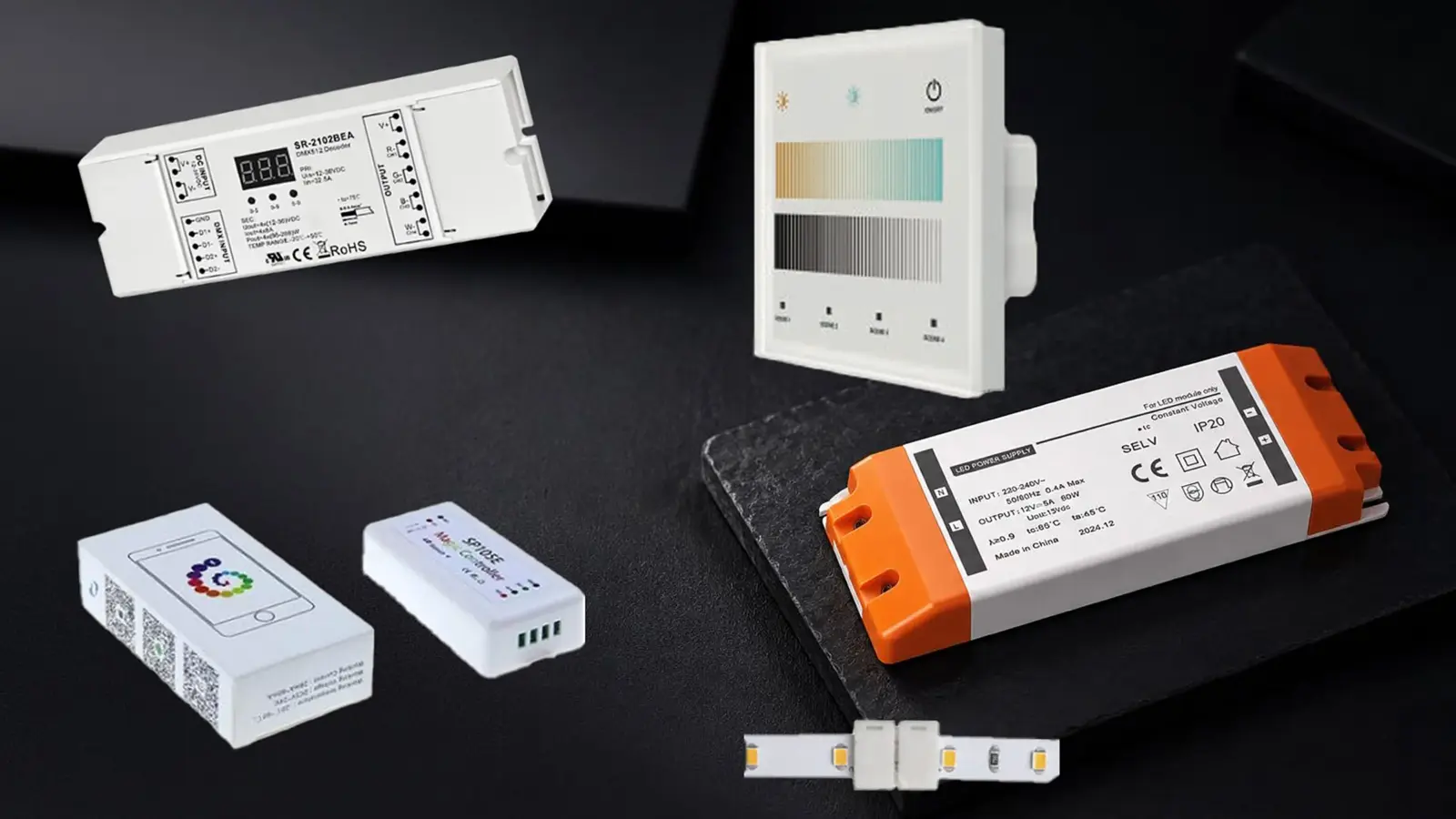
A 0-10V decoder such as UT-C010-350 shows both layers in one box: 0-10V in, a PWM output to the strip, one channel, up to 350 W. On the drawings you choose the control protocol. The PWM comes with whichever driver or decoder you specify.
Decision Table: Pick the Method First
Pick the control system first; the driver follows.
| Your situation | Use | Why |
|---|---|---|
| Existing 120V wall-box dimmers stay | TRIAC (phase-cut) | No new control wire; the dimmer sits in the power line |
| New commercial zones, wall panel or building system | 0-10V | Separate low-voltage pair, one signal per zone |
| Individual addressing, scenes, fault feedback | DALI | Two-way digital bus, every device has an address |
| Tunable white on a DALI bus | DALI DT8 | UT-CDALI-DT8, two channels |
| Color scenes from a lighting console | DMX512 | UT-CDMX-480 decoder, four channels |
| 277V supply | 0-10V or DALI | UT-D60-24-TRC takes 120V input only |
Our opinion: on a new commercial job with no existing dimmers, specify 0-10V unless the owner asks for addressing. TRIAC is for retrofits that reuse the wall box, and DALI earns its commissioning time only when somebody will use the addressing.
Three typical jobs show how the table plays out:
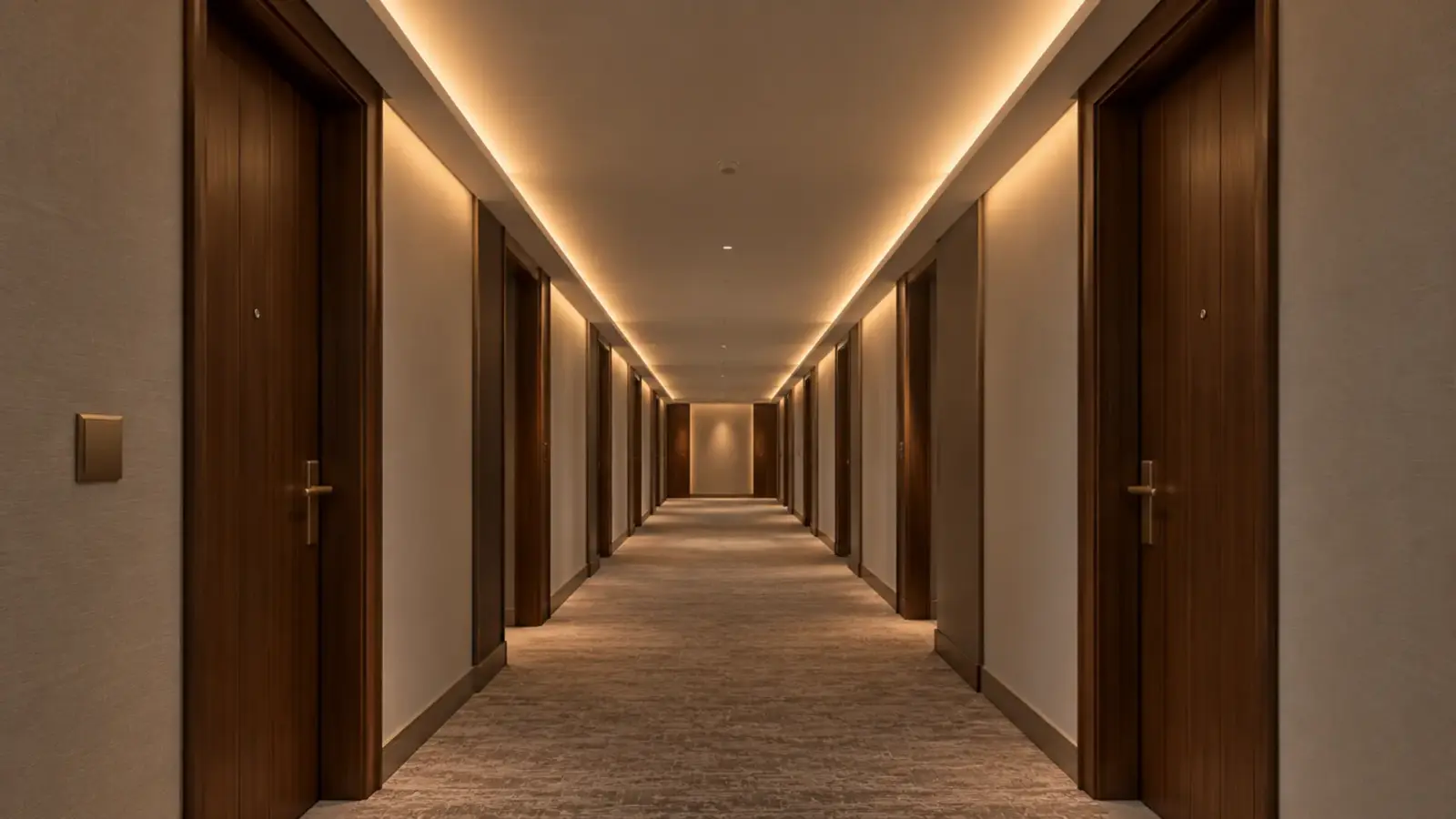
- Corridor coves on a hotel or office floor. Dozens of coves, scenes set by the owner’s control system. DALI if the owner wants per-fixture control and fault reports; 0-10V if scenes only need to work by zone.
- Open office with ceiling slots. Zones follow the floor plan and a wall panel sets the level. 0-10V, one signal pair per zone.
- Retrofit with existing dimmers. The walls are finished and the owner will not open them. TRIAC, with a dimmer from the driver’s compatibility list.
The usual mistake on all three is specifying the strip first and the control system last.
0-10V: The Commercial Default
0-10V dimming sends a low-voltage DC signal on a separate pair of wires. According to IEC 60929 Annex E, the driver gives full output at 10V and its minimum at or below 1V. The driver sources the signal and the dimmer sinks current from it, so the control current stays small: the standard sets it between 10 µA and 2 mA.

Our 0-10V line covers the usual cases:
- UT-D60-24-C2-010: 24V, 60 W, 120–277V input, in our Class 2 group, IP20. The default for interior runs.
- UT-D96-24-010: 24V, 96 W, 100–277V input, IP20. More wattage per supply.
- UT-D100-24-010-67: 24V, 100 W, 90–264V input, Dust-tight, and protected against temporary immersion in water. The usual rating for wet or outdoor runs that are not submerged all the time. potted, for damp and wet spaces.
- UT-CTP-010: 0-10V wall touch panel, 100–277 VAC, one zone.
- UT-C010-350: 0-10V decoder, 12–24V DC input, 350 W, one channel, for a non-dimmable 24V supply that now has to dim.
Match the supply on the drivers, controllers and connectors page, then pair the strip to the driver wattage.
Wiring and signal runs
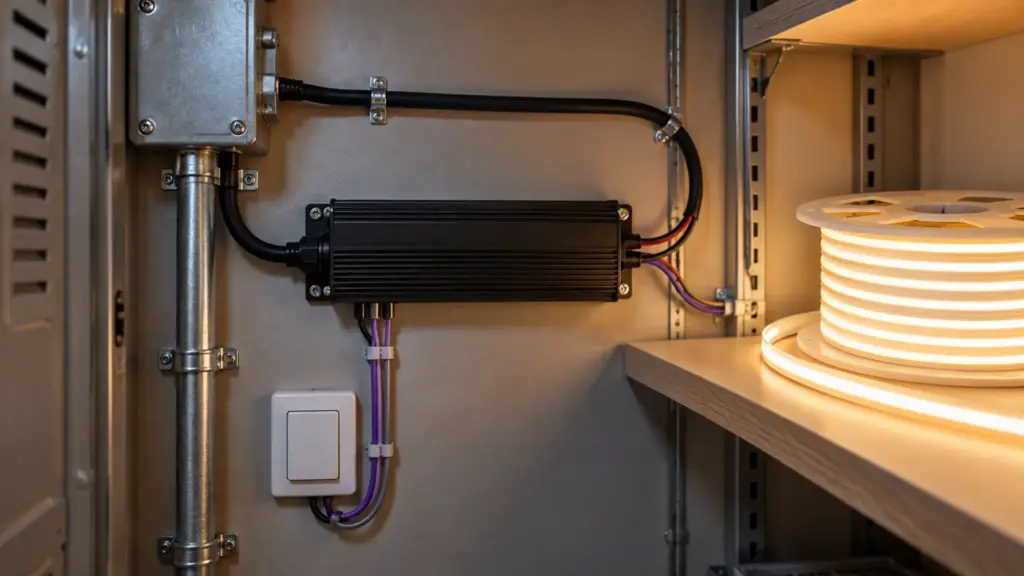
The dimming pair is commonly violet (+) and gray (−), but the label on the driver wins. Reverse it and the zone may not dim at all. Every driver on one pair dims together, which is the point of a zone and also its limit. Keep a drawing of which drivers share which pair; the small signal wires look identical in a ceiling. Because the control current is so low, the pair itself rarely limits distance. The driver maker’s sheet does.
The low end: what 1% means
Our white COB and SMD series dim smoothly to below 1% with a compatible driver. Two details decide whether that number means anything on site.
First, 1% is a measured figure. The eye reads light on a curve, so a common rule of thumb is that 1% measured looks closer to 10% perceived. A space that has to look nearly dark, such as a theater aisle or a hospitality corridor at night, needs a driver that reaches its low end smoothly, and a dimming curve the control system expects.
Second, 1% is not off. Some 0-10V drivers turn off below 1V and some hold their minimum level. If the spec says the strip must go fully dark at the bottom of the slider, choose a driver rated for dim-to-off, or add a relay that switches the driver’s power. Do not assume.
Phase-Cut (TRIAC): Reusing the Wall Box
TRIAC dimming trims each half cycle of the 120V AC supply. The dimmer sits in the power line, so the project needs no extra control wire. That is the whole reason to choose it.
Two of our parts cover it: UT-D60-24-TRC (24V, 60 W, 120V input, forward and reverse phase) and UT-CTRC-240 (120 VAC, 240 W, one channel, forward and reverse phase). Our 120V LED strip also dims on TRIAC directly. A confirmed dimmer compatibility list ships with every quote, which matters more here than anywhere else.

Forward, reverse, ELV and MLV
A forward-phase (leading-edge) dimmer cuts the start of each half cycle. A reverse-phase (trailing-edge) dimmer cuts the end. The older trade names map onto these. MLV dimmers, made for magnetic low-voltage transformers, are forward phase. ELV dimmers, made for electronic low-voltage transformers, are reverse phase.
Electronic LED drivers generally behave better on reverse-phase (ELV) dimmers, and old forward-phase dimmers built for incandescent or magnetic loads are the usual source of buzz. UT-D60-24-TRC accepts both, but the specific dimmer model still has to appear on the driver’s compatibility list. The label “LED compatible” on a dimmer is not that list.
Dimmer loading
Every TRIAC dimmer has a maximum and a minimum load. Add the nameplate wattage of every driver on the dimmer and stay inside both. Four UT-D60-24-TRC drivers add up to 240 W, which is the entire rating of UT-CTRC-240 with no headroom. A dimmer loaded to its limit runs hot and trips early, so we size with margin and confirm the loading at quote.
TRIAC also has a hard stop: UT-D60-24-TRC takes 120V input only, so on a 277V job phase-cut is off the table. Our opinion: TRIAC suits a conference room or a back-of-house retrofit. Past a handful of drivers, every pairing becomes a compatibility test.
DALI: When Addressing Pays Off
DALI is a digital two-wire bus defined in IEC 62386. According to the standard, one DALI line carries up to 64 devices, each of which can belong to 16 groups and 16 scenes, over cable runs up to 984 ft (300 m) with a maximum 2V drop on the bus. Traffic is two-way, so a controller can read status and faults back.
That is the value. 0-10V tells a zone how bright to be. DALI tells one fixture to go to 40%, stores the setting as a scene, and reports that another fixture has a failed driver. In a building tied to a management system or using daylight harvesting, that is worth the setup.
The cost is commissioning. DALI devices have to be addressed and commissioned, and somebody has to own the commissioning file after handoff. For a single retail floor with three zones, 0-10V does the same job with less to maintain.

DALI DT8 for tunable white
UT-CDALI-DT8 is a DALI DT8 controller: 12–24V DC input, 360 W, two channels for warm and cool white. DT8 is the DALI device type for color control, which is how a tunable white strip takes both brightness and color temperature from the bus. It is for tunable white strip, not single-color strip; single-color white on DALI needs a DALI-dimmable driver, matched at quote. Dim-to-warm strip needs only a single-channel dimmer, as our dim-to-warm guide explains.
When DMX is the better call
DMX512 belongs to color and show lighting, not to white zones. If the strip is RGB or RGBW and a lighting console or a show controller runs the scenes, a DMX decoder such as UT-CDMX-480 (12–24V DC input, 480 W, four channels) takes the console’s channels and drives the strip by PWM. For a white office floor, DMX adds addressing and programming that 0-10V or DALI already handle with less setup. Pixel-level effects on addressable strip are a separate choice between SPI and DMX, covered in our SPI vs DMX guide.
PWM: What the Driver Does to the Strip
On constant-voltage strip, PWM turns the output on and off fast, and the share of on-time sets the brightness. The strip never gets a lower voltage. It gets full voltage for shorter periods. Dimming depth is set by the driver or decoder, not by the strip.
Frequency, flicker, and camera
Ask for the PWM frequency. A low frequency can show as visible flicker at low levels, as a strobe effect on moving objects, and as banding on video. A lobby with security cameras, a display filmed for social media, or a broadcast space is where it shows. Ask for the frequency on the decoder or driver sheet, and test one fixture on camera if the space is filmed. For line-voltage runs in those spaces we offer the flicker-free UT-H120-112-FF.
Signal repeaters
On a long run with many strip segments, the PWM signal weakens from one segment to the next, and the far end looks dimmer or lags. UT-CAMP-4 repeats the signal downstream: 12–24V DC input, 384 W, four channels. Put it between segments so the whole run dims in step.
Code and Wiring
Three code points come up on dimmed strip jobs. Confirm each with the AHJ and the NEC edition the area has adopted.
Class 2 power. UT-D60-24-C2-010 sits in our Class 2 group: 24V output, rated at 60 W. The higher-wattage dimmable drivers, UT-D96-24-010 and UT-D100-24-010-67, are not in that group, so do not assume Class 2 wiring on those. Our Class 2 driver guide covers what the inspector reads on the label.
Dimming leads. Whether the 0-10V pair counts as Class 2 depends on how the driver is marked. Read the label; do not assume it from the voltage.
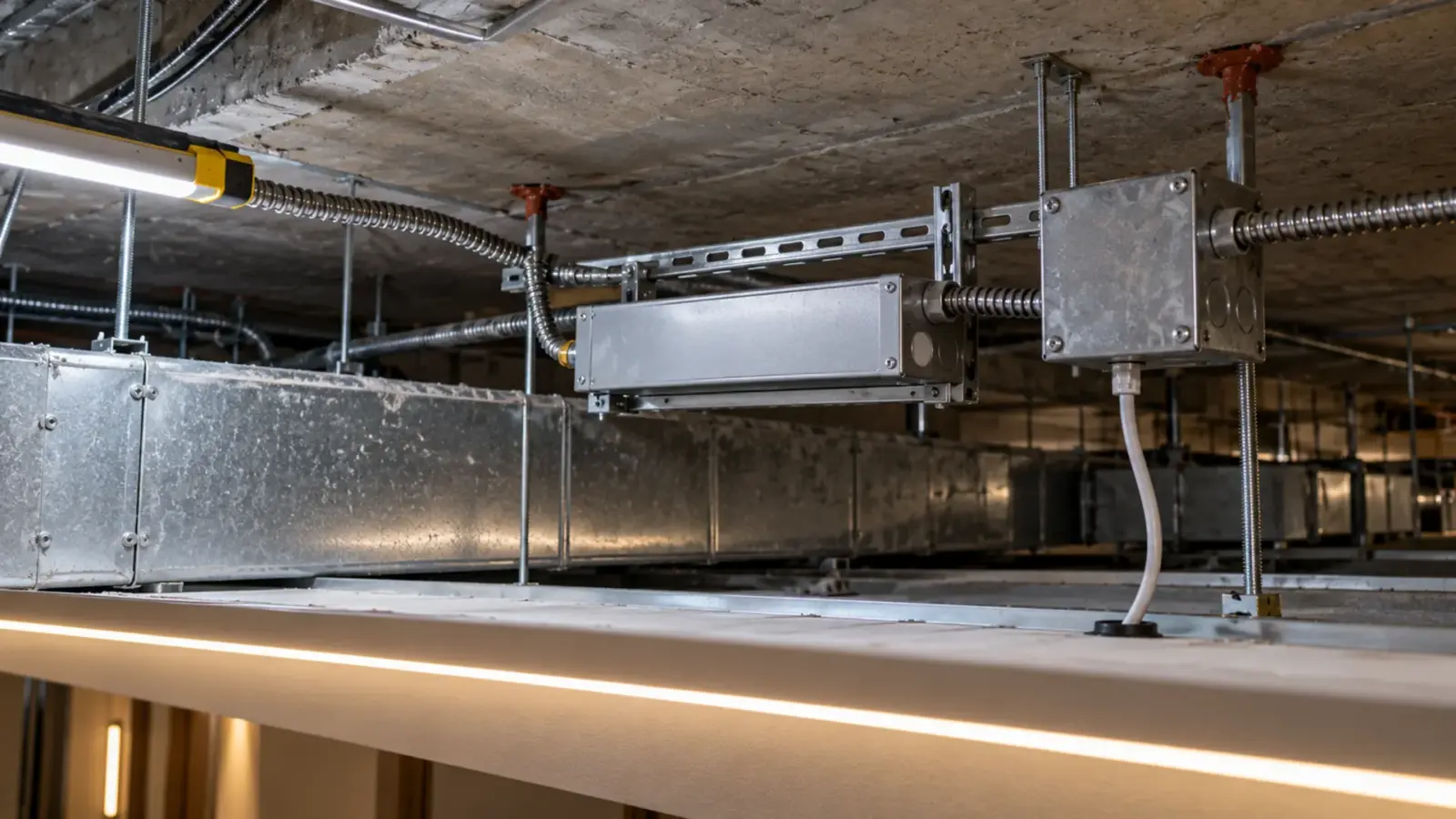
Separation. Class 2 conductors generally may not share a raceway, enclosure, or cable with line-voltage or Class 1 conductors, apart from listed exceptions such as barriers. A Class 2 dimming pair should not ride in the 120V feed’s conduit unless an exception applies. TRIAC avoids the issue because the dimming travels on the power conductors. DALI wiring has its own rules in the controller maker’s instructions.
Troubleshooting
| Symptom | Likely cause | Fix |
|---|---|---|
| Flicker at the low end on TRIAC | Load below the dimmer’s minimum, or a dimmer not on the list | Check the minimum load; use a listed-compatible dimmer |
| Buzz on TRIAC | Forward-phase (MLV-type) dimmer on an electronic driver | Change to a reverse-phase (ELV) dimmer |
| Strip stays at full or minimum on 0-10V | Pair reversed or open, or a non-dimmable driver | Check polarity at the driver; confirm a 0-10V model |
| Strip never goes fully dark on 0-10V | Driver holds its minimum below 1V | Choose dim-to-off, or add a relay |
| Last segment dims late | PWM signal weakened along the run | Add a repeater such as UT-CAMP-4 |
| Flicker or banding on camera | Low PWM frequency | Ask for the frequency; choose a flicker-free option |
| DALI fixture does not respond | Not addressed, or a bus fault | Recommission the address; check bus wiring and length |
Before blaming the strip, test the dimmer and driver as a pair on the bench with a short length of strip. If the pair works on the bench and fails in the ceiling, look at the wiring, the load, and the run length. If it fails on the bench, the pairing is wrong.
FAQ
Can you use a regular dimmer with LED strip?
A regular 120V wall dimmer works only with a TRIAC-dimmable driver such as UT-D60-24-TRC, or with 120V strip. It never connects to 24V strip directly, and it does not work on a 0-10V driver. Use a dimmer from the driver’s compatibility list.
What is the difference between 0-10V and DALI?
0-10V is analog and one-way: one signal sets the brightness of every driver on the pair. DALI is digital and two-way: each device has an address, belongs to groups and scenes, and can report faults. 0-10V is simpler to install and maintain.
Why does my dimmable LED strip flicker?
On TRIAC, the usual cause is a load below the dimmer’s minimum or a dimmer that does not match the driver. On 0-10V, check polarity and the driver’s behavior below 1V. Flicker seen only on camera points to a low PWM frequency.
What is the difference between ELV and MLV dimmers for LED strip?
ELV dimmers are reverse phase (trailing edge) and MLV dimmers are forward phase (leading edge). Electronic LED drivers usually dim more quietly on ELV. The exact dimmer model still has to be on the driver’s compatibility list.
How low can COB or SMD strip dim?
Every white COB LED strip series and every single-color SMD LED strip series dims smoothly to below 1% with a compatible TRIAC, 0-10V, or DALI driver. Whether it turns fully off depends on the driver.
Before You Order
- Name the control system on the drawings before the strip is chosen.
- Check the supply voltage: 277V rules out our phase-cut driver.
- Add up the load on every TRIAC dimmer and every 0-10V zone.
- Decide whether “off” means 1% or dark, and pick the driver to match.
- Ask for the PWM frequency where the space is filmed.
- Keep the dimmer compatibility list for every phase-cut pairing with the submittal.
Send the lighting plan and the control narrative, and we will return a matched driver and controller schedule with the dimmer compatibility list for each pairing: request a quote.