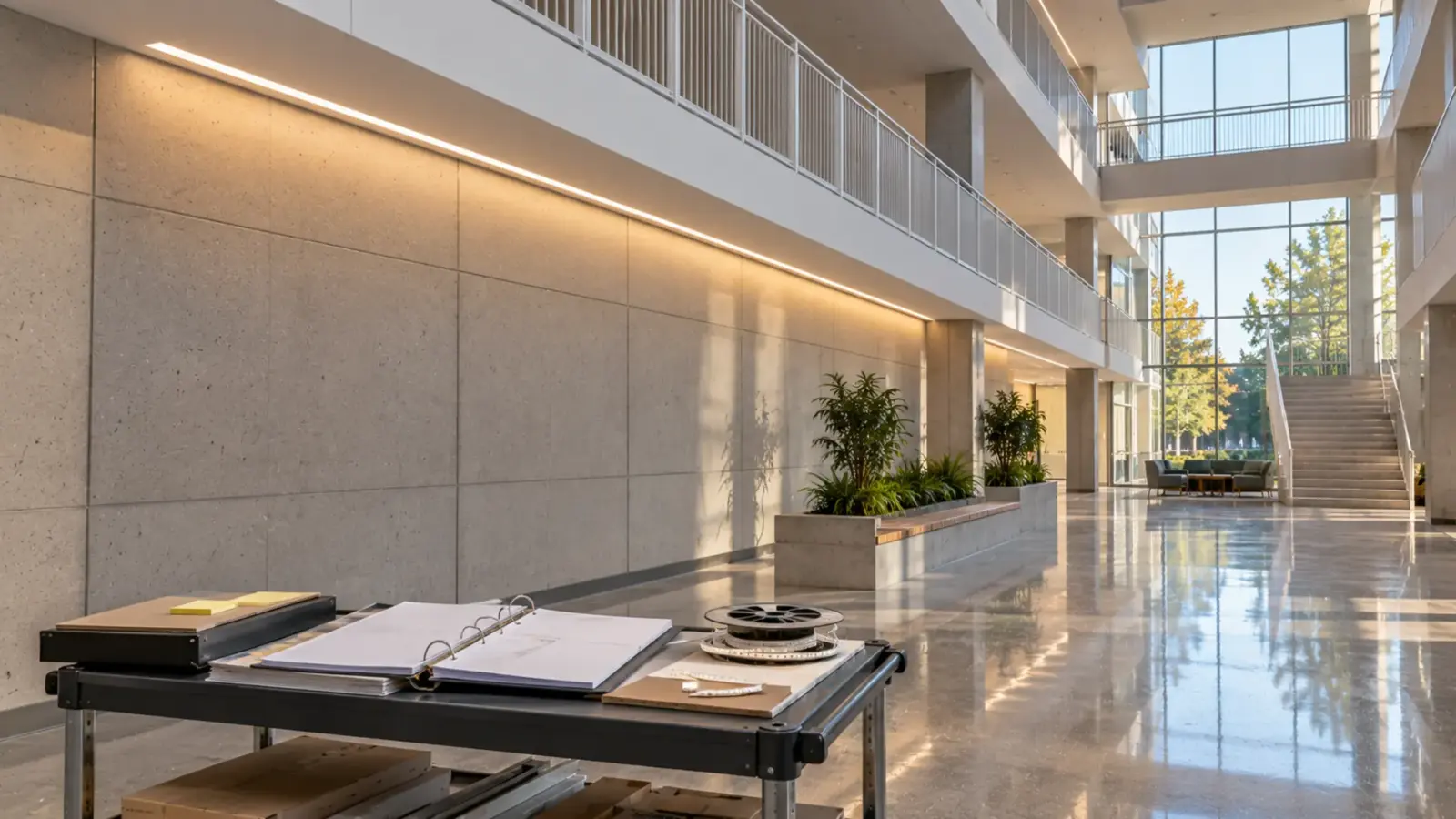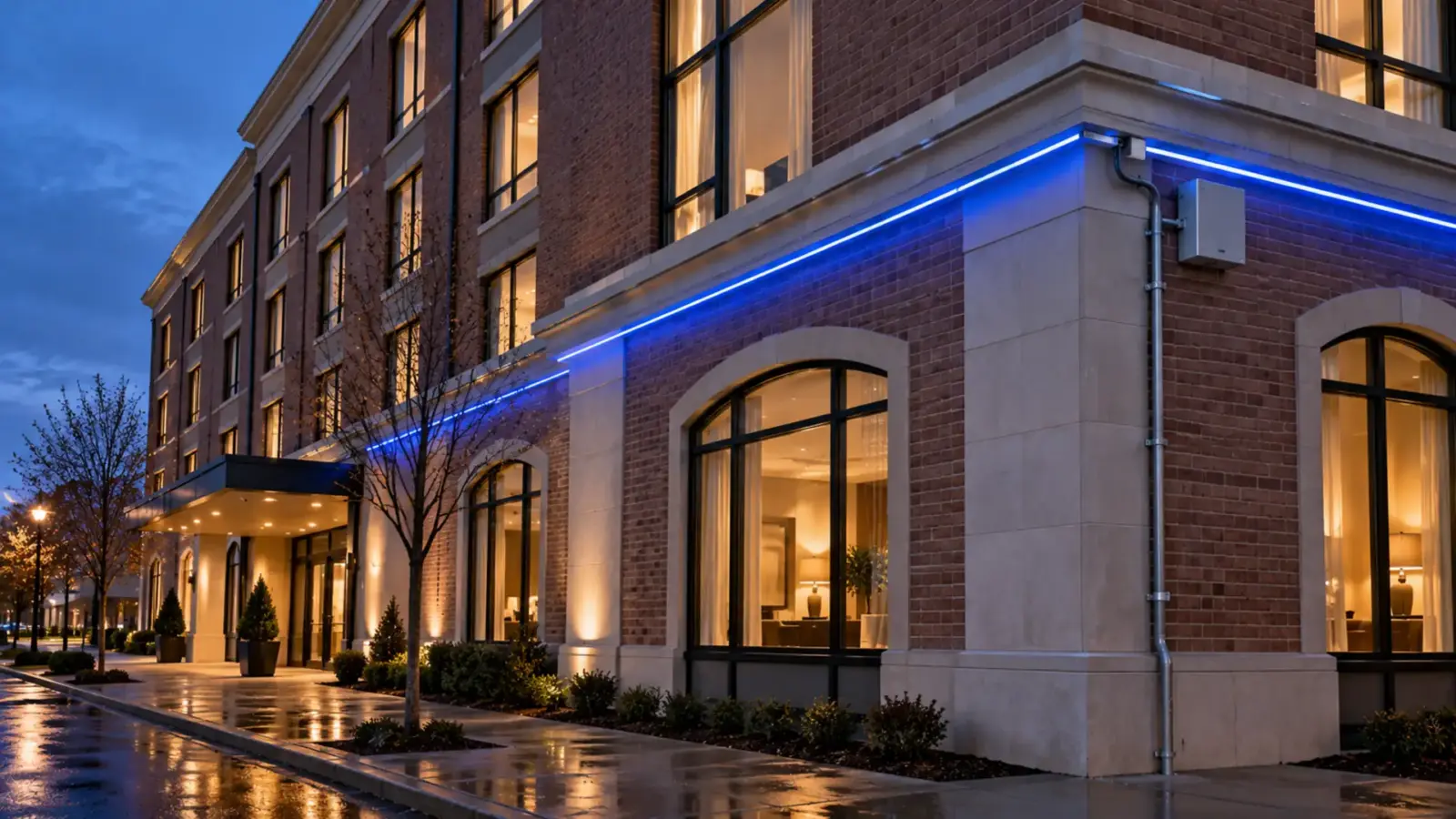
The circuit leaves the panel, climbs 80 ft of wall, and the driver sits under the cornice, where the conduit run and the long cable are the exposed part of the circuit. The question is whether that driver needs help beyond its own protection.
Sometimes. None of the sources we read says the NEC requires a surge protective device (SPD) at an LED driver, but Mersen’s location categories suggest that a driver on exterior wiring is more exposed than one on a short indoor run. Choose protection by where the wire runs, then ask the driver maker for its surge rating.
What the Code Says and What It Leaves Out
The 2023 NEC widened a service SPD rule, section 230.67, beyond dwelling units to many of our jobs. Hubbell’s article on it quotes 230.67(A) as covering dwelling units, dormitory units, guest rooms and guest suites of hotels and motels, and areas of nursing homes and limited-care facilities used exclusively as patient sleeping rooms. It quotes (B) as requiring the SPD to be “an integral part of the service equipment or” located “immediately adjacent” to it, with an exception for next-level distribution equipment downstream toward the load, and (C) as requiring a Type 1 or Type 2 SPD.
Read what that is. The service rule Hubbell quotes is about the service of certain occupancies. The article also quotes a separate requirement for safety circuits for personnel protection, and it does not mention lighting circuits, outdoor lighting or LED drivers, and none of the other sources we read ties a code requirement to a driver. We did not read the NEC text itself, and states adopt editions on their own schedules, so ask the AHJ which edition applies and whether a local amendment adds a requirement. Where 230.67 is adopted, a hotel or dormitory service needs an SPD, and the rule as quoted says nothing about a driver at the end of a long exterior circuit.
On a hotel, dormitory or apartment job, the practical step is cheap. Find the service SPD, or the downstream SPD the exception allows, in the switchgear submittal, note who furnishes it and where it sits, and write that on the lighting drawings, so the person specifying a facade driver knows which layer already exists. If the building is not one of those occupancies, the same check still tells you what the first layer is.
Three Layers, Three Owners
As we split it, surge protection on an LED circuit is three layers with three different owners, and the question for a facade or garage is which of the three is missing.
- The service or panel SPD. Owned by the electrical contractor and the owner. Mersen’s quick guide sorts SPDs by UL 1449 type: Type 1 at the service, Type 2 on the load side of the service overcurrent device including branch panels, and Type 3 at the point of use, at least 10 m (30 ft) of conductor from the service panel.
- A device at the luminaire or driver end. Owned by whoever specifies the fixture and the driver. It is the layer a long or exposed run adds.
- The driver’s own surge immunity. Owned by the driver maker, and stated on its datasheet as a test level.
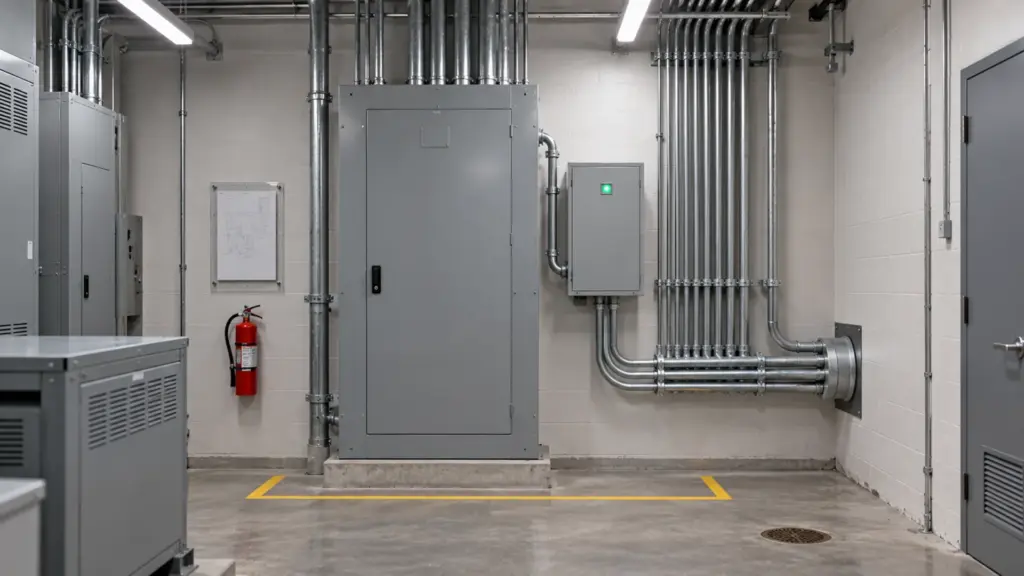
The layers add up, and the first does not stand in for the others. Mersen’s guide says equipment outside the building envelope should be treated as IEEE C62.41 Category C, the most exposed location, because surges “can bypass the service SPD and enter the building through the external equipment and wiring”, and it lists parking lighting among its examples of outdoor loads. Mersen also recommends Type 1 devices at the circuit for such equipment, a stronger step than the Type 2 and luminaire-end options we list below. Our reading is that this puts a facade run and an open-sided garage in the same exposure class as other outdoor loads, which is the reason for the next two sections.
What a Driver Datasheet Promises
A driver’s surge line is a test result, not a promise about your job. Two Mean Well datasheets show the range. The HLG-240H, an IP65 or Dust-tight, and protected against temporary immersion in water. The usual rating for wet or outdoor runs that are not submerged all the time. driver depending on type, states a “light industry level” with surge immunity of 4 kV line-to-earth and 2 kV line-to-line. The XLG-100, an IP67 driver, states 4 kV line-to-line and 6 kV line-to-earth under EN 61000-4-5, and lists an optional higher level as 6K/10K, without saying which mode each figure belongs to. The same sheet adds that the driver is considered a component and that EMC performance “will be affected by the complete installation.”
Those are driver immunity tests. For outdoor luminaires, CITEL describes a different yardstick, the ANSI C136.2 exposure levels: it lists Typical at 6 kV and 3 kA, Enhanced at 10 kV and 5 kA, and Extreme at 20 kV and 10 kA, and advises selecting luminaires “designed, and fully tested” to the 2023 edition. We have not read that standard. Do not compare a driver’s 4 kV with a luminaire’s 10 kV and 5 kA as if they were the same test; in our understanding they are different tests, and the luminaire level also carries a current.
Read the datasheet line for three things. First, both modes: line-to-line and line-to-earth are separate figures, and the HLG-240H and XLG-100 give different numbers for each. Second, the test standard: the XLG-100 sheet names EN 61000-4-5 on the surge line, and the HLG-240H sheet lists it in a general immunity line. Third, whether the figure is standard or an option: the XLG-100 line carries an optional higher level, so the quote must say which level applies.
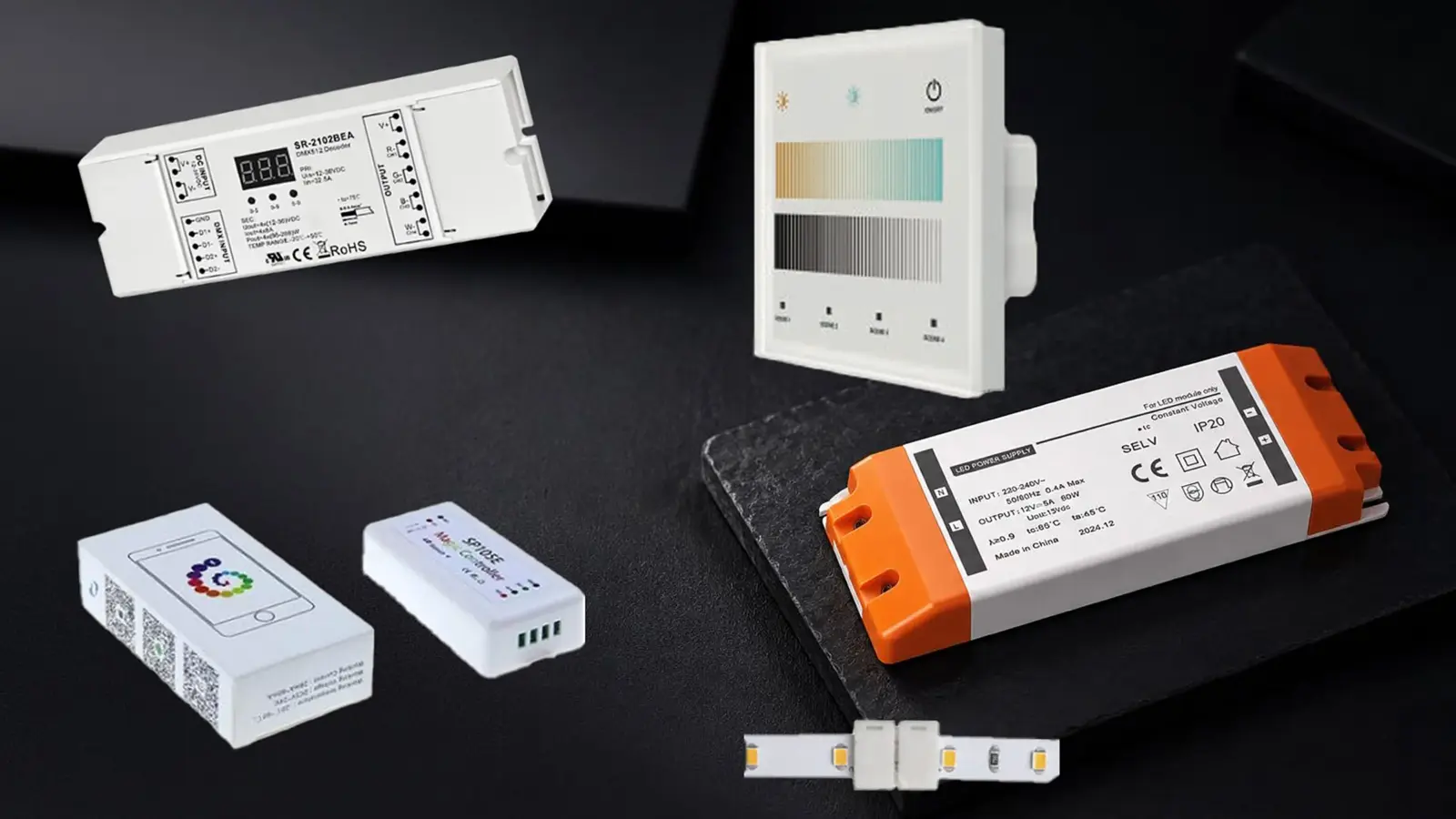
Our drivers page does not publish a surge rating for any UT- driver, so for ours it is a quote question, and the figure on the quote is the one that counts. The same page says our Class 2 drivers are IP20 and stay in a dry space, and that damp and wet locations take a potted IP67 driver such as UT-D100-24-67, so a facade driver is already an IP67 conversation before it is a surge one.
A Facade Run
A facade run has the three traits that raise exposure: wiring on the outside of the building, a long run, and a driver at the end of it. Saltek’s application note, a European vendor note written mainly for street lighting, says that, for disturbances near the installation, where an SPD sits at the installation entry a further SPD is to be installed when light fittings are fitted on a building’s exterior facade. We quote it as an example of the approach, not as an NEC rule.
For a facade job, our planning suggestion is to settle three things in the drawings before the order. First, whether the driver sits outdoors at the end of the run or indoors with only low-voltage cable outside. A driver inside the building on a short run is a different case, and our remote driver guide covers what the cable length does. Second, whether the quote shows a published surge rating for the driver. Third, whether the specifier wants a luminaire-end SPD, which is the designer’s call. Our facade lighting guide covers the shielding and curfew side of the same wall.
A Garage
The word garage does not decide the exposure, the wiring does. In our reading, a garage in the basement of a hotel or apartment building, with every fixture inside the envelope, reads as an indoor case. A free-standing or open-sided structure, a roof deck or ramp with exterior fixtures, or a circuit that leaves the building to reach a detached structure reads as outdoor, and parking lighting is one of Mersen’s examples of outdoor loads. In our reading, a garage run also tends to be long, and Mersen defines a Type 3 SPD as one at least 10 m (30 ft) of conductor from the service panel, so a far panel is worth noting. Our wet location guide covers damp locations for the strip.
| Case | Our reading | What to ask for (planning suggestion) |
|---|---|---|
| Indoor corridor or cove, driver close to a panel | Low exposure | The service or panel SPD of the building; the driver’s datasheet surge level |
| Indoor, driver far from the panel, many drivers on one phase | Longer branch | A Type 2 at the branch panel; ask the maker for the surge level |
| Hotel, dormitory or apartment service | 230.67 applies to the service, as Hubbell quotes it | Confirm the service SPD exists; it does not address the end of an exterior circuit |
| Facade, driver outdoors | Outside the envelope, Category C reading | IP67 driver with a published surge level; ask the designer about a luminaire-end SPD |
| Open-sided or free-standing garage | Treated as outdoor | The same as a facade run |
| Basement garage, fixtures inside | Indoor | The service SPD; check that no circuit leaves the building |
After a Failure
If drivers fail on an exterior or garage circuit, treat a surge as one possible cause and keep the evidence. Our suggestion is to log the date and the weather, which circuits and which phase failed, how many drivers went at once, and whether the service SPD, if any, shows a fault indication. In our experience of how such records are read, a cluster of failures after a storm on one phase points in a different direction than a single driver failing in a hot ceiling, and the record lets the parties sort out which. Our warranty documentation guide lists what to capture, and our warranty page lists over-voltage under electrical misuse without naming surges or lightning, so ask how a surge-related failure is treated before the job, not after.
FAQ
Does the NEC require surge protection on an LED driver?
Not in any source we read. The 2023 rule as Hubbell quotes it is about the service of dwelling units, dormitory units, hotel guest rooms and nursing-home and limited-care sleeping areas. Read the adopted edition with the AHJ.
Is a 4 kV driver the same as an SPD?
No. A surge immunity level is what the driver was tested to withstand. An SPD is a separate device on the circuit, typed by where it is installed, as Mersen’s guide describes.
Where does a surge come from?
CITEL cites about 25 million lightning strikes a year in the US, and Saltek lists direct strikes, nearby strikes and grid switching or faults among its causes of damage. In our reading, most of these reach a driver through the wiring around it.
What to Verify With the AHJ and the Driver Maker
- The NEC edition the AHJ has adopted, and any local amendment on surge protection.
- Whether the building’s service has an SPD, and where it is.
- For each driver on exterior wiring: the surge level on its datasheet, line-to-line and line-to-earth, and the test standard.
- Whether the designer wants a luminaire-end SPD on facade or open-garage runs.
- How the driver is protected from water at the same time, since our guide to IP ratings and our Class 2 driver guide cover the match between location and driver.
Drivers for these jobs are in our drivers, controllers and connectors range, and the strip for exterior runs is in our outdoor LED strip range. If a driver fails and you suspect a surge, our driver troubleshooting guide starts at the terminals.