“It is 24V and 60 W, so it is Class 2.” That sentence fails more LED strip inspections than any wiring mistake. A Class 2 LED driver is one whose output is listed and marked Class 2 on the nameplate; voltage and wattage do not make it so. The inspector reads the label, then checks that the wiring matches it.
The difference matters because Class 2 decides how the inspector treats everything on the 24V side. A Class 2 output can feed the strip through CL2 or CL3 cable and, in most occupancies, without conduit. A non-Class 2 output is wired as a power circuit, and the inspector asks a different set of questions.
NEC references below are general. The authority having jurisdiction (AHJ) and the NEC edition your area has adopted decide what applies on your job.
Class 2 Is a Power Limit, Not a Quality Grade
Class 2 is an NEC circuit classification. A Class 2 circuit is limited in both voltage and available power, so only a small amount of energy can reach a fault. According to a TIA overview of DC power in buildings, Class 2 covers systems up to 60 V and about 100 VA, a level treated as low enough to be safe from a fire-starting standpoint. The driver is what enforces that limit, and the label is how it says so.
That makes Class 2 a statement about the output, not about quality. A well-built 150 W non-Class 2 driver can be a better product than a cheap 40 W Class 2 unit; it is simply wired differently.
Class 2 is also not Class II. Class II describes how a device is insulated: double or reinforced insulation and no protective earth connection. A driver can be Class II and not Class 2, Class 2 and not Class II, both, or neither. Read the two marks separately, and do not accept one as proof of the other.
Why Wattage and Voltage Do Not Settle It
Three shortcuts show up on jobs, and each one costs a second visit.
- “It is 24V, so it is low voltage, so it is Class 2.” Low voltage describes the output. Class 2 also needs the power to be limited and the unit to be listed that way.
- “It is under 100 W, so it is Class 2.” A driver sized under the limit is not the same as a driver tested and marked to stay under it during a fault. The marking is the evidence.
- “48V is still under 60V, so it is fine.” A 48V output can be Class 2 only if it is marked Class 2, and the power available at 48V is limited in its own way. In wet locations the voltage ceiling is lower again, as our wet location LED strip guide explains.
Multi-output drivers add a fourth trap. A driver with two or four outputs may mark each output Class 2, or none of them. Read the marking for each output, and give each strip run its own output.
The practical rule: if the nameplate does not say Class 2, treat the output as non-Class 2 until the supplier shows otherwise. According to a long-running Mike Holt forum discussion, inspectors look for the mark printed on the device itself, not for a calculation.
Class 2 vs Class 1: What Changes on the Job
Many 24V strip systems are designed as Class 2 for one reason: the wiring is simpler. The table shows what changes when the driver is not Class 2 and its output is wired as a Class 1 or power circuit.
| Class 2 driver output | Non-Class 2 driver output | |
|---|---|---|
| Output power | Limited by the listing, marked on the nameplate | No Class 2 limit; sized to the driver rating |
| Output cable | CL2 or CL3 rated cable, plenum-rated where needed | Class 1 or power wiring methods |
| Conduit | Not required in most occupancies | Per the wiring method and the AHJ |
| Separation from line voltage | Required, with listed exceptions | Depends on the wiring method |
| Typical inspector question | Is the output marked Class 2, and is the driver listed? | What wiring method is on the output, and is it rated for the circuit? |
For the contractor, the effect is labor and material: Class 2 output wiring is lighter, quicker to pull, and easier to route through finished spaces. Decide the driver class before the wiring plan is drawn, not after.
The rules themselves moved in the 2023 NEC. Class 1 power-limited circuits went to a new Article 724, Class 2 and Class 3 circuits stayed in Article 725, and the cable requirements moved to a new Article 722. Quote the section from the book your inspector uses.
The Inspector’s Checklist
AHJs vary, but these are the items that come up most often on LED strip jobs. Check them before the ceiling closes.
- The label. The nameplate says Class 2 for each output, with the output voltage and current.
- Listed, not just recognized. The driver carries a listing mark for field installation. A component recognition mark is different, and some AHJs will not accept it for a field-installed supply. Our UL vs ETL guide explains the difference.
- Load against rating. The connected strip load stays inside the output rating. Our power supply sizing guide keeps it at or below 80% of the rating.
- Output cable type. CL2 or CL3 cable on Class 2 output, plenum-rated in a plenum; our in-wall wiring guide covers the markings.
- Separation. Class 2 conductors stay apart from line-voltage and Class 1 conductors. As quoted from the 2023 text on the Mike Holt forum, the rule asks for at least 2 in. of separation unless a listed condition applies, such as one set being in a raceway. Our dimming guide covers the 0-10V pair, which is where this trips up retrofits.
- Location. The driver’s enclosure and location marking suit the space: dry, damp, or wet.
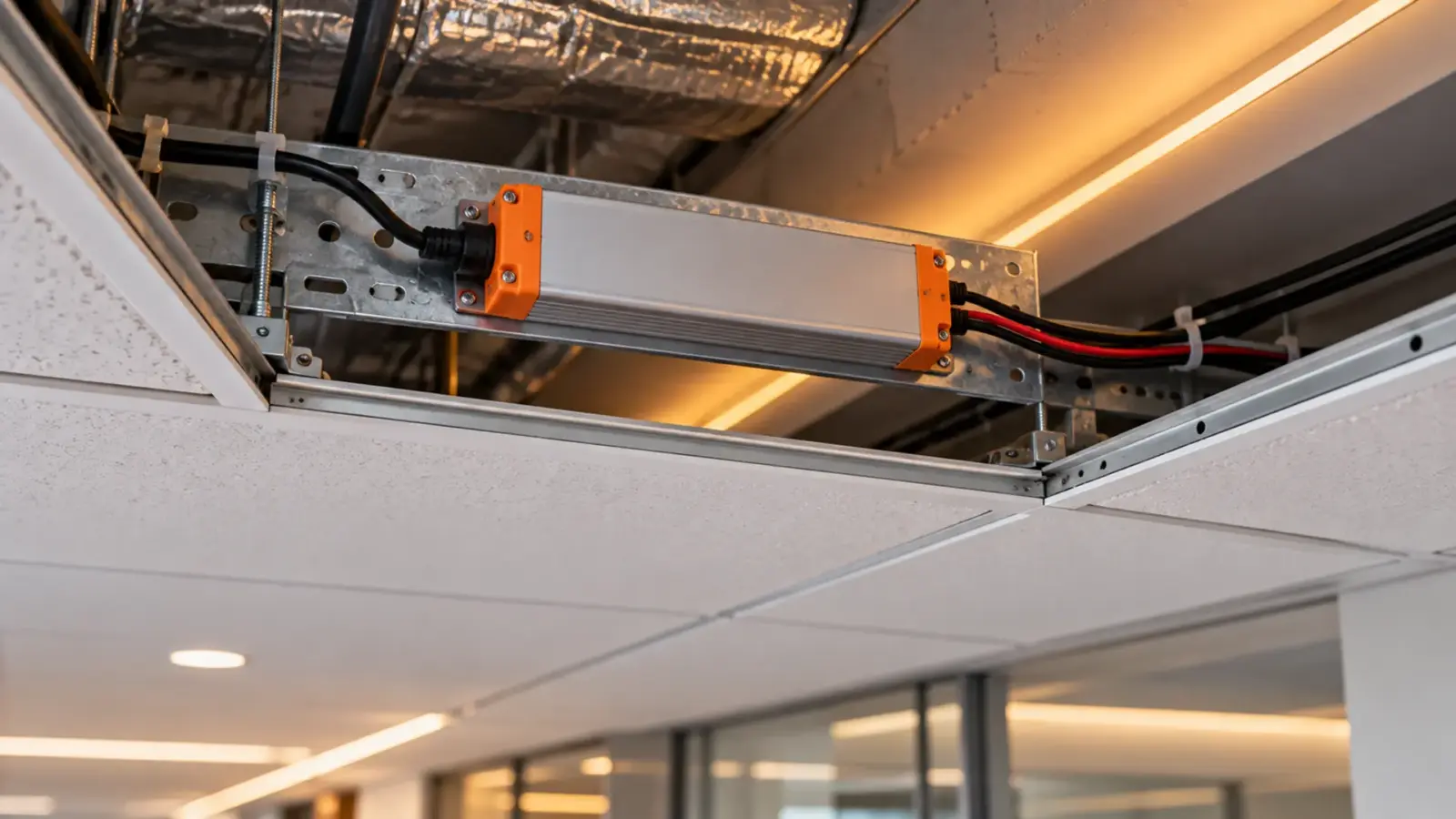
- Access. The driver can be reached without opening a finished surface.
Where it usually fails
Three things fail most often. A driver with no legible label, or a label that does not mention Class 2, so the inspector cannot confirm the wiring method. Class 2 cable pulled in the same raceway as the 120V feed, with no barrier. And a driver that is Class 2 on the drawings and non-Class 2 in the box, because someone substituted a bigger unit to avoid a second driver.
What to have ready for the inspector
Bring three things to the walkthrough: a photo of each driver label taken before the driver goes above the ceiling, a one-page drawing of each driver with its output rating and the runs it feeds, and the data sheet for any driver whose class is in question. Inspectors move quickly when the paperwork matches the box.
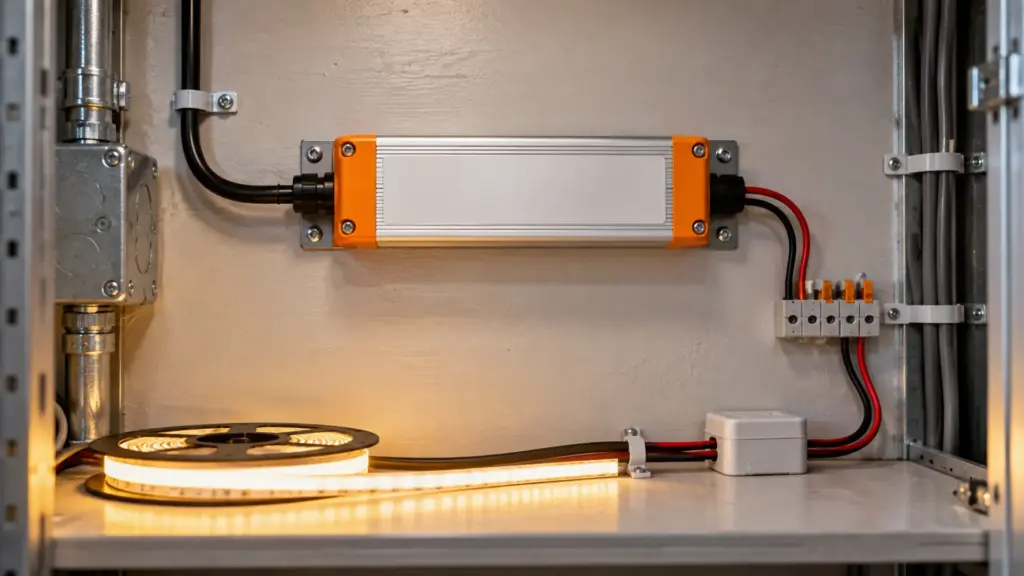
Reading the Label: UL 1310 and UL 8750
Two standards come up on driver labels, and they answer different questions.
UL 8750 is the safety standard for LED equipment. It covers the driver as an LED power supply: insulation, temperature, and fault behavior. Our driver page describes the range as designed to UL 8750.
UL 1310 is the standard for Class 2 power units. It covers the power limiting. A driver built to UL 8750 is an LED power supply, but its output is not Class 2 unless the Class 2 limit is also met and marked. Our UL listing guide explains how these standards fit with UL 2108 for the strip system.
When you read a nameplate, look for the Class 2 wording first, then the standard. If you see only a standard number, ask the supplier which classification each output has. We do not print file numbers in articles; ask for the label photo and listing information at quote.
Splitting Big Loads Into Class 2 Circuits
The Class 2 limit applies to each circuit. A Class 2 source at 24V is limited to about 100 VA; verify the exact figure in the Chapter 9 table of the edition you work under. Our Class 2 drivers are rated at 60 W each, well inside that.
So a single Class 2 circuit cannot carry a 150 W or 400 W strip load. A big job has two choices:
- Split the load into several Class 2 circuits. Each driver output feeds its own runs and stays under its rating.
- Use a higher-power non-Class 2 driver and wire its output as the listing and the AHJ require.
Our opinion: many short runs spread over a large area suit Class 2 circuits split by run. A few long runs from one closet can be simpler on a non-Class 2 driver with proper output wiring.
No paralleled outputs
Do not tie two Class 2 outputs together to feed one run unless the data sheet allows parallel connection. The combined output is not a listed Class 2 source. Give each run its own output. This also helps voltage drop, because each run has its own feed and each cable carries less current.
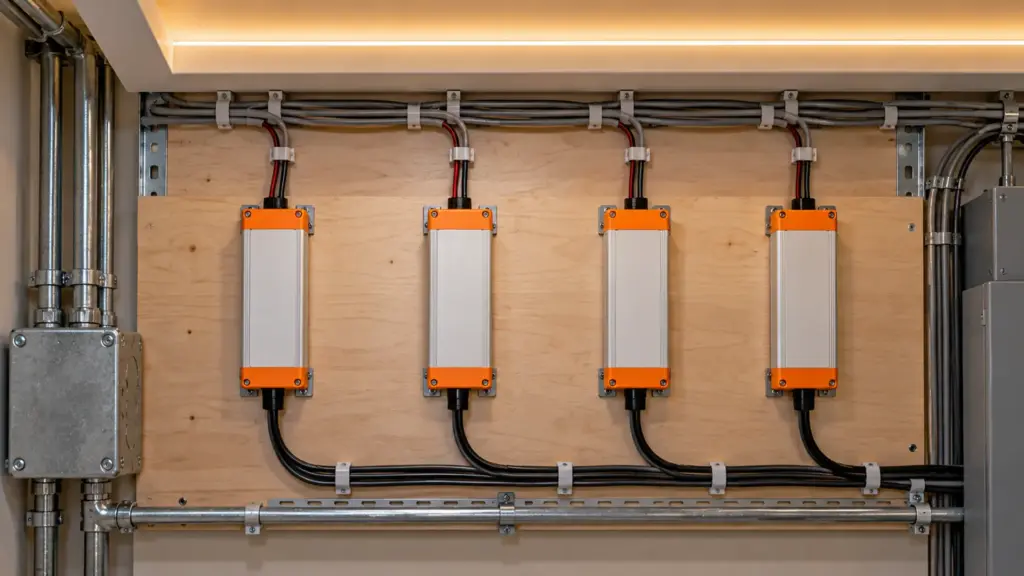
Our Drivers by Group
The table lists the drivers in the groups our driver page uses. The first three sit in the Class 2 group. The rest are not in that group. Whether a specific unit is Class 2 is a question for its nameplate, and we confirm it at quote.
| Model | Output | Power | Input | Dimming | IP | Page group |
|---|---|---|---|---|---|---|
| UT-D40-24-C2 | 24V DC | 40 W | 100–277V | Non-dim | IP20 | Class 2 |
| UT-D60-24-C2 | 24V DC | 60 W | 100–277V | Non-dim | IP20 | Class 2 |
| UT-D60-24-C2-010 | 24V DC | 60 W | 120–277V | 0-10V | IP20 | Class 2 |
| UT-D60-1224-67 | 12/24V DC | 60 W | 90–264V | Non-dim | IP67 | High-power and IP67 |
| UT-D100-24-67 | 24V DC | 100 W | 90–264V | Non-dim | IP67 | High-power and IP67 |
| UT-D150-24-L | 24V DC | 150 W | 100–277V | Non-dim | IP65 | High-power and IP67 |
| UT-D400-24-L | 24V DC | 400 W | 100–277V | Non-dim | IP20 | High-power and IP67 |
| UT-D96-24-010 | 24V DC | 96 W | 100–277V | 0-10V | IP20 | Dimmable |
| UT-D100-24-010-67 | 24V DC | 100 W | 90–264V | 0-10V | IP67 | Dimmable |
| UT-D60-24-TRC | 24V DC | 60 W | 120V | TRIAC | IP20 | Dimmable |
UT-D60-1224-67 is 60 W, the same as the Class 2 units, yet it sits in the high-power and Dust-tight, and protected against temporary immersion in water. The usual rating for wet or outdoor runs that are not submerged all the time. group. Wattage alone says nothing about the class. The page lists no 48V driver; 48V supplies are matched at quote, and their class is read from their own nameplate.
Dimming Leads and Mixed Systems
A 0-10V dimmable driver may be Class 2 on the output while its dimming leads are classified separately, and one project may use Class 2 drivers in the corridor and a non-Class 2 driver in the lobby. Tag each driver with its class, mark which runs it feeds, and check separation wherever a dimming pair meets the line-voltage feed.
Damp and Wet Locations
Class 2 says nothing about water. Our Class 2 drivers are IP20 and belong in a dry, accessible space. For damp and wet spaces, our page lists IP67 potted drivers such as UT-D100-24-67. IP67 is an enclosure test, though, not a location marking. The location marking is on the driver’s label, and the inspector reads it there.
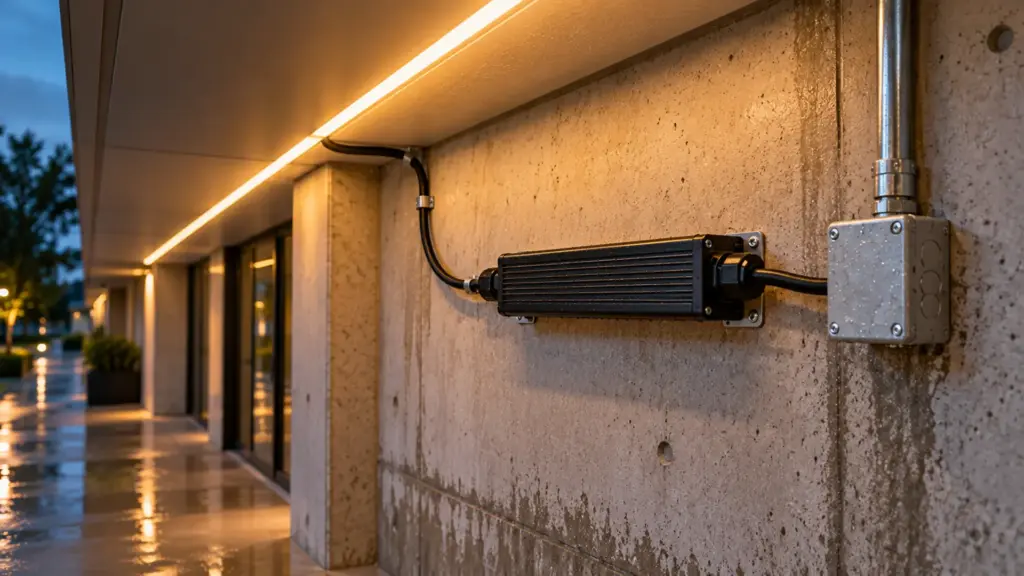
Pair the driver with strip and connectors suited to the same location. The wet location LED strip guide treats the strip, the connectors, and the driver as one system.
Common Mistakes
- Buying by wattage or assuming the label. A 60 W driver is not automatically Class 2.
- Sharing raceways. Class 2 cable in the same raceway as line-voltage conductors, without a barrier or an exception.
- Paralleling outputs to reach a bigger load.
- Swapping drivers after approval. A substitute has to carry the same marking as the one on the drawings.

FAQ
Is LED strip Class 2?
Class 2 is a property of the power source, not of the strip. A 24V strip run from a Class 2 driver output is a Class 2 circuit, and its wiring follows Class 2 rules. The same strip on a non-Class 2 driver is wired as a non-Class 2 circuit, whatever the strip label says.
Do I need conduit for Class 2 LED wiring?
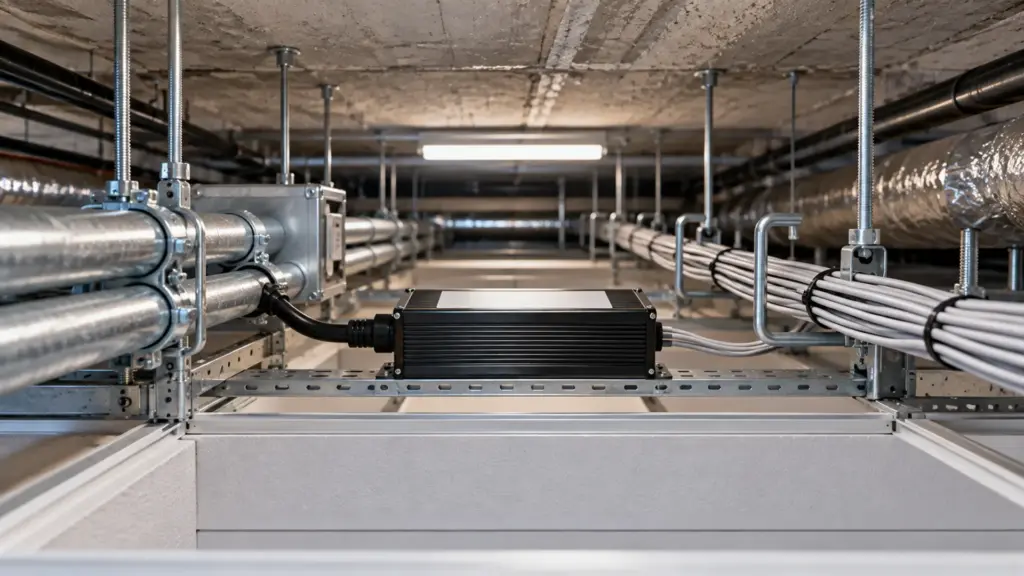
Not in most occupancies. Class 2 output can run in CL2 or CL3 rated cable without conduit, with plenum-rated cable in plenums. The AHJ decides, and separation from line-voltage conductors still applies. The driver itself is a separate question when the ceiling is a plenum; see where a driver can sit above a plenum ceiling.
What is the difference between Class 2 and Class II?
Class 2 limits the output power of a circuit under the NEC. Class II describes double or reinforced insulation in a device. They answer different questions, and a driver can have either mark, both, or neither.
Can I replace a Class 2 driver with a non-Class 2 driver?
Not without changing the wiring. According to Signify’s driver FAQ, a Class 2 driver must be replaced with another Class 2 driver. A Class 2 unit can replace a non-Class 2 one only when it matches the power, current, and voltage of the original. If the replacement changes the class, the output wiring has to change with it.
How many watts can one Class 2 output carry?
A 24V Class 2 source is limited to about 100 VA; check the table in your NEC edition. Our Class 2 drivers are rated at 60 W per output, and the connected load should stay at or below 80% of that. Larger loads need more circuits or a non-Class 2 driver.
What to Verify With the AHJ
Before rough-in, confirm three things with the inspector: which NEC edition applies, whether listed Class 2 cable may run without conduit in this occupancy, and how the dimming leads are classified. Then photograph every label before it disappears above the ceiling.
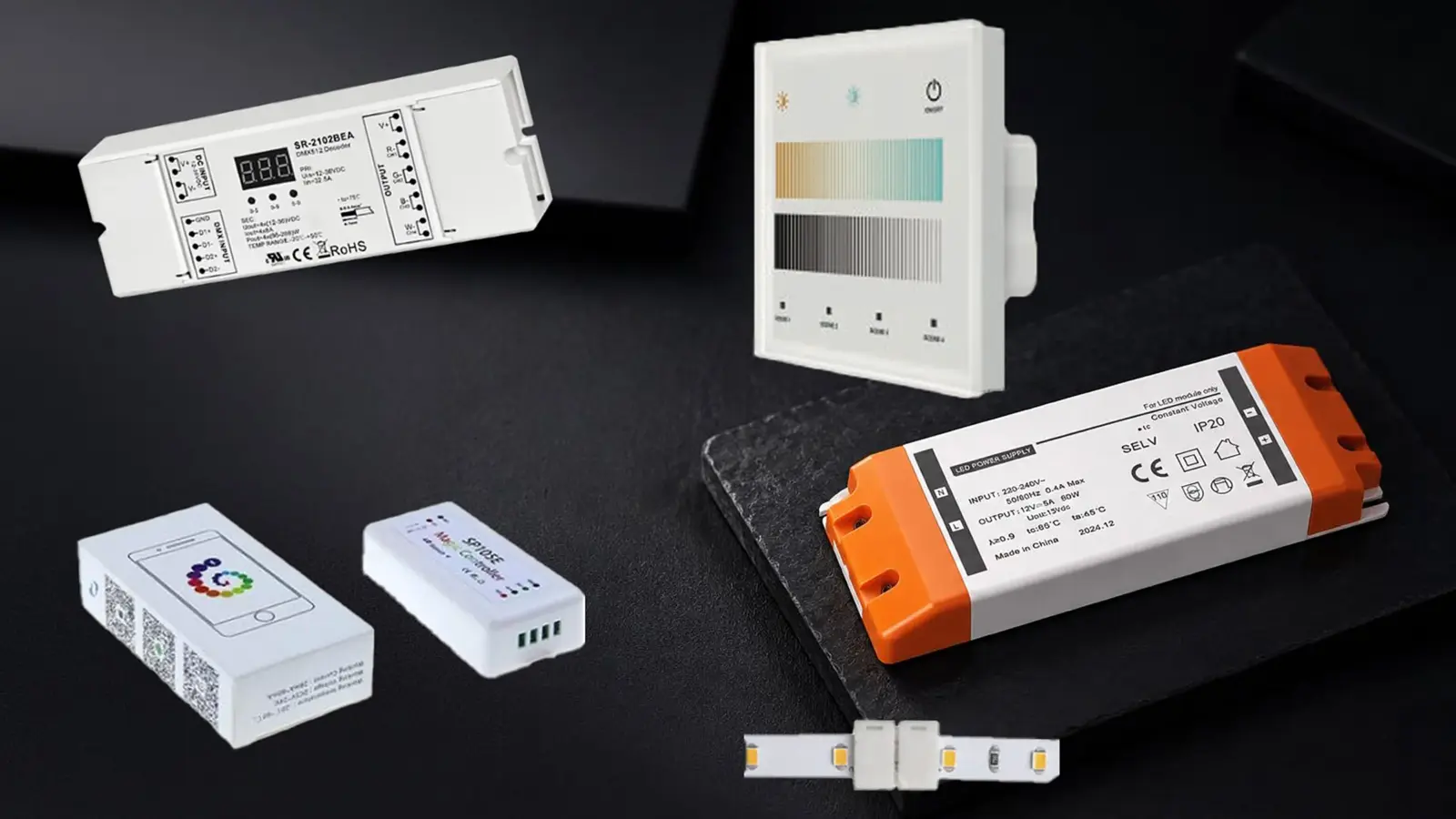
Our drivers, controllers and connectors page groups the range the same way an inspector reads it: Class 2 first, then high-power and IP67, then dimmable.