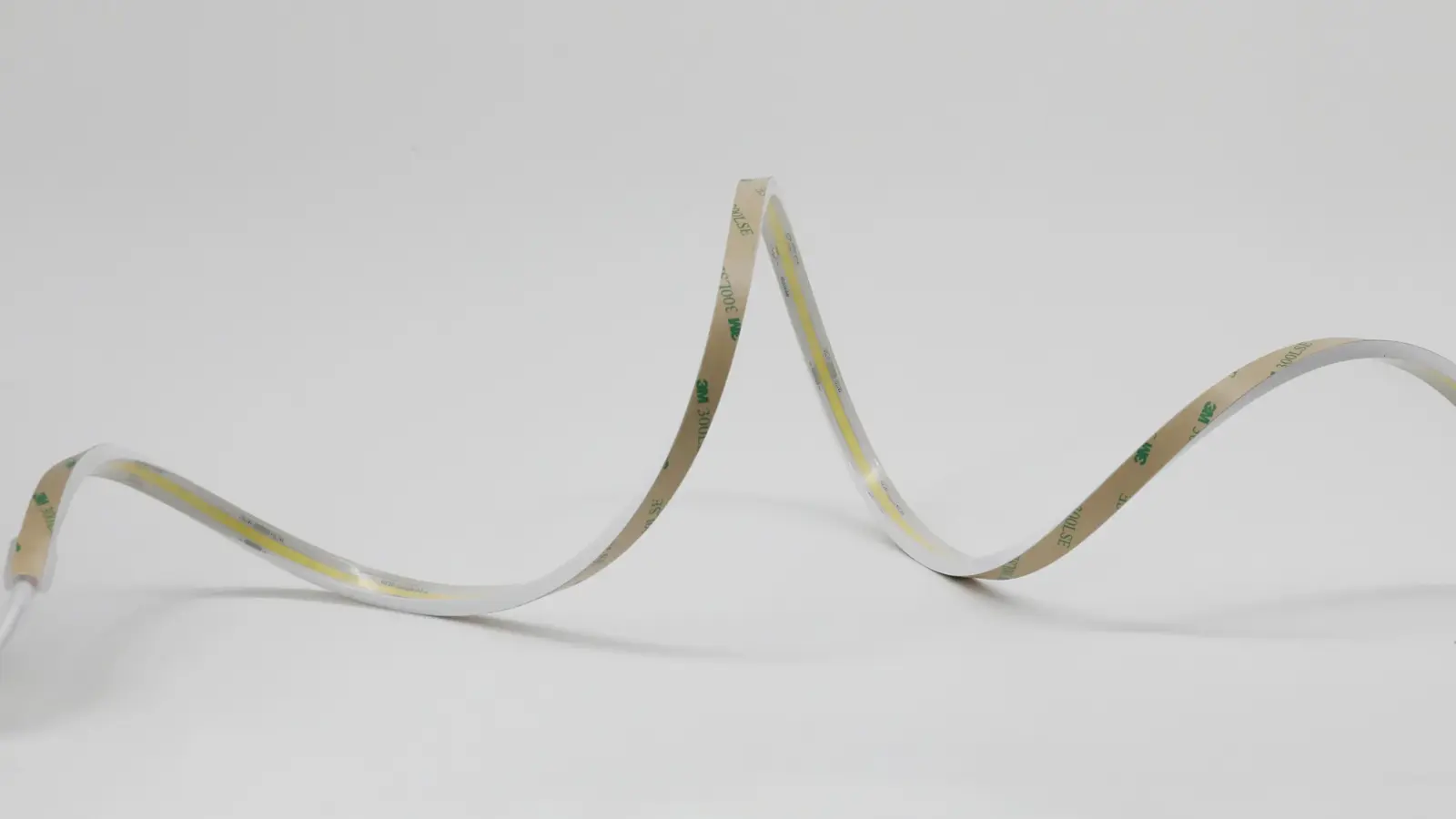
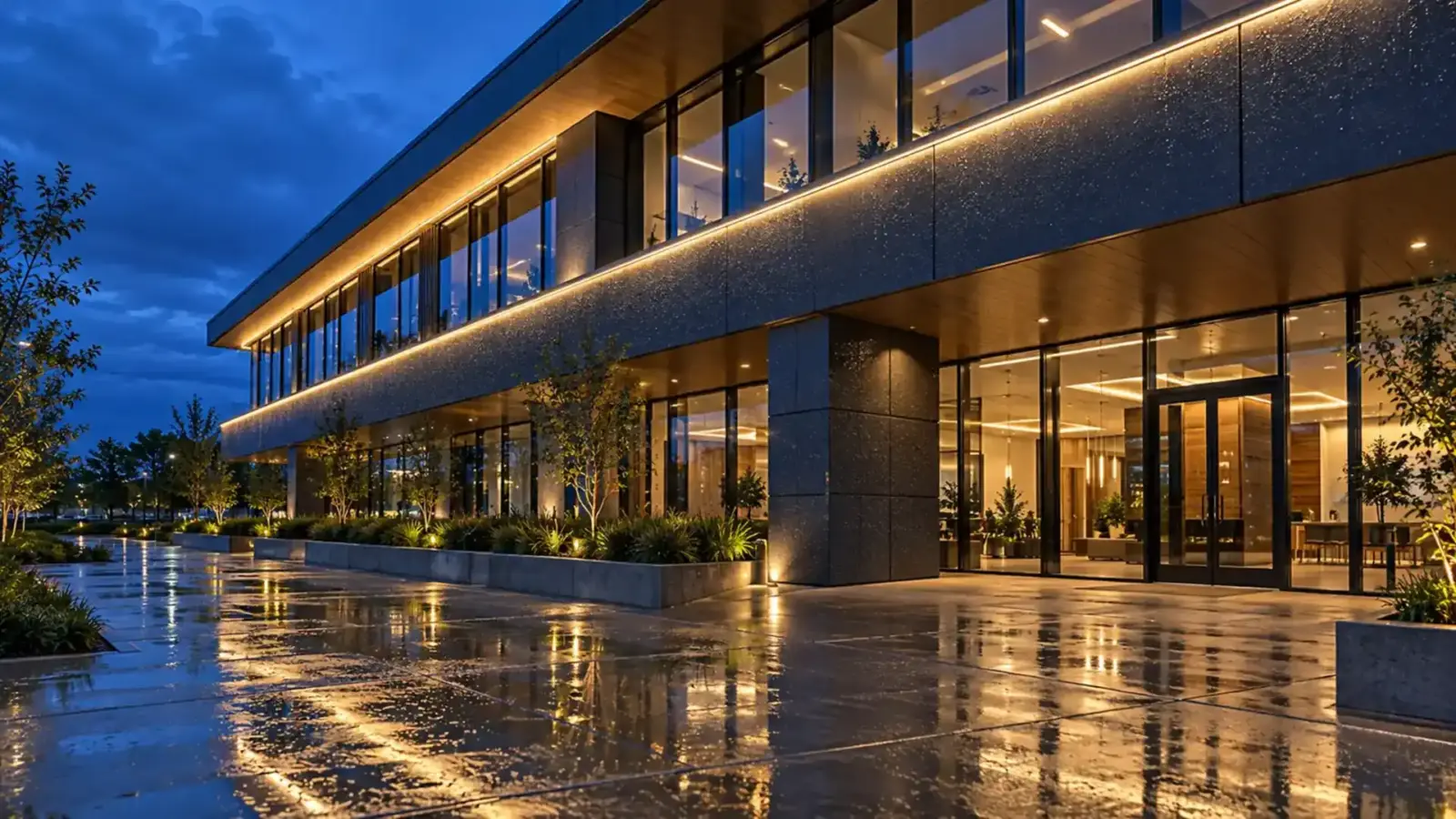
IP68 does not make an LED strip wet location rated. The IP code is a lab result for dust and water. The wet location marking is a code classification that comes from the product’s listing, and the inspector reads the marking, not the IP code. On a US job the strip, the connectors and the driver each need both. A facade or garage driver also needs a look at surge exposure: do LED drivers on a facade or in a garage need surge protection covers it.
IP68 Is Not a Wet Location Rating
Two different documents answer two different questions, and a spec sheet often shows only the first.
| IP code | Wet location marking | |
|---|---|---|
| Question it answers | How much dust and water gets in? | Where may this product be installed? |
| Where it comes from | The IEC 60529 test | The product’s listing and the Code’s location classes |
| Who checks it | The buyer, from a test report | The inspector, at final |
| Covers the connectors and the driver | Only the part that was tested | Each part separately |
According to a forum thread quoting the NEC, luminaires installed in wet locations have to be marked “Suitable for Wet Locations” (Article 410; the thread does not state the edition). The same thread names UL 1598 as the UL standard that defines wet location testing for luminaires. An IP67 strip with no wet location marking can therefore fail an inspection that an IP65 strip with the marking passes, because the inspector is reading a different line. The NEC editions in force and how they differ are in our NEC guide, and the standards that apply to a strip system are in the UL 2108, UL 8750 and UL 1598 comparison.
What IP65, IP67 and IP68 Test
All three ratings start with 6, so each is dust-tight. The second digit is the water test, and that is where they split.
| Rating | Water test (IEC 60529) | What it means on a job |
|---|---|---|
| IP65 | Jets of water from any direction | Rain, spray and hosing; not standing water |
| IP67 | Temporary immersion, 3.3 ft (1 m) for 30 minutes | Water can pool for a while; not continuous submersion |
| IP68 | Continuous immersion under conditions the manufacturer states | Only as good as the stated depth and time |
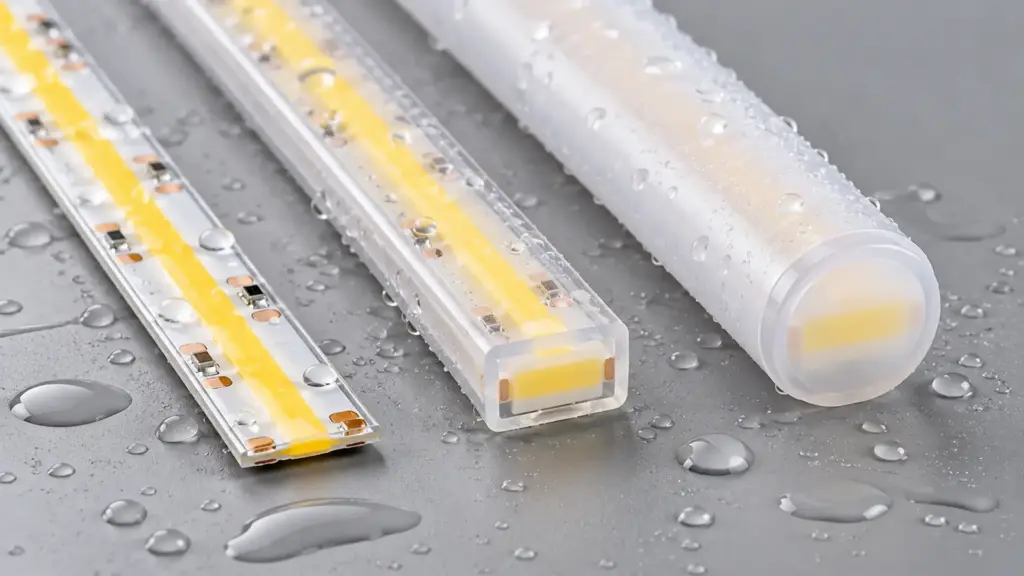
IP68 has no standard depth. The test must be tougher than the Dust-tight, and protected against temporary immersion in water. The usual rating for wet or outdoor runs that are not submerged all the time. test, and the maker decides how much tougher. BTF Lighting’s guide notes that depths on the market vary, with budget strips typically claiming 1.5 to 2 m and mid-range ones 2 to 3 m. Treat an IP68 claim as incomplete until it comes with a depth and a duration, and ask for the test report.
Our outdoor range builds the three ratings in three ways. IP65 strip carries a silicone top coat, such as UT-O120-10-65, UT-O320-8-65 and UT-O480-8-65, at 3.0, 2.4 and 3.2 W/ft with 16 ft (5 m) per feed. IP67 strip sits in an extruded silicone sleeve, such as UT-O320-8-67 and UT-O480-10-67. IP68 strip is sealed in a full silicone tube: UT-O480-12-68 and UT-O120-12-68. The silicone is UV-stable and does not yellow in sun the way a polyurethane coating can.
Dry, Damp, Wet: What the Location Marking Adds
The Code sorts locations by exposure. A damp location is protected from weather and not subject to saturation; a wet location is exposed to weather or subject to saturation. A product marked for wet locations can go anywhere. A product marked damp cannot go in a wet location, whatever its IP code says.
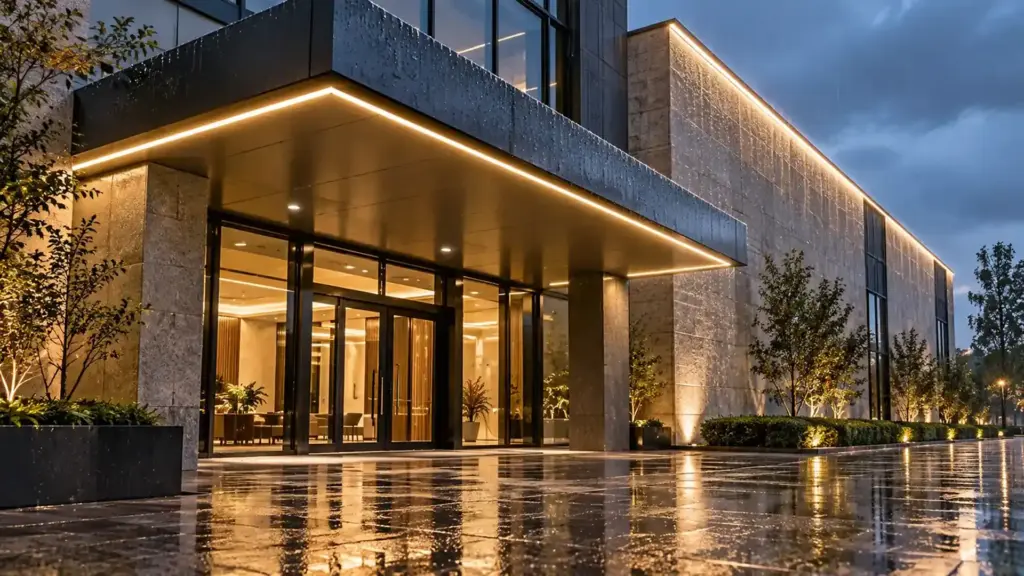
On a real job the line often falls at the roof edge. A strip tucked high inside a deep soffit, where rain never reaches it, is typically damp. A strip on a fascia, a parapet cap or an open facade is wet. When the overhang is shallow or wind-driven rain reaches the strip, treat it as wet. The authority having jurisdiction (AHJ) makes the final call, so settle borderline locations before rough-in.
Low-voltage strip has a second limit. According to ECM Magazine’s explanation of Section 411.3, low-voltage lighting is generally limited to 30 V AC or 60 V DC, and where wet contact is likely the limit drops to 15 V AC or 30 V DC. A 24V DC strip sits under that figure, which is one reason 24V is our default for exterior work: it also draws half the current of 12V, so long facade and soffit runs need fewer feed points. Check the figures against the edition your jurisdiction has adopted.
The Whole System: Strip, Connectors, Driver
A wet location run is only as good as its weakest part. The strip, every joint and the driver have to match the location, and one indoor driver or one unsealed joint takes the whole run out of its rating.
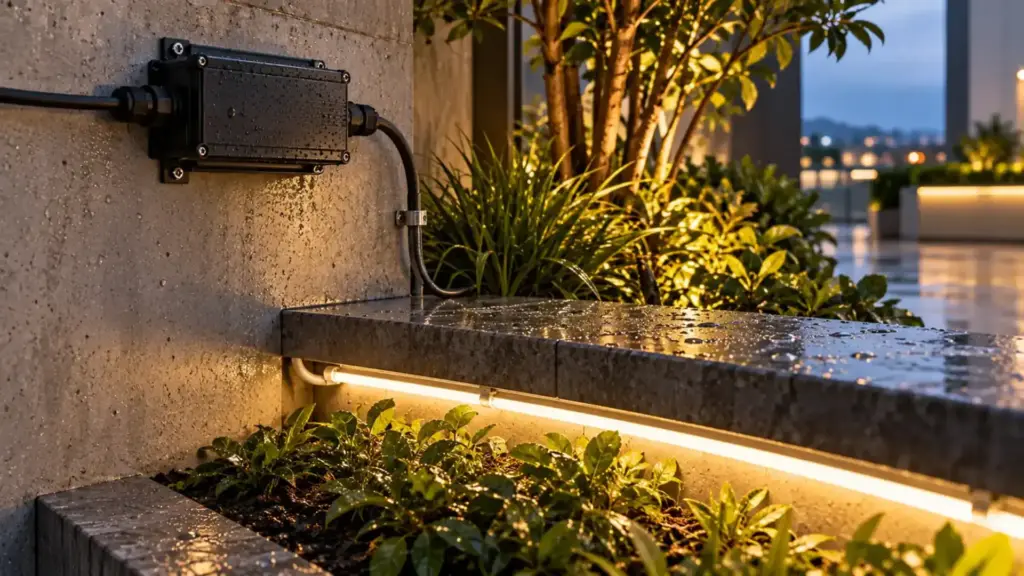
Connectors. Our BB strip-to-strip connectors are IP20 or IP62, and the XB wire-to-strip and BXB strip-wire-strip connectors go up to IP65. On IP67 and IP68 runs the strip can take immersion but the connectors cannot. Put every joint and lead-in above the waterline, or where water cannot collect, and bring the feed down to the strip from above.
Drivers. There are two ways to power an exterior run. A wet-rated driver at the fixture, such as the potted IP67 units UT-D60-1224-67 (60 W, 12V or 24V), UT-D100-24-67 (100 W, 24V) and UT-D100-24-010-67 (100 W, 24V, 0-10V dimming), or a standard driver in a dry location, with low-voltage wire out to the strip. Our Class 2 drivers, such as UT-D60-24-C2 (60 W), are IP20 and stay indoors or in a dry enclosure. Choose the driver location at design time, and confirm the wiring method for its output with the AHJ. The drivers, controllers and connectors range lists the options.
Field Cuts and End Caps
Waterproof strip can be cut, but only at the marked cut points: every 0.98 or 1.97 in (25 or 50 mm) on most outdoor series, and every 3.94 in (100 mm) on the pool series. After a cut, the open end has to be resealed with a matching silicone end cap and adhesive to restore the rating. An unsealed cut lets water straight into the strip at that end. Treat every field cut as a new seal, and let the adhesive cure before the run sees water. The cutting and joining steps for any strip are in our installation guide, and the construction behind each rating is in how LED strip is waterproofed.
Pools, Fountains and Spas
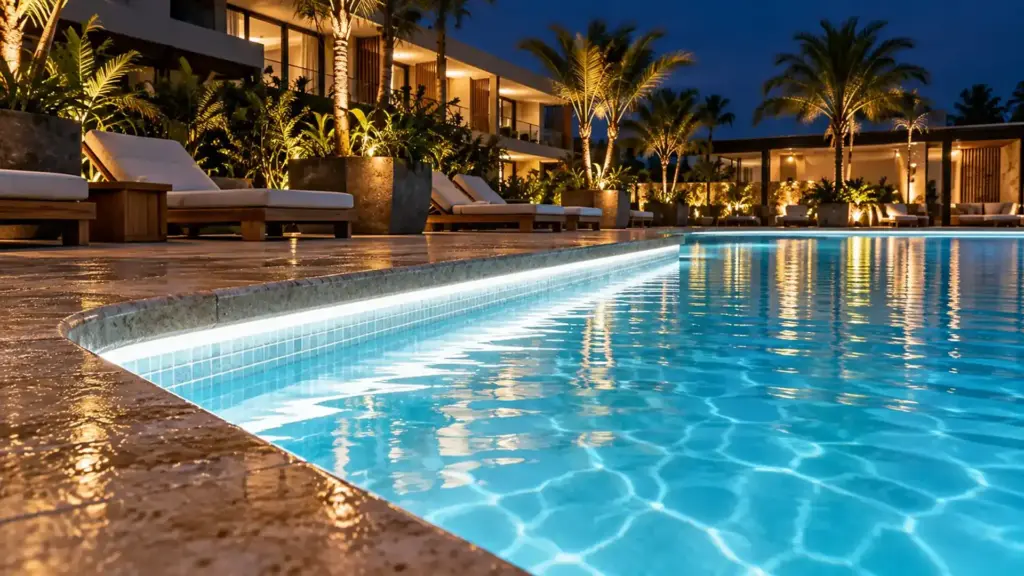
This is the case where the IP rating is most often mistaken for permission. An IP68 strip survives immersion. It is not an underwater luminaire, which is a listed product with its own standard. UL 676 covers luminaires installed below the water surface in pools, spas and similar vessels, according to UL.
The Code is stricter here too. A forum thread quoting the 2017 NEC gives the definition of the low voltage contact limit used in Article 680: 15 V RMS for sinusoidal AC, 21.2 V peak for non-sinusoidal AC, 30 V for continuous DC, and 12.4 V peak for DC interrupted at 10 to 200 Hz. A thread on the 2014 edition describes the requirement for luminaires below the normal water level as a listed underwater luminaire, and notes that the Code text refers to a listed luminaire without naming UL 676. Editions change, so read the adopted one.
For a pool, a fountain or a spa, ask for the listing for the exact model and the layout, and review both with the AHJ before you order. Our pool series, UT-O120-12-PL and UT-O240-15-PL, is IP68, runs at 12V low voltage, takes 10 ft (3 m) per feed and cuts every 3.94 in (100 mm). Certification coverage varies by model, and documentation is available on request.
Saunas are a heat problem more than a water problem. The sauna series uses high-temperature silicone rated to +221 °F (+105 °C): UT-O320-8-SA and UT-O640-10-SA, both 24V at 2700 to 3000K. Keep the driver outside the hot room.
Showers and Wet Rooms
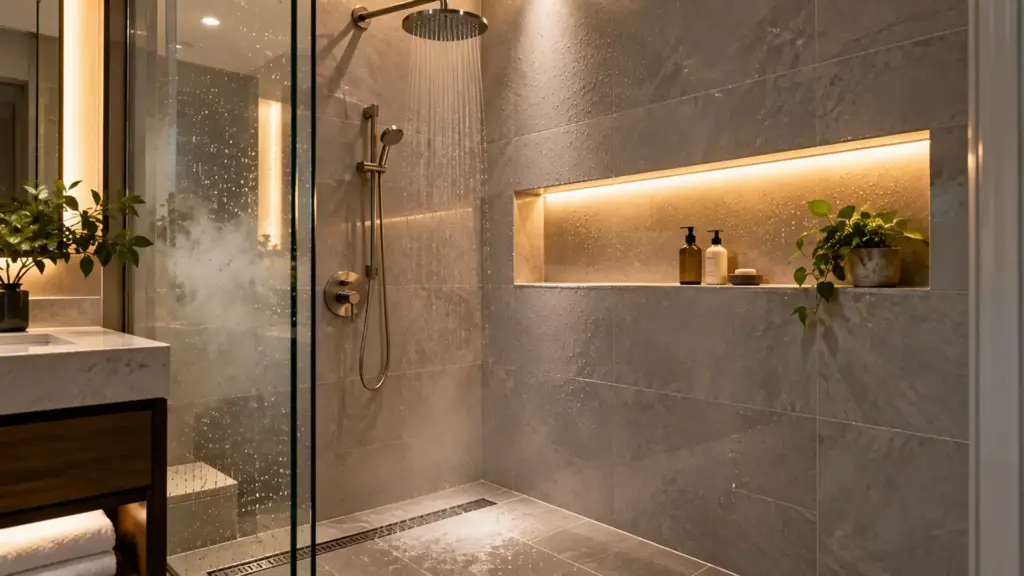
LED strip in a shower niche or along a tub surround falls under the tub and shower rules in NEC 410.10(D). Forum threads quoting the 2011 and 2014 editions describe two parts: a 3 ft (0.9 m) by 8 ft (2.5 m) zone above the tub or shower where cord-connected, hanging and track luminaires are not allowed, and a marking rule for luminaires within the outside dimension of the tub or shower, up to 8 ft (2.5 m) above the rim or threshold, which must be marked for damp locations, or for wet locations where subject to shower spray. The 2020 edition restructured the section, so check the adopted one.
In practice, a strip that sees direct spray in a niche or on a bench needs the wet marking, and IP67 covers water standing on a niche shelf. A strip in a cove above the shower, out of the spray, may only need damp. As outdoors, the driver stays outside the wet zone.
Series Picks by Location
The AHJ decides the classification. This table is the starting point for a conversation with the AHJ, not a ruling.
| Location | Typical class | Construction | Series |
|---|---|---|---|
| Interior, no moisture | Dry | IP20 | Indoor strip |
| Covered porch, canopy, deep soffit | Damp | IP65 silicone top coat | UT-O120-10-65, UT-O320-8-65 |
| Exposed facade, parapet, open eave | Wet | IP65 silicone top coat | UT-O480-8-65 |
| Planters, hardscape channels | Wet, standing water possible | IP67 extrusion sleeve | UT-O320-8-67, UT-O480-10-67 |
| Below-grade wells, submerged details | Wet, submerged | IP68 full tube | UT-O480-12-68, UT-O120-12-68 |
| Pools, fountains, spas | Article 680 | IP68, 12V; ask for the listing | UT-O120-12-PL, UT-O240-15-PL |
| Saunas | High heat | High-temperature silicone | UT-O320-8-SA, UT-O640-10-SA |
Spec Checklist
- Classify every run as dry, damp or wet, and confirm borderline spots with the AHJ.
- Match the IP code to the water exposure: IP65 for rain, IP67 for standing water, IP68 for submersion with a stated depth and time.
- Ask for the wet location marking or listing for the exact model, not only an IP code.
- Choose the driver location: a wet-rated driver at the run, or a Class 2 driver in a dry space.
- Keep the voltage inside the wet-contact limit for the edition in force.
- Match the connectors to the strip, and keep every joint above standing or submerged water.
- Cut only at marked points, and reseal every cut with the matching end cap.
- Plan feed points: 16 ft (5 m) per feed on most outdoor series, 10 ft (3 m) on the pool series.
FAQ
Is IP68 LED strip wet location rated?
Not by the IP code alone. IP68 is a lab test of ingress. A wet location rating is a marking from the product’s listing, and it is what the inspector checks. Ask for the marking or the listing for the exact model, and check the connectors and the driver as well.
Can you put LED strip in a shower?
Yes, if the strip is marked for the location. Forum threads quoting the NEC describe a damp or wet marking for luminaires inside the tub or shower footprint up to 8 ft (2.5 m) above the rim, and a wet marking where shower spray reaches the product. Keep the driver outside the wet area, and check the adopted code edition.
Do outdoor LED strips need a waterproof driver?
They need a driver rated for wherever it sits. Mount an IP67 potted driver, such as UT-D100-24-67, in the damp or wet location, or place an IP20 Class 2 driver in a dry space and run low-voltage wire out to the strip.
Can waterproof LED strip be cut and resealed?
Yes. Cut it only at the marked points, then reseal the open end with a matching silicone end cap and adhesive. A poorly sealed cut loses the rating at that end.
Does 24V LED strip meet the low-voltage limit for wet locations?
According to ECM Magazine’s explanation of Section 411.3, the wet-contact limit for low-voltage lighting is 15 V AC or 30 V DC, so 24V DC is within it. Pools follow the Article 680 contact limit, and our pool series runs at 12V.
What to Verify With the AHJ
- The location class of each run, especially the borderline ones.
- The marking or listing the AHJ will accept for the strip, and for the driver and connectors.
- For pools, fountains and spas, the listing for the underwater luminaire and the layout.
- The adopted NEC edition, since the section numbers and wording changed between editions.
The models mentioned here are in our outdoor and waterproof LED strip range. UL Listed options are available, certification coverage varies by model, and documentation is available on request.