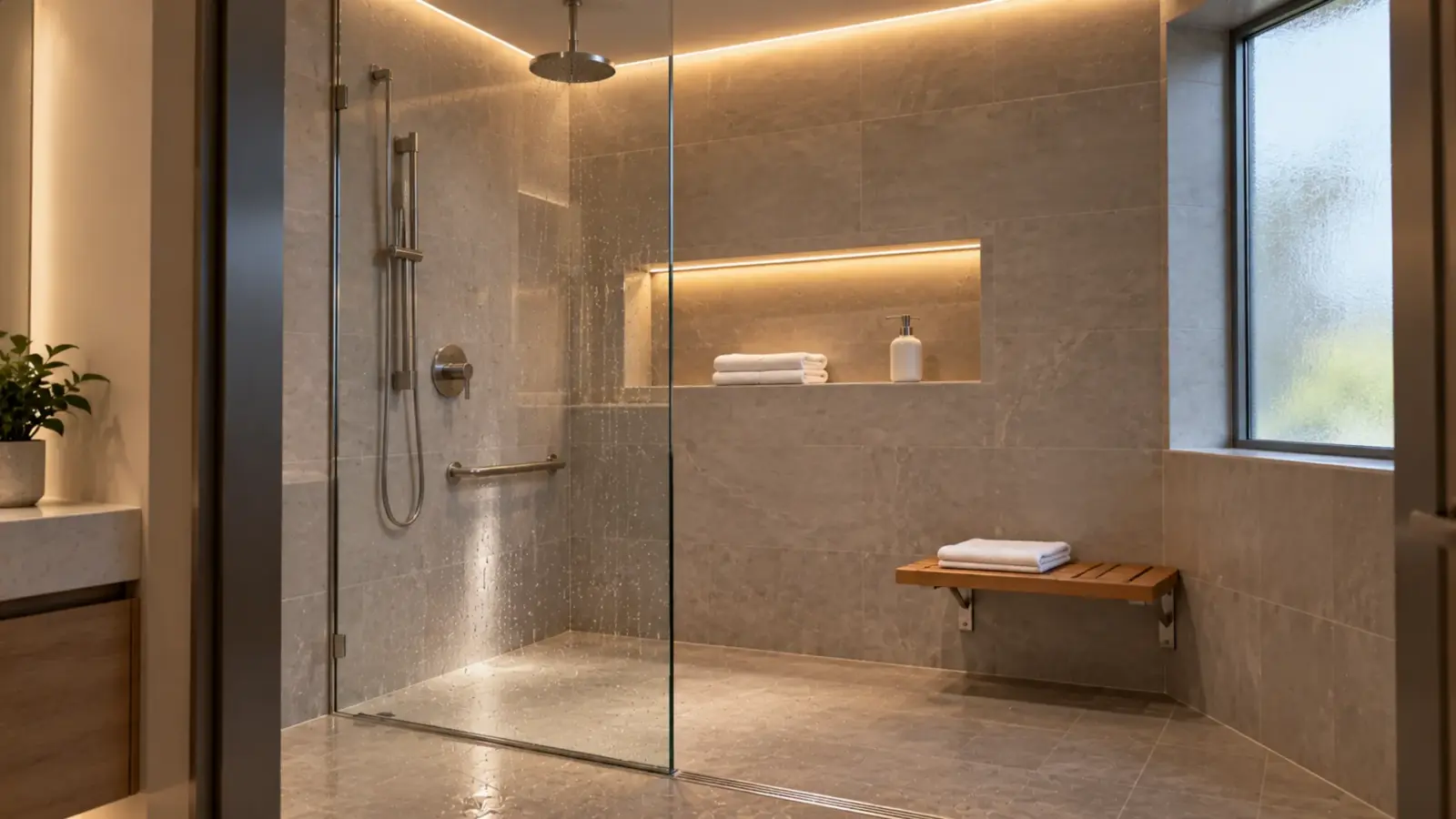
In a spa or commercial wet area, put IP67 or IP68 strip in aluminum channels on the surfaces around the water, keep joints and drivers outside the wet zone, and confirm the wet-location marking for the exact model. Nothing goes below the waterline unless it is a listed underwater luminaire.
You have a tile ceiling, a steam room, a plunge pool and a drawing that says the line goes everywhere. This article sorts the spaces of a spa or a commercial wet area into zones, matches each zone to a strip, and flags the parts of the system that fail first: the connector, the driver and the cut end.
Four Gates Before You Choose a Strip
Answer these in order. Each one is a yes or a no, and a no at any gate changes the product or the location.
- Is the line above the waterline, outside the splash, or both? A line that can be sprayed, soaked or submerged moves to the next gate with a rating to match. A line below the waterline stops here: it is a luminaire question.
- Does the model carry the marking the AHJ expects for this space? The IP code does not answer this. We confirm the marking for a given model from its documentation at quote.
- Is every joint and driver outside the wet zone? If the answer is no, redraw the run so the joint moves out, or choose a system built with a factory lead.
- Can the line be reached and replaced? A sealed niche with no access means a tile cut to change a strip. Decide before the tile goes up.
Most spa lighting problems are a no at gate three. They show up a year later as a dark section at a joint, and a tile cut to find it.
Zones: Dry, Damp, Wet and Underwater
A spa is four kinds of space under one roof. The strip, the connectors and the driver are chosen for the wettest place they touch, and the AHJ classifies each space, so use the table as a first pass and confirm it on the drawings.
| Space | How wet | Strip | What to confirm |
|---|---|---|---|
| Reception, lounge, treatment room | Dry | Standard COB in channels | Nothing special; follow the office and hospitality rules |
| Locker room, corridor, changing area | Damp | IP65 to IP67 in a channel | Condensation on the ceiling and the wall behind the strip |
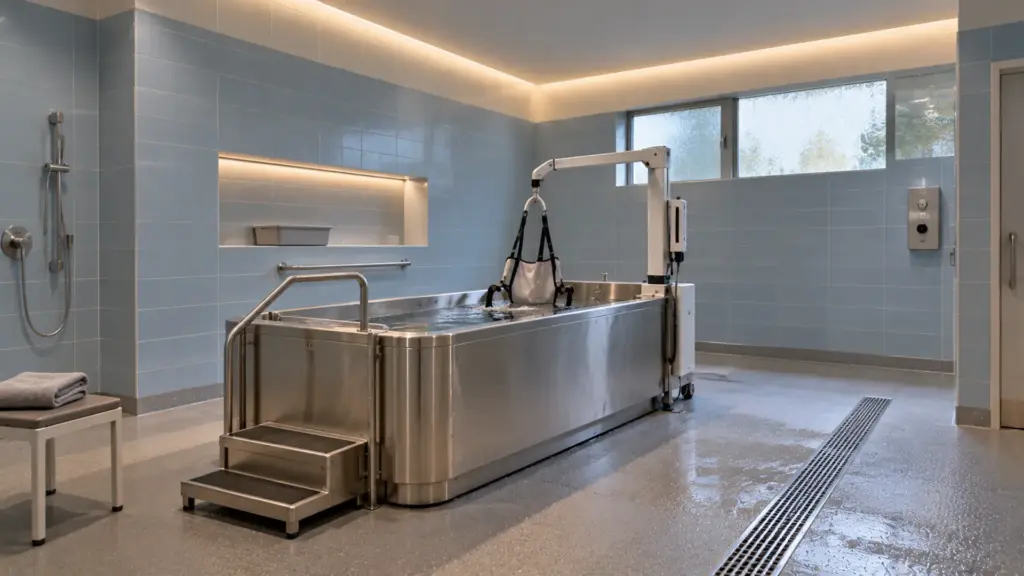
| Shower, hydrotherapy room, wet bar | Wet, splashed | IP67 in a sealed channel | The wet-location marking for the strip and the driver |
| Steam room | Hot and saturated | High-temperature silicone series | Temperature rating, see the steam and sauna article |
| Pool deck, steps, planters | Wet, outdoors | IP67 or IP68 on the deck side | Exterior rating and drainage |
| Underwater | Submerged | Not strip | A listed underwater luminaire |
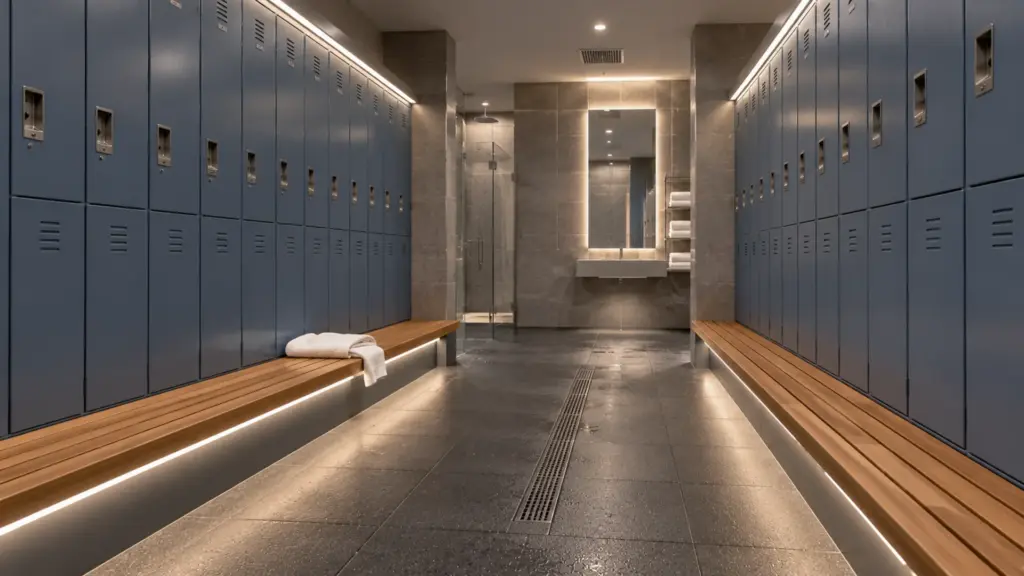
The first row is easy and the last row is where mistakes get expensive. Most of the work is in the middle three rows.
IP Is Not a Wet-Location Marking
An IP code is a lab test of how much water and dust get past a seal. A wet-location marking is a listing decision about where the product may be installed, and it covers the complete assembly. Our outdoor page says it directly: the IP code is a lab test and the wet location marking comes from the product’s listing. For any model, we confirm the marking from its documentation at quote.
That is why “IP68” does not settle a spa. We cover the point in full in does IP68 mean an LED strip is rated for a wet location and in how LED strip is waterproofed. Three parts have to match: the strip, the connectors, and the driver. A strip that survives a splash run through a connector that does not is a leak with a delay.
Strip by Wet Area: Our Models
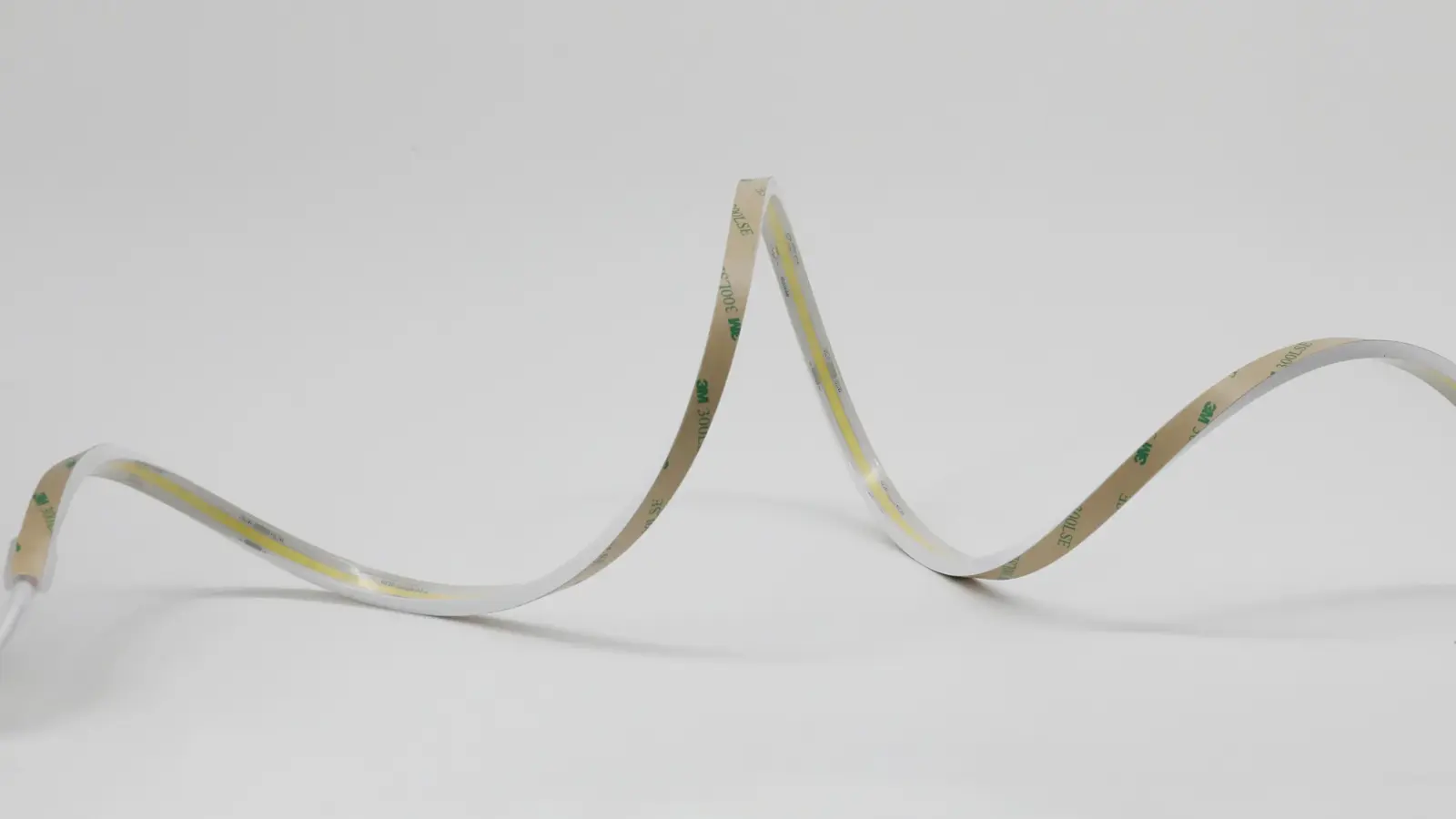
The outdoor and waterproof range covers IP65 to IP68 in three constructions, a silicone top coat for rain and splash, an extrusion sleeve for temporary immersion and a full silicone tube for continuous submersion. For wet areas indoors, these are the models we usually quote:
| Model | Construction | Power | CCT | Cut | Per feed | Use |
|---|---|---|---|---|---|---|
| UT-O320-8-65 | Silicone top coat, IP65 | 2.4 W/ft | 2700K to 6000K | 0.98 / 1.97 in | 16 ft | Damp corridors, locker rooms |
| UT-O320-8-67 | Extrusion sleeve, IP67 | 3.0 W/ft | 2700K to 6000K | 1.97 in | 16 ft | Shower zones, wet niches |
| UT-O480-12-68 | Full silicone tube, IP68 | 3.2 W/ft | 2700K to 6000K | 1.97 in | 16 ft | Features near water, deck steps |
| UT-O320-8-SA | High-temp silicone, IP68, to 221 °F (105 °C) | 2.4 W/ft | 2700K to 3000K | 1.97 in | 16 ft | Steam-adjacent details, sauna |
| UT-CSP-540-RGB-68 | CSP RGB, IP68 | 4.57 W/ft | RGB | 1.31 in | See page | Color scenes |
Cut intervals and per-feed limits come from our spec tables. Where two intervals are listed, the finer one is for the 12V build. The marking for each model is confirmed at quote and is not written here.
Around the Pool, Not In It
Pool areas are the one place where the vocabulary matters most. Our outdoor page puts it plainly: use IP68 as a minimum for fountains and pools, and anything below the waterline needs a listed underwater luminaire. Strip is not that luminaire. The pool series on our outdoor page is built for low-voltage pool and water-feature installations at 12V, with a 3.94 in (100 mm) cut interval, and the system around it still has to be listed for the installation.
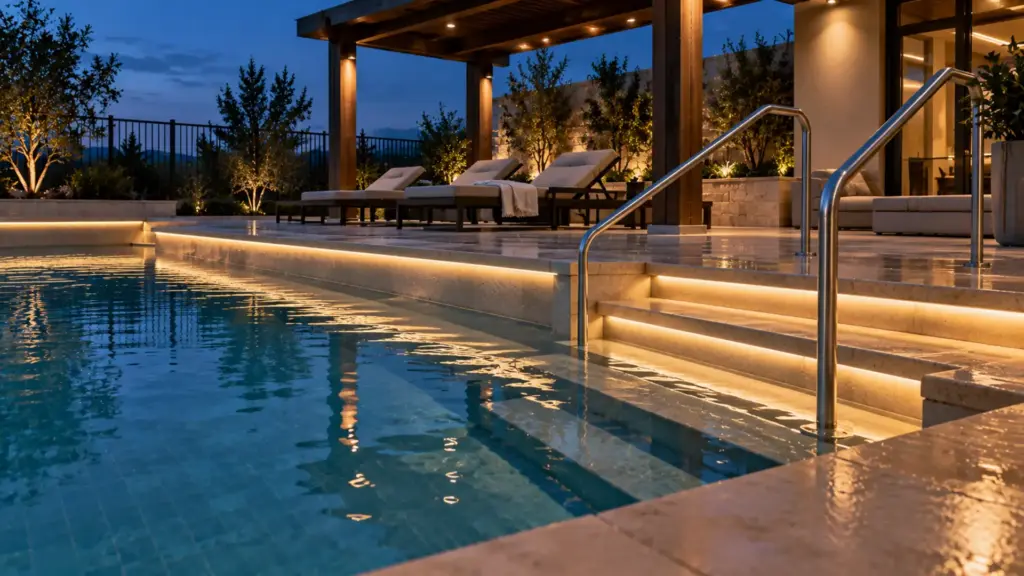
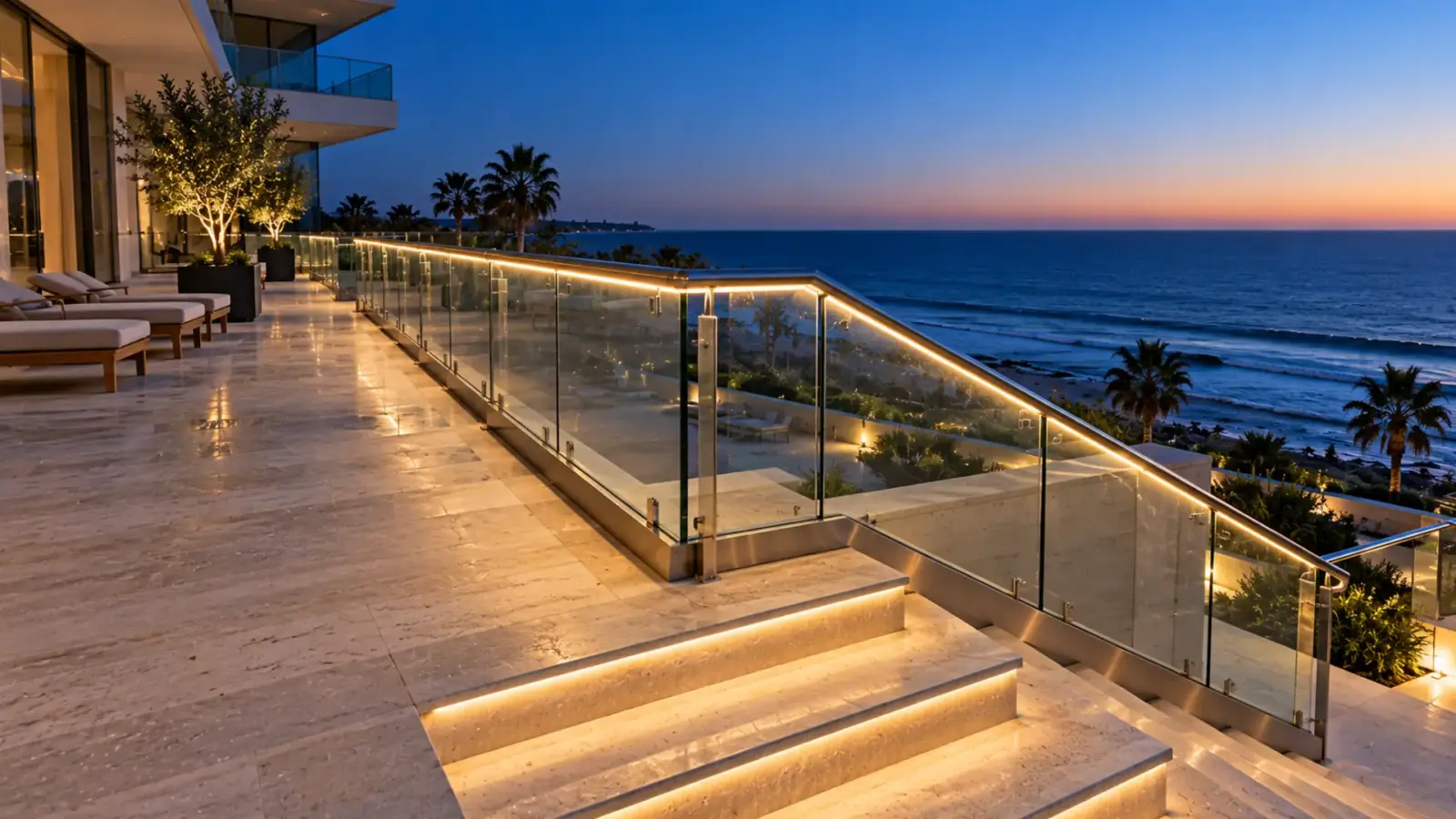
What strip does well at a pool is the dry side: step risers and treads above the waterline, the underside of a coping stone, a niche in the pool wall above the water, a planter on the deck, the edge of a spa bench in a room. Our pool and water feature guide sets out what IP68 does not cover. When the drawing shows a line under the water, change the product and the specifier, not the strip.
Niches, Steps, Mirrors and Coves
Wet areas use the same four details as any commercial space, and each one has a moisture problem the dry version does not.
Shower and wall niches. A niche is a small enclosed pocket; put the strip in a channel at the top of the niche, seal the channel ends, and bring the lead out through the back to a joint outside the niche. Tile and stone reflect the line, so choose the opal cover.
Steps and benches. A line under a step nose or a bench lip lights the tread without glare. Water pools on the tread, so the channel should drain, and the lead should leave from the dry side.
Backlit mirrors. A mirror near a basin sees spray and condensation, and the cavity behind it traps humidity. Our backlit mirror guide covers strip, driver and moisture behind a mirror.
Ceiling coves. A cove above a shower or a pool hall collects condensation on its cold face. Slope the cove floor away from the strip and keep the strip off the bottom of the cove.
In each case use an aluminum channel and a cover. A channel gives the strip a straight mount, a heat path and a place to seal, and our channel and diffuser range lists the profiles. Match the strip width to the channel’s maximum strip width before the order.
Condensation is the quiet failure in these rooms. Warm, wet air meets a cold surface and leaves water on the cover, the channel and the wall behind it. A strip in a sealed channel is protected from the water on the outside, and the channel still sees it as a drip line. Give the channel a path for water to run off, keep the lead on the dry side, and avoid mounting strip in the lowest point of a cove or a niche.
Heat, Steam and Cleaning
Spas add heat and cleaning to moisture. The sauna and high-temperature series on our outdoor page is rated to +221 °F (+105 °C), in 2700K to 3000K, and per the vendor results we reviewed, sauna strip from other makers is similarly rated and mounted in aluminum with the driver outside the room. Steam rooms combine the heat of a sauna with saturated air, and they get their own article: the temperature limit, what survives the steam and where the driver goes are in our guide to LED strip in saunas and steam rooms.
Cleaning is the other half. Spas are washed with disinfectants and treated with pool chemicals, and we do not publish chemical resistance data for the silicone or the cover. Ask for it in writing before the strip goes near a disinfecting wash-down or a chlorinated hall, and plan to wipe, not spray, the line.
Power: Drivers and Joints Outside the Wet Zone
The strip can be rated for the room and the system still fail at the joint, because our connectors stop at IP65. The BB strip-to-strip connector comes in IP20 and IP62, and the XB wire-to-strip and BXB strip-wire-strip connectors come in IP20, IP62 and IP65, with a 5 A current limit. In a wet area, that makes each connector the weakest link. Keep joints out of the wet zone: cut the strip to length, bring a factory lead through a sealed grommet, and make the joint in a dry junction box above the ceiling or behind the wall. Our connector guide shows which connector fits which location.
Put the driver outside the wet zone, in a plant room, a ceiling void or a service cabinet that can be reached. A driver with its own wet-location marking is a separate product and is confirmed per model; do not assume an IP-rated strip implies one. Class 2 limits and the AHJ’s view of the supply are in what the inspector checks on a Class 2 driver. We do not give code conclusions on grounding or ground-fault protection for the supply; those belong to the electrician and the AHJ.
Color and Scenes
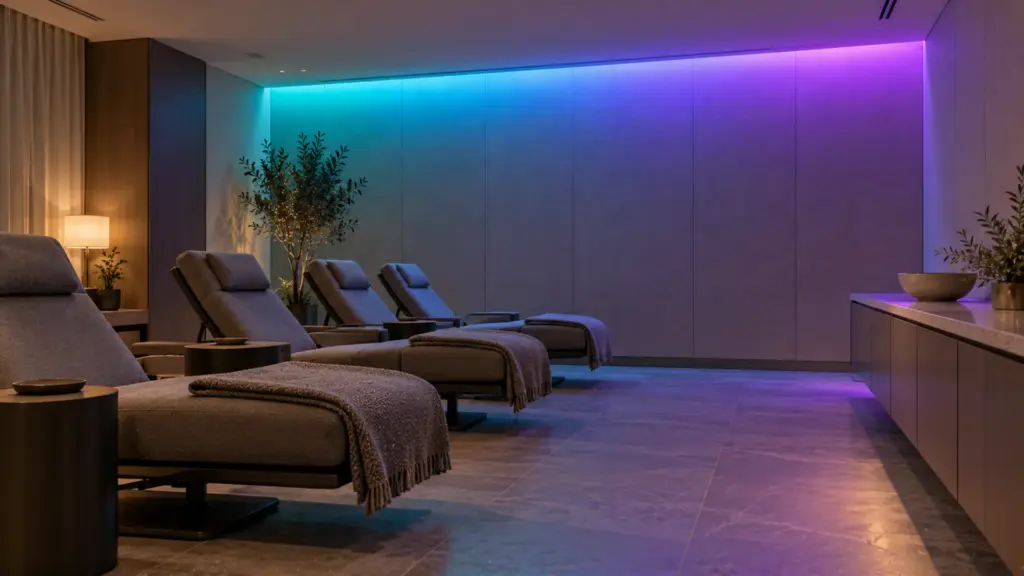
Spas use light to set the mood, and strip does it with two tools. White at 2700K to 3000K for the warm rooms, and colored light for hydrotherapy and relaxation scenes. RGB strip in the IP68 CSP build, UT-CSP-540-RGB-68, gives color scenes in a sealed silicone body at 4.57 W/ft. Dim at the driver and keep a slow fade for scenes; fast color changes in a treatment room read as a nightclub. For the choice between RGB and RGBW, our RGB vs RGBW guide covers the white.
Install, Seal and Test
Wet-area failures arrive at the cut end, the lead exit and the joint. Cut only on the marked line, seal every cut end with the matching cap and sealant, and let it cure fully before the room sees water. Our guide to sealing the cut end of IP67 strip sets out the steps. Leave a drip loop at every lead exit so water runs away from the seal.
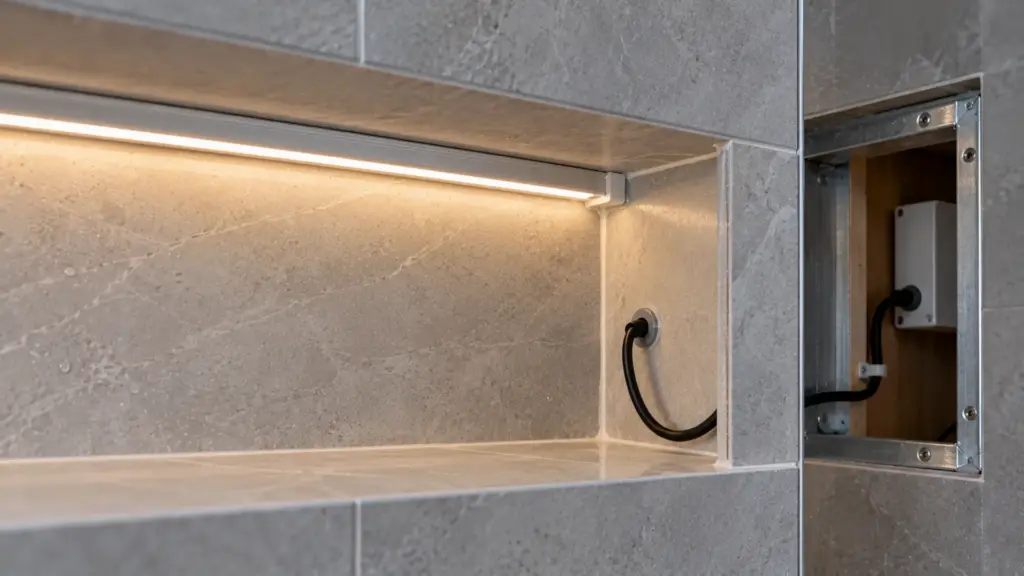
Before the finishes close, switch the run on and soak-test the niche or the cove with a spray. Run it for a day and look for condensation inside the cover. Then write the test into the handover record, with the model, the channel, the cover, the joint locations and the date, so the next person who opens the ceiling knows what was installed and how it was tested. If a section fails later, our troubleshooting guide starts at the driver terminals and works toward the strip.
FAQ
Can LED strip go in a shower?
In the splash zone, only IP67 strip in a sealed channel with the joints and the driver outside the wet area, and with the wet-location marking confirmed for the exact model. Inside a spray zone with no listing, do not install it.
Is IP68 LED strip safe to use in a spa?
IP68 is a lab rating for submersion, not a listing for a location. It is a good start, and the wet-location marking, the connectors and the driver decide the installation.
Can LED strip be used underwater in a pool?
No. Strip is not an underwater luminaire. Anything below the waterline needs a listed underwater luminaire. Strip works on the dry side: steps above the water, coping, niches and the deck.
Can you use LED strip in a steam room?
Only a high-temperature series with a temperature rating that covers the room, mounted in aluminum with the driver outside. Standard IP65 strip is not meant for it. See the steam and sauna article for the temperature limits.
Spec Notes for This Job
Before the order, settle the zone of every line, the marking required for each, the joint and the driver locations, and the color scenes. Send the plans and the finish schedule and we match outdoor and waterproof strip, channels and drivers and connectors to the spaces, and confirm the wet-location marking for each model at quote: request a quote.