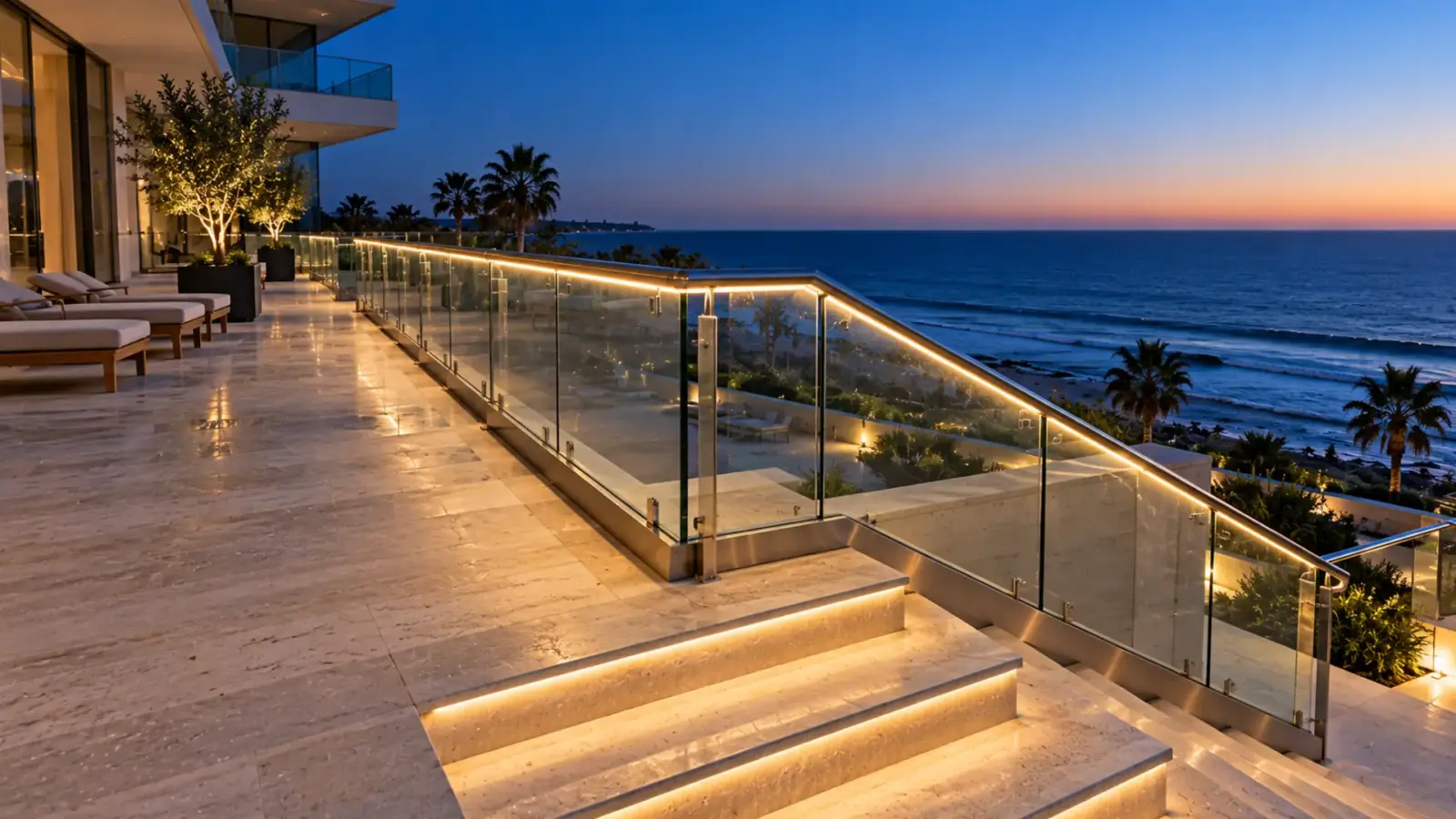
No US standard defines “marine grade” for LED strip. On a project it should mean four documented results: salt fog corrosion, water ingress, UV aging of the jacket, and vibration with mechanical fixing. On a vessel, the shipyard’s approval list decides what counts; on a coastal building, the NEC wet location rules and the corrosion details do.
Read plainly, the UL standard written for luminaires on ships does not cover a 24V LED strip fed from a driver. Buyers often assume a marine test stands behind “marine grade” on a listing. In many listings it stands for features: silicone, sealed ends, stainless clips. A submittal needs results.
Where the Label Comes From
The standard behind marine luminaires in the US is UL 1598A, Supplemental Requirements for Luminaires for Installation on Marine Vessels. It adds to UL 1598, the general luminaire standard, and it applies to luminaires on vessels with grounded systems wired under the Coast Guard’s electrical rules in 46 CFR Subchapter J, the NEC where it applies, and IEEE 45.
It sorts luminaires into types by location, each with a marking:
| UL 1598A type | Where on the vessel | Marking |
|---|---|---|
| Inside | Inside dry or damp locations | INSIDE TYPE |
| Inside dripproof | Inside damp or wet locations with oil or water drippage | INSIDE DRIPPROOF TYPE |
| Outside, fresh water | Outside, evaluated for fresh water only | OUTSIDE TYPE (FRESH WATER) |
| Outside | Outside or other severely wet locations | OUTSIDE TYPE or OUTSIDE TYPE (SALT WATER) |
Then comes clause 1.3. The requirements do not apply to hazardous-location luminaires, to emergency marine luminaires, “or low voltage marine luminaires (less than 50 volts) supplied solely by a battery, transformer, converter, or similar power supply source.”
On a plain reading, that describes a 12V or 24V strip fed from a driver. So a listing that says “UL 1598A” next to a strip deserves a second look: ask which product and configuration the certificate covers. Still, the tests the standard applies to the luminaires it does cover, plus the vibration and UV checks a yard may ask for, are a fair definition of marine grade for strip.
Test 1: Salt Fog
For the ferrous metal parts of an Outside-Type luminaire, UL 1598A sets the corrosion test as ASTM B117 salt spray (fog) for 200 hours. The material may show no pitting, cracking or other deterioration worse than a similar test on passivated type 304 stainless steel. Class societies have a related test: the IACS type-approval specification for shipboard control and monitoring equipment, UR E10, calls for a salt mist test to IEC 60068-2-52 on equipment in weather-exposed areas, four spraying periods with seven days of storage after each.
Salt rarely reaches the board through a sealed silicone jacket. It goes for everything around it: the profile, clips, screws, cable glands and every cut end. That is where the risk moves, and where the salt fog question belongs.
Aluminum gets its own rule. For an Outside-Type luminaire, UL 1598A allows aluminum with a copper content of 0.4 percent or less, or aluminum that passes the 200-hour salt test. Corrosion-resistant stainless steel, silver, copper, brass, bronze and copper-nickel need no added protection. Our channel profiles are AL6063 anodized aluminum; published composition data for 6063 gives copper at 0.10 percent maximum, well under that line. The alloy is half the story: ask for the finish and its salt test, since the anodizing, end caps and fixings meet the spray.
Test 2: Water
UL 1598A’s water test for an Outside-Type luminaire is a hose, not a tank. A solid stream from a nozzle at least 1 in across, at 15 psi at the nozzle, hits the enclosure from 10 ft for 5 minutes. No water may reach the wiring or lamp compartment under any exposure other than submersion. Inside dripproof luminaires take a drippage test instead: an hour under a shower head with no water on the wiring devices or lamps.
An IP code describes something else. IP67, on our outdoor page, is an extrusion sleeve built for temporary immersion; IP68 is a full silicone tube for continuous submersion; IP65 is a silicone top coat for splash. Our wet location guide explains why an IP number does not stand in for a wet location listing, and the same logic holds at sea: an IP rating does not stand in for a marine approval.
Our marine page puts IP67 sleeved strip such as UT-O480-10-67 on handrails and stair nosings, and IP68 tube or neon where water can stand. On a washed deck, the weak points are the cut end, the lead exit and the connector. Seal every cut end and specify connectors to the zone; our guide to how LED strip is waterproofed shows where each construction leaks first.
Test 3: UV on the Jacket
Sun on an open deck or a beachfront facade ages the jacket long before it ages the LEDs. Makers report that PVC jackets yellow and stiffen faster than silicone, but the material name alone proves little, which is why our comparison of silicone vs PVC neon flex asks for UV results with the method and hours. Our outdoor page describes its silicone construction as UV-stable.
There is a published way to test that claim. UL 746C, the standard for polymers in electrical equipment, rates materials for outdoor use. A material carries the f1 rating when it meets both the UV and the water exposure and immersion requirements. According to a test lab’s summary of the standard, the UV exposure is 1,000 hours in a xenon-arc weatherometer, and the material must keep at least 70 percent of its strength and impact properties with no change in flammability class. The water part is 7 days immersed at 70°C (158°F), with at least 50 percent retained.
Ask whether the jacket compound has an f1 rating or a UV aging report, with hours and method. “UV resistant” with no hours behind it is a feature, not a result.
Test 4: Vibration and Fixing
Engines, thrusters and waves keep everything on a ship vibrating. The IACS test specification sets the usual levels for shipboard control and monitoring equipment: from 2 to 13.2 Hz at an amplitude of ±1 mm, and from 13.2 to 100 Hz at ±0.7 g, held 90 minutes at 30 Hz if no resonance shows, in three directions. Near diesel engines and compressors the levels rise to ±1.6 mm and ±4.0 g. A yard may apply those levels to lighting or set its own.
UL 1598A treats vibration through construction. It requires all luminaire wiring to be stranded. Fluorescent tubes 40 in or longer need extra clamps against vibration. Porcelain lampholders mounted without a gasket must survive 5,000 shocks at 25 g. The pattern is clear: nothing is left to hold by friction alone.
For strip, that means mechanical fixing. Our marine page is plain about it: adhesive tape alone can creep or let go, so strip and neon on a ship are held with clips or mounting track at short, even spacing, joints are supported on both sides, and every feed gets a service loop so cables are not pulled tight as the structure flexes. Our neon installation guide covers bends, clips and mounting channel.
On a Vessel, the Yard Decides
For a US-flag inspected vessel under the Coast Guard’s electrical rules, 46 CFR 111.75-20 says the construction of each luminaire for a non-hazardous location must meet UL 1598A or IEC 60092-306:2009, the IEC standard for luminaires on ships. Nonemergency, inside-type decorative luminaires in protected spaces may instead meet UL 1598 or IEC 60092-306 plus six UL 1598A clauses on mounting, glass, clamps, lampholders, connection boxes and shock. Those six clauses do not apply in accommodation spaces, the bridge, the galley and similar spaces where the luminaire is not subject to damage.
How a yard fits a 24V strip into those rules, given clause 1.3, is a question for the yard and its plan reviewer, not a listing page. On top sit the vessel’s flag state, its class society and the owner’s specification, which decide every zone on a cruise refit.
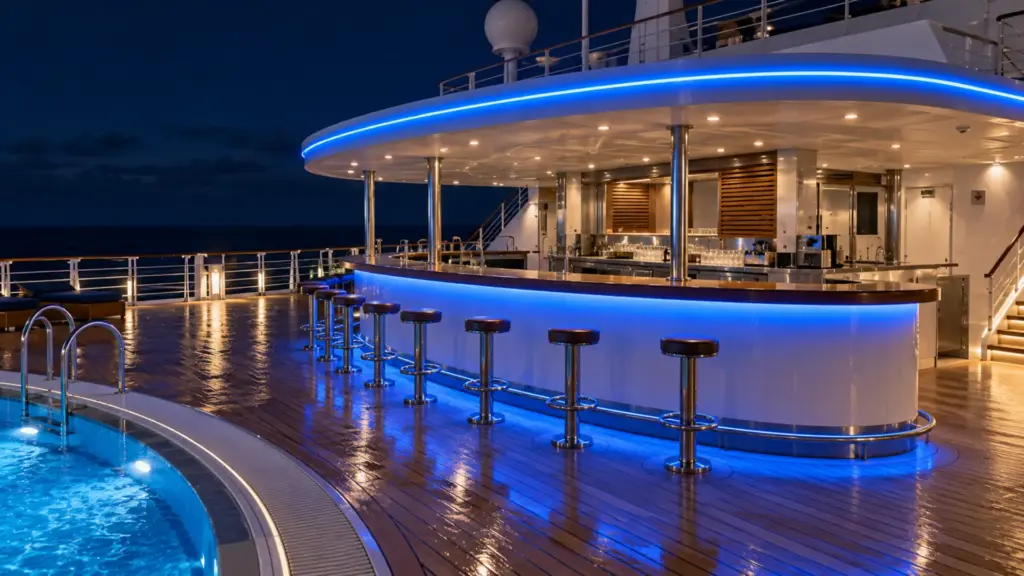
That is why our marine and cruise application page says plainly that we do not claim a marine, class-society or USCG approval for our products. We confirm the listing of each model at quote and work to the documents the yard asks for. Foreign-flag cruise ships follow their own flag and class rules instead. Recreational boats in the US are commonly built to ABYC’s voluntary standards, a separate set this article does not cover.
On Shore: Coastal Hotels and Marinas
An oceanfront hotel, a ferry terminal or a marina building is not a vessel. Its lighting follows the NEC and the local building code like any other building, so outdoor strip needs a wet location listing for the use, and pool decks follow the pool rules covered in our pools and water features guide. None of the vessel standards above apply. Docks and piers at a marina are their own case: NEC Article 555 covers them, and according to EC&M’s reading of 555.38, luminaires there must be listed for the environment, with added rules below the electrical datum plane.
The salt does not read the code book, though. A terrace balustrade close to the surf sees salt air much like a deck rail does. Carry the marine details over:
- Silicone construction, IP67 sleeved for handrails and nosings, IP68 or neon where water stands.
- Every cut end and lead exit sealed, and connectors rated for the zone.
- Fixings in 316 stainless rather than 304; 316 adds molybdenum for resistance to chloride pitting.
- Dissimilar metals kept apart, so stainless screws do not sit bare against an aluminum profile in salt air.
- Mechanical clips, not tape alone, on anything exposed to wind and washdown.
- Drivers in a dry, ventilated room or in a potted IP67 housing such as UT-D100-24-67, reachable for service and out of the spray.
Board corrosion usually starts at an open cut end or a damaged jacket; where a run has darkened instead, our guide to why LED strip turns black or yellow separates chemical darkening and UV yellowing from heat damage.
FAQ
Is there a marine rating for LED strip?
No single one. UL 1598A covers marine luminaires but excludes low-voltage luminaires under 50 volts fed solely from a converter or similar supply. In practice, marine grade should mean documented results for salt fog, water, UV and vibration, and on a vessel the yard’s approval list.
Does IP68 mean marine grade?
No. IP68 says the construction keeps water out under continuous submersion. It says nothing about salt fog on the profile and fixings, UV aging of the jacket or vibration, and it is not a marine or wet location approval.
Does UL 1598A apply to 12V or 24V LED strip?
On a plain reading of clause 1.3, no: the standard excludes low-voltage marine luminaires under 50 volts supplied solely by a battery, transformer, converter or similar power supply. If a listing claims UL 1598A for strip, ask which product and configuration the certificate covers.
What fixings should LED strip use on a coastal building?
Stainless 316 clips and screws, isolated from aluminum profiles, with an anodized profile whose finish has a salt test behind it. Sealed ends and connectors matter as much as the strip.
What to Verify With the Yard or the AHJ
Before ordering, settle these:
- Vessel or building: which rules apply, 46 CFR and the class society, or the NEC and the local AHJ.
- On a vessel, the yard’s approval list for each zone and the documents it wants.
- A salt fog result (hours and method) for the profile finish and fixings, not only the strip.
- The water construction per zone: IP67 for handrails and nosings, IP68 where water stands, with sealed cut ends.
- A UV rating or aging report for the jacket compound.
- The fixing method and spacing, with service loops at every feed.
- Driver location: dry and reachable, or potted IP67.
Our outdoor LED strip and IP68 neon flex pages list the sealed constructions; send the zone list and the yard’s specification with the quote request.