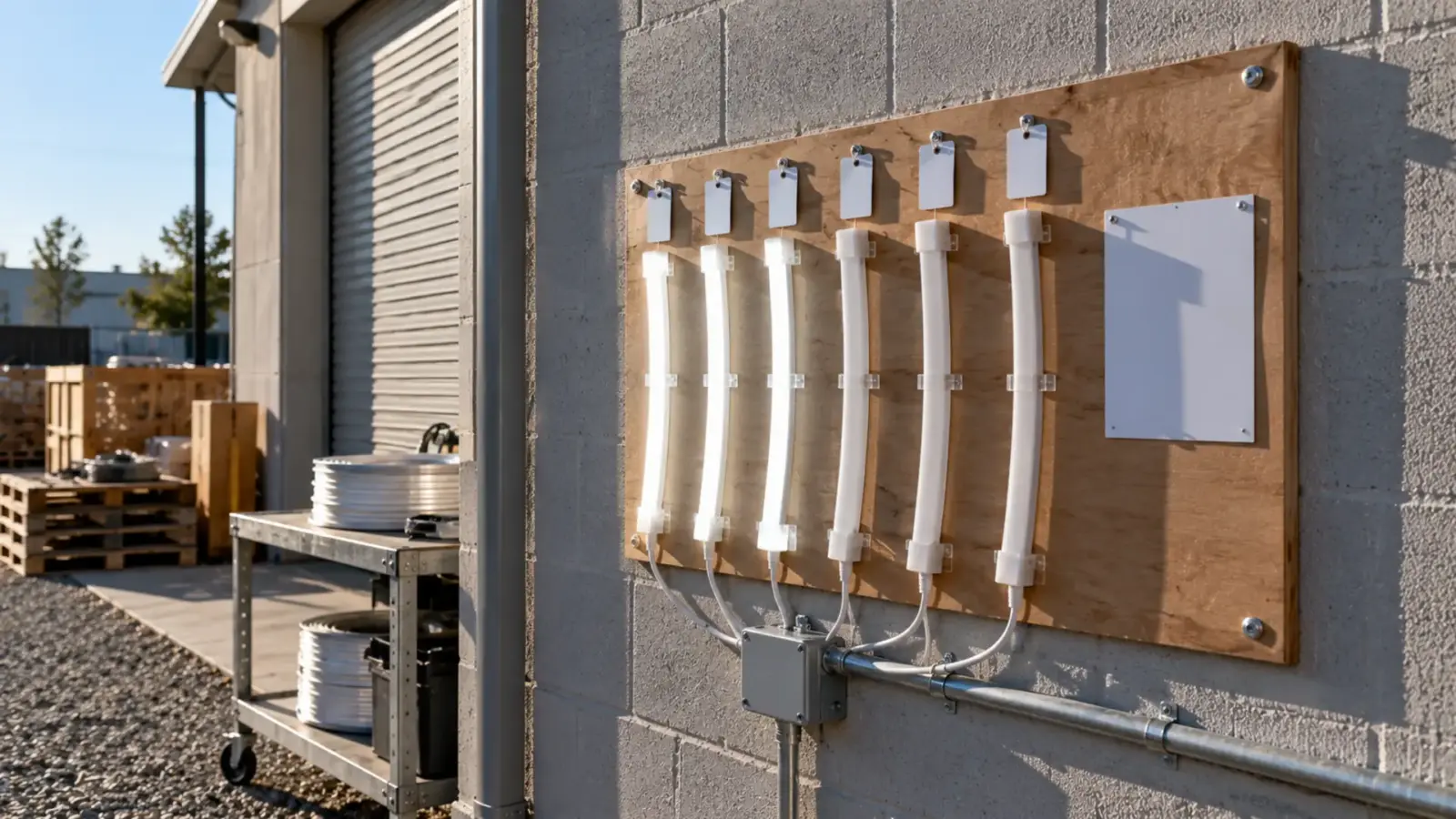
Compare silicone and PVC neon flex outdoors by test data, not by material name. Both are families, and grades within each differ. Ask each maker for UV, salt spray, temperature and chemical results, with the test method and the hours, then check the answers against the site: sun, coast, cold or daily washdown.
The common shorthand is that silicone is for outdoors and PVC is for indoors. It has a basis, and it also hides the question. A schedule line that reads “silicone neon flex, Dust-tight, and protected against temporary immersion in water. The usual rating for wet or outdoor runs that are not submerged all the time.” feels finished, but IP67 describes water and dust, and says nothing about sun, salt air or the cleaner the crew uses on Fridays.
What the Material Name Tells You
The material name tells you what the body is made from and little else. One neon manufacturer’s article, repeated in nine languages, gives its view of the two. It says PVC yellows under UV and heat through a chemical reaction that cannot be reversed, that silicone’s silicon-oxygen backbone resists this, and that silicone is inert to most chemicals while PVC reacts with some cleaners, oils and airborne pollutants. The same article’s table puts PVC at about -15 to +80 °C and silicone at -40 to +200 °C, while its own bullet list gives silicone as -40 to +60 °C.
That conflict is the lesson. The source is one vendor’s marketing, it contradicts itself on the number that matters most, and we found no independent UV, salt-spray or chemical results comparing the two materials. Treat the direction as plausible and the numbers as unverified. The datasheet for the exact product is the only number to design against.
What an IP Rating Does Not Cover
An IP rating is a lab test of dust and water. IP67 means the body is dust-tight and survives temporary immersion. It does not describe how the material ages in sun, how it behaves in salt fog, or how it reacts to a degreaser. Our wet location guide makes the same point about IP68 and the wet location marking, which comes from the product’s listing and not from the IP code.
So a PVC product and a silicone product can both be IP67 and still age differently, and two silicone products can too. When you read a spec line, split it in two: what the IP rating covers, and what the weather will do to the material over years.
The Four Loads on a Neon Body
Outdoor neon flex is loaded by four things at once, and they act together.
- UV and heat. Sun fades and yellows some bodies and hardens others. Heat adds to it, and a dark mounting surface in summer sun can run well above the air.
- Salt. Salt fog settles on every surface, including strip that never gets wet, and attacks metal fixings first.
- Cleaners and solvents. Detergents, degreasers and solvents used on signs and rails can swell, craze or discolor a body.
- Temperature cycling. The body and its end caps expand and contract with each day, and the seals are where cycling shows up first.
A material that does well on one load can do badly on another, which is the reason a single word on a schedule cannot stand for all four.
What the Published Numbers Look Like
When we looked for test data, we found vendor tables and no independent report. One manufacturer’s guide gives a yellowness index after 2,000 hours of ASTM G154 exposure of about 1.0 to 2.5 for silicone and 20 to 50 for plasticized PVC, with no named lab, report or method detail behind it. Another supplier says its silicone kept 98 percent optical clarity in simulated aging while PU and PVC samples yellowed within 14 months and 8 months, from its own tests. A salt-spray table rates silicone excellent and PVC poor, without hours. An importer guide adds that blended or filled “silicone” products can still yellow and recommends a comparative test report and outdoor samples.
Read these as claims to verify. They agree on the direction, and none can be checked. The useful request is the report itself: the method, the hours, the formulation tested and the raw readings by hour, ideally from an accredited laboratory.
Five Questions the Name Does Not Answer
| Question | Why it matters | What to ask for |
|---|---|---|
| How does the body age in UV? | Yellowing and cracking change the light and the look | A UV exposure result with the method (ASTM G154 is one common method), the hours and the measured change |
| How does it handle salt? | Salt air reaches strip that never gets wet | A salt spray result (ASTM B117 is the usual method), the hours and the pass criterion |
| What are the temperature limits? | Cold stiffens bodies, heat accelerates aging | The operating range and the minimum installation temperature from the datasheet |
| What can touch it? | Cleaners, solvents, oils and sealants can attack a body | A chemical compatibility list for the products the site will use |
| How are the seals and joints aging? | End caps, adhesives and potting fail before the body | The end-cap and connector materials and the sealing method |
The method names are not a standard of acceptance. According to ASTM International, B117 is the standard practice for operating salt spray (fog) apparatus, and G154 is the practice for operating fluorescent UV lamp apparatus for exposure of nonmetallic materials. Each describes how a test is run. It does not set a pass mark, so ask for the result and the hours, not just the name of the test.
Reading a Supplier’s Answer
Ask the five questions and read the reply for what it contains. A good answer has a number, a method and a date. A weak answer has an adjective.
| A usable answer | A weak answer |
|---|---|
| “UV exposed for a stated number of hours under a named method, with the measured color change” | “UV resistant” |
| “Salt spray for a stated number of hours, with the criterion and the result” | “Marine grade” |
| “Operating range and minimum installation temperature on the datasheet” | “Works in all weather” |
| “Chemical list: tested with these cleaners at these strengths” | “Resistant to chemicals” |
| “End caps in this material, sealed by this method” | “Fully sealed” |
If the supplier cannot give a usable answer, that is information. It may be that the test does not exist for the product, and then the field sample is the way to find out.
Match the Environment
| Site | What loads the material | What to settle first |
|---|---|---|
| South-facing facade in a hot, sunny climate | UV and heat on the body and on the potting | UV result and the temperature range |
| Coastal or marine | Salt air on the body, the end caps and the fixings | Salt result, fixing finish, end-cap material |
| Cold climate | Cold at installation and in service | Minimum installation temperature and bend-in-cold guidance |
| Daily washdown or public space | Cleaners, pressure and impact | Chemical list, IP rating, IK rating |
| Shaded or covered exterior | Mostly water and dirt | IP rating and cleaning method |
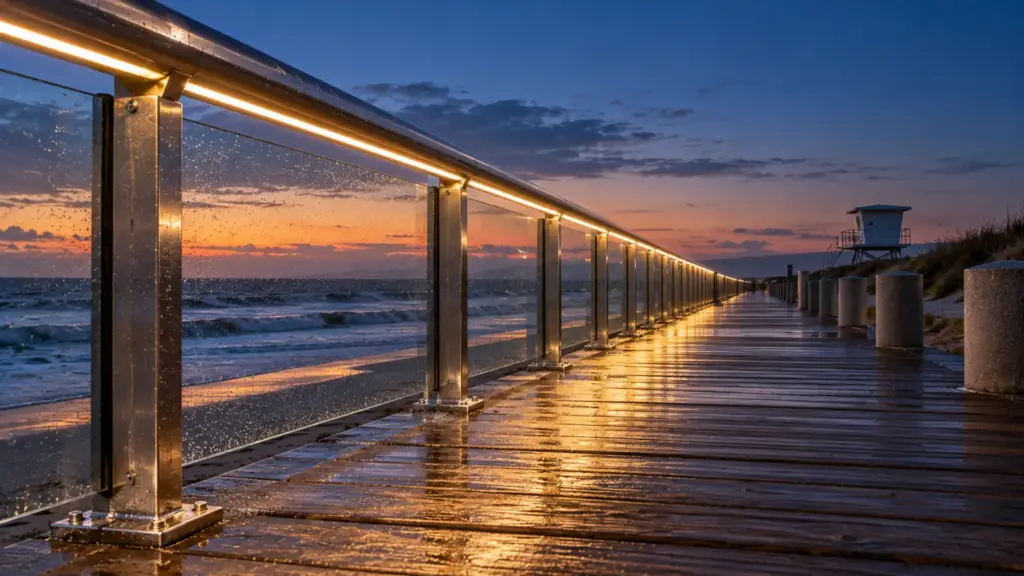
The marine case shows the pattern. Our marine page notes that salt air reaches strip that never gets wet, and that sealed silicone constructions keep it off the board, so the risk moves to the profiles, clips, screws and cable glands. For a coast, the question is as much about the fixings as the body.
A Typical Job: A South-Facing Coastal Facade
A coastal hotel annex has a south-facing facade with an outline in neon flex, in sun all afternoon and in salt air all year. The checks, in order: the datasheet temperature range against a summer surface temperature on that wall; a salt result for the body and for the end caps; the finish of the clips and screws; the chemical list for the cleaner the maintenance crew uses; and a sample mounted on the wall for a season before the order. The material name appears on the schedule, and so do these five lines. That is the whole difference between a spec and a wish.
Cold Installation
Cold changes how a body bends. Our neon page says the profile bends around a 60 mm radius by hand, and the minimum bend radius on the spec table is for installation at normal shop temperature. Ask the maker for the minimum installation temperature, and if the job installs in winter, test an offcut at the real temperature before the crew starts. A body that kinks or cracks in the cold shows up as a failed end days later, not on the bench.
What We Publish and What We Do Not
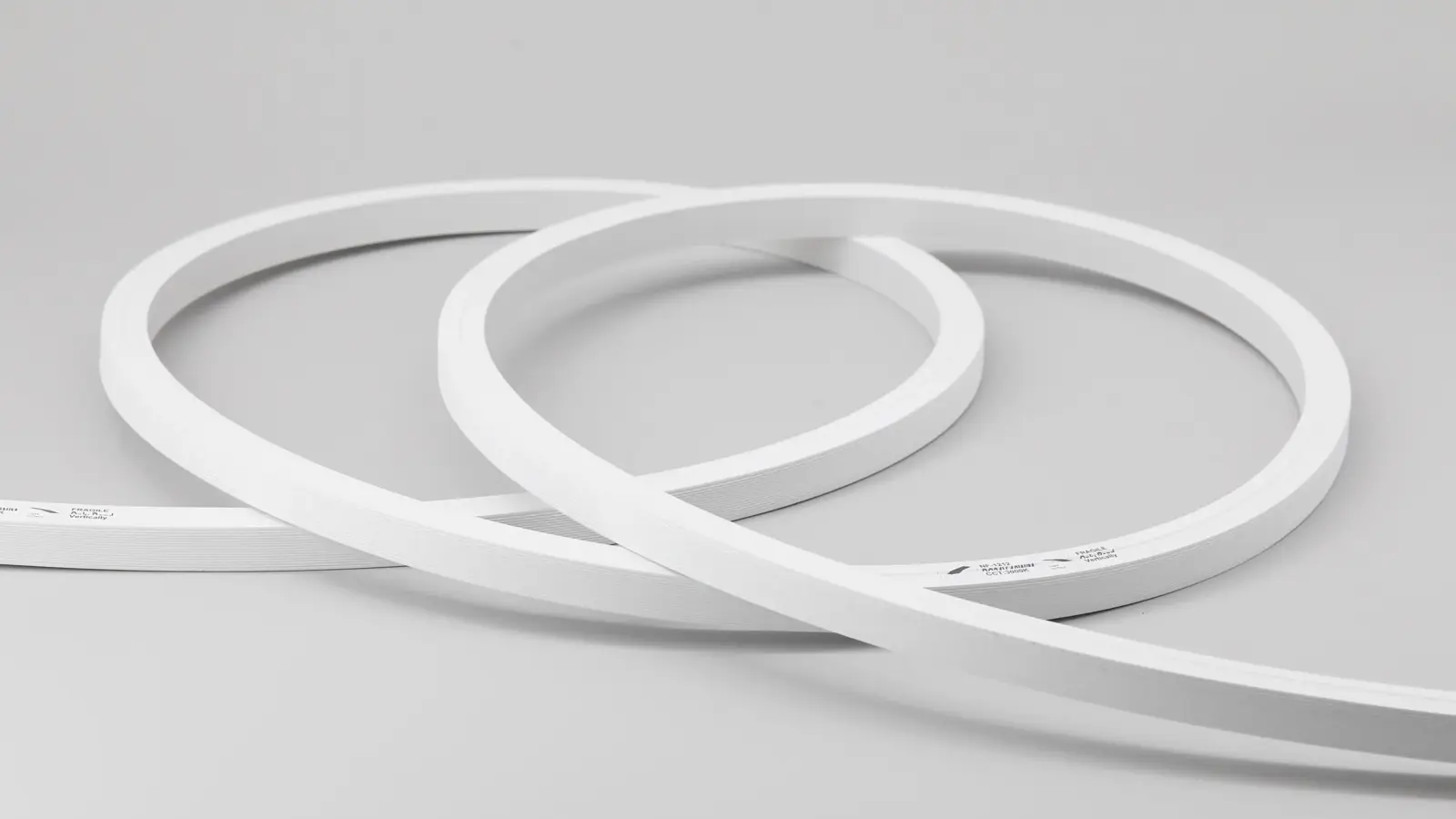
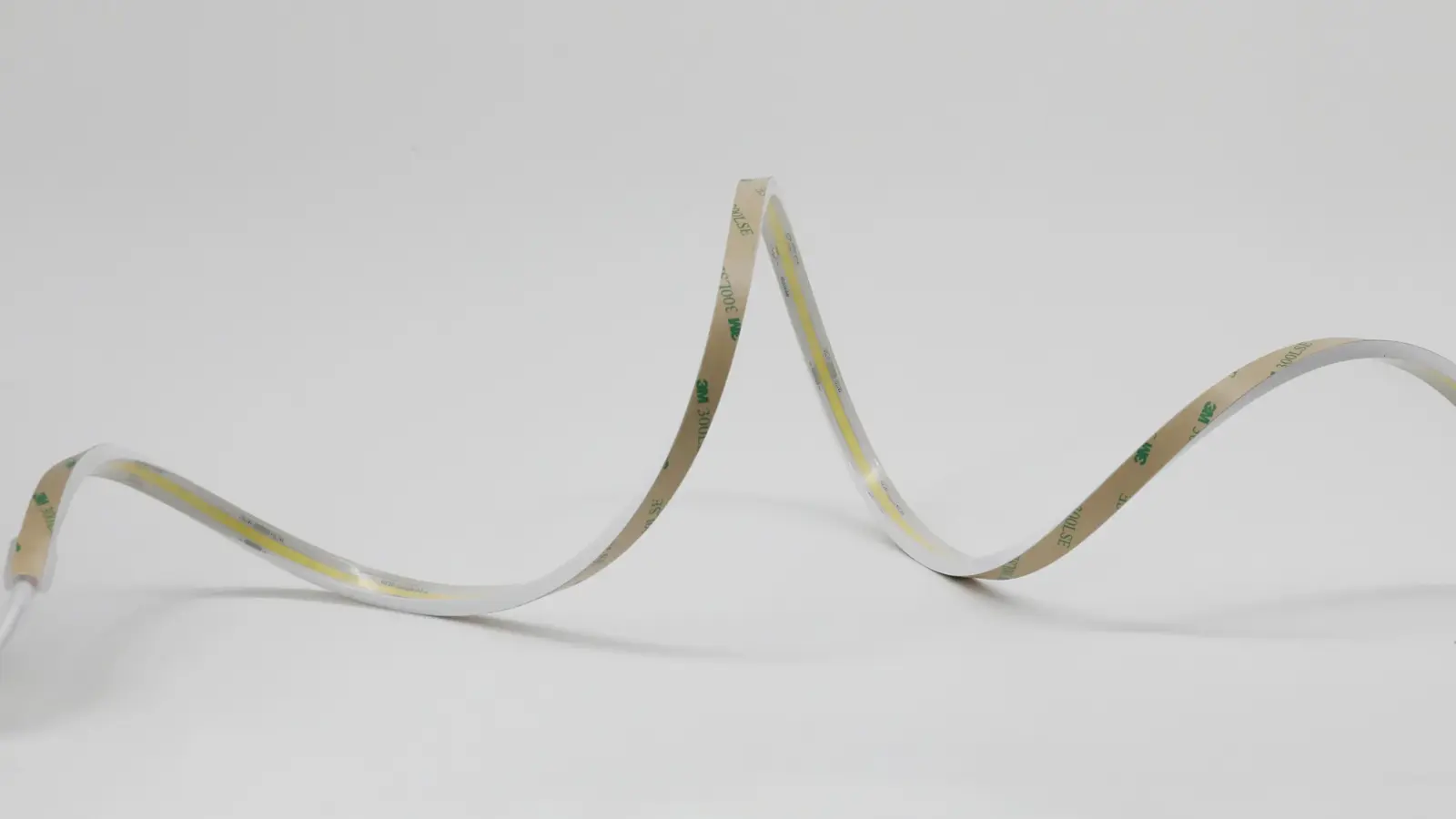
Our LED neon flex page describes the product as silicone-encased LED strip, with IP67 standard and an IP68 and IK10 option for lines within public reach. Our outdoor range builds three constructions: a silicone top coat at IP65 for splash, an extrusion sleeve at IP67 for temporary immersion and a full silicone tube at IP68 for continuous submersion.
We do not publish UV, salt-spray, chemical or operating-temperature figures for the neon profiles on the spec tables. If a job turns on one of them, ask for the datasheet range for the model, and ask for the test report if one exists. Our warranty policy treats temperatures outside the datasheet range as an exclusion, so the datasheet range is the number that governs. Put the environment on the order, because a written statement of where the line will live is what lets the supplier say yes or no before the install and not after the failure. We make no listing or approval claim in this article, and the wet location marking is confirmed per model at quote.
The Weak Points Are Not the Body
On a neon run, the body is rarely the first part to go. The weak points are the end caps, the connectors, the adhesive at the seals and the fixings. Sealants and adhesives can release fumes that darken or yellow the body from the inside, as our guide to strip turning black or yellow explains. Specify the end cap and the mounting hardware as carefully as the profile, and keep the profile away from fresh sealant until it cures.
Compare Two Samples Yourself
A field comparison is not a standard test, and it still tells you something. Order a short length of each candidate and run three checks on the real site.
- Sun: mount both on the real wall, facing the real sun, and photograph them at the same hour each month against a white card. Look for color change on the body.
- Chemicals: wipe offcuts with the cleaner the crew uses, in the strength they use, and compare them with an untouched piece after a few days.
- Cold: bend an offcut around the smallest radius on the drawing at the lowest installation temperature, not in the shop.
Keep the photographs with the submittal. A sample on a south wall for a season is more convincing to an owner than a data sheet, and it costs one length of neon.
Spec Wording
Put these on the schedule, so the answer comes back in writing:
- The material of the body, the end caps and the potting.
- The IP and IK ratings and the wet location marking, as the listing states them.
- The operating and minimum installation temperature.
- UV, salt and chemical results with the test method and the hours, or a statement that none exist.
- The fixing and clip material and finish for the site.
Final Checks
- The environment is named: sun, coast, cold or washdown.
- The material is not the only line on the schedule.
- The datasheet range is in the submittal, and the site stays inside it.
- Fixings and end caps are specified, not assumed.
- A sample has been checked on the real wall, if the job is long-lived or exposed.
Our neon flex range lists the profiles, IP ratings and cut and feed limits, and we can pair a profile with the site if you send the environment and the drawing with your quote request.