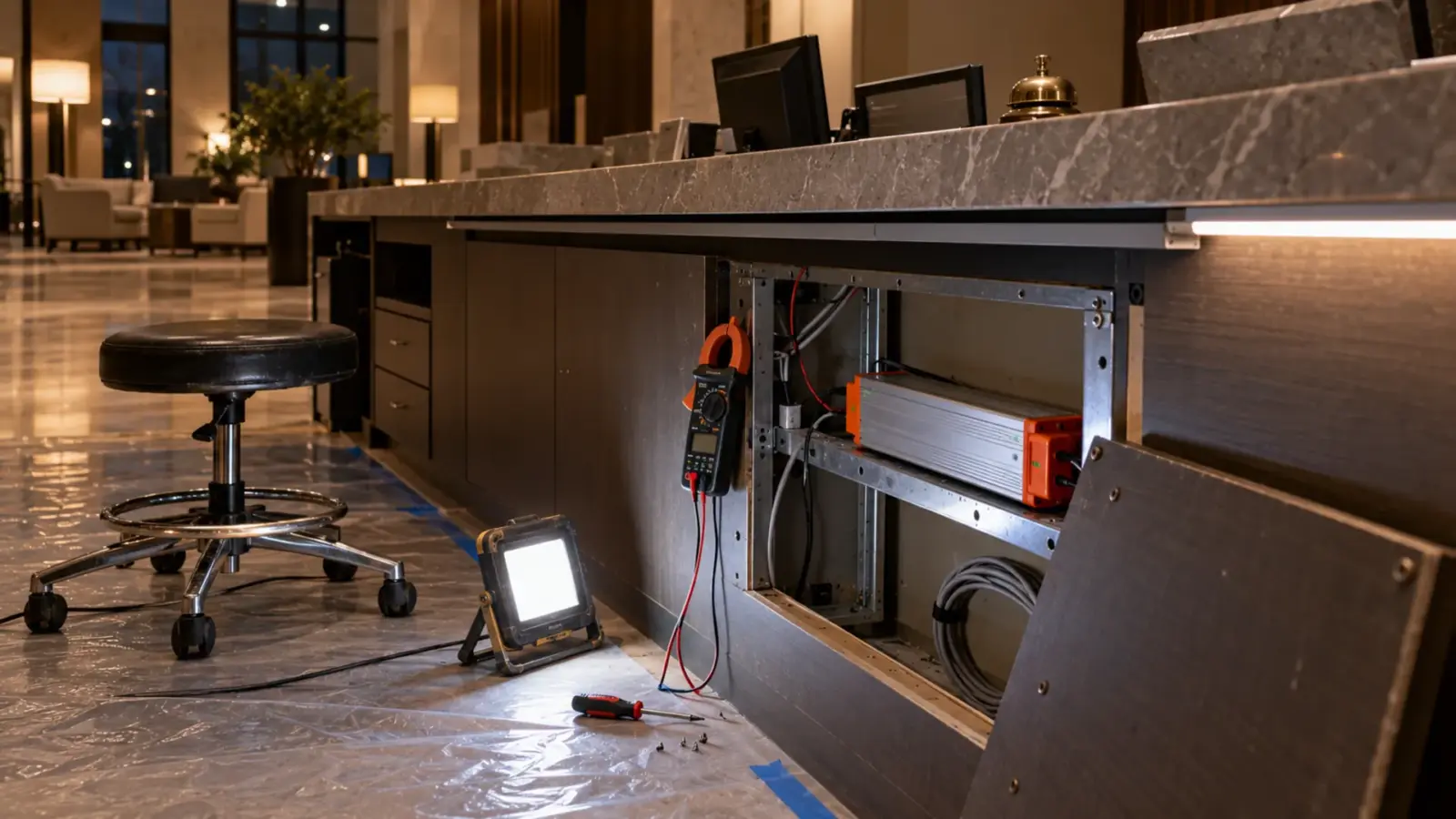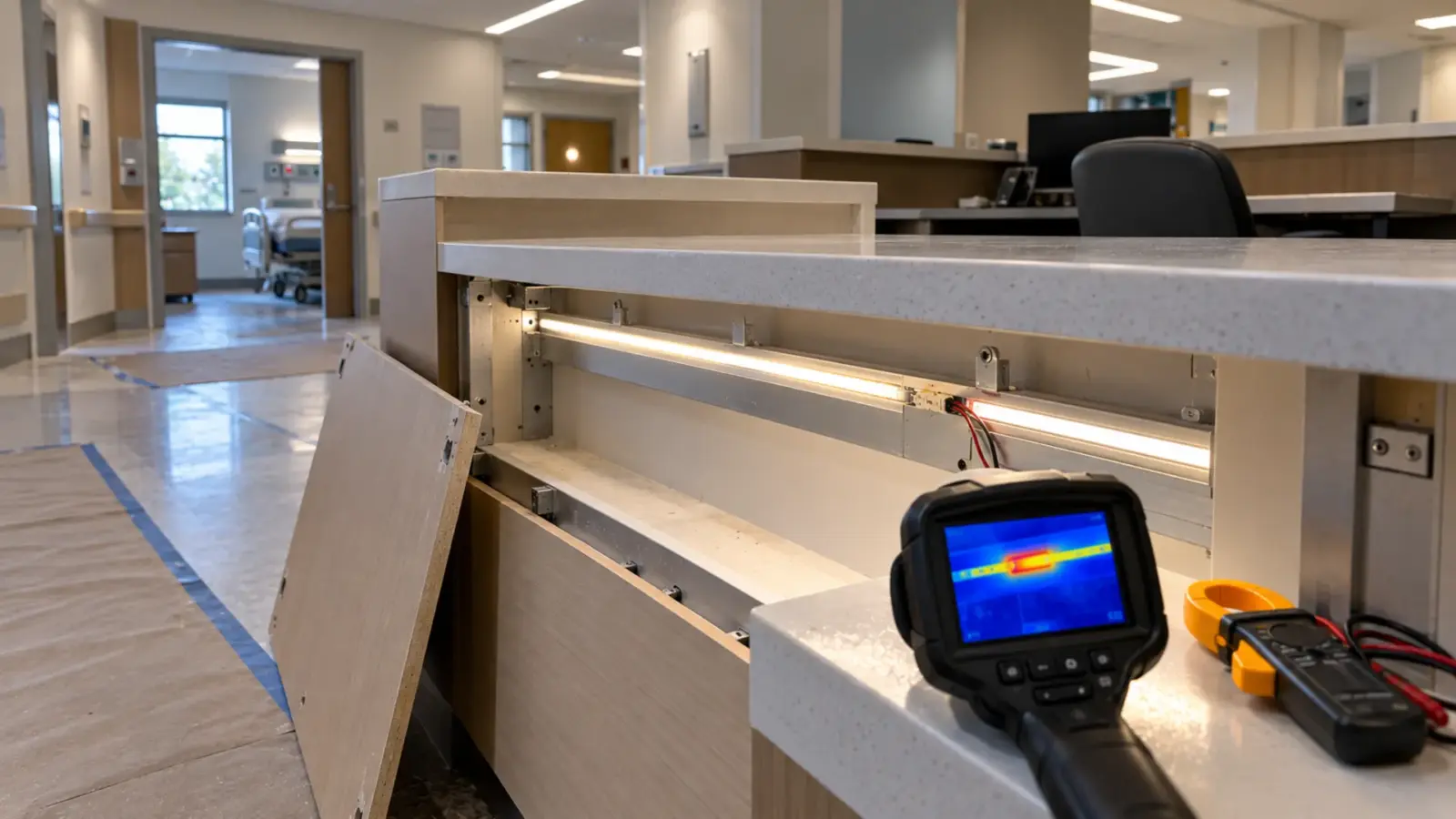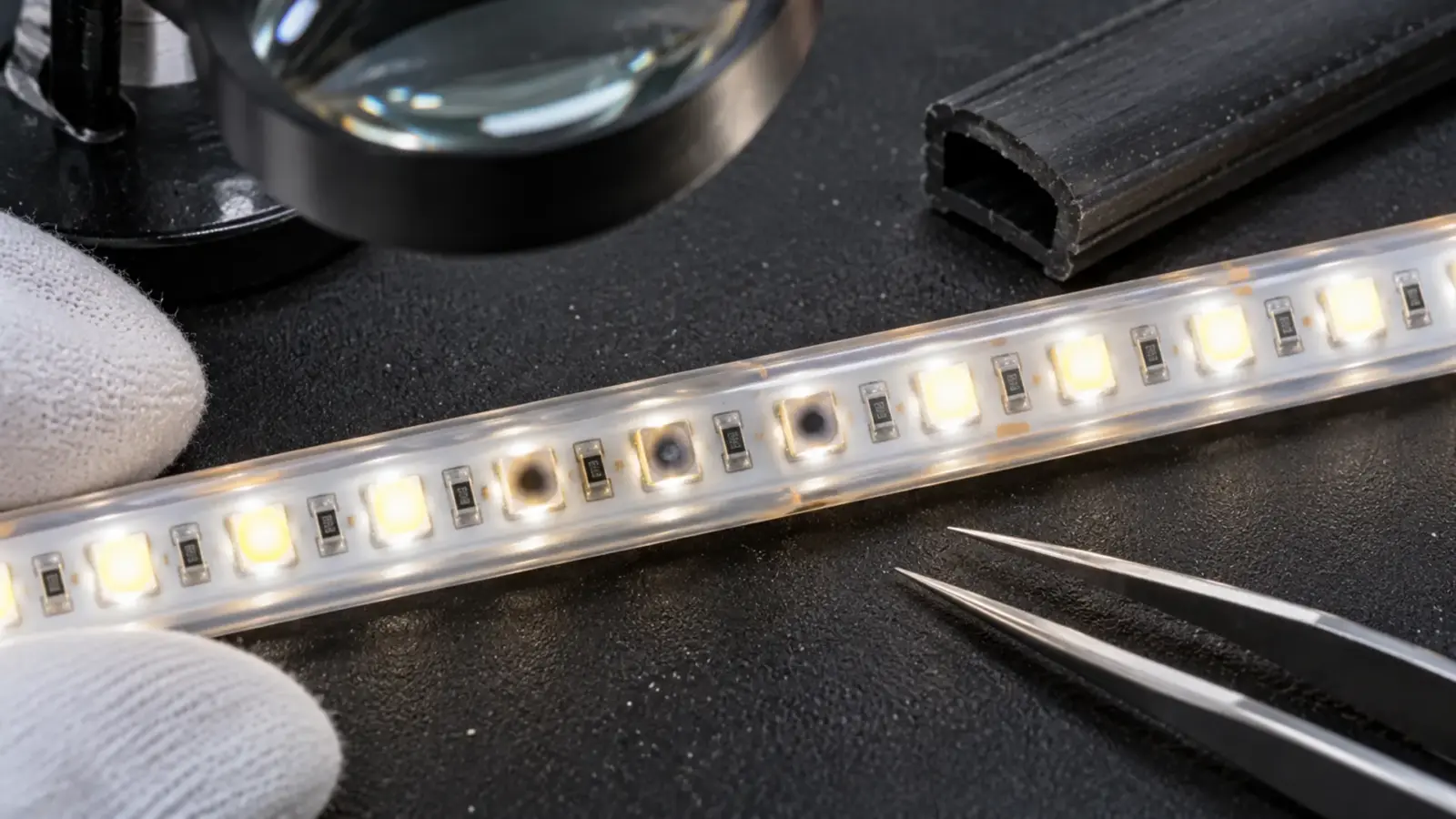
A blackened LED strip is rarely burnt out. Most often a gas reached the silver inside each LED and turned it into dark silver sulfide, or fumes from an adhesive or sealant discolored the LED surface. Too much current is the third cause. Where the color sits on the strip tells you which one you have.
That difference decides what happens next. Sulfide damage is permanent and comes back on the next reel if the source stays. Fume discoloration can reverse once the space is vented. Heat damage points at the installation, not the product. For faults that are not discoloration, see our LED strip troubleshooting order.
Where the Color Sits Tells You the Cause
Look at a darkened section under a magnifier or a phone macro lens with the strip lit and unlit. Compare it with an unaffected section of the same run.
| Where the color sits | Likely cause | Reversible? | What to check on site |
|---|---|---|---|
| Inside the LED, around the chip: gray to black | Sulfur reaching silver plating | No | Rubber gaskets, sealants, the air (wastewater, pools, some industrial spaces) |
| On the LED surface: brown or yellow film | Fumes from adhesives, sealants or coatings in a closed space | Often, after venting | Glue, foam tape, silicone sealant or potting near the strip, cover closed soon after |
| On the jacket or coating: yellow, cloudy | UV and heat aging of the encapsulant | No | Sun exposure, coating type, heat at the mounting surface |
| On the board around the LEDs: brown, scorched | Too much current or heat | No | Supply voltage at the strip, run length, mounting surface |
A pattern along the run helps too. Discoloration that is worst near a gasket, a cable gland or a sealed end cap points to a chemical source at that spot. Discoloration that is worst at the feed end and fades toward the far end points to voltage and heat, because the feed end sees the highest voltage.
Check one more thing before you decide: whether the whole batch is affected. Strip from one reel that darkened across several rooms points to the environment those rooms share or to the product. Strip from several reels that darkened only in one room points to something in that room.
Black Chips: Sulfur and Silver Sulfide
Most LED packages have silver-plated parts under the encapsulant that reflect light out of the package. According to Signlite, sulfur-bearing gas reaches that silver through gaps in the silicone or the package, forms silver sulfide, and the silver turns dark. Chlorine and bromine compounds can do similar damage. An IEEE conference paper on lead-frame LEDs lists sulfur-induced silver darkening as one of the main root causes of light loss, separate from fume damage.
The light output drops because the reflector is now dark, and the color of the light can shift. It does not recover.
Where does the sulfur come from on a job?
- Rubber seals and gaskets. According to SFS, as reported by Dataweek, common seal rubbers such as EPDM and NBR contain sulfur and can release hydrogen sulfide over time inside a luminaire.
- Some sealants, foams and cable jackets used near the strip, especially inside a closed channel or box.
- The air. Wastewater plants, some pool and spa equipment rooms, livestock buildings, rubber and paper industry spaces, and areas near certain geothermal or volcanic sources carry sulfur compounds.
Why does one reel darken in a space and another survive it? LED packages differ in how well they keep gas away from the silver. Patent filings describe two common defenses: a thin noble-metal coating over the silver plating, and silicone encapsulants formulated to slow gas from passing through. Packages built for harsh environments use these; general-purpose packages may not. A datasheet that names a sulfur resistance test is the only way to know before ordering, so ask for it when the space is known to be harsh.
Heat speeds the reaction, so a hot strip in a sulfur-bearing space darkens faster than a cool one.
Chlorine, Bromine and Cleaning Chemicals
Sulfur is the best-known gas, not the only one. According to Signlite, chlorine and bromine compounds react with the silver in a similar way and darken it. The IEEE paper on lead-frame LEDs lists halogen-induced yellowing as its own root cause.
On commercial jobs, halogens come from three places:
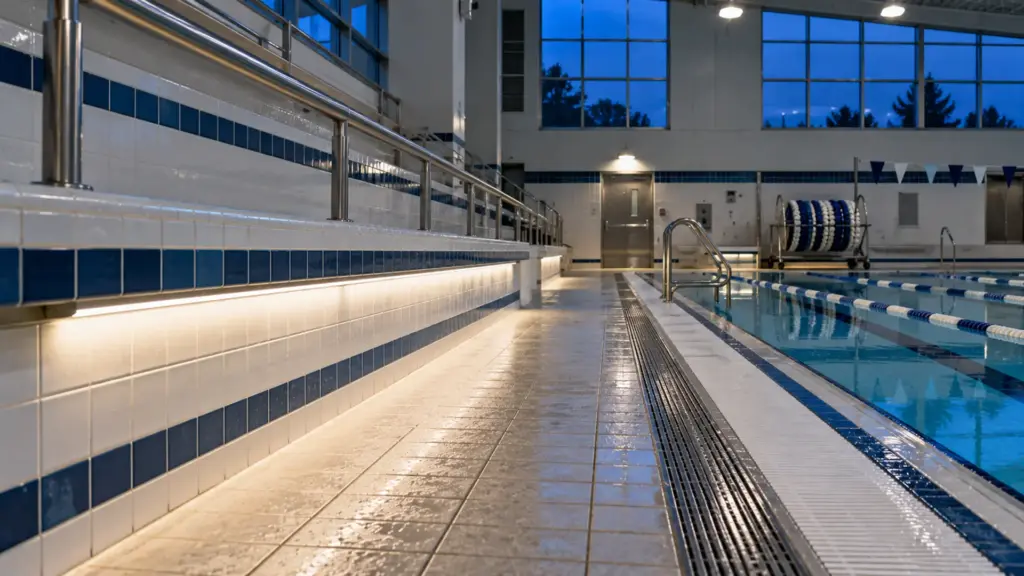
- Pools and spas. Chlorinated and brominated water releases gases into the room air, which is why indoor natatoriums and spa rooms are harsh even for strip that never touches the water.
- Cleaning programs. Strong cleaners and disinfectants used daily in kitchens, restrooms, clinics and food plants, especially sprays used close to a fixture.
- Some sealants and plastics that release halogen compounds as they cure or age.
Strip in these spaces should sit behind a sealed cover or inside a jacket with the gaps sealed at both ends, and the gasket and sealant materials near it should be checked as carefully as the strip.
Brown or Yellow Domes: Adhesive and Sealant Fumes
Volatile organic compounds (VOCs) from glues, foam tapes, conformal coatings, gaskets and potting compounds can collect on and in the LED surface and discolor it. According to Cree’s work on chemical compatibility, reported by LED Professional, the problem shows up mainly in sealed spaces, and it can appear within hours of exposure.
The same source reports the good news: when the closed space was vented, the LEDs in their example recovered nearly all of their lost light within about 24 hours. Fume discoloration is often reversible if it is caught early and the source is removed.
On a job, the typical cases are:
- A channel cover snapped on while a construction adhesive or sealant inside was still curing.
- A strip potted or sealed into a box with a compound that was never checked against LEDs.
- Foam tape or double-sided tape of unknown chemistry used to mount strip inside a closed profile.
Check by removing the cover and running the strip for a day with the space open. If the color improves, it was fumes. Then change the material, not the strip.
Yellow Jacket: UV, Heat and Encapsulant
A yellowed or cloudy jacket is a different problem from a darkened LED. The jacket or coating is aging. Sunlight, heat and the type of encapsulant decide how fast. According to Superlighting, PU (polyurethane) glue used to encapsulate some strip turns yellow with long use, and heat and UV speed the aging of the LED phosphor as well.
Our waterproof strip comes in three constructions: a silicone top coat for rain and splash (IP65), an extrusion sleeve for temporary immersion (IP67) and a full silicone tube for continuous submersion (IP68). For hot locations we offer a high-temperature silicone series rated to +221 °F (+105 °C). Matching the construction to the exposure, as our article on how LED strip is waterproofed explains, is the prevention. A yellowed jacket on a strip that was installed in direct sun with a coating not meant for it is an installation choice, not a defect.
Darkening From Too Much Current or Heat
Over-driving damages strip in a visible way: brown or scorched areas on the board, darkened LEDs near the feed, and faster color shift. The common causes on site are:
- Wrong supply voltage. A 12V strip on a 24V driver is the classic case. Read the output voltage before connecting a replacement reel.
- Strip on a surface that holds heat. Strip on wood, drywall or inside a closed profile with no aluminum contact runs hotter than strip on aluminum. Our guide to whether LED tape needs a channel covers heat and mounting.
- A space hotter than the strip’s rating. The datasheet gives the operating range. Strip above an oven, beside a steam line or in a sauna needs a rating for that environment.
Heat damage does not reverse, and most warranty policies exclude it. Ours excludes temperatures outside the datasheet range and moisture beyond the product’s IP rating.
Can a Darkened Strip Be Saved?
It depends on the cause, and the test is cheap:
- Fume discoloration: open the channel or box, remove the source if you can find it, and run the strip for a day or two with the space vented. If the light comes back, keep the strip and change the material that caused it.
- Sulfur or halogen darkening: the silver has changed chemically. The affected sections will not recover. Replace them at the marked cut points and remove the source before the new strip goes in, or it will darken the same way.
- Heat or over-driving: the LEDs and often the board are damaged. Replace the section and fix the cause first: the supply voltage, the mounting surface or the run length.
Before replacing anything that is still under warranty, photograph it and contact the supplier. Removed sections are the evidence a claim needs, so keep them bagged and labeled with their location.
What to Check Before the Next Install
Discoloration on one job usually repeats on the next unless the source is found. Before reinstalling:
- Photograph the damage under magnification, lit and unlit, and note where it sits on the run.
- List every material inside the channel or box: adhesives, tapes, sealants, gaskets, potting, cable jackets.
- Ask what the space contains: pools, wastewater, industrial processes, or a recent sealant or paint application.
- Read the voltage at the strip and check the run length against the rated run per feed.
- Let adhesives and sealants cure with the cover off before closing a channel, and choose gasket materials that are specified as low-sulfur or sulfur-free for LED use.
- Vent closed profiles where the detail allows it.
If the strip has to live in a wet or harsh space, choose the construction for it rather than the indoor strip. Our outdoor and waterproof LED strip page lists each construction with its IP rating and temperature range.