Swap the AFCI for a standard breaker and the trip stops, but a bedroom circuit that NEC 210.12 lists is no longer protected and the cause is still there. The breaker makers’ guides check wiring and the breaker first; forum threads add the drivers’ own noise or leakage as a suspect.
Read the breaker’s code, lift the loads, rule out neutrals, swap a driver, and change the breaker last.
Where AFCI Applies to a Strip Job
Start by checking the room. St. Paul’s inspection department summarizes the 2023 NEC this way: 210.12(B) requires AFCI protection for branch circuits supplying newly installed 120-volt, 15- and 20-amp outlets or devices in kitchens, laundry areas, family rooms, dining rooms, living rooms, parlors, libraries, dens, bedrooms, sunrooms, recreation rooms, closets, hallways, or similar rooms or areas of a dwelling. Its examples of covered “outlets” include luminaires. A hardwired driver powers a luminaire, so a circuit feeding drivers is within the rule in the usual reading; confirm it with the AHJ.
Three details change what a strip job sees:
| Occupancy | 2023 subdivision | Covered areas | Bathrooms |
|---|---|---|---|
| Dwelling units (apartments) | 210.12(B) | The list above | Not on the list; Mike Holt’s commentary says AFCI is “not required for outlets in bathroom areas” |
| Dormitory units (student housing) | 210.12(C) | Bedrooms, living rooms, hallways, closets, bathrooms | Covered, per St. Paul |
| Guest rooms and suites of hotels and motels | 210.12(D) | Branch circuits supplying outlets or devices, per St. Paul | Not itemized in the sources we read; check the adopted text |
Under 210.12(E), as Mike Holt’s 2023 reprint puts it, 15 A or 20 A, 120 V branch-circuit wiring that is extended, modified or replaced in those areas must be AFCI protected, with an exception for extensions under 6 ft that add no outlets or devices other than splices. A new hardwired driver on an old circuit is that kind of change. Whether student housing counts as a dormitory unit, a dwelling or something else is the AHJ’s call; we did not read the Article 100 definitions. Our multifamily and student housing guide covers the unit details these circuits feed.
Read the Breaker First
Before opening a box, read what the breaker says. Square D’s 2023 Homeline AF and AFGF breakers carry a diagnostics LED that, on power-up, indicates the cause of the previous trip. Its flyer maps the codes: solid for 10 seconds means an arc fault, 2 pulses a ground fault, 4 pulses a grounded neutral, 7 pulses that arc-fault protection is unresponsive, and no light a thermal overload or short circuit. Pressing TEST repeats the stored pattern. Where the breaker has no indicator, Siemens’ older leaflet gives a field test for ground faults: substitute a GFCI breaker for the AFCI, and if it trips, the circuit has a ground fault, commonly a grounded neutral.
| What the breaker does | Check first | Source |
|---|---|---|
| Trips when the drivers go live, all loads | Grounded neutral, then shared neutral | Eaton guide |
| Trips with every load off | Lift the load wires at the breaker: still trips means the breaker or the supply voltage, holds means the circuit wiring | Eaton, Siemens |
| Trips after a fixed time | Overload: add up the loads | Eaton guide |
| Code says grounded neutral | Neutral touching ground: meter the load neutral to the panel’s neutral bar | Square D flyer; Eaton |
| Code says ground fault | Neutral touching ground, or leakage across many fixtures (a forum hypothesis) | Square D flyer; Siemens; forum thread |
| Code says arc fault | Loose connection, pinched cable, then the loads one at a time | Square D flyer; Siemens |
Trim-out is when this tends to show up: drivers are often the first loads on circuits that were only tested empty. That is a field pattern, not a measured one.
A forum case shows why the code matters. A poster who built the house and works in the industry had a combination breaker tripping on about 50 LED fixtures and four fans; a known-good AFCI gave the same result, a standard breaker held, and the breaker’s own diagnostic said ground fault. Another poster suspected an RFI filter in the fixtures leaking enough current to trip the ground-fault function. That is a hypothesis, and the thread ended without a confirmed cause, with posters blaming the fixtures’ internals, but a ground-fault code at least tells you what kind of fault to look for.
Wiring Before the Driver
Wiring comes first in Eaton’s every-load-trips flow and in the Siemens table. Eaton’s guide tells the technician to check for grounded neutrals and for shared neutrals, such as two circuits in one switchbox with all the neutrals tied together. The Siemens table says the same: check that there are no shared neutral connections. One electrician put the odds in a forum thread at “90% of the time” a neutral-to-ground bond or co-mingled neutrals, which is a field estimate and not data.
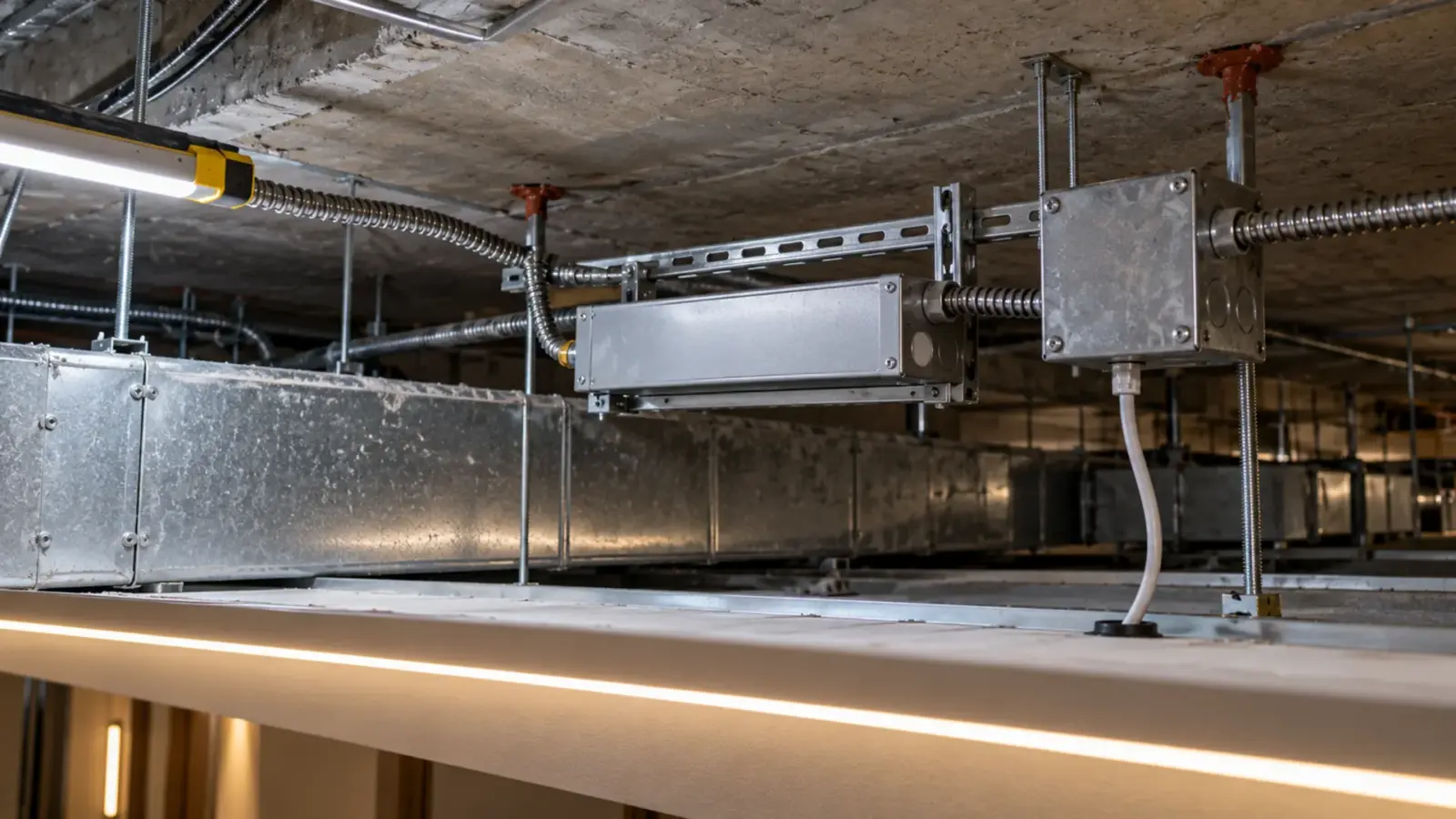
A strip job can be a place for that fault. A hotel guest room or apartment bedroom often has multi-gang boxes with dimmers and switch legs, and the strip driver adds another switched leg; that is field practice, not something the guides state. If a neutral is shared, the drivers did not create it. They may be the first load that makes it trip. Check, with the circuit de-energized:
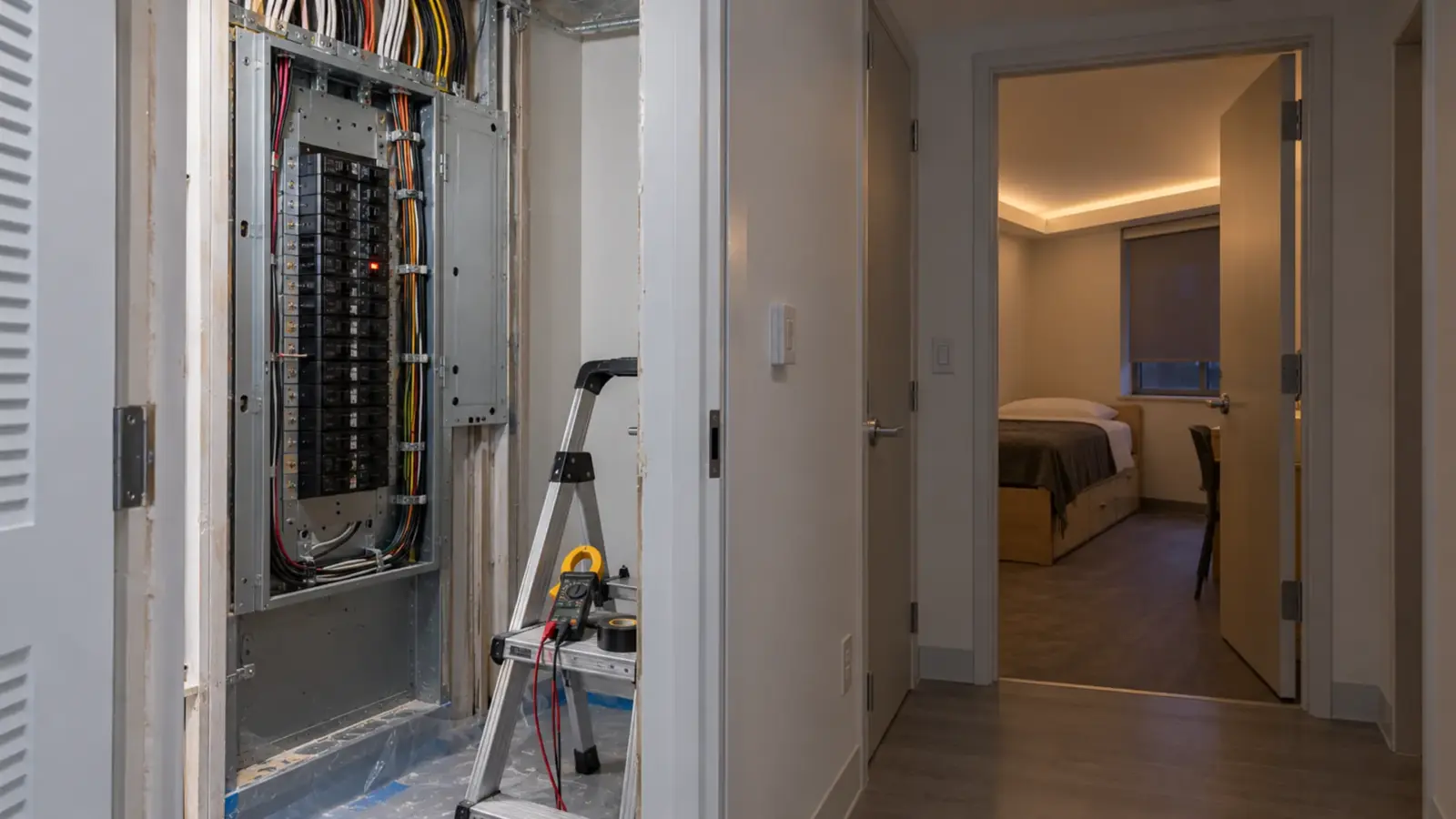
- With the load hot and load neutral lifted at the breaker, meter the load neutral to the panel’s neutral bar, as Eaton’s guide does; continuity means the neutral touches ground somewhere on the circuit.
- Every neutral in each multi-gang box is paired with its own circuit’s hot, which extends Eaton’s shared-neutral check from the breaker to the boxes.
- No cable pierced by a screw or stapled too tight; Siemens lists both among the causes of arc faults.
Eaton’s flow also says to document the make, model and serial number of any load that trips the breaker.
When the Driver Is the Cause
Once the wiring is clean, the load is next. The Siemens leaflet says connected loads such as fluorescent lighting, motors, dimmers and switches “may have inherent arcing as a normal mode of operation,” and says its AFCI is designed to tell them from hazardous arcing. That text was printed in 2003 and names fluorescent lighting, motors and dimmers, not LED drivers, so it tells us what to suspect, not what is proven. Forum threads are split. In one, non-name-brand slim wafer lights and their transformers tripped a combination AFCI about half the time, a swapped breaker changed nothing and the lights ran on a standard breaker, but the poster then found a neutral fault. In another, posters blamed the fixtures’ internals.
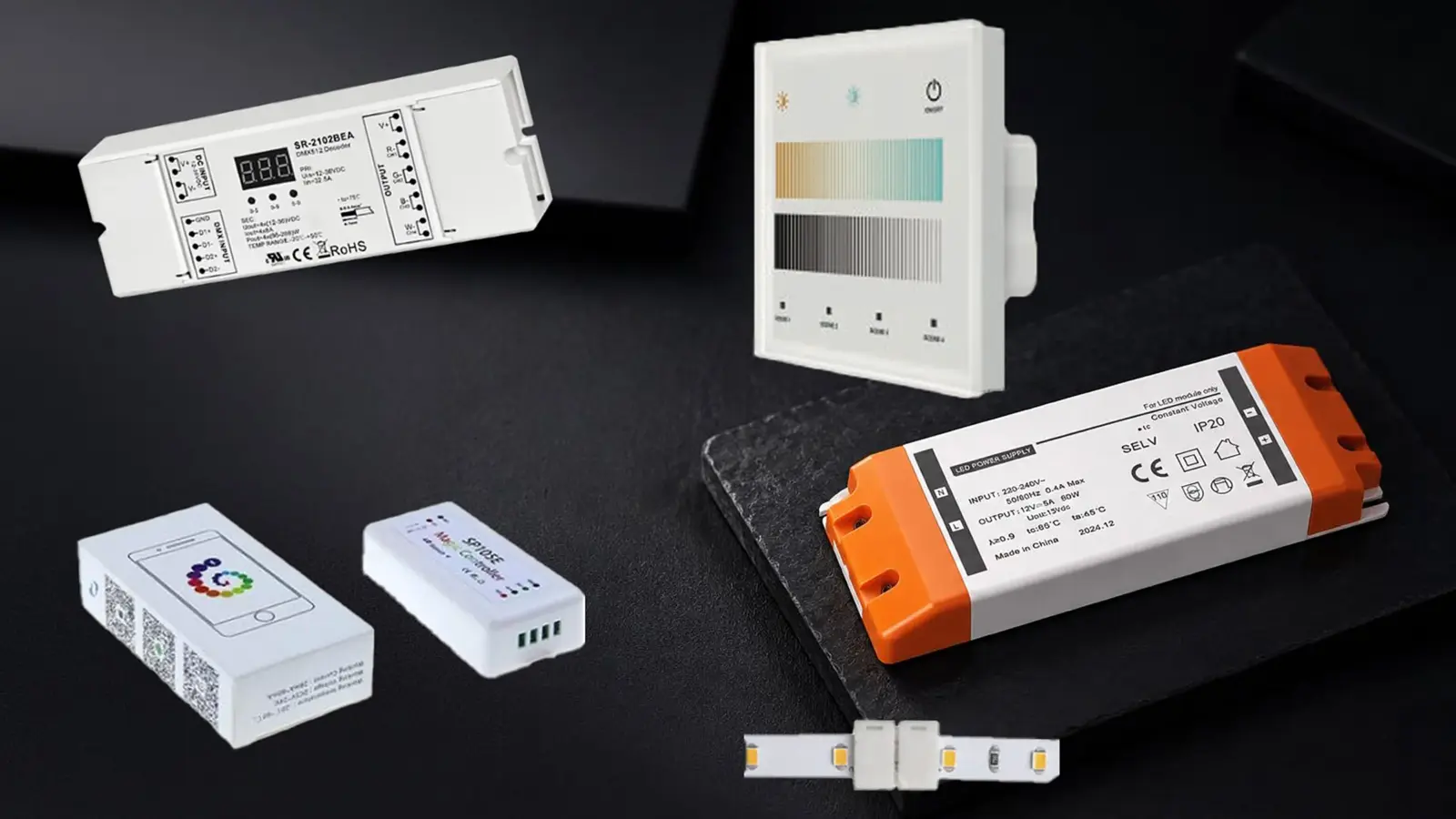
No source we found tests strip drivers against AFCI breakers, and our drivers page makes no AFCI statement for any model, so ask for one in writing. What we can say is what each of our driver types puts on the AFCI’s line side:
| Driver on our page | On the protected circuit (load side of the breaker) | Control |
|---|---|---|
| UT-D60-24-C2, Class 2 CV, 100–277 V, 60 W | The driver | None (non-dim) |
| UT-D60-24-C2-010, 120–277 V, 0-10V | The driver | A 0-10V control pair; a wall panel such as UT-CTP-010 takes 100–277 VAC |
| UT-D60-24-TRC, 120 V, TRIAC | The driver and a phase-cut dimmer | None; the dimmer is on the protected circuit |
| UT-CRF-24G with a non-dim driver | The non-dim driver | 2.4G RF controller |
Phase-cut dimming puts a dimmer on the protected circuit, and Siemens lists dimmers among loads that can arc in normal operation. A 0-10V signal pair and a DC-side RF controller do not sit there, though a mains-powered 0-10V wall panel does. If a TRIAC circuit trips and a 0-10V one does not, that is a clue, not a rule. Our Lutron dimmer guide covers matching phase-cut dimmers to drivers.
Count what is on the circuit before blaming noise. At full rating, one 60 W UT-D60-24-C2 at about 85% typical efficiency draws roughly 70 W from the line, or about 0.6 A at 120 V. Twelve of them on a 15 A circuit draw about 7 A at a power factor near 1, so a trip with the circuit that lightly loaded does not look like an overload. Our page gives no power factor, and at 0.6 the same twelve draw closer to 12 A, so read the datasheet first. If the load is truly light, test neutrals and leakage; do not buy a bigger breaker.
A swap narrows it. Put a known-good driver, ideally a different model, on the same circuit; if the trip follows the driver, suspect the driver, and if it stays, suspect the circuit. A second driver of the same type may behave the same way, which is why the model should differ. One forum poster also suggested an incandescent lamp on the circuit to see whether damping stops the trip, which is a diagnostic only. Inrush and breaker count can look the same from the panel; our inrush guide covers that fault.
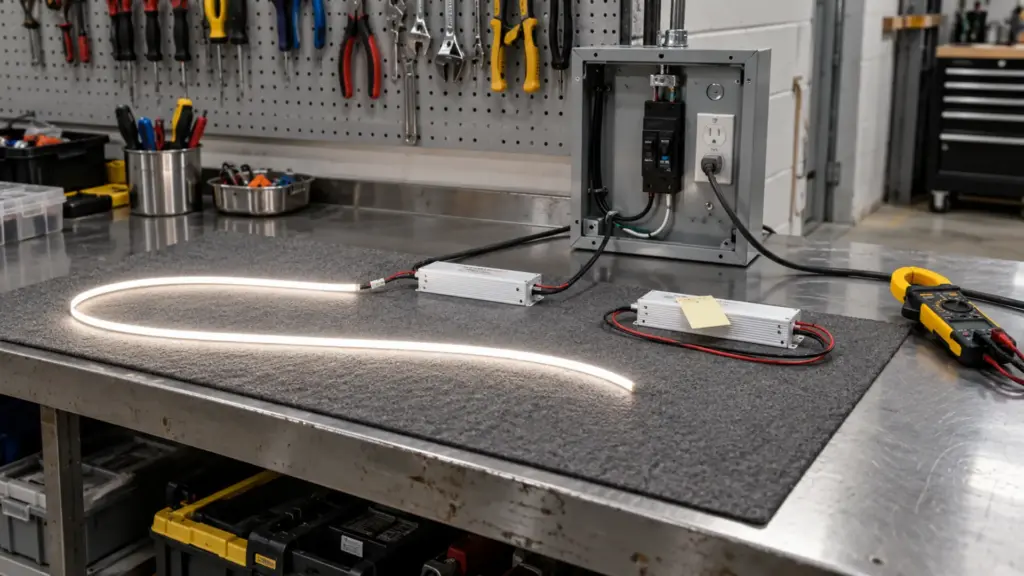
- 1Read the trip codestep 1Ground fault or grounded neutral: test neutrals, multi-gang boxes first. Arc fault: check connections and pinched cable. Unclear: disconnect all loads and retry
- 2Holds with loads off?step 2Yes: add loads one at a time, drivers last. No: the fault is in the wiring
- 3Follows one unit?step 3Yes: swap it and ask the maker for an AFCI statement. No: count drivers per circuit and split
- 4Replace the breakerlastA current-generation unit, only after the steps above
What to Do Before Swapping the Breaker
Work down this order, cheapest and least invasive first:
- Read the breaker’s trip code, or run the GFCI substitution test if it has none.
- Lift the load wires at the breaker and reset it. If it still trips, the breaker or the supply voltage is suspect, as Eaton’s flow checks; if it holds, reconnect the circuit and look at its wiring and loads.
- Test for shared and grounded neutrals in every box on the circuit, multi-gang boxes first.
- Add the loads back one at a time, drivers last, and note which one trips it.
- Swap that driver, or the dimmer, for a known-good unit; ask the maker for an AFCI statement.
- Split the drivers across circuits if the count is high; our driver troubleshooting guide covers failure signs.
- Only then replace the breaker, with a current-generation unit; Square D describes its newer breakers’ detection as designed “to reduce tripping,” which is a maker’s claim, so use the maker’s technical line.
A standard breaker belongs in step 2 as a test, if at all. In the rooms 210.12 lists it is not the fix, and St. Paul’s checklist applies the rule to newly installed, extended and modified circuits. Put the AFCI back before the next trade arrives, and write the trip code and results on the punch list.
What to Tell the Supplier
When the trip follows a driver, send the supplier what you wrote down: the breaker’s make, model and trip code, the number of drivers on the circuit, the driver models, and the dimmer or controller model if there is one. Ask in writing whether the maker has an AFCI compatibility statement for that driver, what its leakage is, and whether another model suits the same strip. Our drivers page lists none of these today, and we pass the question to the manufacturing partner rather than guess.
Checks Before the Breaker Comes Out
- The room and the adopted edition: does 210.12 cover this circuit, and which subdivision?
- The breaker’s trip code, written down before it is reset.
- Neutral continuity and sharing in every multi-gang box on the circuit.
- The load that trips it, by number, with its make and model.
- A driver or dimmer swap, and the manufacturer’s AFCI statement in writing.
The Class 2 and 0-10V drivers named above are on our drivers, controllers and connectors page, and our LED strip troubleshooting guide starts at the driver terminals.