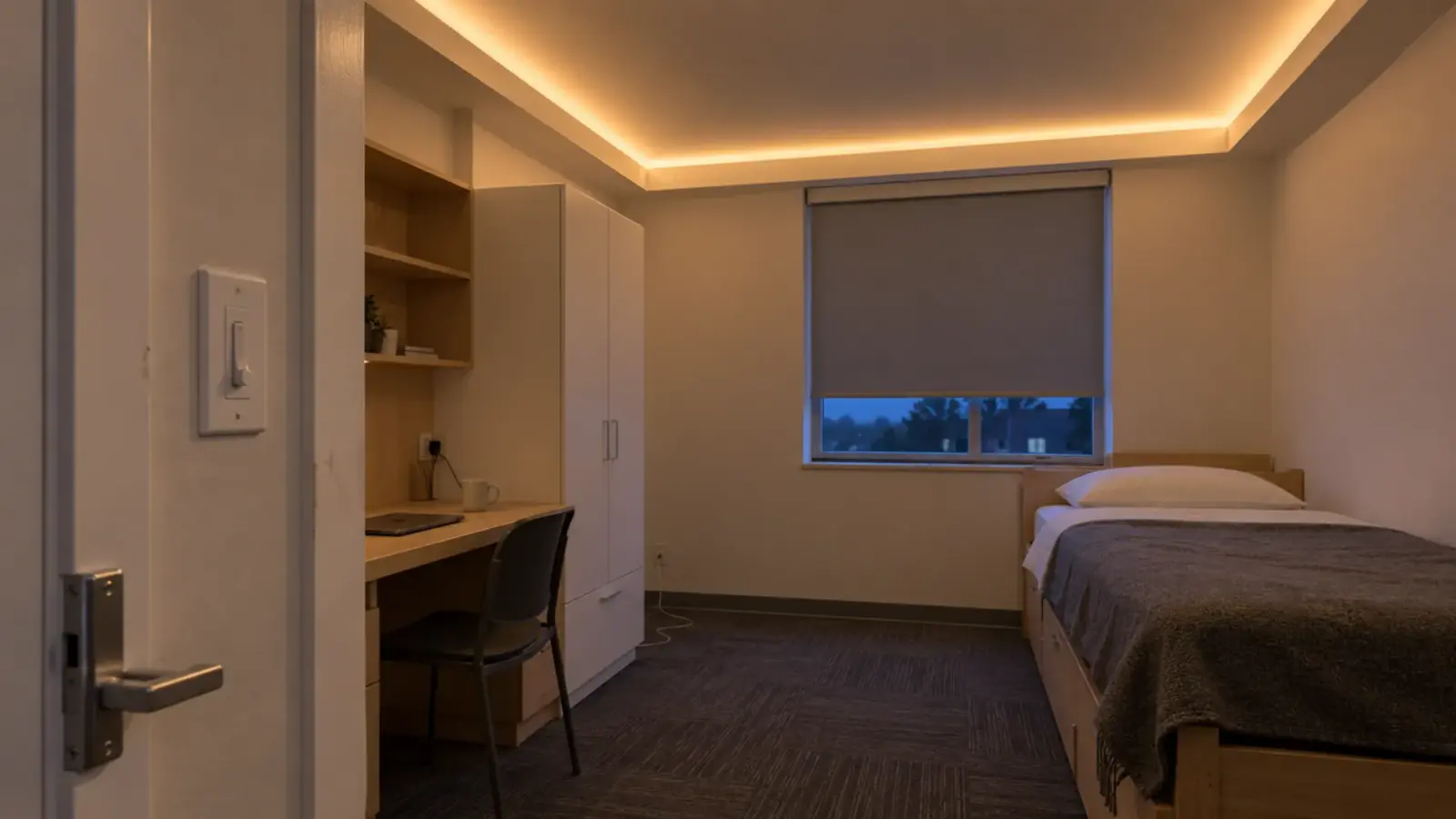
A student-housing bedroom has a cove of LED strip all around the ceiling and no ceiling fixture, and at rough-in an inspector may ask which box is the lighting outlet. We found no NEC text or published interpretation saying a strip counts as one, so the answer comes from the AHJ and from where the switched feed lands.
What 210.70 Asks For
Section 210.70(A) covers dwelling units, and 210.70(B) covers guest rooms and suites in hotels, motels and similar occupancies. Whether a dormitory room or senior-living apartment falls under (A), (B) or neither is the AHJ’s call. The 2023 text of 210.70(A)(1), as Leviton’s code guide reprints it with NFPA’s permission, reads: “At least one lighting outlet controlled by a listed wall-mounted control device shall be installed in every habitable room, kitchen, laundry area, and bathroom.” The next sentence adds: “The wall-mounted control device shall be located near an entrance to the room on a wall.”
Two exceptions follow. Exception No. 1 lets a receptacle controlled by a listed wall-mounted control device stand in for the lighting outlet, but only in rooms other than kitchens, laundry areas and bathrooms. Exception No. 2 lets occupancy sensors control the lighting outlet if they are in addition to listed wall-mounted control devices, or sit at a customary switch location with a manual override that lets the sensor act as a wall switch.
The 210.70 opening also carries a battery rule, and it changed after the 2023 book printed. NFPA’s Tentative Interim Amendment 23-15, effective December 20, 2023, replaced the first wording with this: “The switch or listed wall-mounted control device shall not rely exclusively on a battery power unless it incorporates a positive means of notification of impending battery depletion.” Leviton’s reprint still shows the older wording, which required the lighting to energize automatically on battery failure. A 2026 edition has been published; we did not read its 210.70 text, so check the edition the jurisdiction has adopted. Our NEC guide covers finding it.
Older editions word the rule differently. St. Paul’s rough-in checklist for the 2020 NEC says a listed wall-mounted control device must control lighting outlets in every habitable room, kitchen and bathroom, near the entrance, with a controlled receptacle allowed in other rooms. Mike Holt’s 2017 summary for EC&M still says “wall switch-controlled lighting outlet.” For hotels, a vendor’s reprint of the 2023 text reads that guest rooms “shall have at least one lighting outlet controlled by a listed wall-mounted control device installed in every habitable room and bathroom,” with a controlled receptacle allowed in other than bathrooms and kitchens.
Is a Strip a Lighting Outlet?
A 2005-edition quotation on a Mike Holt forum thread defines a lighting outlet as an outlet intended for the direct connection of a lampholder, a luminaire, or a pendant cord terminating in a lampholder, and EC&M’s 2017 summary points readers to the definition in Article 100. Nothing in 210.70(A)(1) or (B) says a luminaire must hang on that outlet, and one forum poster reports what that gap cost. In a 2006 Mike Holt forum thread, a contractor failed a final inspection on a new house because a bedroom ceiling fan on the switched outlet had no light kit. The first reply called it “an AHJ interpretation thing.”
A strip changes the picture because the light is not at the outlet: a 24V strip is fed by a driver, often in a closet or ceiling space. The strip itself falls inside the voltage limits of Article 411, which the 2023 text sets at 30 volts ac or 60 volts dc. Our Class 2 driver guide covers what an inspector checks on that supply.
So which point is the outlet: the box feeding the driver, or the strip itself? No source we found answers that for a strip system, and we would not state it as settled. What follows is our reading, for the AHJ to confirm. The line-voltage box that feeds the driver, switched from the wall and sitting in or beside the room, is the point an inspector may look to as the “outlet,” and the strip is the luminaire it feeds. A remote driver puts the definition’s “direct connection” in doubt.
The fan story is the nearest case we found, and a strip is the same question in a new form. The useful move is a driver connected to that switched box and shown on the plan, not a feed that ends in a blank cover.
- 1Listed controlnear the doorDimmer, switch or panel on the wall
- 2Switched feedline voltageRuns to a box in or beside the room
- 3The outlet pointour reading, AHJ confirmsThe box the inspector reads as the lighting outlet
- 4Driverreachable, labeledServiceable without opening the finish
- 5Strip in channelthe luminaireLights the room
Three Ways to Pass Rough-In
For a room whose only light is a cove or a mirror strip, there are three layouts. Which one the inspector accepts depends on the AHJ; ask at the rough-in meeting.
| Layout | What the inspector asks | Fix |
|---|---|---|
| Cove only, no ceiling fixture (bedroom, living room) | Which box is the lighting outlet, and what switches it | Switched line-voltage feed to the box that supplies the strip’s driver, driver reachable, labeled on the plan |
| Mirror or vanity strip only (guest bath, unit bath) | Is there a lighting outlet controlled by the wall control; the receptacle exception does not cover bathrooms | Switched feed to the vanity strip’s driver box, or an ordinary switched luminaire in the bath |
| Under-cabinet strip only (kitchen) | Same, and the receptacle exception does not cover kitchens | A switched lighting outlet for the room’s general light, with the under-cabinet strip as task light |
Exception No. 1 gets misused in exactly these rooms. A switched receptacle for a floor lamp can replace the lighting outlet in a bedroom or living room, and it does nothing for the strip. In a kitchen, laundry area or bathroom, the exception is off the table: those rooms need a lighting outlet, and a strip whose driver feed is not recognized as one leaves the room without any.
Three plans are open to the contractor. The first is an ordinary switched luminaire for the room’s general light, with the strip as the decorative layer. The second is to get the AHJ to accept the switched driver feed as the lighting outlet, in writing or in the plan review notes. The third, for habitable rooms other than kitchens, laundry areas and bathrooms, is a switched receptacle under Exception No. 1 plus the strip.
The Control: Listed, On the Wall, Near the Door
In (A)(1), the 2023 text asks for a “listed wall-mounted control device” near an entrance to the room; the reprint of (B) we read has no “near an entrance” sentence. A 2025 Mike Holt forum thread on the 2020 wording shows the open edges: one electrician points out that the section “avoids the word ‘switch'” and does not define “wall-mounted control device,” and asks what would prohibit a listed battery remote screwed to the wall; a moderator reads “near an entrance” as one switch even in a room with two doors. Until an AHJ rules, the safe reading is a listed dimmer, switch or panel on the wall at the door. Here are the controls our drivers page lists, with where each sits in the chain; whether a given controller is a listed wall-mounted control device is confirmed at quote.
| Control | Where it lives | What reaches the wall |
|---|---|---|
| Line-side switch | Switch leg to a non-dim driver such as UT-D60-24-C2 | A wall switch cutting power to the driver |
| TRIAC | UT-D60-24-TRC, or UT-CTRC-240 (120 VAC, 240 W) | A phase dimmer |
| 0-10V | UT-D60-24-C2-010, with the UT-CTP-010 wall panel | A wall panel plus a control pair; the driver stays powered |
| 2.4G RF | UT-CRF-24G, 4 zones | A wireless wall panel, battery powered |
The last row is where the battery rule bites. Our guide to wiring strip to a wall switch describes the RF wall panel as a battery panel, with a switch leg, if there is one, that only cuts power to the driver. If that panel is the only control, the amended text asks for a positive means of notification of impending battery depletion. Whether the UT-CRF-24G panel gives one, and what the strip does when the battery dies, are datasheet questions; ask for both with the quote, and keep a hardwired switch on the driver’s feed where the answer is no.
On the 0-10V row the driver stays powered while the panel sets the level; our guide to occupancy sensors and drivers covers what that means for “off,” and Exception No. 2 is where sensors may share the job.
Hotels, Apartments and Dorms
In a student-housing or apartment bedroom, a perimeter cove can be the whole design, and the lighting outlet is the line the inspector may ask about. Our multifamily guide covers the repeatable unit details.
In a hotel guest room, 210.70(B) puts the same question to every habitable room and bathroom. A 2012 Mike Holt forum thread, written under the 2008 NEC, asks whether a bank of switches at the entry can serve every room; a moderator replied that the NEC does not say where the switch goes, so grouping is code compliant, though the contractor may have an issue with the inspector, and another poster advised asking the AHJ. Our guest room guide covers the room details.
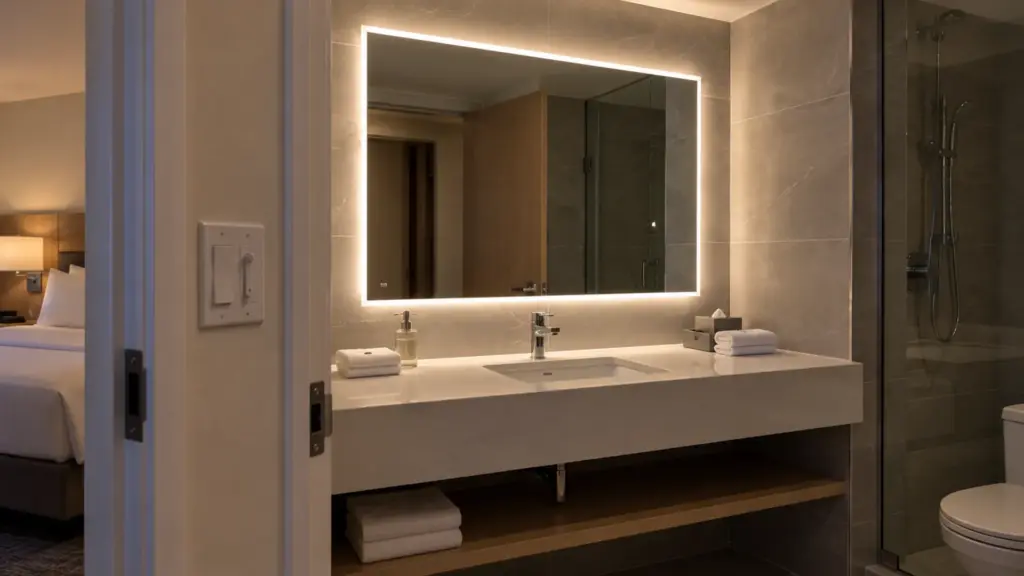
Bathrooms are the third case. A backlit mirror strip is the room’s glow, and in both (A)(1) and (B) the bathroom is a room where a controlled receptacle cannot stand in. The vanity strip’s driver feed has to be switched at the wall, and if the AHJ will not take it as the lighting outlet, the bath needs an ordinary switched luminaire too. Our backlit mirror guide covers moisture and driver location.
FAQ
Does LED strip count as a lighting outlet?
The NEC’s older Article 100 wording defines a lighting outlet as an outlet intended for direct connection of a lampholder or luminaire, and nothing we found says whether a strip system on a remote driver counts. Feed the driver from a switched box, show it on the plan, and ask the AHJ to accept it.
Does a bedroom need a ceiling light fixture?
Section 210.70(A)(1) asks for a lighting outlet controlled by a listed wall-mounted control device in every habitable room of a dwelling unit. The text does not name a luminaire, though one forum thread shows an inspector who wanted one. In other than kitchens, laundry areas and bathrooms, a controlled receptacle can take its place; ask the AHJ.
Can a switched receptacle replace the lighting outlet?
In habitable rooms other than kitchens, laundry areas and bathrooms, yes, under Exception No. 1, if it is controlled by a listed wall-mounted control device. It does not light a cove, and it is not allowed in a bathroom.
Can a battery remote be the only control?
Under the 2023 text as amended by TIA 23-15, a switch or listed wall-mounted control device cannot rely exclusively on a battery unless it incorporates a positive means of notification of impending battery depletion. Check the controller’s datasheet and the edition the AHJ has adopted.
What to Settle Before Rough-In
- The adopted NEC edition, and whether the AHJ reads 210.70 in the 2023 (with TIA 23-15), 2020 or earlier wording.
- Whether the room falls under 210.70(A) or (B), and which box the AHJ accepts as the lighting outlet, written on the plan.
- A switched lighting outlet, not a receptacle, in every kitchen, laundry area and bathroom.
- A listed wall-mounted control in each room, near the entrance where (A)(1) applies, and what a battery panel reports when its cells run down.
- Driver location reachable and labeled, so the inspector can follow the feed.
The drivers and controllers named above are on our drivers, controllers and connectors page, and the strips they feed are in our SMD LED strip range.