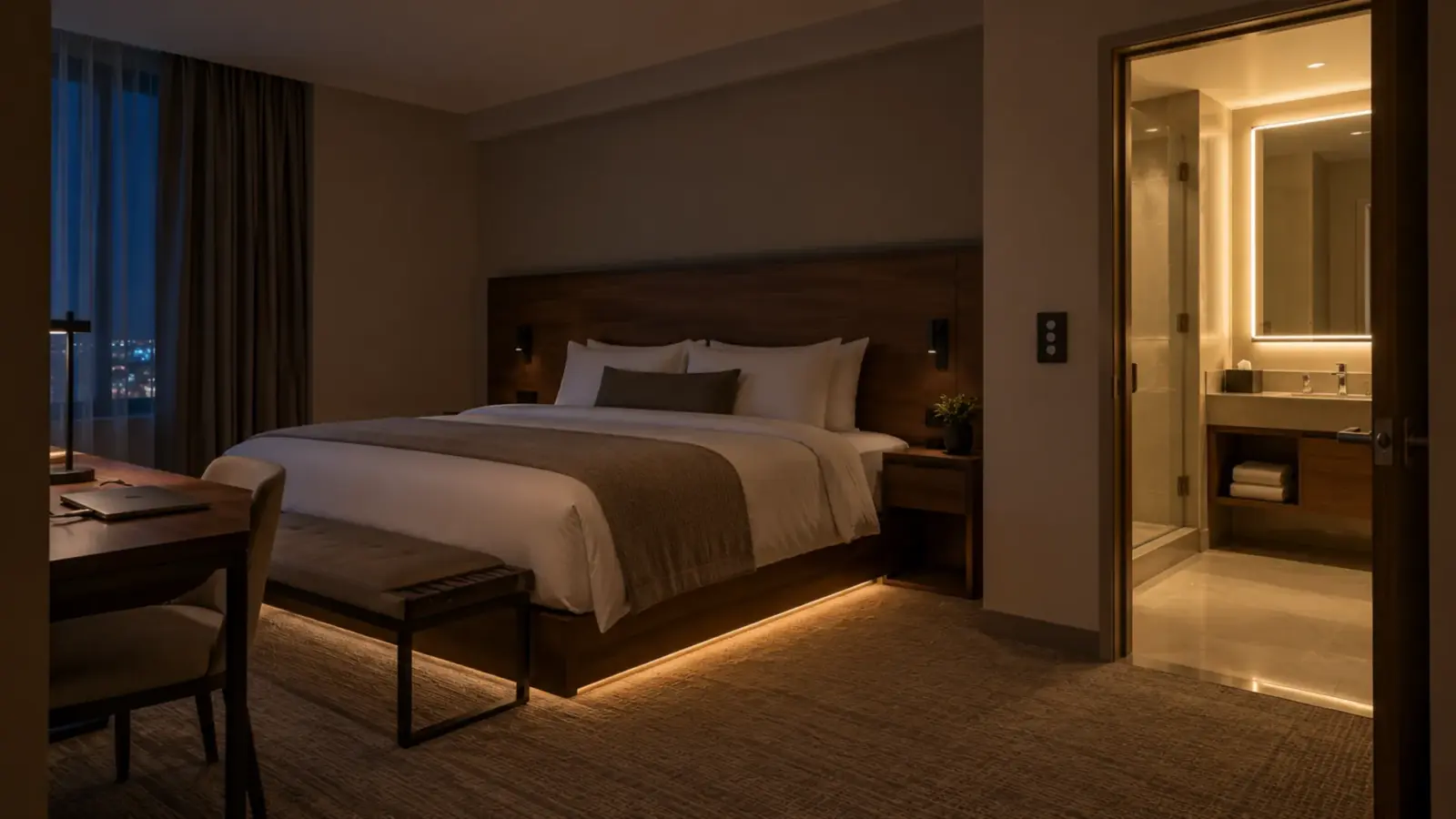
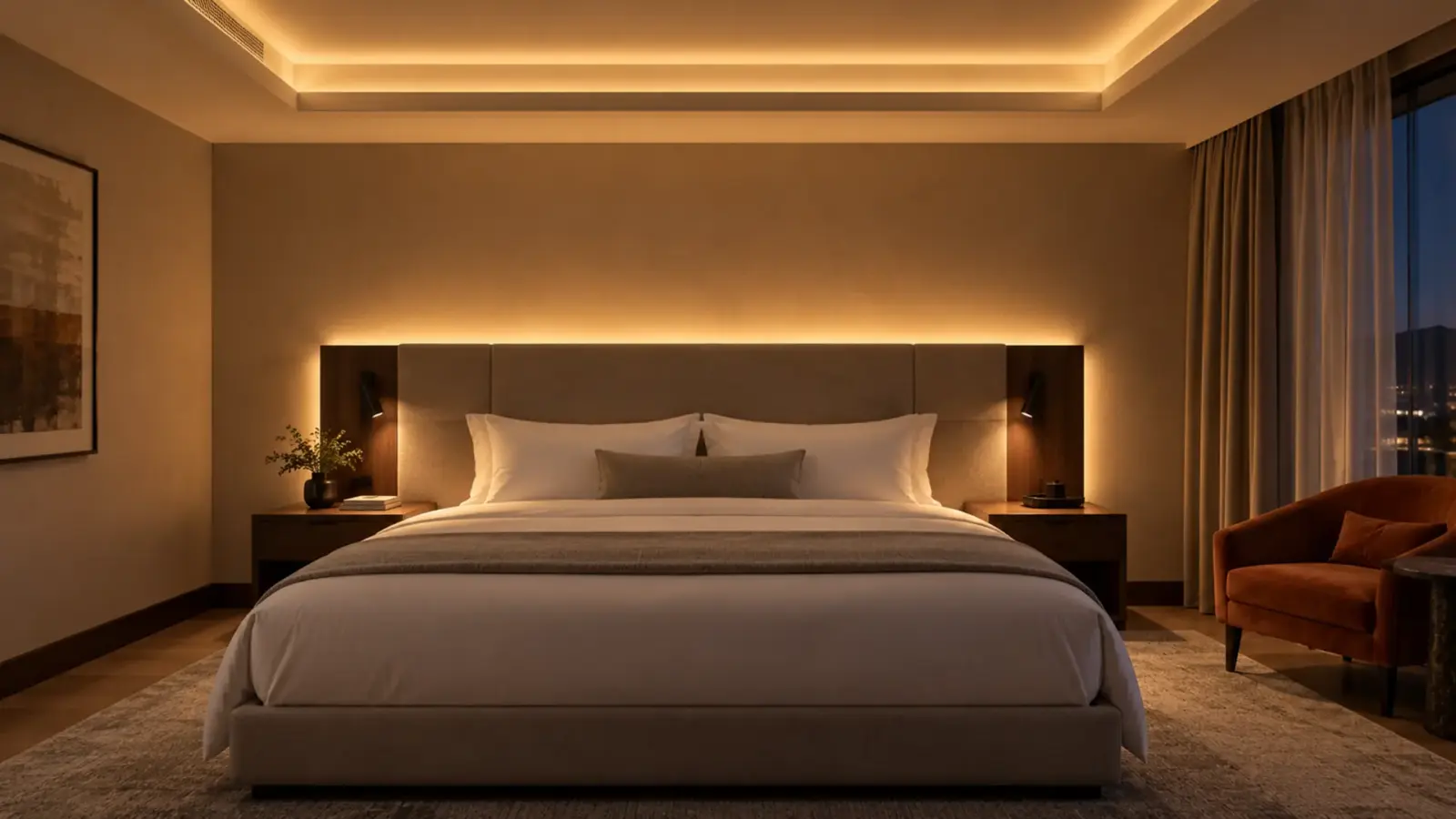
LED strip belongs in five places in a hotel guest room: behind or above the headboard, in a ceiling cove, low along the bed or toe kicks as a night path, behind the bathroom mirror, and inside closets. Each needs its own color temperature, protection and control, and all of them have to behave at 2 a.m.
At 2 a.m. a guest gets up in a dark room they have slept in once. What lights the way to the bathroom decides whether they find it without switching on the room, and whether the light that helps them also keeps them awake. That night scene is the best test of a guest-room lighting design, so it runs through every section below.
The Guest Room Zone Table
| Zone | Product from our range | CCT | Protection | Control |
|---|---|---|---|---|
| Headboard backlight | Dot-free COB UT-C480-8 in a channel | 2700K | Indoor | Dimmed, bedside switch |
| Ceiling cove or curtain pocket | UT-C480-8, or dim-to-warm UT-T672-10-DTW | 2700K–3000K, or 3000K warming to 1800K | Indoor | Dimmed, room scenes |
| Night path under the bed | UT-S2835-60 at a very low level | 2700K | Indoor | Sensor, timed off |
| Bathroom vanity and mirror | IP65 silicone-coated UT-O320-8-65 | 3000K | IP65 near the basin | Switch, bathroom sensor |
| Closet or wardrobe | Narrow COB UT-C400-3, or side-view UT-C320-6-SV | 3000K | Indoor | Door or motion switch |
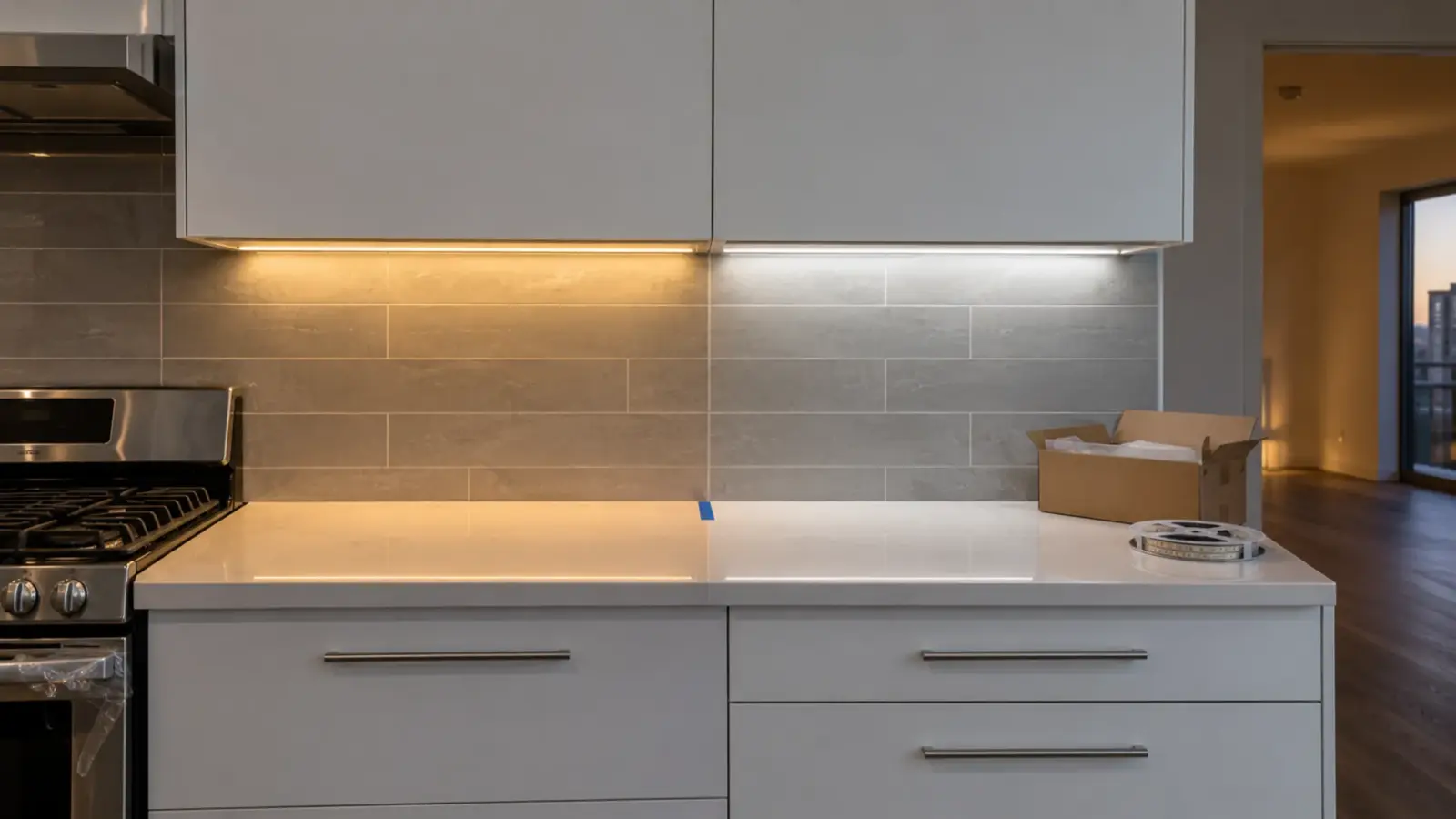
According to Homestyler’s hospitality lighting guide, guest rooms usually sit between 2700K and 3000K. The table keeps the sleep side of the room at 2700K and moves to 3000K where guests groom and dress, the split our 2700K vs 3000K guide explains in more detail.
Headboard: Behind, Above or Under the Panel
The headboard is where most guest-room strip ends up, and where it is most often wrong. Three details work:
- Behind the panel. The strip sits on the back edge of an upholstered or timber headboard that stands a little off the wall, and washes the wall around it. The panel hides the strip from the bed.
- Above the panel. A channel along the top edge throws light up the wall. The channel lip must hide the strip from a guest sitting up in bed.
- Under a shelf or ledge. A strip under a headboard shelf lights the shelf and the wall below it.
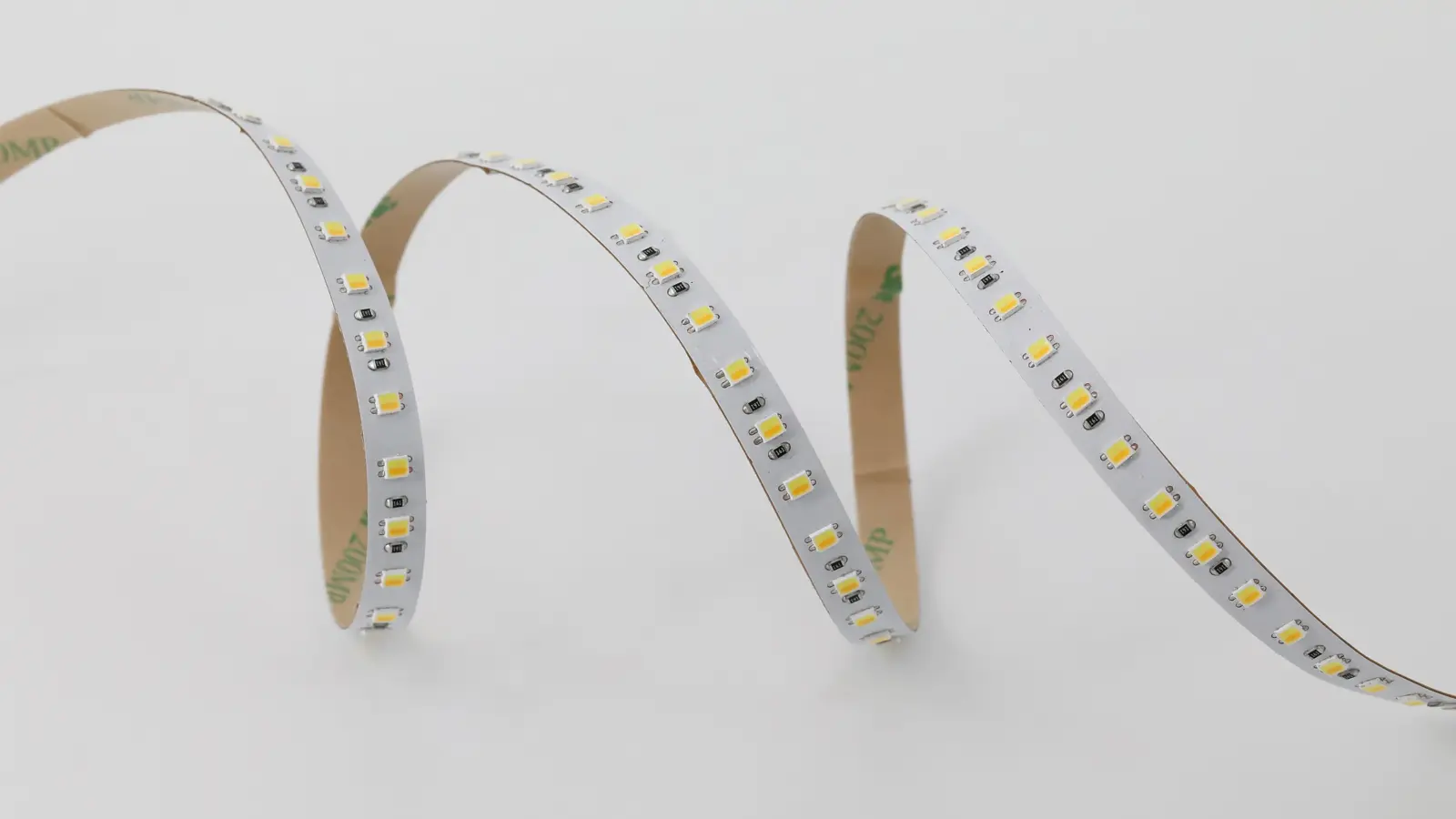
In each case the strip is an accent layer, not the reading light. According to Homestyler, reading light should come from a separate fixture that can be aimed at the page, and exposed sources in the line of sight from the bed are a glare risk. A dot-free COB strip such as our UT-C480-8 at 3.2 W/ft (10.5 W/m) avoids the row of reflections that sparse strip leaves on glossy headboard finishes and on a guest’s phone screen.
Keep the headboard strip on its own dimmed circuit with a switch at the bedside, so a guest can leave a low glow on without the room lights.
Ceiling Cove and Curtain Pocket
A cove around the room or a curtain pocket along the window gives the soft overall light that makes a room feel finished. According to PacLights, layered guest-room lighting relies on dimmable, glare-free ambient light of exactly this kind.
The geometry decides the result: the strip hidden behind a lip, enough distance from the ceiling for the gradient to spread, and no line of sight to the strip from the bed. Our guide to cove geometry covers setback and aim.
For rooms that change mood through the evening, dim-to-warm strip is worth the cost. Our UT-T672-10-DTW is 3000K at full output and warms toward 1800K as it dims, so the same cove reads as clean light on arrival and candle-warm at bedtime. The dim-to-warm guide compares it with tunable white, and our tunable white LED strip page lists both.
Night Path: Under the Bed and Toe Kicks
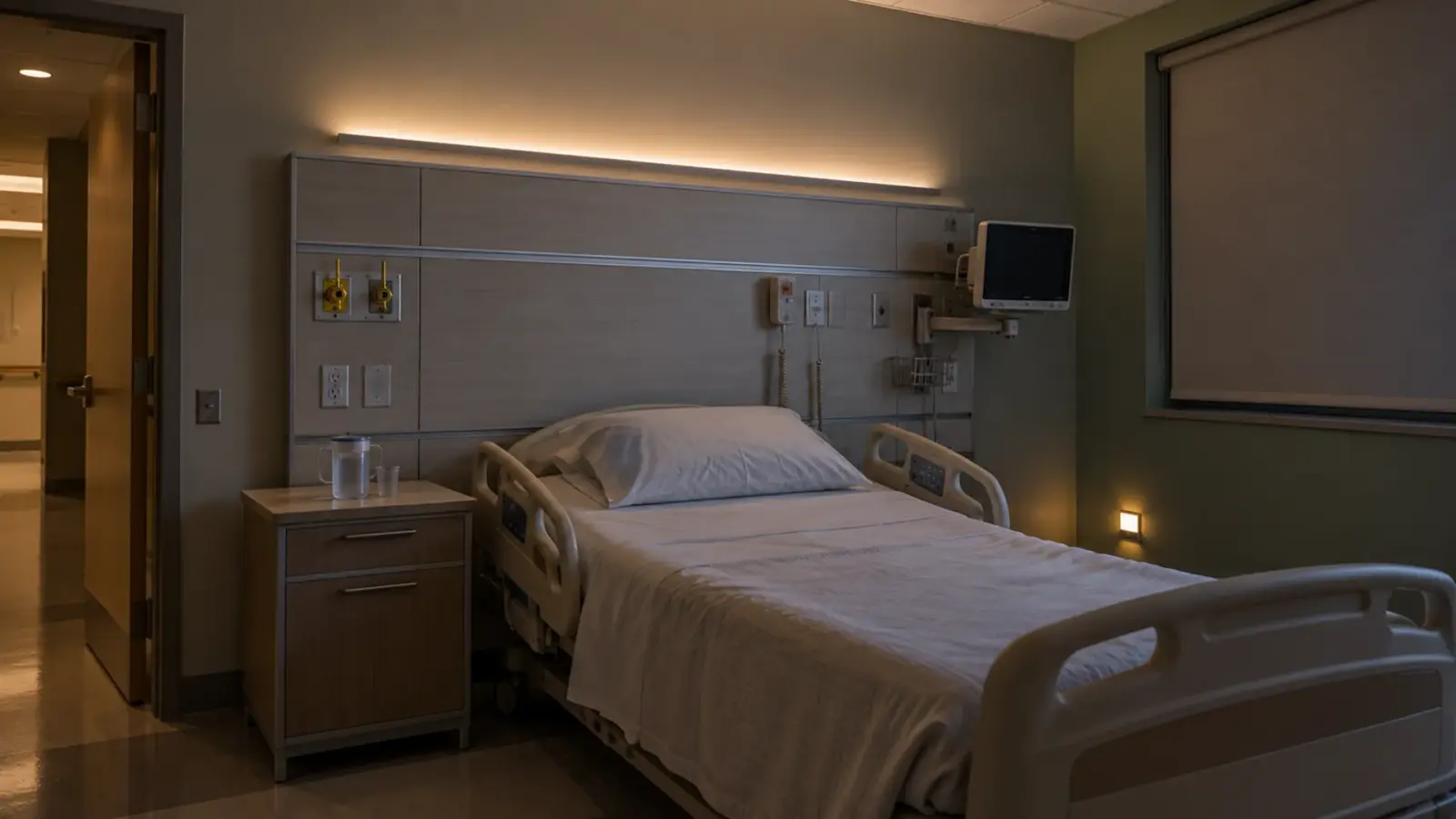
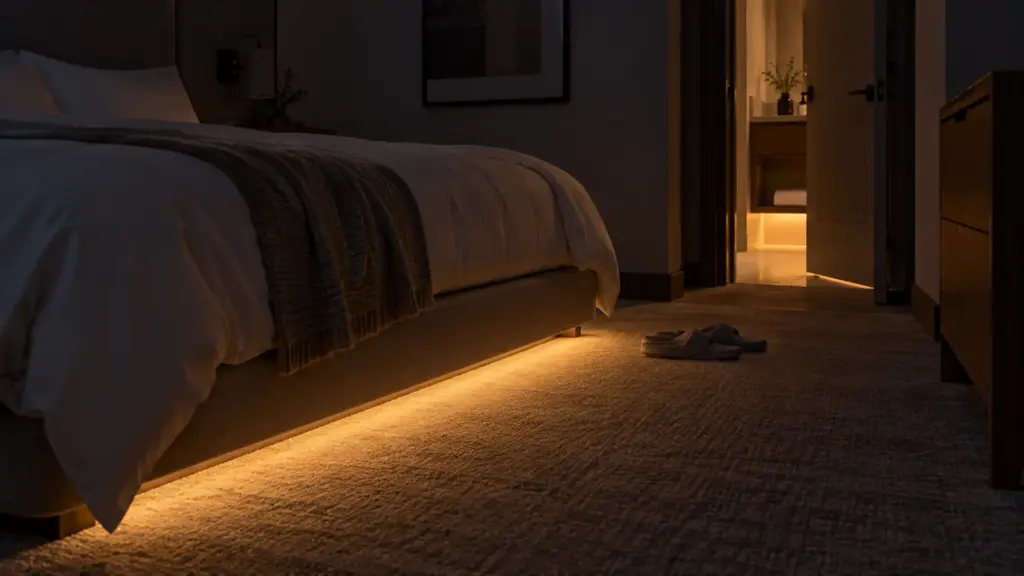
The night path is the zone guests remember. A low strip under the bed base, under a vanity or along a toe kick lights the floor, not the room, so a guest can walk to the bathroom without waking anyone else. Häfele markets its toe-kick lighting for exactly this: helping guests who do not know the room find the bathroom at night.
Three rules make it work:
- Low and aimed down. The strip sits under the edge of the bed base or the toe kick, aimed at the floor, never visible from the pillow.
- Very low output. A sparse strip such as UT-S2835-60 at 1.5 W/ft (4.8 W/m), dimmed well down, is enough. The goal is to see the floor, not to read.
- On a sensor, off by itself. A motion sensor near the floor switches it on when feet touch the floor and a timer switches it off. Legrand, for example, offers a bathroom night-light sensor with auto-off for the same job.
Warm 2700K or warmer keeps the night path from feeling like daylight. Test it with the room dark: if it is bright enough to read by, it is too bright. Check it from the pillow as well; a path that lights the ceiling or shines into the guest’s eyes when they turn over has the strip in the wrong place. For the controller that runs those zones, what a guest room control system needs from the strip driver covers the signals, the outputs and the power-loss state.
Bathroom Vanity and Mirror
The vanity is where the room changes from rest to grooming, and the light changes with it. Our 2700K vs 3000K guide draws the mirror and vanity backlight at 3000K, a cleaner white for faces.
A backlit mirror is its own detail, with its own gap, strip and driver decisions; our backlit mirror guide covers it. Two guest-room points matter here:
- Moisture. Near the basin, spray and daily cleaning reach the strip; a silicone-coated IP65 strip such as UT-O320-8-65 with sealed ends survives it.
- Night use. The mirror light is often the one a guest turns on at night. A low setting, or a link to the night-path sensor, keeps it from flooding a dark room.
Closets and Wardrobes
Closets are where guests look for things, so the light has to show colors and reach the back of the shelves. Two details are common:
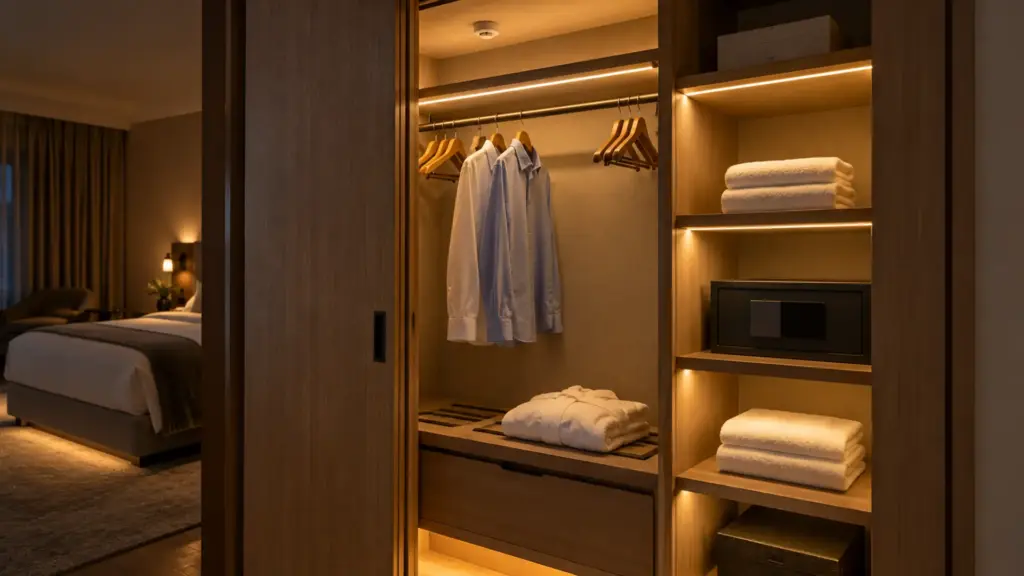
- A strip along the front edge of each shelf or the top of the hanging space, aimed back into the closet. A narrow COB strip such as UT-C400-3, 2.7 to 3 mm wide at 2.1 W/ft (7 W/m), fits a small reveal.
- A side-view strip in the frame of the door opening, such as UT-C320-6-SV, lighting across the hanging space.
According to Ostermann, a motion switch that reacts within about 2 m can switch a closet strip when someone opens the door or reaches in, and Häfele describes lights that come on when a drawer or closet opens. Either way, the closet light should switch off on its own, because guests forget it. Use a sensor or door switch rated for the load and placed where housekeeping can reach it.
Keycard, Scenes and Night Mode
Guest-room lighting runs on the room’s control system, and LED strip has to fit it.
- Keycard. According to setupmyhotel, removing the key card switches off the room’s lights and other loads, often after a short egress delay of about 30 seconds. Strip on those circuits goes off with them; a night path meant to stay available should be on a circuit the keycard does not cut, or on its own sensor.
- Occupancy. According to Lutron’s myRoom brochure, guest-room systems combine occupancy sensing, door status and keypad presses to judge whether a room is occupied.
- Scenes. Arrival, evening, sleep and night are the usual scenes. Each one sets the strip zones to a level; the night scene keeps only the path and perhaps the bathroom at a low level.
Low levels are where LED strip and room dimmers argue. A strip that flickers at 5% or glows faintly when off ruins the night scene; our guide to LED tape that glows or flickers when dimmed covers the causes. For DALI-based room systems, a controller such as UT-CDALI-DT8 drives tunable or dim-to-warm strip on two channels.
Drivers in a Room That Is Never Empty
A guest room is occupied most nights of the year, so any maintenance has to be quick and quiet.
- Put drivers where housekeeping or engineering can reach them without moving furniture: an access panel in the closet ceiling, a cabinet in the bathroom vanity, a service space above the entry.
- Keep drivers away from the bed. A driver that hums faintly is invisible in a corridor and a complaint above a headboard; our driver troubleshooting guide covers hum and its causes.
- One driver per zone, labeled. Headboard, cove, night path, vanity and closet each on their own driver or channel, so one fault darkens one zone, not the room.
- Size to 80%. A 60 W Class 2 driver such as UT-D60-24-C2 carries up to 48 W of strip, which covers most single-room zones with room to spare.
Mock Up One Room Before Two Hundred
Every decision above is repeated in every room of the hotel. A mockup room, built once with the real headboard, cove, vanity and closet, settles the strip, the CCT, the levels for each scene and the driver locations before the order is placed.
Judge it at night, with the room dark: lie in the bed and look for the strip, walk the night path, check the mirror at the night setting, open the closet. Then approve one room and order two hundred of it.
Spec Notes for This Room
- Sleep side 2700K; mirror and closet 3000K; dim-to-warm in the cove if the budget allows.
- Headboard strip hidden from the pillow, dot-free, on its own bedside-controlled circuit.
- Night path low, aimed at the floor, on a sensor and outside the keycard cut.
- IP65 strip with sealed ends at the vanity; a separate low mirror setting for the night.
- Closet strip on a door or motion switch that turns itself off.
- One labeled driver per zone, reachable without moving furniture, away from the bed.
- Approve all of it in a mockup room, at night.
We supply COB, dim-to-warm and IP65 strip, with matched drivers and controls, for hotel guest-room programs across the US. Send the room plan and the room count, and we will return the strip and driver schedule for each zone with samples for the mockup room: request a quote. Strip widths, run lengths and color temperatures are on our COB LED strip page.