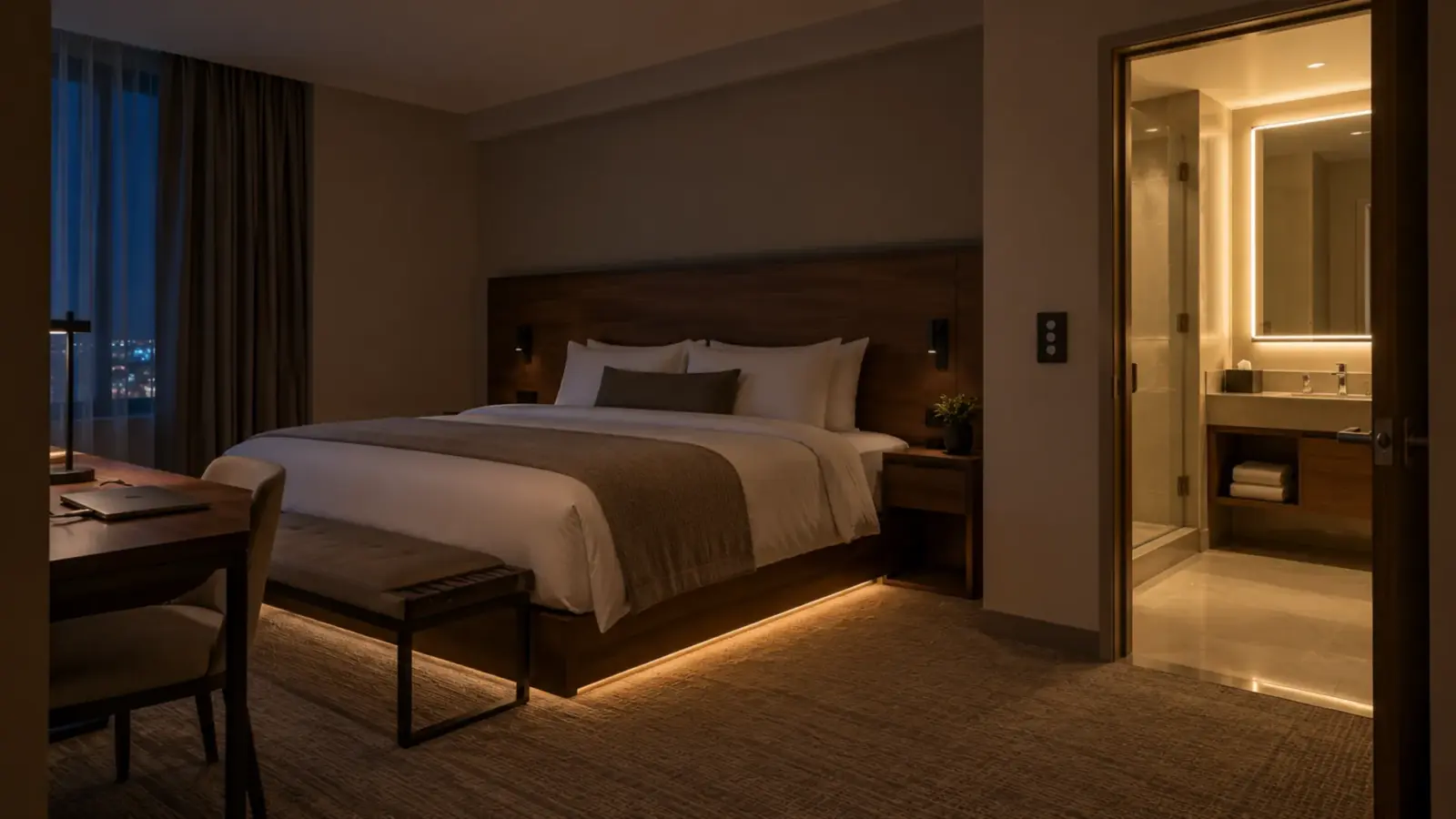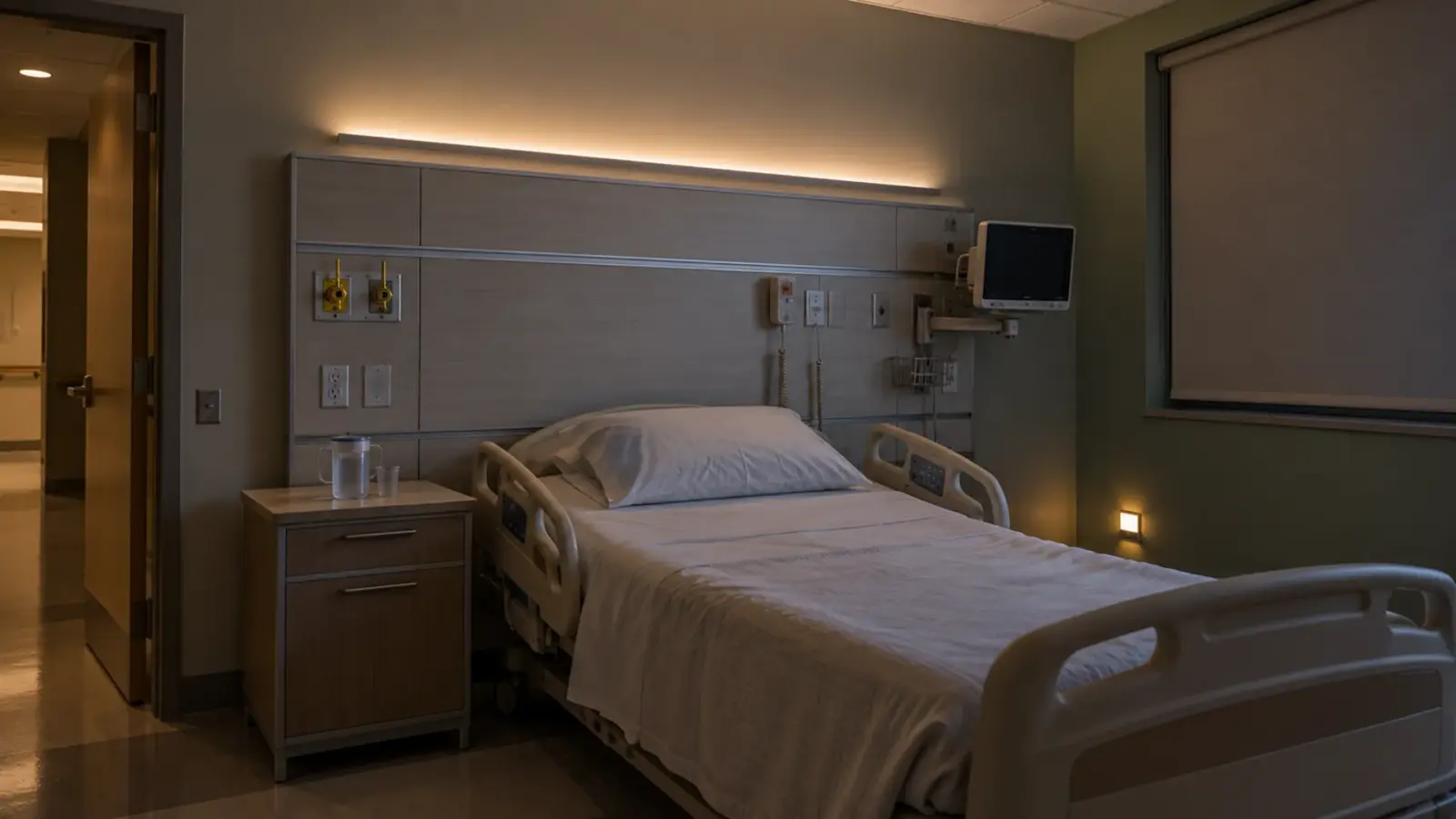
At 3 a.m. a nurse checks an IV line by whatever light the headwall design left on. LED strip near a hospital bed belongs off the headwall’s service zone: on the wall facing the bed or above the unit, aimed at the wall, on its own night circuit, never fixed to a panel that has to come off.
The one nurse-task study we found tested thirteen lighting setups in a full-scale mock patient room. At night, a wall light alone and a dim overhead light above the bed were both rated less difficult for bedside tasks than a night light alone, and the wall light was the easiest. This article sets that result beside the headwall’s services and shows where a strip can sit without touching them.
What the Headwall Already Carries
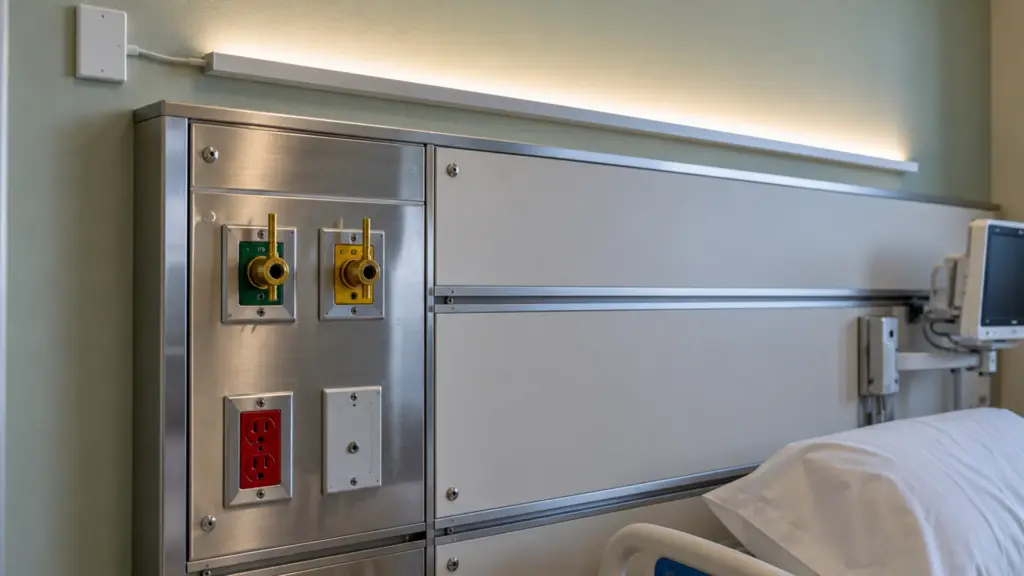
A hospital headwall is where a patient room’s services meet, and two makers’ documents describe it as one factory-built unit. Static Systems describes its Vistr headwall as combining medical gases, nurse call, electrical sockets and lighting, with the services kept “out of direct sight of patients and visitors,” in the words of a product manager at the UK maker. Amico’s recessed flatwall specification describes vertical sections where the services sit, medical gas piping brazed and tested to CSA Z7396.1 and NFPA 99, and 1/2 in. panels that are removable for maintenance. Its shop drawings include the gas termination and the electrical connections, and the unit is UL listed in Canada and the United States.
Static Systems’ article also lists the lighting that unit can carry: color washing, PIR-controlled low-level night lighting that comes on when a patient leaves the bed in low light, and guiding lights that direct staff to the right bedside during a call. If the headwall unit already carries a night light, the strip is the wall layer above it, and the two need one scene plan rather than two controls that fight.
Three things follow for a unit like Amico’s, in our reading:
- The unit is a listed assembly with its own submittal. The strip is a separate system with its own drawings and its own owner, and the two should meet on paper before they meet on the wall.
- The panels come off for service. A channel fixed to a service panel, or bridging a panel joint, leaves with the panel or blocks it.
- The terminations sit above the ceiling. Amico’s specification places the electrical and gas terminations there, so the ceiling space next to the headwall is shared, and a strip cable route through it belongs on the coordination drawing.
Three Jobs of Light at the Bed: Where Strip Fits
South Dakota’s hospital rules, in ARSD 44:75:13:33, give a plain picture of how the light at a bed divides. The table quotes that rule. It is one state’s rule, and the FGI Guidelines, which this article could not read, may say more, so the owner’s adopted edition and the engineer of record decide.
| Job | What the rule asks | Strip’s role (our reading) |
|---|---|---|
| General | “general lighting of at least ten footcandles” in each patient bedroom | A share at most. The room’s troffers or downlights carry the required level |
| Task and reading | task light of at least 30 footcandles at the work surface where task illumination is required, for each patient; a patient’s reading light or other fixed light not switched at the door needs a switch “convenient for use at the luminaire” | None as the only source. A strip is not an aimed task light, so wire it as ambient |
| Night | “night lighting” in each patient bedroom, with at least one night luminaire switched at the entrance | Yes. A low line or a wall wash, on its own circuit |
The night row is where a strip earns its place.
What Strip Does Not Do Here
It is not the reading light, for the reason in the table. It is not emergency lighting either: a strip on a normal-power circuit goes dark in a power loss unless the job feeds it through an emergency relay or inverter, which the emergency power guide covers.
What the Nurse-Task Study Found
Graves, Davis, DuBose, Campiglia, Wilkerson and Zimring published the study in Health Environments Research & Design in 2020. Nurses worked through three tasks that came from an interview with a nurse educator: find a patient’s pill bottle among thirteen by reading the labels; name the color of a word on a card under the bed sheet, a stand-in for wound care; and read a colored letter or number on a rope beside the head of the bed, a stand-in for IV checks.
The wall light in the room was eight 1 ft (30.5 cm) color-tunable linear luminaires mounted on the ceiling 6 in. (15 cm) from the wall and hidden from normal viewing angles by a fascia board about 8 in. (20 cm) tall. It lit the wall remote from the head of the bed, not the headwall. Night navigation came from a single recessed amber night light 1 ft above the floor.
| Question | Compared | Result |
|---|---|---|
| Night | wall light only (3500K, about 28 lux reached the bed), dimmed overhead light above the bed (5 lux target, 2700K), the amber night light only | Task difficulty: wall light easiest, dimmed overhead light second, night light hardest; each difference p < 0.0001 |
| Day | two luminaires over the bed, bed and family area, bed, family area and wall | More zones rated more color appropriate than the two-luminaire case (p = 0.005 and 0.02); comfort and naturalness not significantly different |
| Wall color | white against blue (day), white against red (evening) | Blue rated less comfortable, less natural and less color appropriate than white (p < 0.0001); white rated more natural than red (p = 0.001); comfort and color appropriateness not significantly different after a Bonferroni correction |
| Zone CCT | 3500K bed and wall with 5000K over the family area, against 3500K throughout | No significant difference |
The limits matter. The 33 participants analyzed were nurses and nursing students, tested one at a time, the exposures were no longer than five minutes, the room was new, and the study did not look at a headwall. A companion study from the same program (DuBose and colleagues, 2022), as PNNL summarizes it, asked 34 volunteers to rate twelve conditions as patients: they found the cooler, brighter conditions less pleasing and less natural, and reacted badly to saturated blue light on the room’s footwall, while accepting a mix of warmer and cooler CCTs.
We read the night result as a reason to try a hidden indirect line on the wall facing the bed as the night task layer: it reached the bed with about 28 lux, well above the 5 lux of the dimmed overhead condition, without a lamp in the nurse’s view. It is untested for a patient looking up from the pillow. If the scene changes color temperature through the day, that is the case for tunable white rather than a fixed CCT. It is one laboratory study, not a code basis.
Where the Strip Can Sit: Four Positions
| Position | What backs it | Watch for |
|---|---|---|
| A ceiling-edge cove or soffit on the wall facing the bed, with a fascia | The study’s wall light, on the wall remote from the head of the bed: set back about 6 in., hidden by a fascia about 8 in. tall | Typically sprinkler heads and ceiling access; the sightline from the pillow |
| A channel above the headwall unit, aimed at the wall above the services | Our design reading, no study behind it | Keep the channel off the unit’s panels and clear of the terminations; the line ends short of the unit’s sides; a wash behind the pillow is the glare case to check |
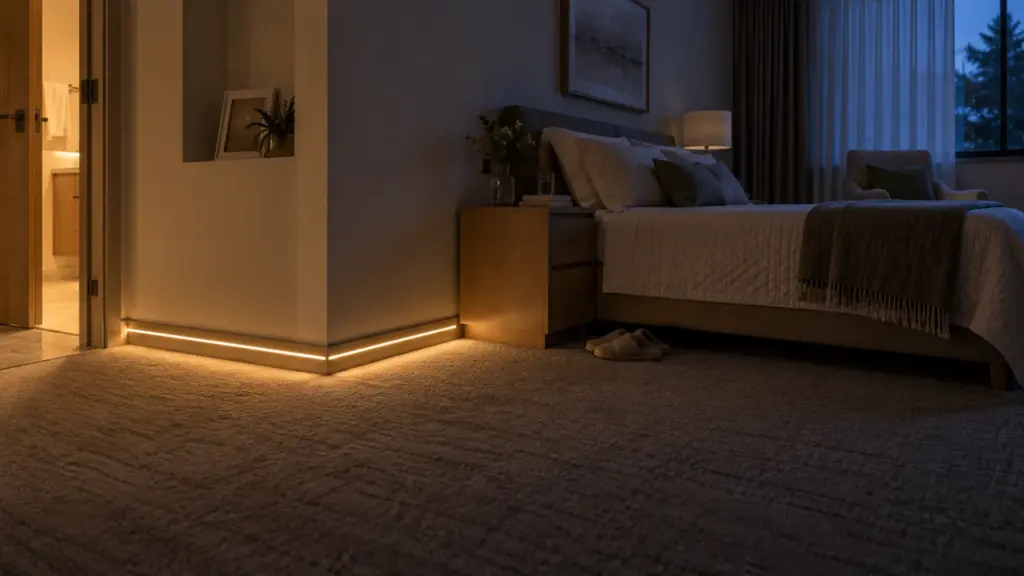
| A low line under casework or along the base, on its own circuit | Our design reading; the study’s night light was one recessed amber fixture 1 ft above the floor | The night light alone was the hardest night condition, so use a low line with the wall layer, not instead of it |
| Not here: the faces of the service panels and the zone around the outlets | Amico’s recessed flatwall: removable 1/2 in. panels, services in the vertical sections | Nothing mounts to a panel face, a gas outlet body or a receptacle plate |
Keep It Off the Services
- Do not fix anything to a service panel. Amico’s panels are removable for maintenance. Mount to the wall plane or the ceiling structure around the unit.
- Keep the cable route on the drawing. A 24V strip cable that wanders into the service raceway or past the terminations above the ceiling becomes a finding. The in-wall wiring guide covers Class 2 separation.
- Check the view from the pillow. The paper says its wall light was hidden from “normal viewing angles” and does not define them; we read that as a standing viewer. A patient looking up from a raised bed sees from lower and nearer, so ask the designer to check the sightline from the pillow before the fascia height is fixed.
- Give the night scene its own circuit and control. A dimmable line that staff can leave on while the room stays dark is the point of the position. If the strip is the night luminaire the rule counts, it is the one switched at the entrance, so the owner decides which circuit that is. The dimming guide compares the control options.
- Plan the cleaning and the access. Closed covers and sealed end caps take wipe-down, and ceiling work next to an occupied bed is an infection-control risk assessment item. The hospital strip guide covers covers and seals, and the ICRA guide covers the work classes.
Who Owns What Before Rough-In
A typical split; confirm it in the contract documents.
| Who | Owns | Ask before the strip is drawn |
|---|---|---|
| Headwall maker | The listed unit, its service layout, any built-in lighting | Does the unit already carry a night or indirect light, and on which control? |
| Electrical contractor | Supply circuits, driver input, the permit | Where do the drivers go so they can be reached from outside the patient room? |
| Strip crew | The 24V side: channel, cover, end caps | Which wall and height, and how does the line end beside the unit? |
| Owner’s infection control | The ICRA class and the cleaning method | What class is the ceiling work, and when is the room free? |
| Lighting designer | The scenes: day, evening, night, control from the bed | Which scene is the strip’s, and who sets the night level? |
Spec Notes for This Job
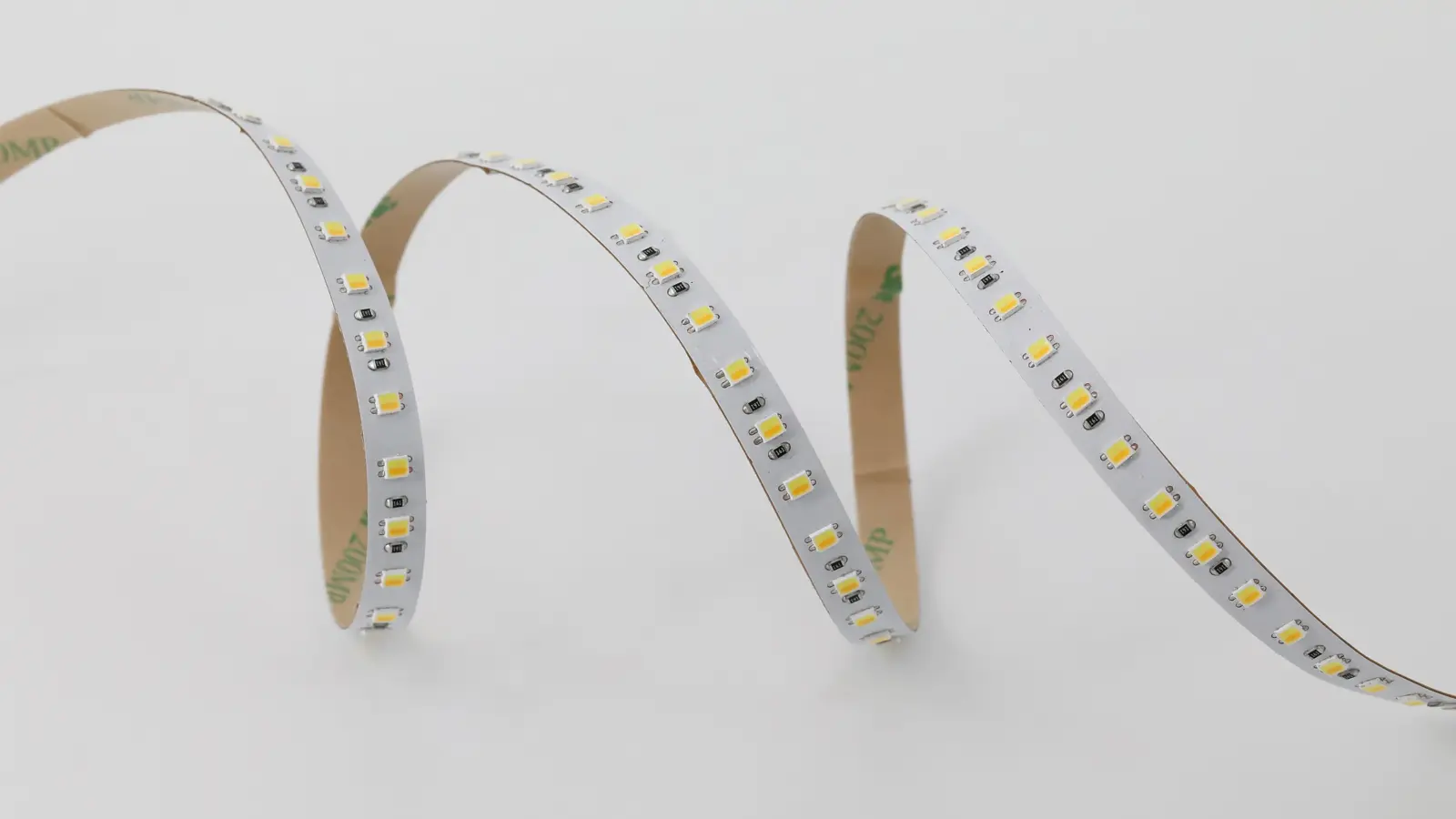
- Strip: a bed-zone scene needs a strip that dims low and changes color temperature. A 3-wire tunable white COB such as UT-T624-8 (24V, 2700–6500K, Ra≥90, 4.3 W/ft, 16 ft per feed) takes a 0-10V, DALI or DMX control through its separate CCT channel.
- Cover and ends: a channel with a closed opal cover and capped ends, mounted to the wall around the unit.
- Drivers: outside the patient room and reachable. A 12 ft run of UT-T624-8 loads about 52 W (4.3 W/ft); at 80% load it needs at least 65 W of driver rating. Our Class 2 drivers are 40 W and 60 W, so the run takes two, each on its own circuit.
- Night level and CCT: set by the designer and the owner. The study’s night wall light was 3500K and its dim bed-area condition 2700K, which are starting points for a mock-up, not specifications.
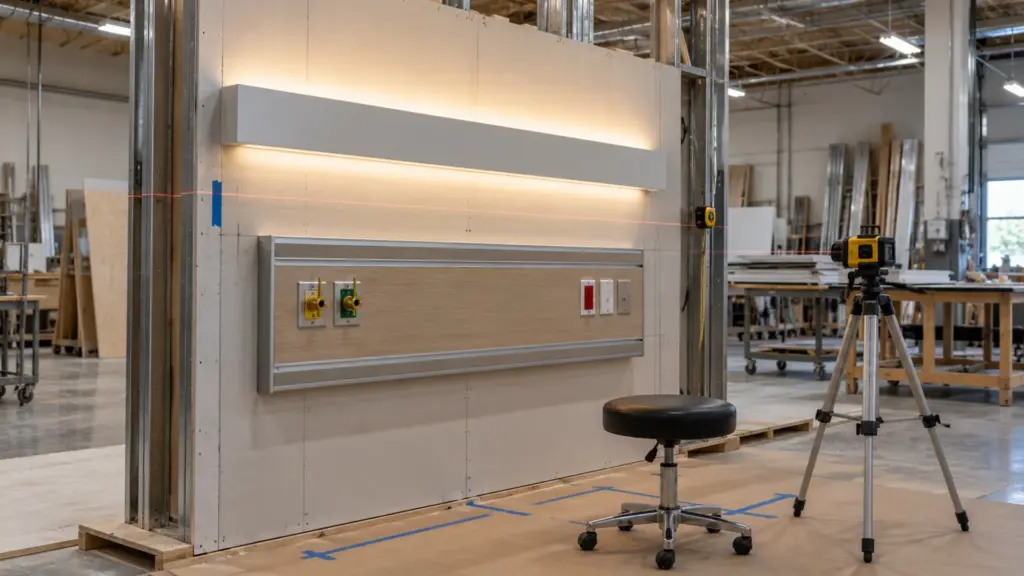
- Mock-up: a full-size wall section with the fascia, checked from the pillow and from the nurse’s position, per the mock-up approval guide.
Unitop Lighting supplies tunable white LED strip and LED channels and diffusers for commercial and healthcare projects across the US, with controller matching handled at quote. Send the headwall elevation and the room schedule, and request a quote.