A 40 W Class 2 driver can sit under a city’s 50 W permit exemption. A 60 W driver on the same ten feet of LED strip may not, because the wording asks what the equipment can supply, not what the strip draws. So “it’s only 24 volts” settles neither the electrical permit nor who may install it.
Whether an LED strip job needs an electrical permit is usually set by the city or county, not by the NEC. Who may install it is usually set by the state, though a city can add rules of its own, and the connection to the building supply is a third question. A Class 2 strip job can clear one of the three and still fail another.
Three Questions, Three Deciders
Pull the questions apart before anyone calls the building department, because one phone call rarely answers all three.
| Question | Who decides | Where it is written | What we found for Class 2 work |
|---|---|---|---|
| Does the work need a permit? | The city or county building department, the AHJ | Local amendments to the adopted building and electrical code | A written exemption with a voltage and wattage line, or a separate low-voltage permit |
| Who may do the work? | The state contractor or electrical licensing board | State statute and board rules | Some states exempt Class 2 circuits from the electrician license, others license low-voltage work as its own trade |
| Who connects the driver to the building supply? | The same state rules and the electrical code | State statute and the NEC | Line-voltage work, which Washington’s rule keeps with a licensed electrician and Texas’s exterior-lighting exemption excludes |
A permit exemption does not settle the license, and a license exemption does not settle the permit. The sections below take them in order: the permit wording first, then four places that answer differently, then the connection to the supply.
The 50 W Line: How Permit Exemptions Read
Several cities use short, old wording. The residential code’s permit-exemption list, as the City of Federal Way, Washington prints it, exempts electrical wiring and equipment “operating at less than 25 volts” and “not capable of supplying more than 50 watts of energy.” Ventura County, California carries the same item in its amended IBC section 105.2 and adds another one: “Low-energy power, control and signal circuits of Class II and III as defined in this Code.” Houston raises the voltage line to 50 and says “supplying or controlling more than 50 watts of power,” so on a plain reading a dimmer that controls more than 50 W is caught as well as a driver.
Read “capable of supplying” slowly. A 24V strip is under the 25 V line, so the open question is the 50 W. Our Class 2 drivers are rated 40 W (UT-D40-24-C2) and 60 W (UT-D60-24-C2). No source we read says how to apply the phrase, and three readings are possible: the driver’s rating, the load actually on each driver, or the whole job. The same strip gives different answers under each.
| Job on 24V | Drivers | By driver rating | By load on each driver | By whole-job load |
|---|---|---|---|---|
| 10 ft under-cabinet run of UT-C384-8 (3.0 W/ft), 30 W | one UT-D40-24-C2 | 40 W: under | 30 W: under | 30 W: under |
| The same 30 W run on a larger driver | one UT-D60-24-C2 | 60 W: over | 30 W: under | 30 W: under |
| 16 ft corridor row of UT-S2835-120 (4.4 W/ft), about 70 W | two UT-D60-24-C2 | 60 W each: over | about 35 W each: under | 70 W: over |
| 100 ft cove of UT-C384-8, 300 W | seven UT-D60-24-C2 | 60 W each: over | about 43 W each: under | 300 W: over |
Loads come from the strip wattage on our product pages, with each driver held to 80% load, the headroom rule in the power supply sizing guide. Feed points and voltage drop are separate questions and are not counted here.
A commercial corridor job lands in the “over” column on two of three readings, which is why the first question for the building department is how the watt line is applied. None of this is a license to skip the code. The people who proposed Houston’s 2023 amendment wrote that many NEC requirements “apply equally to circuits under 50 V / 50 Watts, which are exempt from permitting.”
Four Places, Four Answers
Four documents, read from their own sources, show how far the answers spread.
| Place | Permit | License or trade |
|---|---|---|
| Houston, TX | Exempt below 50 V and not capable of supplying or controlling more than 50 W. A 2023 proposal to exempt Class 2 and Class 3 work was rejected | Texas: no electrician license for work on Class 1, 2 or 3 remote-control, signaling or power-limited circuits; the exemption for crews doing low-voltage exterior lighting as part of landscaping work excludes power sources |
| Ventura County, CA | The exemption list carries the 25 V / 50 W item and Class II and III low-energy power, control and signal circuits | California: classification C-7 covers energy-limited systems not exceeding 91 V and lists low-voltage landscaping lighting; low-voltage fire alarm is excluded |
| Washington State | Licensing and permitting exemption for Class 2 systems on a listed supply, but only for the systems the rule names: residential garage doors and built-in vacuums, underground landscaping sprinklers and landscaping lighting | Line-voltage equipment and conductors feeding the system go to licensed electrical contractors and electricians; no conductors through fire-rated walls, ceilings or floors outside residential units |
| Cape Coral, FL | A separate commercial low-voltage permit from June 1, 2025, listing systems such as landscaping lighting, gate controls and interior lighting control systems | The notice cites the Florida Building Code, the Florida Administrative Code and NFPA 70, and lists who may apply: electrical contractors, Limited Energy Specialty Contractors, certified alarm system contractors and owner-builders under a job-value limit the notice sets |
Three lessons come out of the table. First, a license exemption is not a permit exemption. Houston’s staff wrote in 2023 that the state licensing act “does not exempt Class 2 and Class 3 wiring from permit or code requirements,” and among other reasons turned the proposal down on that ground. The state’s own TDLR page adds that municipal or regional regulations may override its exemptions. Second, Washington’s exemption is narrow. A commercial interior strip is not on its list, and the fire-rated wall condition alone could catch a hotel or hospital corridor whose cable crosses a rated wall. Third, none of the four documents names LED strip. Cape Coral’s list names lighting control systems, not strip, which is the kind of gap a phone call to the permit desk closes.
California adds a license question of its own. The C-7 page lists low-voltage landscaping lighting among its examples and does not say whether an interior LED strip job is C-7 work or electrical work, so ask CSLB.
The Supply Side Belongs to an Electrician
A Class 2 driver has two sides. Its output is the 24V DC circuit the strip crew runs. Its input is a building branch circuit: our Class 2 drivers take 100–277 V, and the 0-10V model takes 120–277 V. That input is line-voltage work.
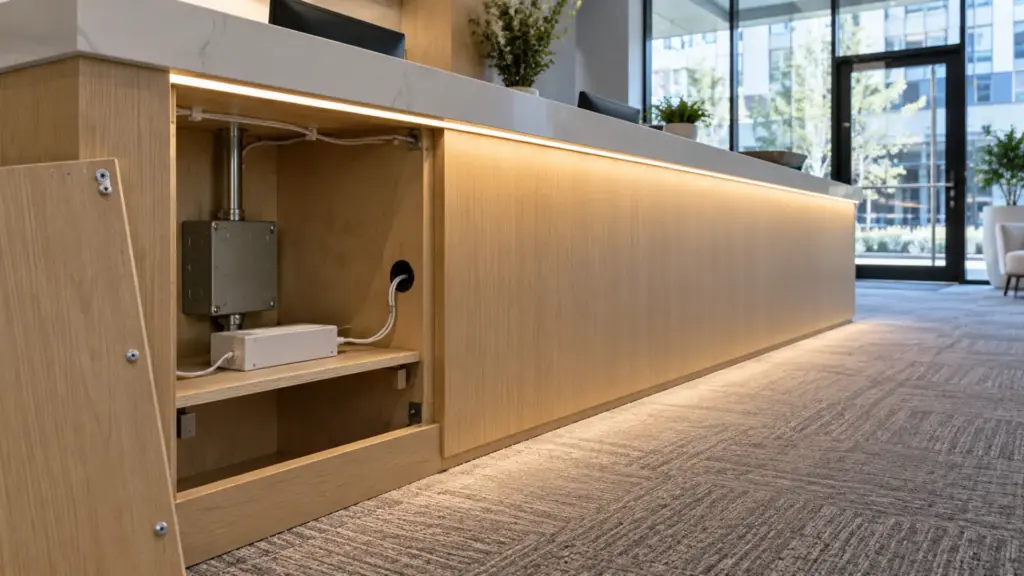
Washington’s rule says it outright: line-voltage equipment and conductors supplying the system are installed by appropriately licensed electrical contractors and electricians. Texas’s exemption for low-voltage exterior lighting done as landscaping work excludes power sources, which points the same way. Our 120V strip page goes further for a strip that is itself line voltage: hardwired installations should be completed by a licensed electrician, as covered in the 120V versus 24V guide.
On a split crew, that line is the easy way to schedule the job. The electrician sets the box, the supply conductors and the driver input, and often pulls the permit. The strip and channel crew runs the 24V side from the driver output. The Class 2 drivers, controllers and connectors page lists wattage and input range for each model, which is what both trades need on the submittal. The NEC edition that governs the output wiring is a separate question, covered in the NEC guide.
What Else Moves the Answer
An exemption can be lost by where the strip goes, not only by its wattage.
- Fire-rated walls and floors. Washington’s exemption drops out when conductors pass through a fire-rated wall, ceiling or floor outside a residential unit. The fire-rated wall guide covers the penetration itself.
- Pools and fountains. The same rule excludes installations under NEC Article 680. A hotel pool deck or a courtyard fountain falls outside Washington’s exemption.
- Class 2 listing. Washington’s exemption starts from a listed Class 2 supply. A driver that is not a listed Class 2 supply is outside it. The Class 2 driver guide explains what the inspector reads on the label.
- Required lighting. A strip that serves as a room’s required lighting raises its own NEC questions, covered in the lighting outlet guide.
Carry It in the Bid
A bid that says “LED tape, by others” and nothing about the permit leaves the question with whoever finds out first. Five lines settle it:
- The permit: whose name, whose fee, and whether the electrician’s permit covers the low-voltage side or a separate one is needed.
- The electrician for the supply side: named, or an allowance.
- Inspections: the rough-in look before the ceiling closes, and the final.
- The paper the building department wants: listing documents for strip and driver, as in the submittal package.
- Schedule float for the inspector’s slot, which is rarely the day the crew finishes.
FAQ
Does Class 2 LED strip need an electrical permit?
Sometimes. Some cities exempt wiring under 25 V or 50 V that cannot supply more than 50 W, a few add Class II and III circuits, and others run a separate low-voltage permit. Our Class 2 drivers are 40 W and 60 W, so one sits under a 50 W line and one does not. Ask the building department how its line is applied.
Can a low-voltage technician install LED strip?
On the Class 2 side, often yes, where the state exempts Class 2 circuits from the electrician license, as Texas does for Class 1, 2 and 3 circuits. California licenses energy-limited systems up to 91 V under C-7. The connection to the driver input stays with a licensed electrician in the two state texts we read.
Who pulls the permit, the electrician or the GC?
Whoever the building department allows to apply, which is question 3 in the list below. On a split job the electrician who makes the supply-side connection is the obvious name on the permit, and the open question is whether that permit also covers the low-voltage side. Put the answer in the bid.
Does a permit exemption mean the work can skip the code?
No. Exempt from a permit is not exempt from the code. The proponents of Houston’s rejected 2023 amendment wrote that many NEC requirements “apply equally to circuits under 50 V / 50 Watts, which are exempt from permitting.” Ask the building department what it will check on an exempt job.
What to Verify with the AHJ
Call or write to the permit desk before the bid, and get these six answers on paper:
- Does LED strip on a Class 2 supply need an electrical permit here, and is the line drawn in volts and watts or by Class?
- If there is a watt line, is it per driver rating, per driver load or per job?
- Who may apply: a licensed electrical contractor only, a low-voltage license holder, or the owner?
- Is the supply-side connection inside the same permit, and who must make it?
- Which inspections are required, and is a rough-in look before the ceiling closes one of them?
- What documents does the desk want: listing proof for strip and driver, drawings, a riser?
If the answers change the scope, send the revised drawings and run lengths with your request a quote; we size the Class 2 drivers from the layout.