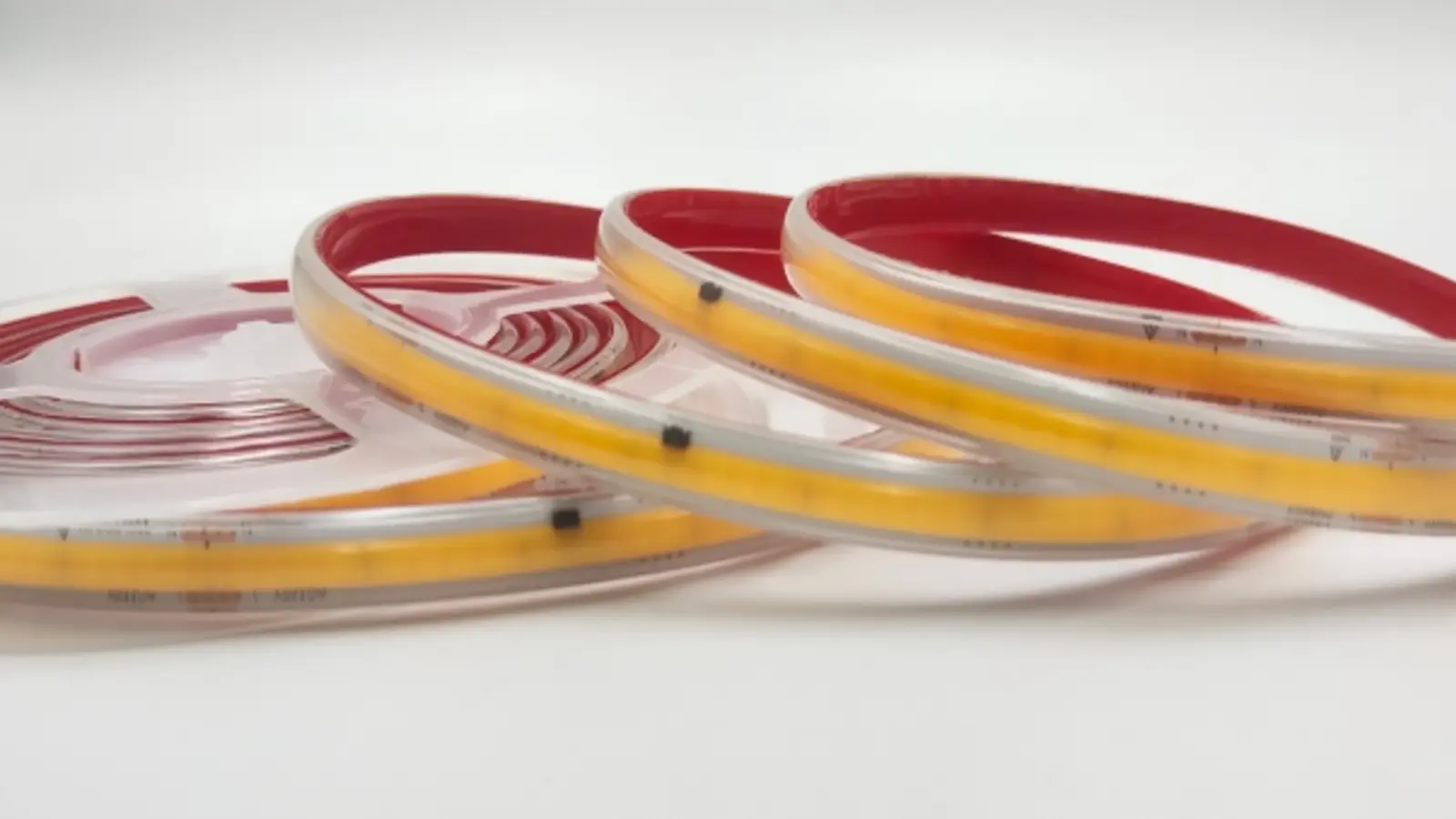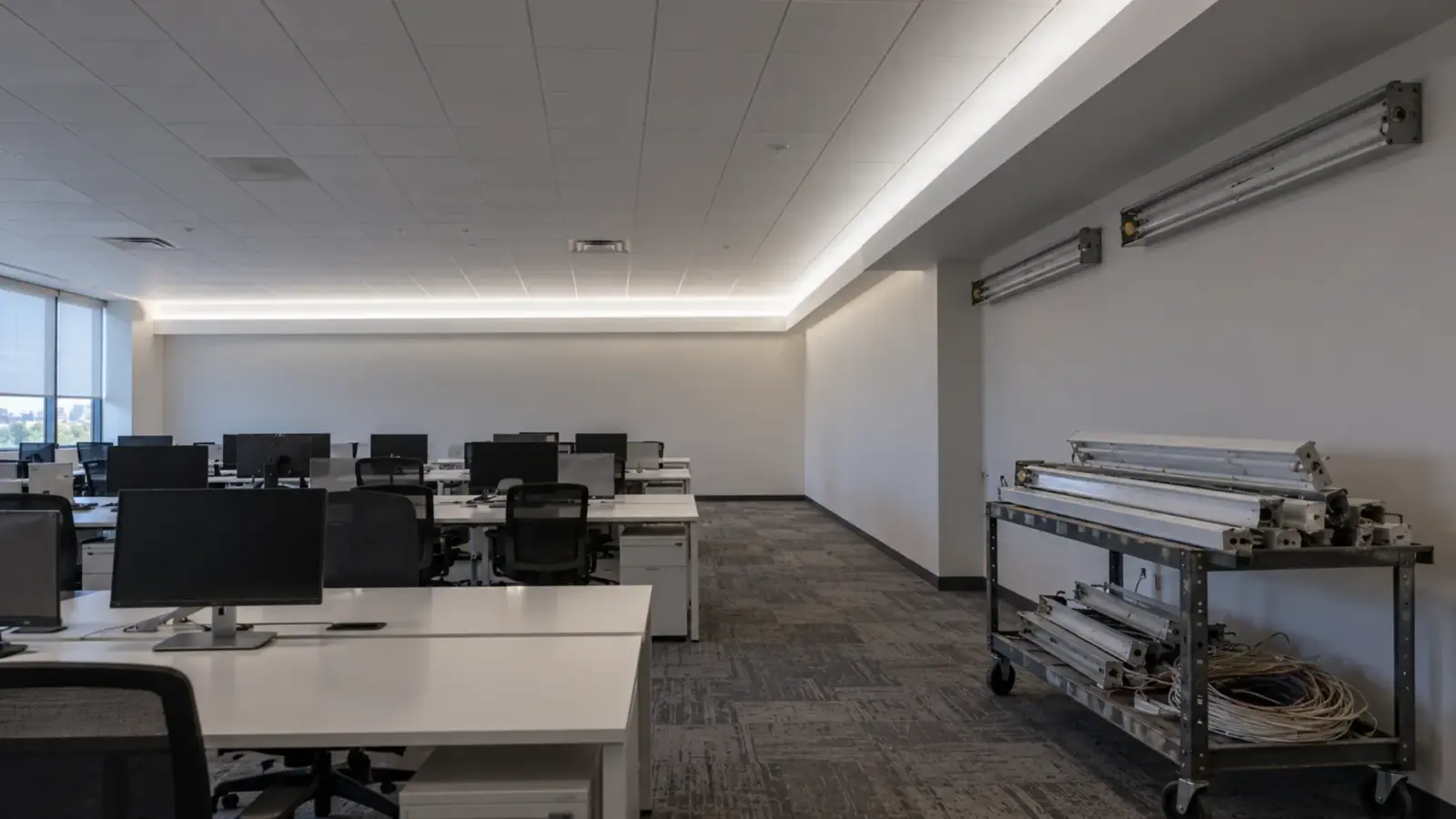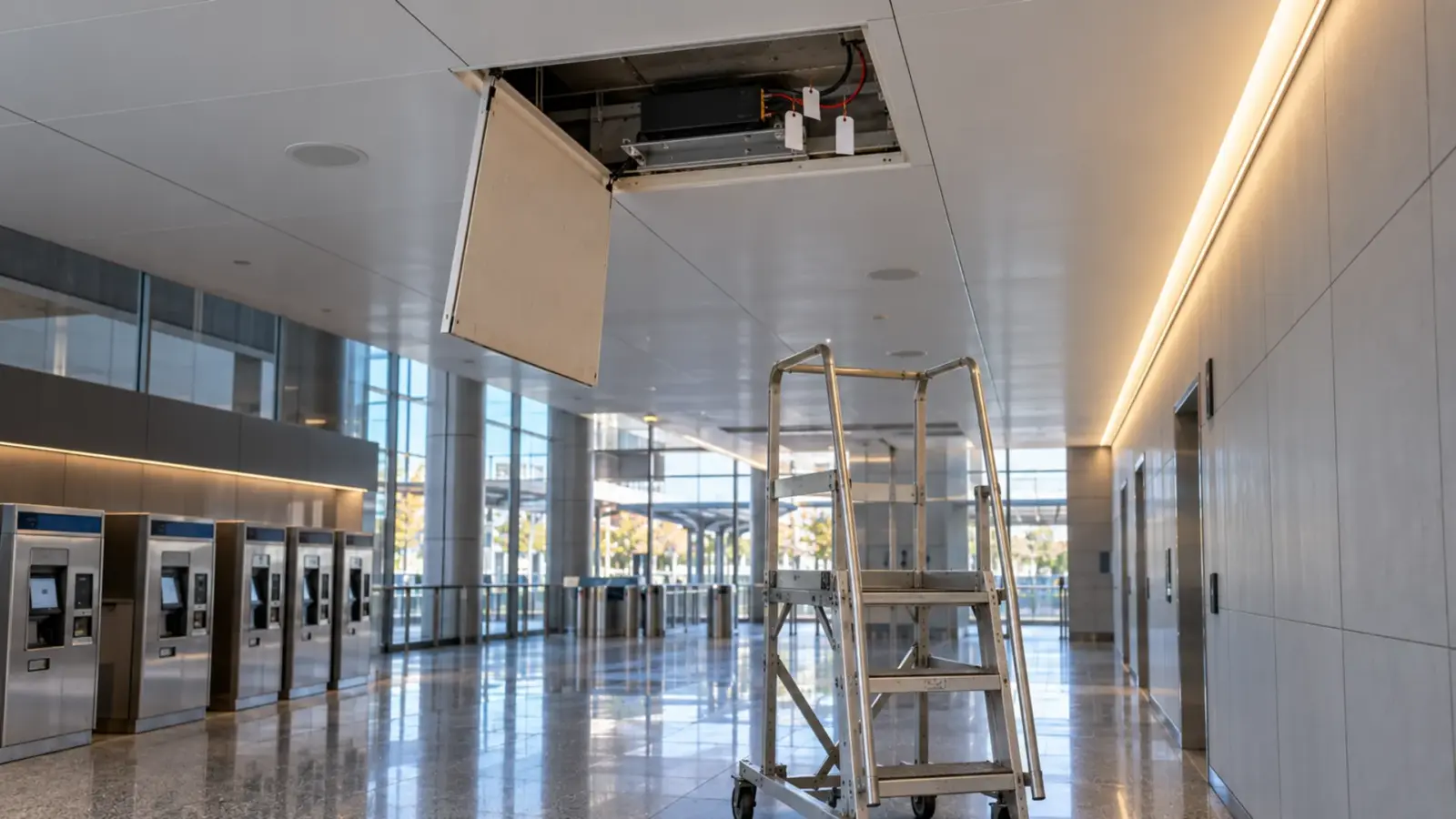
One feed lights 98 ft (30 m) of our 120V LED strip. The same 98 ft of 24V COB, at a 32 ft run limit, takes four feeds, and at 2.4 W/ft it loads about 235 W: four 60 W Class 2 drivers before headroom. Line voltage wins on long runs. Low voltage wins on color, cut length, and control.
NEC references below are general. The authority having jurisdiction (AHJ) and the NEC edition your area has adopted decide what applies on your job.
Decision Gates: Answer These Four First
Work down the gates in order. The first one that applies usually settles the choice.
| Gate | If yes | Why |
|---|---|---|
| 1. Is color judged here? Merchandise, art, finishes | 24V strip on a driver | Ra≥90 against Ra≥75–80 on 120V |
| 2. Does the job need 0-10V, DALI, or PWM control? | 24V strip on a driver | 120V strip dims by TRIAC only |
| 3. Are there short pieces, framed shelves, tight corners? | 24V strip on a driver | 0.76 to 1.97 in (19 to 50 mm) cuts against 4.9 to 19.7 in (125 to 500 mm) |
| 4. Is there one long run and no good place for a driver? | 120V strip | One feed covers up to 98 ft (30 m) |
If none of the first three applies and gate 4 does, line voltage is usually the better job. If a camera-safe, occupied space is involved, use the flicker-free UT-H120-112-FF or low-voltage strip on a low-flicker driver.
Gates 1 to 3 come first for a reason. Color rendering, the control protocol, and the cut interval are fixed by the product and cannot be corrected after the strip is in. Run length can be worked around with more feeds.
Side by Side: Two Different Systems
120V strip is not a 24V strip at a higher voltage. It is a line-voltage product with its own power path, cutting rules, and wiring category.
| 120V strip | 24V strip on a driver | |
|---|---|---|
| Power path | Listed rectifier plug off line voltage, no LED driver | Driver converts line voltage to 24V DC |
| Single run | 98 ft (30 m) from one feed | 16 to 32 ft (5 to 10 m) per feed on standard strip; 65 ft (20 m) on 48V and constant-current series |
| Cut interval | 19.7 in (500 mm); 9.8 or 4.9 in (250 or 125 mm) on COB | 0.76 to 1.97 in (19 to 50 mm) on our COB |
| Color rendering | Ra≥75–80 | Ra≥90; up to Ra≥97 on COB and Ra≥98 on full-spectrum SMD |
| Dimming | TRIAC phase-cut from standard wall dimmers | 0-10V, DALI, PWM, or TRIAC, depending on the driver |
| Protection | IP65 silicone extrusion as standard | IP20 standard, higher ratings by series |
| Wiring | Line-voltage methods | Class 2 on the output of a Class 2 driver |
The figures come from our 120V LED strip and COB pages. The 120V cut interval is large because each segment has to hold a complete AC circuit.
Run Length and Driver Count
The strongest argument for 120V strip is not the missing driver. It is the number of drivers and feeds the same length needs on low voltage.
The load math
A full 98 ft run of UT-H120-296-COB draws about 235 W at 2.4 W/ft. The same length of UT-H120-120 at 4.3 W/ft draws about 421 W. Both are single feeds from the wall.
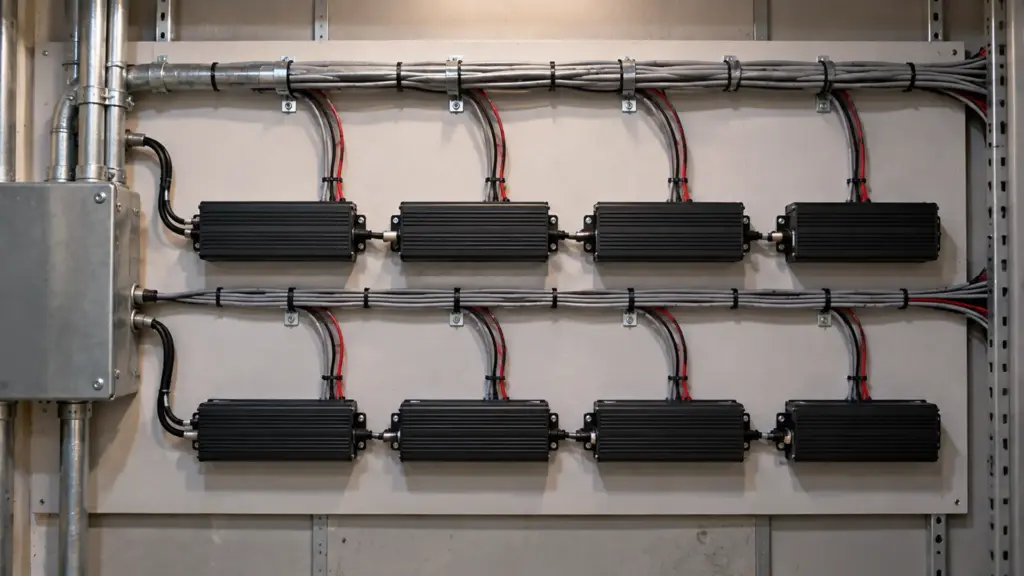
On low voltage, that load splits. A Class 2 driver such as UT-D60-24-C2 is rated 60 W, so 235 W takes four and 421 W takes eight, before headroom. Keep the connected load at or below 80% of each driver’s rating and the count rises again. Larger supplies on our drivers, controllers and connectors page cut the count but sit outside the Class 2 group, which changes the wiring.
The strip limits the run too. UT-C384-8 is listed at 32 ft (10 m), so 98 ft is four runs and four feeds; a 16 ft (5 m) per feed strip needs seven. Our voltage drop guide explains why, and covers the 48V and constant-current options that reach 65 ft (20 m).
So a 98 ft soffit or parking structure outline on 120V is one feed and one cable. On low voltage it is several drivers, several feed cables, and a closet to put them in. Our opinion: below about 32 ft the driver count is small, and the choice should follow color, cut length, and control.
The labor picture
The saving is not only the drivers. On low voltage, each feed is its own cable pulled back to the driver location, sized for its own current, and each driver needs a place that stays dry, ventilated, and reachable without opening a finished surface. On a long exterior run that can mean a weatherproof enclosure at the base of a wall, conduit to it, and a service visit to every driver when one fails.
The same length on 120V is one feed at one point. The work moves to the electrician’s side instead: a line-voltage connection, a box, and an inspection. That trade pays off on a long building edge and barely matters on a 12 ft shelf, where the driver can sit in the cabinet next to the strip.
Color and Cut Length: What 120V Gives Up
Our 120V page states the trade plainly: Ra 75–80, and larger cut intervals than low-voltage strip. For color-critical interior work it says to specify low-voltage COB instead.
Color. UT-H120-60, -72, -120, -112-FF and -296-COB are Ra≥80; UT-H120-288-COB is Ra≥75. Our low-voltage COB LED strip series are Ra≥90, with UT-SC320CRI97-15 at Ra≥97. Our high-CRI guide explains where the higher tiers matter: merchandise, artwork, finish samples.
Cut length. Standard 120V strip cuts every 19.7 in (500 mm), UT-H120-288-COB every 9.8 in (250 mm), and UT-H120-296-COB every 4.9 in (125 mm). Low-voltage COB cuts every 0.98 to 1.97 in (25 to 50 mm) on UT-C320-8 and UT-C480-8, and every 1.23 in (31.25 mm) on UT-C384-8.
Strip comes in whole increments, so the interval sets the largest unlit gap at a run end: up to about 5 in on the 4.9 in COB and up to 19.7 in on standard 120V. In a continuous cove the gap hides. In a framed shelf or a short case it does not.

Dimming and Flicker
Our 120V series dim by TRIAC phase-cut from standard wall dimmers, with no extra control wiring. That suits a project where the wall boxes already exist and each area has one dimmer.
It also limits control. A 120V strip does not take a 0-10V signal, a DALI address, or a PWM decoder. Low-voltage strip on the right driver takes all of them. Our dimming guide covers each path.
Flicker is the other point. Direct-AC strip can show flicker, and occupied or filmed spaces are where it gets noticed. For those spaces we offer the flicker-free UT-H120-112-FF at 3.7 W/ft, or low-voltage strip on a driver chosen for low flicker. Our opinion: if the owner may later want scenes or a building-management tie-in, use low voltage, because moving a 120V run to DALI means replacing it.
Line Voltage Is Not Class 2
Many 24V jobs are designed as Class 2 because the output is power-limited, so the strip wiring can use CL2 or CL3 cable and, in most occupancies, skip conduit. Our Class 2 driver guide covers what the inspector checks on that side.
A 120V strip has none of that. Its conductors are line voltage and follow line-voltage wiring methods, boxes, and connections. Our 120V page says so directly: follow NEC and local code, and hardwired installations should be completed by a licensed electrician. Carry the electrician, the permit, and the inspection in the schedule from the start.
The trade cuts both ways. Class 2 saves wiring effort but caps each circuit, which is why a long low-voltage run needs several. Line voltage has no Class 2 cap, but every conductor and termination is an electrician’s job. Ask the AHJ early about the wiring method for a line-voltage strip in the space.
Follow the Listing: Cuts, Joints and Rated Length
A line-voltage strip is installed the way its listing’s instructions say, and those instructions are stricter than habit from low-voltage work.
- Cut only at the marked points, and cap every cut end with the matching listed end cap. An open end on a 120V strip is a live conductor, not a cosmetic issue.
- Join only with the parts the instructions name. Low-voltage clip connectors and field splices do not carry over to a line-voltage strip.
- 98 ft is the rated maximum, not a target. Our 120V page lists 98 ft (30 m) from a single feed. Do not extend a run past it, and do not feed a run from both ends unless the instructions allow it.
- Use the listed rectifier plug and keep it where it can be reached and kept dry.
- IP65 is not a location rating. Our 120V page says the wet location marking comes from the product’s listing and is confirmed per model at quote. Our wet location guide explains the difference.
Service changes as well. One feed lights the whole run, so a failed feed or a bad joint darkens everything downstream of it. On low voltage, separate runs fail separately. The smallest replaceable piece is the cut interval: 19.7 in on standard 120V.
Mixed Projects
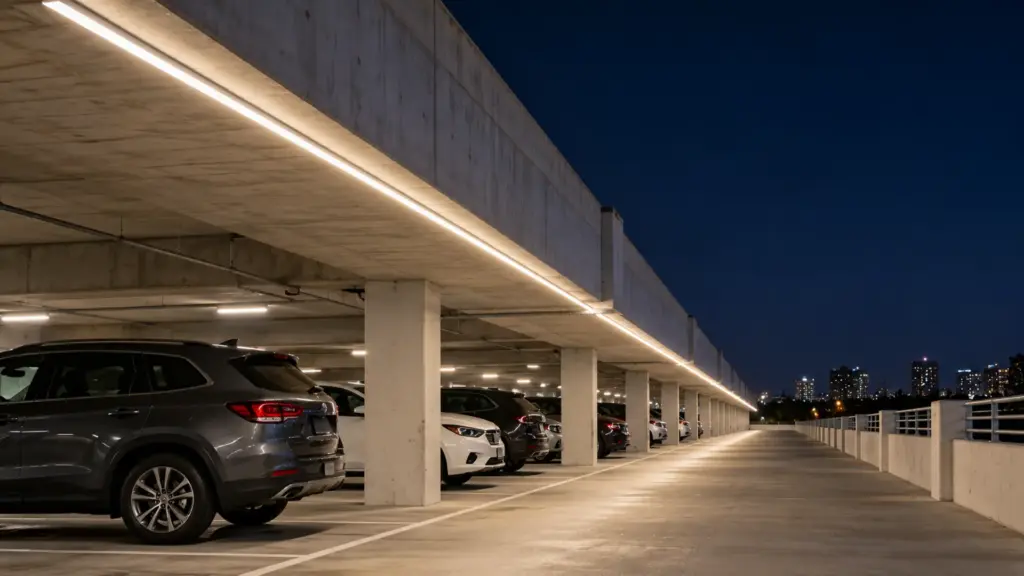
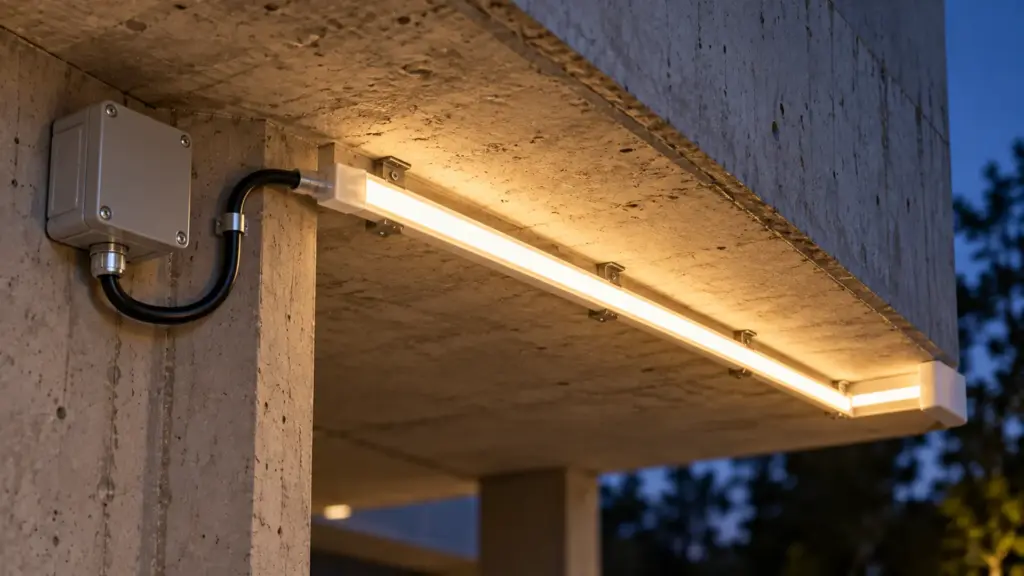
Many projects use both. A common split is 120V strip for the exterior outline, the soffit, and the parking structure, and 24V strip on drivers for the lobby, the retail floor, and anywhere color is judged.
Mixing has two traps. The first is matching whites. The 120V strip comes in 2700–6500K and the 120V COB in 3000, 4000, and 6000K, while low-voltage COB runs 2700–6000K or 2700–6500K by model. Where an exterior band and an interior band are seen together, such as an atrium wall through glass, compare samples side by side before the order is released, under the light the space will actually have at night.
The second trap is control. If the 120V zones stay on wall dimmers and the low-voltage zones tie into 0-10V or DALI, the owner has two control systems. Show that on the drawings so the commissioning scope is clear.

Common Mistakes
- Choosing 120V on a color-critical job to save drivers. The Ra gap cannot be fixed after install.
- Wiring 120V strip as if it were Class 2. It is a line-voltage product; plan the electrician, the permit, and the inspection.
- Forgetting the control system. A future DALI or building-management tie-in needs low voltage now.
- Ignoring the cut interval. A 19.7 in increment leaves a visible dark end on a short shelf.
- Using low-voltage connectors on 120V strip. Join and cap only with the parts the listing names.
Where Each Wins by Application
| Application | Use | Reason |
|---|---|---|
| Building outline, roofline, soffit | 120V strip | Long single runs, IP65 standard |
| Parking structure perimeter | 120V strip | Long runs, no driver cabinets to maintain |
| Long corridor cove | Either | 120V for one feed per run; low voltage for Ra≥90 and scene control |
| Display case or framed shelf | 24V strip on a driver | Ra≥90 and 0.76 to 1.97 in cuts |
| Gallery or artwork wall | 24V strip on a driver | Color rendering decides |
| Signage and light boxes | 120V strip | Long continuous lengths from line voltage |
| Filmed or camera-heavy space | UT-H120-112-FF or low voltage | Flicker-free series offered for these spaces |
FAQ
Does 120V LED strip need a driver?
No. 120V strip connects to 120V AC through a listed rectifier plug, which removes the LED driver, the driver location, and the low-voltage wiring plan. The line-voltage wiring follows NEC and local code.
How long can a 120V LED strip run be?
98 ft (30 m) from a single feed on every 120V series we list. The 230V international versions run 164 ft (50 m). Treat the listed length as the maximum, not a target.
Can you cut 120V LED strip?
Yes, at the marked cut points only: every 19.7 in (500 mm) on the standard series, 9.8 in (250 mm) on UT-H120-288-COB, and 4.9 in (125 mm) on UT-H120-296-COB. Cap each cut end with the listed end cap.
Is 120V LED strip dimmable?
Yes, by TRIAC phase-cut from standard wall dimmers. 120V strip does not take 0-10V, DALI, or PWM control. For filmed or occupied spaces, pair dimming with the flicker-free series.
Do I need an electrician for 120V LED strip?
120V strip is a line-voltage product, so follow NEC and local code. Our 120V page says hardwired installations should be completed by a licensed electrician. The strip is IP65 and available as a UL Listed option; confirm the location marking for the exact model.
Decision Rule
Settle color, control, and cut length first; if all three allow it and the run is long, use 120V. When they conflict, color and control win over run length, because a long low-voltage run can be split across drivers while Ra and the control protocol cannot be changed after install.
Have a mixed job? Send the elevations and the run lengths. We will mark which runs suit 120V LED strip, which need low-voltage COB on drivers, and how many drivers that takes: request a quote.