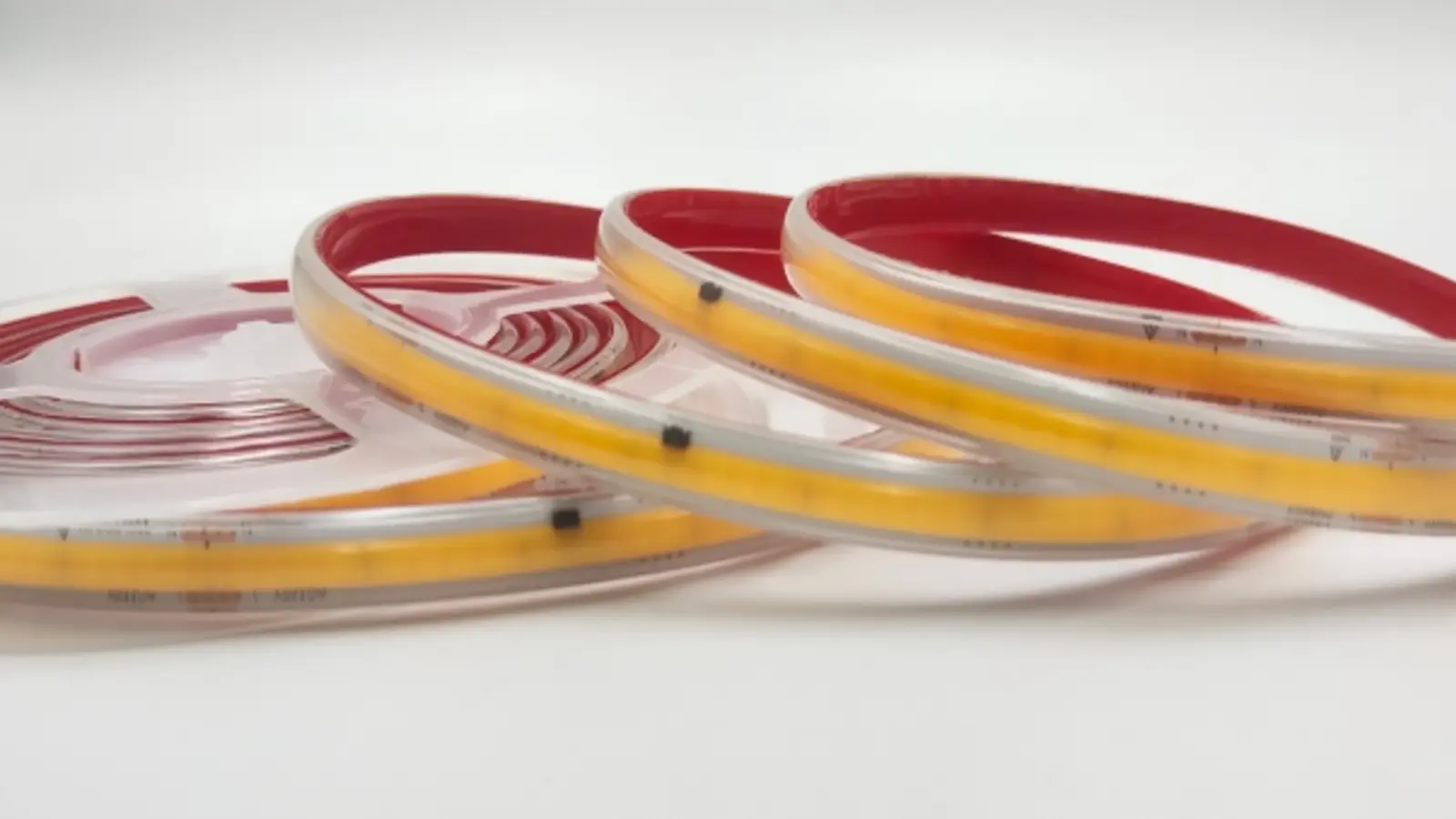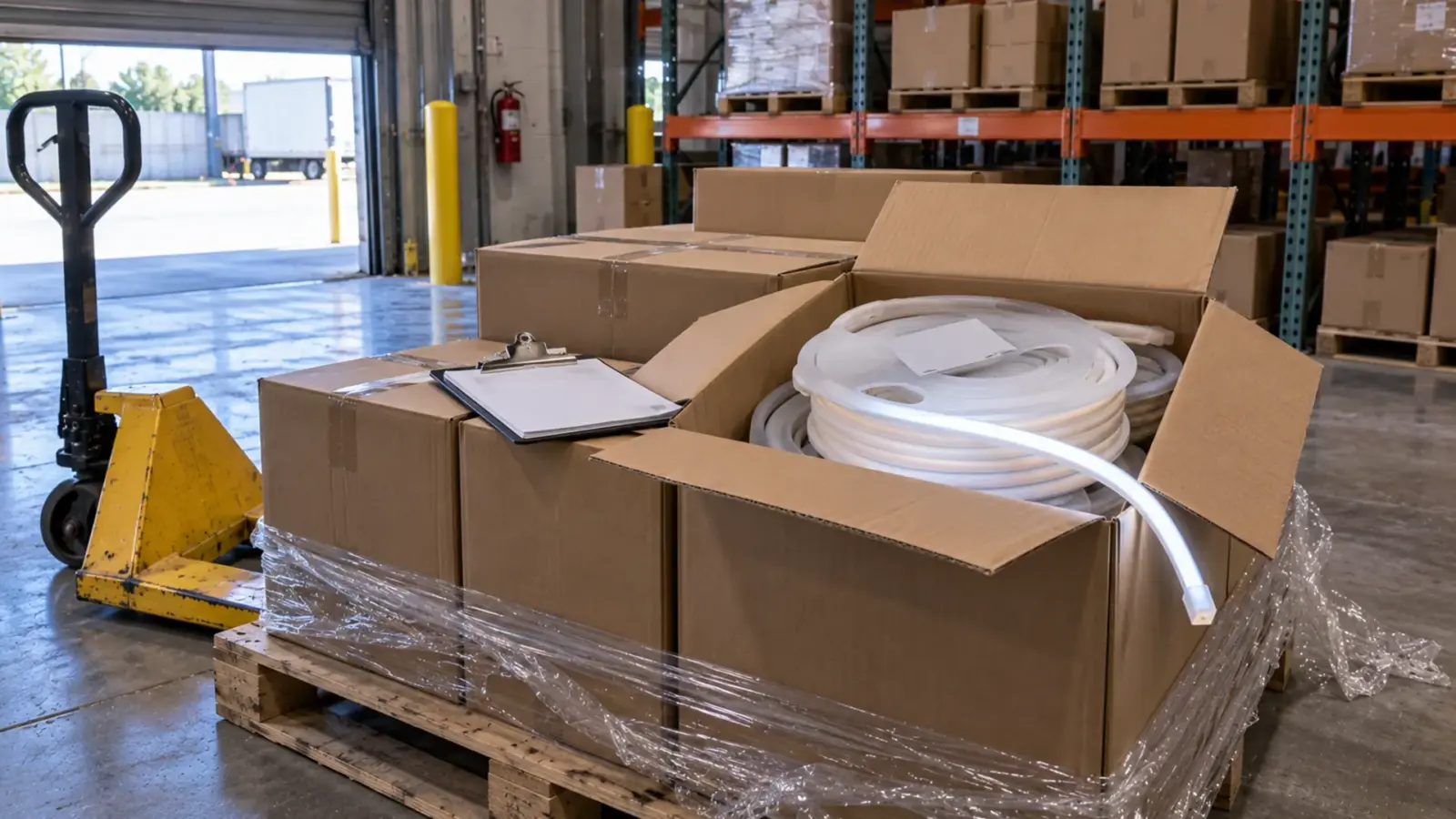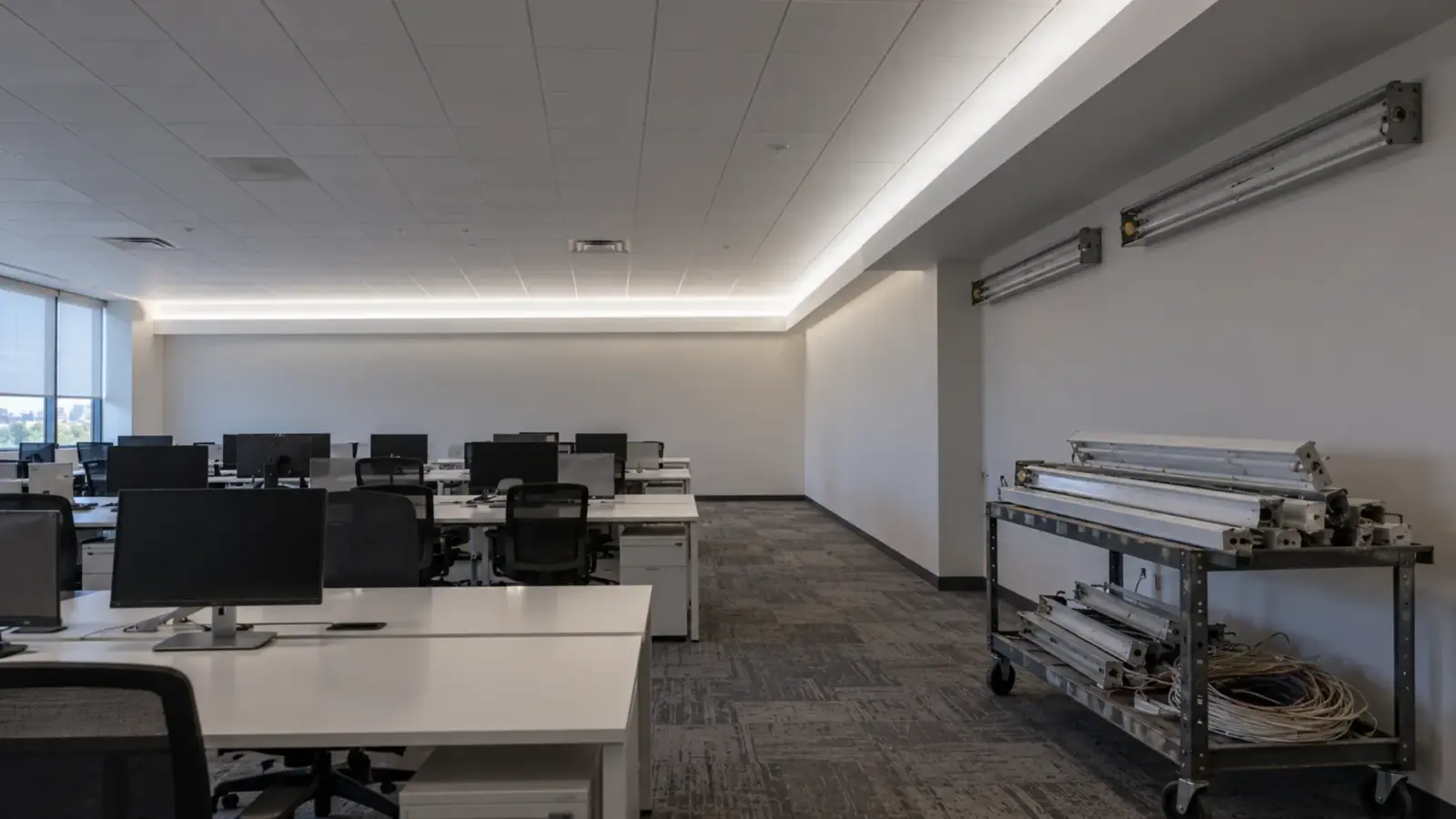
Can a 120V LED strip’s plug sit in the cove with its cord run through the drywall to a box? No. A cord is not fixed wiring, and the 120V LED strip cord rule inspectors cite, NEC 400.12 in Mike Holt’s 2020 summary, keeps cords out of walls and ceilings. The strip’s listing decides whether hardwiring exists.
The rest is a ladder of follow-up questions: what 400.12 forbids, which kind of listing the strip carries, when a cord may feed a luminaire, and how a hardwired connection stays inside the listing.
What 400.12 Forbids
Section 400.12 lists the places flexible cords may not go, unless 400.10 specifically permits them. Mike Holt’s 2020 NEC Q&A for EC&M sets them out: not as a substitute for fixed wiring; not through holes in walls, structural or suspended ceilings, or floors; not through doorways, windows or similar openings; not attached to building surfaces; not concealed by walls, floors or ceilings or above a suspended ceiling; not in raceways; and not where subject to physical damage. Each one maps onto a 120V strip detail that inspectors see:
| 400.12 prohibition | Typical 120V strip detail | The fix |
|---|---|---|
| Substitute for fixed wiring | Strip plugged into a cord run back to a distant outlet | Branch circuit to a box or receptacle at the start of the run |
| Through holes in walls or ceilings | Cord fed through drywall into the cove | Receptacle or listed connection inside the cove |
| Through doorways or windows | Cord across a door head to the next cove | A second feed point; 98 ft per feed leaves room |
| Attached to building surfaces | Cord stapled along a soffit to reach an outlet | Box at the run end, cord short and free |
| Concealed in walls or above ceilings | Cord hidden above a drop ceiling to a remote outlet | Fixed wiring above the ceiling, cord only in the open |
| In raceways | Cord pulled through conduit to the strip | Conductors rated for the raceway, not the cord |
| Subject to physical damage | Cord at a loading dock or in a parking structure | Box and connection out of reach |
The table explains why the same strip passes in one building and fails in the next: the strip did not change, the cord’s route did.
Two Kinds of Listing
120V strip is sold two ways, and the listing and instructions that come with each are the first thing to read.
The first is the flexible lighting product: decorative strip or rope light with a power-supply cord and plug, evaluated to UL 2388. That standard covers portable flexible lighting products with a maximum input of 120 V, and UL’s guide text for the category, as quoted on a 2005 Mike Holt forum thread, described them as provided with an attachment plug with “no provisions for permanent mounting to a building or structure”. Makers’ instructions say the same thing in plainer words. One American Lighting manual reads: “Do not route the cord or rope light through walls, ceilings, doors, windows or any similar part of the building structure,” and “Not intended for hardwire use.”
The second is strip sold with instructions for a permanent connection, through a factory hardwire lead or a listed connector to a junction box. Some 120V tape makers offer the same product either way; NORA Lighting’s 120V tape sheet lists “Hardwired or Cord & Plug”.
| Question | Flexible lighting product, cord and plug | Strip with hardwire instructions |
|---|---|---|
| Plug to a receptacle | Yes, the only connection | Often optional |
| Cord or lead into a junction box | No, where the instructions say so (“Not intended for hardwire use” in one maker’s manual) | Yes, per the instructions: factory hardwire lead or listed connector |
| Permanently fixed to the building | The maker’s clips or track only; no staples or nails | Per instructions |
| Field cutting | Often voids the listing | Per the listing: some at marked points with listed end caps, some factory-cut only |
Our 120V LED strip connects through a listed rectifier plug, and our page says “hardwired installations should be completed by a licensed electrician”; which connection method a given model’s listing allows is in its documentation, available on request with the quote. Read it before the box goes in, because it decides where the box goes.
- 1Read the listingstart hereStrip listing and instructions decide the path
- 2Cord and plug onlypath 1Receptacle at the start of the run; cord visible, not through walls, not attached, not concealed (400.12)
- 3Hardwire allowedpath 2Junction box at the start of the run; listed connector or kit; licensed electrician
- 4Not allowedcrossed outCord through drywall to a box above (400.12)
When a Cord May Feed a Luminaire
A cord is not always wrong. Section 400.10(A)(2) permits flexible cord for connecting a luminaire, and Minnesota’s electrical bulletin on cord-connected lighting walks through what follows. The luminaire must be listed, and under 410.62(C)(1), for a luminaire that is not adjustable, the cord must run directly below the outlet box, be visible its entire length, have strain relief, and not be exposed to physical damage. When those conditions hold, the cord may end in a grounding-type attachment plug, in a luminaire assembly with strain relief and a canopy, or in a listed manufactured wiring system.
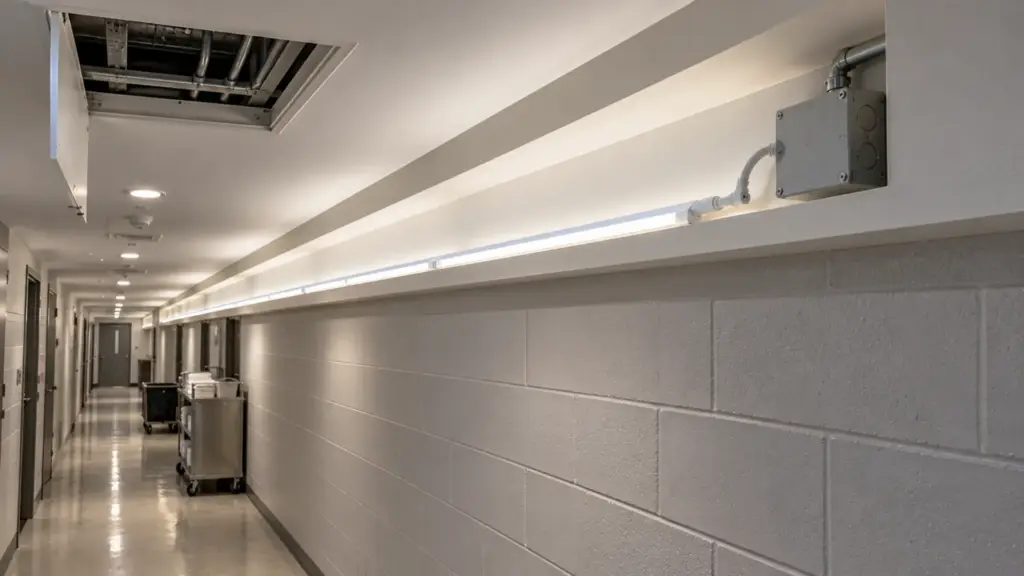
Minnesota’s bulletin is written for luminaires listed to the luminaire standard, and no source we found applies it to a cove, so what follows is our reading for the AHJ to confirm. A rectifier plug in a receptacle mounted inside the cove at the start of the strip, with a short cord that stays visible in the open cove, keeps the cord out of the wall and close to its outlet. A receptacle in the room below with the cord climbing the wall and over the cove lip is likely fastened to the wall and is nowhere near directly below its outlet. Put the receptacle where the plug lands.
Minnesota’s three scenarios are worth reading in full, because the third settles a common argument. If the instructions for a luminaire with a factory-supplied cord allow the cord to enter the side of a field-installed outlet box with strain relief, the department considers that compliant under 110.3(B): listed equipment installed per its instructions. Without that instruction, the cord ends in a plug or a canopy assembly.
Hardwiring 120V Strip
Where the listing allows it, hardwiring removes the receptacle and the cord question together. What it takes:
- A box at the start of each run. The connection is made in a junction box, not in the cove floor or behind the strip. Line-voltage strip is “wired with line-voltage methods like any other 120V load”, as our page puts it, and it is not Class 2; our channel bonding guide covers what that means for a metal channel around it.
- The connector the listing names. The hardwire kit or listed connector supplied for the product, not a cut-off plug and a wire nut. Cutting the plug off a cord-and-plug product is a field modification, and one rope light manual says altering the cord “will void the UL Listing”; our guide to cutting strip and its listing covers what modifications do to a listing.
- A licensed electrician. Our page says hardwired installations should be completed by one, and the connection is inspected under the electrical permit.
- The listing on file. Have the model’s listing and instructions on site; our listing lookup guide shows how to confirm the file number.
Covers, Soffits and Signs
Outdoors the same rules meet water. Our 120V series are IP65 silicone extrusion, which is a water-jet test, and our page adds that the wet location marking comes from the listing, confirmed per model, and that “the plug and connections need the same protection as the strip.” A rectifier plug in a soffit sits in a weatherproof in-use receptacle cover at the start of the run, with the cord dropping straight to the strip; it does not lie on the soffit board. Makers of cord-and-plug products, American Lighting among them, also call for GFCI protection on outdoor circuits. Our soffit and eave guide covers rating, mounting and sealed ends for the rest of that detail.
Millwork is the indoor version of the same problem. A 120V strip under a run of cabinets with its plug in a receptacle behind the cabinets puts the cord out of sight, and many inspectors read a cord behind or through casework as concealed. The simpler path on most cabinet jobs is to keep line voltage out of the casework altogether: 24V strip on a remote Class 2 driver rather than 120V strip.
Parking structures test the last line of the table. A 120V strip along a garage wall is within reach of vans and lifts, and a cord there is “subject to physical damage” in the plainest sense; feed it from a box at the run end, above the bumper line, with the cord as short as the connection allows.
Signs and display cabinets are the other common place for 120V strip. Signs have their own NEC article and listing (our LED neon sign guide covers UL 48 and UL 879), so treat strip in a sign as a sign question, separate from the cord rules here.
Circuit and Dimmer
A single 120V feed carries up to 98 ft (30 m) on every 120V series on our page. At 4.3 W/ft, 98 ft of UT-H120-120 is about 420 W, roughly 3.5 A at 120 V before power factor; UT-H120-60 at 2.7 W/ft is about 265 W. Several runs fit on one branch circuit, so the limit is usually the number of feed points the architecture needs, not the circuit.
The strip dims from standard TRIAC phase-cut wall dimmers, our page says, with no extra control wiring. Check the dimmer’s LED rating against the total strip load on it, and use the flicker-free series where cameras or occupied spaces demand it; our Lutron dimmer guide covers phase type and minimum load. And cap every cut end with the listed end cap, at the marked cut points, every 19.7 in on the SMD series, 9.8 in on UT-H120-288-COB and 4.9 in on UT-H120-296-COB.
FAQ
Can you hardwire 120V LED strip lights?
Only if the product’s listing and instructions provide for it, through the factory lead or listed connector into a junction box. Some cord-and-plug flexible lighting products, such as American Lighting’s rope light, say “Not intended for hardwire use.” Our 120V strip connects through a listed rectifier plug, and hardwired installs should be done by a licensed electrician.
Can the cord of a 120V LED strip run through a wall?
No. NEC 400.12 does not permit flexible cords to run through holes in walls, ceilings or floors, or to be concealed by them. Put a receptacle or a listed connection at the start of the run instead.
Is 120V LED strip low voltage?
No. It runs on line voltage, so the Class 2 rules for 24V strip do not apply, and it is wired with line-voltage methods like any other 120V load.
What is UL 2388?
UL 2388 is the standard for portable flexible lighting products with a maximum input of 120 V, such as decorative strip and rope lighting. UL’s guide text has described them as supplied with an attachment plug and with no provisions for permanent mounting to a building.
What to Settle Before Rough-In
- Which listing the strip carries, and whether its instructions allow a hardwire connection.
- A box or a receptacle at the start of every run, placed where the plug or connector lands.
- No cord through framing, across openings, attached to surfaces or concealed above ceilings.
- Weatherproof covers and listed wet location marking for outdoor runs.
- Feed points per the 98 ft limit and the architecture, and the dimmer’s LED rating against the load.
The models priced in watts above are on our 120V LED strip page; our 120V vs 24V guide covers when line voltage is the right choice in the first place.