LED strip earns no LEED or WELL credit by itself. Credits score the lighting design and its documents, and strip can be part of the lighting that earns WELL’s color, flicker, glare and circadian points and LEED v5’s quality electric lighting point. What decides it is how the strip is used and what the submittal shows. Material disclosure is a separate paper trail; HPD, EPD and Declare for LED strip shows what exists for strip and what to ask for.
The rules below are read from the current WELL v2 standard and the LEED v5 credit language for new construction. Both treat strip as a luminaire like any other; WELL adds two exemptions that matter a great deal for coves.
What the Credits Actually Score
| Credit line | What it asks | How strip fits | What to document |
|---|---|---|---|
| WELL L08 Part 1, color rendering (1 pt) | CRI ≥90, or CRI ≥80 with R9 ≥50, or TM-30 P1 | Ra≥90 strip passes on CRI alone; decorative strip is exempt | Ra (and R9 or TM-30 where used) per model, at each CCT for tunable |
| WELL L08 Part 2, flicker (2 pts) | Title 24 JA-10 reduced flicker, IEEE 1789 RP 1–3, or Pst LM ≤1.0 and SVM ≤0.6 | The strip and driver pairing is what is tested | A report for the driver and dimming method |
| WELL L04, glare (2 pts) | Per luminaire: 100% uplight, UGR ≤19, or ≤6,000 cd/m² at 45–90°; or UGR ≤19 for the whole space | Concealed and wall-wash fixtures are excluded from the luminaire option | Which strip runs are concealed; data for visible lines |
| WELL L03, circadian (3 pts) | 150 or 275 EML at workstations for four hours | Coves can add vertical light at the eye | A design calculation with the strip’s spectrum; points are verified by on-site measurement |
| LEED v5 EQc2 Path 2 (1 pt) | ≤6,000 cd/m² or UGR ≤19; CRI ≥90 or TM-30 Table 1 | Ra≥90 strip meets the color line | Same data as above |
| LEED v5 SSc6, light pollution (1 pt) | Uplight limits; facade lighting exemption in LZ3–4 | Exterior strip and wall washers | BUG data or the exemption and its midnight shutoff |
Decorative or General: Decide on the Schedule
Two of the WELL lines turn on a single word. L08’s color and flicker parts exclude decorative fixtures, and L04’s glare requirement excludes concealed, wall wash and decorative fixtures. WELL does not say who classifies each run, so classify every strip type on the lighting schedule, with the designer’s reasoning, so the reviewer can follow it against the drawings.
The honest test is what the strip does in the room. A cove that provides the room’s ambient light is general lighting that happens to be concealed: exempt from L04’s luminaire option, not exempt from L08’s color rule. A colored line behind a reception desk or a bar that nobody reads by is decorative. A visible slot over workstations is general and visible, so it meets both. Classify every strip type that way before the submittal is assembled, and the rest of the documents follow from it.
WELL L08: Color and Flicker
L08 Part 1 asks that “all luminaires in occupiable spaces (except decorative fixtures, emergency lights and other lighting for signage)” meet Color Rendering Index, 0–100: how truthfully the light shows colors next to a reference source. Ra≥90 is the usual bar for interiors. 90 or better, CRI 80 with R9 of 50 or better, or the TM-30 P1 values. A cove that lights the room is not decorative; a color line behind a bar probably is. Write the classification on the lighting schedule so the reviewer can follow it.
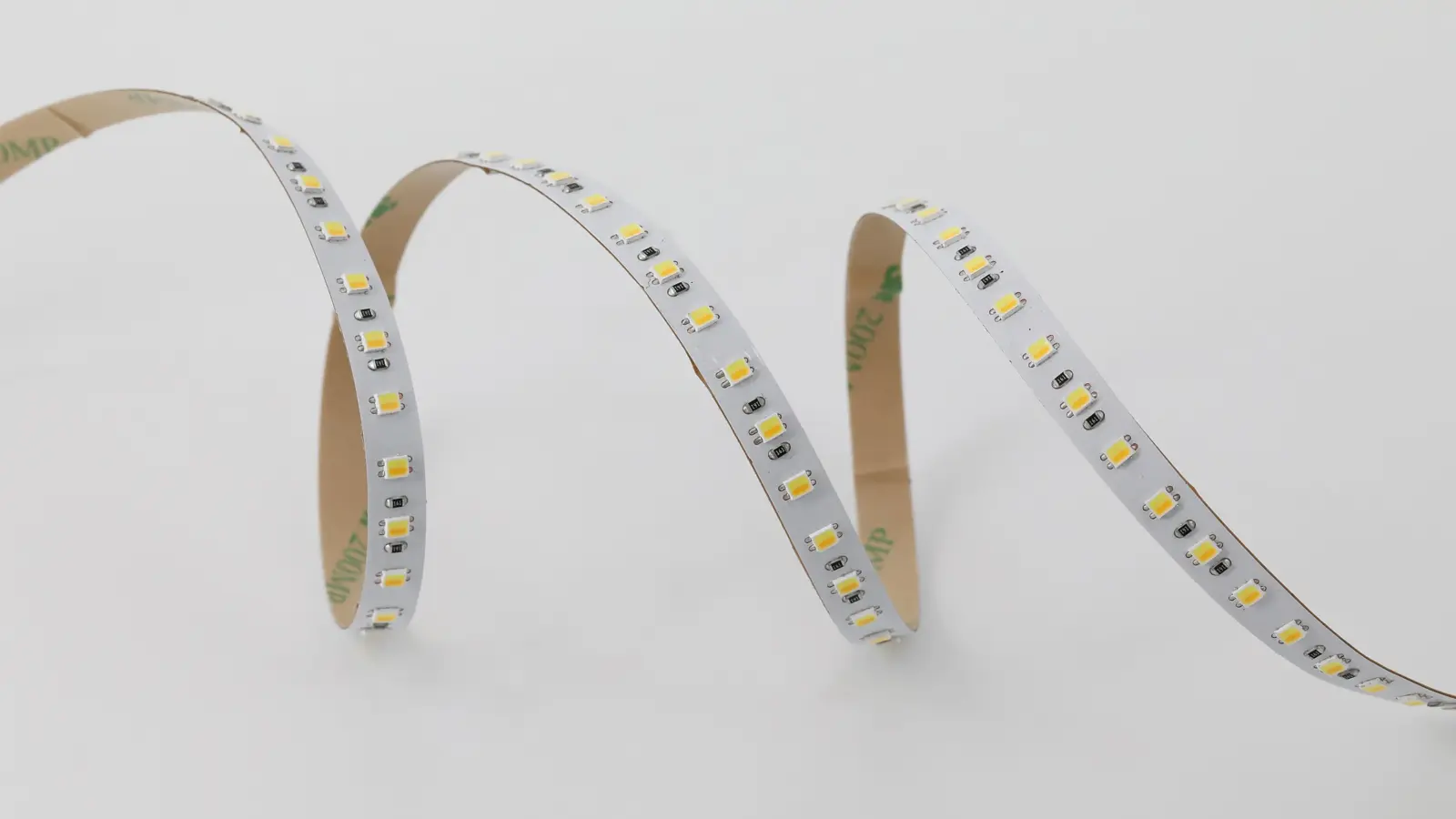
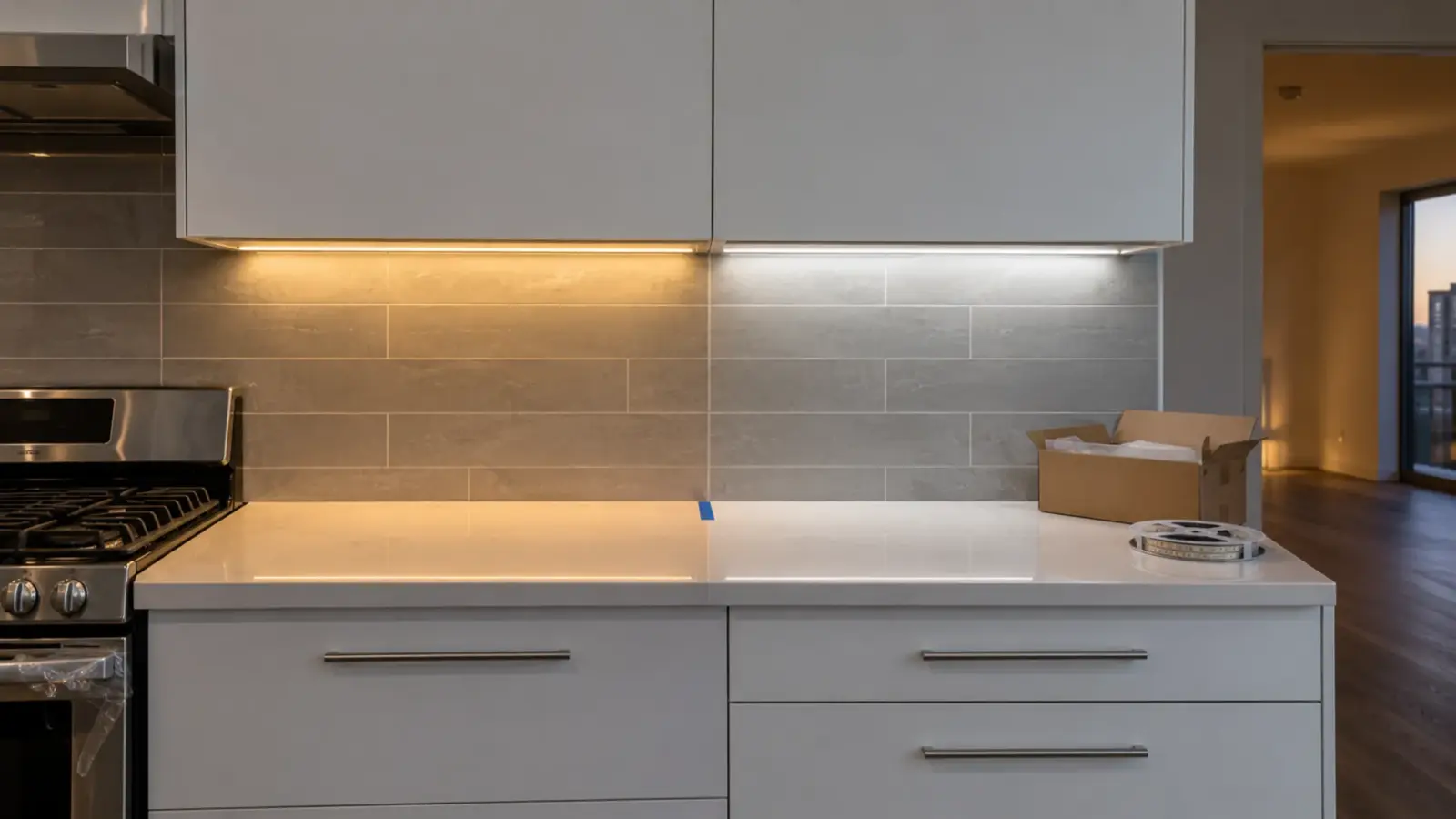
Color is the easy part for strip. (Circulation areas such as corridors have a lower bar in L08, CRI 80 or TM-30 P2.) Our standard COB rows are Ra≥90, and our tunable strips run “dual WW+CW channels, both rendering at Ra≥90”. Tunable strip has one extra test: WELL asks for the color requirement to be met “at 1000 K intervals from the lower end (with a minimum of 2700 K) to the higher end (with a maximum of 5000 K)”, so a 2700–6500K strip is documented at 2700, 3700, 4700 and 5000 K, not only at its two ends. Ask for the data at those points. If the project uses the CRI 80 path, R9 has to be on the sheet too; our cove page already tells designers to “ask for R9, the saturated red, along with Ra”, and our high-CRI guide explains what R9 shows.
Flicker is worth two points. Part 2 asks for one of three documented results for the luminaire and its controls: “reduced flicker operation” under California’s Title 24 JA-10 test, IEEE 1789-2015 recommended practice 1, 2 or 3, or Pst LM ≤1.0 and SVM ≤0.6. For strip, the driver and the dimming method decide the result. Our product pages say “all pairings are verified flicker-free before shipment”; for WELL, that verification has to become a report against one of those three metrics, so ask for it per driver and dimmer pairing at quote. Our flicker guide explains why the dimming method changes the answer.
WELL L04: Glare, and Why Coves Are Exempt
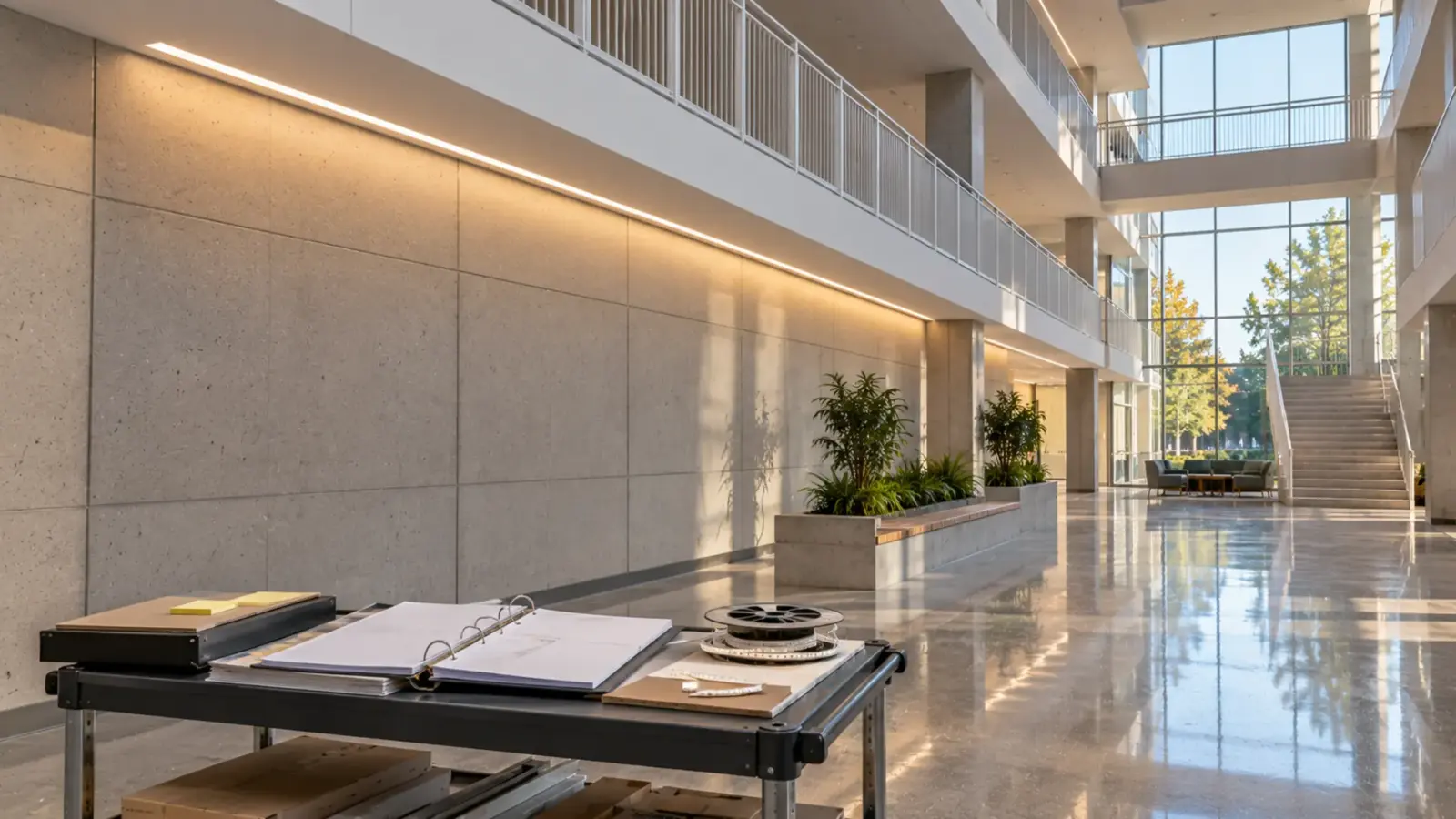
L04 is the credit where strip has an advantage. The luminaire option applies to all luminaires in regularly occupied spaces “excluding wall wash fixtures, concealed fixtures, emergency lighting and decorative fixtures installed as specified by the manufacturer”. WELL does not define the terms in the feature, but a strip hidden in a cove or behind a valance is normally treated as a concealed fixture and a wall grazer as a wall wash fixture; confirm with the project’s WELL AP. Treated that way, neither has to show a UGR or a luminance figure under that option.
Visible lines are different. A recessed slot with an opal diffuser seen from below, or a pendant profile, is a luminaire someone looks at, and it has to meet one of the luminaire choices, measured at regular-use output: 100% of its light above the horizontal, a UGR of 19 or lower, or luminance not over 6,000 cd/m² between 45 and 90 degrees from nadir. The alternative is to show a UGR of 19 or lower for every regularly occupied space as a whole. A deep channel with an opal cover and a lower-output strip is how slots usually get there; ask for the luminance figure of the channel and strip combination, not the bare strip. Our IES file guide covers which photometric file describes strip in a channel.
WELL L03: Circadian Light
L03 asks for melanopic light at the eye. For workstations, WELL wants at least 150 EML (136 melanopic EDI) for Tier 1 or 275 EML (250 melanopic EDI) for Tier 2, for at least four hours beginning by noon, measured on the vertical plane at eye level 18 in above the work-plane; projects with enhanced daylight get lower thresholds. In dwelling units the targets apply in living rooms and kitchens at 55 in, the light must be dimmable, and automated lighting must dim after 8:00 pm.
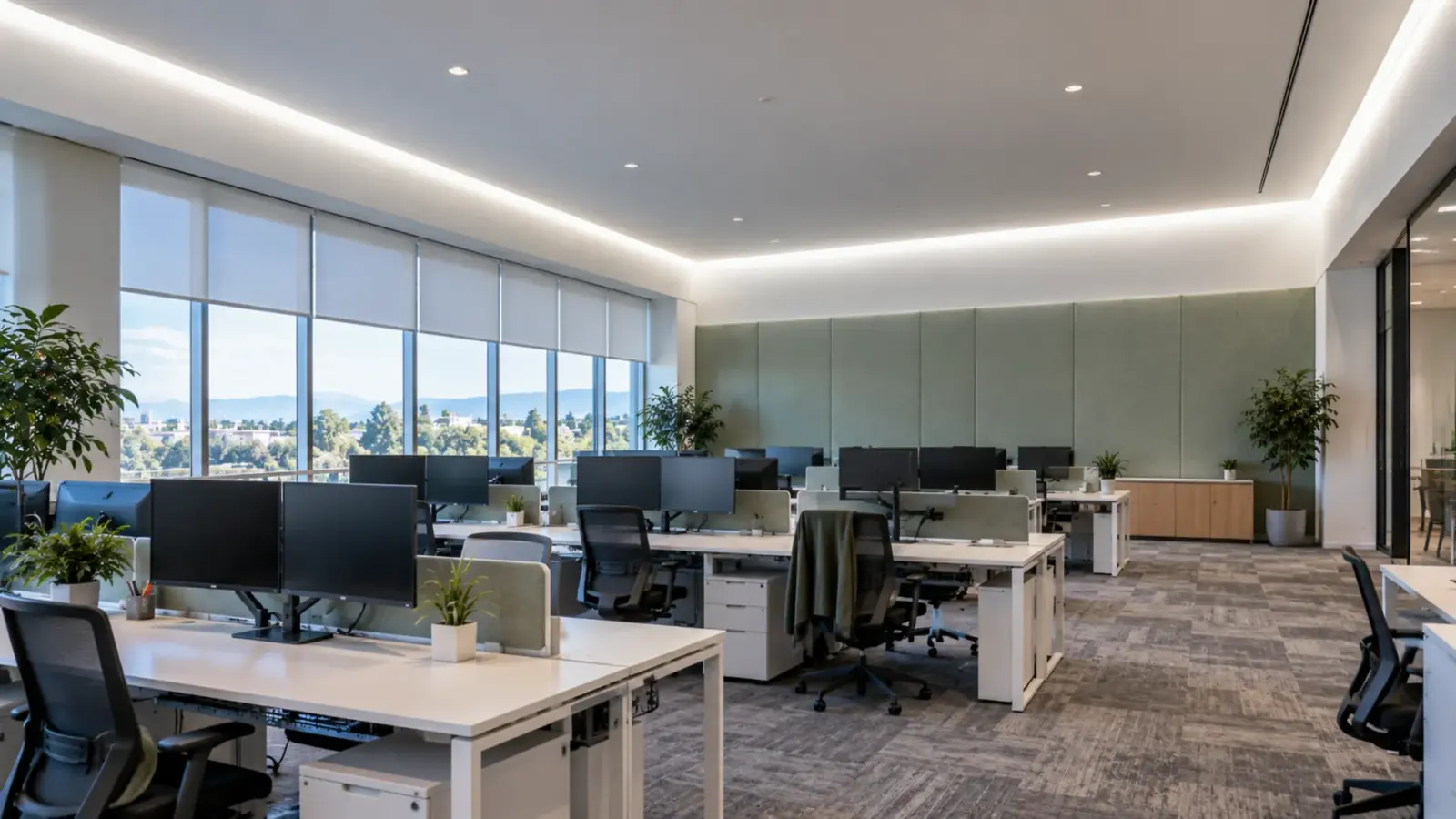
A perimeter cove can add vertical light at the eye, because it lights the walls and ceiling people face. A tunable cove at a cool CCT in the morning adds melanopic content where the target is measured. The designer predicts the result with the strip’s spectral data, so ask for that data with the photometric files; the points, though, come from a performance test on site, where WELL measures lux and spectrum with a spectrometer at night under electric light only, requires the median to meet the threshold and the lowest point to reach at least half of it. Who sets the schedule that keeps the morning cool and the evening warm is the question our tunable white guide answers.
LEED v5: One Point for Quality Electric Lighting
LEED v5 for new construction folds lighting into its Occupant Experience credit. Path 2, Quality Electric Lighting, is worth one point and asks two things of regularly occupied spaces: each luminaire under 6,000 cd/m² between 45 and 90 degrees from nadir or a UGR of 19 or lower, and luminaires with a CRI of at least 90 or the TM-30 Table 1 values.
The color line is the same as WELL’s simplest path, so Ra≥90 strip documents it directly. The glare line reads differently from WELL’s: the LEED v5 text read here gives no explicit exemption for concealed fixtures, so ask the LEED consultant early how coves will be documented, and keep the luminance data for any visible slot on file. USGBC’s deadlines page shows registration for LEED v4 and v4.1 commercial projects open until June 30, 2027, so some projects still use the older interior lighting credit; check which version the project registered under before preparing documents.
Outdoors: LEED v5 Light Pollution
Exterior strip and wall washers fall under LEED v5’s Light Pollution Reduction credit, one point. It limits uplight by lighting zone, U0 in LZ0 and LZ1 up to U4 in LZ4, and controls backlight and glare. It also exempts lighting used only for facades and landscaping in MLO lighting zones 3 and 4, provided it is controlled separately and “automatically turned off from midnight until 6 a.m.” A facade wash in a city center can stay out of the uplight count if it is on its own control and timer.
Energy Points Come From Watts
LEED v5’s energy credit carries far more points than the lighting one: Enhanced Energy Efficiency (EAc3) is worth up to 10 points against 1 for Quality Electric Lighting. It can be earned by energy simulation or by a prescriptive path built on ASHRAE 90.1-2022 Section 11 credits, which include lighting measures. Strip helps where it delivers the design’s light with fewer watts; our lighting power density guide covers how strip is counted.
FAQ
Does high-CRI LED strip earn a WELL point?
It can help earn the one-point color rendering part of WELL L08, if every non-decorative luminaire in occupiable spaces meets CRI 90 or another listed path. The strip alone earns nothing; the whole lighting schedule has to comply.
Is concealed cove lighting exempt from WELL glare requirements?
Yes, under the luminaire option of WELL L04: concealed fixtures and wall wash fixtures are excluded, as are decorative and emergency lighting. Visible slots and pendant profiles still have to meet UGR 19 or the 6,000 cd/m² limit.
Does tunable white strip earn WELL circadian points?
It can contribute to L03 by raising melanopic light at the eye in the morning, but the points depend on an on-site performance test showing 150 or 275 EML at workstations for four hours. Tunable strip must also meet L08 color rendering at 1000 K intervals between 2700K and 5000K.
What flicker documentation does WELL accept?
One of three: reduced flicker operation under California Title 24 JA-10, IEEE 1789-2015 recommended practice 1, 2 or 3, or Pst LM of 1.0 or less with SVM of 0.6 or less. For strip, test the driver and dimming method actually used.
What to Put in the Credit Submittal
- The lighting schedule with every strip run classed as general, concealed, wall wash or decorative.
- Ra for every model; R9 or TM-30 values if the CRI 80 or TM-30 path is used; tunable strip at 1000 K steps from 2700 to 5000K.
- A flicker report per driver and dimming pairing against JA-10, IEEE 1789 or Pst/SVM.
- Luminance or UGR data for visible slots and profiles, for the channel and strip combination.
- Spectral data for the design’s EML calculation where L03 is pursued, with the schedule that runs it, and a plan for the on-site performance test.
- For exterior strip, BUG data or the facade exemption with its separate control and midnight-to-6 a.m. shutoff.
The tunable and high-CRI strips described here are on our tunable white LED strip and COB LED strip pages; ask for the color and flicker data with the quote.