Yes. LED strip is lighting power, and energy codes count it. Under the rule described in the California code reference, tape wattage is its installed length times its rated watts per foot, or the maximum rated input of the driver that powers it. That wattage goes into the same lighting power total as every other fixture in the space.
Does LED strip count toward lighting power density? It is the question that comes back from plan review when a cove or a run of display tape shows up on the drawings without a wattage next to it. The short answer is above. The longer answer is how it is counted, which allowance it falls under, what controls it needs, and what the reviewer wants to see. This article walks through each, in the order a plans examiner checks them.
A caution first. Energy codes differ by edition and by jurisdiction, and they change every few years. According to CSE Magazine, standards such as ASHRAE 90.1 and the IECC are updated every three years. Treat this article as a map of the questions, and the adopted code text as the answer.
How a Code Counts a Strip’s Watts
A downlight has a wattage on its label. A strip has a wattage per foot, and the installed length is decided on site. So codes need a rule for turning strip into watts.
According to the Energy Code Ace reference for California’s code, the wattage of LED tape lighting, and of linear lighting built with tape, is either:
- the installed length times the tape’s rated linear power density in watts per foot, or
- the maximum rated input wattage of the driver or power supply that feeds it.
The same reference requires the tape to be tested to UL 2108, UL 8750 or IES LM-79, so the watts-per-foot figure comes from a test rather than a catalog estimate. Energy Code Ace’s commentary on ASHRAE 90.1 describes the same two-way rule. Which of the two numbers applies, and whether you may choose the lower one, depends on the edition and on how the reviewer reads it. Ask before the submittal, not after.
The two numbers can differ a lot. A run of 40 ft at 3.2 W/ft is 128 W by length. If that run is fed from three drivers each rated for much more than their share, the drivers’ maximum rated input adds up to a larger figure than the strip’s 128 W. Drivers sized close to the load keep the two numbers close, which is one more reason the 80 percent sizing rule matters.
Older code language also had a rule for track lighting priced per linear foot. According to the foreword to an ASHRAE 90.1-2019 addendum, the requirement of 30 W per linear foot for track dates back to 90.1-1999 and had not been updated, and the addendum proposed changing it. That rule is about track, not tape, and the foreword itself is informative, so do not apply it to strip without checking the text of your edition.
Building Area or Space by Space
Once each fixture has a wattage, the code compares the total with an allowance. According to PNNL’s summary of ASHRAE 90.1, the lighting power allowance is the floor area times a lighting power density, a value in watts per square foot set for the building or space type. The DOE’s IECC lighting summary describes interior lighting power allowances in the same units.
Most codes offer two ways to set the allowance:
- Building area method. One LPD for the whole building type, multiplied by the gross lighted floor area. Simple, and strip simply adds to the building total.
- Space-by-space method. An LPD for each space type, such as an office, a corridor or a lobby, multiplied by that space’s area. More work, but it lets a lobby with a lot of decorative lighting borrow against a storage room with very little.
Strip-heavy projects often do better space by space, because coves and accent runs tend to cluster in the few spaces with generous allowances. According to the PNNL and Oregon summaries, interior LPDs in 90.1-2016 were lowered mainly because LED lighting had become more efficient, so allowances that once absorbed a decorative cove without notice are tighter now.
Where Strip Usually Lands: General, Decorative or Display
Strip can play three roles in a space, and codes treat them differently.
- General lighting. A cove or a linear slot that provides the room’s ambient light counts against the space’s base allowance like any other fixture.
- Decorative lighting. Many editions provide an additional allowance for decorative lighting in certain spaces, with conditions such as separate controls. A cove that exists for its look rather than its light may qualify. The conditions are specific to each edition, so read them before counting on the extra watts.
- Display or merchandise lighting. Retail codes have often allowed additional power for lighting merchandise, again with conditions. Shelf and case strip can belong here.
Additional allowances usually come with a control requirement: the extra lighting has to be switched or controlled separately from the general lighting. That decides the circuiting, so it has to be settled on the drawings.
A Worked Lobby Example
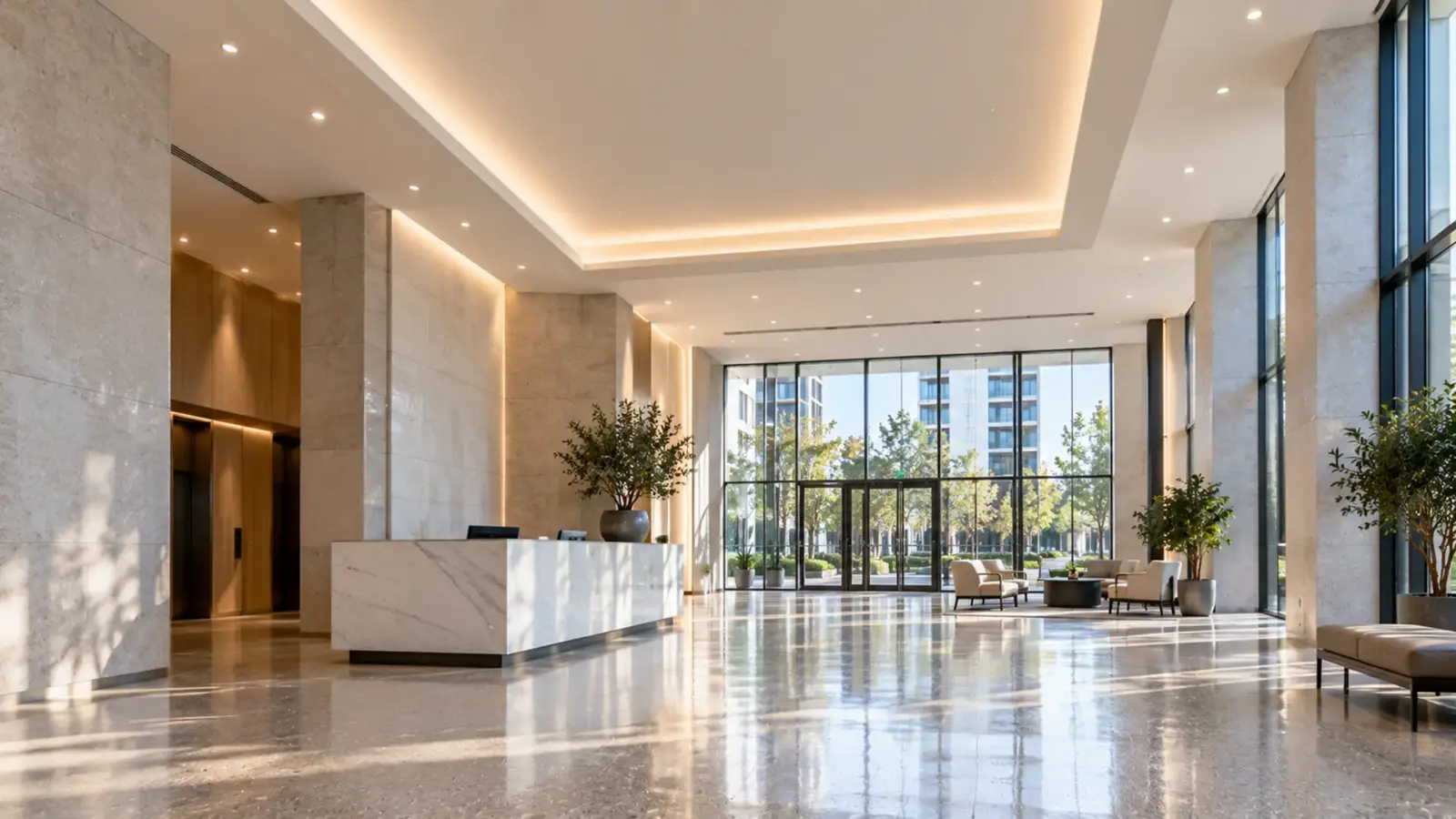
Take a 2,400 ft² office building lobby with a perimeter ceiling cove of 160 ft and twenty 12 W downlights.
- Downlights: 20 × 12 W = 240 W.
- Cove by length: 160 ft × 3.2 W/ft for a dot-free COB strip such as UT-C480-8 = 512 W.
- Total: 752 W.
- LPD of the design: 752 W ÷ 2,400 ft² ≈ 0.31 W/ft².
Now compare 0.31 W/ft² with the lobby allowance in the adopted edition. If the cove is counted by driver input instead, use the sum of the drivers’ maximum rated input from their datasheets in step 2; with 60 W Class 2 drivers each carrying 48 W, the 512 W cove needs eleven drivers, and their maximum input is the figure to use.
If the total comes out over, there are three levers. Use a more efficient strip for the same light: our high-efficacy UT-S2835-128-HE draws 2.9 W/ft, and the SMD LED strip page lists the efficacy tiers. Check whether the cove qualifies as decorative and can use an additional allowance. Or reduce the strip’s output and length where the design allows. Compare strips by light per watt, as our guide to LED strip lumens per watt explains, not by watts alone: a lower W/ft strip that also gives less light may not do the job.
Controls the Strip Has to Meet
Lighting power is half of an energy code; controls are the other half. Strip zones usually have to meet the same control rules as the fixtures around them:
- Manual control in the space, often with a requirement that the occupant can reduce the lighting.
- Automatic shutoff by occupancy sensor or time schedule.
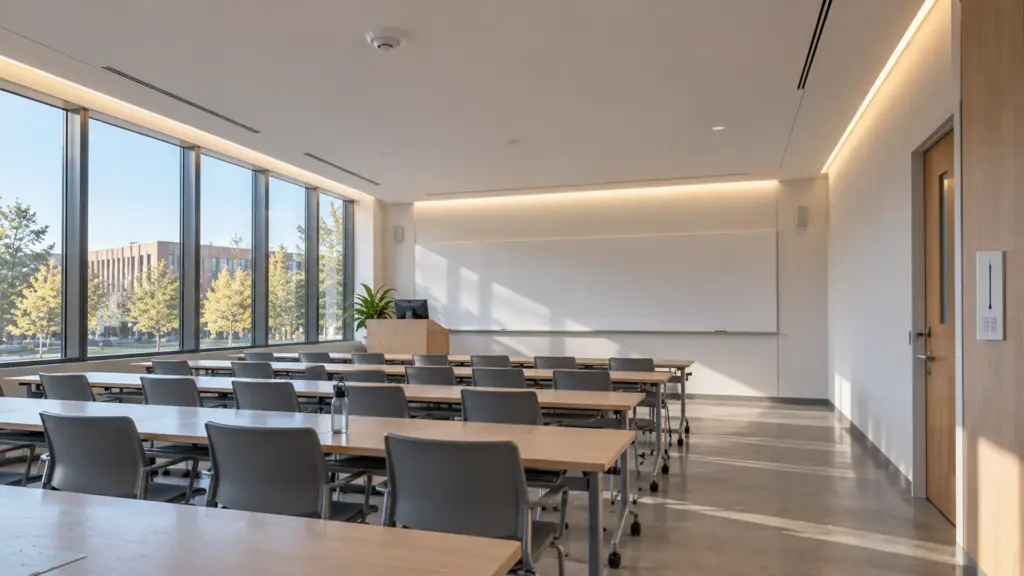
- Dimming or multi-level control in some space types. According to CSE Magazine, the IECC requires continuous dimming down to 15 percent in some spaces, such as offices and classrooms.
- Separate control for any lighting that uses an additional allowance.
The strip’s driver has to support the control the code demands. A non-dimming driver cannot meet a continuous-dimming rule; a 0-10V or DALI driver can. Settle the driver with the control design, and check that it dims smoothly to the code’s low point on the actual strip.
What Goes in the Submittal
A plans examiner checking strip needs to see the same things for every run:
| Item | Why |
|---|---|
| Run length per space | The length in length × W/ft |
| Rated W/ft from a tested datasheet | The other factor, from UL 2108, UL 8750 or LM-79 testing |
| Driver model and maximum rated input | In case the driver method applies |
| Which allowance it uses | General, decorative or display |
| Control method | Dimming, sensor, separate control |
According to a sample IECC compliance certificate in the DOE materials, fixtures are listed by wattage and quantity and totaled against the allowance; a strip run is one more line, with its wattage worked out as above. Our guide to the LED strip submittal package covers the documents that back those numbers, and LED strip lumens per foot helps match output to the design. For the California code specifically, see our Title 24 guide for LED strip.
Plan Review Comments That Come Back on Strip
Most comments on strip are about missing information rather than too much power. These are the ones that return most often, and the line that answers each.
| Comment | What it means | Answer |
|---|---|---|
| “Provide wattage for linear fixture L3” | The schedule shows tape with no watts | Length per space × tested W/ft, or driver input |
| “W/ft not substantiated” | The figure came from a catalog page | Datasheet with the test basis |
| “Decorative allowance claimed without separate control” | Extra watts used without the control condition | Show the separate circuit or zone |
| “Space type not identified” | Space-by-space method used without labels | Space names and areas on the lighting plan |
| “Dimming not shown for this space” | The space type needs multi-level or continuous dimming | Dimming driver and control on the schedule |
Two habits prevent most of them. Give every strip type its own fixture tag on the schedule, with a W/ft column next to the other fixtures’ wattages. And put the run length for each space on the plan or in a table, so the reviewer can multiply without measuring the drawing. A reviewer who can check the arithmetic in a minute rarely sends the set back.
On projects that use a compliance tool such as COMcheck, the same numbers go in as a line per fixture type. Enter strip as its own fixture with its wattage worked out for the space, not folded into another fixture’s count, so later changes to the cove length are easy to update.
FAQ
Does LED tape count as lighting power?
Yes. Codes count it like any other luminaire. Its wattage is usually the installed length times its rated watts per foot, or the maximum input of its driver, depending on the code edition and the reviewer.
Should I count the strip or the driver?
Read the adopted edition. Under the California reference either method is described; some reviewers expect the driver’s maximum rated input. Ask the reviewer before submitting, and keep driver sizes close to the load so the two numbers stay close.
Is decorative LED strip exempt from lighting power?
Usually not exempt, but some editions give an additional allowance for decorative lighting in certain spaces, with conditions such as separate controls. Check the conditions before counting on the extra watts.
Does the strip need to be tested?
Yes. The California reference requires tape to be tested to UL 2108, UL 8750 or IES LM-79, and reviewers elsewhere expect a tested W/ft figure too. Our guide to UL listings for LED strip explains which listing applies.
What to Verify With the AHJ
- Which energy code edition is adopted, and whether the building area or space-by-space method will be used.
- Whether tape is counted by length × rated W/ft or by driver input, and whether you may choose.
- Whether any strip qualifies for a decorative or display allowance, and the control it then needs.
- The dimming and shutoff requirements for each space type with strip.
- The test basis the reviewer accepts for the W/ft figure.