Lumens per watt does not tell you how good a strip is. It tells you how much light each watt buys. Two strips in our own tables draw about 3 W/ft, yet one delivers 190 lm/W and the other 30–34. The comparison is fair only when the strips share a build, a Color Rendering Index, 0–100: how truthfully the light shows colors next to a reference source. Ra≥90 is the usual bar for interiors. target and a level of measurement.
LED Strip Lumens per Watt: The Ratio and Where It Comes From
Lumens per watt (Lumens per watt: how much light the strip gives for the power it draws. Higher means less heat and less driver load per foot.) is light output divided by the power drawn. For strip, take lm/ft and divide by W/ft. UT-CSP-320-N lists 296–316 lm/ft at 3.05 W/ft, which is the 97–103 lm/W on its spec table. Strictly, that ratio is efficacy, a number with units. Efficiency is a percentage. Spec sheets use efficacy, so that is the number to compare. The ratio runs both ways: lm/ft equals lm/W times W/ft, so 97 lm/W × 3.05 W/ft gives 296 lm/ft, the low end of the same listing.
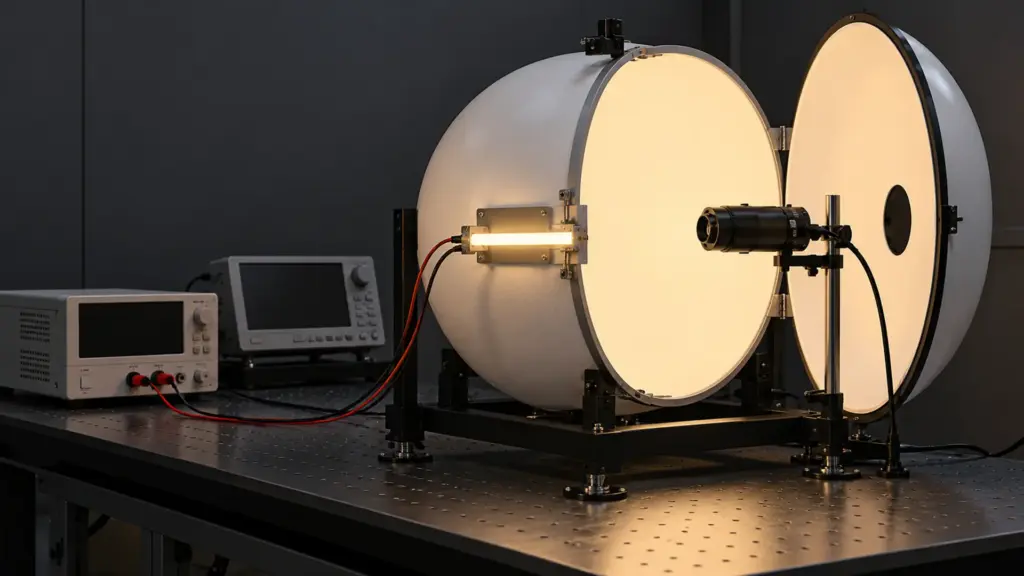
The same ratio gets quoted at three levels. Chip efficacy is the LED package alone. Strip efficacy includes the board, the phosphor layer, the heat of a dense run, and any diffuser or jacket. System efficacy adds the driver. The higher the level, the lower the number, and a datasheet that does not say which level it quotes cannot be compared with another.
Lumens come from a photometric test of the finished strip, and watts from the power measured at its input. Both belong to one build at one color temperature, so a figure quoted for the bare strip does not carry over to its diffused or jacketed sibling.
Our Range: From 30 to 190 lm/W
Most of our white strip families list lm/W, or list the lm/ft and W/ft that give it. The table puts one representative model from each build in order. Values run low to high across the range each model lists.
So what is a good number? For a bare white strip, about 100 lm/W is normal and 130 to 190 is high efficacy. According to Lumistrips, 100 to 149 lm/W is good performance and 150 to 200 is high, which is close to where our bare builds sit. Figures below 100 are expected where a build trades light for something else: more density, a diffuser, or a jacket.
| Model | lm/W | W/ft | Notes |
|---|---|---|---|
| UT-S2835-128-HE | 190 | 2.9 | SMD high efficacy, Ra≥90 |
| UT-SC320HE-15 | 130–140 | 4.6 | SCOB high efficacy, Ra≥90 |
| UT-SC336SS-6 | 115 | 1.8 | SCOB super slim, Ra≥90 |
| UT-SC308TW-18 | 110 | 5.5 | SCOB tunable white, Ra≥90 |
| UT-SC320CRI97-15 | 105 | 4.6 | SCOB high CRI, Ra≥97 |
| UT-SC300-15 | 100 | 4.6 | SCOB free-cut, Ra≥90 |
| UT-SFS series | about 100–125 | 1.5–5.9 | SMD full spectrum, Ra≥95 |
| UT-CSP-320-N | 97–103 | 3.05 | CSP standard |
| UT-CSP-480-N | 90–94 | 4.39 | CSP higher density |
| UT-CSP-160-MC | 85–100 | 2.93 | CSP mini cut |
| UT-CSP-320-DD | 78–89 | 3.05 | CSP dome diffused |
| UT-CSP-320-68WJ | 60–66 | 3.05 | CSP IP68, white jacket |
| UT-CSP-320-68BJ | 30–34 | 3.05 | CSP IP68, black jacket |
The UT-SFS figure is calculated from the listed lm/ft and W/ft across the four models. COB standard series do not list lm/W on the spec table, and their full photometric files ship with the quote.
The spread is not a quality ranking. The top row is a bare 2835 strip tuned for output at Ra≥90. The bottom row is a black-jacket IP68 strip built to disappear when it is off. Each does the job it was built for.
Read the table by build, not by rank. The high-efficacy SMD and SCOB rows sit at the top because those builds are tuned for output. The CSP standard and mini-cut rows sit in the middle, where the build trades a few lumens for fewer points of failure and finer cuts. The diffused and jacketed rows sit lower because a dome, a sleeve, or a black skin absorbs part of the light.
What Moves the Number: CRI, Density, Diffusers, Jackets
Four choices explain most of the gap, and our own tables put a number on each.
CRI. UT-SC320HE-15 and UT-SC320CRI97-15 share the same 320-LED, 4.6 W/ft construction. The first is Ra≥90 at 130–140 lm/W. The second is Ra≥97 at 105 lm/W, about 19–25% lower. High color rendering needs more red in the spectrum, and red light gives fewer lumens per watt. The high-CRI guide covers when that cost is worth paying.
Density. UT-CSP-480-N packs more chips per foot than UT-CSP-320-N and draws 4.39 W/ft against 3.05. It gives about 31–34% more light per foot (396–415 against 296–316 lm/ft) for 44% more power, so it lands about 7–9% lower per watt (90–94 against 97–103 lm/W). The CSP vs COB guide has the full comparison.
Diffusers. UT-CSP-320-DD is the same board under a hazed dome. It lists 78–89 lm/W against 97–103, about 14–20% lower. The dome opens the beam to 170.5° against 151.6° on the standard build, and the line looks smoother, but the strip spends more watts for the same light. The lumens per foot guide shows what that does to sizing.
Jackets. A plain sealed IP68 build barely moves the number: UT-CSP-320-68 lists 96–99 lm/W. A white jacket (UT-CSP-320-68WJ, 60–66) is about 36–38% lower. A black jacket (UT-CSP-320-68BJ, 30–34) is about two thirds lower, by design, because black silicone absorbs light. The sealed series was verified through 1,000 hours at 185 °F (85 °C) and 85% relative humidity with zero measured lumen loss, so the lower figure is a build choice, not aging. Never spec a black jacket by lumens.
Put the CRI case in lumens. Twenty feet of either SCOB strip draws 92 W (4.6 W/ft × 20 ft). At 130 lm/W, the low end of the Ra≥90 build, that is about 11,960 lm. At 105 lm/W it is about 9,660 lm, roughly 2,300 lm less for the same power. To match the light with the Ra≥97 strip you need about 24% more strip and 24% more power, or you accept the lower level.
Same Conditions or No Comparison
Two efficacy numbers compare only if they were measured the same way. Four things change a measurement without changing the strip:
- The test method. The IES LM-79 method measures the electrical and photometric output of a complete LED product, which is where lumens and watts for a finished strip should come from. LM-80 is a different test: it tracks how the lumens of LED packages hold up over time, and it does not give you a strip’s efficacy.
- Temperature. LED output falls as the junction heats, so lumens measured on a cold strip for a short time read higher than the same strip running warm. Ask at what ambient temperature, and how long after power-on, the number was taken.
- Drive level. The same strip driven harder gives more light and a lower lm/W, which is why a high-density build can list more lm/ft and fewer lm/W.
- Color. CCT and CRI move lm/W, as the CRI rows above show, so compare at the same CCT and Ra.
The practical rule: a figure on a spec sheet is a rated value for one build under stated conditions. The light you get is the delivered value, and it is lower after the diffuser, the heat of the run, the driver and the aging of the strip. The sections below put numbers on the first three; the lumens per foot guide carries the rest to the surface.
Same Watts, Different Light: Why W/ft Is Not Brightness
Watts tell you how much power the strip draws, not how much light it makes. Four CSP builds on the same 320-LED board all draw 3.05 W/ft.
| Model | W/ft | lm/ft | lm/W |
|---|---|---|---|
| UT-CSP-320-N | 3.05 | 296–316 | 97–103 |
| UT-CSP-320-DD | 3.05 | 238–271 | 78–89 |
| UT-CSP-320-68WJ | 3.05 | 183–201 | 60–66 |
| UT-CSP-320-68BJ | 3.05 | 91–104 | 30–34 |
Same wattage, and the brightest build gives about three times the light of the dimmest, 296 against 91 lm/ft at the low ends. The lumens per foot guide explains why that matters for sizing: a target in footcandles needs lm/ft, and watts alone cannot give it.
Turn it around and hold the light constant. Take a target of 5,920 lm, the output of 20 ft of UT-CSP-320-N at its low end. At 97 lm/W the strip draws 61 W. At 78 lm/W, the low end of the dome-diffused build, the same light takes about 76 W, which is 15 W more. Over 1,000 hours that is about 15 kWh for one 20 ft run. At 30 lm/W, the black jacket would need about 197 W for the same lumens, which is why it is never specified by lumens.
Chip, Strip, System: Where the Watts Go
Strip efficacy stops at the strip’s terminals. The driver sits between the wall and the strip, and the wall is what the meter reads. Run the numbers on one example.
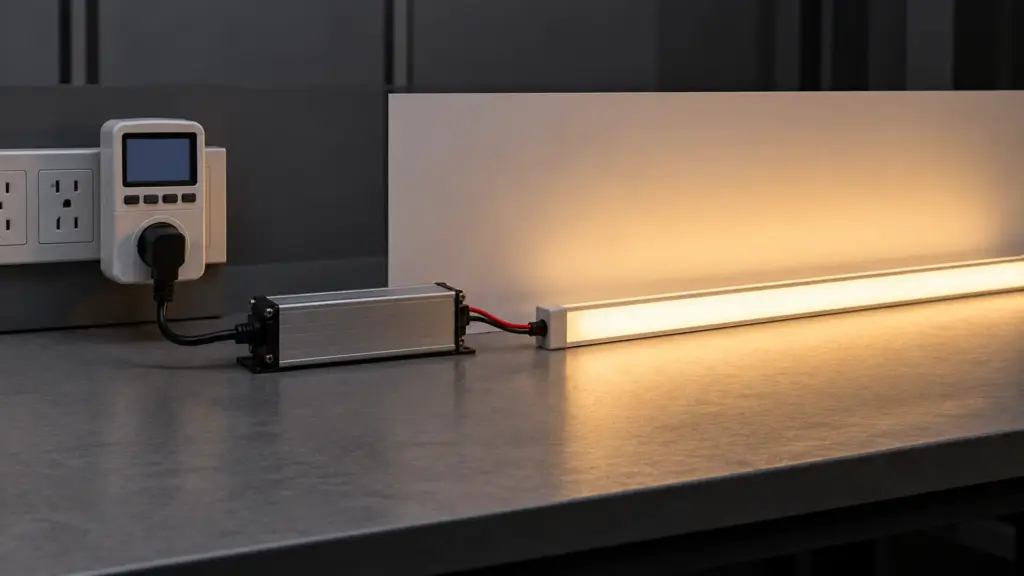
Take 20 ft of UT-CSP-320-N at its low-end 296 lm/ft. That is 5,920 lm. At 3.05 W/ft the strip draws 61 W, so strip efficacy is 5,920 ÷ 61, about 97 lm/W.
Now add the losses. According to FacilitiesNet, typical driver losses mean multiplying the LED figure by 85 percent. FacilitiesNet adds that some manufacturers recommend derating luminous flux by 10 percent for thermal effects.
| Level | lm/W for the example |
|---|---|
| Strip only | about 97 |
| Plus driver at 85% | about 83 |
| Plus 10% thermal derating | about 74 |
At 85% the wall draws about 72 W for the same 5,920 lm. FacilitiesNet cautions that this is a rough approximation, and that accurate measurement can only be made at the luminaire level. Treat the table as a rule of thumb from one source, not as a measurement of our strips.
The loss scales with the run. A 100 ft job of the same strip draws 305 W at the strip and about 359 W at the wall on the same 85% factor. That 54 W difference is turned into heat by the driver, and it never shows on a strip spec sheet.
Driver efficiency is on the driver datasheet and differs by model. Our driver pages do not list it, so ask for it at quote. Two systems with the same strip can differ at the wall by whatever their drivers lose.
When Efficacy Decides the Spec
Efficacy decides the spec on energy-code jobs and on long, bright runs.
The first is the energy-code job. Codes limit the lighting power a space may use, and the meter reads wall watts, so strip lm/W is only the first input. We do not quote code thresholds here, because the adopted code for the project and the authority having jurisdiction set them. Ask the designer which limit applies and at what level it is measured before you compare any two strips.
The second is a long, bright run. Every watt per foot turns into driver size, wire size, and voltage drop. A strip that gives the same lm/ft at fewer W/ft shrinks all three.
| Job | Check first | Why |
|---|---|---|
| Energy-code project | System efficacy at the wall | The meter reads wall watts |
| Long, bright run | W/ft at the target lm/ft | It sets driver size and voltage drop |
| Visible line, no diffuser | Line quality | COB reads as one band |
| Merchandise or gallery | CRI tier | Ra≥95 costs light on purpose |
| Sealed or dark channel | Ingress and finish | Jackets cost light by design |
Efficacy does not decide the spec where the line of light is seen. Our COB vs SMD cove guide shows the trade: the highest-efficacy strip we list is an SMD, while COB is the safer spec where dots would show. The other rows follow the same logic. A tier or a finish that exists for a reason is not ranked by lm/W.
Datasheet Check: Six Questions
- Which level is the number? Chip, strip, or system. A chip figure will always look best.
- Which build? Bare, diffused, or jacketed. On one CSP board, those builds span 30 to 103 lm/W.
- Which CRI and CCT? Ra≥90 and Ra≥97 differ by 19–25% on one platform. CCT moves it a little too: UT-CSP-512-CCT lists 238 lm/ft at 2700K and 244 lm/ft at 6500K.
- A single number or a range? UT-CSP-320-N lists 97–103. Compare the low ends.
- Whose watts? The strip’s W/ft, or the wall watts with the driver.
- Under which test method and temperature? LM-79 on the finished strip, at a stated ambient, is a number you can compare.
Ask for the photometric file with the quote. Full photometric files and IES data ship with our quotes, and they report the lumens, watts, CCT, and CRI for the actual build.
A quote that answers all five in writing can be compared with another quote that does. A quote that answers none of them is a marketing figure.
What to Ask Before You Compare
Lumens per watt compares strips only when they share a level, a build, a CRI and a test condition. In our range it runs from 30 to 190, and the gap is mostly the job each strip was built to do. Pick efficacy first on energy-code jobs and long runs, and ask for the system number at the wall. The SMD LED strip page lists the high-efficacy 2835 series, including UT-S2835-128-HE at 190 lm/W.