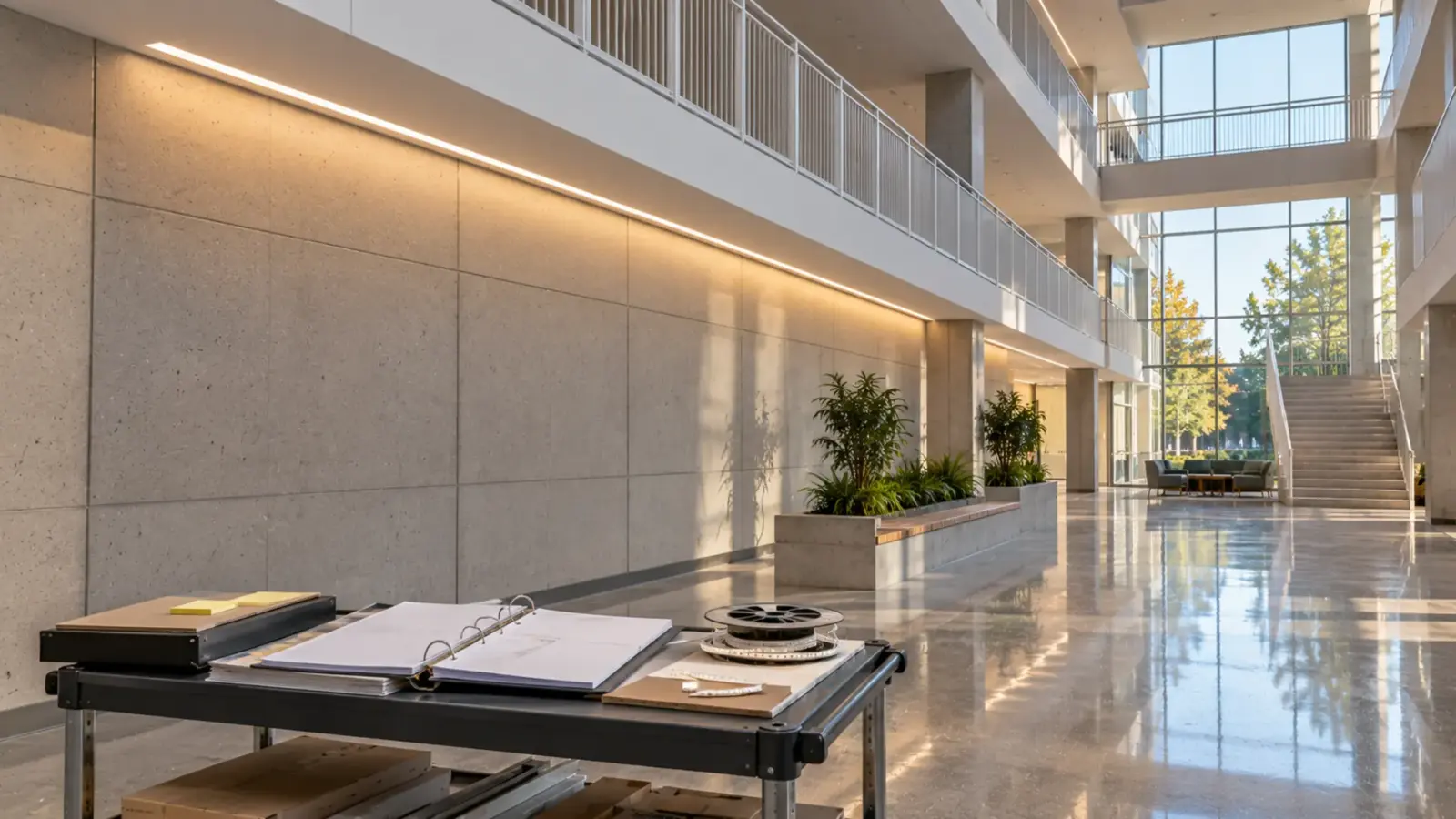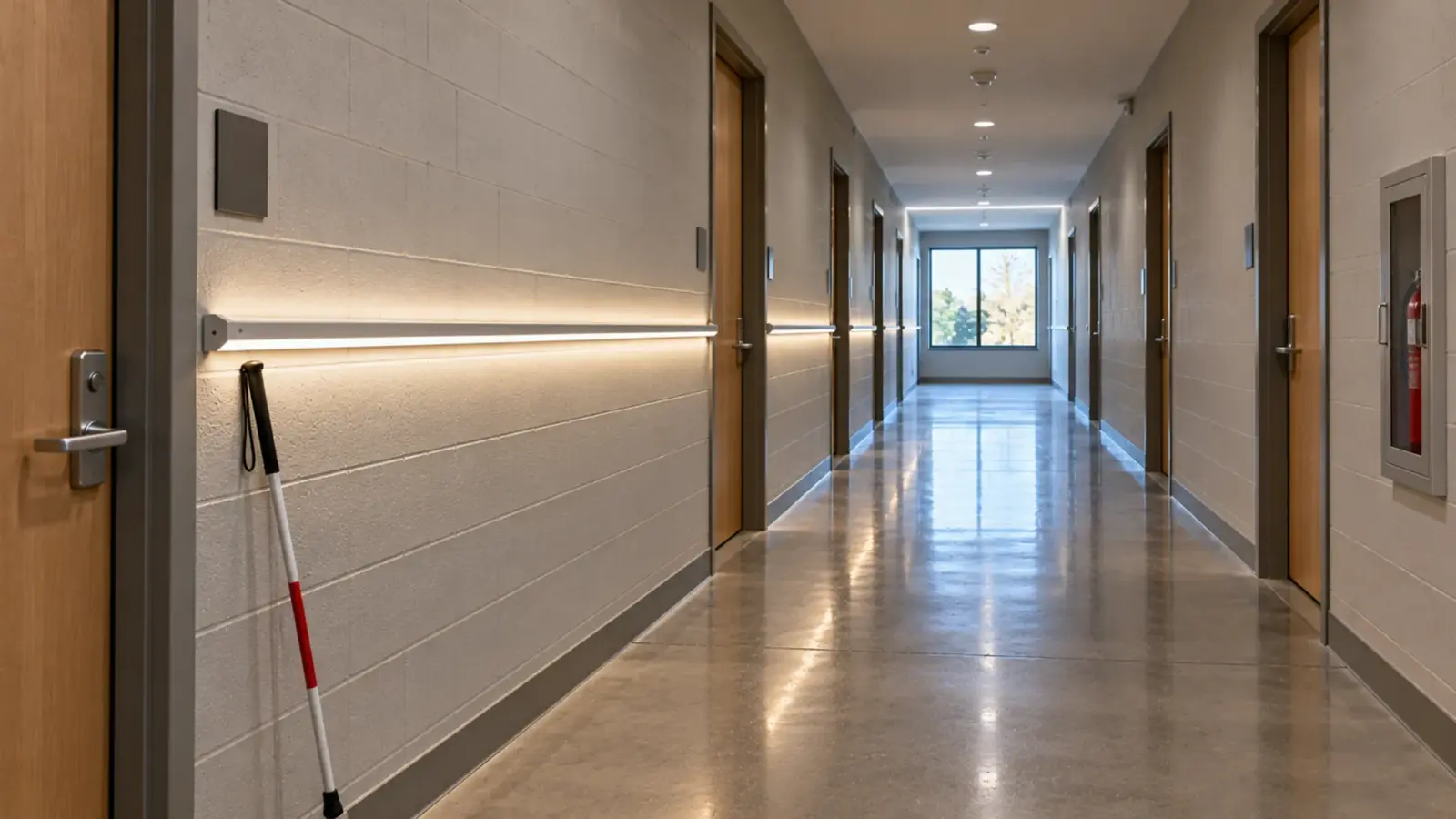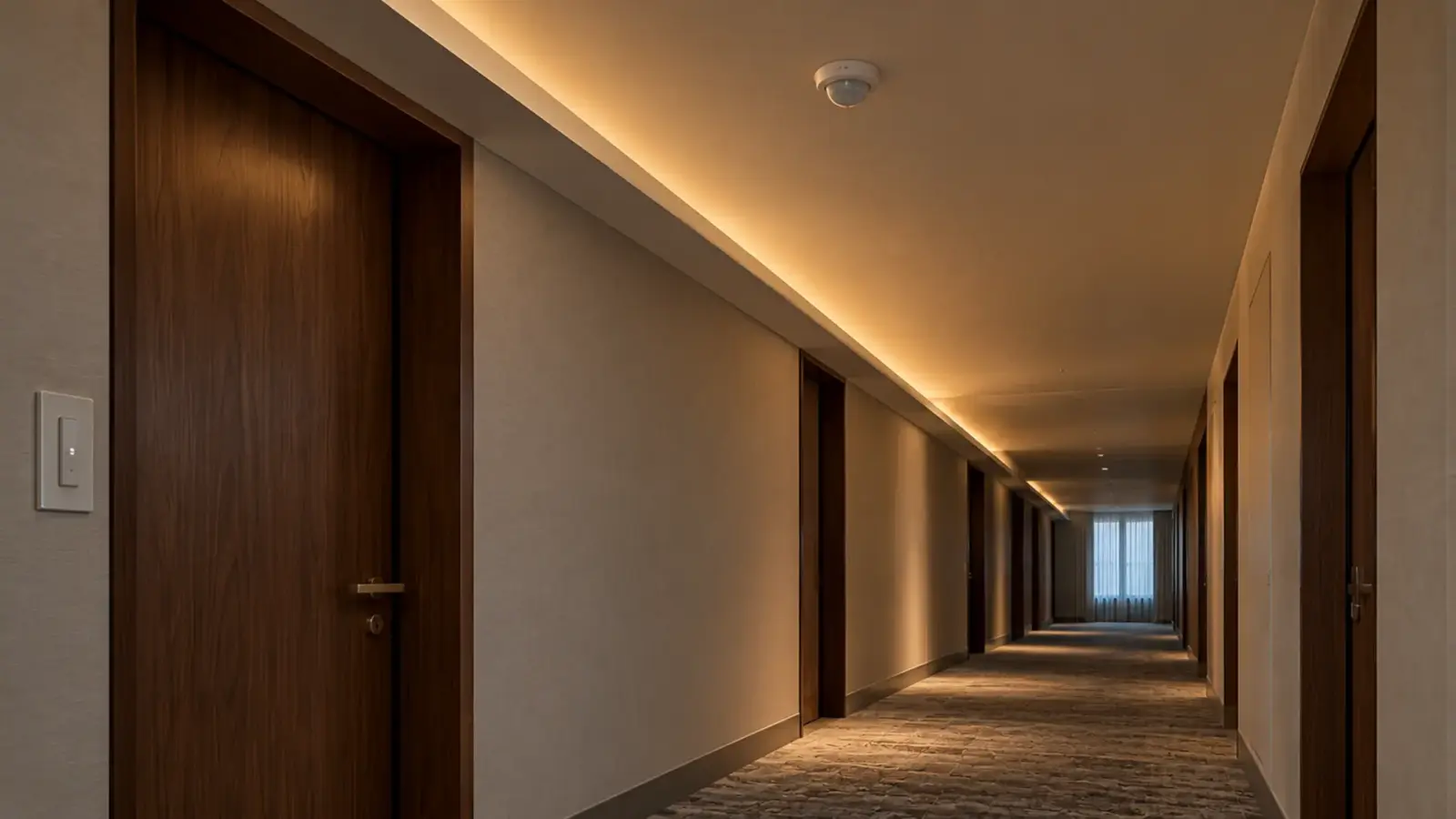
Is LED strip Title 24 compliant? The code never asks that of a strip. Part 6 of the code sets controls and power limits for the lighting system: dimming, automatic shutoff, daylight response and a power allowance. The 2025 edition applies to permit applications on or after January 1, 2026. JA8 is a separate qualification aimed at residential-type light sources.
That matters on a bid, because a spec line that says “Title 24 compliant LED strip” asks the wrong question. A strip cannot be compliant by itself. The strip, its driver, the control and the layout together either meet the project’s compliance forms or they do not. This guide sorts out which rules sit where, and what the strip side has to be able to do.
Which Code Year Applies
The California Energy Commission’s 2025 Energy Code takes effect on January 1, 2026. Permit applications submitted on or after that date fall under the new edition and use its compliance software and forms. A job whose permit application was filed earlier is not on the 2025 edition by default, so ask the plan checker or the energy consultant which edition the project was filed under.
Do not decide from the spec book alone. A spec written in 2024 can say “Title 24” without naming a year, and a renovation can sit across the date.
California adopts this code for California projects. Other states use their own energy codes, so a Title 24 line in a spec for a job outside California is a question for the engineer of record.
Nonresidential Controls: What the Strip Circuit Must Do
For offices, retail, lobbies and corridors, the mandatory lighting controls sit in Section 130.1. The table follows the Lighting Controls Association’s summary of the 2025 edition, which describes the control changes as mostly “corrections and clarifications” compared with 2022. Read the adopted text for exact thresholds before you design to any number below.
| Control | What the summary says | What it means for an LED strip run |
|---|---|---|
| Manual control (§130.1(a)) | Manual controls may sit in the space or remotely with status annunciation | The wall station is not on the strip circuit; someone has to own where it lands |
| Multilevel control (§130.1(b)) | Continuous dimming from 100% to 10% or lower | The driver and the control together must reach that low level on the strip |
| Automatic shutoff (§130.1(c)) | Occupant sensing, a time switch or an equivalent turns lighting off when the space is empty | A strip on its own circuit still needs a sensor or schedule feeding its driver |
| Daylight response (§130.1(d)) | The load that triggers daylight controls dropped; the summary cites 75 W of general lighting in a daylit zone | Cove and perimeter strip near glazing can reach the threshold |
| Demand response (§110.12) | Demand-response controls must comply with a qualifying standard | Applies to the control system, not the strip |
| Acceptance testing (§130.4) | Testing covers installed controls | Someone demonstrates the dimming and shutoff on site |
The 2025 edition also removes the Tailored Method for lighting power. Its allowances moved into Additional Power Allowances under the Area Category Method, according to the same summary. For a feature wall or a cove, that is a question for the energy consultant who builds the compliance forms.
What Manufacturer Guides Add
Manufacturer quick-reference guides from Lutron and nLight, which summarize the 2025 code for specifiers, add details the headline summaries leave out. According to those summaries, dimming applies to general lighting in spaces over 100 sq ft, occupancy sensing is not required for lighting mounted higher than 24 feet, a vacant zone must drop its lighting power substantially after a delay of about 20 minutes with full off complying, and daylight zones for spaces over 250 sq ft are drawn on the architectural plans. Treat each of these as a pointer to the code text, not a quotation of it. Lutron says its guide is not meant to replace the official energy code, and Inside Lighting says its article covers major requirements, not exceptions.
Strip circuits get missed in two places. The first is the drawing set: the architect shows a cove as a line on the reflected ceiling plan, and the controls schedule lists the room’s ceiling fixtures but not the strip. The second is the handover: the acceptance test walks the room with a meter and a switch, and the cove driver turns out to be on a circuit nobody wired to the sensor. Both are cheap to catch at submittal and expensive to catch at the walkthrough. Add each strip driver to the controls schedule by name before the order goes in.
Acceptance Testing: Proof Before Occupancy
The controls have to be shown to work before the building is occupied. Electricians in older Mike Holt Forum threads describe the same arrangement: lighting controls must be certified as properly installed and operational before the occupancy permit, and in California that check is done by a certified acceptance technician. Those threads predate the 2025 edition, so ask your plan checker how acceptance testing is handled on your permit.
What this means for a strip job is simple. The technician will operate the dimmer, step the control to its lowest level, trip the sensor and look at the result. If the cove does not dim to the level on the compliance form, or does not turn off when the room is vacant, the job does not pass, however good the strip is. A common arrangement in those threads is a 0-10V dimming switch plus a ceiling occupancy sensor feeding 0-10V drivers. It works because the driver is built for it, which is why the dimming protocol is chosen before the driver is bought. Our guide to 0-10V, TRIAC and DALI dimming covers which protocol fits which control system.
What the Strip Side Has to Do
The code speaks about spaces and circuits. On the strip side, three things carry the load.
Dimming depth. A 100% to 10% requirement is a system number. It depends on the driver’s lowest output, the control protocol and the strip itself. “Dimmable” on a datasheet does not tell you the minimum level. Ask for it by driver model and write it into the submittal.
Zones versus runs. A control zone follows the room, the sensor and the schedule. A strip run follows the driver, the feed points and the voltage drop. They do not line up on their own. A zone with three drivers needs all three to follow one dimming signal and one shutoff, or the cove will step on and off in sections.
Declared power. The compliance forms need installed watts. Strip watts per foot, driver size and any derating all change that number. Ask the energy consultant which wattage basis the forms use before you quote a long run, and keep the model datasheet figures for the file.
JA8: Residential-Type Spaces in Commercial Jobs
Joint Appendix JA8 sets the qualification requirements for high-efficacy light sources. The summaries we reviewed place most of it on residential lighting, and they list single-family homes, multifamily dwelling units, hotel and motel guest rooms, dormitories and senior housing in its reach. For a hotel or student-housing contractor that is the part that bites.
The requirements agree across the sources on these points:
- Color Rendering Index, 0–100: how truthfully the light shows colors next to a reference source. Ra≥90 is the usual bar for interiors. of 90 or higher with an R9 of 50 or higher
- Dimming down to 10% of light output
- Rated life of at least 15,000 hours
- The light source is certified together with its driver; if the source cannot be separated from the luminaire, the whole luminaire has to meet the requirements
The sources do not agree on the color temperature limit. One CEC fact-sheet summary gives 4000 K or lower for inseparable luminaires and light engines and 3000 K or lower for other sources; others state one number. Confirm against the JA8 text of the edition your project is under.
JA8 products are registered with the state and marked JA8-YYYY, where YYYY is the code year of the qualification, or JA8-YYYY-E when the product is also qualified for elevated temperature in enclosed fixtures. The registry is the CEC’s appliance efficiency database, called MAEDbS in the sources we read. Those sources describe lamps and luminaires and do not say how a loose LED strip qualifies, so for strip, ask the supplier for the database entry instead of assuming a generic reel counts.
Two consequences for strip. CRI alone does not qualify a strip; JA8 is a certification of a source with its driver, and compliant products are checked in the CEC’s product database, not on a datasheet line. And a strip with a high CRI range on a catalog page is not the same as a JA8-listed product.
A Typical Job: Corridor Cove and Guest-Room Cove
This is a typical hotel renovation, not a specific project. The corridor has a 120 ft (36.6 m) cove with strip fed from a closet at each end. The guest rooms off it each have a short headboard cove. Both use warm white strip on 24V drivers.
The corridor falls under the nonresidential controls. The design needs multilevel dimming to a low level, automatic shutoff tied to occupancy or a schedule, and an acceptance test at handover. The feeds from each closet are a voltage-drop decision. The zone is a control decision. If the two closets drive one corridor zone, the two drivers have to dim together, and the commissioning agent has to see the corridor step down as one line, not in two halves.
The guest rooms are a different question. If the plan checker files the rooms under the residential-style rules, each light source in the headboard cove has to be JA8-certified with its driver, and that certification comes from a database entry, not from the strip’s CRI line. A corridor strip with no JA8 paperwork can be perfectly acceptable, and the same strip in the guest room can fail the review.
The practical rule from this case: separate the two sets of paperwork before ordering. Put corridor and public spaces in one submittal against the nonresidential controls. Put guest rooms in another against whatever the plan checker applies there, and ask for the certified model numbers early, because the choice of strip can narrow to what is already certified.
Which Project Falls Where
| Space | Rule set to expect | First question to ask |
|---|---|---|
| Office, retail, lobby, corridor | Nonresidential controls in Section 130 | Which dimming depth and shutoff does the compliance form assume? |
| Hotel or motel guest room | Residential-style lighting rules, JA8 sources | Is each light source JA8-certified with its driver? |
| Hotel lobby, restaurant, back-of-house | Nonresidential controls | Same as office; confirm with the consultant |
| Multifamily dwelling unit | Residential lighting rules, JA8 sources | Same as guest room |
| Outdoor facade and signage | Outdoor lighting rules, not covered here | Does the plan check treat this under outdoor lighting? |
FAQ
Does Title 24 apply outside California?
No. Title 24 is California’s building standards code. Other states adopt their own energy codes, so a Title 24 line in a spec for a project elsewhere is a question for the engineer of record.
Does Title 24 require dimmable LED strip?
For nonresidential spaces, the multilevel control requirement asks for continuous dimming down to 10% or lower, so a strip circuit in a controlled space needs a driver and control that can reach it. Check the exception list in the adopted text for your space type.
Is JA8 required for commercial LED strip?
JA8 is aimed at residential-type lighting, including hotel and motel guest rooms. It is not the main route for offices and retail, which follow the nonresidential controls. Ask the energy consultant which route each space is filed under.
Which code year applies to a job permitted in 2025?
The 2025 edition applies to permit applications on or after January 1, 2026. Ask the plan checker which edition the application was filed under, especially for renovations that span the date.
Where do I check whether a source is JA8-certified?
In the California Energy Commission’s product database, not on the product page. Look the model up there and keep the record with the submittal.
Before You Order
- The permit application date, and the code edition your plan checker says applies.
- The compliance forms: the dimming depth, shutoff and daylight rules per space.
- Who performs the acceptance test, and which control the cove drivers hang on.
- The minimum dim level of each driver model, in writing.
- JA8 certification of the source and driver together for any guest room or dwelling unit.
- Zones versus runs: one dimming signal and one shutoff per zone.
Unitop Lighting supplies drivers, controllers and connectors with 0-10V and TRIAC dimming, matched to the strip at quote. Send the control scheme with your quote request and we will check driver and dimming protocol against it.