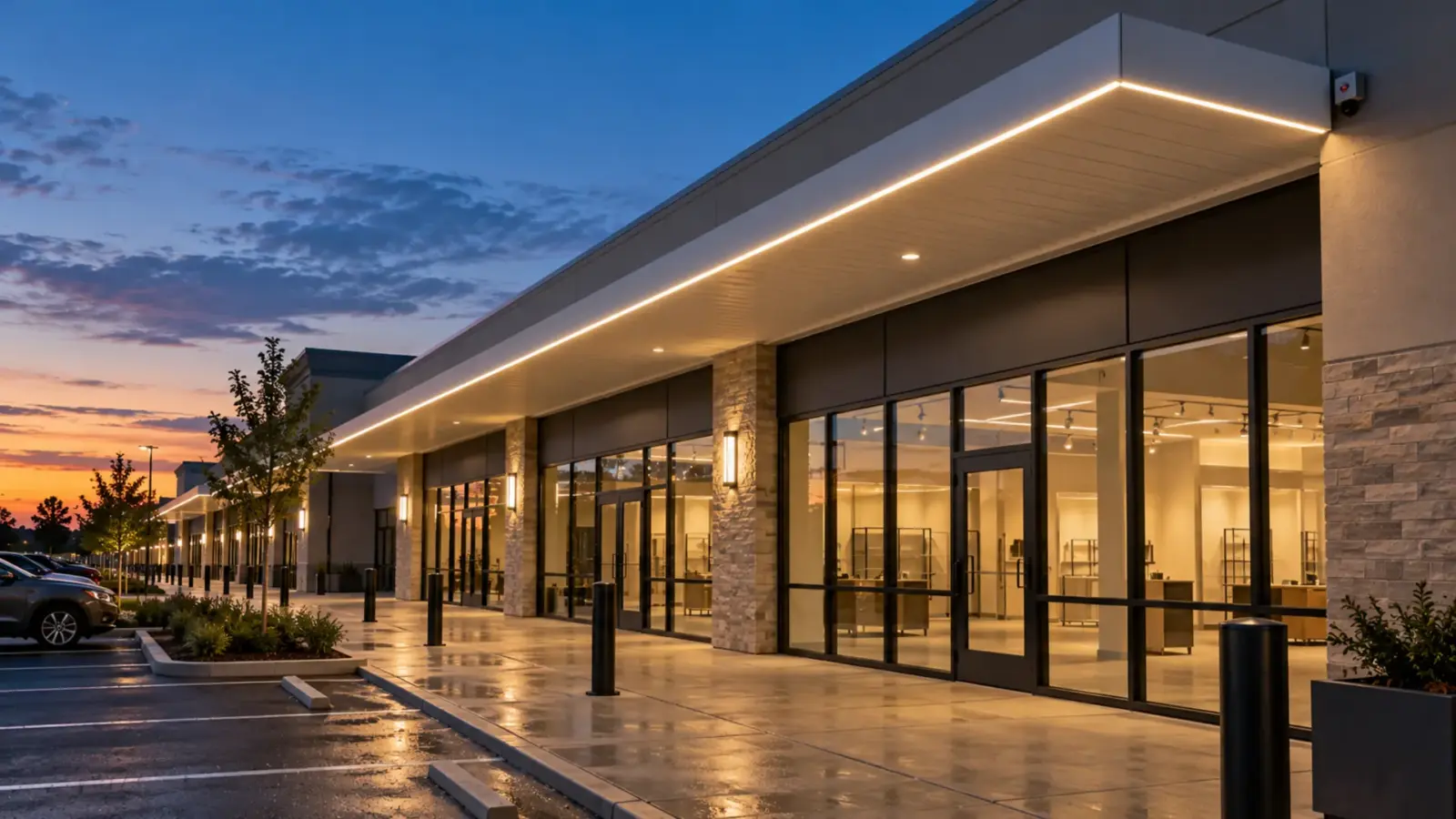
Six hours a night is the least a building facade can stay dark under the 2018 IECC, unless business hours set a shorter window. Outdoor LED strip needs a photocell, an astronomical time clock, or both, because every current energy code turns exterior lighting off in daylight, and most also switch or dim it on a night schedule.
Which device does the job depends on the code, the site and the driver behind the strip. A soffit line on a shopping center, a canopy fascia at an apartment entry and a sign band on a restaurant all face the same three questions: what turns it off in daylight, what turns it off or down at night, and whether a sensor has to dim it when nobody is there. This page goes through the codes, then the hardware, then the driver that decides what the schedule can actually do.
Three Things the Codes Ask
Across the IECC, ASHRAE 90.1 and California’s Title 24, exterior lighting controls come down to three requirements, in different words and numbers:
- Daylight off. Exterior lighting turns off automatically when daylight is enough.
- Night schedule. Lighting turns off, or down, during set night hours or after business closes.
- Occupancy. Some exterior lighting dims or turns off when no one is around.
Facade and landscaping lighting, which is where most outdoor strip sits, usually gets the stricter night rule: off, not dimmed. Read the adopted edition, because section numbers and percentages move between editions and states. Some states also add their own exterior rules on top of the model code, so check the state energy code, not only the model edition it is based on.
IECC and ASHRAE 90.1: Facade Off at Night
The 2018 IECC, in the text Washington adopted, requires building facade and landscaping lighting to “automatically shutoff for a minimum of 6 hours per night or from not later than 1 hour after business closing to not earlier than 1 hour before business opening, whichever is less.” Other exterior lighting has to drop by at least 30% in set periods. All exterior lighting turns off when daylight is present. In the 2021 IECC, the same controls sit in section C405.2.7.
ASHRAE 90.1-2019, according to Cooper Lighting’s summary of section 9.4.1.4, uses business hours too: facade and landscaping lighting off from no later than midnight or business closing until 6 a.m. or business opening, and other exterior lighting reduced by more than 30% from midnight to 6 a.m., or one hour after close to one hour before opening, or after 15 minutes without activity.
For strip, the practical reading is simple. A facade or soffit line needs a daylight-off control and a time schedule that switches it off at night. A strip that lights a walkway or an entry, where people need light all night, falls in the other category and can be dimmed instead, if the driver dims.
Title 24: Daylight, Schedule, Motion
California’s Title 24 is more detailed. In the 2022 edition, section 130.2(c), as summarized by Energy Code Ace and the California Energy Commission, outdoor lighting must have:
- A photocontrol, astronomical time switch or other control that turns it off when daylight is present.
- Automatic scheduling able to reduce lighting power by 50 to 90% and to turn it off during scheduled unoccupied periods, with at least two nighttime periods at separate levels.
- Motion sensing on luminaires mounted 24 ft or lower, able to reduce power by 50 to 90% and turn off separately, except for building facade, ornamental hardscape, outdoor dining and sales frontage lighting.
Lighting that a health or life-safety rule requires to stay on is exempt. The 50 to 90% reduction is the part that catches strip jobs: a step-down needs a driver that dims. Our Title 24 guide covers the indoor side of the same code.
Is Your Strip Facade Lighting?
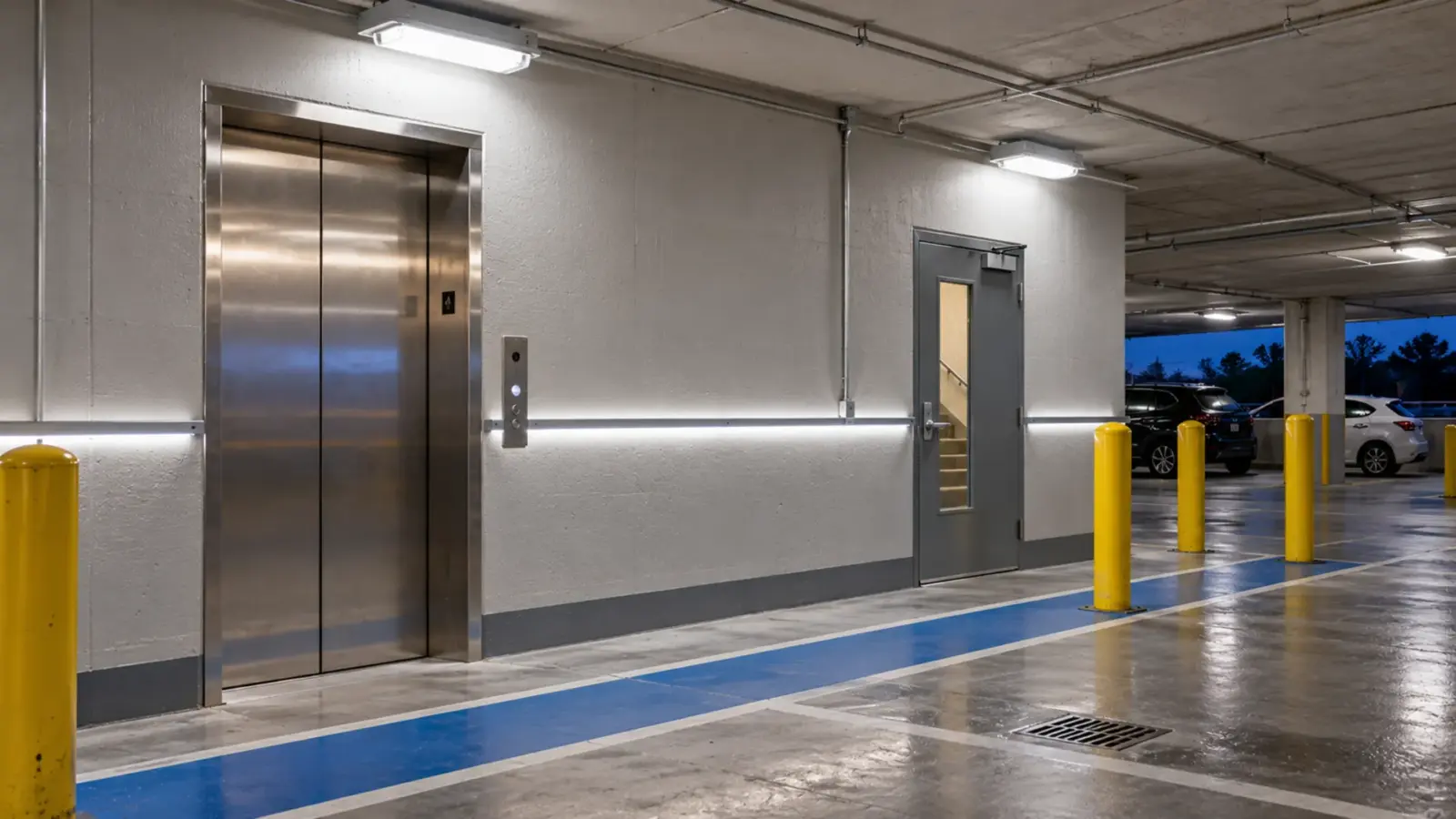
The classification decides the rules, and outdoor strip sits on the line between categories. A strip in a soffit that washes the building face is facade lighting under most readings. A strip in an entry canopy that lights the walk below is closer to general site or canopy lighting, with its own power allowance and, in California, possibly the motion-sensing rule if it is 24 ft or lower. A strip outlining a storefront may be sales frontage. A line along a planter is ornamental hardscape.
Ask the energy consultant or the AHJ how each outdoor strip run is classified before the control design is drawn, because the answer changes what the control must do. Our soffit and eave guide covers the soffit detail itself, and the wall washer design guide covers facade washing at higher output.
Photocell, Astronomical Clock or Both
A photocell measures light. It switches with the real conditions at the site, so a dark storm afternoon turns lights on and a long summer evening keeps them off. It fails when the sensor sees the wrong light: its own fixture, a new pole light, headlights, a lens covered in dust, snow or webs. Many photocells use a time delay so a passing car does not switch them off.
An astronomical time clock calculates sunrise and sunset from the location and date. It needs no sensor and is not fooled by headlights, but it does not see weather, and it has to be programmed, keep its time and follow daylight saving changes.
Many commercial sites use both, as electricians on the Mike Holt forum describe: the photocell for the evening on, and a time clock for the off time when the business closes. For strip under the energy codes, that pairing covers the first two requirements: the photocell or the clock’s dusk function handles daylight off, and the clock’s schedule handles the night shutoff or step-down. Where the code needs two night periods at different levels, as Title 24 does, the clock or a lighting control panel sets them.
The Driver Decides What the Schedule Can Do
A control can only ask for what the driver can do. A non-dimming driver, such as our potted Dust-tight, and protected against temporary immersion in water. The usual rating for wet or outdoor runs that are not submerged all the time. UT-D100-24-67, can be switched on and off by a photocell, clock or relay, and nothing in between. That works for a facade line that must be off at night. It does not work for a run that has to step down 50% after midnight; for that, the strip needs a dimming driver tied to the schedule, such as the potted IP67 0-10V driver UT-D100-24-010-67.
Plan it per run: off-only runs on switching drivers, step-down runs on dimming drivers, with the 0-10V control wiring brought to the same control panel as the relays. Our 0-10V, TRIAC and DALI comparison covers the protocols, and the drivers and controllers page lists the potted outdoor drivers. Keep drivers out of standing water and where they can be reached, as with any outdoor run; our wet location guide covers the rest of the system.
120V Strip Outdoors
Line-voltage strip changes the control picture. Our 120V LED strip runs straight from 120V AC with no driver, up to 98 ft (30 m) from a single feed, so a long canopy fascia can be one run on one circuit. The photocell, clock or relay switches that circuit directly. Where the schedule needs a step-down, 120V strip dims with TRIAC phase-cut dimming rather than 0-10V, so the control has to provide a phase-cut output for that circuit.
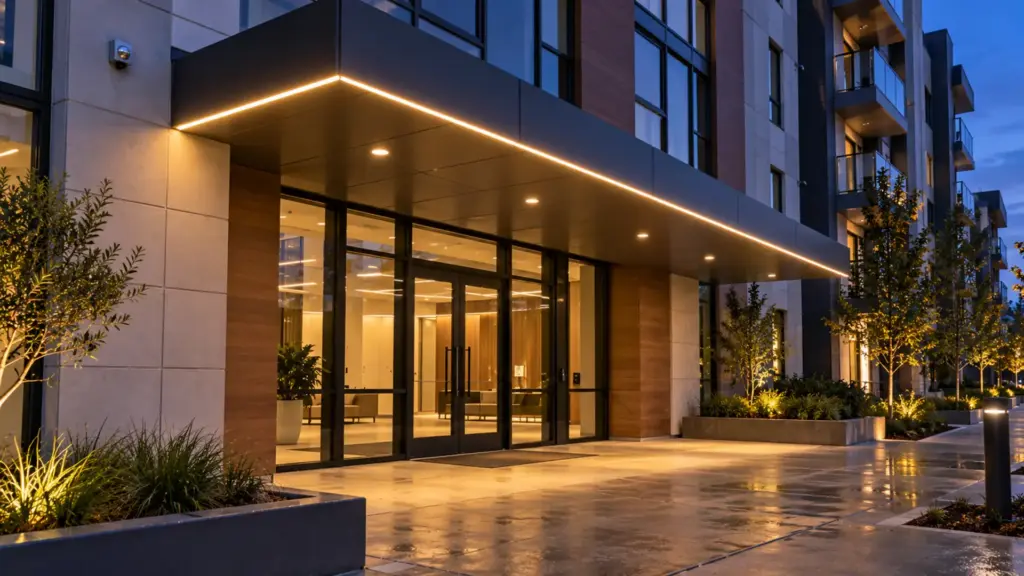
Two cautions. 120V strip is not a Class 2 product, so it is wired with line-voltage methods, confirmed with the AHJ. And the series are IP65 silicone extrusion, built for water jets, not immersion; the wet location marking for an outdoor install is confirmed per model, as for any outdoor strip. The dot-free UT-H120-296-COB comes in 3000K, 4000K and 6000K at 2.4 W/ft.
Wiring and Relays
Most outdoor strip control happens on the line side: a photocell or clock driving a relay or contactor that switches the drivers’ supply. LED drivers draw a high inrush current when switched on, and a bank of drivers on one relay can weld contacts or trip a breaker, which our inrush guide explains. Size relays for the LED inrush, or split the load across relays.
Put the photocell where it sees the sky and not the lit surface, usually on the north side of the building, away from the strip and from other site lights. Mount clocks and panels indoors where they can be reached, labeled with the schedule they run.
Acceptance Tests and Handover
In California, outdoor lighting controls go through acceptance testing; the Title 24 reference manual’s NA7.8 outdoor lighting shut-off control tests check that photocontrols, astronomical time switches, scheduling controls and motion sensors work as installed. Elsewhere, the commissioning scope usually includes the same checks. Either way, test at dusk: cover and uncover the photocell, step the clock through its schedule, and confirm each run does what its classification requires. Record the schedule, the photocell location and the relay map in the handover pack, and note when daylight saving changes need a check.
FAQ
Do I need a photocell for outdoor LED strip?
You need a daylight-off control. The current IECC, ASHRAE 90.1 and Title 24 all require exterior lighting to turn off when daylight is present; a photocell is one way, an astronomical time clock is another. Most sites also need a night schedule, which a clock provides.
Photocell or astronomical timer: which is better for LED strip?
A photocell follows real conditions but can be fooled by nearby light or dirt; an astronomical clock is not fooled but ignores weather. Many sites use both: photocell or astronomical dusk-on, clock-based off or step-down at night.
Does outdoor LED strip need a dimmable driver?
Only if a schedule or sensor has to step it down rather than switch it off. Title 24 scheduling and motion rules call for 50 to 90% reductions on some lighting; facade lighting under the IECC and ASHRAE 90.1 is usually switched off at night, which a non-dimming driver can do.
Is soffit LED strip facade lighting under the energy code?
Usually, when it washes the building face. A soffit or canopy strip that lights a walkway may be classified as general or canopy lighting instead. Confirm the classification with the energy consultant or AHJ before the controls are designed.
Rules of Thumb
- Classify every outdoor strip run first: facade, landscaping, canopy, frontage or walkway.
- Daylight off for everything: photocell, astronomical clock, or both.
- Facade runs switch off at night on a schedule; walkway runs may dim instead, on dimming drivers.
- Title 24 jobs: plan 50 to 90% step-downs and motion sensing where the run is 24 ft or lower and not facade.
- 120V strip switches on its own circuit and dims with phase-cut, not 0-10V.
- Size relays for LED inrush; put the photocell where it sees sky, not light.
- Test at dusk and hand over the schedule and the relay map.
The IP-rated strip and potted drivers mentioned here are in our outdoor and waterproof LED strip range; send the elevations and the control intent with your quote request and we will match each run to a switching or dimming driver.