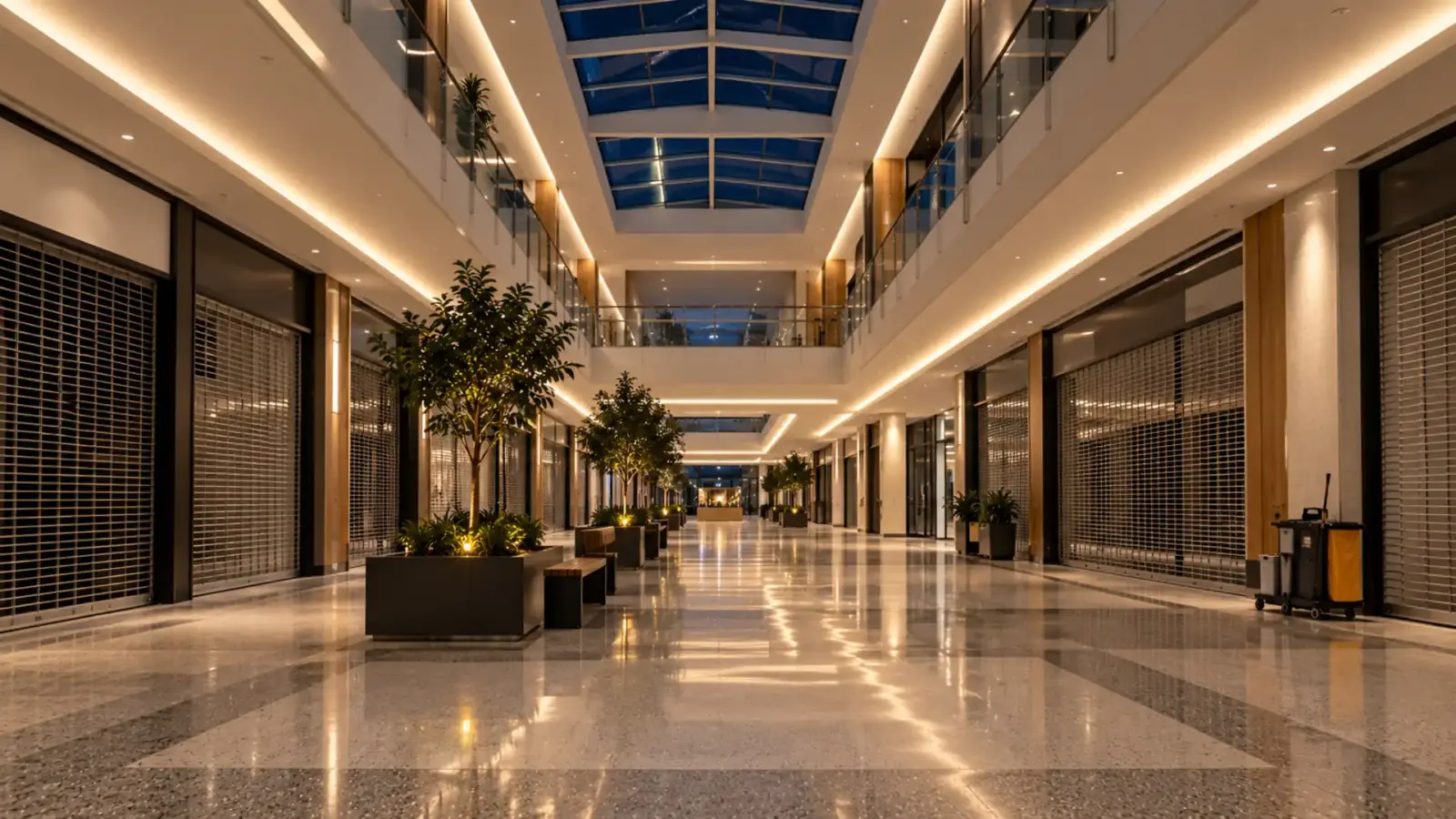
The mall closes at 9 p.m., and the atrium cove has to be relit and swept clean before the doors open at 10 a.m. Shopping mall LED lighting is two jobs in one building: the landlord’s common areas, built at night around an open mall, and each tenant’s fit-out, built to the landlord’s design criteria.
Most of the problems on mall strip jobs come from mixing those two up: a tenant contractor who assumes the storefront bulkhead is theirs, a landlord spec that never told tenants which CCT the concourse uses, a cove retrofit planned like a daytime job. This page sorts the scope by owner, then goes through the details and the constraints that decide the work.
Two Owners, One Building
The lease line is the border. On one side, the landlord owns and lights the common areas; on the other, the tenant owns and lights the store, under the landlord’s criteria. The storefront sits right on the line, and every center draws it a little differently, so read the lease exhibits that define landlord’s work and tenant’s work before pricing anything.
| Location | Typical owner | Strip detail | Rules that apply |
|---|---|---|---|
| Atrium and concourse ceilings | Landlord | Coves, ceiling slots, bulkhead lines | Landlord standard, energy code, night work |
| Food court | Landlord (common seating), tenant (counters) | Coves, counter fronts, menu bulkheads | Landlord standard, cleaning, grease and heat |
| Neutral piers and bulkheads between stores | Landlord, usually | Continuous line across storefronts | Landlord standard |
| Storefront sign band | Tenant, under criteria | Halo letters, neon flex outlines | Tenant design criteria, sign permit |
| Show windows and storefront entry | Tenant, under criteria | Window header lines, display edges | Criteria, time switch |
| Store interior | Tenant | Shelf edges, coves, feature walls | Tenant’s own design and energy code |
| Restrooms, service corridors, parking entries | Landlord | Mirror lines, coves, canopy lines | Landlord standard, wet locations |
Read the Tenant Design Criteria
Most centers publish a tenant design criteria manual, and its lighting section binds every tenant contractor. Two public examples show what they cover. One retail design criteria document filed with the Washington, DC Zoning Commission lists recessed, LED, linear strip and projection fixtures as acceptable for exterior storefronts, with projection needing landlord approval, and bars chasing or flashing lighting and exposed wiring on illuminated signs. A mall’s tenant criteria in a City of Palo Alto file prefer LED for sign illumination, prohibit neon tubing, and require storefront entry lights, show window lights and show window receptacles to be separately circuited on a 7-day time switch programmed for mall hours with the mall operations team.
For a strip detail in a tenant space, that means four checks before the submittal: whether strip is an allowed fixture type where you plan it, whether moving or color-changing effects are allowed, how wiring must be concealed, and what circuiting and time control the landlord requires.
Storefronts and Show Windows
The storefront is where strip does the most visible work for a tenant: a continuous line in the window header that lights the display, a strip under a display platform, a lit entry portal. Keep each one on the circuit and time switch the criteria require, separate from the store’s interior lighting, so the mall can run the window lights to its hours.
Light the merchandise, not the shopper’s eyes. A window header line should be hidden behind a lip and aimed at the display, and a line at the floor of a window should be shielded from people walking past. Our retail display guide covers shelves, cases and display edges inside the store.
Sign Bands
The sign band above the storefront is usually tenant work under the landlord’s sign criteria and a local sign permit. Halo-lit channel letters with strip inside the letter returns, or a face-lit letter, are the common forms; our halo-lit vs face-lit guide compares them. Where a criteria manual prohibits glass neon, LED neon flex can carry an outline or a script line in the same look; our IP67 LED neon flex such as UT-N1010-TB runs at 24V, 3.0 W/ft, up to 16 ft per feed.
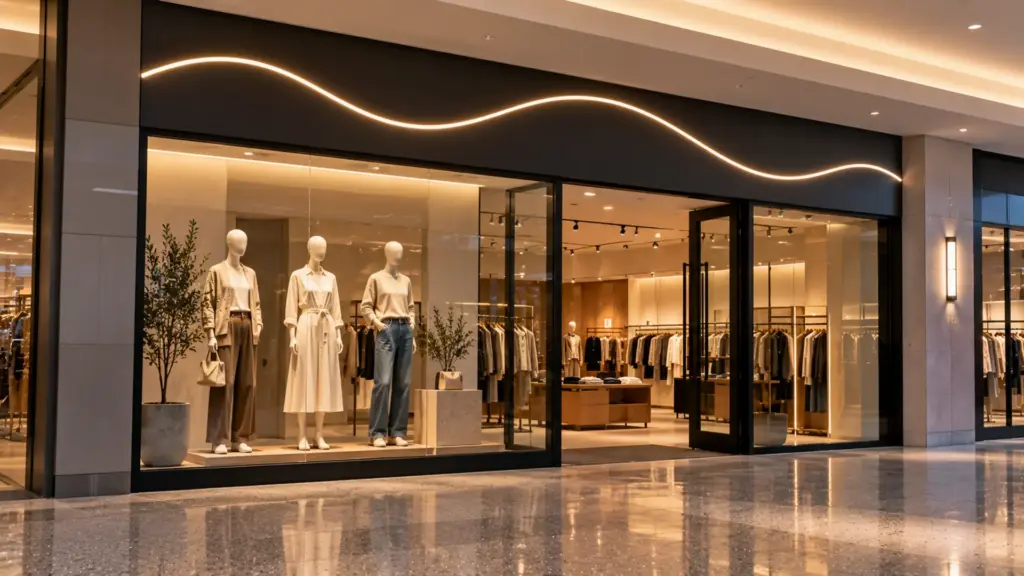
Read the sign clause in the lease as well. A sample clause we found requires the storefront sign to be lit during open hours and no more than one hour after close, which is another time-switch requirement. A tenant replacing an old lightbox can use the cabinet sign retrofit guide.
Submittals for Tenant Contractors
A tenant’s lighting goes through two reviews: the landlord’s design review against the criteria, and the building department’s permit review. The landlord’s reviewer usually wants to see the storefront elevation with every lit element marked, the cut sheets for the strip, neon flex and drivers, the CCT and Color Rendering Index, 0–100: how truthfully the light shows colors next to a reference source. Ra≥90 is the usual bar for interiors., the mounting and concealment detail, the circuiting and time switch, and the sign drawings that go with the sign permit.
Submit before fabrication, not after. A sign band built before the landlord approves it can be rejected for a color, an effect or a visible wire, and a storefront that misses the opening date costs the tenant rent and sales. Our submittal package guide lists the documents a complete strip submittal carries, which is most of what a landlord review asks for.
Common Areas: Atrium, Concourse, Food Court
Landlord lighting sets the character of the center: coves in the atrium ceiling, continuous lines along the concourse bulkheads, a lit edge at each level of an open atrium. It also sets the reference for color. Write the common-area CCT and CRI into the landlord standard and into the tenant criteria, so a tenant’s storefront line does not sit at 4000K next to a 3000K neutral pier.
Food courts are their own case. Common seating areas are landlord lighting; tenant counters and menu bulkheads are tenant work. Strip near cooking sees heat and grease, so keep it in closed channels away from hoods, and plan for daily cleaning. Restrooms and service corridors follow the same rules as any commercial wet area.
Open atriums add one more detail: the edge of each upper level. A strip under the slab edge or the handrail cap lights the level line from below and marks the guardrail at night, but it is seen from every level and from the escalators, often from below. Keep the source hidden from those upward views, check it from the lowest level and from the escalator before approving, and keep the line continuous around the curves, where long rigid channels will not follow; flexible channel or neon flex follows a curved slab edge better than straight pieces.
Anchors, Big-Box and Grocery
Anchor stores and big-box tenants often sit outside the mall’s tenant criteria, under their own lease terms and their own brand standards. Their lighting is usually designed by the brand, built by the brand’s contractor and specified to the brand’s CCT, which for grocery and big-box is often cooler than the mall concourse. Inside, strip shows up on shelf edges, refrigerated case canopies, produce displays and checkout bulkheads; our retail display guide covers those details.
The boundary to watch is the anchor’s mall entrance, where the brand’s storefront meets the landlord’s concourse. Agree who lights the opening and at what CCT, so the threshold does not show a hard color change.
Parking, Entrances and Exterior
Parking garages, entry canopies and the exterior facade are landlord lighting, and they are where strip meets weather and energy-code exterior controls. Canopy and soffit lines at the main entrances need outdoor-rated strip, a wet location marking confirmed for the model, and controls that turn them off in daylight and follow the center’s night schedule. Garage entries need even light from day to night so drivers’ eyes adapt, and that is usually a fixture job, with strip used for wayfinding lines at the entry and the pedestrian doors.
Long Runs in High Coves
Atrium coves are long and high, and every feed point means a lift, a driver location and a cable route. Choosing the strip by run length cuts feed points, which on a night-shift job means fewer nights.
| Strip (our range) | Rated run | Feeds for a 200 ft cove | Driver |
|---|---|---|---|
| UT-C480-8, 24V, 3.2 W/ft | 16 ft per feed | 13 | Constant-voltage 24V |
| UT-C480-8-48V, 2.4 W/ft | 65 ft single feed | 4 | Constant-voltage 48V |
| UT-C480-8-CC, 2.3 W/ft | 65 ft constant current | 4 | Constant-current driver |
The 48V strip needs a 48V constant-voltage driver, which we supply with it; ask us with the quote. The constant-current strip runs only on constant-current drivers, matched to the strip; it is not a 24V constant-voltage product. Our constant-current vs constant-voltage guide and the 12V, 24V and 48V comparison explain the trade-offs. For any of them, order the cove pre-cut and labeled by run, so each night’s crew installs known pieces; our LED channel range ships channels cut to the run schedule the same way. The COB LED strip page lists the long-run series.
Working Nights in an Open Mall
Common-area work in an operating mall happens at night. Contractors on occupied-mall renovations describe the pattern: at Lynnhaven Mall, Hoar Construction ran crews from 10 p.m. and cleaned the work areas before the mall reopened; at Westland Market Mall, Chandos planned 10 p.m. to 6 a.m. shifts so that no scope was left unfinished in an unsafe state; at Maplewood Mall, lifts were brought in each night because scaffolding was not an option.
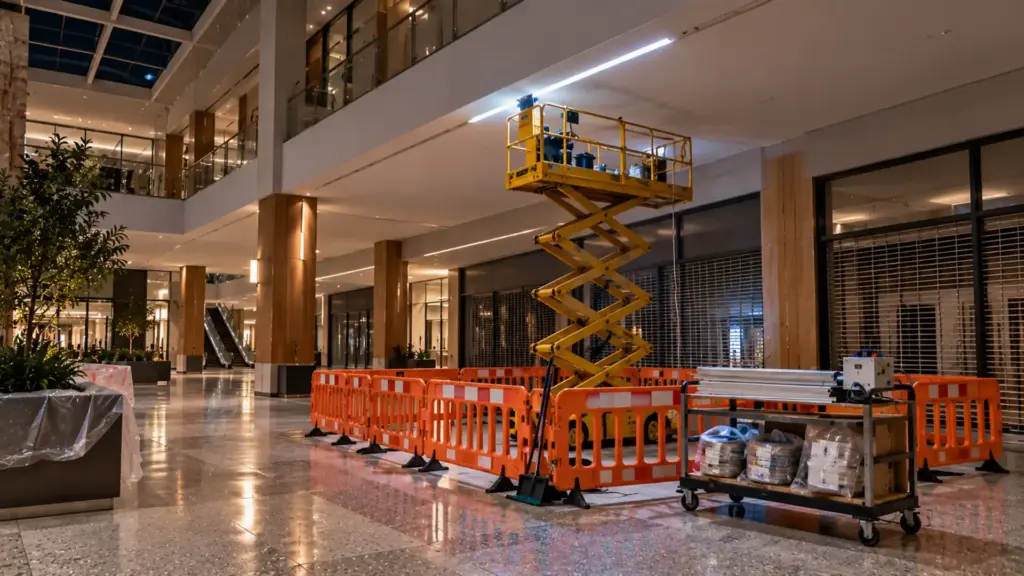
- 110 p.m.after closeBarriers and lift in
- 2OpencoveFit the channel
- 3Strip inby run labelKnown length per night
- 4Teston the driverBefore the cover goes on
- 5Closecover onCeiling closed
- 66 a.m.before openingDebris and lift out
For a strip cove, plan each night as a complete unit: lift in, channel and strip in for a known length, test, cover on, debris out, lift out. Never leave an open ceiling, a hanging lead or a half-installed channel over a walkway at opening. Stage material for each night by run label. Test each night’s section on its driver before the cover goes on, because the next time anyone reaches that cove is another night with a lift.
Hours, Controls and Rated Life
Malls run long hours: open hours, then cleaning and security. A common-area cove on for 14 hours a day reaches 5,110 hours a year, so a strip rated L70 ≥ 50,000 hours, like our COB range, reaches that point in just under ten years. Put common-area strip on the center’s lighting control system with schedules for open, after-hours and overnight levels, and dim it where daylight from the atrium allows.
Tenant strip runs on the tenant’s switches inside the store and on the landlord’s required time switch at the storefront. The drivers and controllers page lists dimming drivers and controls for both sides.
Re-Tenanting and Spares
Tenants change; the landlord’s lighting stays. When a store turns over, the storefront and sign come out, and the neutral piers and bulkhead lines on either side have to stay intact and matching. Keep spare common-area strip from the same production lot, labeled by location, and keep the run register current, as our maintenance plan guide describes. A replacement section on a concourse bulkhead that does not match its neighbors is visible to every shopper.
Spec Notes for This Job
- Landlord’s work and tenant’s work defined from the lease exhibits before pricing.
- Tenant criteria checked for allowed fixture types, effects, wiring concealment and time switches.
- Common-area CCT and CRI written into both the landlord standard and the tenant criteria.
- Long atrium coves on long-run strip, with constant-current strip only on constant-current drivers.
- Night-shift units: install, test and cover a known length each night; nothing open at opening.
- Common-area strip on center schedules; storefront strip on the landlord’s time switch.
- Same-lot spares for landlord lighting, kept through re-tenanting.
Unitop Lighting supplies strip, neon flex, channels and drivers for shopping centers across the US, for landlords and for tenant contractors. Send the reflected ceiling plans or the storefront elevation with the center’s criteria, and we will match the runs, pre-cut the pieces by night shift or by store, and confirm the drivers. Request a quote.