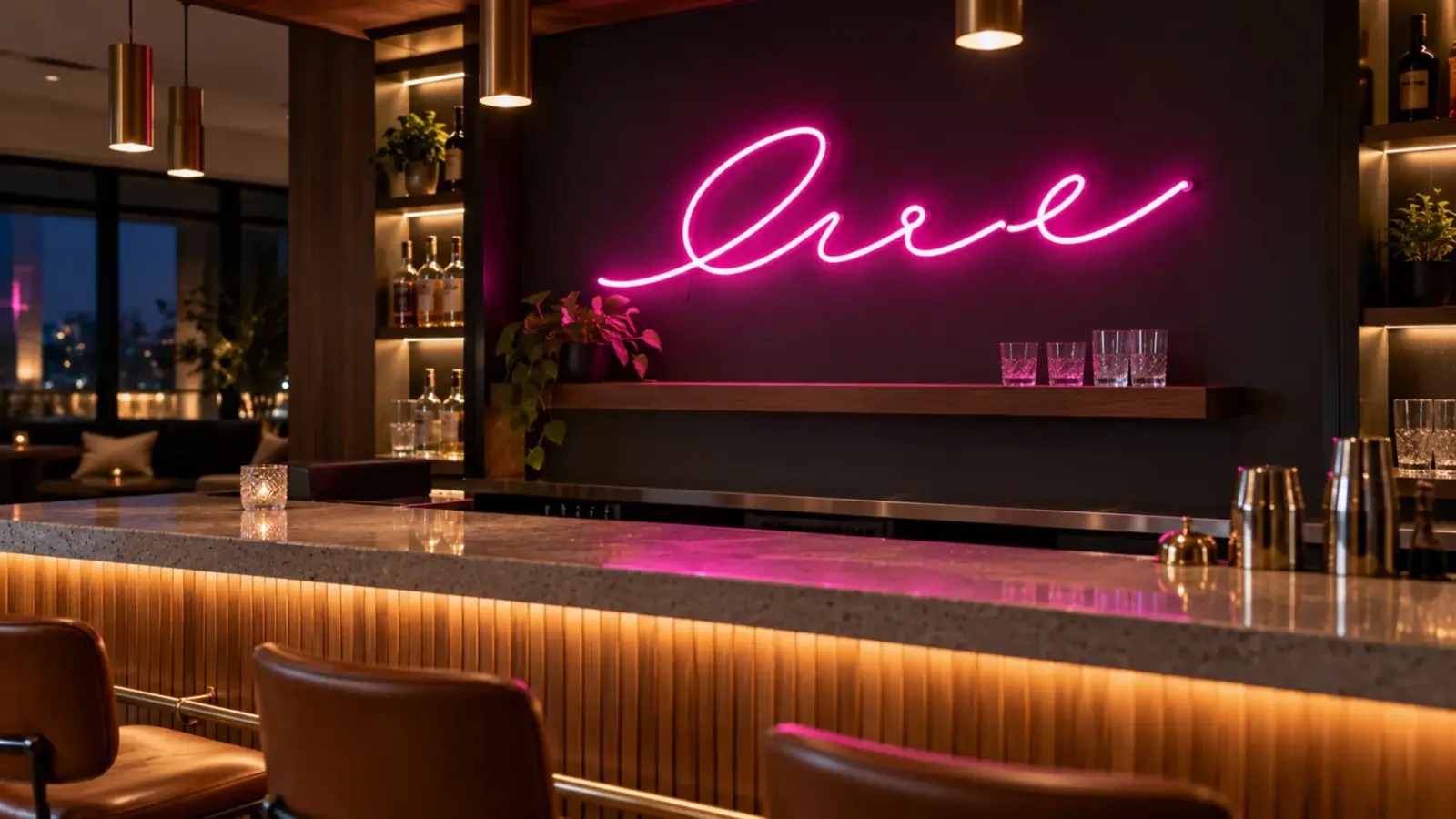
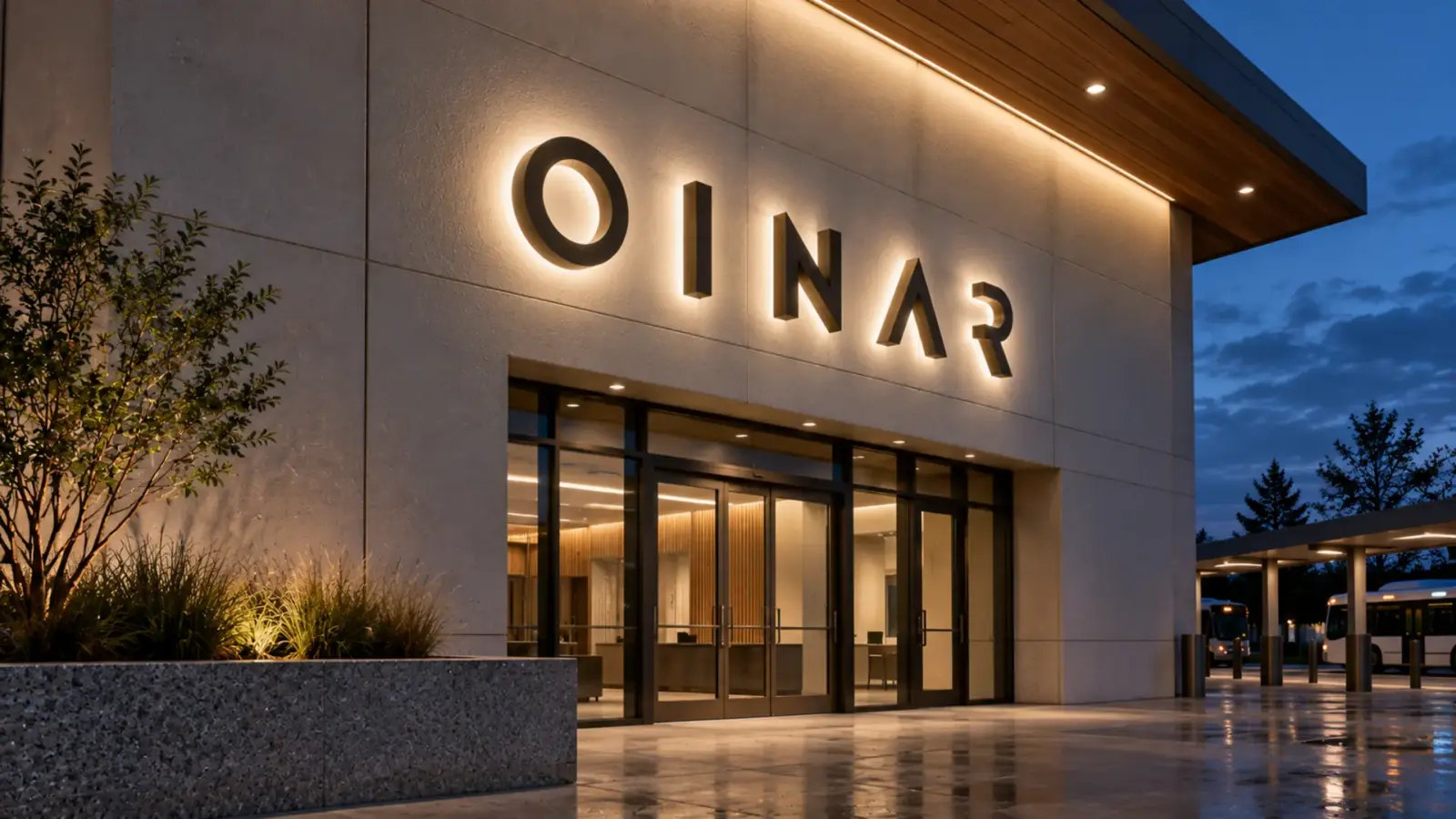
Choose halo-lit letters when the wall is light, smooth and about 1.5 to 2 in (38 to 51 mm) behind the letter, and face-lit letters when the wall is dark, textured or too close to hold a glow. LED strip works in both. The wall, the depth, the face and the power decide the result.
A typical job: a storefront with dark brown brick, a brand that wants a glow around its name, and a sign shop that has quoted halo letters. The glow depends on what the wall sends back, and dark brick sends back very little. Four checks settle it before the quote is signed.
Side by Side: What Each Type Lights
| Item | Face-lit | Halo-lit | Both (face and halo) |
|---|---|---|---|
| Where the light goes | Out through the translucent face | Back onto the wall behind | Both |
| What the viewer sees | A lit letter | A dark letter with a glow around it | A lit letter with a glow |
| Wall dependence | Low | High: color, finish, flatness | High |
| Standoff from wall | Flush or small | About 1.5 to 2 in (38 to 51 mm) typical | Same as halo |
| Return depth driver | Evenness across the face | Light spread to the wall | Both |
| Unlit by day | A colored face | A solid dark shape | Colored face |
The halo type depends on something the sign shop does not own, which is the wall. The face-lit type depends on things the shop does own: the face, the depth and the source. That is why the first check is the wall.
The Wall: What a Halo Needs
A halo is light reflected off the wall behind the letter. The wall decides how much of it comes back. A light, matte, smooth surface returns a soft, even glow. A dark or heavily textured surface, such as brown brick with deep mortar joints, absorbs most of it and breaks the rest into patches. A glossy surface mirrors the light and shows a hard edge instead of a glow.
According to sign-industry trade articles from Signmedia and Graphics Pro, halo letters typically stand 1.5 to 2 in (38 to 51 mm) off the wall, and mounting them closer can weaken the halo and make the sign harder to read at night. One supplier quotes a range from about 3/8 in for small letters seen up close to about 2.4 in for large, deep letters. The sources do not agree, and no standard sets the number, so treat the range as a starting point.
Three tests before you quote a halo:
- Look at the wall, lit. Hold a bright flashlight against it at night from where the letter will sit. If the patch is dull or uneven, the halo will be too.
- Check the standoff your mounting allows. If the wall surface needs spacers more than 2 in, the halo grows soft and wide.
- Mock up one letter on the real wall. A halo that looks right on a white board looks different on brick.

If the wall fails, switch to face-lit or a face-and-halo build, or paint a light panel behind the sign. A light panel is a design change the owner has to approve.
Depth and Face: What Sets a Face-Lit Evenness
A face-lit letter is a box of light, and the face is the diffuser. Light is even when the source is far enough from the face for the individual LEDs to blend. A shallow return with widely spaced LEDs shows bright spots behind each one, and a deep return with a close pitch looks even.
Trade sources quote halo returns around 3 in (76 mm) and face-lit returns from about 1.5 in up to 5 in (38 to 127 mm), and the numbers vary by source. We do not give a fixed depth-to-pitch rule, because none has a standard behind it. The pitch of the strip you use is a number you can compute from the spec table:
| Strip | LEDs per meter | Pitch | Power | One feed |
|---|---|---|---|---|
| UT-C320-6-SV (side-view COB, 12V) | 320 | 3.1 mm (0.12 in) | 2.4 W/ft | 10 ft (3 m) |
| UT-S2835-120 (SMD, 12V or 24V) | 120 | 8.3 mm (0.33 in) | 4.4 W/ft | 16 ft (5 m) |
| UT-H120-60 (120V strip) | 60 | 16.7 mm (0.66 in) | 2.7 W/ft | 98 ft (30 m) |
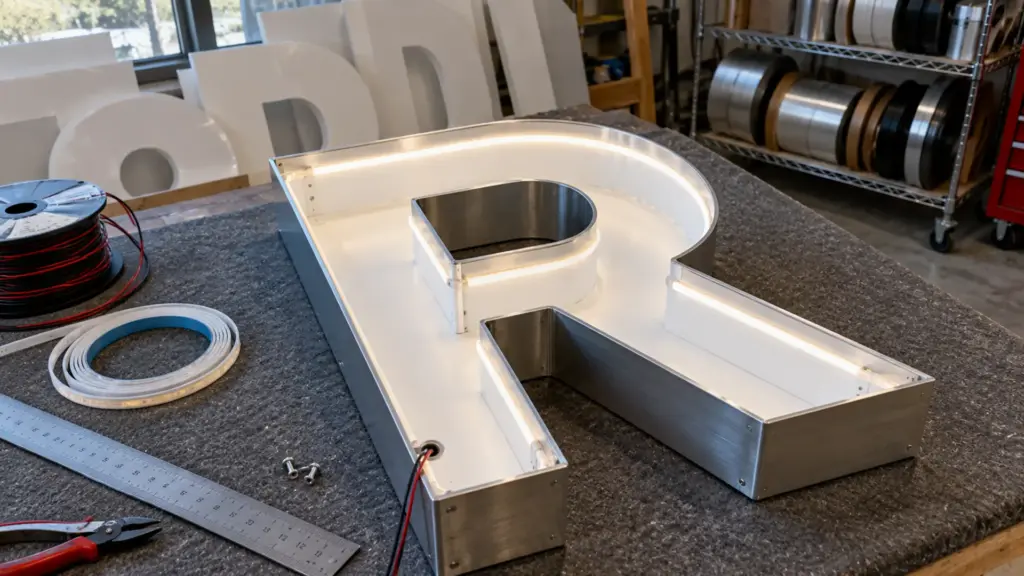
A close pitch hides spots in a shallow face, and a wider pitch needs depth or a diffusing layer. Our signage page puts it this way: inside a letter, the face does the diffusing, so even spacing behind the face matters more than the look of the strip itself. Build the face with the real material and mock up one letter at full depth before the whole sign is cut.
Source: Strip, Modules or Neon
| Source | Where it fits | What to know |
|---|---|---|
| LED strip | Inside face-lit letters, halo returns and light boxes | Continuous line, cut at marked points, spacing set by the strip |
| LED modules | The standard sign-shop source for channel letters | Not our product; pitch and angle come from the module maker |
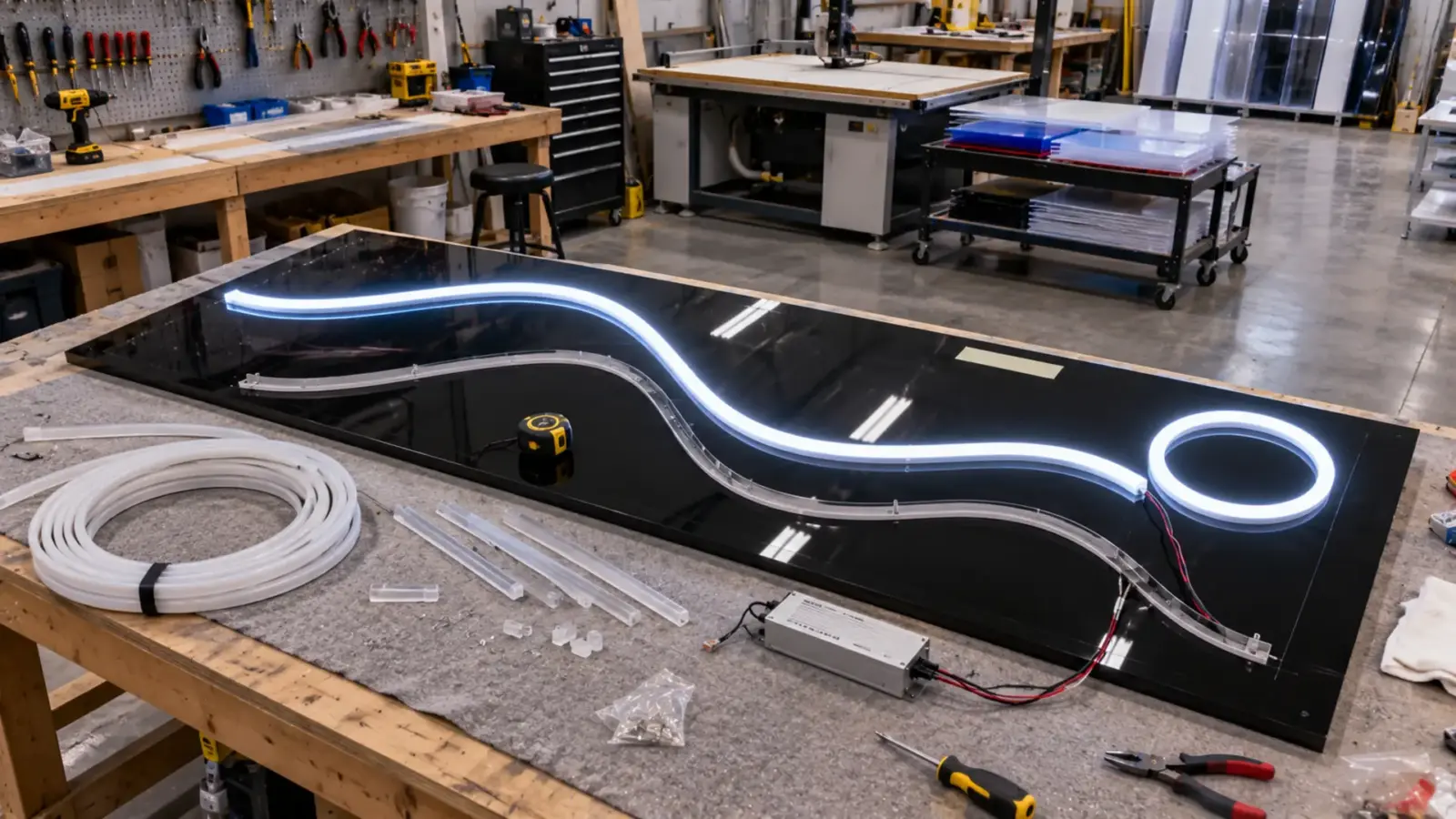
| Neon flex | Exposed lettering where the line is the letter | Not inside a letter; bend radius sets the smallest curve |
Strip has a continuous pitch, so it avoids the shadow gaps that spaced modules can leave when the pitch is wrong. Modules have the advantage that sign shops know them, and the shop’s habits and the letter returns are often built around them. We supply the strip side and say so when a letter is better built on modules. Our SMD strip and COB strip pages list pitch and run limits, and the 120V strip suits long light boxes.
Neon flex belongs in a different sign. Exposed neon is the letter itself, drawn with a line that bends in its rated direction. Side bend profiles such as the UT-N0612-SB bend to 4.72 in (120 mm) radius, and top bend profiles such as the UT-N0606-TB to 2.36 in (60 mm). A letter with tighter curves than the profile allows is a halo or face-lit job, not a neon one. Our neon flex selection guide covers bend direction and the signage page covers the rest.
Power and Feeds: A 40 ft Letter Set
A typical wordmark of six or seven letters at a storefront can carry about 40 ft (12 m) of strip once every return is counted. The load and the feeds depend on the strip, and not by a little.
| Strip | Load for 40 ft | Feeds for 40 ft (at least) |
|---|---|---|
| UT-C320-6-SV, side-view COB | 96 W | 4 (10 ft per feed) |
| UT-H120-60, 120V strip | 108 W | 1 (98 ft per feed) |
| UT-S2835-120, SMD | 176 W | 3 (16 ft per feed) |
The feed counts are a floor. Each letter is its own enclosure, so each letter needs its own feed point, and a seven-letter sign has at least seven. The table still shows the pattern: the side-view COB strip needs more feeds on a long set, and the 120V strip needs the fewest, but it needs a line-voltage connection and is dimmed by TRIAC or ELV only. Plan the driver locations before the letters are built, because a driver inside a sealed letter is hard to reach. Size each driver with headroom, and keep the low-voltage run from driver to letter short, because a long thin cable drops voltage before the strip sees it. Our driver and connector range lists the supplies by output, and we match them to the letter set at quote.
Day and Night
A sign is seen unlit for half the day. A face-lit letter shows its face color. A halo-lit letter shows a solid dark metal shape, and a halo letter with a poor finish looks plain by day and weak at night. A face-and-halo letter gets both, at the cost of both sets of conditions: the wall must hold a glow and the face must be even.
Choose the face color for the night and for the day together. A white face is brightest after dark, and a colored face keeps its color in sunlight when the sign is off. If the brand color is deep, ask for a mockup of the face lit and unlit.
Color helps when the wall is dark. According to the trade articles, white or warm white reads best at night, and a solid deep blue is the weakest because it is close to the color of the night sky. A white or amber glow on a pale wall beats a colored glow on dark brick.
Face and Halo Together
A letter can light both ways: a translucent face for the viewer and an open or clear back for the wall. The same strip serves both paths, so the face is dimmer than a pure face-lit letter and the halo weaker than a pure halo. It is a good choice when the wall can hold a glow and the face needs presence from across a parking lot. It is a poor choice when the wall is dark, because the halo adds cost and delivers little, or when the face is the whole message, because the back light dilutes it.
If you spec both, ask for a mockup of one letter on the real wall at night, with the face on and the back open, and look at it from the distance the public will see it.
Dimming and Brightness at Night
Signs are rarely run at full output after dark. Strip on a driver is dimmed by the driver: 0-10V or PWM on the low-voltage strips, and TRIAC or ELV only on the 120V strip. Put a dimmable driver on the schedule if the sign will be dimmed at night, because a driver without the interface cannot be fixed later by a controller. Some jurisdictions also limit sign brightness at night, so ask the permit office what applies before you size the output.
Which Job Gets Which
| Wall and condition | Pick | Why |
|---|---|---|
| Pale, smooth, matte wall; 1.5 in or more of standoff | Halo-lit | The wall returns a soft glow |
| Dark brick or stone | Face-lit | The wall cannot return light |
| Glass storefront with no wall behind | Face-lit | A halo has nothing to light |
| Less than about 1 in of standoff | Face-lit | A halo needs room to spread |
| Textured plaster or stucco | Mock up first | A texture can break the glow |
| Long view from the road | Face-lit, or face and halo | The lit face carries at distance |
| Light interior lobby wall, close view | Halo-lit | Depth and glow read well up close |
Outdoor, Service and Listing
The strips we list for letters on the signage page are IP20, except the 120V strip at IP65, so a letter that sits outdoors depends on its enclosure: sealed seams, drainage and a clean cable exit. Ask the sign shop how the letter drains before you choose the source.
Service is a short list. The face should come off without cutting the return, the strip should be reachable, and each letter’s feed should be labeled. A letter that has to be cut open to replace a driver is a bad detail.
The finished sign has its own listing and permitting questions, and they belong to the sign manufacturer, who builds and labels the whole assembly. Ask them which listing applies, and do not carry a strip maker’s paper over to the finished sign.
Mistakes on Letter Jobs
- Halo on dark brick. The glow disappears. Test the wall or change the type.
- Standoff set by the bracket. Set it by the glow, then pick the bracket.
- Shallow face, wide pitch. The bright spots show the first night. Mock up a letter at full depth.
- One feed for the whole sign. Each letter needs a feed, and the long run drops voltage.
- Driver sealed in the letter. Put it where the next technician can reach it.
- Colored glow on dark brick. A colored halo needs even more reflection than white. If the wall is dark, choose white or switch to face-lit.
- Choosing by the quote. The cheapest letter on the sheet is the one the wall cannot support. Ask for the wall test in the quote.
FAQ
What is the difference between halo-lit and face-lit channel letters?
Face-lit letters light through a translucent face and the viewer sees a lit letter. Halo-lit letters have an opaque face and light the wall behind, so the viewer sees a dark letter with a glow around it. A letter can do both.
How far should halo-lit letters stand from the wall?
Trade sources typically give 1.5 to 2 in (38 to 51 mm), with a wider range of about 3/8 in to 2.4 in depending on letter size and viewing distance. No standard sets the number, so test it on the real wall.
Can halo-lit letters work on dark brick?
Poorly. Dark, textured brick absorbs most of the light and breaks the rest into uneven patches, and deep mortar joints make the edge of the glow ragged. A face-lit letter, or a light panel behind a halo letter, works better, and a mockup on the real wall settles it.
Is LED strip or an LED module better for channel letters?
Neither is better in every letter. Strip gives a continuous pitch and cut-to-length convenience, and the pitch is a number you can read off the spec table. Modules are the sign shop’s usual choice and come in set angles. We supply strip; the shop’s letter design usually decides, and a letter built for modules should not be changed to strip without a mockup.
What to Send With the Drawing
Send the letter height, return depth, face material, wall color and finish, the standoff, and where the driver can go. With those we can match strip, spacing and power to each letter.
Unitop Lighting supplies LED strip for signs and neon flex for sign shops and contractors across the US. Send the letter drawing with your quote request, and we will check the strip, the pitch against the face, the feeds per letter and the load before anything is built.