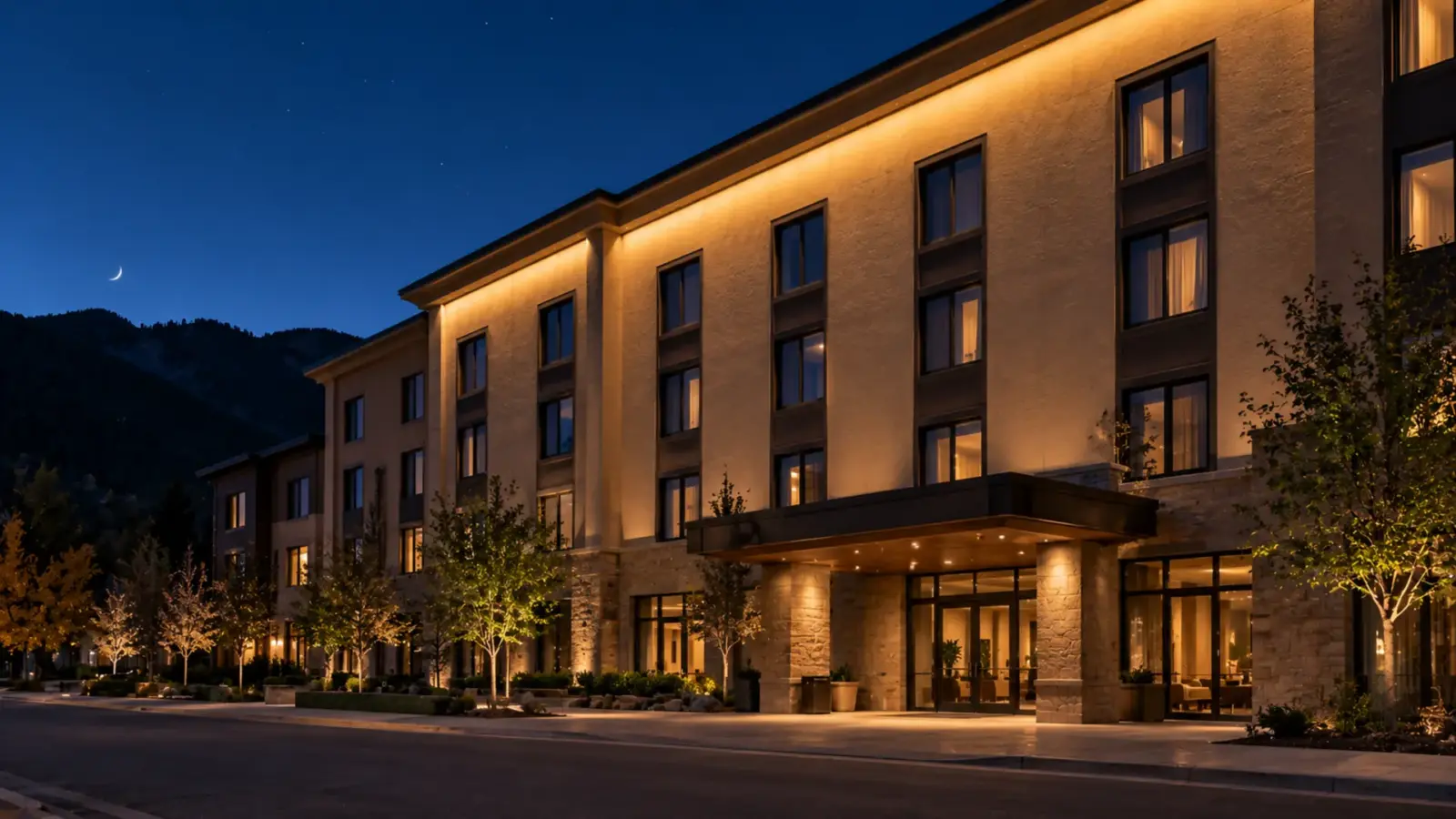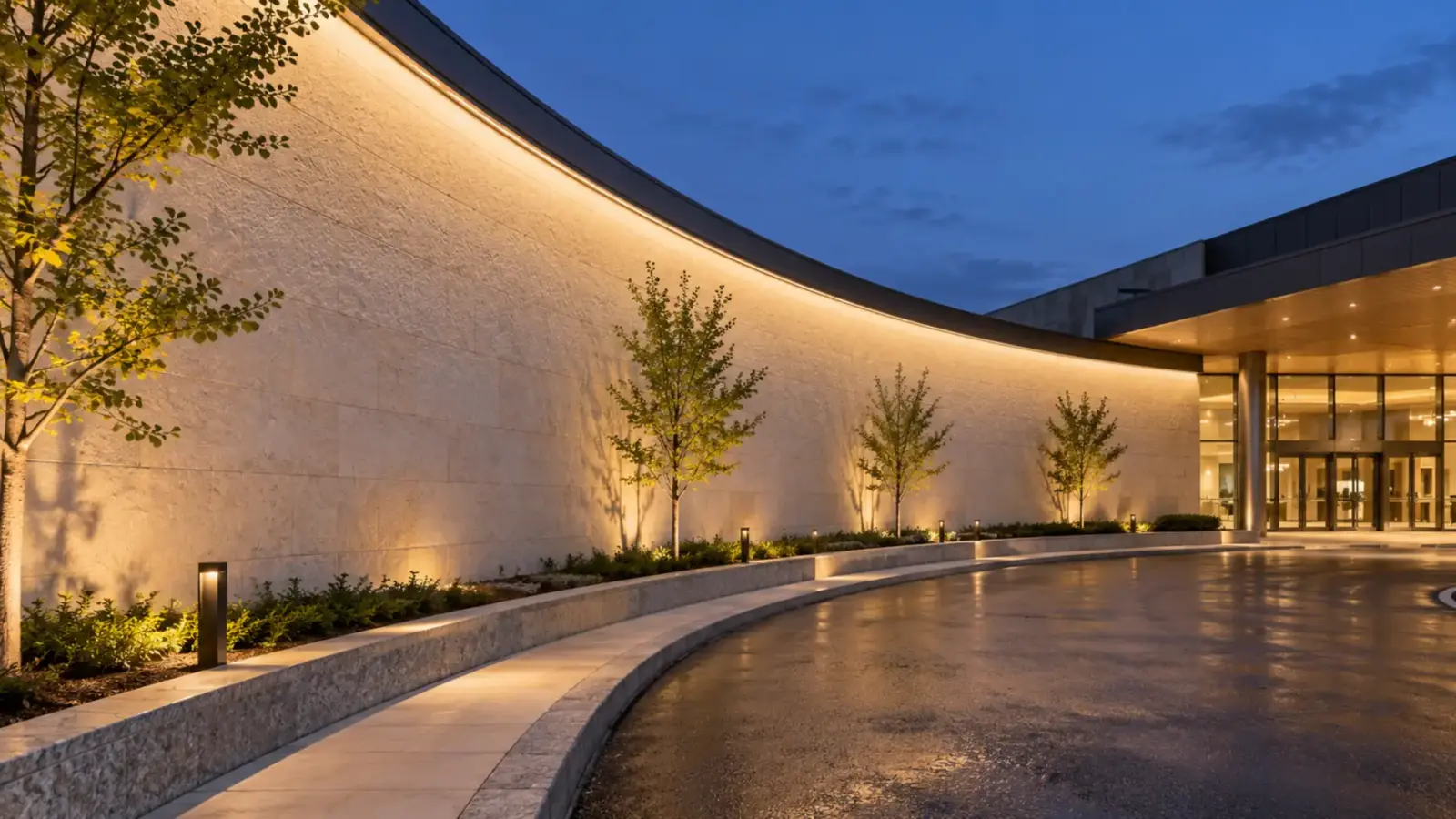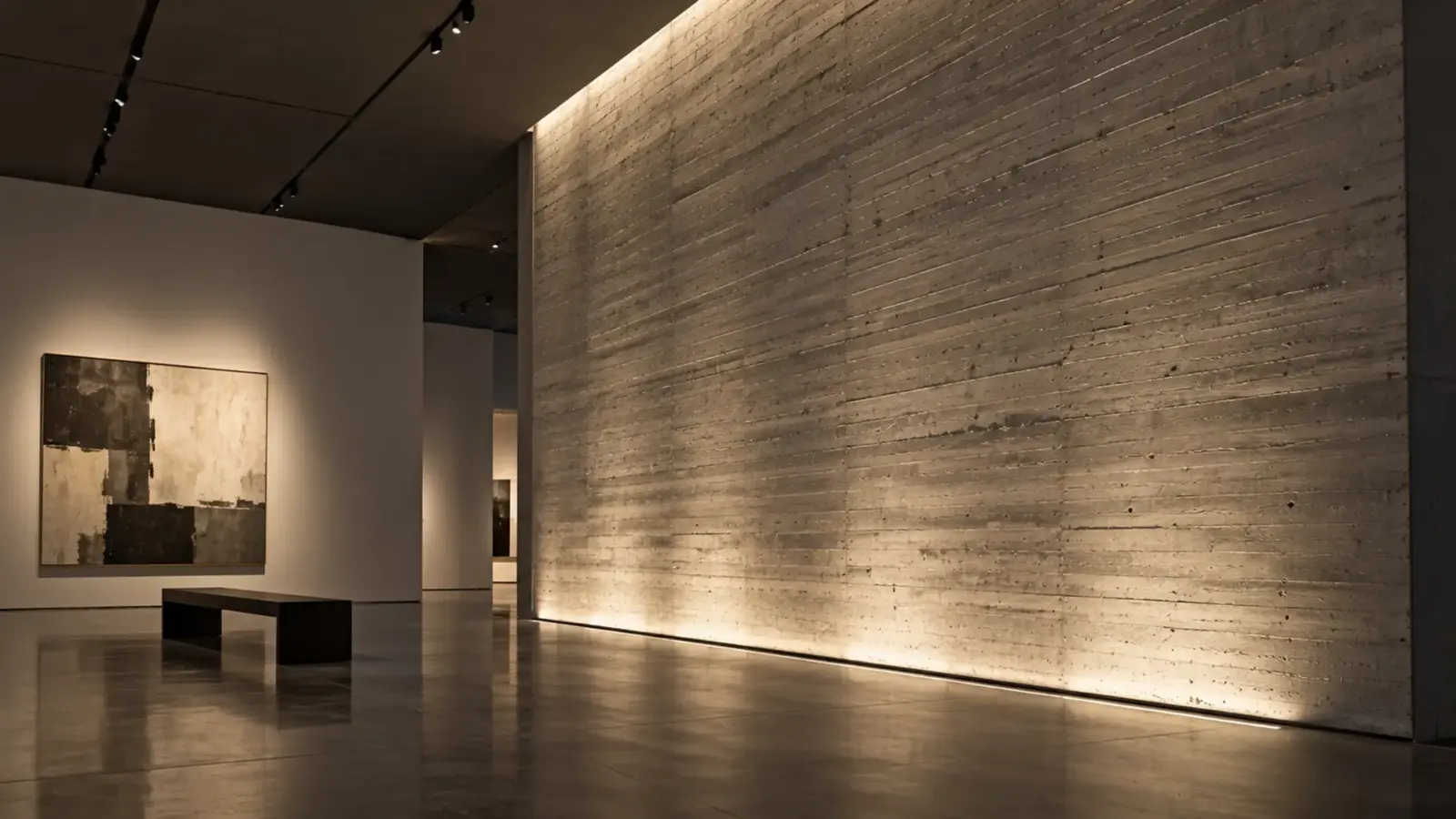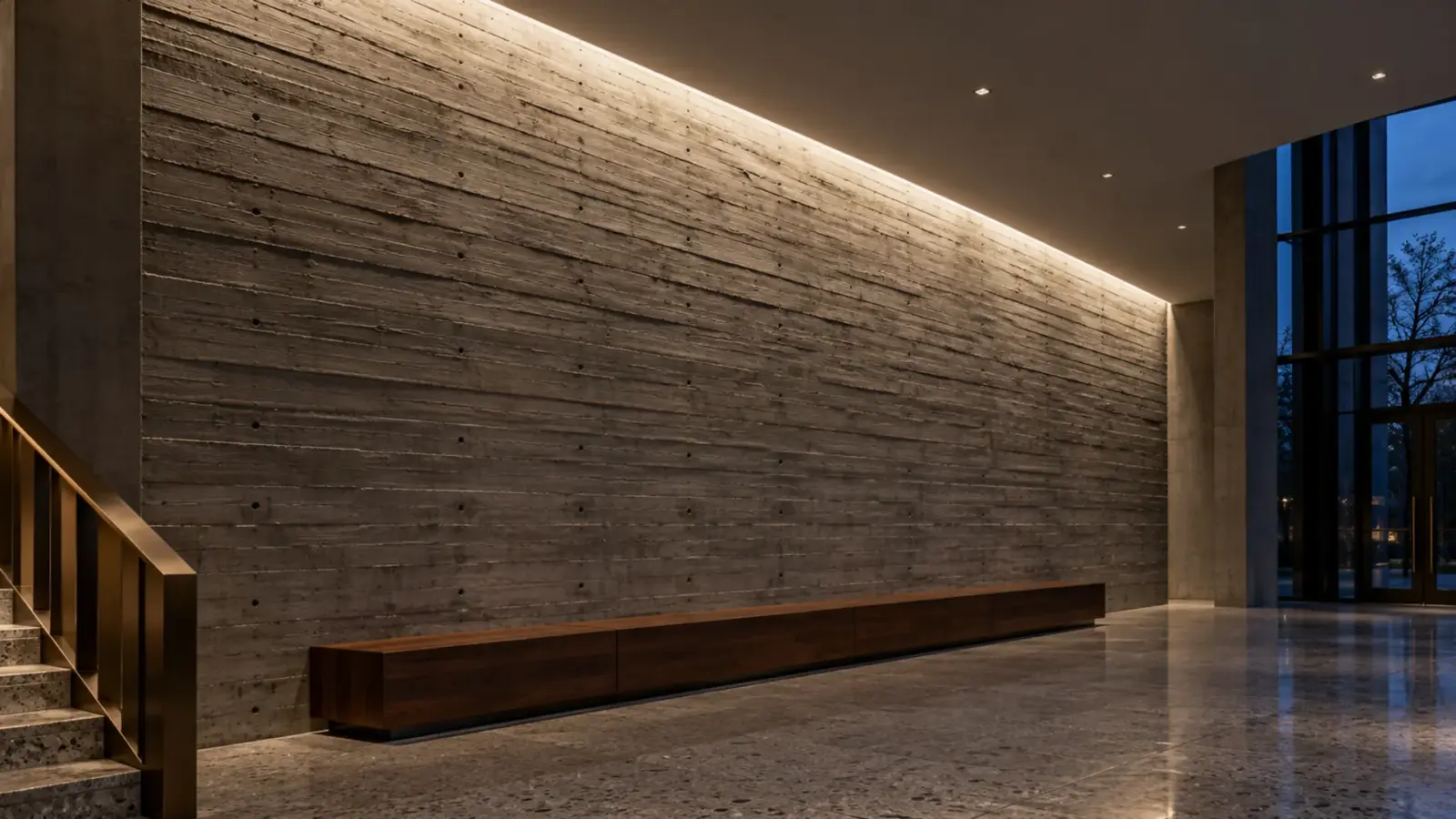
Choose the technique by the wall finish before you choose a fixture. Wall grazing, with a linear LED within 6 in (150 mm) of the surface, turns stone, brick and fluting into relief, and it also exposes every drywall joint. Wall washing, at 6 to 12 in (150 to 300 mm), evens the surface out and hides flaws.
On a typical lobby job the drawing says “linear wall wash” at a six-inch ceiling pocket, the wall is painted drywall, and a limestone feature panel sits beside it. One line of light cannot treat both surfaces the same way, and the pocket was framed before anyone decided. Four checks settle it, in this order: the finish, the pocket, the sightline and the load.
Finish Gate: What the Wall Will Show
A graze lights the surface from a low angle, so any bump or ridge throws a shadow. That is the point on stone and the problem on painted board. Read the wall first.
| Wall surface | Technique | What happens if you pick the other one |
|---|---|---|
| Stone, brick, board-formed concrete | Graze | A wash flattens the relief you paid for |
| Fluted or slatted wood, ribbed panels | Graze | A wash removes the shadow lines that make the pattern |
| Painted drywall, Level 4 finish | Wash | A graze shows joints, screw heads and roller marks |
| Painted drywall, Level 5 or skim-coated plaster | Either, test it | Smooth enough to graze, but check at night |
| Gloss paint, vinyl, glass, metal | Wash, from the larger setback | A graze mirrors the strip and shows every ripple |
| Dark paint | Wash, with a brighter optic | A graze leaves most of the wall dark |

The Level 4 and Level 5 labels come from GA-214, the Gypsum Association’s *Recommended Levels of Gypsum Board Finish*. According to GA-214, Level 5 is typically specified where critical lighting occurs, which the document describes as surfaces lit at an oblique angle, such as by large windows or surface-mounted fixtures. A graze is exactly that kind of light. Check the finish level in the drywall specification section before you choose, and confirm which edition of GA-214 the project follows.
Level 5 adds a skim coat of joint compound over the whole wall. If the budget stopped at Level 4, wash the wall or change the finish. Do not graze it and hope.
Pocket Gate: How Much Setback You Have
The ceiling pocket or cove sets the setback, and the framing usually gets built before the lighting decision is final. Wall grazing needs the strip within 6 in (150 mm) of the wall. Wall washing needs 6 to 12 in (150 to 300 mm). Published guides draw the dividing line anywhere between 6 in and 12 in, so treat the numbers as product-specific and settle them on a mockup; our wall washer range uses the 6 in line.
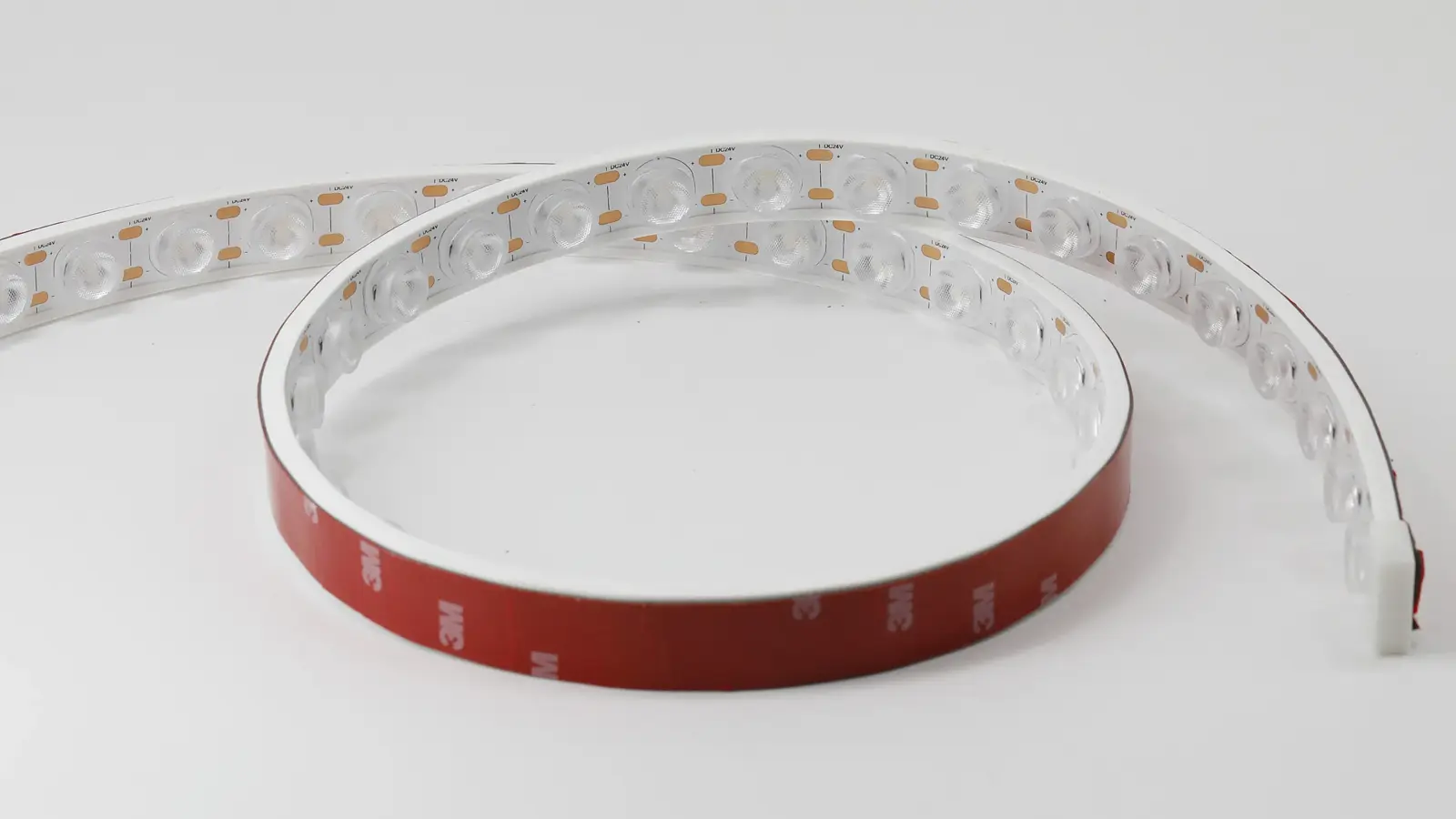
Allow depth for the product. The 27 × 27 mm bar needs a pocket about 1.5 in (38 mm) deep once the wiring base is counted, so a shallow soffit can rule out the bar before any lighting question comes up.
- Pocket under 6 in from the wall: graze, or wash with a wide optic and accept a bright band near the ceiling.
- Pocket 6 to 12 in: either technique works, and the beam angle does the tuning.
- Pocket over 12 in: wash only. A grazing optic that far out lands too low on the wall to rake it.
The geometry of where each beam angle lands, with a table at 6 and 12 in, is in our wall washer beam angle guide. One result matters here: a 10° beam set 6 in off the wall lands about 68 in (1.7 m) down from the strip. A graze therefore leaves a dark band under the slot, and on a 9 ft wall that band is more than half the wall. Grazing pays off on tall walls.
Sightline Gate: Where People See the Wall
The same wall looks different from the door than from the corridor that runs along it. Grazing is strongest when the viewer looks along the wall at a shallow angle, because the shadows are long. Standing square to the wall in a lobby, a viewer sees the lit texture but also the bright lens of the fixture if it is not shielded.
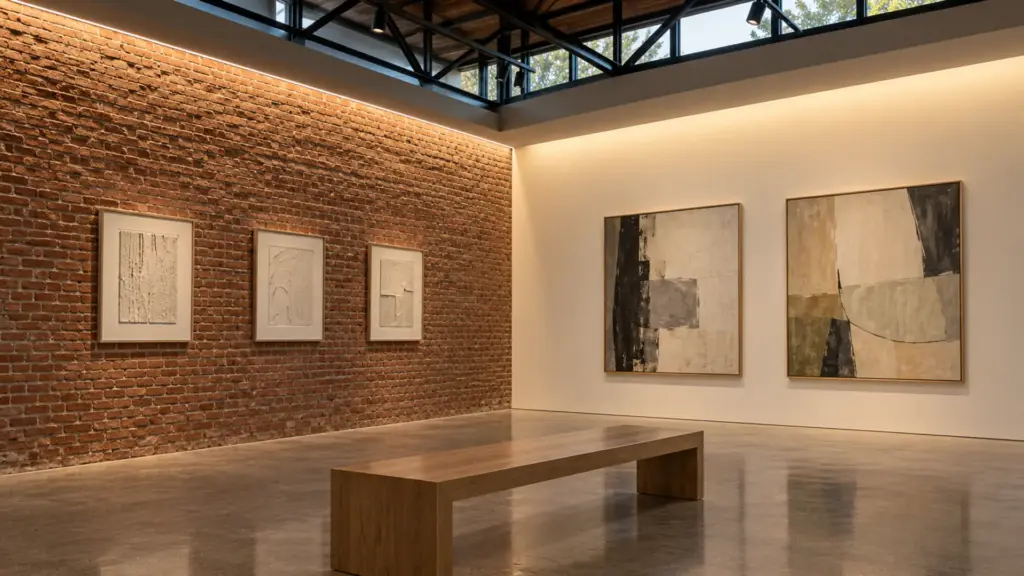
Check three sightlines before you decide: the main entry view, the long approach along the wall, and the seated view if people sit near it. On a glossy wall, a graze can show the fixture’s reflection to a viewer who walks the length of the wall. On a matte wall it cannot. A wash is more forgiving of position, which is why it is the default for artwork rows and gallery walls where every piece should read at the same level.
Optics for Each Job
The beam angle and the setback work as a pair, and each technique has a natural place in our wall washer tables.
| Job | Optic | Model | Power | Output | Max run |
|---|---|---|---|---|---|
| Graze | 10° × 60° | UT-WB27-1060 | 8.2 W/ft | 494 lm/ft | 16.4 ft (5 m) |
| In between | 20° × 30° | UT-WB27-2030 | 8.2 W/ft | 675 lm/ft | 16.4 ft (5 m) |
| Wash | 45° | UT-WB27-45 | 8.2 W/ft | 551 lm/ft | 16.4 ft (5 m) |
| Wash, thin silicone | 45° | UT-WS18-45 | 4.4 W/ft | 562 lm/ft | 16.4 ft (5 m) |
| Wash, thin silicone | 30° | UT-WS20-30 | 4.9 W/ft | 527 lm/ft | 16.4 ft (5 m) |
| Wash, long run | 36° | UT-WC112 | 2.9 W/ft | 389 lm/ft | 32 ft (10 m) |
All of these are Ra80 except where a color-critical wall needs more. If a stone or timber wall must keep its true color, the PU-potted UT-WP24-WHT comes in Ra90 with 30° and 45° optics, but it has no narrow grazing optic, so ask for a mockup with the real material before you commit. The UT-WC112 is IP20 board for use in an aluminum profile, and its 32 ft single run suits a long smooth wall that needs only a wash.
Read the table for what is missing. Nothing here gives you a narrow graze at Ra90. If that is the brief, say so at quote and we will tell you what the range can and cannot do.
Load and Feed: Same Watts, Different Wall
Switching from a wash to a graze does not change the load. Take a 40 ft (12.2 m) wall. The bar draws 8.2 W/ft in every optic, so the wall is a 328 W load whether the optic is 10° × 60° or 45°. The difference is on the wall: the grazing optic gives 494 lm/ft and the 45° optic 551 lm/ft, but the graze puts its light into a narrow strip near the slot, which is why it reads brighter there and leaves the lower wall dark.
The run limit is the same too. At 16.4 ft (5 m) per run, a 40 ft wall needs three runs and three feed points. Plan the joints for a place where the eye does not stop, such as a door return or a column, because a break in a graze is easier to see than a break in a wash. Size each driver with headroom, and keep it where a technician can reach it. We match driver and run limits to your drawing at quote.
Both on One Wall
Sometimes the brief wants texture in one part of a wall and an even field in another. Three ways work, in rising order of cost.
- A middle optic. The 20° × 30° bar sits between the two. It will not graze as hard as the 10° × 60° or wash as evenly as the 45°, and on a mockup it can read as an unsure wash. Use it when the wall is mixed and neither effect needs to be strong.
- Two lines at two setbacks. A graze slot close to the wall and a wash slot farther out, on separate circuits. This gives the cleanest result and doubles the load: two 328 W runs on a 40 ft wall.
- Two zones along the wall. Graze the stone section, wash the painted section, and end each run at a natural break.
Dimming does not turn a graze into a wash. A dimmed grazing line is still a grazing line, only dimmer. Only geometry, meaning setback and optic, changes the technique. The DMX bar variants, for example UT-WB27-2030-DMX, change color and level, not the way light meets the surface.
Mockup Check at Night
According to GA-214, a jobsite mockup is recommended for areas that receive Level 3, 4 or 5 finishes. For a lighting decision it is the cheapest test there is. Build a section as tall as the real wall and wide enough to include two joints, with the final finish and the final paint coats.
- Light it at the final CCT with the room’s other lights on, then off.
- View it head-on, at about 30° along the wall, and from the seated eye height.
- Photograph each view with the same camera settings so the comparison is fair.
- Look at the joints, the screw heads and the corners, not at the center.
- Check the dark band under the slot against the wall height.
Do the check at night or with daylight blocked. A work light in the room hides exactly what a graze would show.
Mistakes That Show Up at Handover
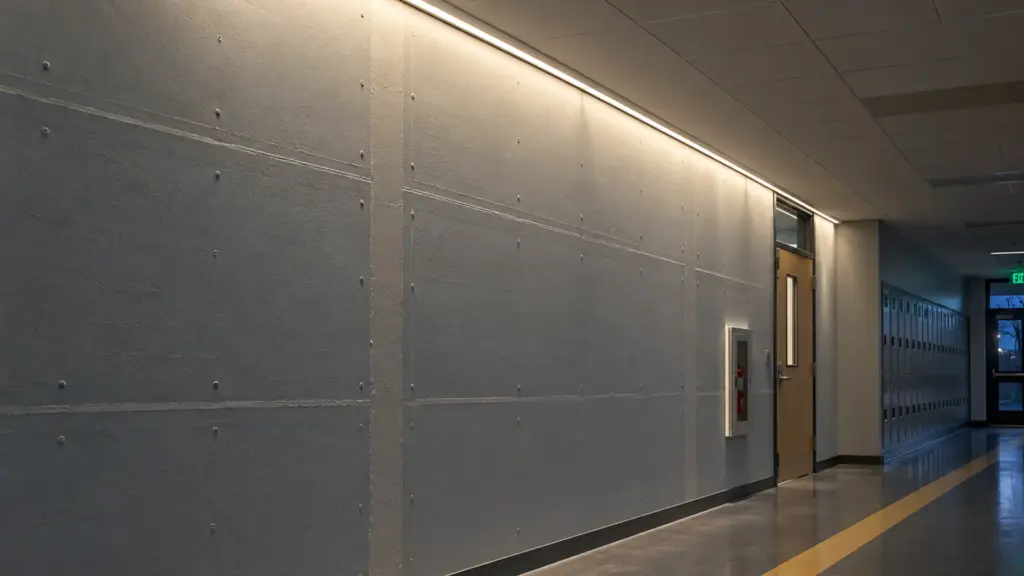
- Grazing a Level 4 wall. The joints show the first night the strip is on, and the fix is a skim coat on a finished wall.
- Choosing the optic before the pocket. A 10° optic in a 15 in pocket cannot graze, and the pocket cannot move once the ceiling is closed.
- Comparing by day. A mockup under work lights shows even light. The wall will not look like that at night.
- Treating dimming as a switch. The technique is fixed by geometry. Plan it before the framing, not after.
FAQ
Can one wall washer strip both graze and wash?
Not from one position. A strip with a wide optic placed at 6 to 12 in washes the wall, and the same strip placed within 6 in with a narrow optic grazes it. A middle optic such as the 20° × 30° bar gives a compromise. If you need both effects, use two lines at two setbacks on separate circuits.
What distance separates wall grazing from wall washing?
Published guides draw the line between 6 in and 12 in from the wall, and some quote it as a fraction of wall height for spot fixtures. For a linear strip in a ceiling pocket, use within 6 in (150 mm) for a graze and 6 to 12 in (150 to 300 mm) for a wash, then confirm on a mockup.
Will wall grazing show drywall flaws?
Yes. A graze casts shadows from any surface bump, so joints, screw heads and roller marks show. GA-214 describes Level 5 finish as the one typically specified for critical lighting, which includes oblique light. If the wall is Level 4 or lower, wash it.
Is a wash or a graze better for artwork?
A wash. It gives the same light level across a row of pieces and keeps the wall from competing with them. A graze belongs on the wall surface itself when the texture is the feature.
Decision Rule
Graze when the wall has relief worth showing, the pocket holds the strip within 6 in, and the finish can take an oblique light. Wash when the wall is painted, smooth or glossy, or when the pocket is deeper than 6 in. If two answers disagree, the finish wins.
Unitop Lighting supplies LED wall washers for commercial and architectural walls across the US. Send the wall elevation, the pocket section and the finish schedule with your quote request, and we will check optic, run lengths and driver load against the drawing before anything is ordered. For the full layout process, see our wall washer design guide.