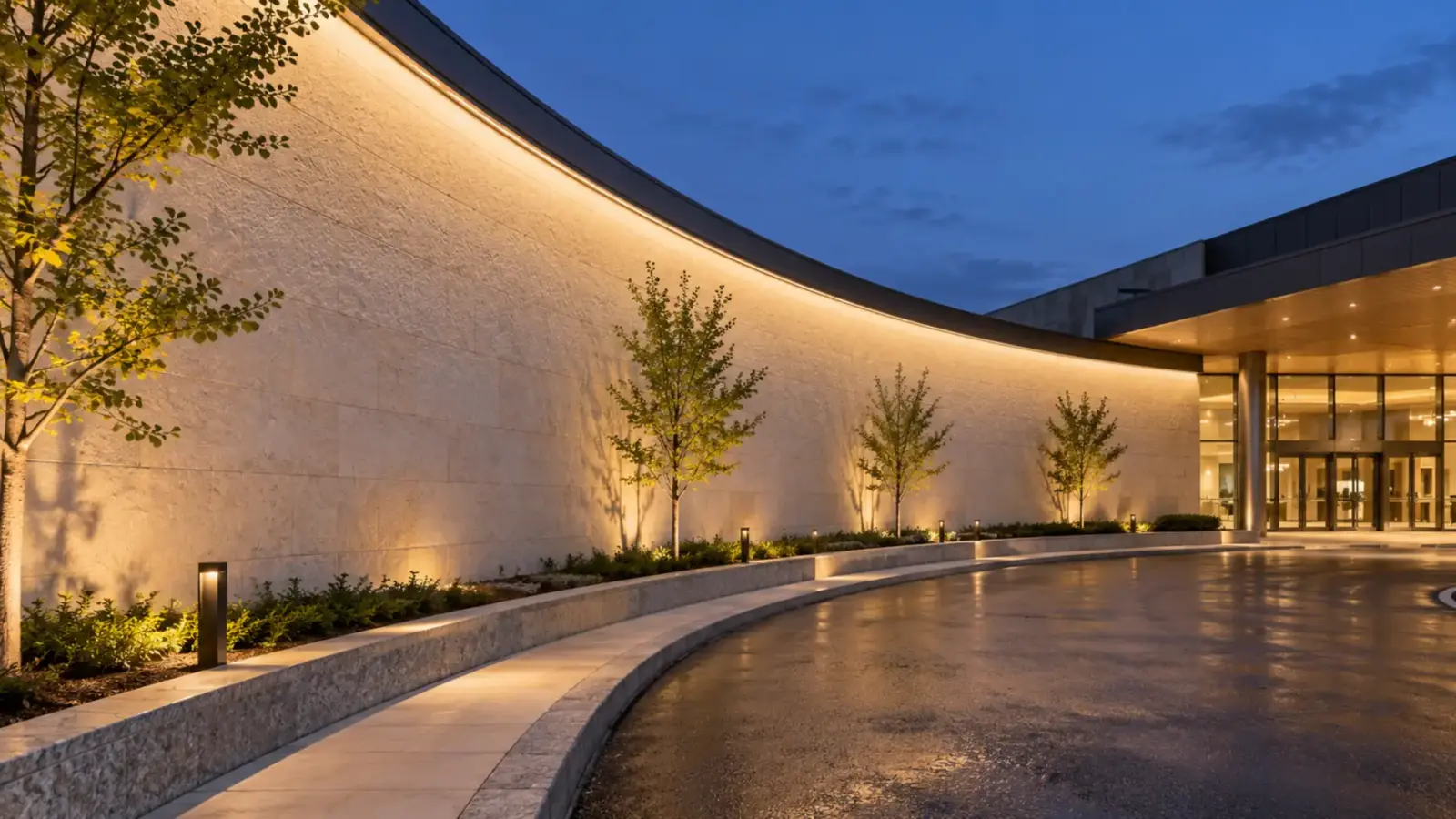
Specify a flexible LED wall washer when the facade curves, turns corners or has to be cut to length on site, and a rigid one when the elevation is straight and tall and the job needs an extruded aluminum housing. Heat, impact and service then settle the rest. Output per foot comes from the data sheet, not the housing.
A 16 ft (4.9 m) aluminum fixture grows about 1/4 in (6 mm) between a January night and an August afternoon on a facade in the sun*. That movement is small, and it still has to go somewhere. A silicone or PU body moves with the wall. A stiff extrusion bolted at both ends does not, and the first sign is a bracket that works loose or a joint that opens.
Side by Side: What the Body Changes
“Flexible” and “rigid” describe the housing. The LEDs and optics can be the same in both. The comparison below separates what the body decides from what it does not. The rigid column describes aluminum-housed fixtures in general, and every row there should be checked against the maker’s data sheet.
| Factor | Flexible (silicone or PU body) | Rigid (extruded aluminum housing, typical) |
|---|---|---|
| Curves and corners | Follows the surface, in one or both axes by model | Straight pieces; a curve becomes facets |
| Length | Cut to length, reels or 1040 mm sections | Fixed fixture lengths, joined end to end |
| Joints | Few; continuous line | An end cap and connector at every fixture |
| Heat path | The body is not a heat sink | Aluminum can carry heat away from the LEDs |
| Thermal movement | Moves with the substrate | Needs sliding or slotted mounting on long lines |
| Weight and depth | Light, 27 mm class bodies | Heavier, deeper housings |
| Impact | Model-specific (our lens bar lists IK07) | Model-specific; often higher ratings, confirm |
| Service | Cut, reseal, replace a section | Replace a fixture |
| Output and optics | Lens choice per model | Lens choice per model |
The last row is where most sales pages lean on the housing. A lens and a driver current decide light on the wall, so compare lumens per foot and beam angle from data, not the word “rigid”.
Geometry: Curves, Corners and Joints
A straight fixture on a curve touches the wall at its ends and leaves the middle away from it. The gap, called sag, is roughly the fixture length squared divided by eight times the radius. The table assumes a 3.3 ft (1 m) fixture.
| Facade radius | Sag at the fixture center |
|---|---|
| 40 ft (12 m) | 0.4 in (10 mm) |
| 20 ft (6 m) | 0.8 in (20 mm) |
| 10 ft (3 m) | 1.6 in (41 mm) |
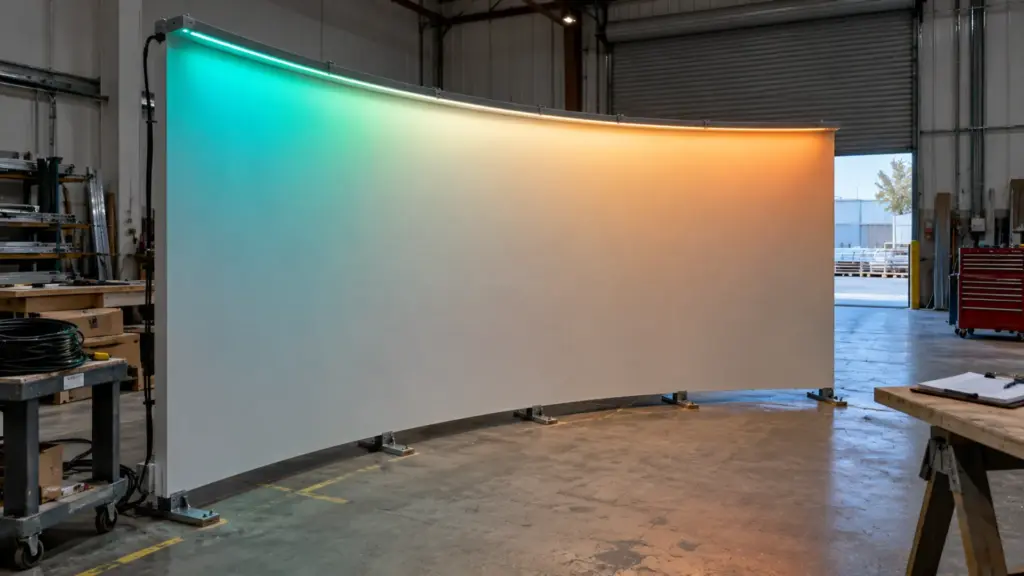
A wall washer sits 6 to 12 in (150 to 300 mm) from the wall, so a 0.8 in sag is 7 to 13 percent of the setback and changes where the beam lands. The result is a pattern that repeats at every fixture length, which reads as scalloping on the wall. The geometry of landing points is in our wall washer beam angle guide.
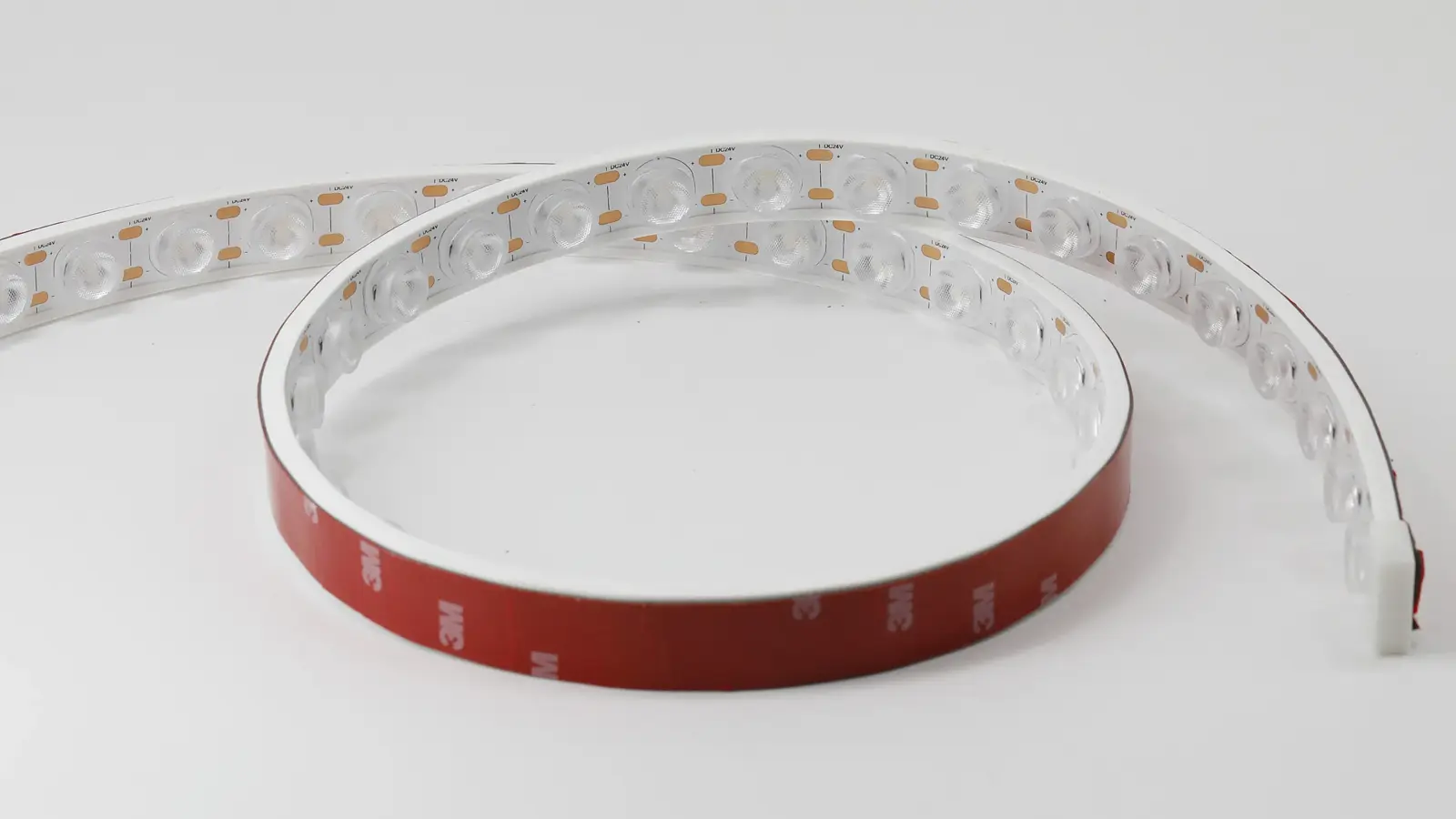
Flexible bodies avoid the facet. Our wall washer range has the 27 × 27 mm silicone bar that bends on both axes, so it can follow a curved wall and a corner in one run. Minimum bend radius is not on our spec table, so ask for it by model and test the radius on a mockup before the order. Single-axis products matter too: the 140 LED/m silicone family bends on one axis only, so a compound curve needs the 70 LED/m UT-WS20-30-3D.
On straight walls the situation reverses. A rigid line stays straight without a track to hold it, and a long flexible run needs clips or a profile along its length to stay aligned.
Heat and Movement: Where Aluminum Needs Room
Aluminum expands more than steel or masonry. The table shows the growth of an aluminum fixture over a 100 °F (56 °C) swing, the difference between a winter night and a summer afternoon on a sunlit surface.
| Fixture run | Growth over a 100 °F swing* |
|---|---|
| 10 ft (3 m) | 0.16 in (4 mm) |
| 16 ft (4.9 m) | 0.25 in (6 mm) |
| 33 ft (10 m) | 0.51 in (13 mm) |
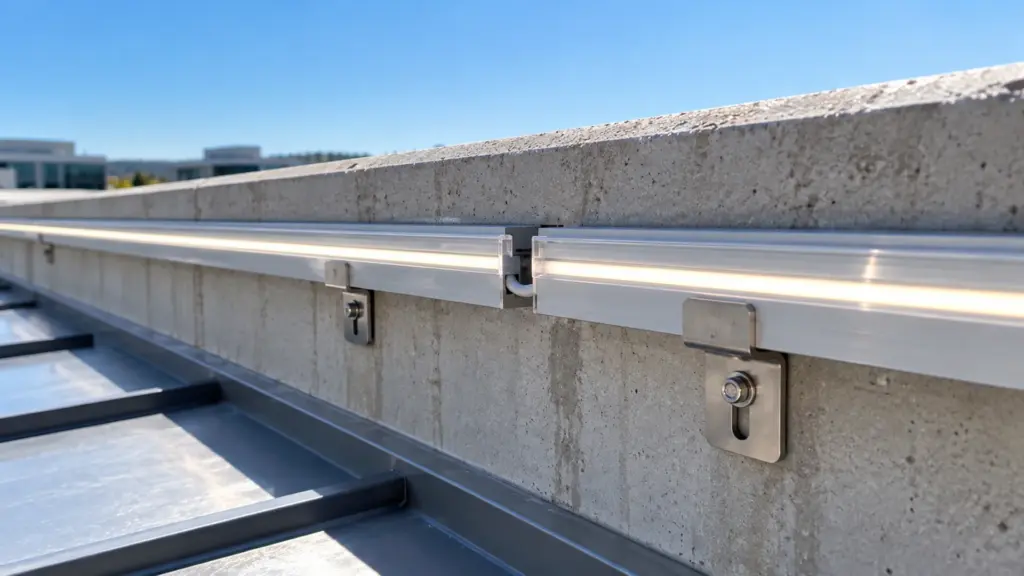
*Typical value for common aluminum alloys, about 12.9 µin per in per °F; use the extrusion maker’s figure.
Half an inch over 33 ft is why long aluminum lines are fixed at one point and left free at the other, with joints that can slide. If the brackets are rigid at both ends, the line pushes on its fixings. A flexible body takes up the same movement in its own length, which is one reason it suits a long run on a substrate that moves differently from aluminum.
Heat is the second half. A silicone or PU body is not a heat sink, so the LEDs rely on the lower watt density the product is rated for. The bar runs 8.2 W/ft. Ask any maker, ours included, for the ambient limit and the derating at the load you plan. Vendor pages claim better heat handling for aluminum, and none of the search results we checked contained independent test data comparing the two, so treat that claim as the maker’s.
Throw and Output: Compare Data, Not Housings
Light on the wall comes from the optic, the LED count and the drive current. The flexible families we supply span these figures from our wall washer range:
| Model | Body | Bend | Optic | Power | Output | IP / IK |
|---|---|---|---|---|---|---|
| UT-WB27-1060 | Silicone bar | Both axes | 10° × 60° | 8.2 W/ft | 494 lm/ft | IP67 / IK07 |
| UT-WB27-2030 | Silicone bar | Both axes | 20° × 30° | 8.2 W/ft | 675 lm/ft | IP67 / IK07 |
| UT-WB27-45 | Silicone bar | Both axes | 45° | 8.2 W/ft | 551 lm/ft | IP67 / IK07 |
| UT-WS20-30-3D | Silicone, 70 LED/m | Both axes | 30° | 3.0 W/ft | 347 lm/ft | IP67 |
| UT-WP24-WHT | PU-potted | Follows surface | 30° / 45° | 6.1 W/ft | 452 lm/ft | IP65 |
Each family runs 16.4 ft (5 m) from one feed. Our page lists wash heights up to 23 ft (7 m) for the higher-output modules. Taller walls, longer throws or very high output per fixture are where a rigid fixture can be the better tool. Say so at quote and we will tell you if the job is outside our range.
Impact and Service
Impact is a location question. Within reach of the public, such as a plaza wall or a stair edge, the IK rating matters more than the housing. IK ratings, defined in IEC 62262, run from IK07 at 2 joules to IK10 at 20 joules. Our lens bar is listed IK07; rigid fixtures are often rated higher, which you confirm by model. For lines at ankle height in public areas, our facade page lists the IP68 and IK10 neon flex UT-N1616-68 instead of a wall washer.
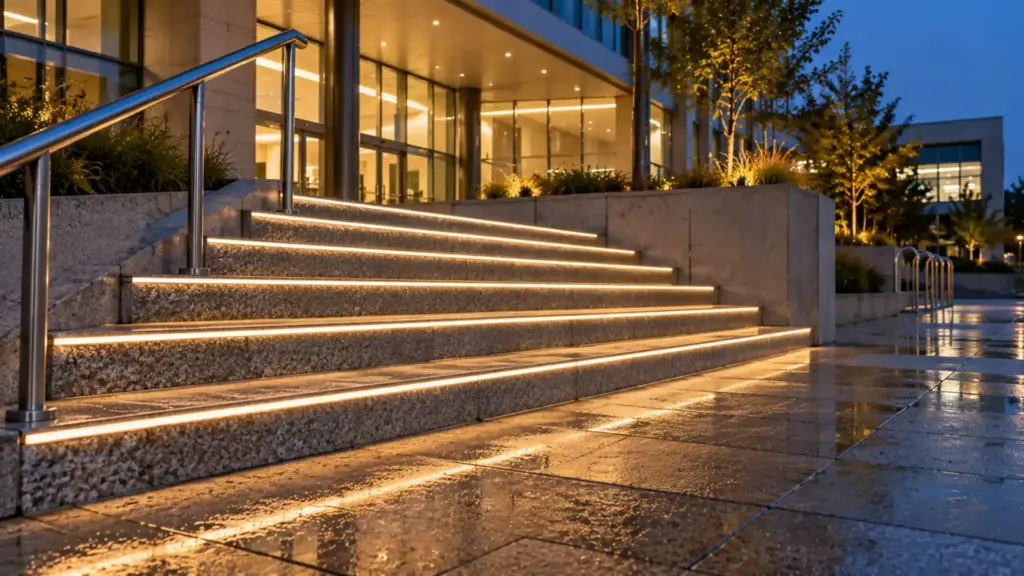
Service is the other half. A flexible run can be cut, resealed and re-fed; the cut end must be sealed to the same standard as the strip, as we describe in our guide to sealing a cut end of IP67 strip. A rigid line is serviced by replacing a fixture. Which is faster depends on the access: a lift on a blank wall favors the one-piece swap, a cove favors the cut-and-feed.
Worked Example: A 120 ft Curved Podium
A typical case: a curved podium wall, 120 ft (36.6 m) along the arc, smallest radius 25 ft (7.6 m), washed from a pocket under the coping. The flexible build uses the 45° silicone bar UT-WB27-45; the rigid build uses 3.3 ft (1 m) fixtures.
| Item | Flexible bar | Rigid, 3.3 ft fixtures |
|---|---|---|
| Pieces | 36 sections of 1040 mm, cut at 250 mm increments | 37 fixtures |
| Breaks in the line | 7, one between each run of 16.4 ft (5 m) or less | 36 end joints |
| Load at 8.2 W/ft | 984 W for the wall | per the maker’s data |
| Sag at 25 ft radius | None, the body follows the arc | 0.65 in (16 mm) at the center of every fixture |
The flexible build has seven breaks, and each can sit behind a pilaster or a coping joint where the feed lands. The rigid build has 36 end joints, each with an end cap and a connector, and every facet changes the setback by up to 0.65 in. Neither build is wrong. The difference is that the facet pattern repeats every 3.3 ft and cannot be adjusted once the coping is closed. Plan drivers where service can reach them, with headroom on each, and let us check the driver count against the drawing at quote.
Mounting and Alignment
A bent body does not hold its aim by itself. The flexible bar sits in a mounting profile with clips at regular spacing, and the profile, not the silicone, keeps the optic pointed at the wall. A rigid fixture holds its aim in its own housing, and its brackets mostly carry weight. Either way, aim is a detail on the drawing: the pocket depth, the clip spacing, the profile joint and the cable exit.
The bar’s 27 × 27 mm body needs 38 mm of depth with the wiring base, so the coping pocket is detailed to 1.5 in. Check the same dimension on any rigid fixture before the pocket is framed, because housings are deeper and the bracket adds to it.
Sun, Weather and Listings
Outdoor work adds sun, rain and cleaning. IP67 means dust-tight and protected against temporary immersion; IP65 means dust-tight and protected against water jets. The ratings cover the body, and the cut ends and connectors have to be sealed to the same level. Our wet location guide covers the IP code and the wet-location marking. For sun and cleaning exposure, ask for the material data, because “silicone” and “aluminum” are families and the grades differ.
Listings need the same care. A listing attaches to a tested assembly and the maker that holds it, not to a category such as flexible or rigid. Ask each supplier which listing, if any, covers the exact fixture, driver and cable you plan to install, and who holds it.
Control and Color
Both bodies can carry DMX512 control. The DMX bar variants, such as UT-WB27-2030-DMX, use the same body and brackets as the white bar, so a project can run white and RGBW sections on one installation detail. The addressable UT-WA16-SPI is a decorative line at 60° and 134 lm/ft, not a wash, so do not specify it to light a wall. Keep the control path on the schedule from the start: DMX drives a whole section to one color, and SPI addresses segments.
Which Facade Gets Which
| Facade | Pick | Why |
|---|---|---|
| Curved podium, drum, column | Flexible | No facets; one continuous line |
| Long straight parapet, 40 ft and up | Either | Run limits, feeds and output decide; rigid needs slotted fixings |
| Corner returns and inside corners | Flexible | One run turns the corner without a joint |
| Narrow pocket or retrofit into an existing profile | Flexible | 27 mm body, 38 mm deep with the wiring base |
| Very tall wall, long throw | Check data; rigid if it exceeds our range | Output and optics decide |
| Within public reach | Check IK first | Impact rating beats housing |
| Mixed straight and curved | Flexible | One product, one detail |
Mistakes on Facade Jobs
- Facets on a tight curve. Straight fixtures on a 10 ft radius leave a 1.6 in sag. Pick the product by the smallest radius on the elevation.
- Fixing aluminum at both ends. A 33 ft line moves half an inch. Fix one end and let the other slide.
- Reading IP as IK. Water ingress and impact are separate ratings; the public-reach wall needs both.
- Judging output by housing. Compare lumens per foot and beam angle in the data sheet, and ask for photometric files.
- Skipping the mockup. The curved section is the one to build, at the real radius, in the real finish.
FAQ
Can a rigid LED wall washer follow a curved facade?
Only as a series of straight segments. A 3.3 ft (1 m) fixture on a 20 ft (6 m) radius leaves a 0.8 in (20 mm) gap at its center, which changes the beam pattern on the wall. A flexible body follows the curve in one line.
Do aluminum LED fixtures need expansion gaps outdoors?
On long runs, yes in the mounting. A 33 ft (10 m) aluminum line grows about 0.5 in (13 mm) over a 100 °F swing, so fix it at one point and let the rest slide. Follow the maker’s bracket spacing and joint details.
What IK rating does a facade wall washer need?
It depends on who can reach it. IEC 62262 defines IK07 as 2 joules and IK10 as 20 joules. Out of reach, a lower rating can do. At ankle or hand height in public areas, specify the rating for the location and confirm it for the exact model.
Is aluminum better for LED heat?
Aluminum conducts heat better than silicone, but the whole assembly sets the temperature: LED density, drive current, mounting and ambient. Ask for the ambient limit and derating of the exact product at your load.
Which One to Spec
Choose flexible for curves, corners, cut-to-length runs and narrow pockets. Choose rigid when the wall is straight and tall and the data sheet shows the output and IK rating you need. When the two answers conflict, start from the smallest radius on the elevation.
Unitop Lighting supplies flexible LED wall washers for commercial and architectural facades across the US. Our range is flexible silicone and PU bodies, and when a job needs a rigid fixture we say so at quote. Send the elevation, the smallest radius and the mounting detail with your quote request, and we will check optic, run length and driver load against the drawing. For the layout process, see our wall washer design guide; for the facade page, see facade and outdoor lighting.