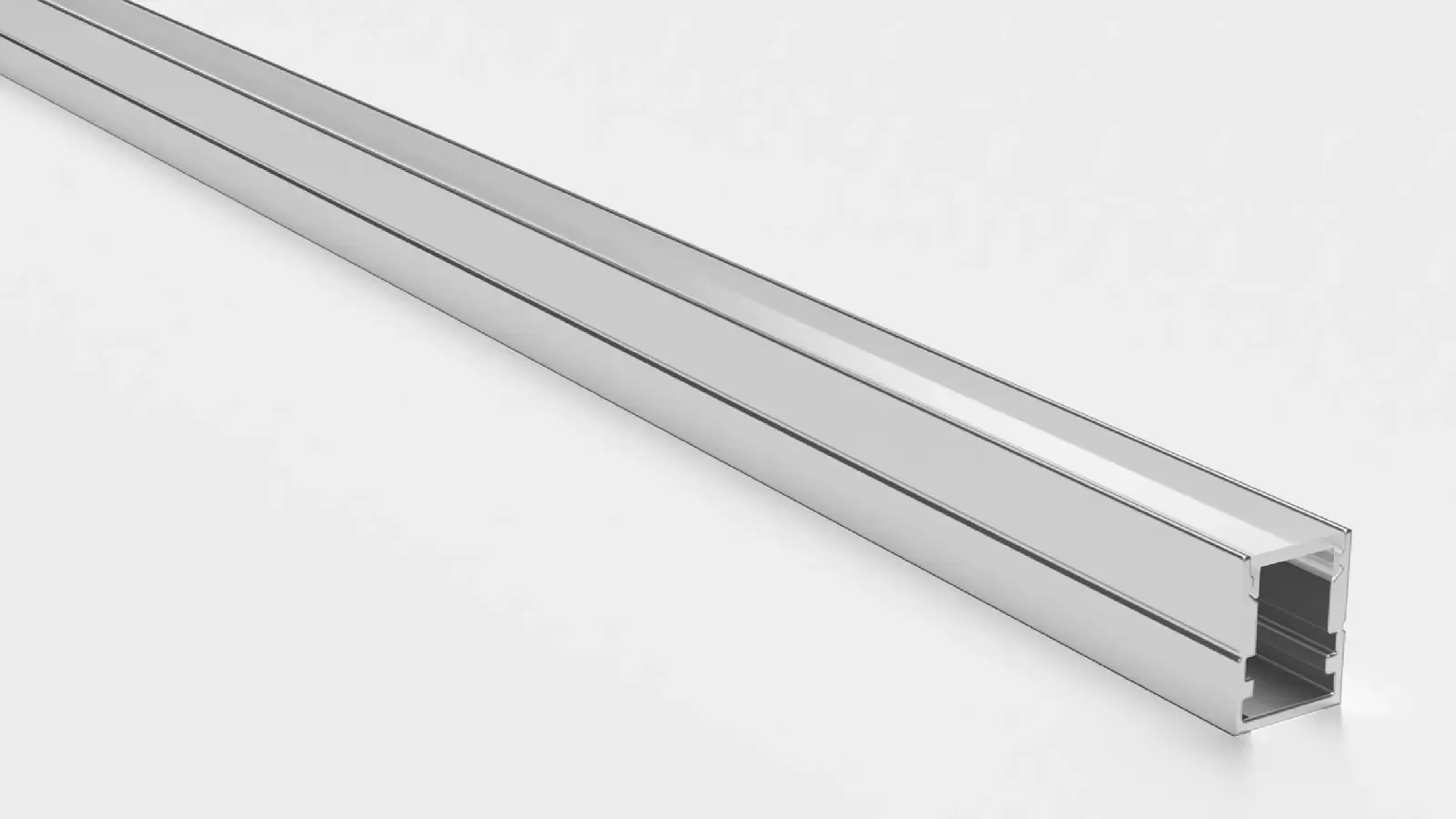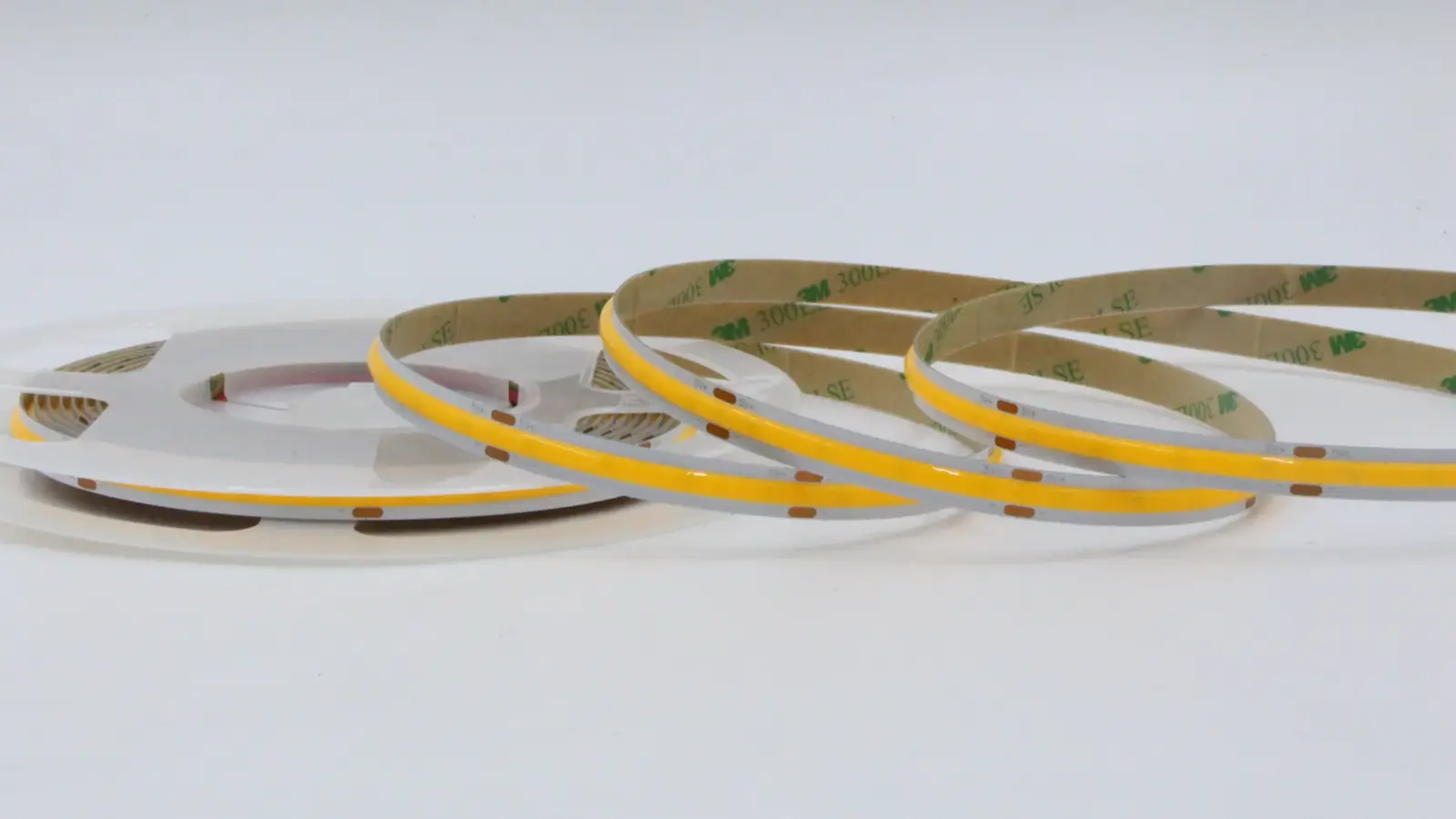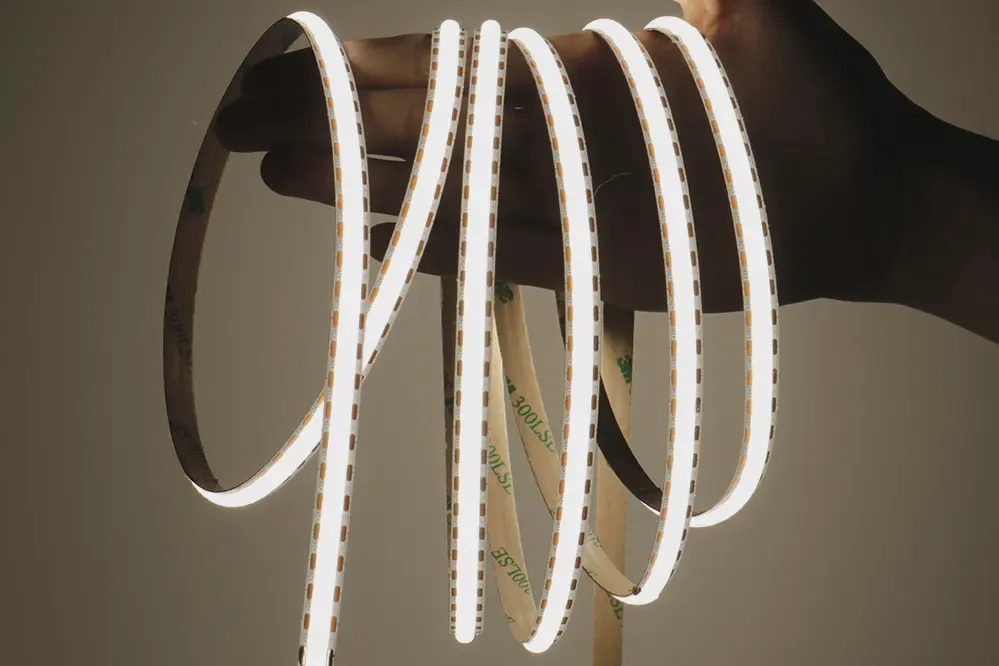
LED strip in a channel is the right spec when the run needs custom lengths, corners or a shallow pocket, and the contractor accepts assembling and owning the system. A finished linear fixture is the right spec when the drawings call for a listed luminaire with its own photometric file. Six things move to the contractor with the swap.
A typical value-engineering request: the schedule lists a 4000K linear fixture along 120 ft of corridor perimeter, and the owner’s representative asks for the strip-in-channel alternative. The line on the schedule goes from one catalog number to several, and the person asking usually has a cost number in mind and no list of what else changes. The sections below cover what the swap does to the submittal, the inspection, the mockup, the ceiling and the handover, so the answer to the request is a list and not a yes or a no.
Six Moves: What the Swap Hands to You
| Item | Finished linear fixture | Strip in a channel | Who answers for it |
|---|---|---|---|
| Listing | One luminaire, listed as a unit | Strip, channel and driver are separate parts | The contractor, with the AHJ |
| Photometrics | IES file from the maker | Strip data times cover transmission, then a mockup | The contractor and the designer |
| Lengths | Catalog lengths with a joint at each end | Cut to the run schedule | The contractor |
| Heat | Housing, board and driver designed as one | The strip’s mounting requirement | The contractor |
| Service | Replace the fixture | Lift the cover, replace the strip | The contractor, at handover |
| Line items | One | Strip, channel, cover, end caps, clips, driver | The contractor |
None of this makes strip in a channel the weaker choice. It makes it a system that someone has to assemble, document and stand behind. If the project has no one in that seat, the fixture is the safer spec.
Listing: Who Answers to the Inspector
A finished linear fixture is normally a UL 1598 luminaire. A strip sold as a low-voltage lighting system is normally listed to UL 2108 for installation under NEC Article 411, with UL 8750 parts inside it. A channel with a cover, what sellers outside the US often call a profile light, is hardware around that system. Our guide to UL 2108, UL 8750 and UL 1598 sorts the three standards by product form.
The open question is how the inspector classifies the assembly. Search results for this question are vendor pages and forum threads, and they disagree. One vendor says strips are outside the listing requirement, and a code forum thread argues listed components are required. Do not settle it by choosing the more convenient answer. The adopted code edition and the local authority decide, and our NEC checklist shows how to find both.
We do not state that a field-built strip-and-channel assembly is a listed luminaire, and a submittal should not either. Ask the strip, driver and channel makers what each is listed to, and who holds the listing. Ask the inspector in writing whether the assembly is accepted when built from listed parts. If the answer is no, the swap is off the table, and that is better to learn before the order.
Photometrics: What You Can Show the Designer
A fixture arrives with an IES file. A strip in a channel arrives with a strip data sheet and a cover that takes some of the light. The designer needs a number on the wall, so you build it: strip output times cover transmission, then a mockup to check what the arithmetic cannot show.
Our channel page lists the covers: PC clear transmits roughly 90 to 95 percent of the strip’s output, and PC opal roughly 70 to 80 percent. The table applies those ranges to a round-number strip of 500 lm/ft. The strip is an example, not a model.
| Cover | Transmission | Light out of the channel |
|---|---|---|
| PC clear | roughly 90–95% | 450–475 lm/ft |
| PC opal | roughly 70–80% | 350–400 lm/ft |
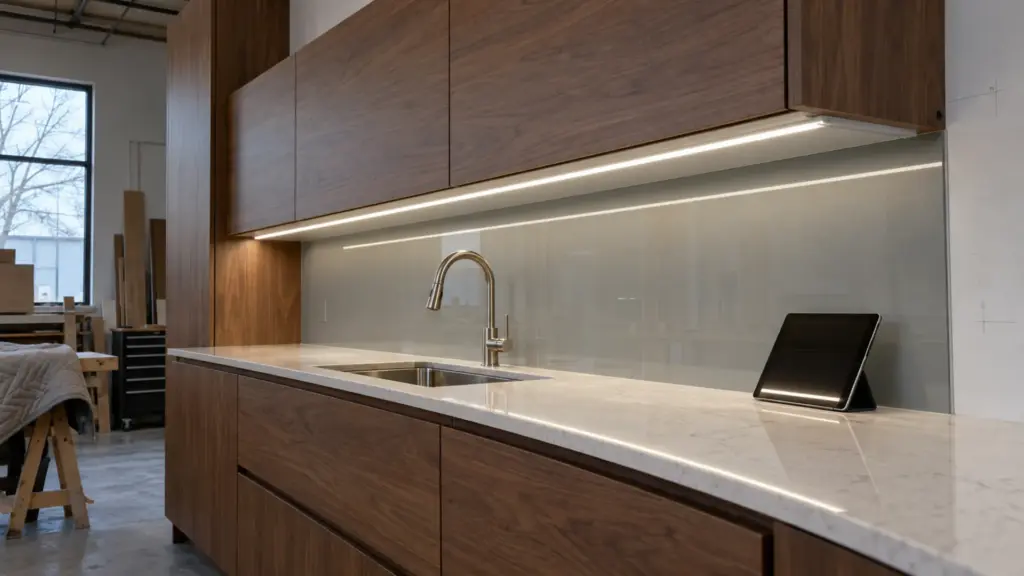
Opal costs up to 150 lm/ft on this example, which is why our page says to size the strip up one step when the line is seen directly. Opal also hides the dots. The UT-CH2415 has 14.5 mm of optical depth and gives a dot-free line even with standard-density strip; a shallow channel needs a denser strip or a dot-free one, and our guide to dots showing through a diffuser covers the fix. Dots are the most common reason the owner rejects the swap on the mockup wall.
Ask for the data in this order: the strip’s LM-80 report and its CCT and CRI tolerance, the cover’s transmission and its color shift, and the channel’s finish. Our guide to LM-80 and TM-21 explains what the lifetime numbers mean. If the design needs a measured photometric file for the whole assembly, ask for a lab test of the exact combination and treat it as a line in the schedule, because a fixture’s IES file was measured with its own housing and a strip’s was not.
A mockup also catches color. The cover, the anodized finish and the wall paint change how the same 4000K reads, and none of that is in an IES file.
Lengths, Corners and Joints
This is where strip in a channel earns its place. Channels ship as 6.6 ft (2 m) or 9.8 ft (3 m) lengths, or factory pre-cut and labeled for each run on your schedule. Aluminum and cover cut with a miter saw on site, and the end caps re-seat on the cut end. A fixture comes in catalog lengths, and a wall that is 14 ft 3 in long ends up with a joint or a filler piece.
The profile shapes matter more than the lengths:
- Plaster-in, trimless: the UT-CH2020, 20.2×19.5 mm, takes joint compound on its wings so the channel disappears into the ceiling plane.
- Compact surface: the UT-CH1207, 12×7 mm, fits an 8 mm strip into a shelf reveal.
- Corner: the UT-CH1616 seats in a 90° corner and aims the strip out at 45°.
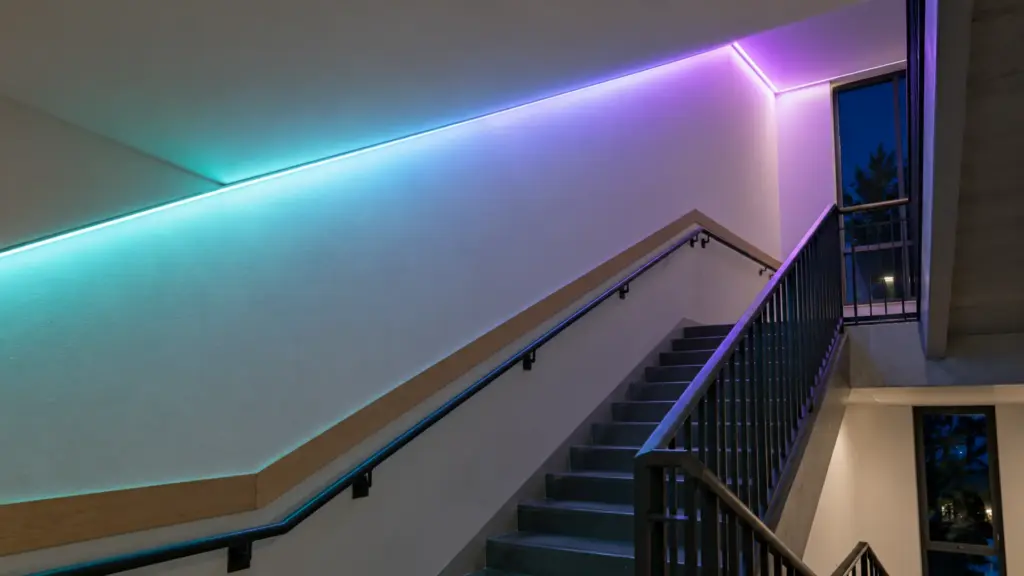
A rigid fixture has an end plate or connector at each joint, and the spacing comes from the maker’s catalog. Read the joint detail on the data sheet before you promise a continuous line, and ask what the joint does to the light at each end.
Heat and Output
A strip at 6 W/ft or more needs aluminum behind it, as we explain in our guide to strip thermal management. The channel supplies that aluminum, and the AL6063 body pulls heat off the strip only when the strip sits flat on the channel floor. A finished fixture’s maker has already chosen the board, the housing and the driver together, and its data sheet states an ambient limit.
For a strip in a channel, the designer picks the combination, so the combination has to be checked: the strip’s watts per foot, the channel’s width and depth, and the air around it. The COB LED strip range lists watts per foot by model, so the check is arithmetic, not a guess. If the line is doubled in a wide channel such as the UT-CH3020 for more output, the load doubles and the check starts again.
Control and Dimming
A finished fixture usually arrives with its driver and its dimming interface chosen by the maker. With strip in a channel, you choose both. A 24V strip runs on a constant-voltage driver, and the dimming method is a driver property: 0-10V, TRIAC or PWM, with the controller on the schedule. Our dimming protocol guide sorts them, and the driver and dimmer compatibility test shows why you check the pair on the bench before the ceiling closes.
This is also where the strip path has more range. Tunable white, RGBW and addressable strip all fit the same channel and cover, so one detail can carry a white line in the corridor and a color line in the stair hall. A fixture family usually offers the options its maker built, and a custom CCT or color is a special order.
Service and Handover
The click-in diffuser lifts out by hand, and the strip behind it is replaceable without touching the ceiling. A fixture is replaced as a unit. Neither is better in every building; the question is who will do the work in ten years. A facility team with a ladder and a spare reel can service strip in a channel. A team that wants to unplug a fixture and plug in another should get the fixture.
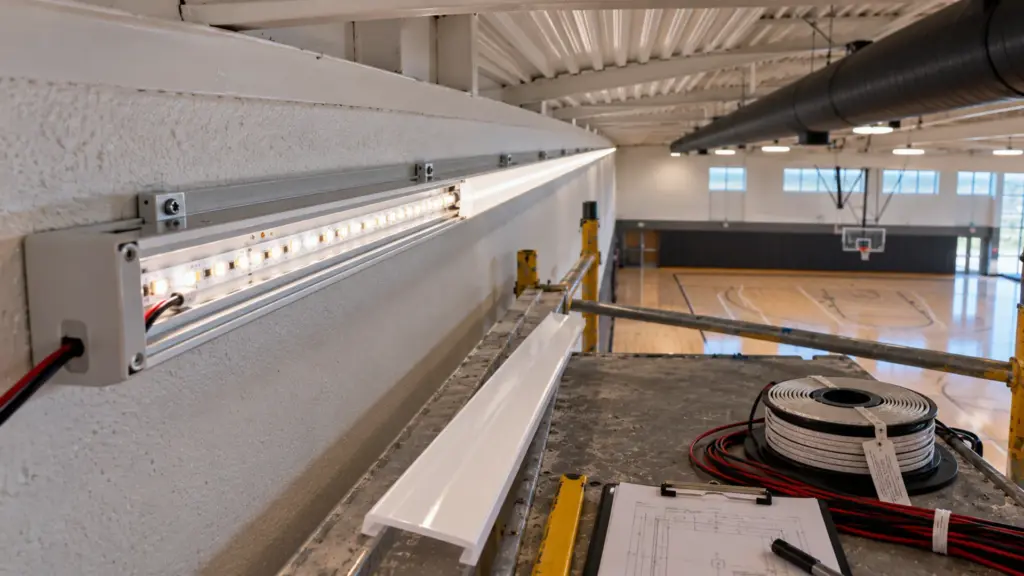
Hand over what the building will need: the strip model and CCT, the channel and cover model, the run labels, and a spare strip with the same CCT and bin. Pre-cut and labeled channels make the run labels part of the delivery.
A Typical Job: 120 ft of Corridor Perimeter
The 120 ft perimeter from the opening, built as strip in a channel with 9.8 ft lengths, looks like this. The fixture path is one catalog line per fixture length.
| Item | Strip in a channel | Linear fixture path |
|---|---|---|
| Channel and cover | 13 channels and 13 covers (120 ÷ 9.8 = 12.2, rounded up) | Fixtures at the maker’s catalog length |
| Clips | About 74 at 19.69 in spacing, supplied with the kits | In the fixture |
| End caps | 26 supplied, used only at run ends | Per fixture |
| Strip | 120 ft plus cut waste | In the fixture |
| Driver and load | At 5 W/ft, a 600 W load, driver sized with headroom | Per the maker’s data |
| Documents to collect | Strip, channel, cover, driver, connector data | One data sheet and IES |
The strip-and-channel path is not more work on the ceiling. It is more work in the office: five sets of data to collect, check against each other and file. Budget the time for that before you promise the swap.
Comparing Cost Without a Price Sheet
The fixture and the strip path cost money in different places, and a single number hides it. A fixture’s price includes the listing work, the photometric test, the housing and the warranty process. The strip path moves part of that to the project: assembly hours on the ceiling, the document set in the office, a mockup, and the risk that an inspector asks for something the parts do not carry. Put each of those on the comparison as a line, even if the figure is a rough hour count. If the person who asked for the swap sees only the material price, the saving shown on paper is partly the labor and the risk, relocated and unpriced.
Which Job Gets Which
| Job | Spec | Why |
|---|---|---|
| Custom lengths and cut-to-schedule runs | Strip in a channel | Pre-cut and labeled channels fit the run schedule |
| Corners, coves and 45° aim | Strip in a channel | Corner profile and flexible strip follow the geometry |
| Shallow pocket or reveal | Strip in a channel | A 12×7 mm profile fits where a fixture does not |
| Trimless plaster-in lines | Strip in a channel | A 20.2×19.5 mm profile disappears into the ceiling plane |
| Spec requires a listed luminaire | Finished fixture | The listing is one document, not an assembly |
| Design calculation needs an IES file | Finished fixture | The maker has measured it |
| Staff will not service strip | Finished fixture | Replace as a unit |
| No assembly time or documentation budget | Finished fixture | One line item, one data sheet |
| High output per foot at a long throw | Check data | Output comes from optics and drive, not the housing |
Where the existing fixtures are T5 fluorescent, our guide to when a T5 fixture should become LED strip runs the three gates for that case.
Mistakes on a Swap
- Pricing the strip against the fixture. The fixture price covers a listing, a photometric file and a warranty. The strip price does not. Compare the six items, not the sticker.
- Skipping the inspector. A swap that the AHJ rejects after install costs a ceiling. Ask before the order.
- Judging by the bare strip. The cover takes 5 to 30 percent of the light. Judge the lit channel.
- Shallow channel, sparse strip. The dots show on the mockup wall and the owner rejects the line.
- No spare reel. The next reel from a different bin may not match the run.
- Mixing covers across zones. Clear in one room and opal in the next changes the look of the same CCT. Keep one cover per visible space.
- Forgetting the driver location. A fixture often carries its driver. A strip path needs a driver closet or a ceiling box with access, drawn before the ceiling is framed.
FAQ
Will an inspector accept LED strip in a channel instead of a listed fixture?
It depends on the adopted code edition and the local authority. Ask in writing whether an assembly built from listed strip, driver and connectors is accepted, and attach the listing documents for each part. Our NEC checklist shows how to find the adopted edition. If the answer comes back as no or as a maybe, switch to a listed fixture before the order, not after the inspection.
Is LED strip in a channel a luminaire?
Not by being in a channel. A finished fixture listed as a luminaire is one. Whether a field-built assembly counts depends on how its parts are listed and on the inspector. We do not claim it is.
How much light does the cover cost?
A PC clear cover transmits roughly 90 to 95 percent and PC opal roughly 70 to 80 percent, per our channel page. A 500 lm/ft strip gives 350 to 400 lm/ft under opal. Size the strip up one step when the line is seen directly.
Can I mix strip in channels and fixtures on one job?
Yes, if CCT, Color Rendering Index, 0–100: how truthfully the light shows colors next to a reference source. Ra≥90 is the usual bar for interiors. and appearance match on a mockup and each space keeps one source type. Different covers and finishes shift color, so check them side by side in the real finish. Put the fixtures where the owner wants a luminaire on the drawing, such as a feature line, and the strip where geometry or length rules the fixture out.
Before You Order
Put the listing question in the RFI before the price. Ask for IES data where the calculation needs it, and build the mockup with the real cover, the real paint and the real driver. Count the line items on both paths and assign each one an owner, including the person who will service the line after handover. Draw the driver location on the plan, check the strip and driver pair on the bench, and record the strip model, CCT and spare reel in the closeout.
Unitop Lighting supplies LED channels and diffusers and the strip that goes in them for commercial and architectural projects across the US. Send the run schedule, the pocket section and the control scheme with your quote request, and we will pair strip, channel, cover and driver and pre-cut the channels to your schedule. If the job needs a listed luminaire, we will tell you that too.