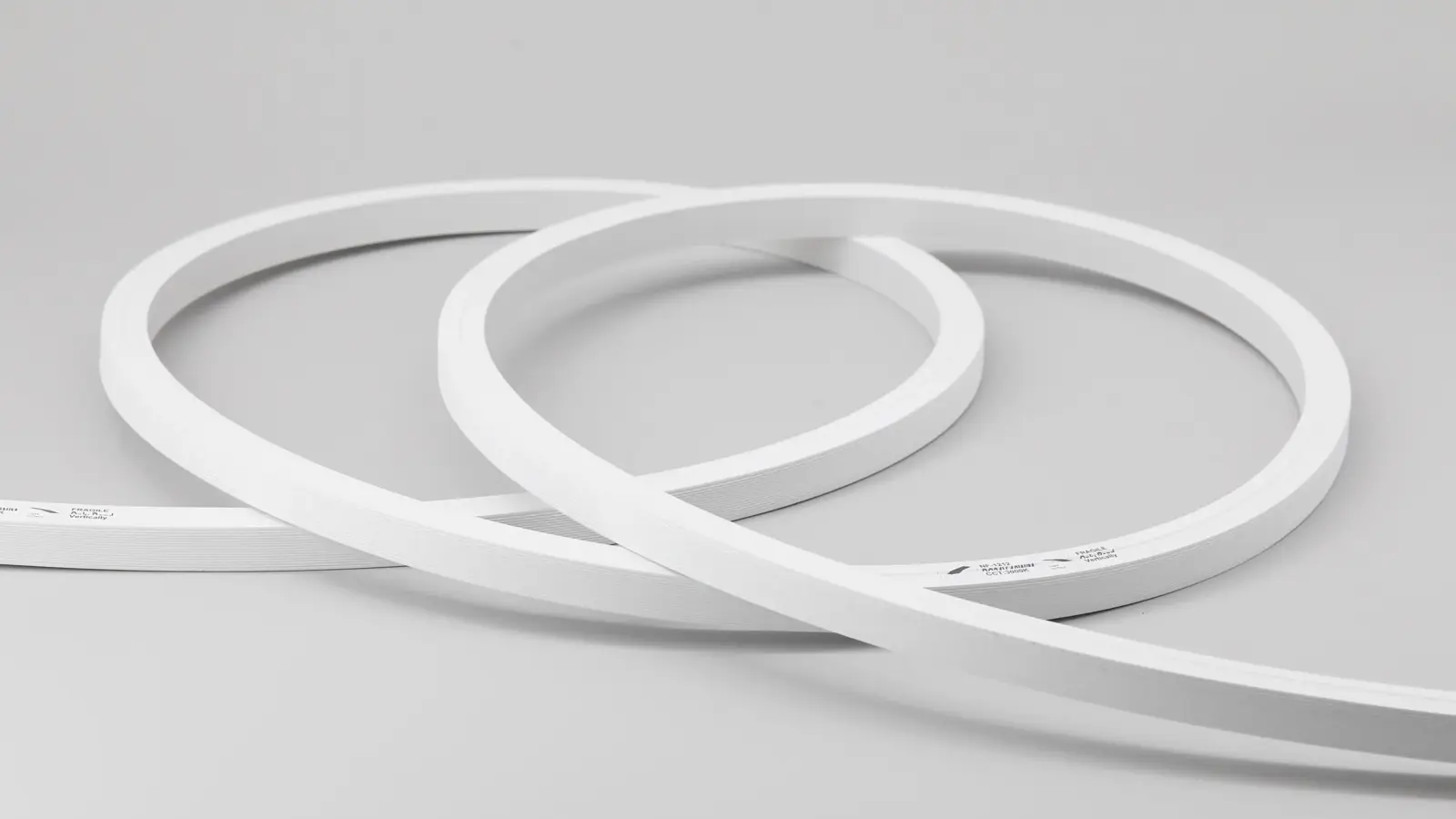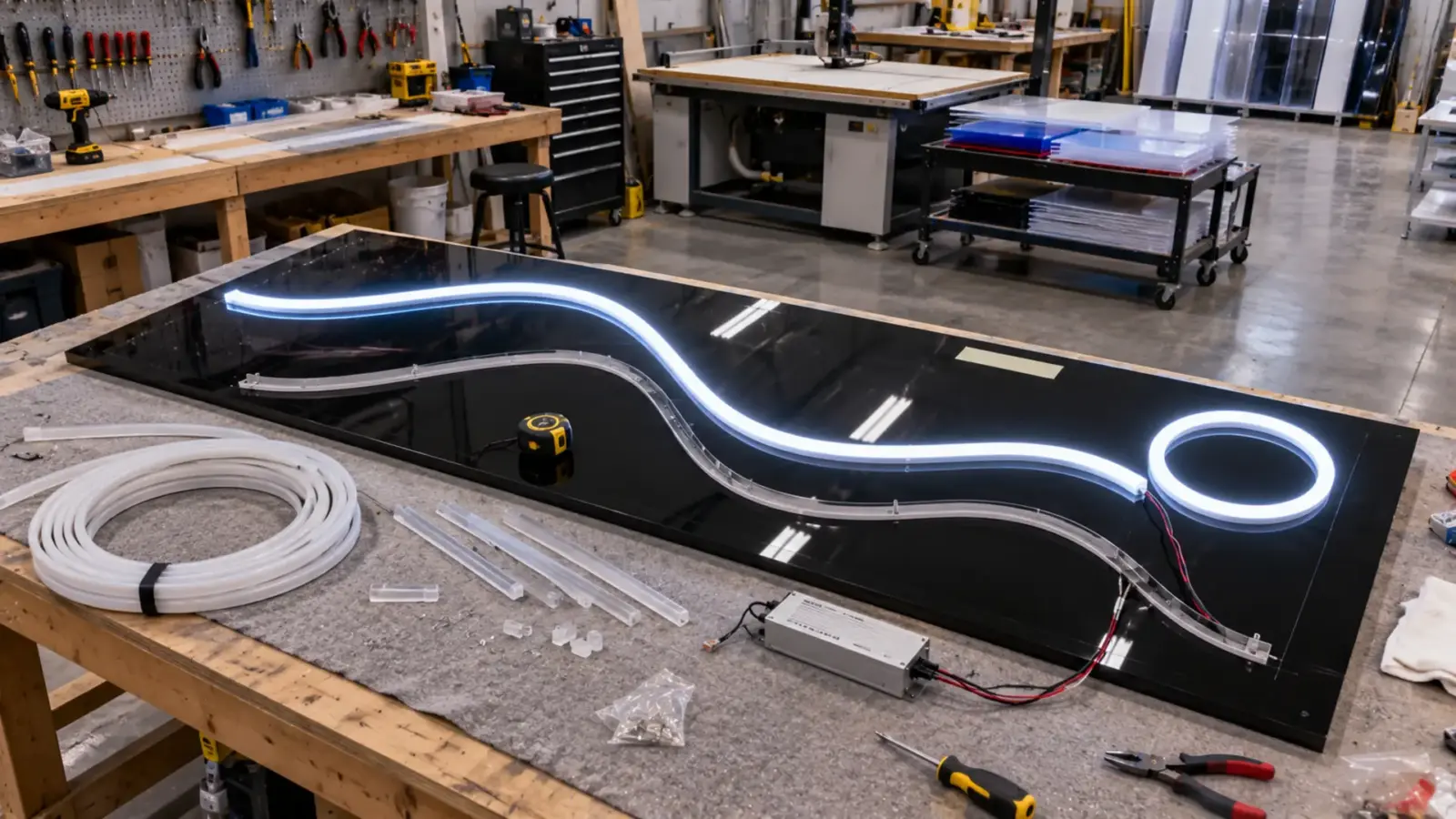
A reel of UL-listed neon flex does not make a listed sign. An LED neon sign is listed as a finished sign under UL 48, usually by the shop that builds it; the neon flex and drivers inside it are components under UL 879 or their own listings; a kit converting an existing sign falls under UL 879A.
The confusion is understandable. Neon flex arrives with a listing mark, the driver has one, and the finished sign looks like a product. But the National Electrical Code asks for a listed sign, and a listing belongs to the thing that was evaluated. The sections below sort out which standard covers which part, what the NEC checks, and the questions to put to a neon flex supplier before a sign is built.
Who Lists What
| What it is | Standard (as described by the sources) | Who usually holds the listing |
|---|---|---|
| A complete electric sign, including LED neon signs and channel letters | UL 48, Electric Signs | The sign manufacturer, often a sign shop in a sign certification program |
| Components used in signs and outline lighting: LED modules, drivers, power supplies | UL 879, Electric Sign Components | The component manufacturer |
| Kits that convert an existing listed sign to LED | UL 879A, LED Sign and Sign Retrofit Kits | The kit manufacturer |
| Flexible decorative and outline lighting not intended as a sign | UL 2388, Flexible Lighting Products (excludes signs) | The product manufacturer |
| Low-voltage LED lighting systems used as luminaires | UL 2108 (see our UL listing guide) | The system manufacturer |
The table follows standards summaries rather than the standards’ full text, which is sold by UL. The rule of thumb holds anyway: the standard follows the product’s intended use. The same neon flex can be a sign component in one job, outline lighting in another and a cove luminaire in a third. Our UL 2108, UL 8750 and UL 1598 guide covers the luminaire side.
What Article 600 Requires
Signs and outline lighting are covered by NEC Article 600. According to EC&M’s code basics review:
- Listing. All electric signs, section signs and outline lighting must be listed and installed per the listing instructions (600.3). Two field-installed items are exempt: skeleton tubing, and outline lighting wired according to Chapter 3.
- Marking. Signs and outline lighting systems are marked with the manufacturer’s name, trademark or other identification (600.4(A)); the marking must be visible during servicing, not necessarily after installation (600.4(C)), and weatherproof in wet locations (600.4(D)).
- Sign outlet. Each tenant entrance in a commercial building accessible to pedestrians needs a sign outlet on an individual branch circuit rated at least 20 A (600.5(A)).
- Disconnect. Each sign circuit has a switch or breaker that opens all ungrounded conductors, within sight of the sign, meaning visible and not more than 50 ft away (600.6).
- Grounding. Remote metal parts of a section sign or outline lighting fed from a remote Class 2 power supply do not need an equipment grounding conductor (600.7(B)(1) exception).
The inspector’s first check is the label. A sign without a listing mark, or with a mark on a part instead of on the sign, is the usual failed inspection.
Sign, Outline Lighting or Luminaire?
Before choosing a standard, decide what the neon flex is on this job. The NEC defines outline lighting as light sources arranged to outline or call attention to features such as the shape of a building or the decoration of a window. A neon flex line tracing a parapet, a roof edge or a storefront frame fits that definition, and Article 600 applies: listed outline lighting, or field-installed outline lighting wired by Chapter 3 methods.
A neon flex line inside a sign band that forms a logo or words is part of a sign. A neon flex line in a ceiling recess lighting a room is a luminaire, which falls back to the luminaire rules. Same product, three different code paths. Ask the AHJ which one they will apply when the line is ambiguous, such as a decorative outline that also frames the tenant’s sign. Our LED neon flex page shows the profiles used for each.
The Sign Shop Holds the Sign Listing
A sign is listed as a finished product, and for custom signs that usually means the sign shop participates in a certification program with a listing body. The shop builds the sign to the requirements of the sign standard, applies the listing label to the finished sign, and is audited for it. The neon flex supplier and the driver supplier provide components; they do not list the sign.
The IAEI put the shop’s side plainly in a 2008 article on LEDs in signs: since only listed electric signs are allowed, sign builders can use only listed and recognized components, and those components are controlled by UL 879 and its conditions of acceptability. In practice, the shop’s listing file defines which components it may use. A shop that substitutes a neon flex or a driver outside its file is building an unlisted sign, however good the parts are.
Components Under UL 879
Components carry their own listings or recognitions, and each one comes with conditions: the driver it must be used with, the maximum length per driver, the mounting, the environment. Those conditions are what the sign shop’s listing relies on. For LED neon, the relevant components are the neon flex itself, its connectors and end caps, and the power supply, usually a Class 2 driver.
Neon flex intended for signs may also be evaluated under other standards depending on its intended use, which is why the certificate matters more than the word “listed” on a datasheet. Ask which standard the certificate names and whether it covers use in signs. Our Class 2 vs non-Class 2 guide explains the driver side, and the drivers and controllers page lists the Class 2 range.
Custom Text, Cut Lengths and Driver Swaps
Every custom sign is different text at a different size, and that is normal: the sign standard and the shop’s listing program are built for custom signs. What matters is whether the components are used inside their conditions. Neon flex is cut at its marked cut points (every 3.94 in on our top-bend neon) and sealed as the maker’s instructions say; the run per driver stays within the rated length, 16 ft per feed on UT-N1010-TB; and the driver is the one the component’s conditions name.
Changes after the sign is built are a different matter. Swapping the driver for a different model, lengthening a run past its rating or replacing the neon flex with another maker’s product can take the sign outside what was listed. Our guide on whether cutting LED strip voids its UL listing works through the same question for strip systems.
Indoor and Plug-In Neon Signs
Interior neon signs are signs too. The NEC text of 600.3, as the IAEI article quotes it, applies to electric signs whether fixed, mobile or portable, so a neon wall piece in a restaurant or a cord-and-plug sign in a shop window still needs a listing as a sign. A piece of neon flex screwed to a board and powered from a wall adapter is not a listed sign, even if the neon flex and the adapter each carry a mark.
For interior work, that usually means one of two routes: a sign built and labeled by a listed sign shop, or a neon element treated as a luminaire or decorative lighting under its own listing and installed per its instructions, if the AHJ agrees it is not a sign. Words, logos and symbols push it toward the sign side. Settle it before the fabrication drawings, because a relabel after installation means taking the piece back to the shop.
Retrofits Under UL 879A
Converting an existing sign from glass neon or fluorescent to LED is a retrofit. According to UL’s retrofit materials and Intertek’s UL 879A notices, UL 879A covers LED sign and sign retrofit kits for field installation in signs that comply with UL 48 and stay at their original site, with kits that can include LED arrays, drivers, power supplies, controls and wiring. The NEC adds a marking rule: a retrofitted sign is marked that its illumination system has been replaced (600.4(B)).
So a retrofit has two halves: the host sign was listed, and the kit is listed for the retrofit, installed per its instructions. A cabinet sign converted with loose strip and a driver from the shelf meets neither. Our cabinet sign retrofit guide covers the lighting side of a lightbox conversion.
What to Ask the Neon Flex Supplier
Before a sign shop or a contractor builds with a neon flex, ask for:
- The certificate for the exact model, with the standard it names and the listing body’s file number.
- Whether the certificate covers use as a sign component, as outline lighting, or as a luminaire.
- The conditions of use: driver type and model, maximum run per driver, mounting, indoor or wet location.
- The marking on the product, and where it appears after cutting.
- The installation instructions the listing refers to, including cutting and sealing.
Our neon flex is sourced from qualified manufacturing partners and is available with UL Listed, ETL Listed, FCC compliant, RoHS compliant and other applicable configurations. Certification coverage varies by model, and certification is held by the original manufacturing partner. We send the documentation for the models you specify at quote, so the sign shop can check it against its own listing file.
A Typical Restaurant Facade
A typical job, not a specific client: a restaurant fit-out with a script sign on the storefront and a neon flex line tracing the parapet. The script sign is a sign: it is built and labeled by a listed sign shop to UL 48, using neon flex and Class 2 drivers that its listing file allows, on the tenant’s sign circuit with a disconnect within sight. The parapet line is outline lighting: either a listed outline lighting product installed per its listing, or a field-installed outline wired by Chapter 3 methods, as the AHJ decides. The neon flex can be the same product in both; the paperwork is not. Our halo-lit vs face-lit guide covers the letter construction, and the neon flex install guide the mounting.

FAQ
What is the difference between UL 48 and UL 879?
UL 48 covers complete electric signs; UL 879 covers components used in signs and outline lighting, such as LED modules and drivers. A sign is listed as a whole under UL 48, built from components listed or recognized under UL 879 or other applicable standards.
Does UL-listed LED neon flex make my sign listed?
No. A listing belongs to the product that was evaluated. The finished sign needs its own listing, usually applied by a sign shop in a certification program; the listed neon flex is one of its components.
Is LED neon flex on a building outline a sign?
Usually not. Under the NEC, light sources that outline features such as the shape of a building are outline lighting, covered by Article 600 as listed outline lighting or as field-installed outline lighting wired by Chapter 3 methods. Confirm with the AHJ.
What standard covers converting an old neon sign to LED?
UL 879A covers LED sign retrofit kits for field installation in signs that comply with UL 48. The NEC also requires the sign to be marked that its illumination system has been replaced.
What to Verify With the AHJ
- Whether each neon element is treated as a sign, outline lighting or a luminaire.
- Which listing mark the inspector expects on the finished sign, and where.
- For outline lighting, whether a listed product is required or field installation by Chapter 3 is accepted.
- The sign circuit and disconnect location for each sign.
- For a retrofit, the host sign’s listing and the retrofit kit’s listing and marking.
- The local sign permit, which is separate from the electrical inspection.