For retail displays, use dot-free COB strip at Ra 90 or higher, in 3000K to 4000K for most departments, set in a channel on the shelf lip or the case top, with its driver on the stockroom side. Keep the line out of the glass, pick color by the goods, and size each driver from real watts per foot.
Friday night is the reset. Forty shelf runs get new product, and by Monday the strip under every shelf lip has to show red packaging and blue packaging the same way it did before. This article covers the choices around that rule: where the strip goes, what the glass does to it, which color suits which goods, how much power a shelf takes, and what happens to the strip on the next reset.
Where the Strip Goes: Shelf Lip, Case, Back Panel, Wall
Display lighting is geometry first. The same strip gives a clean wash on a shelf lip and a harsh stripe on a case front, so place it before choosing it. Four positions cover most store work.
| Position | What the strip does | Strip we usually quote | Channel | Watch for |
|---|---|---|---|---|
| Shelf lip, front | Lights the shelf below and the goods on it | COB strip: UT-C480-8 (3.2 W/ft), UT-C320-8 (2.4 W/ft) | Shallow aluminum channel with a diffuser | Glare for shoppers looking up at the next shelf |
| Shelf edge, hidden | Grazes goods from the side | UT-C320-6-SV, side-view, cut every 0.25 in | Slim surface or recessed channel | A visible hot line on glossy packaging |
| Case top or underside | Lights goods from above, away from the glass | UT-C400-3, 3 mm PCB, cut every 0.39 or 0.79 in | Narrow profile behind the lip | Reflections of the line in the glass front |
| Back panel and wall wash | Lights the field behind the product | COB in a deeper channel, or a wall washer for tall walls | Deep channel, opal diffuser | Scalloping near the strip, covered in our wall washer setback guide |
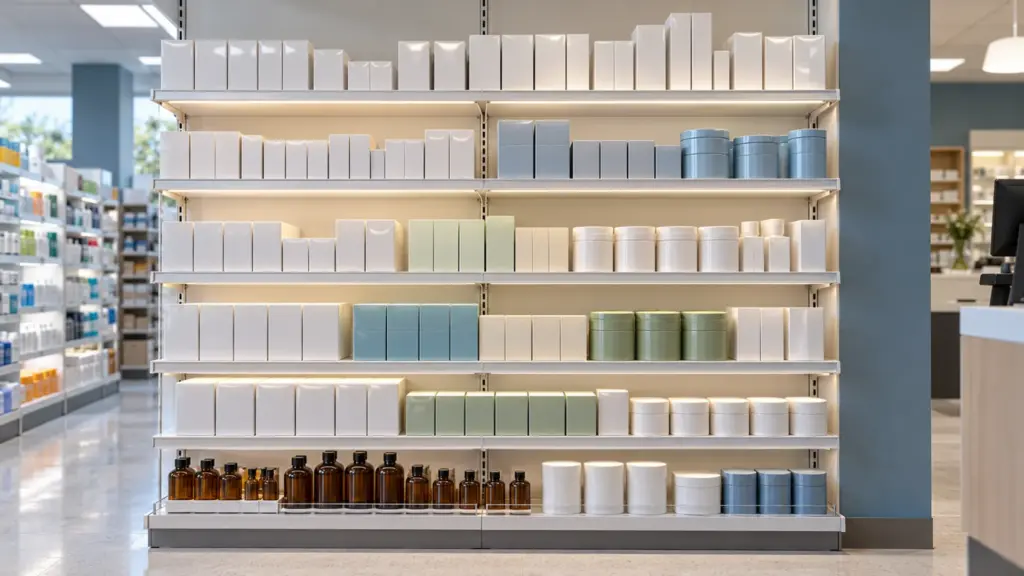
Pick the position from where the shopper stands. A shelf lip lights downward and works for low gondolas and wall shelving. A strip near the top of a case lights the goods and keeps the line out of view. A strip on the wall behind the product is atmosphere; it does not light the goods themselves.
According to Future Light’s retail lighting guide, a strong display combines a broad layer for the aisle with a controlled layer aimed at the product. A strip is a controlled layer. It belongs to the product, and the ceiling grid still lights the floor. Plan both before the strip is ordered, because the strip’s brightness is set against what already lights the aisle.
For tight millwork, the same logic applies to the base cabinets and counters. Our under-cabinet driver placement guide covers that side, and the slat wall in our slat wall guide shows how a groove hides the strip when the face of the panel must stay clean.
Light the Goods, Not the Glass
Glass is where retail strip fails first. A strip behind a case lip lights goods, and it also lights the glass in front of them. Every LED dot becomes a bright point on the glass, and the shopper sees the points before the goods. According to Wearify’s display-case guide, standard SMD strip creates visible point sources that reflect off glass, so continuous strip is often preferred there. The same is true on glossy packaging and polished shelves.
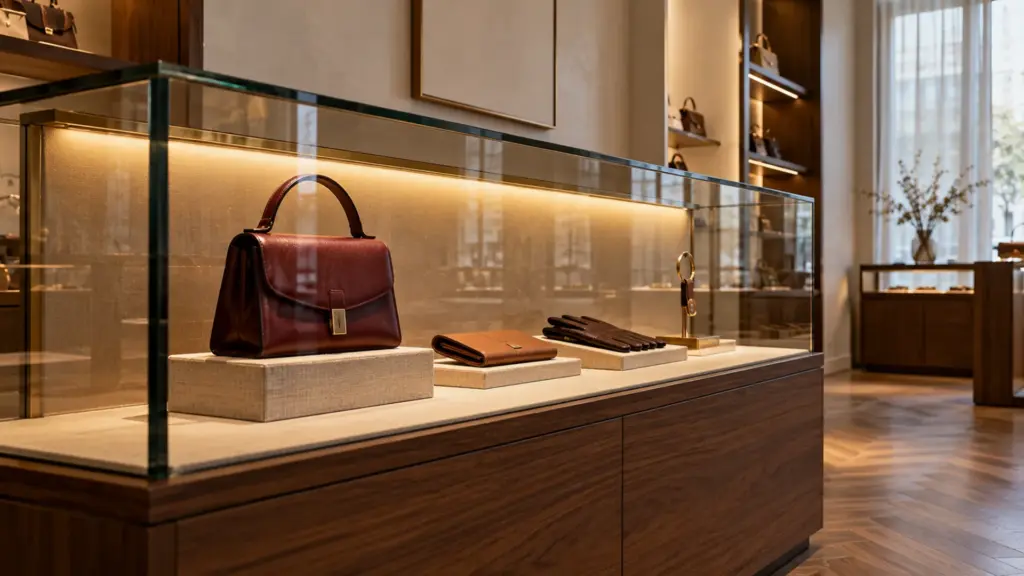
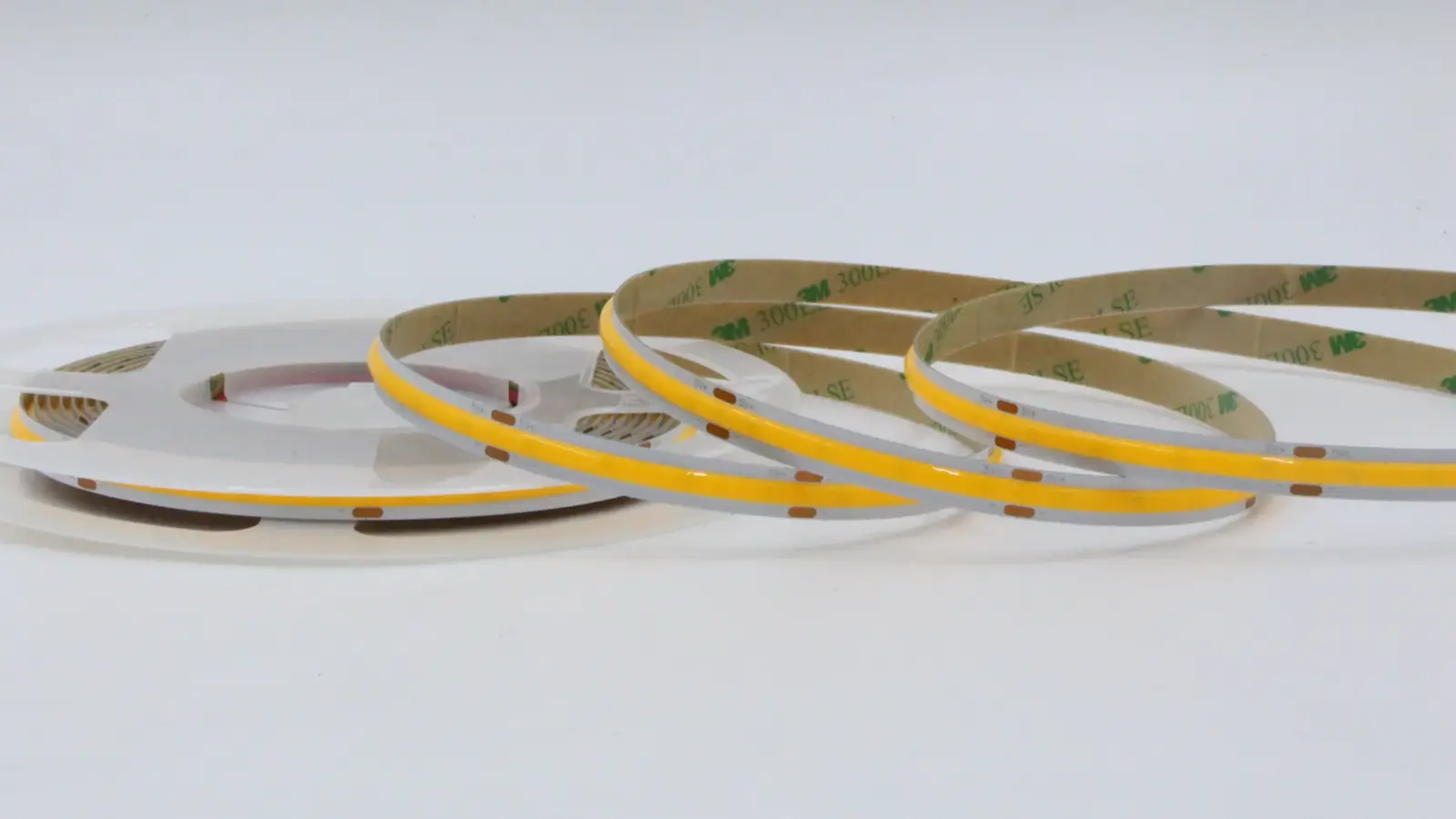
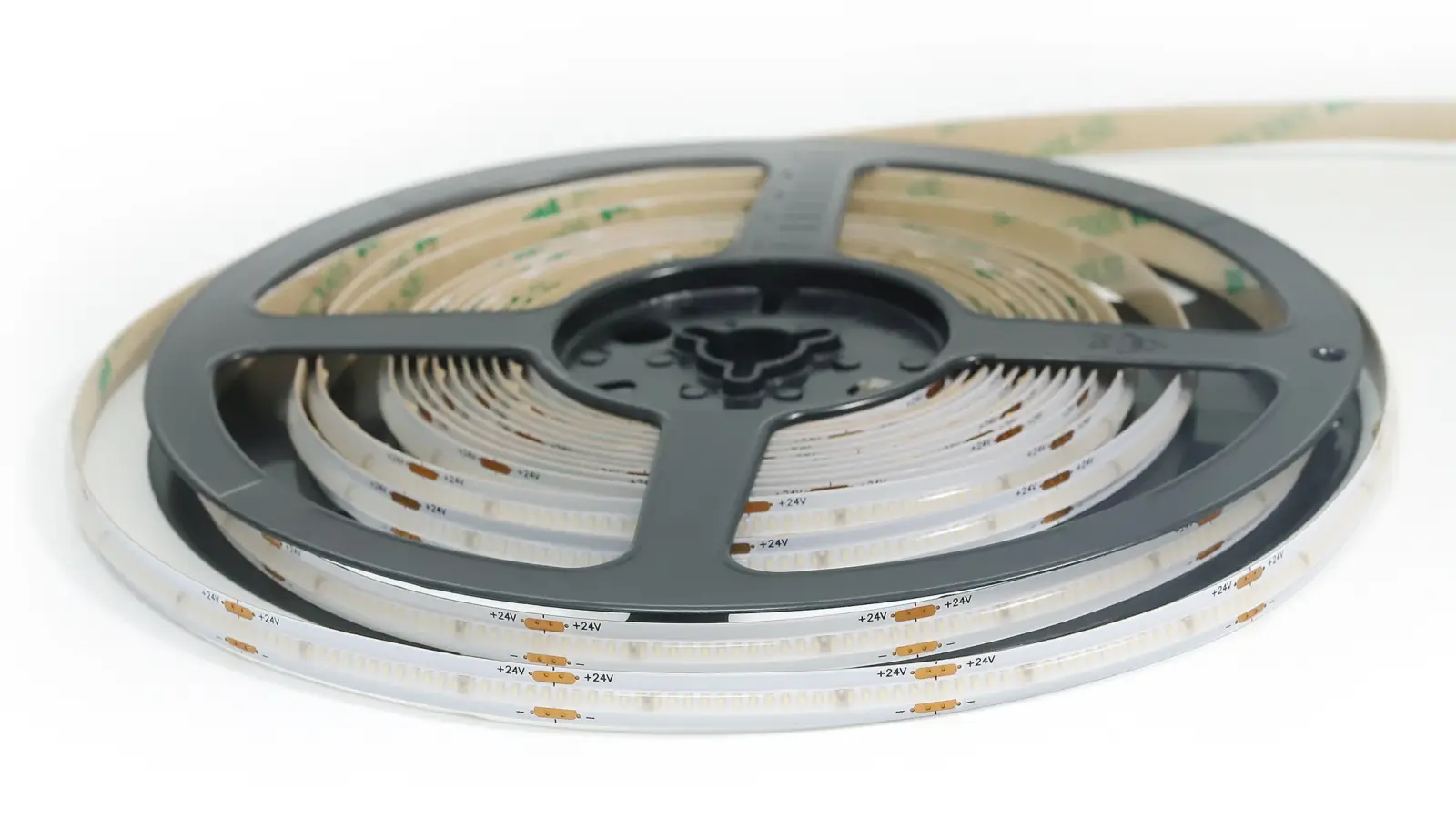
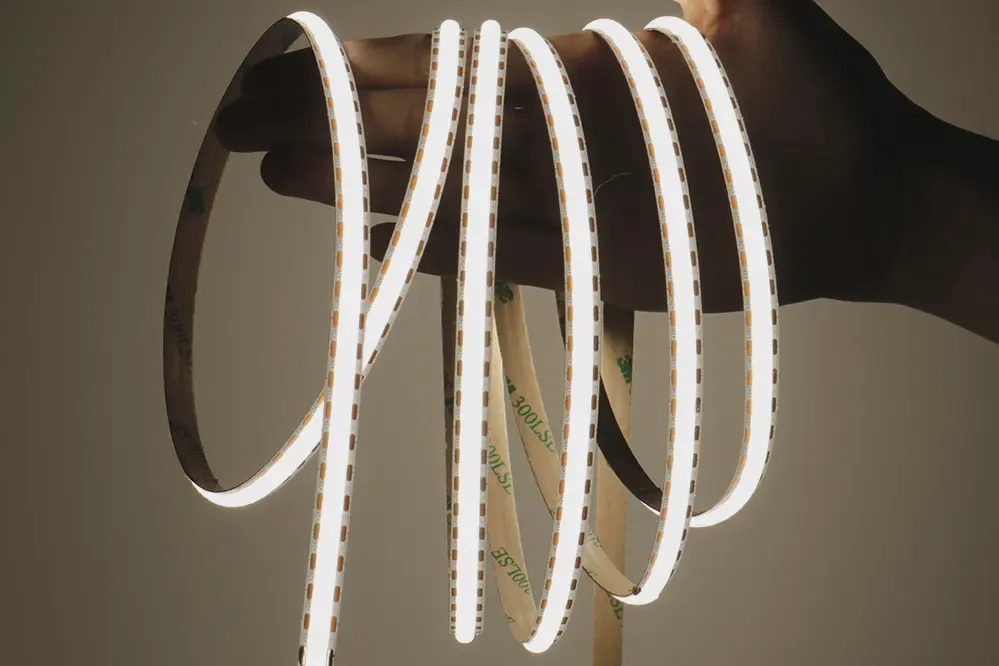
COB strip puts the chips under one phosphor layer, so it reads as one line even close up. Our COB range runs 280 to 1,600 LEDs per meter, and UT-C480-8 gives a continuous 8 mm line. Where the case is shallow or the shelf nosing is thin, UT-C400-3 has a PCB of about 3 mm and can sit behind a lip that an 8 mm strip would not clear. CSP is a second route: UT-CSP-300-MC12 (12V) cuts every 0.39 in (10 mm), which matters on very short shelves where a longer cut interval leaves a dark stub at the end.
Three habits keep the line out of the glass:
- Set the strip back from the front. Move it behind the lip so the glass reflects the lip, not the strip.
- Aim light at the goods, not at the viewer. A strip lighting straight down grazes the front of the packaging and does not throw its image into the glass at eye level.
- Diffuse where the line itself is visible. An opal diffuser in a shallow channel removes the line; leave it off only when the lip fully hides the strip.
The cut interval shows up on short runs. A 48 in (1,219 mm) shelf on a 1.97 in (50 mm) cut interval takes 24 segments, so the lit length is 47.2 in and about 0.75 in at the end stays dark. On a 0.98 in (25 mm) interval the dark stub shrinks to under an inch only if the shelf length happens to fall on the cut; a free-cut or a finer interval is the way to keep the end bright. Check the interval on the model you quote and design the shelf length around it.
Color: CCT and CRI by Product
Color temperature in a store is set by what is on the shelf, not by the store’s brand. Retail vendors give a range of numbers and no standard. According to one retail lighting guide, warm 2700K to 3000K suits jewelry and gifts, 4000K to 5000K suits sporting goods and electronics, and about 3500K suits apparel. Signlite suggests 4000K to 5000K for general retail. They disagree because they are guessing at different stores, so a project should decide by department and put it in the submittal.
| Department | Starting point | Why |
|---|---|---|
| Grocery and pharmacy | 4000K, Ra≥90 | Neutral white keeps packaging colors honest |
| Hardware and automotive | 4000K to 5000K | Crisp light for labels, tools and finishes |
| Apparel and shoes | 3000K to 4000K | Fabric color shifts quickly; the first mock-up decides |
| Electronics and showrooms | 5000K | Reads clean against screens and white finishes |
| Jewelry and gift | 2700K to 3000K | Warm metals look warm; see the jewelry case guide |
| Mixed department stores | Tunable white, 2700K to 6500K | One strip, set per department |
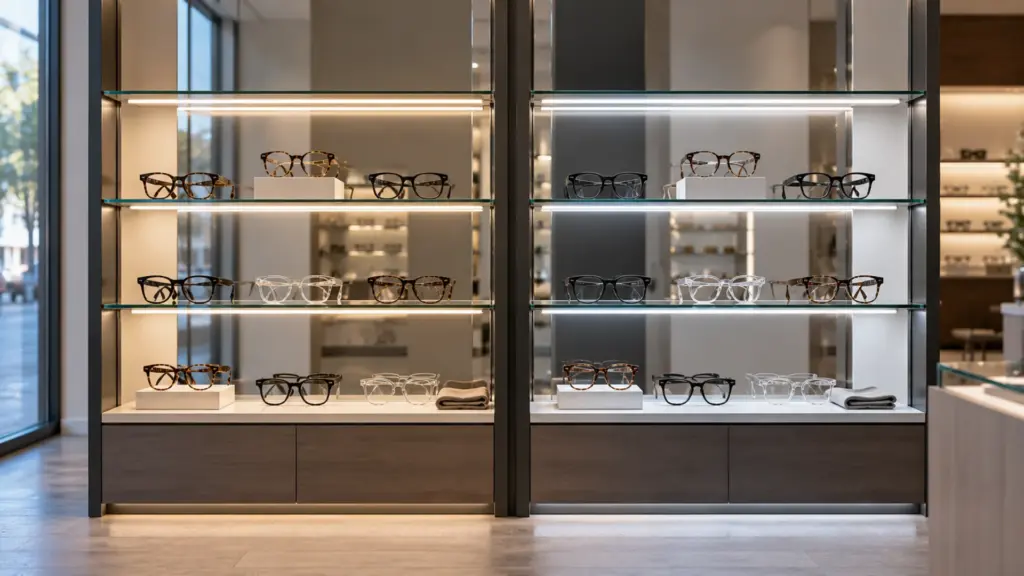
Our COB models list 2700K to 6000K or 6500K depending on the family, in Ra≥90. Tunable white strip runs a 2700K and 6500K pair, and UT-CSP-512-CCT in the CSP range cuts every 2.46 in. Where color accuracy is the whole point, the COB page also lists UT-SC320CRI97-15, a dot-free SCOB strip at Ra≥97.
CRI is a floor, not a promise. Most vendor guides, including Signlite’s, set 90 as the minimum for retail. Ra measures eight pastel samples and does not weigh red, so a strip can reach Ra 90 and still render a red sweater dull. Ask the supplier for the R9 value when red goods matter, and for the SDCM bin when two runs sit side by side. The reasons are in our high-CRI guide and the color temperature guide.
Heat, UV and Fading
A strip emits very little ultraviolet compared with sunlight or fluorescent tubes, but fading is not decided by the lamp alone. According to the Lumileds white paper hosted by Mouser, fading depends on the material being lit and on the exposure, and the spectral content of the light can reduce the risk. That is a vendor statement and not a test of our strip. For a project with dyed fabric, leather or prints, ask the supplier for the spectral power distribution and run a short mock-up under the real light with a sample of the real goods.
Heat is the more common retail problem, and it is mechanical. A strip in a closed, unventilated case holds its heat. A strip with a thin PCB on bare wood runs warmer than the same strip on an aluminum channel. Our thermal management guide works through the numbers: a 6.7 W/ft strip needs aluminum behind it, and a 2.4 W/ft shelf strip is much easier on the case. Where goods are heat-sensitive, choose the lower-wattage strip (UT-C320-8 at 2.4 W/ft rather than UT-C480-8 at 3.2 W/ft) and add brightness with dimming headroom rather than with watts at the lip.
Brightness and Power
Choose brightness at the shelf, then size the power. Vendor guidance for displays ranges widely; one retail source suggests 900 to 1,500 lumens per meter for retail or exhibition displays. We do not publish a single lumen number, because it depends on the strip, the diffuser and the color temperature; the lumens-per-foot method in our lumens per foot guide shows how to convert a target.
The power arithmetic is simple and it surprises people on a shelf run. Take a gondola with five shelves of 4 ft:
| Item | UT-C320-8 | UT-C480-8 |
|---|---|---|
| Strip per gondola | 5 × 4 ft = 20 ft | 20 ft |
| Load at the spec sheet W/ft | 2.4 × 20 = 48 W | 3.2 × 20 = 64 W |
| Driver load at 80% | 48 ÷ 0.8 = 60 W | 64 ÷ 0.8 = 80 W |
| Longest single run | 4 ft | 4 ft |
Each 4 ft shelf is far under the 16 ft per feed that both models list, so voltage drop does not limit this layout. The driver does. The brighter strip pushes the gondola past one small driver and into two, or into one larger driver on a different circuit. The practical way to plan it is by gondola: one driver per gondola or per shelf group, in the base cabinet or the stockroom side, with joints on the 5 A connectors that fit the strip width. Class 2 limits and sizing are in our power supply sizing guide.
Resets, Finishes and Swappable Modules
A store changes. Shelves move, product lines rotate, and a department gets repainted in a different color. A display lighting system that cannot follow those changes becomes the first thing contractors tear out. Three design choices decide that.
Surface finish changes the look. The same strip on matte shelves, on white laminate and on a mirrored back panel shows three different amounts of light. Mirror and polished stone double the visible line; matte paint and wood absorb it. Test the strip against the real finishes, because a plan that works on white laminate dims on a dark oak shelf.
Make the strip a module. Put the strip in a channel with a snap-in diffuser, and cut it to the shelf module with connectors at the joints. When the shelf moves, the module moves with it, and the strip does not get cut again. Solder-free models such as UT-C320-6-SF make a field change possible without a soldering iron. Our channel range lists the profiles, and UT-CH1013 with an opal diffuser is one we use under cabinets and shelf lips.
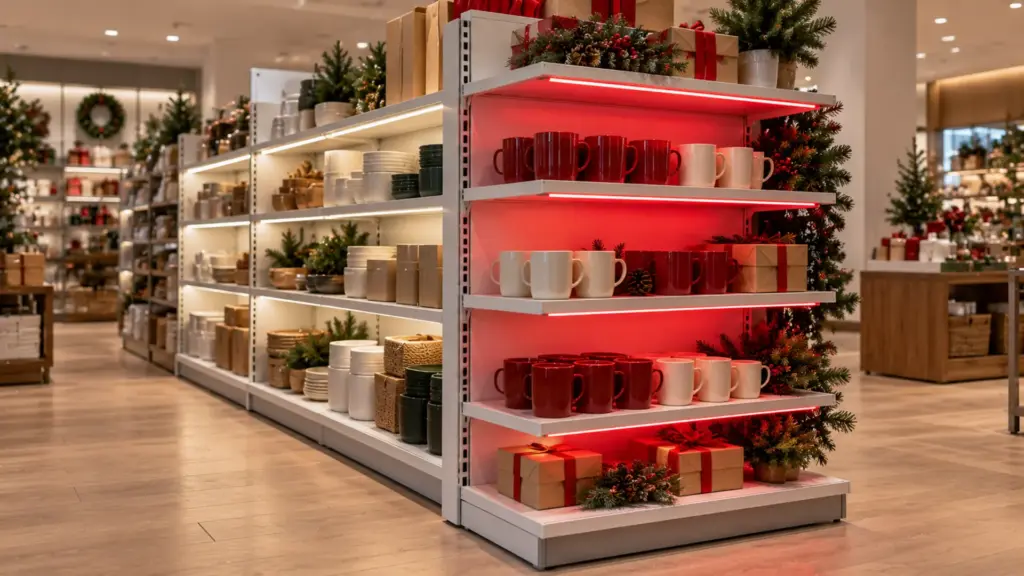
Use color as a setting, not a rewiring. Tunable white lets one department move from 3000K to 4000K at a reset, from a controller, without touching the strip. Colored strip is a smaller tool: a seasonal accent on an end cap, not a department color. For effects that change often, use a controller and keep the strip standard.
Dimming and Open Hours
Retail runs on long hours, so the strip is dimmed more than it is switched. A 0-10V decoder such as UT-C010-350 serves a zone from a wall panel; a 2.4G RF controller such as UT-CRF-24G suits small zones without new control wiring. The choice depends on the building, and it is covered in our dimming guide. Test the lowest level with the real driver: a strip that is steady at 100% can flicker at 1%, and the cleaning crew sees that at night.
Access and Service
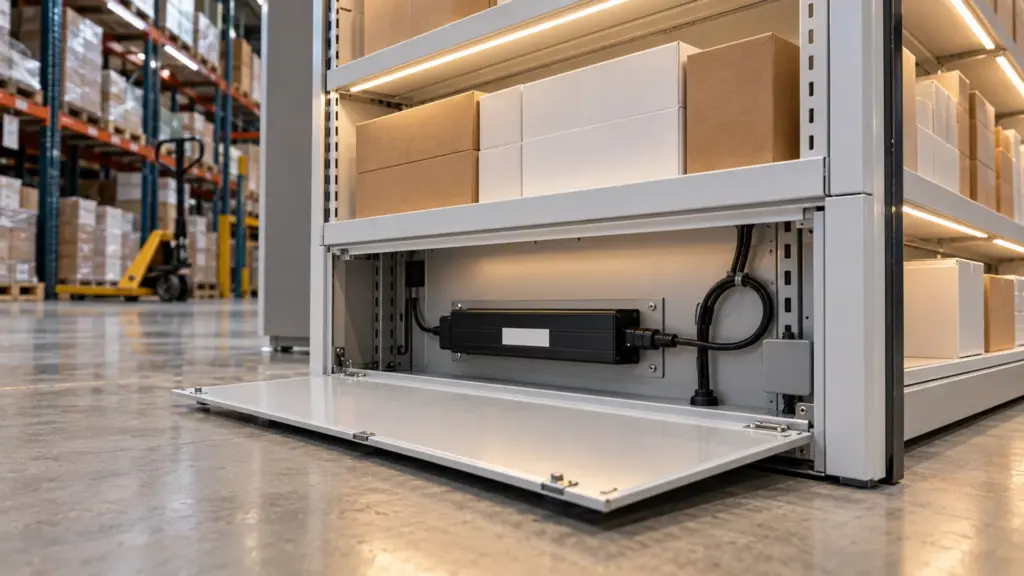
Every strip gets serviced. A driver that is hidden above a closed shelf will be cut out of the wall the first time it fails. Keep drivers reachable from the stockroom side, in the base cabinet, or in a service panel, and label each one with the shelf group it feeds. Leave a loop of cable at the shelf so the strip can be lifted out of its channel. Our driver placement guide has the layout for cabinet work.
FAQ
What color temperature is best for retail LED strip?
There is no single best number. Warm 2700K to 3000K suits jewelry and gifts, 4000K suits grocery, pharmacy and general merchandise, and 4000K to 5000K suits hardware, sporting goods and electronics. Mixed stores can use tunable white and set the value per department.
What CRI do I need for retail display lighting?
Ra 90 or higher is the usual floor for retail strip. Where red goods, food or fabrics matter, ask the supplier for the R9 value and the color bin as well, because Ra alone does not weigh red. Our COB models list Ra≥90, and a SCOB model lists Ra≥97.
Can LED strip go in a glass display case?
Yes. Use a dot-free COB strip set back behind the lip, aimed at the goods, with a diffuser if the line itself shows. Standard SMD strip tends to reflect its dots in the glass.
Do LED strips fade merchandise?
A strip gives off little ultraviolet, but fading depends on the material and the exposure. For dyed fabric, leather or printed goods, ask for the spectral data and check a sample of the real goods under the real light before the full order.
How much power does a shelf run need?
It depends on the model. UT-C320-8 draws 2.4 W/ft and UT-C480-8 draws 3.2 W/ft, so a 20 ft gondola loads 48 W or 64 W. Size the driver at 80% of its rating and keep each run under the model’s per-feed limit.
Spec Notes for This Job
Before the strip is ordered, settle four things: where it sits relative to the glass, the color temperature per department, the shelf module length against the cut interval, and where each driver will be reached from. Send the shelf drawings or the store plan and the department list, and we match COB or CSP strip, channels and drivers to the layout. Every system is built to order, and the run limits and driver loads are checked before anything is quoted: request a quote.