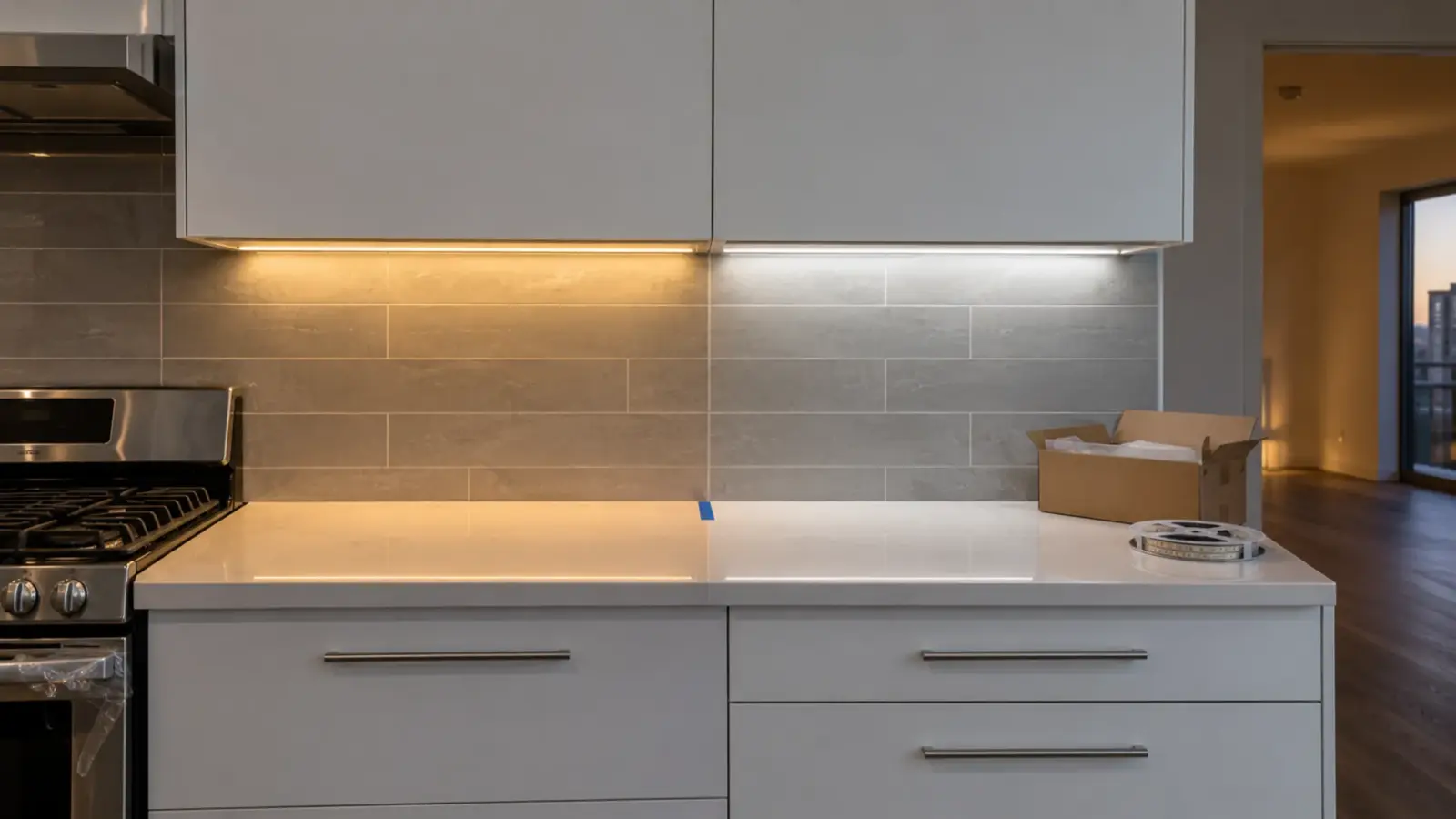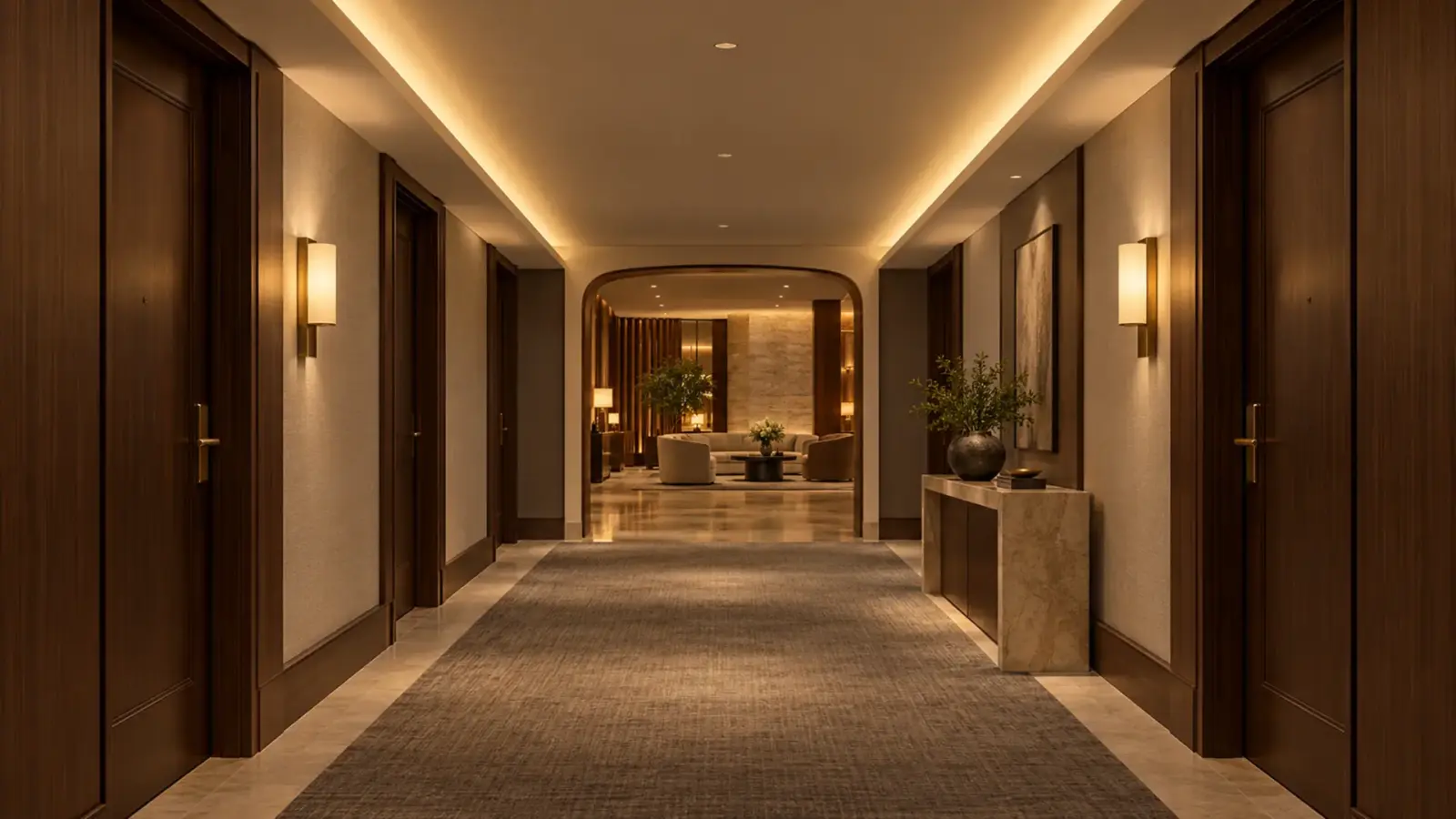
On a typical hotel floor, the lobby downlights are 2700K, the corridor strip arrives at 3000K and the doors at the end of the hall sit under 4000K. Each is fine alone; nobody chose them together. LED strip color temperature runs through three gates: what the room is for, what is in it, and what sits next to the strip.
Three Points: What 2700K, 3000K, and 4000K Look Like
Color temperature (CCT) describes the color of the light, not how much of it there is and not how well it renders color. According to LED Lighting Supply, a 3000K fixture can have CRI 90+ while a 5000K fixture has CRI 70 or 80, so Kelvin never tells you color accuracy. Check Ra separately.
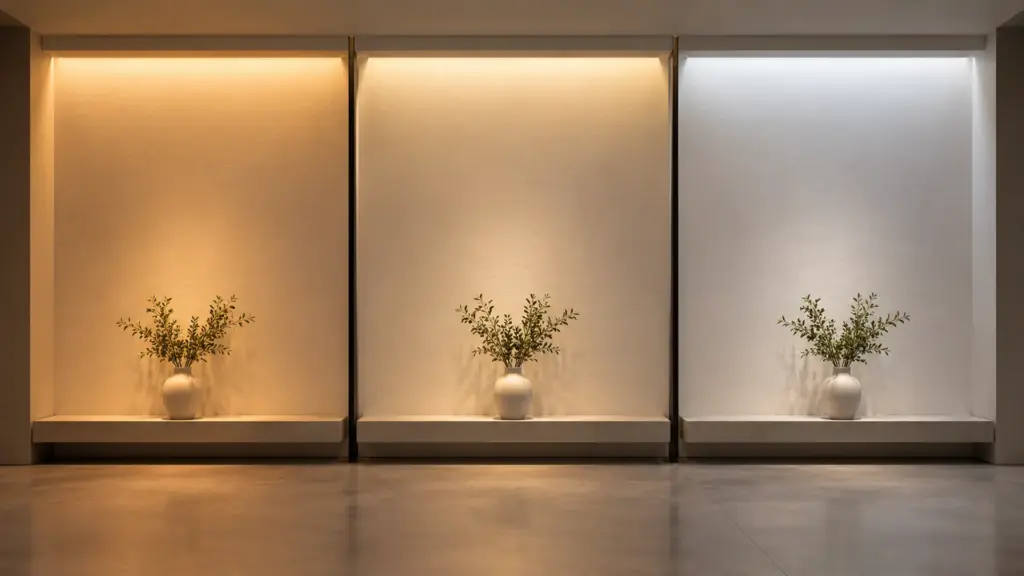
| 2700K | 3000K | 4000K | |
|---|---|---|---|
| Look | Warm white, visibly amber | Warm white, cleaner than 2700K | Neutral white, no yellow cast |
| Reads as | Intimate, relaxed | Welcoming but clear | Alert, clean, task-ready |
| Typical use | Guest rooms, restaurants, lounges | Lobbies, corridors, retail, cafés | Offices, back-of-house, clinical work areas |
| Watch for | Looks dim and yellow in work areas | The safe default, easy to overuse | Looks flat and cold in hospitality |
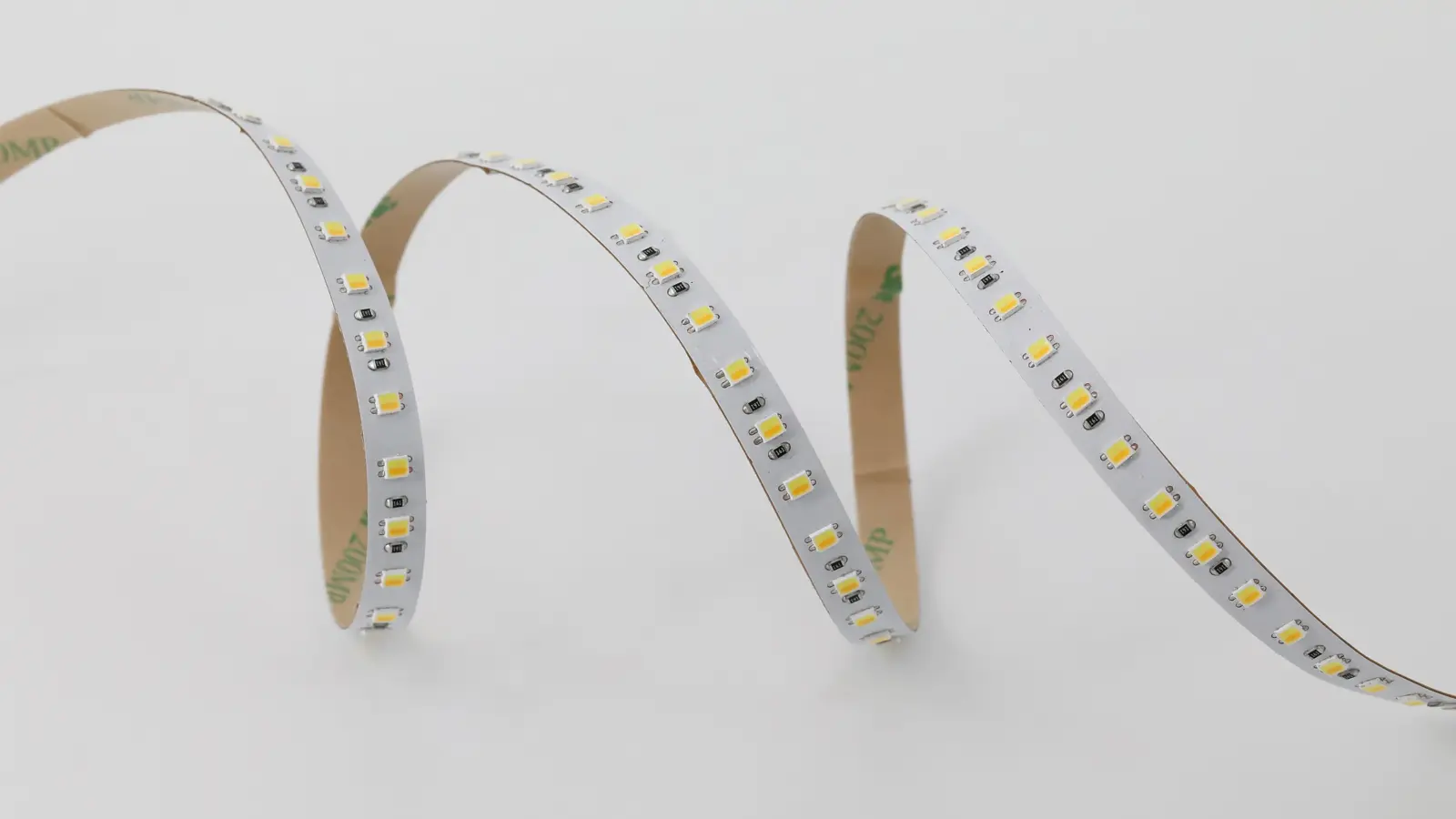
Standard COB strip such as UT-C480-8 is listed at 2700-6000K and Ra≥90. Our full-spectrum SMD series (UT-SFS80-8, UT-SFS160-8) comes in exactly these three points: 2700K, 3000K, and 4000K. Confirm the exact CCT points for any other model at quote.
Where 3500K and 5000K Fit
Two more points come up on drawings, and they are where the old “this K versus that K” comparisons usually start. Per the vendor guides we reviewed (Signlite’s color temperature chart and Lumistrips), 3500K sits between warm and neutral and is the point often named for fashion and jewelry, and 5000K is a cooler-than-neutral white used for workshops, gyms and showrooms. Stretch the table to all five and the choice reads as one scale instead of five arguments.
| Point | Reads as | Typical use | Where we list it |
|---|---|---|---|
| 2700K | Warm white, visibly amber | Guest rooms, restaurants, lounges | COB and SMD ranges |
| 3000K | Warm white, cleaner | Lobbies, corridors, retail, cafés | COB and SMD ranges |
| 3500K | Between warm and neutral | Fashion and jewelry, per vendor guides | CSP page lists it as available; confirm on any other model |
| 4000K | Neutral white | Offices, back-of-house, clinical work areas | COB and SMD ranges |
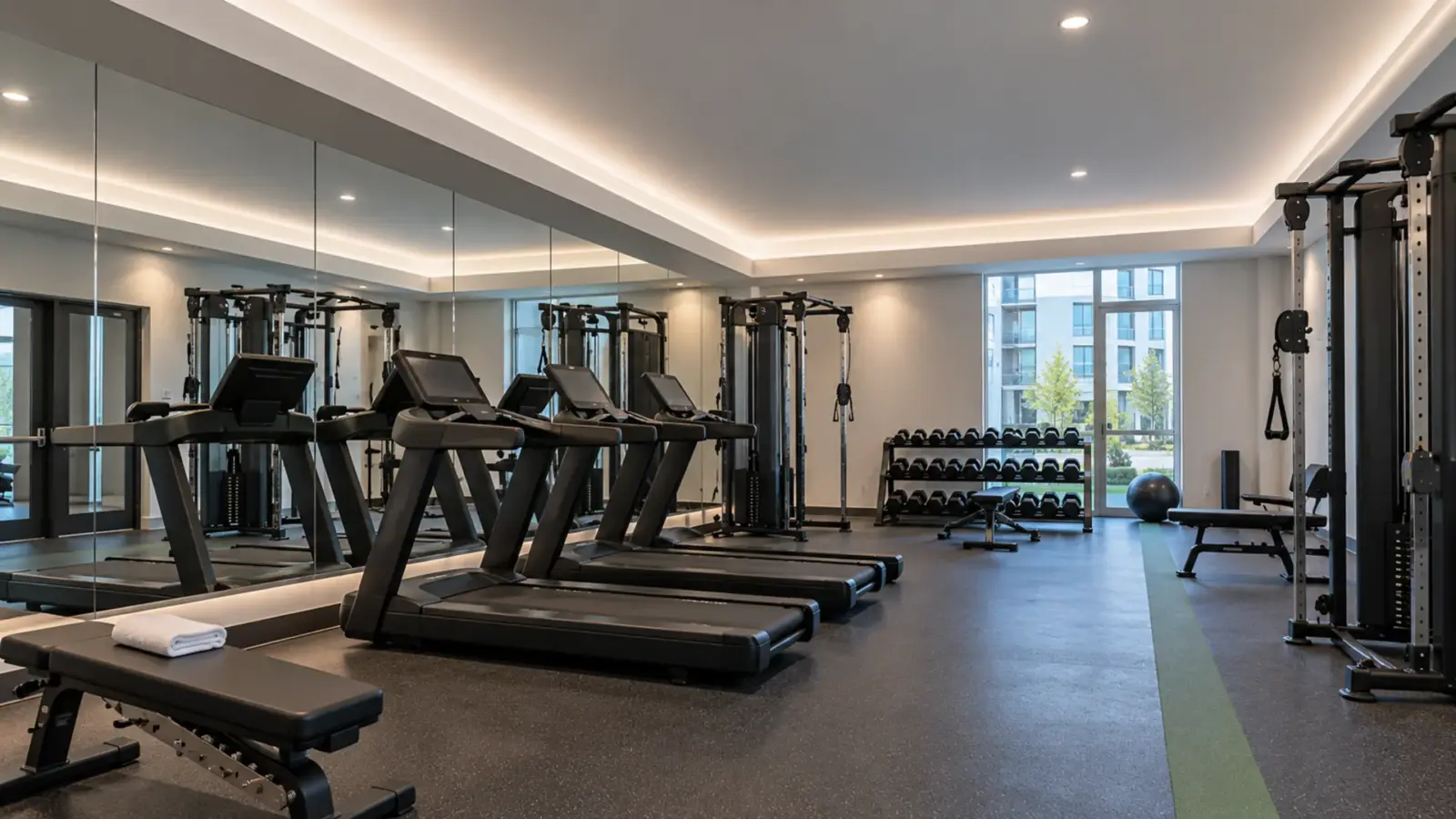
| 5000K | Cool, crisp | Workshops, gyms, showrooms | Listed on several families, such as the silicone wall washers; confirm the point for the model |
Treat the last column as the limit. Our COB and SMD pages list ranges, 2700-6000K and 2700-6500K, so confirm the exact point for the model before it goes on a drawing, and never specify 3500K on a model whose page does not list it. A pair that straddles the table, 2700K beside 4000K, still reads as a mistake: keep every neighbor in one sightline within one step of the strip.
Gate 1: Is the Room for Dwelling or Working
Ask one question first. Do people come here to linger, or to finish something?
If they linger (a lobby, a restaurant, a lounge, a guest room), start at 2700K or 3000K. Warmer light suits sitting and talking, and it flatters skin and finishes. If they work (an office, a back-of-house corridor, a clinical workspace), start at 4000K. Neutral white keeps text and faces clear without the amber cast.
Pass-through spaces are the hard case. A corridor is neither, so its neighbors decide, and that is what Gate 3 is for. For everything else, Gate 1 gives you a first answer.
Some rooms do both. A hotel lobby has a check-in desk where staff work and a lounge where guests wait. A clinic corridor leads to exam rooms and a waiting area. Do not average them to a middle number. Pick the number for the space that holds the most people for the longest, and give the other space its own zone, its own circuit, and its own Kelvin. Two clean zones read better than one compromise that suits neither.
Room by Room: LED Strip Color Temperature for Each Space
Use 3000K where people linger, 4000K where they work, and 2700K for guest rooms and restaurants. The table below applies that to each space. Ranges follow what LED Lighting Supply, Flexfire LEDs, and Ledvance publish for commercial spaces, and the default column is our pick when the drawing gives you nothing else.
| Space | Default | Go warmer when | Go cooler when |
|---|---|---|---|
| Hotel lobby and reception | 3000K | Wood, brass, or stone finishes; lounge seating (2700K) | Rarely; 4000K reads clinical here |
| Hotel corridor | 3000K | Guest-room doors and sconces are 2700K | The corridor doubles as a service route (4000K) |
| Guest room and suite | 2700K | Dim-to-warm on the headboard and cove lines | Desk or vanity zone wants 3000K |
| Restaurant and bar | 2700K | Evening-only service | Daytime café or casual dining (3000K) |
| Retail, apparel and general | 3000K | Boutique and luxury fitouts (2700K accents only) | Big-box or high-turnover floors (4000K) |
| Retail, jewelry and display | 3000K | Gold and warm stones | Silver and cool-toned stones (4000K, full spectrum) |
| Office and workspace | 4000K | Lounge, breakout, reception (3000K) | Daylit open plan, where 4000K already holds up |
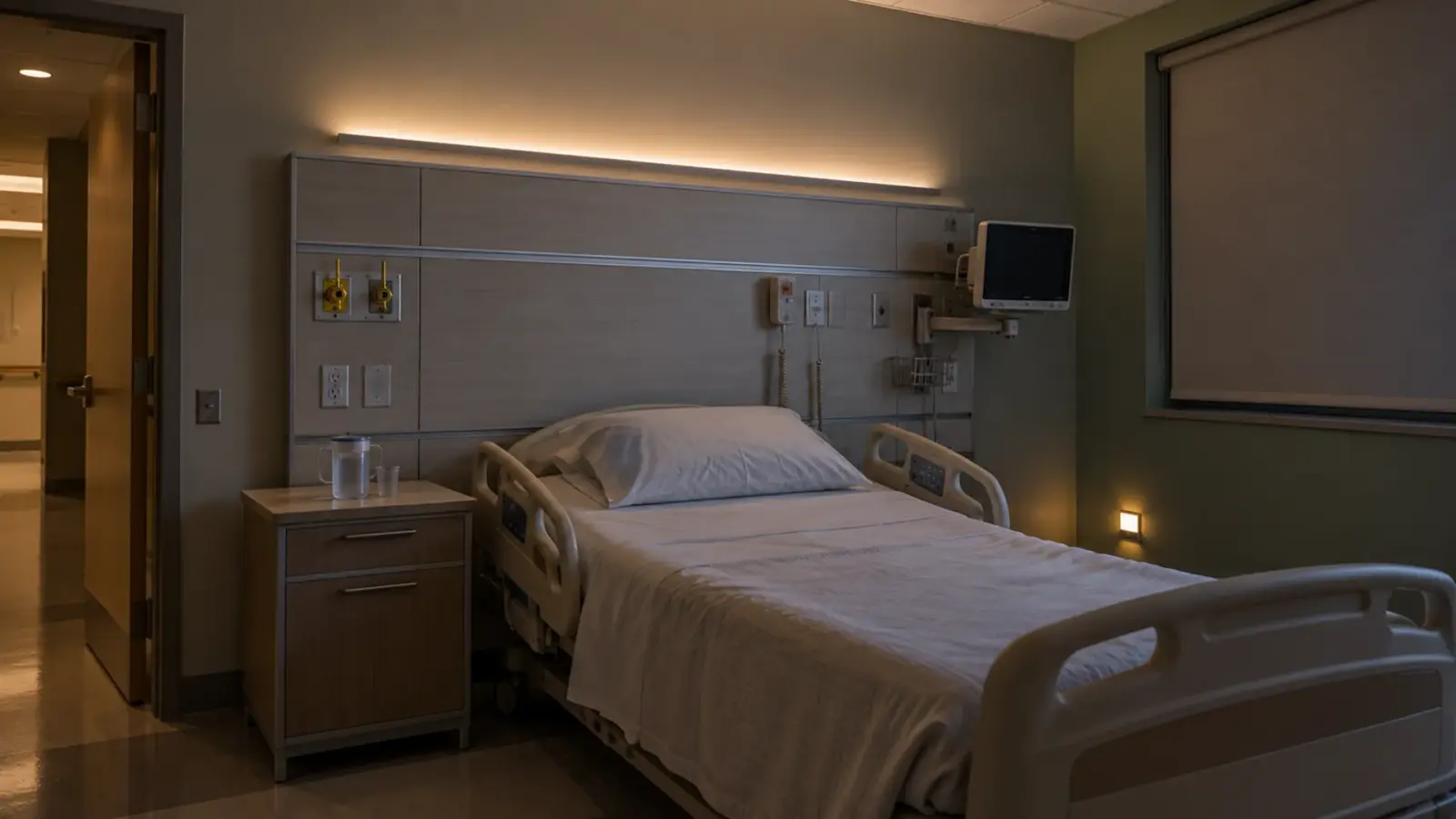
| Healthcare and senior living | 3000K in patient and common areas | Evening scenes (tunable or dim-to-warm) | Exam and work areas (4000K) |
| Stair, utility, back-of-house | 4000K | Stairs open to a lobby (match the lobby) | Warehouse-style areas |
Some context on the numbers. According to Flexfire LEDs, 2700K to 3000K is standard for lodging reception, restaurants, and grocery, 3000K to 3500K for jewelry, art, and fashion, and 4000K is a common specification point for offices. LED Lighting Supply puts hotels at 2700K to 3500K and corridors at 3000K to 4000K “depending on building type and adjacent spaces.” Ledvance describes 2700K as the pick for guest rooms and suites and 3000K as frequent in lobbies, reception, meeting rooms, and corridors.
Healthcare is the one row where published guidance does not converge, and LED Lighting Supply says plainly that it varies by clinical area. Take the project standard first, then use the table.
Read the table for patterns, not for exact answers. Hospitality spaces sit at 2700K to 3000K. Work spaces sit at 4000K. Retail follows the merchandise, and the “go warmer” and “go cooler” columns are one step in either direction, never two. If a room does not appear in the table, find the closest row by what people do there, then run it through Gates 2 and 3.
Gate 2: Finishes and Merchandise
The same strip looks different on different surfaces, so look at what the light lands on before you lock a number.

Warm wood, brass, travertine, and terracotta come alive at 2700K to 3000K. White paint, gray stone, glass, and cool-toned metal look better at 4000K, and at 2700K white walls turn a cream that the client did not choose. If the room mixes both, pick the material that covers the most area and the most sightlines. Ignore the accent piece.
Merchandise is the same decision with a higher cost for a miss, because a wrong color on a shelf is a return at the register. Flexfire LEDs puts jewelry, art, and fashion at 3000K to 3500K, grocery and food at 2700K to 3000K, and general merchandise at 3000K to 4000K. Those ranges say nothing about rendering. For retail, galleries, and food display, our UT-SFS series is rated Ra≥95 with R1-R15 at 90 or above, in 2700K, 3000K, and 4000K. The high-CRI LED strip guide covers when 90, 95, or 98 earns its efficacy cost, and the SMD LED strip page lists the full-spectrum models.
Gate 3: What Sits Next to the Strip
This is the gate most spec sheets skip. A strip is rarely alone. It sits next to downlights, sconces, signage, a window, or a strip in the next zone.
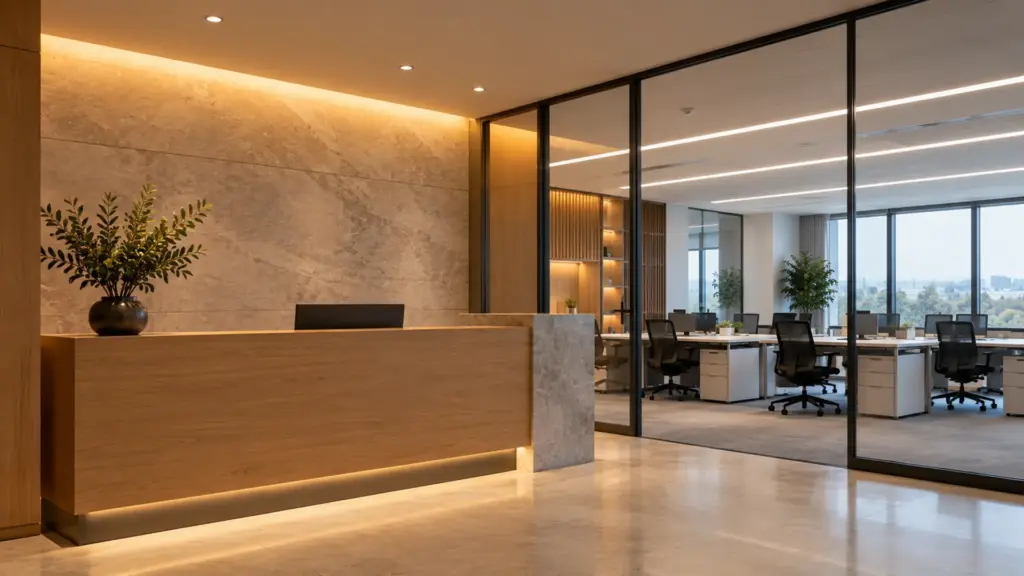
Our rule of thumb is simple. Within one sightline, keep the strip within one step of its neighbors, where a step is the move between two of our three points.
| Pair | Steps apart | How it reads |
|---|---|---|
| 2700K and 3000K | 1 | Layered, usually fine |
| 3000K and 4000K | 1 | Noticeable but intentional, usually fine |
| 2700K and 4000K | 2 | Reads as a mistake |
2700K beside 3000K reads as layered light. Ledvance says the two can be mixed in the same space because the difference is subtle, ideally with one as the main source and the other as accent or task light. 2700K beside 4000K reads as a mistake, and the client will say the strip is “the wrong one” even if it matches the drawing.
Zones matter too. According to Flexfire LEDs, mixed color temperatures within the same retail environment create visual inconsistencies that customers notice, so spec the same CCT and Color Rendering Index, 0–100: how truthfully the light shows colors next to a reference source. Ra≥90 is the usual bar for interiors. across every strip zone in a given space.
Run the hotel floor from the opening through that table. The lobby downlights are 2700K, so a 3000K corridor strip is one step away and holds. The guest-room entry sconces are 2700K too, so the strip stays at 3000K the whole way. The 4000K at the end of the hall is a service stair. It is two steps from the lobby, so either break the sightline with a door or bring the stair to 3000K. That is a spec change on one line item, and it is cheap on paper and expensive after the finishes are in.
Windows are the last neighbor. Daylight makes a 3000K strip look amber at noon. If the area is daylit and mostly for work, move to 4000K. If it is a lounge, let it be amber.
Consistency: Reels, Batches, and Reorders
You can pick the right Kelvin and still get a floor that does not match. Strip from different reels, orders, or reorders can differ slightly in color even when every label says 3000K. The tolerance is the SDCM bin, and nothing else on the spec sheet tells you about it.
Our COB strip is binned to ±2 Color-consistency steps (MacAdam ellipses). Fewer steps means two strips from different reels look like the same white; 3-step is hard to tell apart by eye. across every reel, as stated on the COB page. Ask for the bin tolerance in writing on any strip you compare, and treat a quote that omits it as incomplete.
Three habits keep a floor consistent. Order each zone in one batch. Keep a spare reel from that batch for service. On a reorder, confirm the bin against the original order before the new reels go up. The high-CRI guide has a longer section on binning and what to ask for at quote.
Dimming and Tunable: When One Point Is Not Enough
Standard strip holds its color temperature as it dims. A 3000K strip at 10% is still 3000K, and next to an incandescent-style downlight that warms as it dims, it will start to look cold.
Dim-to-warm strip fixes that. UT-T672-10-DTW (COB) and UT-T120-8-DTW (SMD) shift from 3000K down to 1800K as they dim on a 2-wire dimmer, with no programming. The dim-to-warm LED strip guide covers controls and when to spec it.
Tunable white goes further, with any point from 2700K to 6500K on two white channels. UT-T576-8 (COB, 2-wire) suits retrofits, and UT-T608-8 (COB, 3-wire) works with 0-10V, DALI, and DMX systems. The use cases are the ones where a single number is not enough, such as workplaces that shift across the day, senior living, and hotel guest rooms. One caveat from the spec table. Power is listed as total warm plus cool, so a 16 W (8+8) strip delivers half its wattage at pure 2700K or pure 6500K. Plan the supply for the full mix. Details are on the tunable white LED strip page.
If the room truly needs two answers, tunable settles the argument. If it needs one, do not add controls to avoid making the decision. Controls add a controller, a commissioning step, and a wiring architecture to choose between 2-wire and 3-wire, and a fixed 3000K strip needs none of them.
Channels and Diffusers: Test the Shade, Not the Spec Sheet
The Kelvin number is for the strip. What the client sees is the strip plus the channel plus the diffuser.
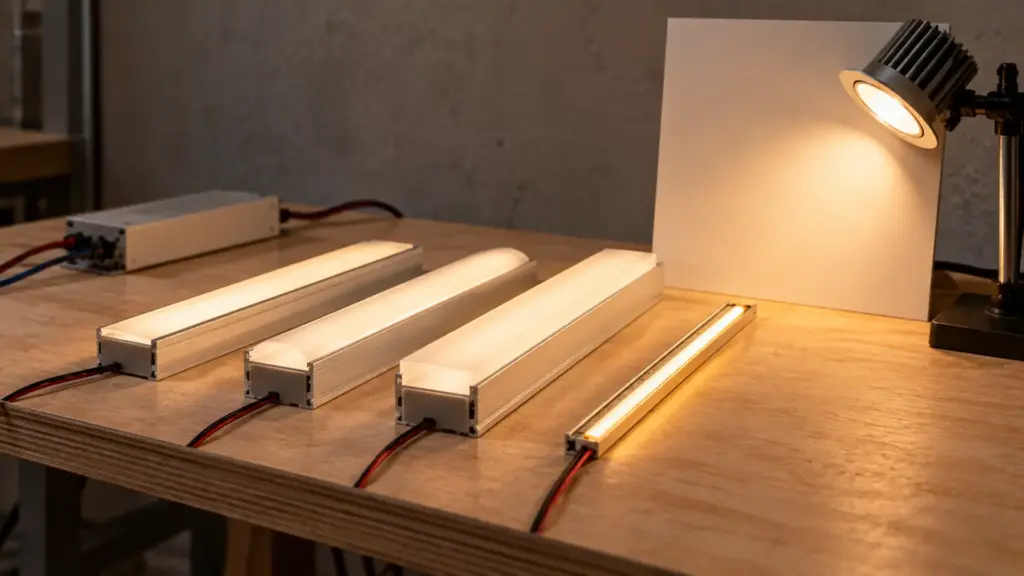
An opal diffuser hides dots and softens the line, and it also cuts output and can make a warm, high-CRI strip look flatter than it does bare. The spec sheet cannot tell you how a particular opal reads next to a particular downlight. A cut sample can.
Before you order a long run, mount a short piece in the actual channel, with the actual diffuser, next to the neighboring fixture, and look at it at the dimmed level the room will live at. The LED channel selection guide covers depth and diffuser choice, and the LED channels and diffusers page lists the profiles.
Spec Errors: What Gets Caught at Walkthrough
- “Warm white” on the drawing with no Kelvin. Warm white is 2700K to 3000K, and the gap is visible. Write the number.
- Specifying by room name, not by sightline. The corridor is “a corridor” until it sits between two lobbies. Check what each end of it looks into.
- 4000K in hospitality because the brief said “clean.” It reads as cold and flat. Use 3000K and keep the finishes clean.
- Checking Kelvin but not Ra. Two 3000K strips can render the same wall differently. Specify both.
- No sample in the channel. The first look at the finished diffuser should not be at walkthrough.
- Splitting a zone across orders. Same label, different bin. Order a zone once.
FAQ
Is 3000K or 4000K better for commercial spaces?
Neither wins on its own. Use 3000K where people linger, such as lobbies, hospitality corridors, and most retail, and 4000K where people work, such as offices and back-of-house. According to LED Lighting Supply, retail runs 3000K to 4000K depending on merchandise and offices 3500K to 4000K.
Can I mix 2700K and 3000K in the same space?
Yes. According to Ledvance, the difference between the two is subtle and can create layered lighting, with one as the primary source and the other as accent or task light. Keep 2700K and 4000K out of the same sightline.
Does color temperature change how bright the strip is?
No. According to LED Lighting Supply, CCT does not tell you how bright a fixture is, so check lumens per foot on the spec sheet. The exception is tunable white, where a dual-channel strip delivers half its listed wattage at pure 2700K or pure 6500K.
Should the strip match the downlights?
Within one sightline, yes, to the same Kelvin where possible and within one step at most. If the downlights warm as they dim, specify dim-to-warm strip so the two move together.
What color temperature is best for an office?
4000K is the common specification point. Flexfire LEDs gives 3500K to 4500K for most offices and LED Lighting Supply gives 3500K to 4000K. Use 3000K in lounge, breakout, and reception areas.
Lock One Kelvin per Zone
Ask three questions in this order. First, do people linger or work here, which starts you at 2700-3000K or at 4000K. Second, what do the finishes and merchandise want, warmer for wood and brass, cooler for white and gray. Third, what sits next to the strip, and does it land within one step. Then lock one Kelvin per zone and order each zone together.
Working from a room schedule with a Kelvin target for each space? Send it with the control system, and we check every zone against the available models and CCT points before anything is quoted: request a quote. The standard options sit in our COB LED strip range.